
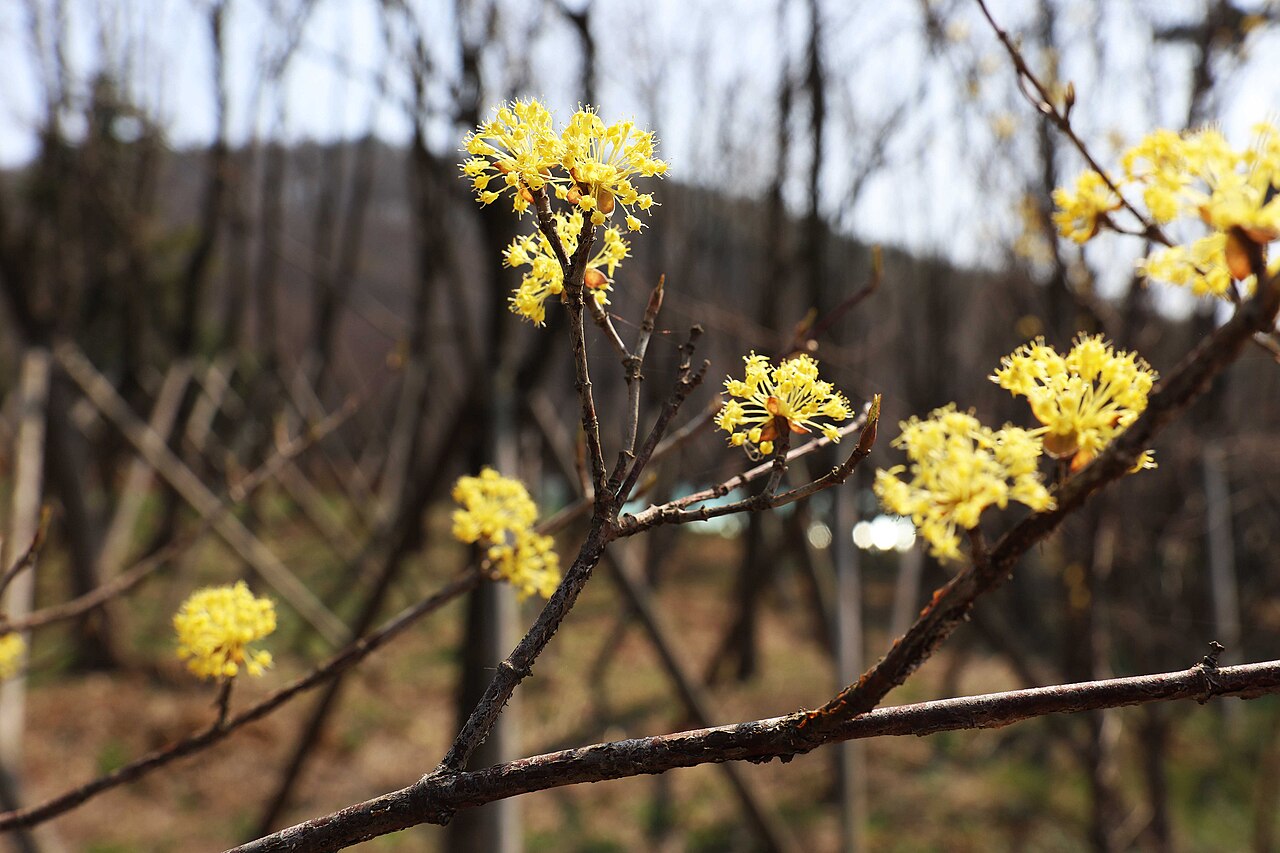
In early spring, while patches of snow still linger on the mountainside, yellow flowers burst open before a single leaf appears. This is the scene in the sansuyu valleys of Sandong, in Gurye, South Jeolla Province. Blooming even earlier than the plum, this tree that gilds its bare branch tips in yellow is what Koreans call sansuyu. Curiously, its English name is Japanese cornel. The name points to Japan, yet its red fruit has been prized as medicine across East Asia for more than two thousand years. What is more, preparing it as medicine means painstakingly removing the seed from each ripe fruit by hand. Let us follow the path sansuyu has traveled, from the first yellow of spring to its place in the herbal pharmacy.
The Yellow Flower That Opens Early Spring
Sansuyu is a deciduous shrub or small tree of the dogwood family (Cornaceae). Its accepted scientific name is Cornus officinalis Siebold & Zucc., formally described from specimens collected in nineteenth-century Japan (POWO, IPNI). Fully grown, it can reach roughly 8 meters in both height and spread, and it bears a distinctive bark that peels away in thin flakes. The leaves are opposite, ovate to elliptic, and turn red in autumn.
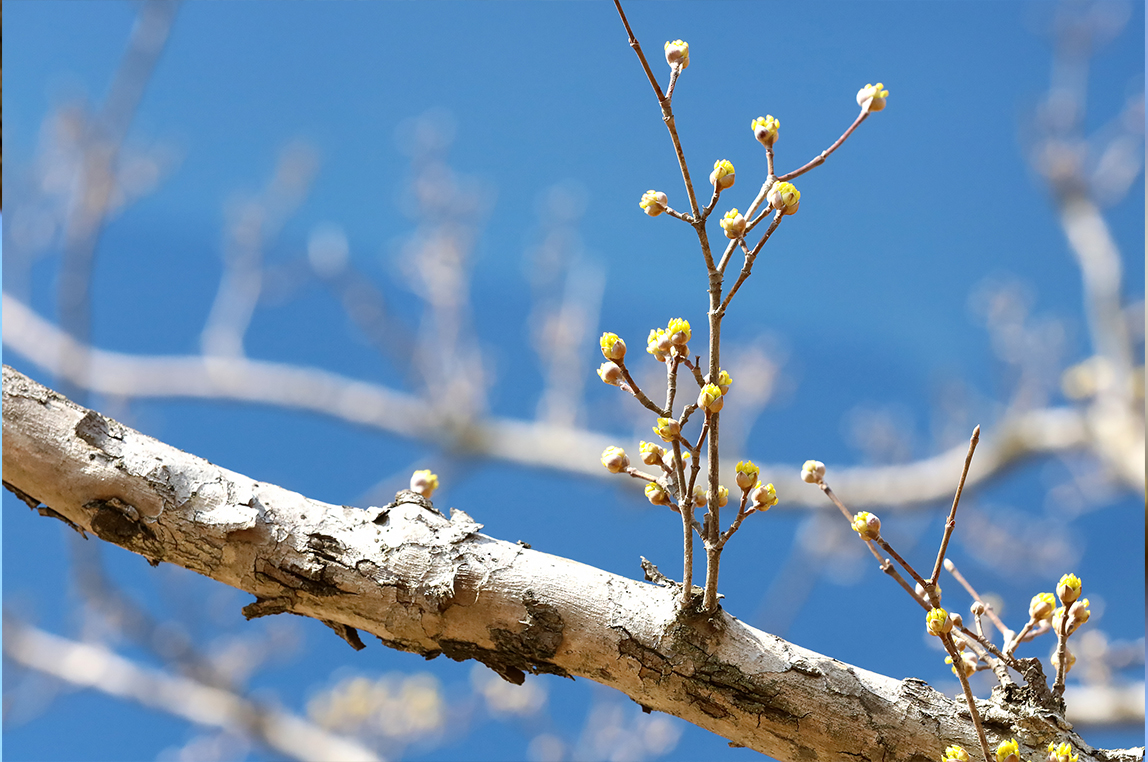
The tree’s most striking trait is its bloom time. Usually in early spring, before the leaves even emerge, small yellow flowers cluster in umbel-shaped inflorescences that spread like the ribs of an umbrella (Wikipedia). That burst of yellow on bare branches, arriving before spring has fully settled in, is counted among the earliest signs of the season, alongside spicebush and plum. Through summer and autumn, oblong red drupes ripen in their place. The species epithet officinalis means ‘used in medicine, of the apothecary,’ and the red fruit, though sharply sour, is also edible.
As one of the first trees to open its flowers in spring, sansuyu also serves as a valuable nectar source for insects such as honeybees early in the season. Once the flowers fade and the leaves fill out, it stands in deep green through the summer; then, as autumn deepens, the leaves turn red and the fruit ripens with them, studding every branch with points of red. A single tree, in effect, shows an entirely different face in each season.
The Name Says Japan, the Roots Are East Asian
Its English names are Japanese cornel and Japanese cornelian cherry. Contrary to the name, however, sansuyu is not a tree of Japan alone but grows wild across China, Korea, and Japan (NCSU Extension). The provinces of Zhejiang and Henan in China are among its principal growing regions. Called sansuyu in Korea and shanzhuyu in China, the tree has long been a companion across these lands.
There is also a species easily confused with it. Cornus mas (the cornelian cherry), native to Europe and Southwest Asia, looks similar but is a distinct species, used in European folk medicine for astringent and tonic purposes (comparative study, PMC). The East Asian Cornus officinalis, by contrast, became established in herbal medicine as the material called Corni Fructus. Although both trees carry ‘cherry’ in their names, neither has any relation to the genus Prunus to which cherry trees belong. The name springs only from the impression of a red, sour fruit. So even when choosing a medicinal material sold as ‘sansuyu’ in the market, it helps to know that it differs in constituents and use from the European cornelian cherry.

From the Shennong Bencao Jing to the Dongui Bogam
The path sansuyu took as medicine is attested by the written record. The fruit already appears in the Shennong Bencao Jing, the oldest surviving Chinese materia medica. That work is thought to have taken shape around the Later Han period (25-220 CE) and classifies 365 substances into upper, middle, and lower grades, the so-called three ranks (materia medica overview). One comprehensive review reports that sansuyu fruit was first recorded in this text about 2,200 years ago, and it is accordingly known as a remedy long used across East Asia (Chinese Medicine review). The three-rank scheme is an old system that sorted remedies into upper, middle, and lower classes according to their toxicity and use. That sansuyu found a place on the official list of medicines from so early a date suggests that its use was not some chance folk remedy but something organized upon long observation and experience.
Korea’s records are equally clear. Sansuyu appears in the Hyangyak Jipseongbang (1433), compiled under King Sejong, and in the Dongui Bogam (completed 1610, printed 1613), brought to completion by Heo Jun. The Dongui Bogam, a medical text inscribed on the UNESCO Memory of the World register in 2009, describes sansuyu as an astringent, tonic remedy acting on the liver and the kidney to keep vital essence from leaking away. Such descriptions, however, must be understood strictly as usages of traditional Korean medicine, and read as distinct from any therapeutic effect proven clinically by modern medicine. That the materia medica tradition of China and the medical texts of Korea alike recorded sansuyu side by side shows well that this fruit belonged not to one region alone but was an asset shared by East Asian medicine as a whole.
Removing the Seed, Keeping Only the Flesh
As an herbal material, sansuyu conceals an intriguing step of preparation. The part used as medicine is not the seed but the flesh. Ripe red fruit is briefly blanched in boiling water, the hard seed at the center is removed, and only the remaining flesh is dried for use. This process is called geohaek, meaning ‘seed removal’ (Korea Institute of Oriental Medicine).
This single step compresses the experience of earlier generations. The seed contains constituents different in character from the flesh, and tradition held that the seed must be removed for the material to become proper medicine. So while ‘sansuyu’ usually brings to mind the whole tree or the red fruit, the herbal material Corni Fructus refers precisely to the dried flesh with the seed taken out. This sour flesh is exactly the storehouse of the active constituents we turn to next.
The sour taste, too, is no accident. In Korean medicine sourness is linked to the astringent quality of drawing scattered energy back inward, which touches on the traditional understanding of sansuyu as gathering up vital essence so that it does not leak away. Such an account, of course, is framed in the language of the old medicine, and one should keep in mind that it sits on a different level from the story of chemical constituents we look at later.
Loganin and Morroniside, the Chemistry Inside the Fruit
Some ninety compounds have so far been isolated and identified from sansuyu fruit (Chinese Medicine review). Among them, iridoids, tannins, and flavonoids stand out as the three principal groups of constituents. Alongside these are triterpenoids such as ursolic and oleanolic acid, gallotannins and ellagitannins, organic acids, polysaccharides, and anthocyanins. Iridoids are a characteristic group of constituents made by many plants, often associated with bitterness or a distinctive scent.
Of these, the constituents that most represent sansuyu fruit are the iridoid glycosides loganin and morroniside. The two are the most abundant iridoid glycosides in the fruit, followed by cornuside, sweroside, loganic acid, and others. Loganin and morroniside, with molecular weights of roughly 390 and 406 respectively, are similar in structure, yet each holds a slightly different standing within Corni Fructus. Morroniside is especially interesting. Europe’s Cornus mas and East Asia’s Cornus officinalis share constituents such as loganin and sweroside, yet morroniside stands out as a constituent that distinctly characterizes the fruit of Cornus officinalis (comparative study, PMC). For this reason the Chinese Pharmacopoeia designates morroniside and loganin as marker constituents for judging the quality of Corni Fructus, and has their content measured by high-performance liquid chromatography, HPLC (Frontiers review).
The chemistry that God has fashioned inside this small red fruit is astonishingly intricate. Yet activities such as antioxidant and anti-inflammatory action have for the most part been reported only at the laboratory and animal-study stage, and it is still too early to declare them therapeutic effects proven in humans. It calls for the care to read traditional usage and still-experimental possibility as two separate things.
The Thousand-Year Tree of Gurye Sandong, and a Legend
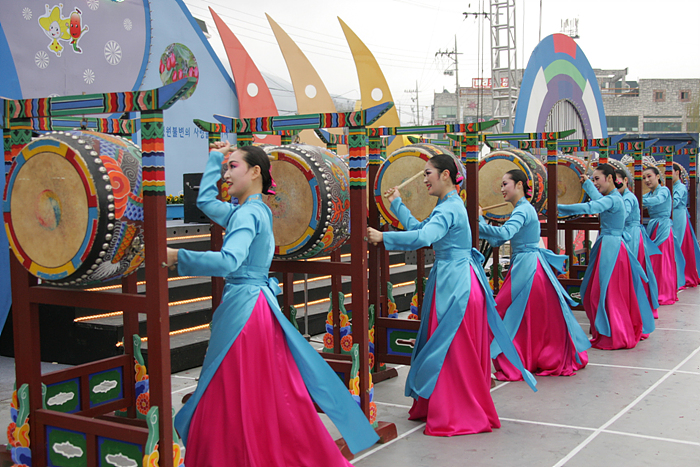
No account of sansuyu in Korea can leave out Sandong township in Gurye County, South Jeolla. The area is among the country’s largest sansuyu-growing regions, and in spring the whole valley turns yellow. In Gyecheok village in Sandong stands a founding tree said to be about a thousand years old. Roughly 7 meters tall and about 4.8 meters in girth, this ancient tree is the village’s emblem. In 2020 the Baekdudaegan National Arboretum placed seeds from this tree into permanent storage in its Seed Vault. In spring the valley holds a sansuyu festival, and in autumn the village grows busy with hands harvesting the ripened red fruit and picking out the seeds. Tourist guides sometimes describe the area as accounting for most of the country’s production, but the exact share differs from source to source, so it is safer to understand it as one of the largest growing regions in the country.
Gyecheok village carries an old story. It tells of a young woman who, marrying in from the Shandong region of China about a thousand years ago, brought sansuyu with her and planted the first tree. This, however, is more accurately seen as a legend handed down in the village than as an established fact. The claim that it is ‘the first sansuyu tree in Korea’ likewise rests on no firm evidence. What is certain is that the people of this valley have long tended sansuyu and, seed by seed, prepared it as medicine, living alongside it for generations.
Though its name says ‘Japanese cornel,’ its roots reach deep into East Asia, and a single unshowy shrub holds within it everything from the first yellow of early spring to the red fruit of autumn, and even the intricate chemistry inside the seedless flesh. To look quietly at this one small tree that God has made is also to read, together, the long story of nature and people inscribed in a single plant.
References
- Wikipedia — Cornus officinalis
- Plants of the World Online (Kew) — Cornus officinalis Siebold & Zucc.
- International Plant Names Index (IPNI) — Cornus officinalis
- North Carolina State Extension — Cornus officinalis
- Cornus mas and Cornus officinalis: phytochemical comparison (PMC)
- Cornus officinalis: ethnopharmacology and phytochemistry review, Chinese Medicine (PMC)
- Active components of Cornus officinalis, Frontiers in Pharmacology (PMC)
- Korea Institute of Oriental Medicine — Corni Fructus (sansuyu)