
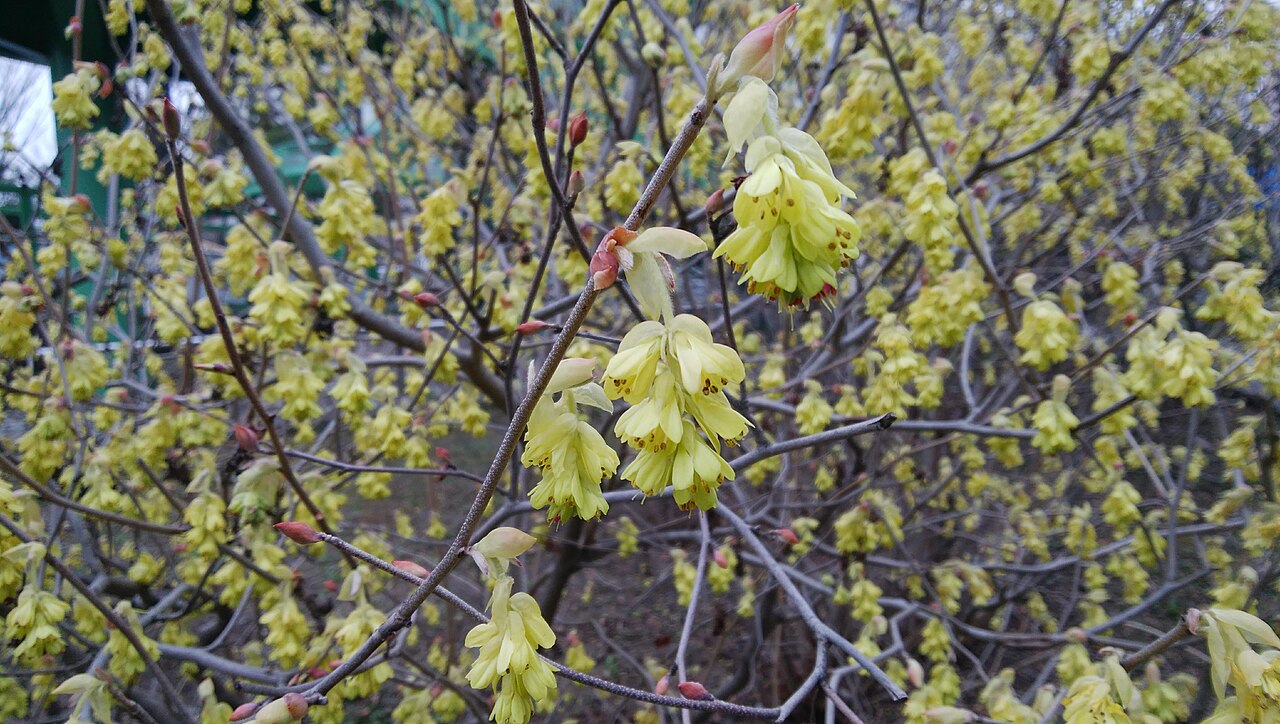
In early March, a yellow haze begins to spread over gray branches that still hold the memory of winter. There is not even a shadow of a leaf, yet at the tip of every bare branch small yellow flower clusters pop open first. This is Cornus officinalis, one of the very first trees to announce spring. Unlike most trees, which unfurl their leaves first and flower among them, Cornus officinalis reverses that order: the flowers come before the leaves. Hidden behind this seemingly hasty choice is a precise timetable for safely crossing the fickle season of early spring.
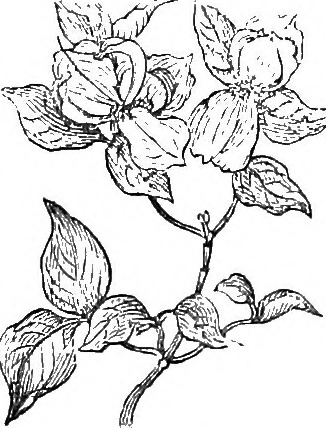
A Tree That Opens Yellow Flowers Before Its Leaves
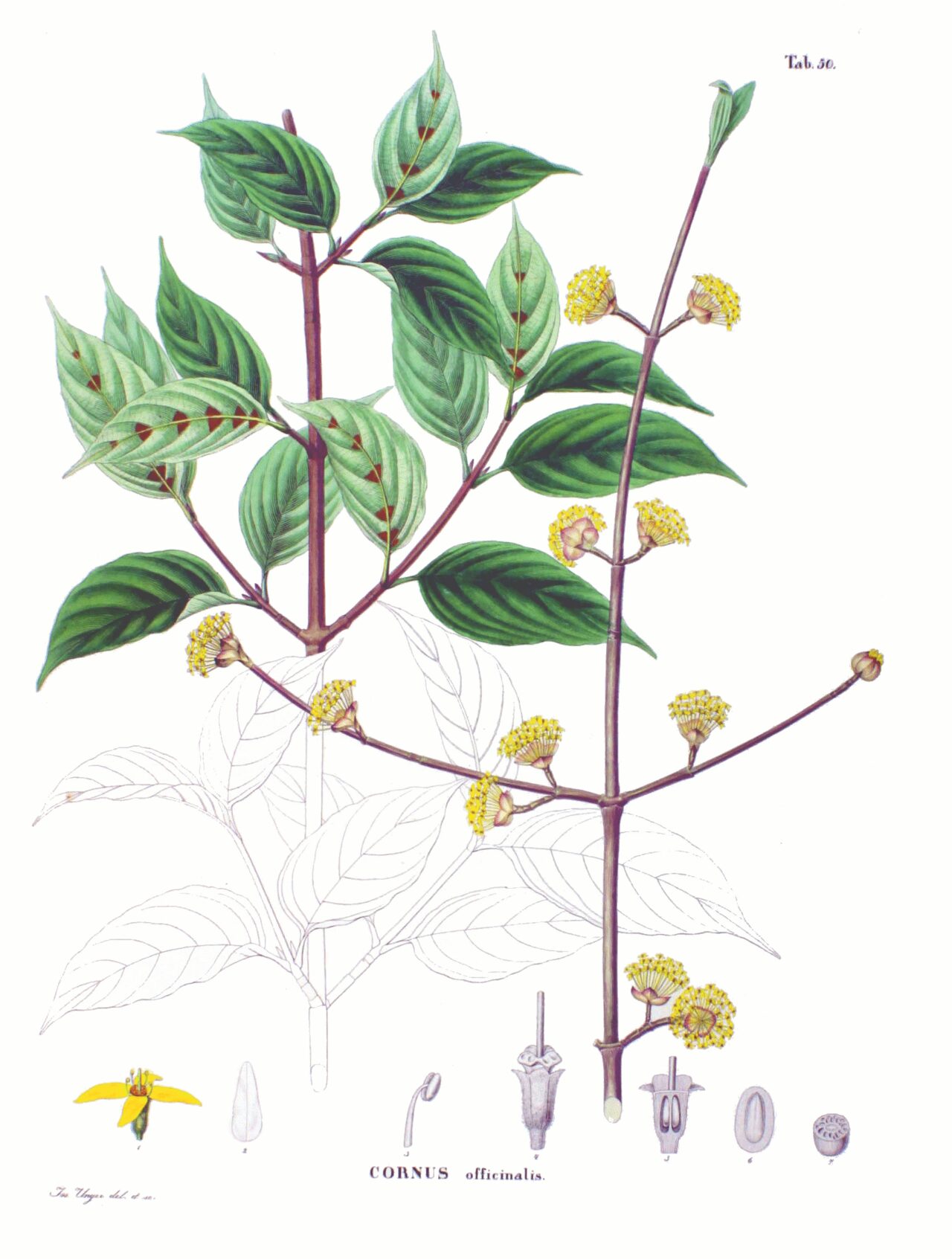
Cornus officinalis is a deciduous member of the dogwood family (Cornaceae) and the genus Cornus. It usually grows as a small tree 4 to 8 meters tall, but in good wild or cultivated conditions it can reach 10 meters (Trees and Shrubs Online). Its grayish-brown bark, which peels away in thin flakes, and its foliage that turns red in autumn are further clues for recognizing it. The leaves are ovate with 6 to 7 pairs of lateral veins, a point that distinguishes it from its European cousin Cornus mas, which has only 3 to 5 pairs (Trees and Shrubs Online).
Its most striking feature, however, is the flowering order. As many botanical and horticultural institutions consistently record, Cornus officinalis opens its yellow flowers in early spring before the leaves emerge (Wikipedia; Missouri Botanical Garden). Seen individually, each flower is tiny, no more than 0.3 to 0.4 centimeters across, with four petals bent slightly backward. Several of these small flowers gather into an umbel about 2 centimeters wide, like a little yellow parasol, its base wrapped by four bracts (Trees and Shrubs Online). In Korea this yellow tide generally unfolds from mid-March to early April.
Flower Buds and Leaf Buds Keep Different “Temperature Clocks”
So why the flowers first? The most direct answer is hidden inside the buds that clung to the branches all winter. Even on a single tree, the flower buds that hold blossoms and the leaf buds that hold foliage need different temperature conditions to wake in spring. Their requirement for sufficient winter chilling is similar, but the warmth actually needed to push the buds open in spring, the so-called forcing requirement, is lower for flower buds than for leaf buds. So when the first warmth of spring begins to rise, the lower-threshold flower buds open first (World Agroforestry).
This principle was not obtained by measuring Cornus officinalis alone. It is a general mechanism revealed by studies of related temperate woody plants such as apricot and wild peach, and it applies broadly to trees like Cornus officinalis that open their flowers first in early spring (World Agroforestry). Inside this small tree that God made, two kinds of buds grown from the same branch carry different temperature thresholds, each quietly awaiting its own moment according to a precise timetable.
What Bare Branches Signal to Insects
If the low temperature threshold of the flower buds explains “how” the flowers come first, the question of why it is beneficial leads into the story of pollination. People often hear that “flowers open before leaves in order to carry pollen on the wind,” but this does not fit Cornus officinalis. For a wind-reliant tree such as oak or birch, being leafless does help pollen travel; but the yellow, nectar-bearing flowers of Cornus officinalis are a classic signal meant to attract insects. Cornus officinalis is insect-pollinated, its pollen carried by bees and hoverflies (Syrphidae), not wind-pollinated.
The fact that the leaves have not yet emerged actually works in the insects’ favor. When yellow flowers open all at once on bare branches unshaded by foliage, they are far more visible to insects out searching for food in early spring. Indeed, a 2024 study of insect-pollinated American plums reported that the habit of flowering before leafing may have been selected in connection with the benefit of avoiding drought together with the benefit of attracting pollinators (Buonaiuto et al. 2024). It is telling that Cornus mas, of the same genus, is well known as a precious early-spring nectar source for bees at winter’s end.
The Price of Early Bloom, Between Frost and Drought
Opening flowers earlier than others does, of course, carry a price, because early spring is a dangerous season when frost may fall at any time. Intriguingly, a study surveying several North American woody plants found that the earlier a species flowers, the better its flowers tend to withstand freezing damage. After a chilling treatment at minus 5 degrees Celsius, the damage index was only about 18 percent for early-flowering species, while for late-flowering species it reached 78 percent (Annals of Botany).
Yet rather than concluding that the flowers of Cornus officinalis are inherently cold-hardy, the researchers interpret this as the combined result of physiological tolerance and a timing-based “avoidance,” blooming when the risk of frost is relatively low (Annals of Botany). In addition, separating the timing of flowering from that of leafing keeps the periods of heavy water demand from overlapping all at once, which reduces water stress. The 2024 study mentioned above likewise pointed to drought avoidance as another reason for early flowering (Buonaiuto et al. 2024). Early bloom, then, is not reckless haste but a choice finely balanced between the twin dangers of frost and drought.
Correcting a Few Common Misconceptions
Several old misconceptions follow Cornus officinalis around. First, because its English common name is “Japanese cornel,” it is easy to assume the tree is native to Japan; but Cornus officinalis grows wild in China and on the Korean Peninsula, and the prevailing view is that it was cultivated and introduced in Japan (Trees and Shrubs Online). Conversely, declaring it endemic to Korea is not accurate either.
Second, the phrase “the first flower to bloom in spring” calls for caution. Cornus officinalis is clearly among the earliest trees to flower (The Morton Arboretum), but others, such as spicebush and Japanese apricot, open around the same time. It merely blooms about ten days to two weeks earlier than its cousin Cornus mas; it is not the sole first flower of spring (Trees and Shrubs Online). Third, the red drupes that ripen in autumn (about 1.2 to 1.8 centimeters long) have traditionally been used as food and medicine (Wikipedia), but claiming cure-all powers to heal specific diseases goes well beyond the evidence.
A Tree That Opens Spring, Alongside People
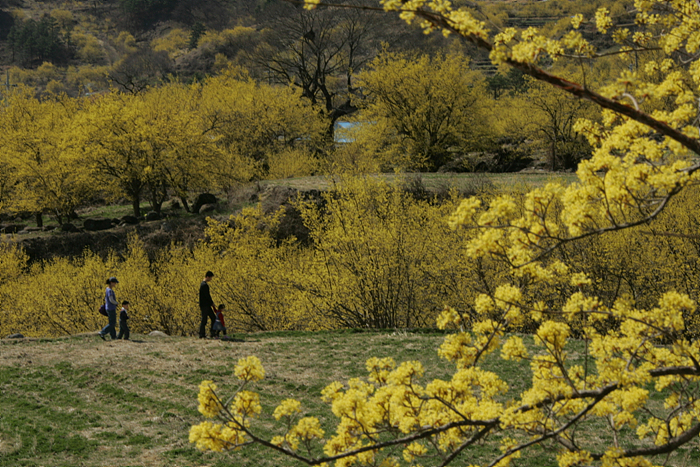
Thanks to its early bloom, Cornus officinalis has long been cherished as a herald of spring. In Korea, the place most associated with the tree is the Sansuyu village in Sandong-myeon, Gurye, South Jeolla Province. It is the country’s largest growing area, accounting for more than 70 percent of national sansuyu production, and from mid-March to early April the whole valley turns yellow (Korea Tourism Organization). A local tale holds that a young woman who married into the area from Shandong, China, about a thousand years ago brought the first Cornus officinalis seedlings; this is better read as a fond legend than as historical fact.
The choice of Cornus officinalis to open its flowers before its leaves was never mere impatience. Flower buds with a low temperature threshold, yellow signals calling insects from bare branches, timing that dodges both frost and drought at once, layer upon layer of wisdom is packed into this small tree’s single spring. Within the order that God created, Cornus officinalis knows how to choose the very threshold of the most dangerous season and open spring in the most conspicuous way. If you meet those yellow flowers on gray branches this spring, it is worth pausing to recall the precise timetable hidden behind them.
References
- Wikipedia: Cornus officinalis
- Trees and Shrubs Online: Cornus officinalis
- Missouri Botanical Garden: Cornus officinalis
- The Morton Arboretum: Japanese cornel (Cornus officinalis)
- World Agroforestry: Why do some trees produce flowers before leaves unfold?
- Buonaiuto et al. (2024), New Phytologist — PubMed
- Annals of Botany: frost tolerance of early-flowering species — PMC
- Korea Tourism Organization (VisitKorea): Gurye Sansuyu Village