
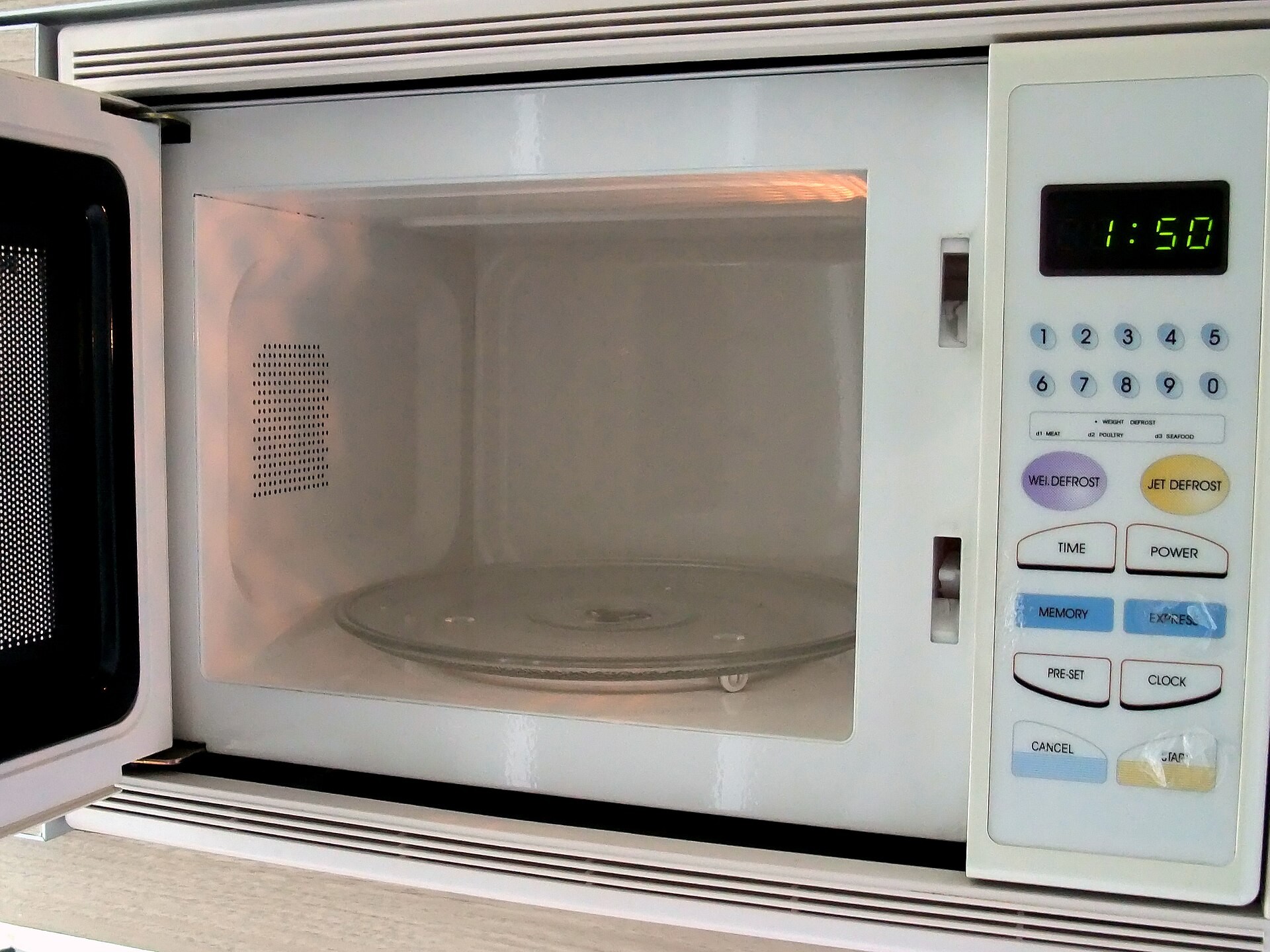
There is no flame inside a microwave oven, and no hot plate either. Yet close the door, wait a few minutes, and a cup of water starts to steam and cold rice turns warm. Then you take a spoonful and often find the edges piping hot while the middle is still lukewarm.
Both experiences come from the same principle, and it is the key to how microwave ovens work. A microwave oven does not bake food from the outside; it uses invisible radio waves to shake the water molecules inside the food so that the food produces its own heat. Follow how far those waves reach and how they overlap inside the cooking chamber, and the reason for the hot and lukewarm spots comes into view as well.
Mk2010 · CC BY-SA 3.0 · Wikimedia Commons
The heart that makes microwaves: the magnetron
The radio waves a microwave oven uses are microwaves. Most household ovens use 2.45 GHz, an electromagnetic wave that oscillates 2.45 billion times per second. The length of one cycle of this wave, its wavelength, is about 12.2 cm. Large industrial equipment sometimes uses 915 MHz, with a wavelength of about 32.8 cm. 2.45 GHz is so widely used because it is an industrial, scientific and medical (ISM) band available worldwide, whereas 915 MHz is allowed for this purpose only in some countries.
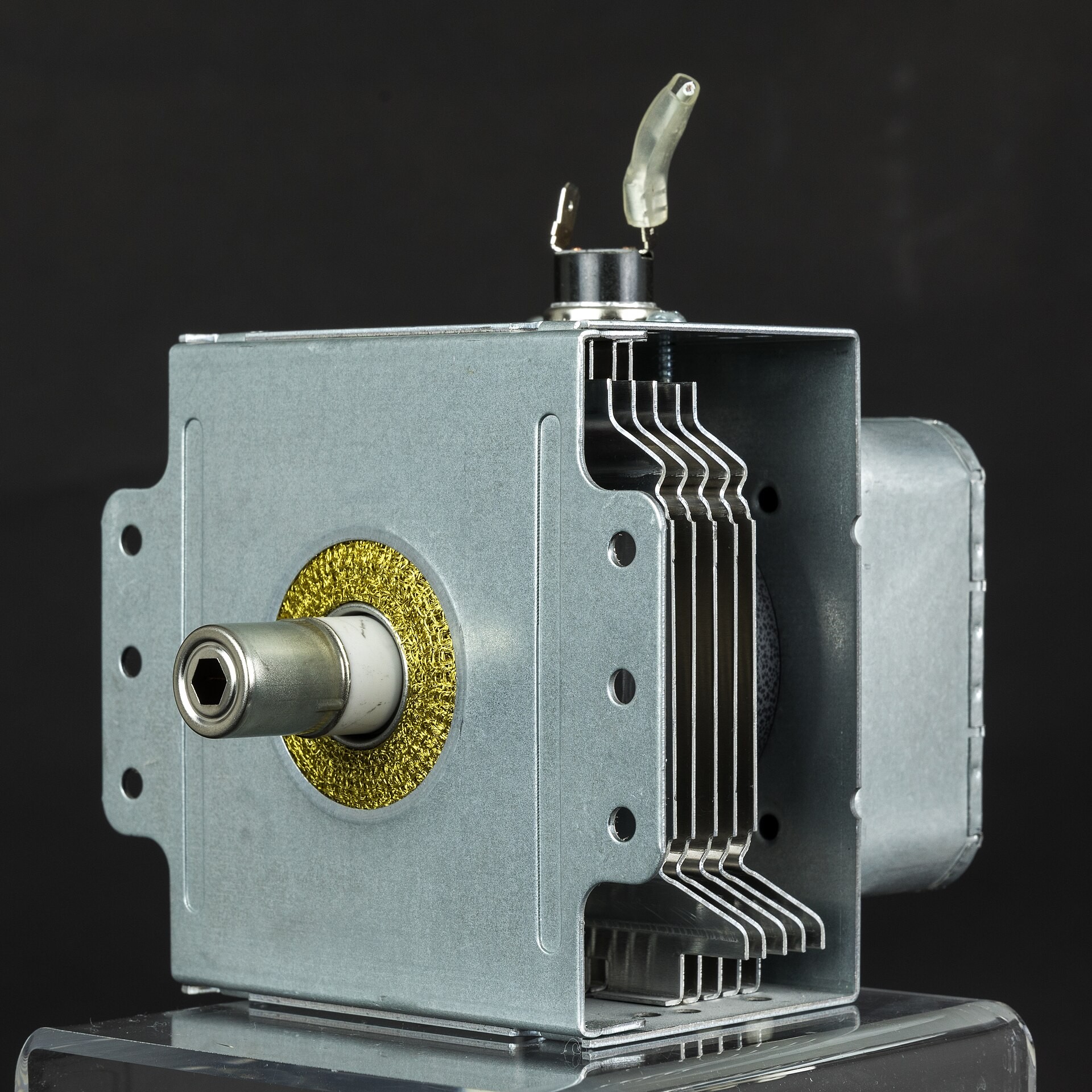
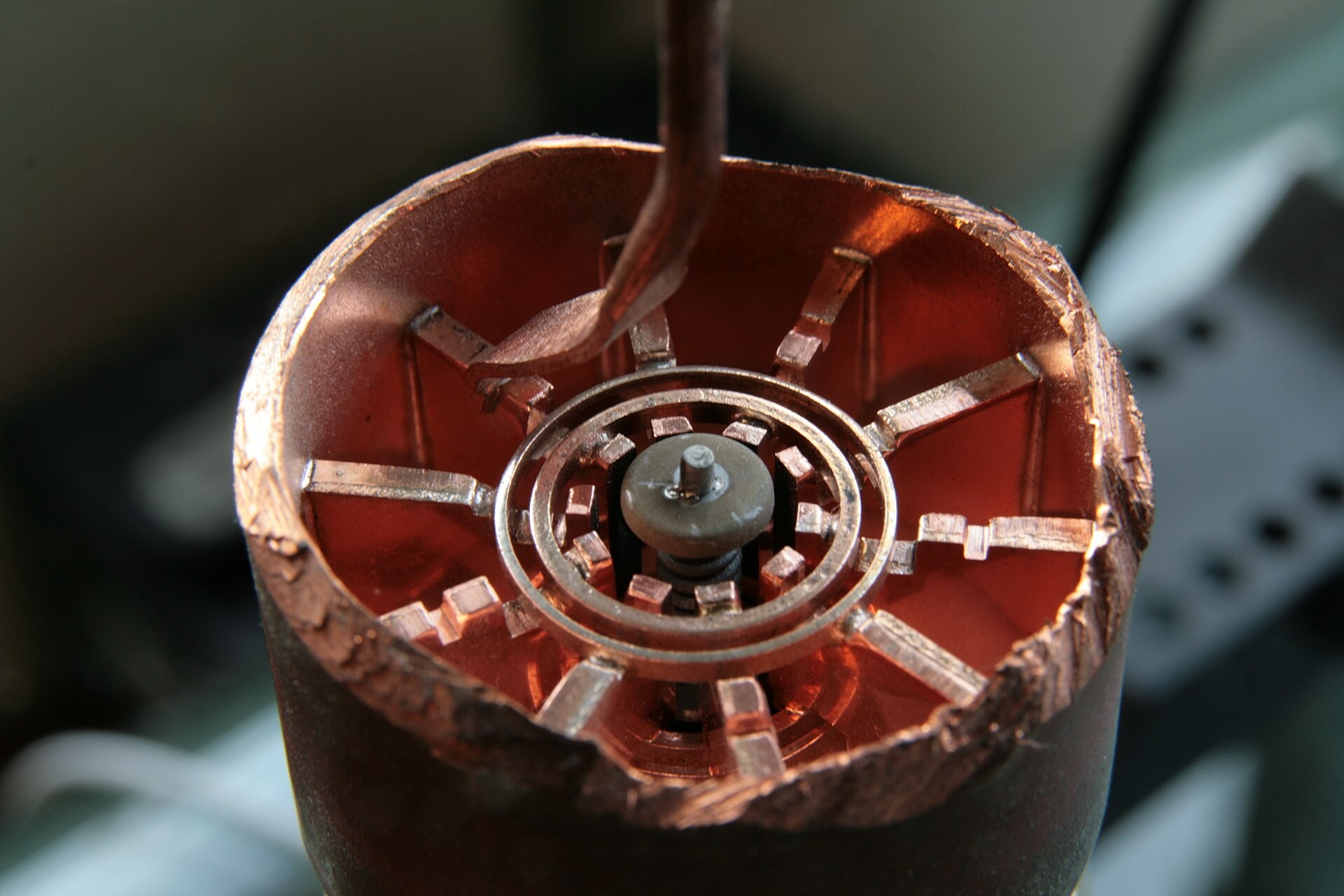
The part that produces these microwaves is the magnetron. Electrons leave a heated cathode at the centre, but a magnetic field applied from outside keeps them from flying straight; instead they curve and spiral toward the copper anode around it. Small chambers, or cavities, are arranged in a ring in the anode, and as the swirling electrons sweep past their openings they set up fast electrical oscillations matched to the size of the cavities. The microwaves produced this way travel along a metal channel, the waveguide, into the cooking chamber.
Raimond Spekking · CC BY-SA 4.0 · Wikimedia Commons
Pingu Is Sumerian · CC BY-SA 3.0 · Wikimedia Commons
Making heat by shaking water molecules
A water molecule is one oxygen atom with two hydrogen atoms attached at an angle. Because of this, the oxygen side carries a slight negative charge and the hydrogen side a slight positive charge, making water a “polar molecule.” Placed in an electric field, such a molecule tries to turn to line up with the field.
But the electric field of a microwave never stays still. At 2.45 GHz, its direction flips about 4.9 billion times per second. The water molecules try to turn with every reversal, but tangled up with their neighbours they cannot follow perfectly; as they push and bump against one another, they convert the field’s energy into heat. This is called dielectric heating. The U.S. Food and Drug Administration (FDA) describes it this way: microwaves cause the water molecules in food to vibrate, producing heat. The FDA also notes that the absorbed energy simply turns into heat and does not make food radioactive.
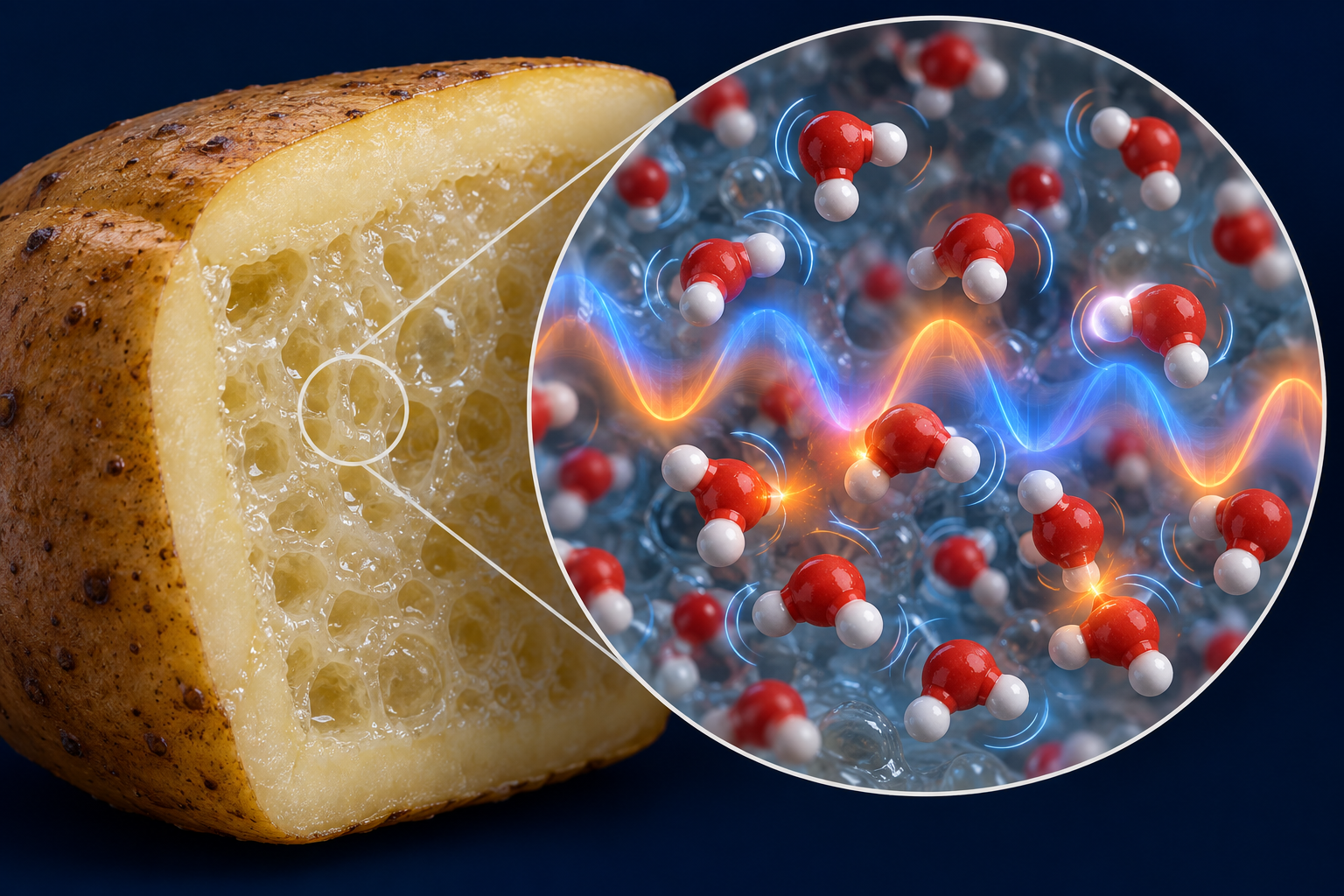
Illustration · AI-generated (Codex/ChatGPT subscription) · Purpose: Concept diagram of dielectric heating
It is often said that 2.45 GHz is used because it is the “resonant frequency of water,” but that is a widespread misconception. Not only water but polar molecules throughout the food take part in the heating. What is more, the frequency at which water absorbs microwaves most strongly lies several times higher than 2.45 GHz. At such a frequency, the outer layer of the food would soak up nearly all the energy, leaving none to reach the centre. The fact that 2.45 GHz is not absorbed too strongly actually helps send heat deeper into the food.
Microwaves reach only about 1 cm
That does not mean microwaves travel deep into food. In most foods, 2.45 GHz microwaves penetrate only about 1 cm. Contrary to the idea that food “cooks from the inside,” it is really the layer within about 1 cm of the surface that is heated directly first.
So how does the inside get warm? The FDA explains that in thick foods the outer layers are cooked mainly by microwaves, while the inside is cooked mainly by heat conducted from the hot outer layers. Conduction is far slower than microwave heating. That is why thick food can come out hot on the outside and cold in the middle. Letting food stand for a moment after cooking, or stirring it partway through, gives the heat gathered in the outer layer time to spread inward.
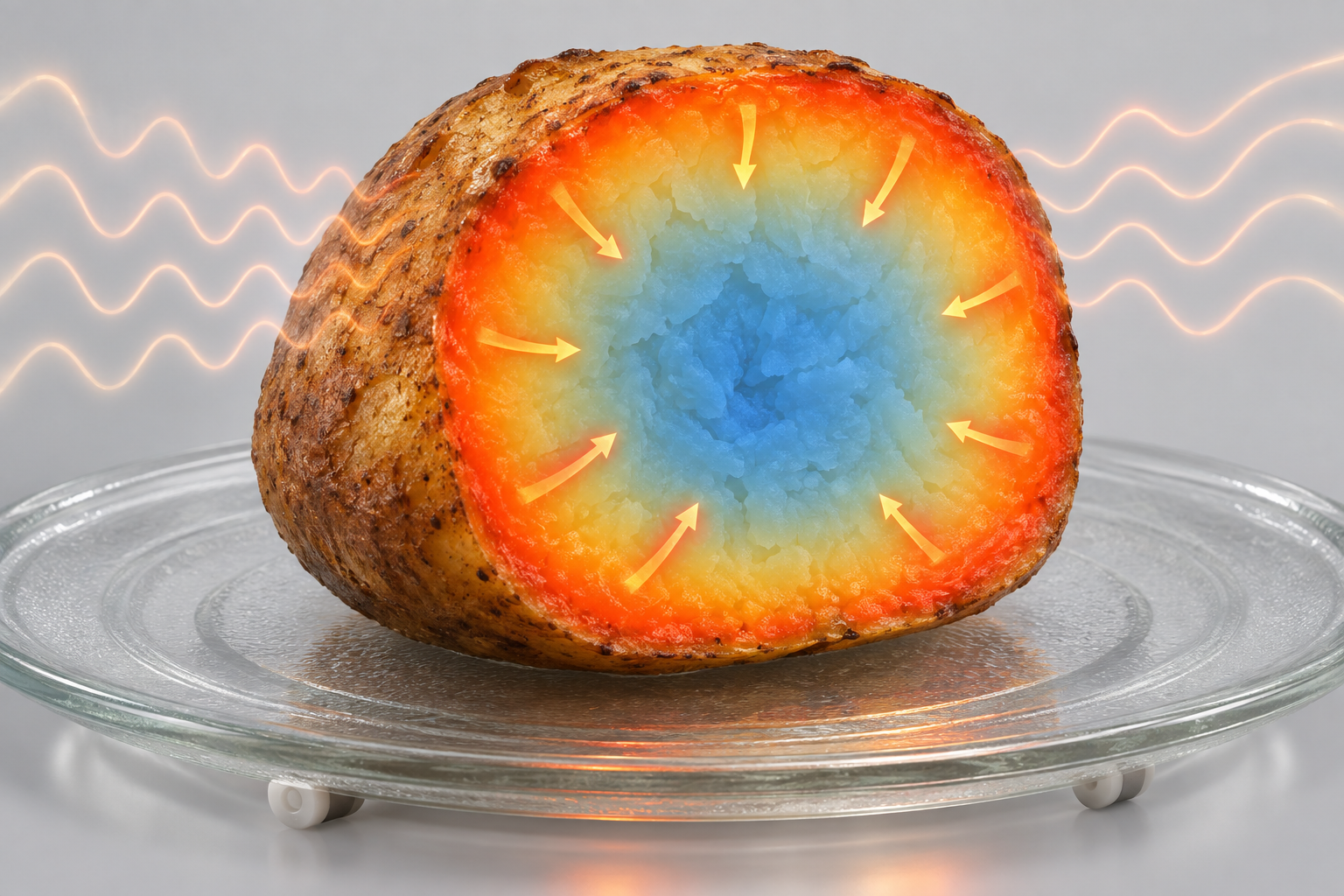
Illustration · AI-generated (Codex/ChatGPT subscription) · Purpose: Concept diagram of microwave penetration depth and heat conduction
Another reason the middle stays cool: standing waves
The walls of a microwave’s cooking chamber are metal. Metal reflects microwaves, so the microwaves coming out of the waveguide bounce between the walls and overlap with their own reflections. When waves travelling back and forth overlap like this, they form a standing wave that rises and falls in place. A standing wave has alternating places of maximum vibration (antinodes) and almost no vibration (nodes). Food where an antinode falls heats up quickly, while food sitting on a node barely warms at all.
The spacing between one antinode and the next is half a wavelength, or about 6 cm. In a real chamber, waves from many directions overlap in three dimensions and the pattern becomes more complicated, but hot and lukewarm spots still form a few centimetres apart. The turntable on the oven floor keeps moving food through this pattern so that it shares the hot spots more evenly. Some models instead use a metal fan, called a stirrer, that reflects and scatters the microwaves.
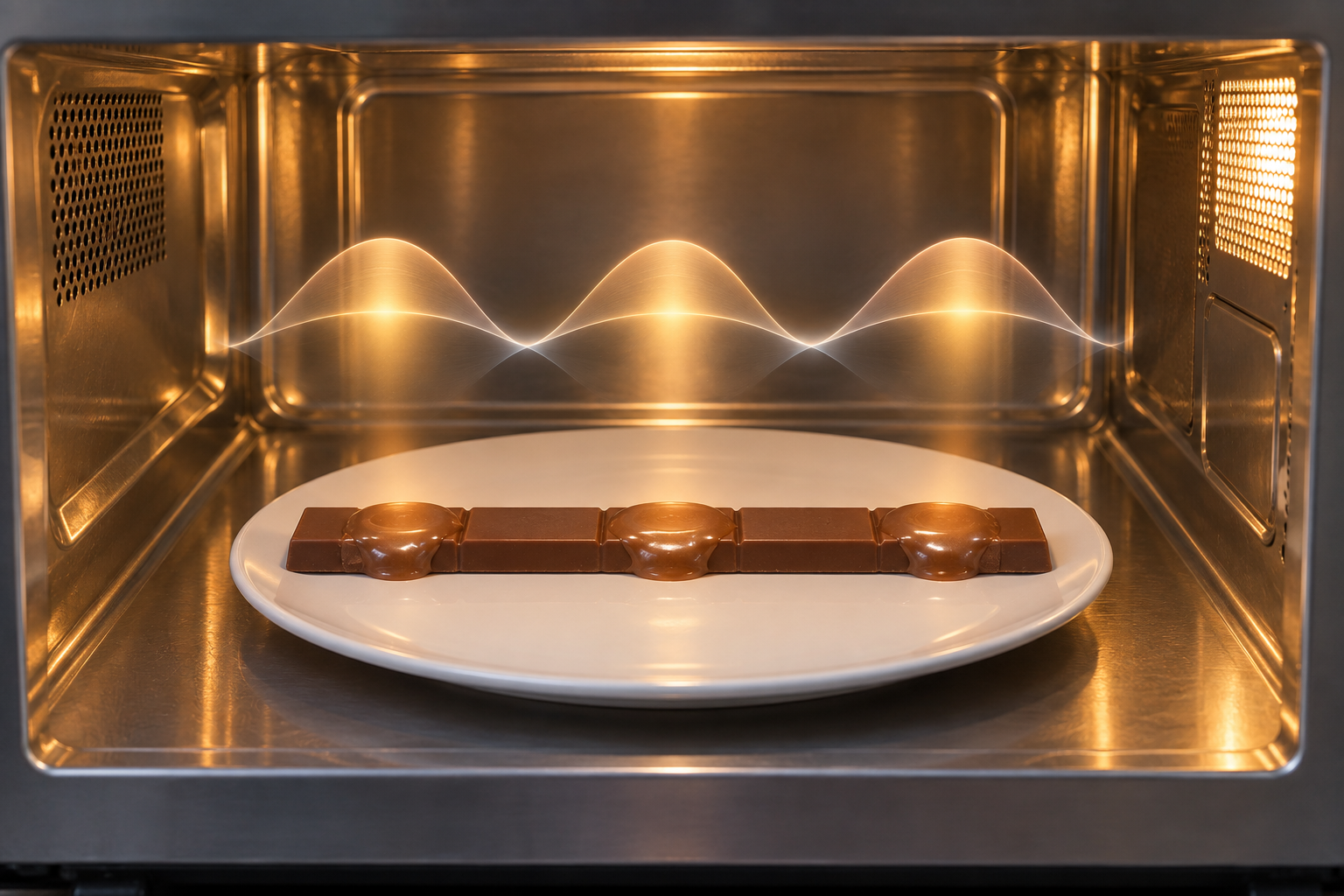
Illustration · AI-generated (Codex/ChatGPT subscription) · Purpose: Concept diagram of a standing wave and melted spots in chocolate
Measuring the speed of light with chocolate
You can even see this standing wave in your kitchen. A science education resource from the UK’s Open University describes how. Stop the turntable from rotating and briefly heat a flat bar of chocolate: instead of melting all over, the chocolate melts only in a few places. The distance between the melted spots is half a wavelength.
If the melted spots are 6 cm apart, the wavelength is 12 cm. Multiply that by the frequency printed on the back of the oven, 2,450 MHz, and you get about 294,000 km per second. That is only about 2% off the real speed of light, about 300,000 km per second. The calculation works because microwaves are electromagnetic waves, just like light. When trying it, heat the chocolate only very briefly and do not use a metal dish.
Why don’t microwaves leak through a see-through door?
The cooking chamber is enclosed by metal on every side, which traps the microwaves inside. The window in the door, through which you watch your food, also contains a fine metal mesh. The holes in the mesh are much smaller than the 12.2 cm wavelength of the microwaves, so visible light, whose wavelength is only a few hundred nanometres, passes through, but the microwaves cannot escape. That is why you can see your food through the window while the microwaves stay inside.
The FDA limits microwave leakage to 5 mW per square centimetre at about 5 cm from the oven surface. It also requires two independent interlock systems that stop microwave production the moment the latch is released or the door is opened. The advice not to put metal pans or aluminium foil inside is likewise because metal reflects microwaves.
From a radar part to the kitchen
The magnetron was developed not for the kitchen but for war. In 1940, John Randall and Harry Boot at the University of Birmingham in England built the cavity magnetron, with cavities cut into a metal block, and in late September that year the device was shared with the United States through a British technical mission, the Tizard Mission. A small but powerful microwave source greatly improved the performance of radar.
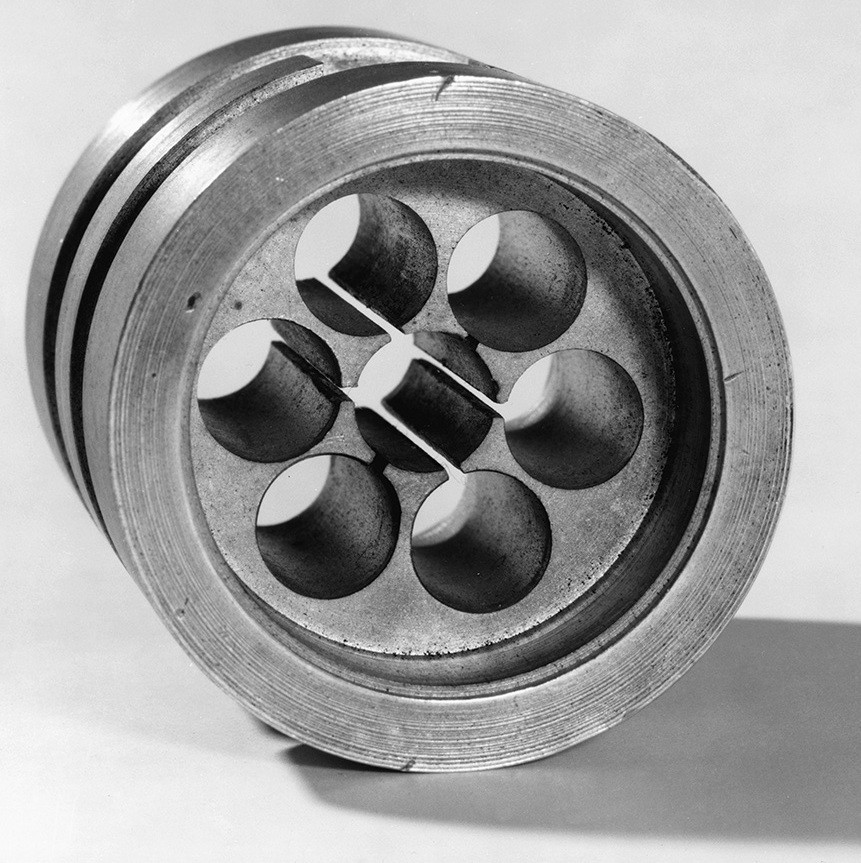
Science Museum London / Science and Society Picture Library · CC BY-SA 2.0 · Wikimedia Commons
Percy Spencer, an engineer at the American company Raytheon, developed a system for mass-producing magnetrons that raised output to 2,600 a day. According to a widely told story, one day in 1945 a chocolate bar in his pocket melted while he was near a running magnetron. He is said to have then placed kernels of corn in front of a magnetron and watched them pop.
On October 8, 1945, Raytheon filed a patent application for a method of cooking food with microwaves; the patent (U.S. Patent 2,495,429, “Method of treating foodstuffs”) was granted on January 24, 1950. The first commercial microwave oven, the Radarange, introduced in 1947, was a large machine about 1.8 m tall and weighing about 340 kg. A Radarange that could sit on a home kitchen countertop arrived at $495 in 1967, through Amana, the appliance maker Raytheon had acquired in 1965.
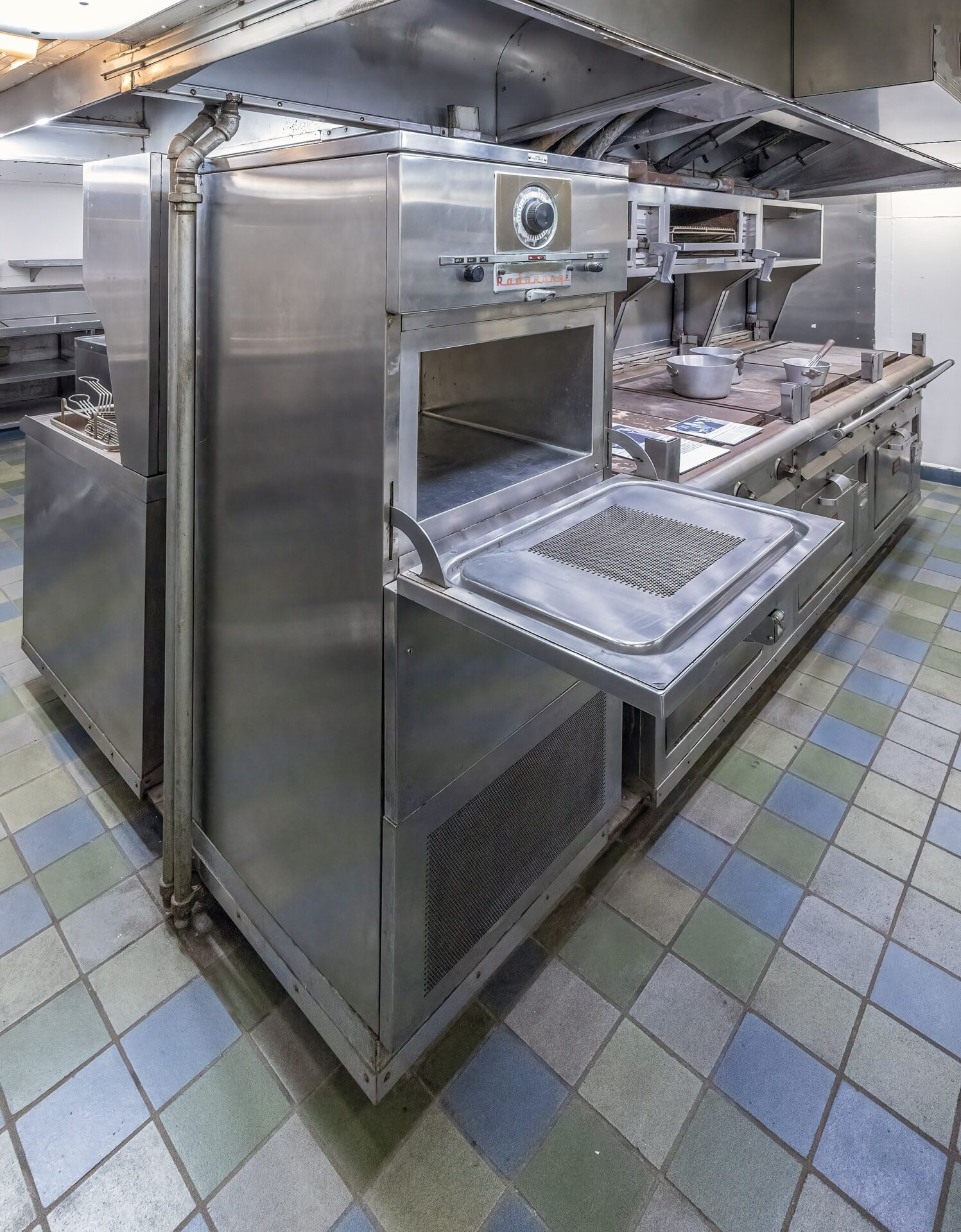
Acroterion · CC BY-SA 4.0 · Wikimedia Commons
Now back to the opening question. A microwave oven heats food without fire because an electric field that flips direction billions of times per second shakes the water molecules in the food, and that shaking becomes heat. Microwaves reach only about 1 cm into food and form hot spots about 6 cm apart inside the chamber, so a lukewarm middle is a natural trace of this principle. The small fact that a water molecule is built with one side slightly positive and the other slightly negative leads all the way to the warm bowl on tonight’s dinner table.
References
- Wikipedia — Microwave oven
- Wikipedia — Dielectric heating
- Wikipedia — Cavity magnetron
- U.S. Food and Drug Administration — Microwave Ovens
- IOP Publishing — Physics of the microwave oven (M. Vollmer, Physics Education 39(1):74, 2004)
- OpenLearn, The Open University — Measure the speed of light with your microwave
- Google Patents — US2495429A — Method of treating foodstuffs (Percy L. Spencer, Raytheon)
- MIT Technology Review (1999-01-01) — Melted Chocolate to Microwave
- Atomic Heritage Foundation — Percy Spencer