
When the cherry blossoms fall like snow, it can seem the tree’s yearly story is over. Yet on the very branches the petals have left behind, another scene quietly begins the moment the pale green young leaves unfurl. Look closely at a fresh leaf and you will usually find two tiny red bumps, no larger than grains of millet, sitting side by side at the base where the blade meets the leafstalk. At a glance they are easy to dismiss as a blemish or a chance swelling. But these little bumps are in fact glands that ooze a sugary fluid, and ants file up the leafstalk to drink it. In other words, the cherry tree is summoning guests with its leaves rather than its flowers. And those guests have not come to move pollen; they have been hired as bodyguards to hunt down the caterpillars that chew on the young leaves.

Two Red Dots on the Leafstalk
The proper name for these glands is the extrafloral nectary. As the name says, it is a nectar gland located outside the flower, and in cherry trees it sits mainly on the upper side of the petiole, near the base where the blade begins. Its appearance varies quite a bit by species. Some are only small green bumps the same color as the leaf, while others form a distinct pink-to-crimson donut shape that catches the eye at once. (OSU BYGL)
In cherries these glands usually emerge in pairs near the leaf base, and this arrangement serves as a fingerprint-like feature for recognizing the genus Prunus in the rose family. The exact position shifts a little from species to species, however, appearing on the petiole in some, or moving onto the stipules or the leaf margin in others. On a spring walk, if you come across a young cherry leaf, take a look at the tip of the leafstalk. More often than not, two dots will be sitting there facing each other.
A Different Purpose from Floral Nectaries
Even though both are nectar glands, the nectary inside the flower and the extrafloral nectary aim at entirely different partners. The nectary within the flower exists to draw pollinators such as bees and butterflies and to bring about pollination. The extrafloral nectary, by contrast, has nothing to do with pollination. The sugary fluid it offers is aimed at predatory insects such as ants and wasps that hunt other insects. (Wikipedia)
Having received the sweet reward, the ants patrol the leaves as if paying it back, carrying off eggs and caterpillars. Instead of prying the herbivores off by itself, the plant uses cheap nectar to hire ants and hand the defense over to them. Warding off herbivores by drawing in a third party like this is called indirect defense. That is why ants are often likened to bodyguards the tree has put on its payroll.

The Precise Timing of the Nectar Flow
A classic study that revealed this alliance was a paper the ecologist David Tilman published in the journal Ecology in 1978. His subject was the North American black cherry (Prunus serotina). Tilman found that the tree’s extrafloral nectaries secrete their fluid most actively during the first three weeks after budbreak. The ants that gathered during this period were mainly the western thatching ant (Formica obscuripes), and they clustered especially on trees standing within about 20 meters of an ant colony. (Tilman 1978; OSU BYGL)
The prey the ants were after included the larvae of the eastern tent caterpillar moth (Malacosoma americanum), a major defoliating pest of the black cherry. The intriguing point is that the ants cannot catch these caterpillars at just any time. They can only handle the small larvae up to about three weeks after budbreak; once the caterpillars grow larger, most of them escape the ants’ hunt. Yet the period when the tree pours out the most nectar and the period when the caterpillars are most vulnerable to ants overlap with each other. This is also why ant visits peak right after budbreak and taper off together with the decline in nectary activity.
Tilman worded his conclusion carefully. The relationship between the ants and the cherry is not an obligate symbiosis in which each is inescapably bound to the other, but a facultative mutualism, and the timing of the nectar flow appears to be geared toward raising the ants’ hunting success against tent caterpillar colonies. Indeed, the farther a tree stood from an ant colony, the higher the survival rate of its caterpillars. (OSU BYGL)
A Switch That Herbivory Turns On
There is also evidence that these glands are not a passive device that merely secretes on a fixed schedule. In a 2008 study published in the journal Functional Ecology, Pulice and Packer deliberately damaged the leaves of sweet cherry (Prunus avium) with a hole punch or scissors to mimic caterpillar feeding. The damaged trees then produced significantly more extrafloral nectaries per leaf than the controls, and this held regardless of how the damage had been inflicted. (Pulice & Packer 2008)
In other words, when the pressure of herbivory is detected, the tree makes more nectaries and prepares to call in more ants. Ramping up defense after an attack in this way is known as induced defense. It fits well with the observation that the more a plant invests in nectar, the more ants it recruits and the greater the ant-mediated defense against herbivores. The red dots on the leafstalk, then, are not fixed ornaments but defensive equipment that responds to the situation and builds up its forces.
Not a Secret Unique to Cherry Trees
Here one misunderstanding needs correcting. The extrafloral nectary is not a special organ possessed by cherry trees alone. According to a survey Weber and Keeler compiled in the journal Annals of Botany in 2013, extrafloral nectaries have been confirmed in a remarkable 3,941 species, 745 genera, and 108 families of plants. The richest group is the legume family, reaching 1,069 species, more than a quarter of the total, followed by the passionflower family and the mallow family. (Weber & Keeler 2013)
Even more striking is that this organ has arisen independently at least 457 times over the history of plants. The same solution has appeared again and again across many lineages of different ancestry. The cherry is only a representative and well-studied example of this widespread defensive strategy, not its sole protagonist. The same wisdom of defense that God built has been scattered throughout the plant world.
The Park’s Cherry Trees, and the Conditions of the Alliance
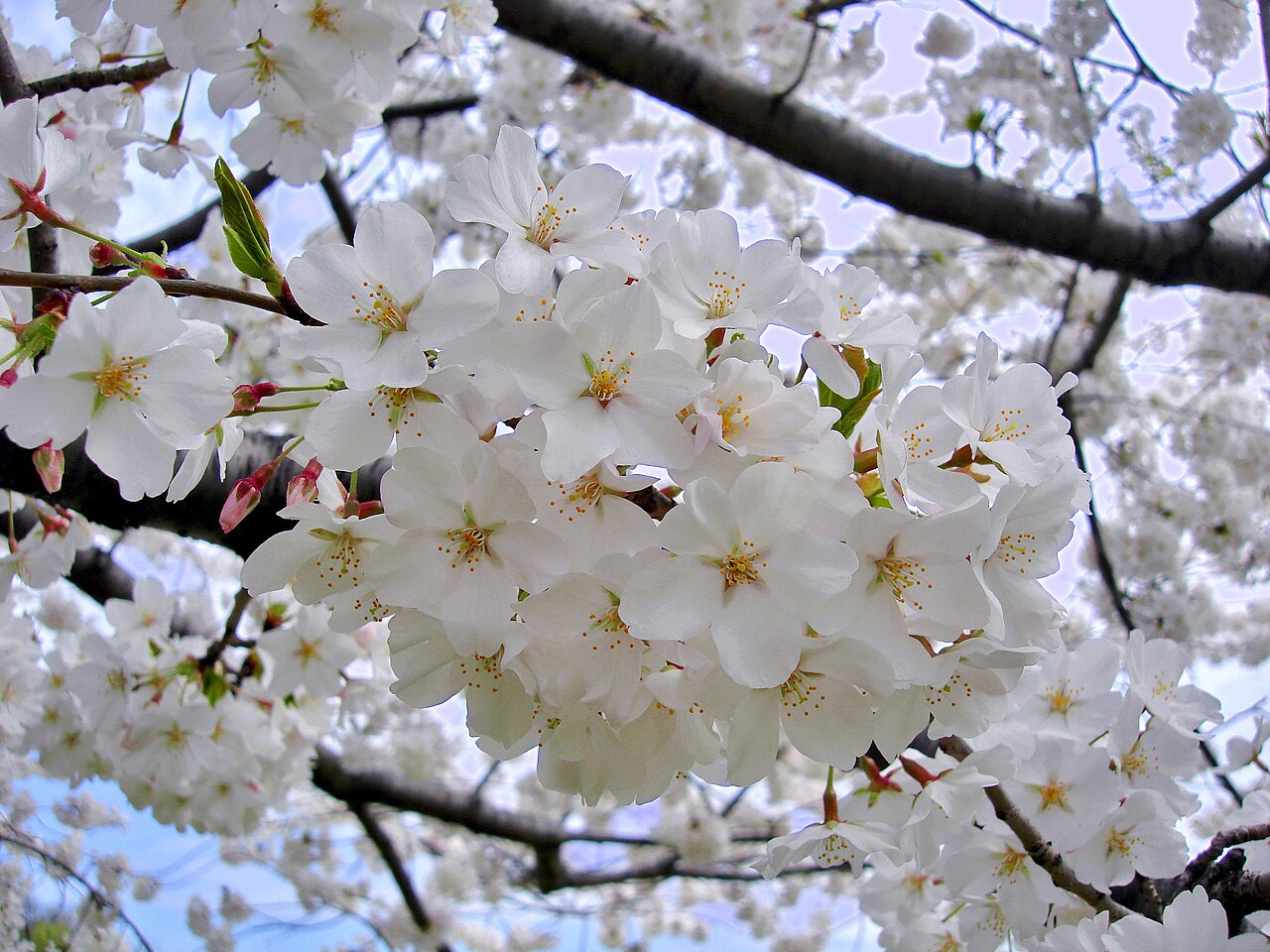
The ornamental cherries we look up at every spring carry these glands too. The Yoshino cherry (Prunus × yedoensis) bears two or more large wart-like glands at the tip of the petiole, and whether these glands touch the base of the blade or stand apart from it is used as a clue for distinguishing cherry species. (NC State Extension) These petiole glands also secrete a sugary fluid, so they are regarded as a kind of extrafloral nectary.
There is, however, a point to be careful about. The experimental confirmation that ants catch caterpillars and protect the tree was carried out mainly on the black cherry and the sweet cherry. It is hard to assert that this defensive effect has been proven by experiment in the same way for ornamental cherries such as the Yoshino, and it is more accurate to understand it as a principle established across the genus Prunus and in closely related species. Nor are ants always on the tree’s side. When aphids grow abundant, ants may shift their foraging from the gland’s nectar to the honeydew the aphids exude, so this defense is, after all, an alliance that depends on the conditions. (aesa)
And so the two red dots set on a cherry tree’s leafstalk are a finely meshed device placed where it is all too easy to overlook. The nectar flows when the young leaves are at their most tender, and it draws in guests with the power to protect them at precisely that moment. This is not something the tree worked out by its own calculation; it is a matter of one season’s timing being set so as not to fall out of step with another’s. Even in a single small nectary that God made, there lies, in a spot the eye barely notices, an intricate design that keeps life alive.
References
- Nectar — Wikipedia (definition of extrafloral nectaries, ant defense mutualism, global scale of distribution)
- Tilman, D. (1978) Cherries, Ants and Tent Caterpillars — Ecology
- Eastern Tent Caterpillars, Extrafloral Nectaries, and Ants — OSU BYGL
- Extrafloral Nectaries — OSU BYGL
- Pulice & Packer (2008) Simulated herbivory induces extrafloral nectary production in Prunus avium — Functional Ecology
- Weber & Keeler (2013) The phylogenetic distribution of extrafloral nectaries in plants — Annals of Botany
- Prunus × yedoensis (Yoshino cherry) — NC State Extension
- Ant foraging shifts from extrafloral nectar to aphid honeydew (Vicia faba) — Annals of the Entomological Society of America