
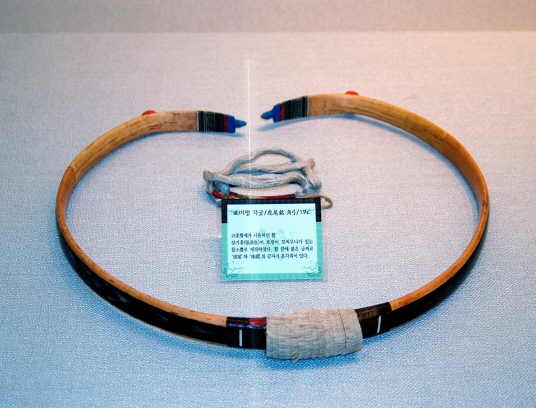
The first time you see a gakgung (角弓), the Korean horn bow, lying in a museum, it looks less like a bow than a broken bracelet. With its string removed, the whole bow curls backward until its two tips almost touch. To shoot it, you have to flip that ring the other way and hook the string on. Why not simply make it straight? Why bend it backward on purpose? The answer lies in its layers of water-buffalo horn, bamboo and ox sinew, and in a design that stores energy before the string is even drawn.
APoincot · CC BY-SA 3.0 · Wikimedia Commons
Unstrung and strung: two faces of the same bow
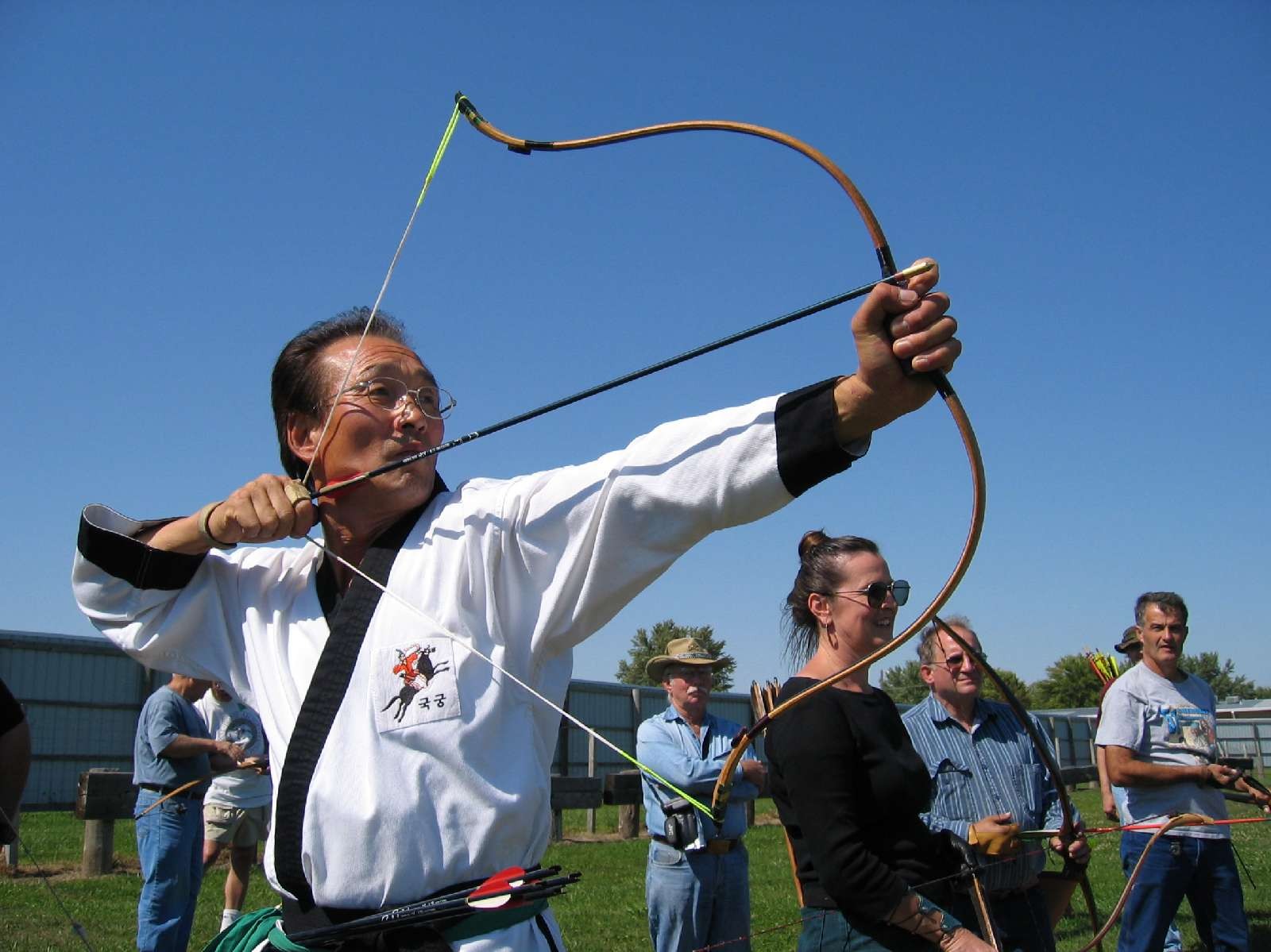
Korean archers say a bow is “relaxed” (burinda) when its string is taken off, and “mounted” (eonneunda) when the string is hooked onto the stiff tips, called goja. An unstrung bow is a burinhwal; a strung one is an eonjeunhwal.
A simple bow carved from one piece of wood usually returns to a straight shape when unstrung. A composite bow of the Central Asian family, such as the gakgung, is a reflex bow: once unstrung, the whole bow bends strongly toward its back, the side that faces the target. Timo A. Nieminen, a physicist at the University of Queensland in Australia, explains that such bows form a distinctive “C” shape, and that in extreme cases such as Korean bows the tips can even overlap.
Historiographer · CC BY-SA 3.0 · Wikimedia Commons
Stringing the bow means opening that C, bending it the opposite way and hooking on the string. So a strung gakgung is already deeply bent before anyone draws it, and energy is already stored inside it.

Illustration · AI-generated (Codex/ChatGPT subscription) · Purpose: concept drawing of how the unstrung bow is flipped into its strung shape and where the layers end up
Why no single material can do the job
When a bow is drawn, its two faces go through opposite ordeals. The back, facing the target, is stretched more and more (tension), while the belly, facing the archer, is squeezed more and more (compression). Nieminen points out that it is hard to find a single material that can withstand large amounts of both while still bending a great deal. It is also why a bow carved from one piece of wood had to be about 2.3 times as long as the draw, so that the wood would survive the bending.
The gakgung solves this by giving each material its own job. According to the Korea Heritage Service’s description of the bow-and-arrow craft, the bow has oak at the grip and mulberry at both ends; a bamboo core is set in for springiness, and ox horn and ox sinew are glued to its two faces with glue made from the swim bladder of the croaker fish (minieo). In composite bows the horn goes on the belly, facing the archer, and the sinew on the back. Horn is especially strong against squeezing, and sinew especially strong against pulling. Both can store more energy than wood.
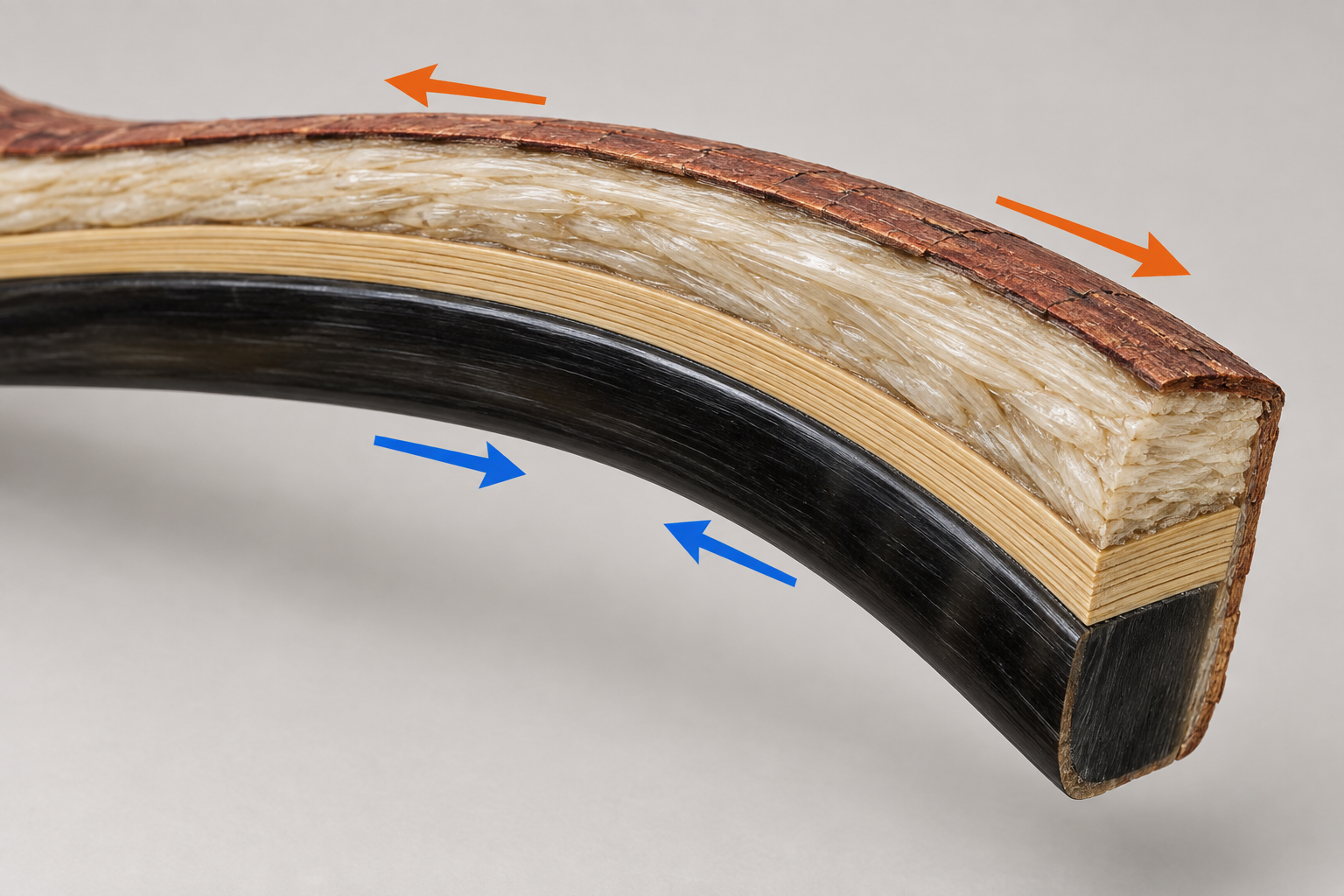
Illustration · AI-generated (Codex/ChatGPT subscription) · Purpose: cutaway concept explaining the gakgung’s material layout and where compression and tension act
The Korea Heritage Agency lists the gakgung’s materials as the “seven materials”: water-buffalo horn, bamboo, ox sinew, mulberry, oak, croaker swim-bladder glue and hwapi. Hwapi is cherry bark; the bow said to have been used by Emperor Gojong is painted over a hwapi layer made of cherry bark. Horn and sinew carry the load, bamboo and wood form the frame, glue binds them into one, and bark wraps the outside, each with its own place.
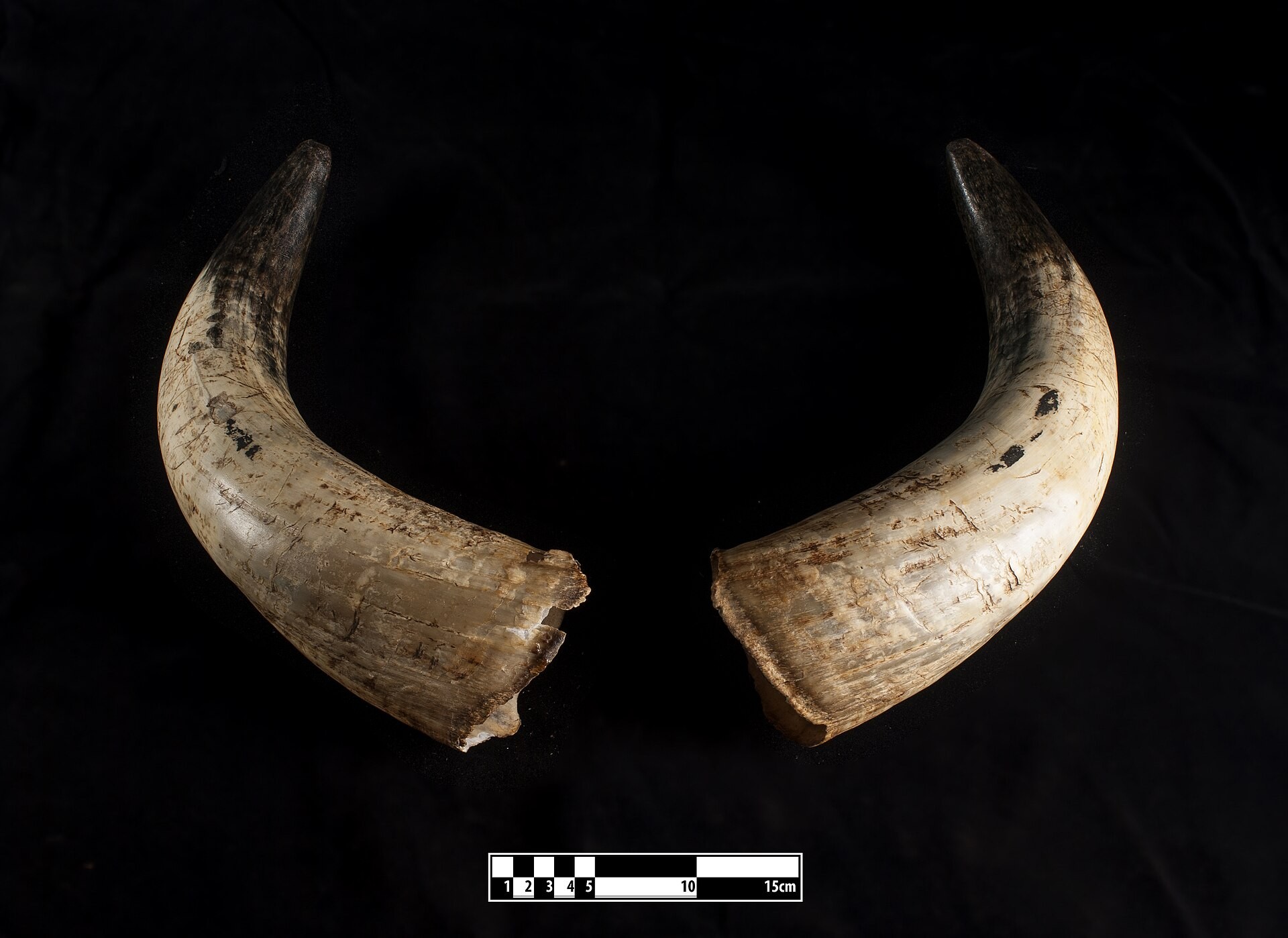
The water-buffalo horn that forms the gakgung’s black belly could not be found on the Korean Peninsula. With no water buffalo living there, Joseon had to bring in horn for its bows from places such as China, Japan and Ryukyu (today’s Okinawa). It was a strategic material, too scarce for bows to be made in large numbers.
Museum of Veterinary Anatomy FMVZ USP / Wagner Souza e Silva · CC BY-SA 4.0 · Wikimedia Commons
How a backward-bent bow gathers more energy
The energy a bow can hand to an arrow equals the work the archer does while drawing, that is, the drawing force added up over the distance drawn. If you plot draw distance on the horizontal axis and force on the vertical axis, the area under the curve is the energy built up in the bow during the draw, that is, the most energy it can hand to the arrow.
A straight bow gets heavier little by little as it is drawn: light at first, heavy at the end. A backward-bent bow, by contrast, is already bent against its natural shape the moment it is strung, so the force climbs quickly right after the draw begins. Even if the weight felt at full draw is the same, more force is there early in the draw, so the area under the curve, and therefore the stored energy, is larger. Nieminen explains that the reflex design produces exactly this kind of upward-bulging force curve.
Experimental numbers make the difference clear. In a 1993 paper, the Dutch bow-mechanics researcher B. W. Kooi compiled data from shooting tests with replica bows. Drawn the same 81.3 cm and shooting the same 50 g arrow, a replica medieval longbow took 36.2 kgf to draw fully and sent the arrow off at 53 m per second. A replica Tartar-type bow, a reflexed composite bow, took only 27.2 kgf, about three-quarters as much, yet shot the arrow at 51 m per second, almost the same speed. Measured as the arrow’s kinetic energy relative to draw force times draw length, the longbow scored 0.24 and the composite bow 0.30. Drawn with the same force, the composite bow would have sent about a quarter more energy into the arrow.
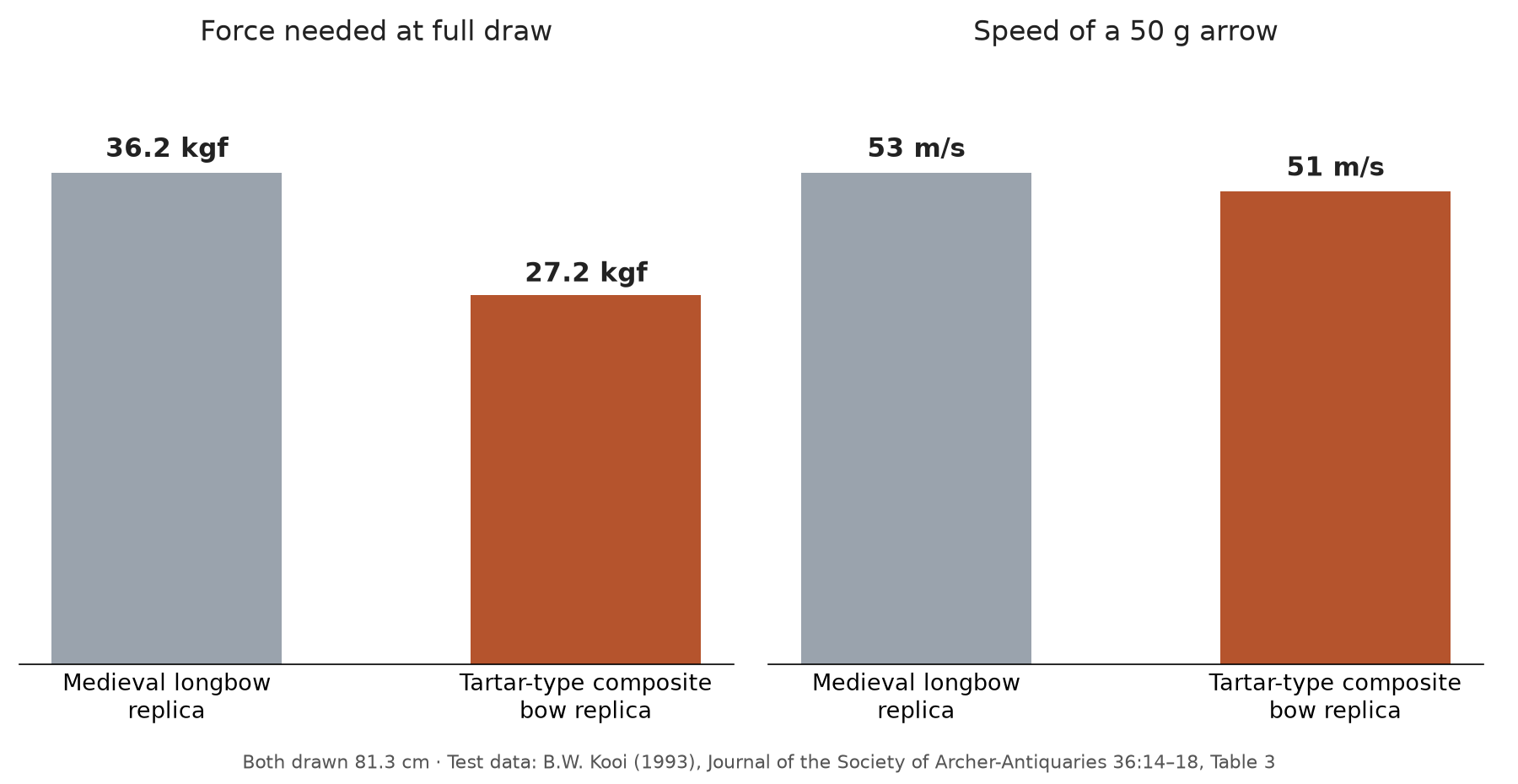
Chart by GLU · Data: B. W. Kooi (1993), Journal of the Society of Archer-Antiquaries 36:14–18, Table 3
This comparison concerns a replica composite bow of the same family, not a gakgung, but the way a reflex gathers energy is the same. Kooi also explains that in a reflexed bow whose ends do not bend, those rigid ends act like levers and raise the share of energy the bow stores for a given draw force and draw length. The mulberry pieces at both ends of the gakgung are exactly such non-bending ends. Nieminen adds that the strong reflex lets a relatively short bow reach a high draw weight and a long draw, and that Korean bows had very long draws, with the archer pulling the string back to the ear.
A bow that is never made in summer
Gluing so many materials together has an obvious weakness. The croaker swim-bladder glue that holds the gakgung together does not bond well when it is humid and hot. So bowyers do not make bows in summer; as a rule they build them between October and March of the following year. The same goes for finished bows: the organic glues in composite bows absorb moisture from the air and weaken, and a gakgung that soaks up the damp of the rainy season is said to lose its spring.
The Korean Traditional Knowledge Portal lays out gakgung making in 21 steps. The bamboo and wood are heated over a fire and bent, the horn is glued on, and ox sinew is pounded, shredded into fine fibres and applied in several rounds. Once the sinew is on, the bow dries in a warm room for about a month, and near the end a tool called a dojigae is fitted to flip the middle of the bow while heat is applied to set its shape. Because it takes so much work and breaks easily if handled carelessly, improved bows made of modern materials have largely taken the gakgung’s place at archery ranges today.
Even so, the Korean archery target is as far away as ever. Korean traditional archery shoots at a standard target 120 bo, about 145 m, away. Because the gakgung is drawn with the thumb, archers commonly wear a thumb ring.
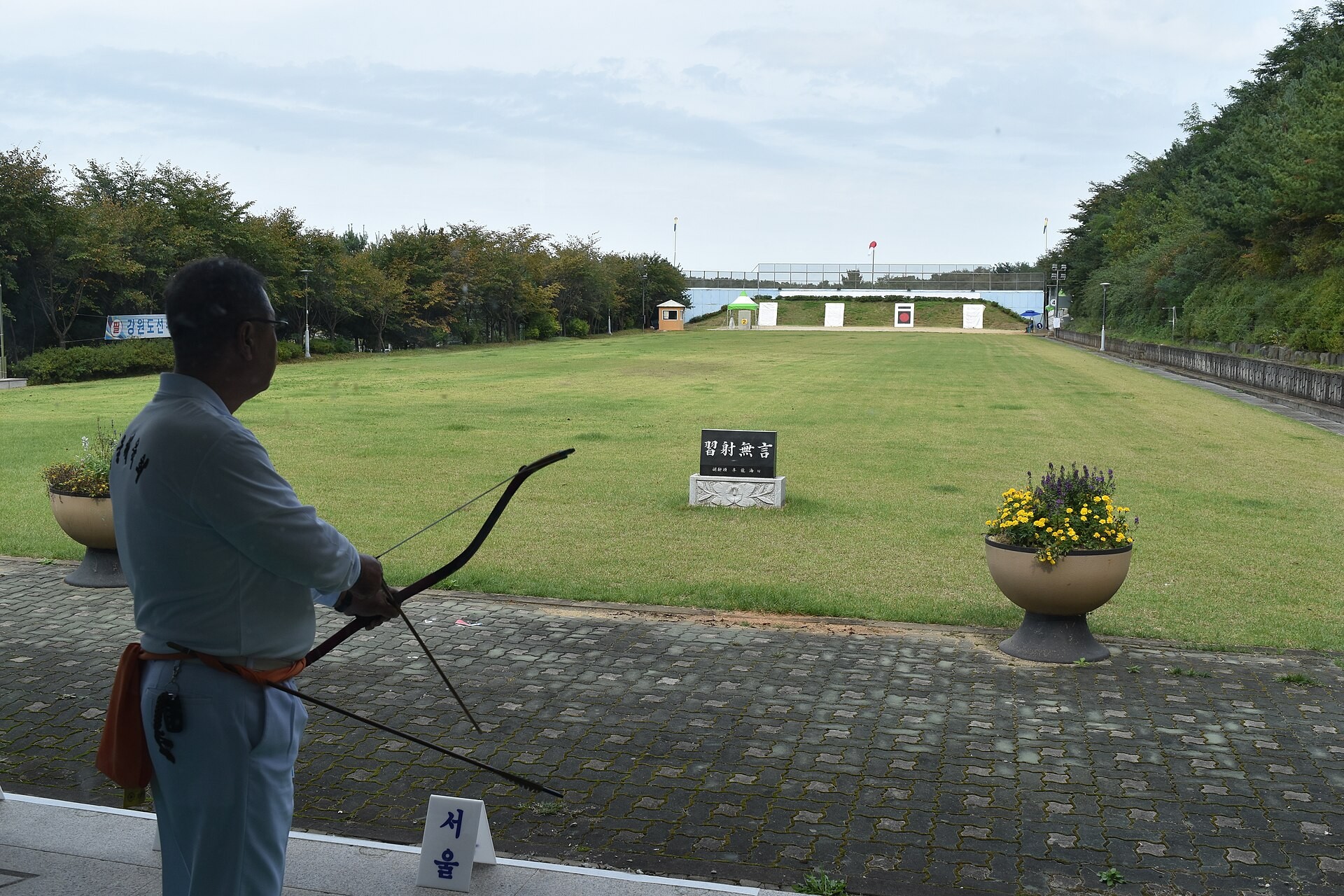
Jjw · CC BY-SA 4.0 · Wikimedia Commons
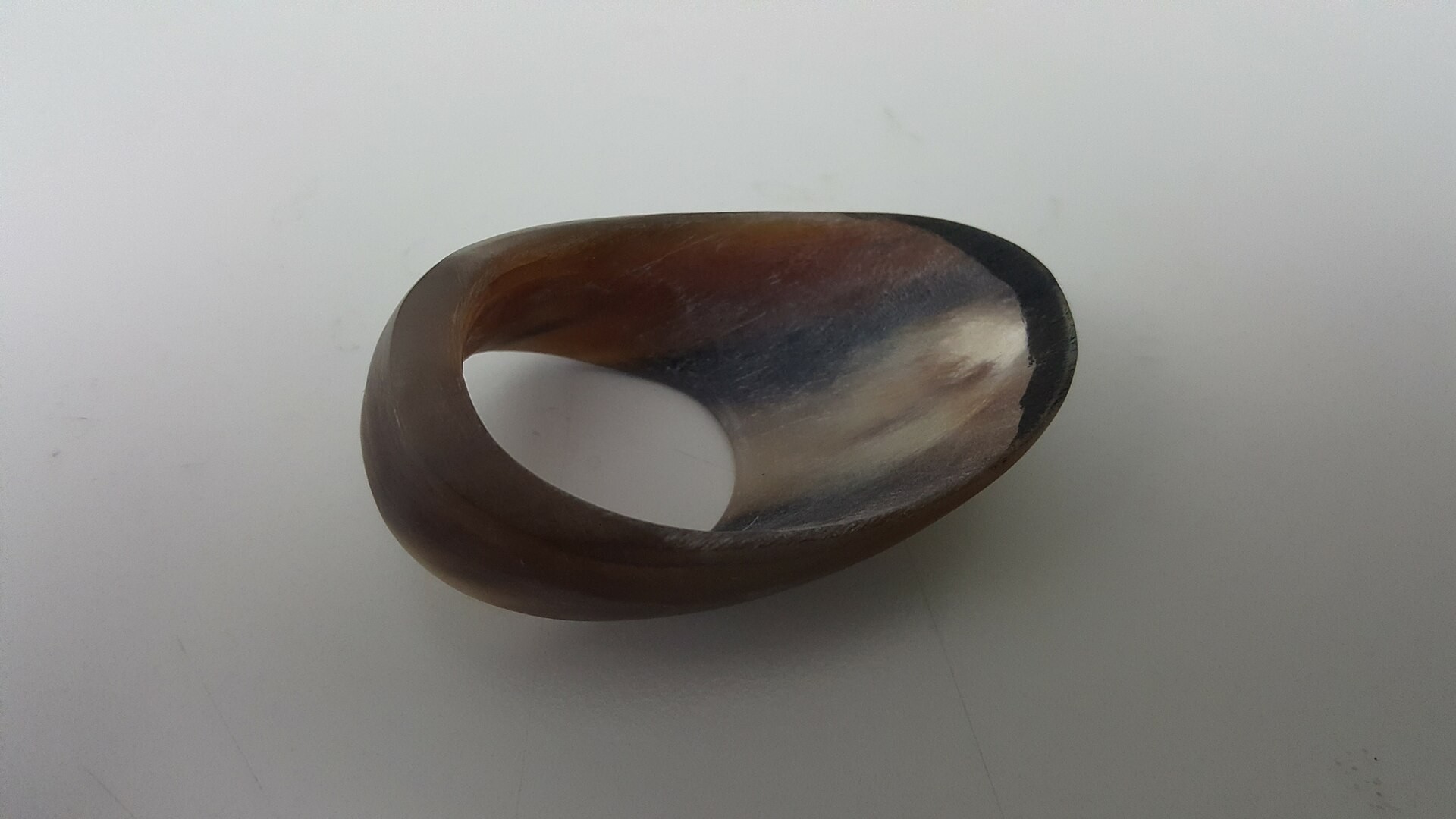
Ryuch · CC BY-SA 4.0 · Wikimedia Commons
A bowmaking skill still handed down
The craft of making bows and arrows, gungsijang (弓矢匠), was designated an Important Intangible Cultural Property (now National Intangible Heritage) on 13 September 1971. A bowmaker is called a gungjang (弓匠) and an arrowmaker a sijang (矢匠). One gakgung said to have been used by Emperor Gojong was designated an Important Folklore Material (now National Folklore Cultural Heritage) in 1976. It is 124 cm long, and its two ends are inscribed with “Homi” (虎尾) and “Juyeon” (珠淵), the latter being Gojong’s pen name.
The design inside a backward curve
An unstrung gakgung curled up like a ring is not a mistake in the making; it is the result of design. Horn takes the squeezing, sinew takes the pulling, and bamboo and wood hold the frame. Then the whole bow is bent backward in advance, so that it gathers energy before the string is ever drawn. Thanks to this layered structure, which reads the different properties of each material taken from creation with precision, one small bow could hold great power.
References
- Korea Heritage Service, National Heritage Portal — Gungsijang (bow and arrow making) — National Intangible Heritage
- Korea Heritage Service, National Heritage Portal — Gakgung (horn bow) — National Folklore Cultural Heritage
- Korea Heritage Agency — Gungsijang Kim Bak-yeong (Heritage Stories, 21 Jan 2021, in Korean)
- Korean Traditional Knowledge Portal — Gungsijang (No. 47) / Kim Bak-yeong, Yu Yeong-gi (in Korean)
- arXiv:1101.1677 — The Asian war bow (T. A. Nieminen, 19th Australian Institute of Physics Congress, 2010)
- Vrije Universiteit Amsterdam (author-hosted copy) — On the Mechanics of some Replica Bows (B. W. Kooi, Journal of the Society of Archer-Antiquaries 36:14–18, 1993)
- Wikipedia — Composite bow
- Wikipedia — Gakgung
- Dongguk University HK+ Institute — Unexpected and amusing stories about water-buffalo horn (Kim Seung-hyun, 22 Jun 2021, in Korean)
- Korean Wikipedia — Gakgung (in Korean)