
Every spring, when cherry blossoms burst into bloom, someone is bound to say it: “The cherry blossom is Japan’s national flower, isn’t it?” We hear it so often that we rarely stop to question it. Yet no matter how thoroughly you search Japanese law, you will not find a clause declaring the cherry blossom the national flower. More surprising still, Japan has no legally designated national flower at all. A sentence we recite as common sense turns out to be not a legal fact but a cultural assumption. Untangling that knot leads us to some unexpected truths in the history and genetics of the cherry blossom.

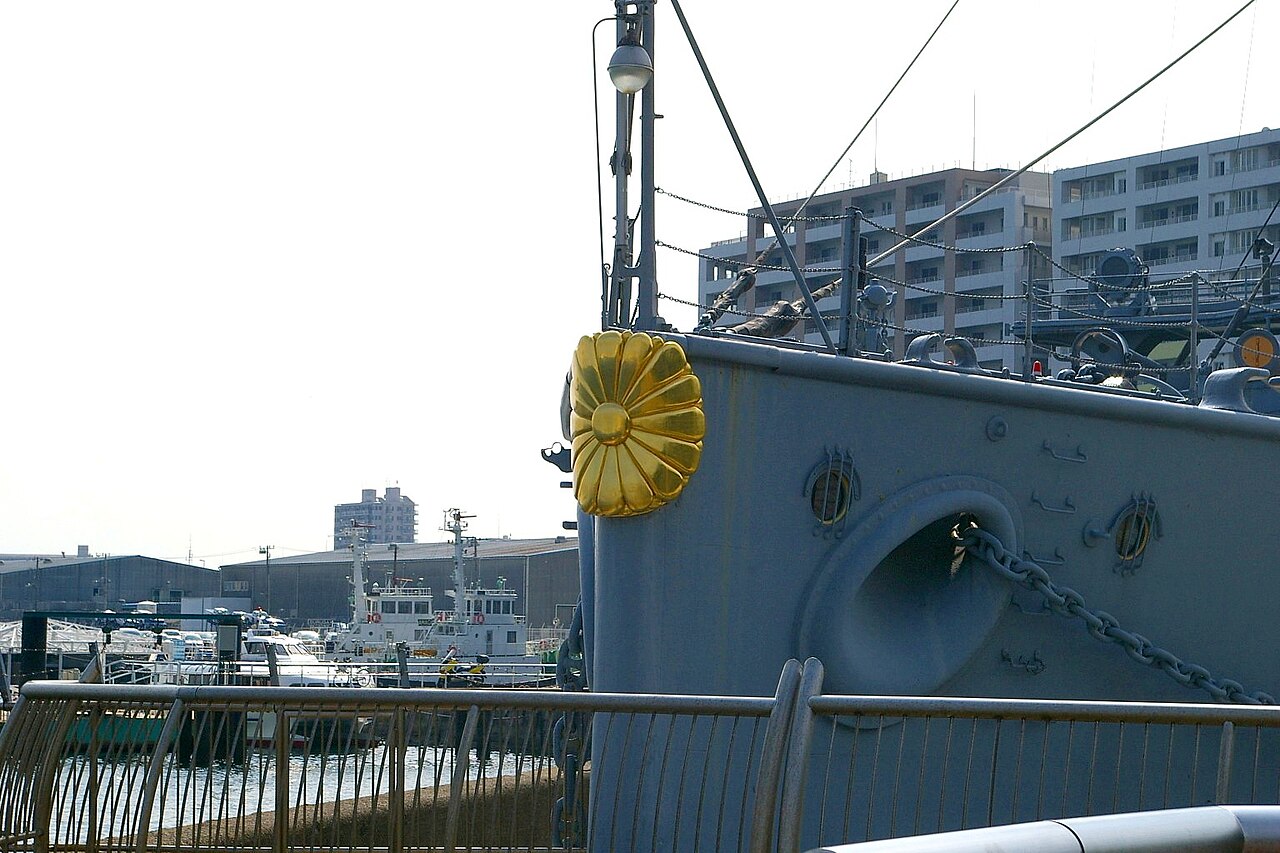
Japan Has No Legally Designated “National Flower”
People routinely call the cherry blossom Japan’s national flower, but this is not a status fixed in law. Two flowers function as national symbols on different levels. One is the chrysanthemum (kiku), the de facto symbol representing the imperial house and the state. The other is the cherry blossom (sakura), an unofficial cultural symbol rooted in popular sentiment but holding no legal standing. Neither has ever been enacted into law as the “national flower” (Nippon.com).
The flower closer to an official state symbol is, in fact, the chrysanthemum. The sixteen-petaled Chrysanthemum Crest is the emblem of the Japanese imperial family and a de facto mark of the state. It originated when Emperor Go-Toba (reigned 1183–1198) adopted it as his personal crest; it was used as an emblem in practice from the thirteenth century, though it was not established in law until 1926 (Wikipedia). Even today the Chrysanthemum Crest appears on the cover of the Japanese passport, on some coins, and at the gates of overseas diplomatic missions. And yet the chrysanthemum itself was introduced from China as a medicinal plant during the Nara period (710–794), a reminder of how thoroughly the notion of a “national flower” is something constructed.
The Cherry Blossom Did Not Become a Symbol “Since Antiquity”
The impression that the cherry blossom has symbolized Japan since time immemorial is also mistaken. The custom of hanami (flower viewing) reaches back to the Nara period, but the flower people first admired was not the cherry but the plum (ume), reflecting the strong Chinese cultural influence of the era. Then, in the Heian period (794–1185), the object of admiration shifted from plum to cherry (Wikipedia).
The earliest recorded cherry-blossom hanami was a banquet held by Emperor Saga in 812 at the Shinsen-en garden in Kyoto, recorded in the Nihon Koki. By 831 it had become an annual official court event. In other words, the cherry blossom’s rise to a national symbol of Japan hardened over the Heian, Edo, and modern periods; it is not a matter of remote antiquity. The blossom’s habit of flowering briefly and then falling without regret came to symbolize the transience of life, the sensibility known as mono no aware, and in warrior culture it served as a metaphor for an honorable death at the moment of one’s peak.

Every Somei-yoshino in the World Is, in Effect, One Tree’s Double
The cherry tree we most commonly see today is the Somei-yoshino (Prunus × yedoensis ‘Somei-yoshino’). It hides a remarkable secret: the countless Somei-yoshino planted around the world all descend from a single original tree as clones. Somei-yoshino is a hybrid of different species and is self-incompatible, unable to pollinate itself, so it cannot reproduce by seed. It has therefore been propagated only by grafting and cutting, with the result that the world’s Somei-yoshino are genetically, in effect, the same individual (Wikipedia).
Self-incompatibility is a precise mechanism God built into plants so that they avoid inbreeding and preserve healthy genetic diversity. Humans, however, bypassed that mechanism through grafting, copying a single genotype unchanged for centuries. That said, to claim that every Somei-yoshino is perfectly identical is an oversimplification. A 2024 study by Shirasawa and colleagues in DNA Research detected 684 somatic mutations across 46 samples, showing that tiny genetic differences accumulated over the long history of grafting (PubMed). Intriguingly, this does not overturn the single-clone origin but rather confirms it: the researchers used those mutations as tracers to reconstruct the propagation lineage and concluded that one tree in Tokyo’s Ueno Park is closest to the original ancestor. The parent species are the Edo-higan lineage on the maternal side and the Oshima cherry on the paternal side; a high-resolution genome published in 2019 (about 690.1 megabases, roughly 95,076 genes) also supports this cross (Oxford DNA Research).
Somei-yoshino Is a Cultivated Variety Made in Edo
So where did that “one tree” come from? The birthplace of Somei-yoshino was Edo, today’s Tokyo, in the village of Somei, an area of present-day Komagome in Toshima Ward, where it was raised by local horticulturists. One study (Iwasaki, 1991) estimates that the cultivar arose from artificial crossing around 1720 to 1735. The oldest surviving planting record dates to 1775, at the Koishikawa Botanical Garden (Wikipedia).
It was named much later. In 1900 Fujino Yorinaga coined the name “Somei-yoshino” by combining Somei, its birthplace, with Mount Yoshino, a famous cherry site; the following year, in 1901, Matsumura Jinzo assigned the scientific name Prunus yedoensis. In short, Somei-yoshino is not a tree that spread on its own in the wild but a horticultural variety shaped by the gardeners of Edo.

The Jeju King Cherry Is an Entirely Different “Wild Hybrid”
Here the Korean king cherry enters the story. The king cherry that grows wild on Jeju Island is a taxon genetically distinct from Somei-yoshino. A study by Cho and colleagues (2014) in the American Journal of Botany used molecular and morphological data to demonstrate for the first time that the wild Jeju king cherry arose as a hybrid (American Journal of Botany). Katsuki and colleagues (2016) then distinguished it from Somei-yoshino and proposed the scientific name Cerasus × nudiflora (= Prunus × nudiflora) (Wikipedia).
The king cherry’s parents are the Edo-higan lineage on the maternal side — a lineage that also grows wild in Korea — and a wild mountain cherry lineage on the paternal side. It shares the maternal lineage with Somei-yoshino but differs on the paternal side, and the two trees arose independently. As of April 2017, the wild Jeju population was recorded at about 194 trees on Mount Halla, distributed between altitudes of 165 and 853 meters (Wikipedia).
Genetics Settles the “Origin Dispute”
For a long time the claim circulated that “Japan’s Somei-yoshino originated from the Jeju king cherry.” It grew out of early-twentieth-century observations (Koehne in 1912, and Wilson in 1916, who judged the evidence insufficient) combined with the fact that wild king cherries really do exist on Jeju. Modern genetics, however, reaches a different conclusion. A study by Cho and Kim (2019) in Frontiers in Plant Science, verified with four molecular markers — nuclear rDNA (ITS and ETS), chloroplast DNA, RosCOS, and PolA1 — confirmed that the wild Korean king cherry and the cultivated Somei-yoshino are distinct taxa of independent origin (PMC). The claim that “Somei-yoshino is a descendant of the Jeju king cherry” does not hold up genetically.
What matters is not to force this fact into a frame of which country is the “original” and which the “thief.” What science says is simple and balanced: the Jeju king cherry is a genuine wild hybrid species that truly grows wild in Korea, and Somei-yoshino is a single cultivated clone made in Edo-period Japan; the two trees share only their maternal lineage and are otherwise separate products. Genetics has precisely corrected the common misconception that lumps the two together as “the same tree.” The handling of the scientific name, however, still varies from database to database. Kew’s Plants of the World Online (POWO) keeps Prunus × yedoensis Matsum. as the accepted name and lists its native range as Jeju Island, whereas the 2014 and 2016 studies cited above separate the wild Jeju plants as a distinct nudiflora (Kew POWO). It is therefore premature to declare that the taxonomy has been fully settled into a single name.
Behind a single cherry blossom lies a history and lineage far more intricate than common assumption suggests. A “national flower” that was never fixed in law, a symbol carried over from the plum, a clone copied from one tree, and the independent origins of two trees that share only a maternal line — the nature God made is always woven with more delicacy and order than our hasty assumptions allow. When we pause the phrase we murmur each spring and look at the truth behind it, the cherry blossom comes to us with a deeper and more accurate beauty.
References
- Nippon.com — The Chrysanthemum: Flower of Emperors
- Wikipedia — Imperial Seal of Japan
- Wikipedia — Hanami
- Wikipedia — Prunus × yedoensis (Somei-yoshino)
- Wikipedia — Prunus × nudiflora (King cherry)
- Cho & Kim (2019), Frontiers in Plant Science
- Shirasawa et al. (2024), DNA Research
- Phased genome of Cerasus × yedoensis (2019), DNA Research
- Cho et al. (2014), American Journal of Botany
- Kew POWO — Prunus × yedoensis Matsum.