
When spring arrives, a whole city’s cherry trees burst into bloom within a few days of one another, as if by appointment. Then, about a week later, they shed their petals all at once as well. Hundreds of trees stand scattered across a city — so how do they bloom in the same week and fall in the same week? This remarkable synchrony is no accident. It is the result of a temperature calculation the cherry trees have been quietly running since last winter.
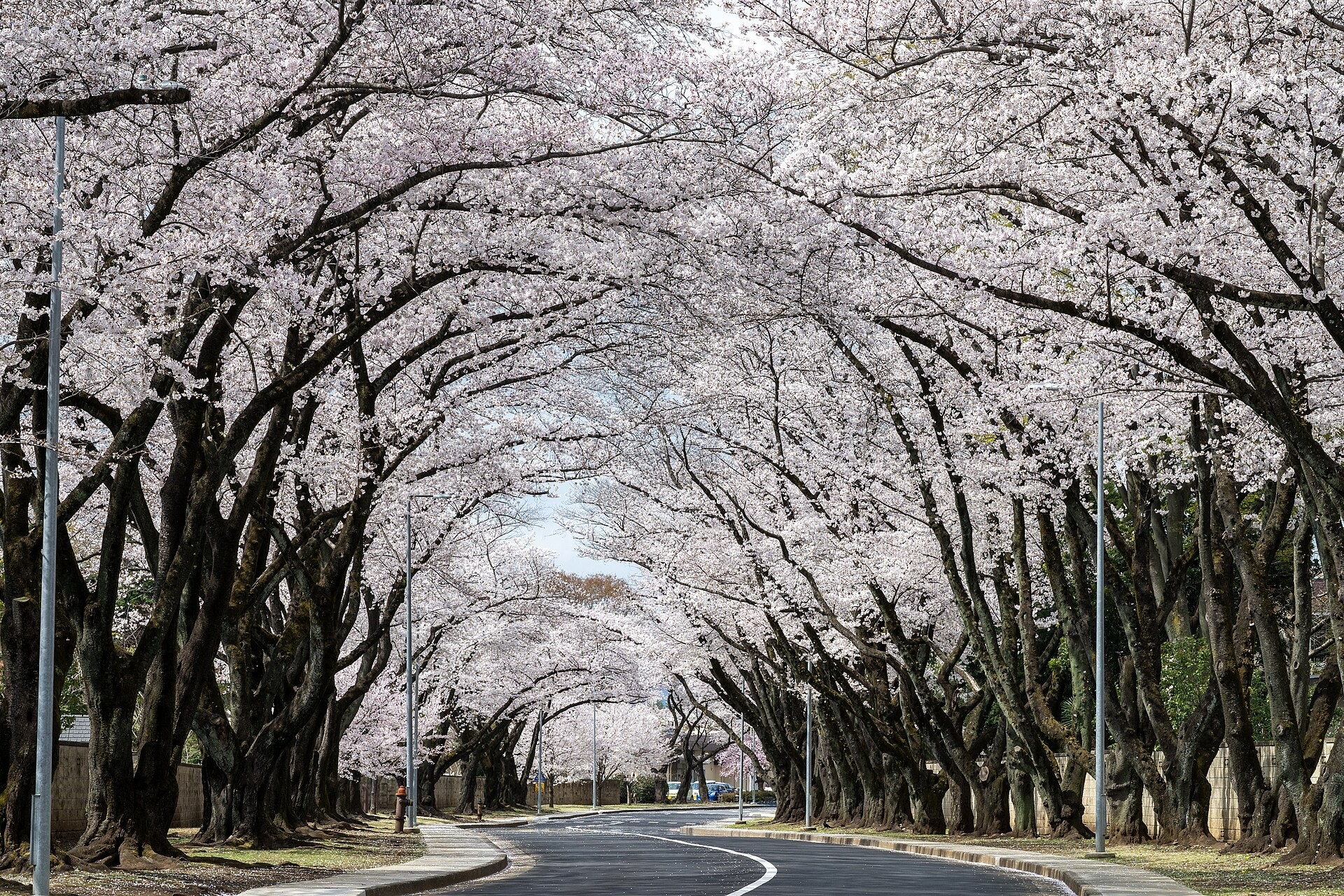
Photo · Cherry blossoms in full bloom, Yokota Air Base, Japan — U.S. Air Force photo by Yasuo Osakabe, public domain, Wikimedia Commons
The spring flowers were already prepared last summer
First, we need to clear up a misconception. Cherry trees do not hastily build their flowers once spring comes. The flower buds of the blossoms we see in April actually begin forming the previous summer, around July. By autumn the flower is all but sketched out inside the bud, at which point growth halts and the bud overwinters in that state.
So the cherry tree’s springtime task is not “whether to bloom” but “when to open.” Precisely when to unfurl those already-prepared buds — this timing decision is where the cherry tree’s exquisite sense of temperature is hidden.
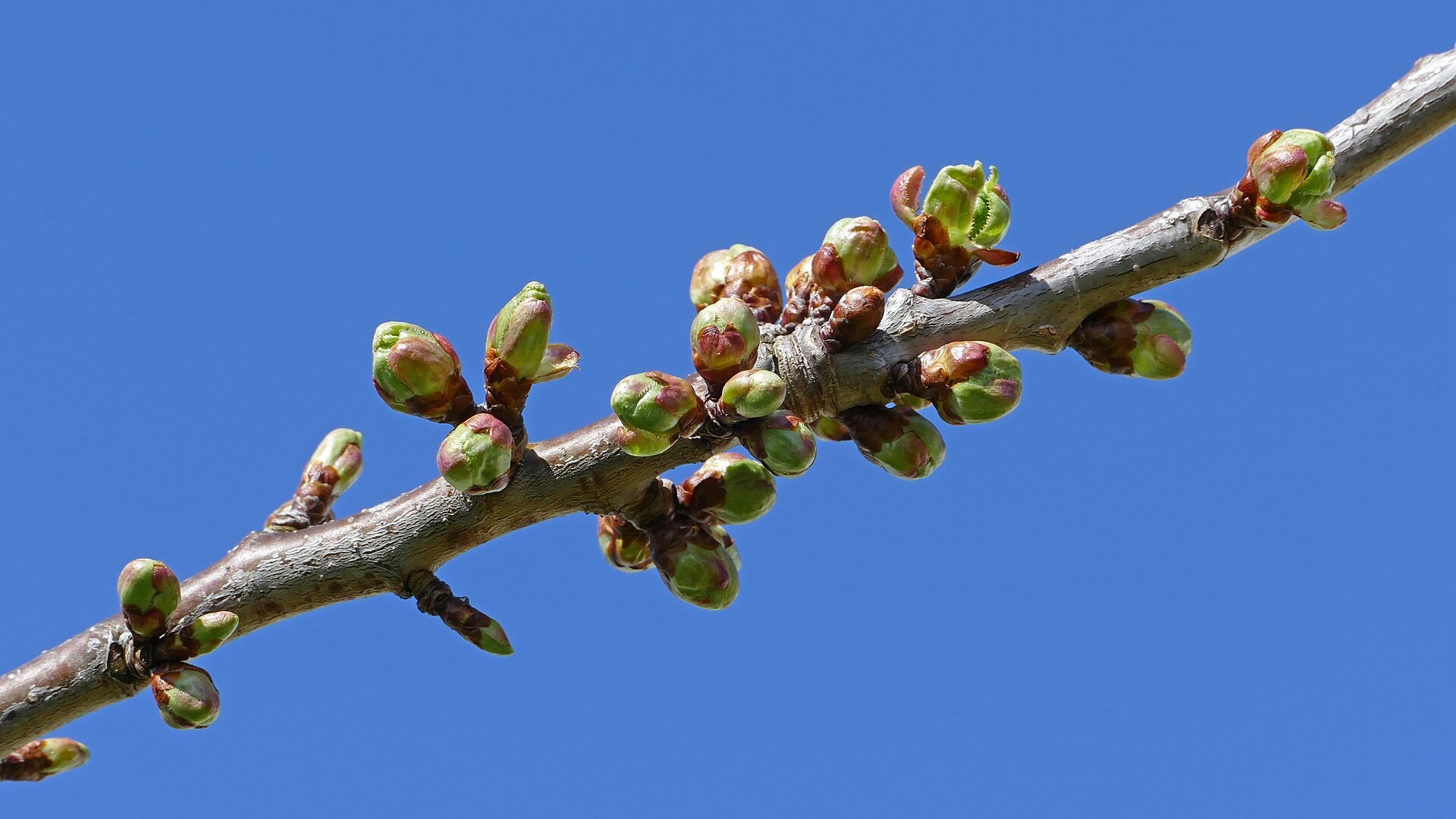
Photo · Cherry blossom buds (Prunus sect. Cerasus), Sweden — W.carter, public domain, Wikimedia Commons
Two signals — winter cold, then spring warmth
For a bud to open in spring, it must pass through two different temperature signals in sequence.
The first signal is, surprisingly, the cold of winter. A bud that fell into deep sleep (endodormancy) in autumn will not wake immediately no matter how warm you keep it. Only after being exposed through the winter to enough low temperature (roughly the 0–7°C range) does this deep sleep finally lift. The cumulative amount of cold required is called the chilling requirement. Once it is met, the bud passes from deep sleep into light sleep (ecodormancy), now poised to respond sensitively to the outside temperature.
The second signal is the warmth of spring. A bud in light sleep senses warmth above roughly 5°C accumulating day by day. When this banked warmth — the accumulated temperature — reaches a certain level, the bud swells and the flower finally opens. In short, cherry blossoming is determined by a balance of two demands: “winter cold to wake the sleep (a chilling demand), and spring warmth to push the flower (a heat demand).”

Diagram · Made by glu.kr (schematic). Based on: University of Minnesota Extension on dormancy and chilling requirements, and JIRCAS on cherry flowering
The twist — too warm a winter actually scatters the bloom
Here comes a fact that upends intuition. It is easy to assume “the warmer the winter, the earlier the spring flowers,” but in reality, if the winter is too warm, cherry blossoms actually bloom later and more unevenly. The first signal — the chilling requirement — goes unmet, so the deep sleep never fully lifts.
This phenomenon is confirmed by several studies. According to one study observing Somei-yoshino at the southern edge of its range, at sites where winter cold was severely deficient, blooming was consistently delayed by 16 days or more, and while 93% of flowers opened where cold was sufficient, only 34% opened where cold was lacking. The span from first bloom to full bloom also nearly doubled, so that brief, brilliant peak dragged out into a blur. In the Japanese pear, a close relative, a winter cold deficit likewise appears as a kind of flowering disorder — reported as “delayed flowering, bud abortion, fewer flowers, and a lack of uniformity in bud break and blooming.”
A warm spring pulls cherry blossoms earlier, but a winter that is not cold enough throws the clock into disarray. This is the real tension that global warming poses for cherry blossoms.
Why does a whole city bloom in “the same week”?
Now back to the opening question. How do hundreds of scattered trees bloom in the same week? The answer has two layers.
First, trees in the same area experience the same weather. Cherry trees within one city meet their chilling requirement through the same winter cold and bank their accumulated temperature through the same spring sun. So even if they differ genetically here and there, their warmth builds up side by side and they cross the bloom threshold at nearly the same time. This alone produces “week-level” synchrony.
Second, a “clone” adds uniformity on top. Somei-yoshino, today’s most widely planted ornamental cherry cultivar, is a clone spread by grafting from a single original tree. Because it is propagated by grafting branches rather than from seed, Somei-yoshino trees around the world are, in effect, genetically the same tree. With the same genes they respond almost identically to the same weather. As a result the bloom tightens from “week-level” to a matter of days, and a whole street turns into a blossom tunnel in an instant. That said, what sets the actual bloom timing in a given year is entirely that year’s temperature; being a clone merely erases the variation between trees and aligns their responses more evenly.

Diagram · Made by glu.kr (schematic). Based on: Wikipedia ‘Cherry blossom’ (clones of the same cultivar bloom all at once), National Geographic
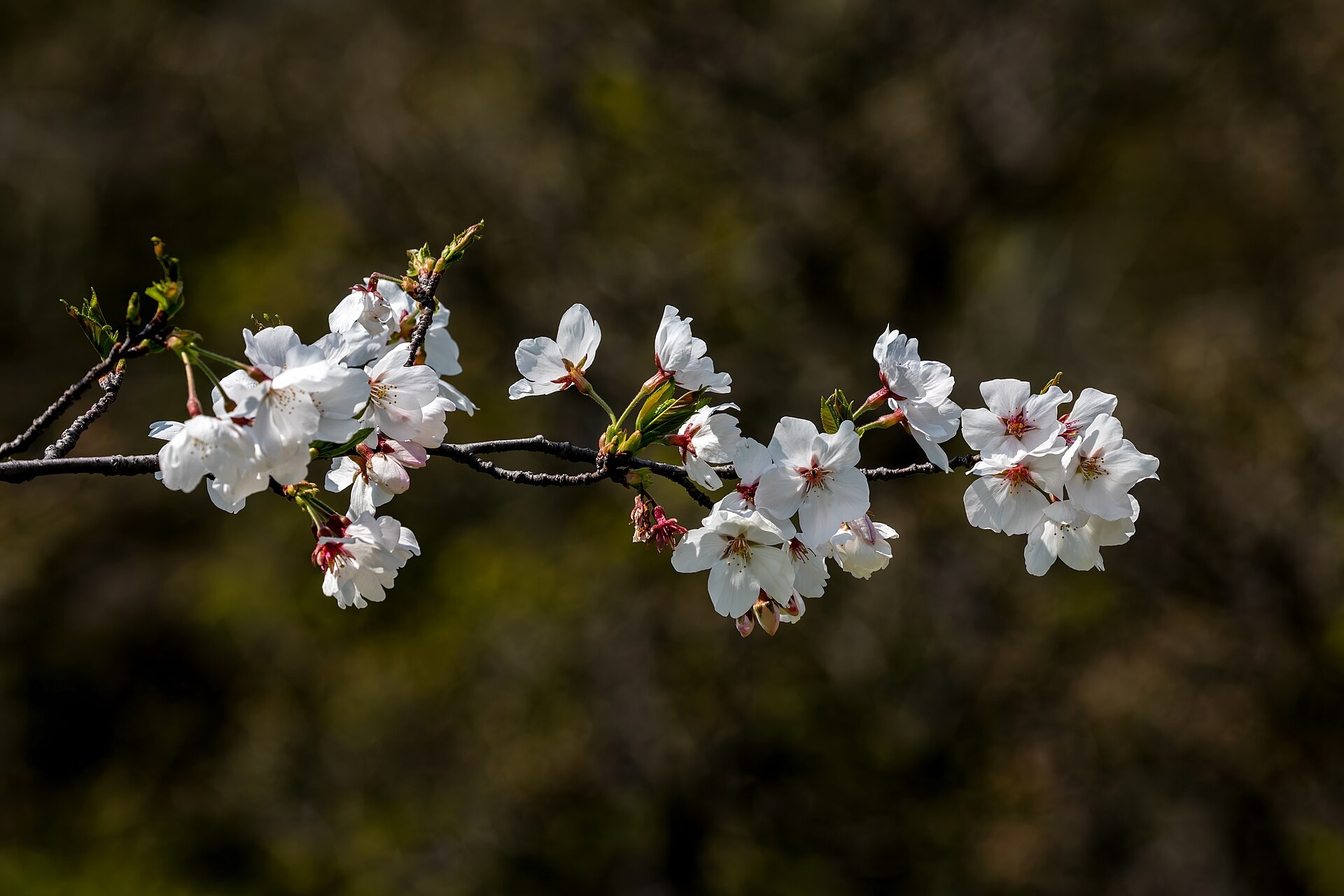
Photo · Cherry blossoms (Somei Yoshino), Nagai Botanical Garden — Laitche, CC BY-SA 4.0, Wikimedia Commons
And so bloom can be predicted — accumulated temperature and the “cherry blossom front”
Because blooming hinges not on the calendar date but on accumulated warmth, it can be forecast. A bloom-prediction model essentially adds up the daily mean temperature from a start date and takes the day the sum reaches a threshold as the bloom date. The methods range from the simplest accumulated-temperature approach to sophisticated models such as DTS (Days Transformed to Standard temperature), which treats the temperature response as an exponential function — but the key predictor is always the temperature of February and March.
In Korea, the Korea Meteorological Administration (KMA) designates a standard tree and “observes” the bloom. In Seoul, using a cherry standard tree in the grounds of the Seoul weather station, the day three or more flowers open on a single branch of the standard tree is judged the “first-bloom day.” Seoul’s cherry observations have continued since 1922, and since 2000 the cherry trees of Yeouido’s Yunjung-ro have been observed separately as well. Bloom forecasting — telling you in advance “when it will open” — is mainly handled by the Korea Forest Service’s National Institute of Forest Science and by private weather companies (people often assume “the KMA predicts it,” but observation and prediction are done by different bodies). A widely cited rule of thumb holds that “cherries bloom once the accumulated temperature of daily means from January 1 reaches around 200°C,” but this is merely a common approximation whose value shifts depending on the base temperature chosen — not a strict, single constant.
In Japan, the way this bloom date moves north along gradients of latitude and temperature — from Kyushu in the south (late March) to Hokkaido in the north (mid-May) — is called the “cherry blossom front” (sakura zensen). The Japan Meteorological Agency (JMA) long forecast this front itself, but in 2010 it discontinued its own bloom forecasts and handed prediction to the private sector. It still carries out and records the observation of first bloom and full bloom on standard trees. Incidentally, the criteria for judging bloom differ slightly by country: the JMA counts five or six open flowers on a standard tree as “first bloom,” and 80% or more open as “full bloom.”
A brief peak, then a snow of petals
The peak so reached is astonishingly brief. About a week after the first flowers open comes full bloom, and roughly another week later the peak ends and the petals begin to fall. An individual tree shows off its splendor for a little over ten days at most.
Petals fall because the flowers reach the end of their life and age, but what greatly hastens that moment is rain and wind. A single spring rain or a strong gust sends petals flurrying down like snow, cutting the short peak even shorter. That the fall of cherry blossoms feels so dramatic is precisely because the whole tree crests almost simultaneously and then fades together.
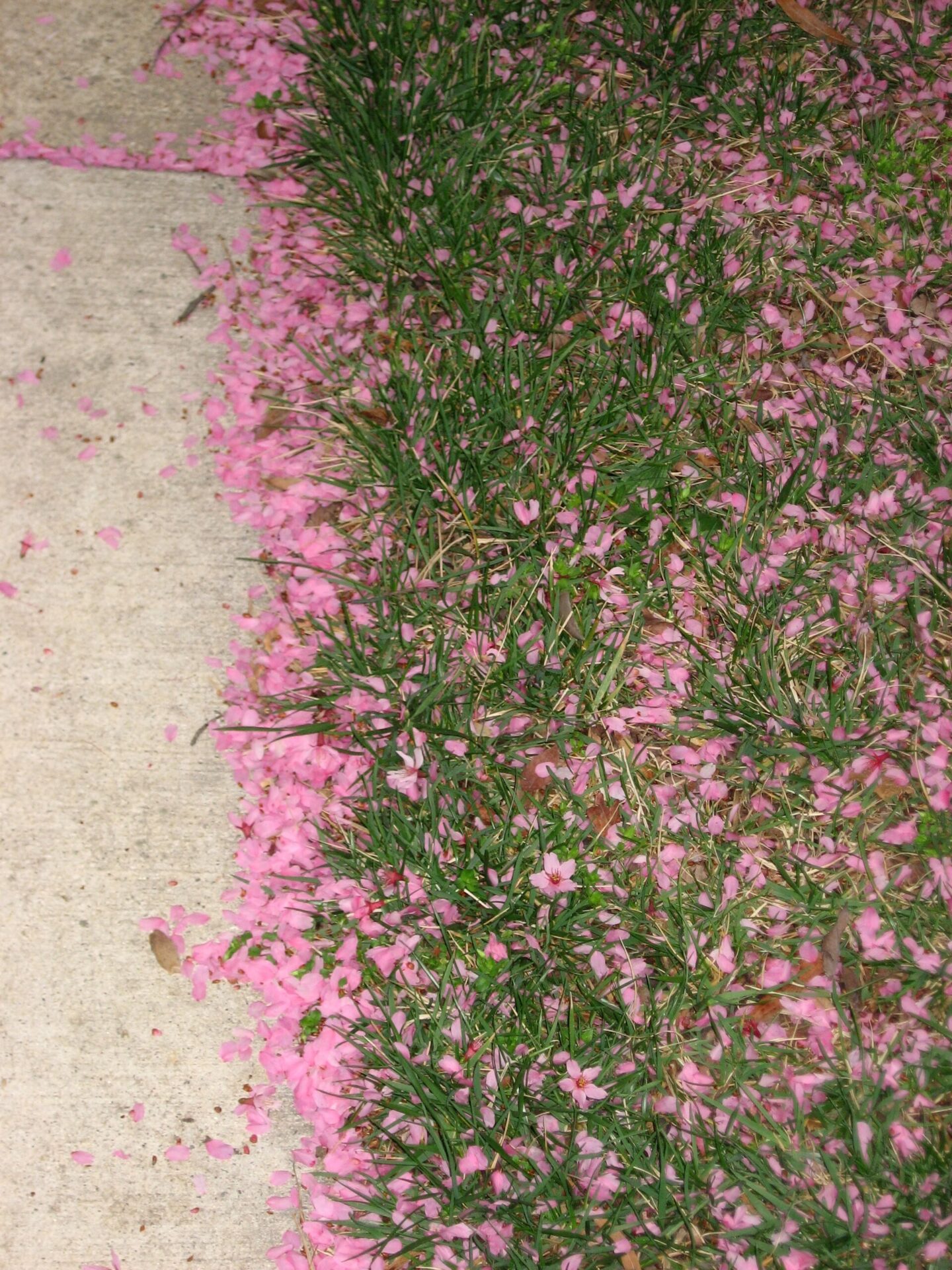
Photo · Cherry Blossom Fall — Mrs. Gemstone, CC BY-SA 2.0, Wikimedia Commons
1,200 years of records, and springs that keep arriving earlier
The fact that cherry blossoms read that year’s spring temperature so faithfully has left an unexpected gift. The cherry full-bloom date has become a natural thermometer telling us how warm that year’s spring was. Kyoto, Japan, holds a record of cherry full-bloom dates reconstructed back to the 9th century (around 812 CE), gathered from flower-viewing entries in the diaries and chronicles of the court, nobles, and monks (reconstructed by Yasuyuki Aono and colleagues). It is one of the longest phenological records in the world. (Note that the trees observed in these old records were of the native yamazakura lineage, distinct from Somei-yoshino, a cultivar of the 19th century onward.)
This 1,200-year time series shows a clear trend of full-bloom dates growing steadily earlier through the 20th century. Rising temperatures from climate change and the urban heat-island effect are cited as the causes. And in 2021, Kyoto’s cherry blossoms recorded the earliest full bloom in roughly 1,200 years of records (March 26) — breaking the previous earliest record of March 27, 1409. A single cherry tree we pass without a thought each spring has, in fact, been writing down a thousand years of climate.
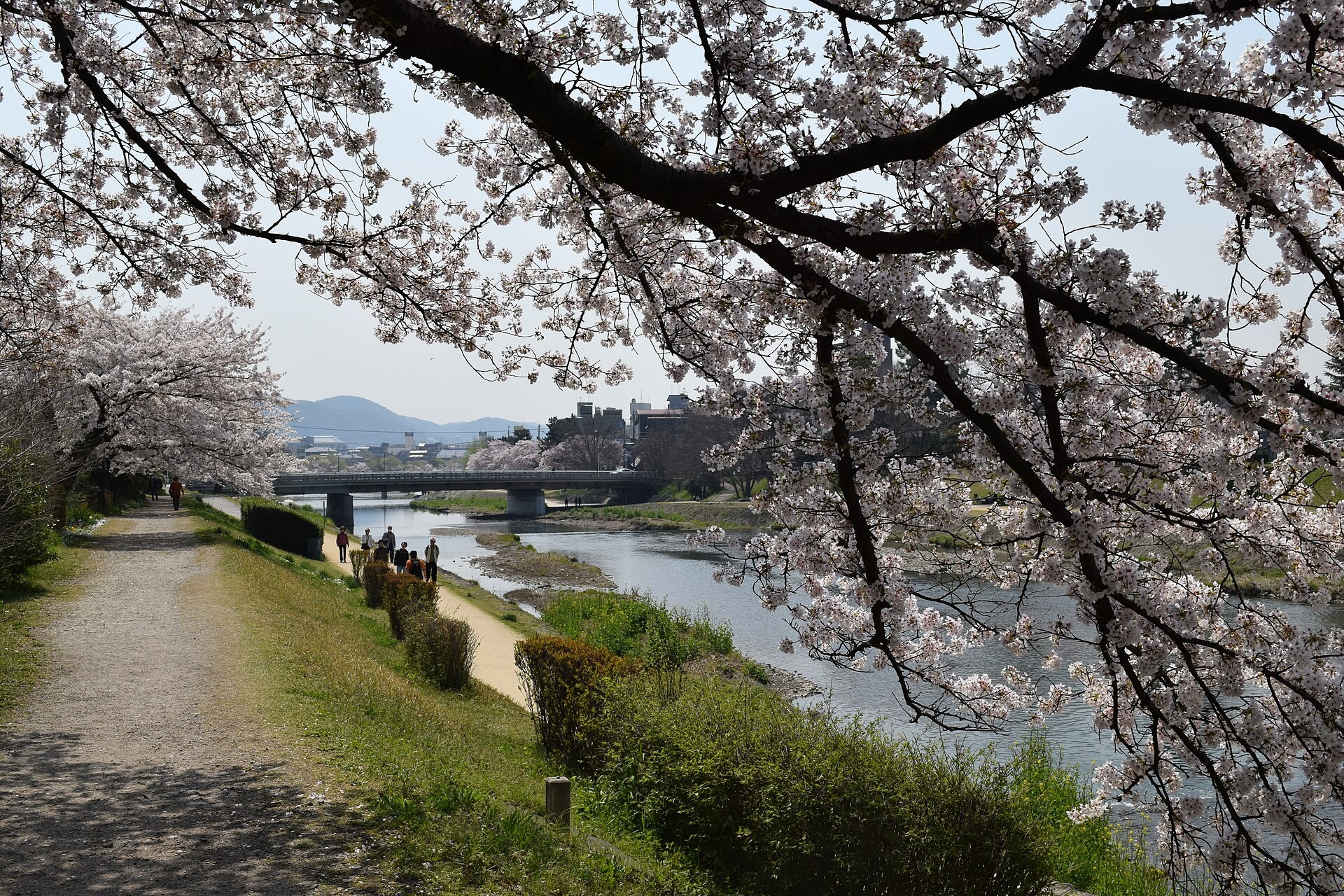
Photo · Cherry blossom in Kyoto (Kamo River) — ::::=UT=::::, CC BY-SA 3.0, Wikimedia Commons
An exquisite design hidden in a familiar spring flower
Inside a single cherry tree we greet so casually each year lies an exquisite temperature calculation that counts the cold of winter and adds up the warmth of spring. The flower buds prepared last summer; the two signals — winter cold to wake the sleep and spring warmth to push the flower; and the synchrony by which every tree, answering the same signal under the same sky, turns a whole city pink within days — all of it is the fruit of a design that had been hidden behind the familiar.
This spring, as you pass beneath the cherry blossoms, pause to consider how precise a calculation these flowers have been running since last winter. The moment you realize that the commonplace scene of a whole street blooming in the same week is in fact the fruit of an uncommon precision, spring will feel that much deeper.
References
- Wikipedia — Cherry blossom (clones of the same cultivar blooming all at once; Kyoto’s earliest full bloom in 2021)
- Wikipedia — Cherry blossom front (the sakura front, the DTS model, the JMA)
- Wikipedia — Prunus × yedoensis (Somei-yoshino as a single clone)
- University of Minnesota Extension — Understanding dormancy and chilling hours
- JIRCAS — Impact of Climate Change on Cherry Blossom Flowering
- PMC — Impact of warmer winters on the flowering display of Tokyo cherry (Somei-yoshino)
- PMC — Flowering (Dormancy) Disorder in Japanese Pear
- U.S. National Park Service — Cherry Blossom Bloom Watch (accumulated temperature / GDD)
- Nippon.com — Measuring the Spread of Spring (the JMA ending its forecasts in 2010)
- National Geographic — The genetic reason cherry blossoms bloom at the same time
- Korea Meteorological Administration — press release on Seoul cherry bloom (standard-tree observation)
- Smithsonian Magazine — 1,200 years of Kyoto cherry full-bloom data (Aono)
- Japan Guide — When do the cherry blossoms bloom? (first bloom, full bloom, petal fall)