
At some point while slicing an onion, your eyes begin to sting and tears well up on their own. People often wave this away as “the smell is just strong,” but what’s actually happening is a very specific chemical reaction driven by two enzymes working in sequence inside the onion’s cells. In the brief moment it takes to cut an ordinary vegetable, ingredients that had been kept apart come together to complete one particular gas molecule.
Ingredients Kept Apart Inside the Cell
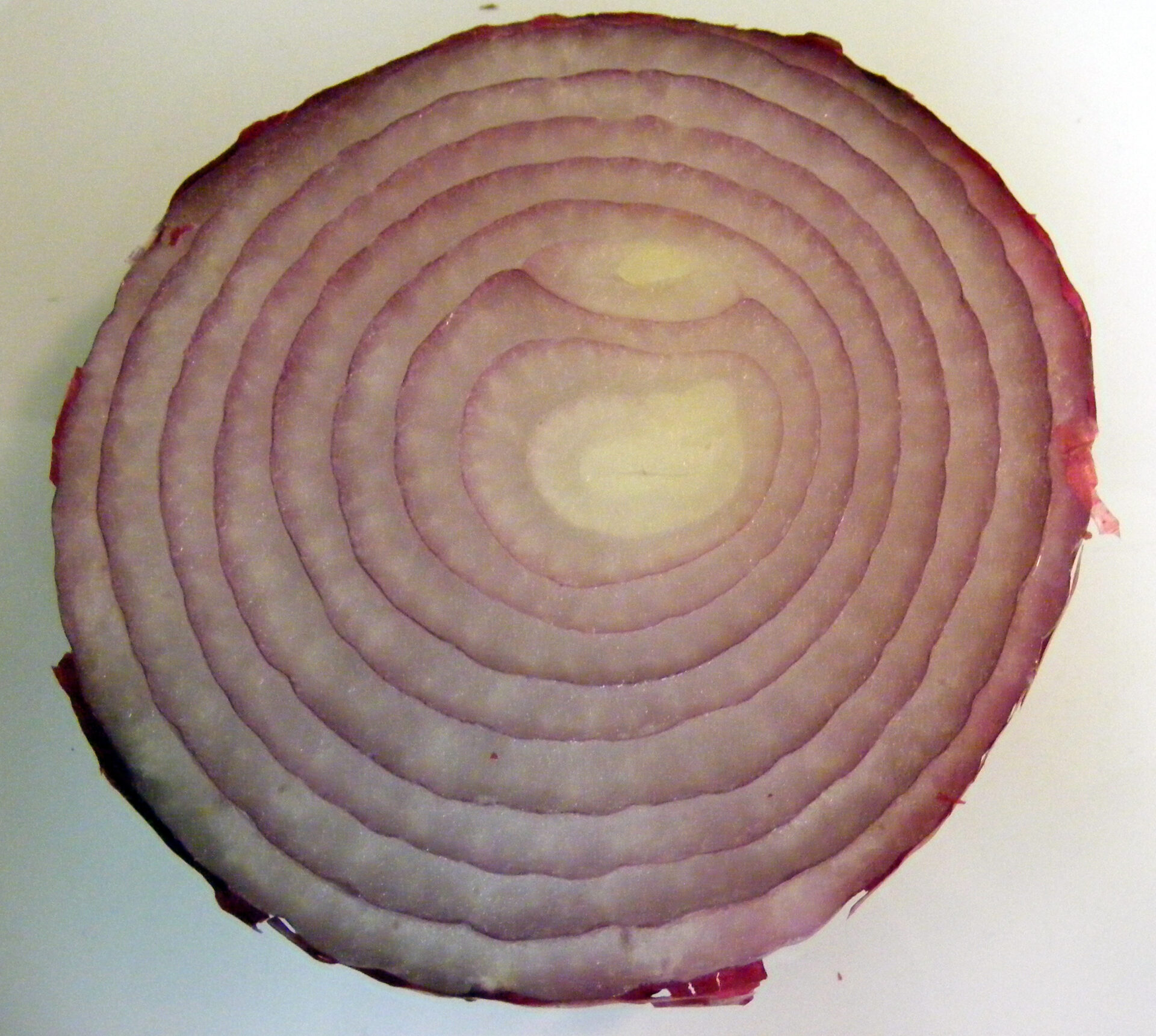
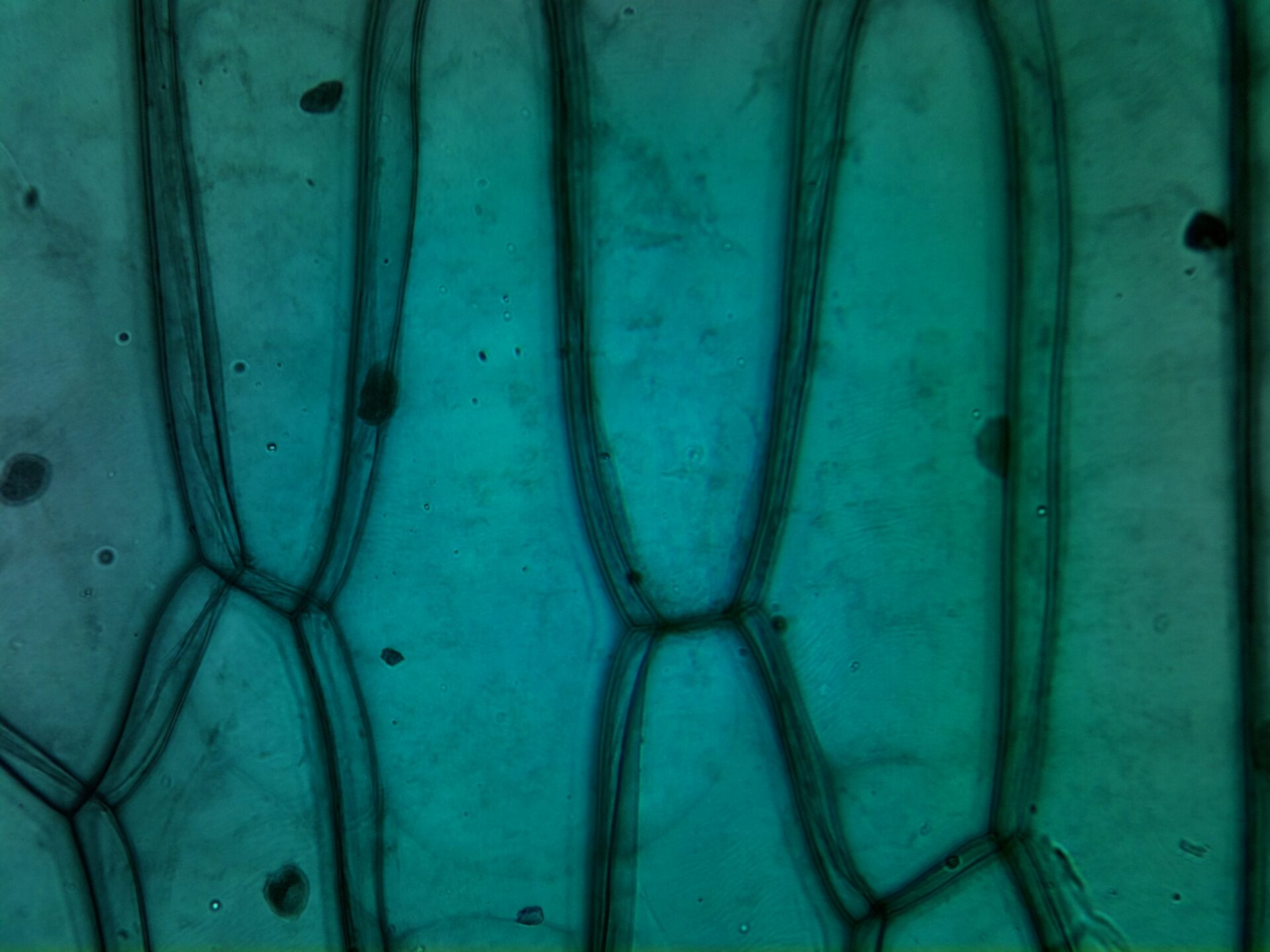
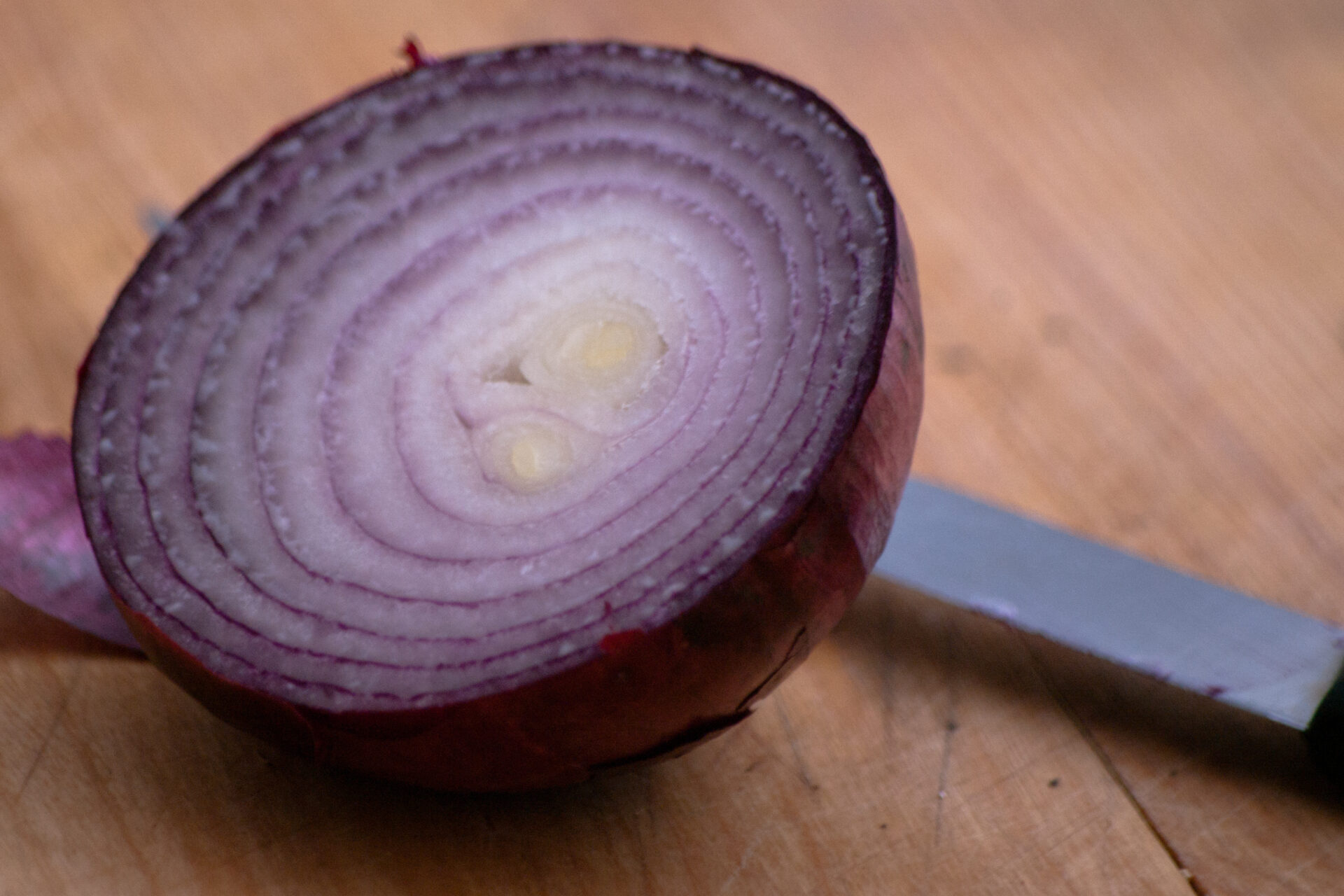
Inside an onion cell, two components are kept in storage, deliberately separated so they never mix. One is the enzyme alliinase, held inside the vacuole, a small storage sac within the cell. The other is isoalliin (1-propenyl-L-cysteine sulfoxide), an amino acid derivative that will serve as this enzyme’s reactant, stored in the cytoplasm outside the vacuole. Until a knife tears through the cell membrane and the vacuole membrane, the two never have any physical chance to meet. Cutting is, in effect, the event that collapses this compartmentalization and mixes both components together at once.
Two Enzymes Working in Relay to Make a Gas
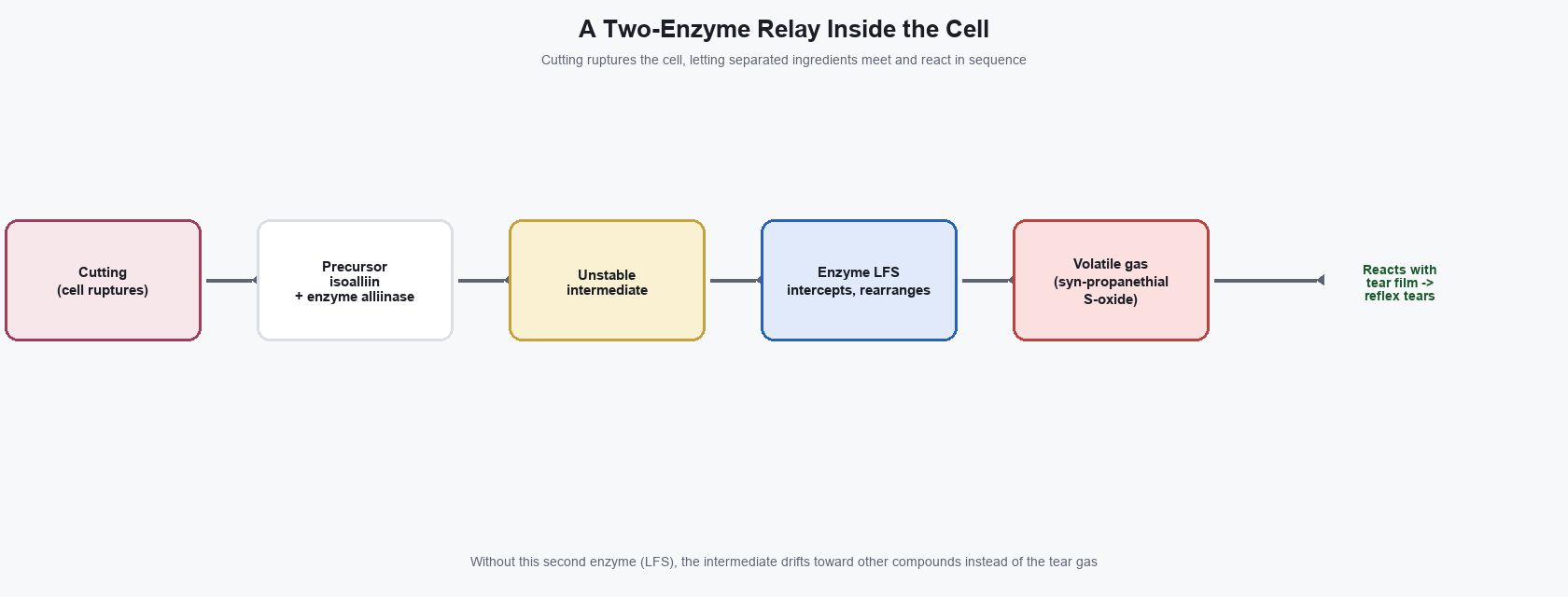
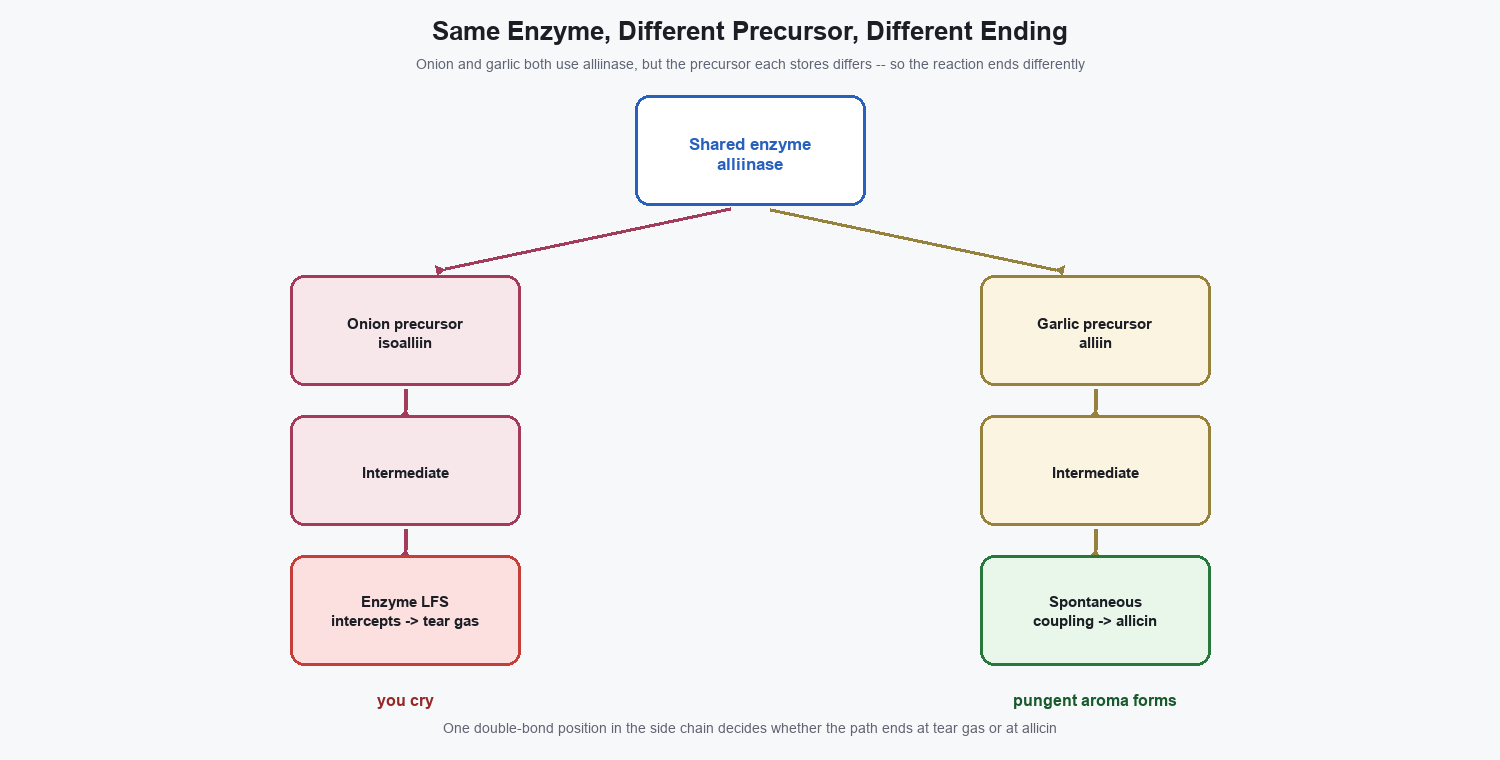
Once the cell is ruptured and alliinase meets isoalliin, the enzyme breaks it down into pyruvate and ammonia, along with a highly unstable intermediate called 1-propenesulfenic acid. This sulfenic acid intermediate is so reactive that it would normally recombine with other molecules on its own, but onions have a separate, second enzyme that intercepts it at precisely this moment. This enzyme, called lachrymatory factor synthase (LFS, EC 5.3.99.12), captures the unstable intermediate and rearranges it into the volatile gas syn-propanethial S-oxide (molecular formula C3H6OS, molecular weight about 90.14 g/mol). The existence of this second enzyme remained a matter of speculation for a long time, until it was experimentally identified and named in a short research letter published by Imai and colleagues of the House Foods Corporation research team in Japan, in Nature, volume 419, issue 6908, page 685 (October 17, 2002). Until then, the tear-inducing gas had been assumed to be simply a natural byproduct of the alliinase reaction, but this study showed that alliinase and isoalliin alone produce almost none of the tear gas — LFS has to be present as well before it is actually formed.
What Happens in the Eye
The volatile gas produced this way spreads through the air and reaches the tear film covering the surface of the eye. According to university chemistry education materials, some of this gas is described as reacting with the moisture in the tear film to form a small amount of sulfuric acid, which then irritates nerve endings in the cornea and triggers burning and reflexive tearing. However, no primary research literature has been found that establishes the exact stoichiometry of this reaction, so it is more accurate to treat this as an explanation at the level of popular science rather than settled chemistry.
Same Family, Fewer Tears: Why Garlic Is Different
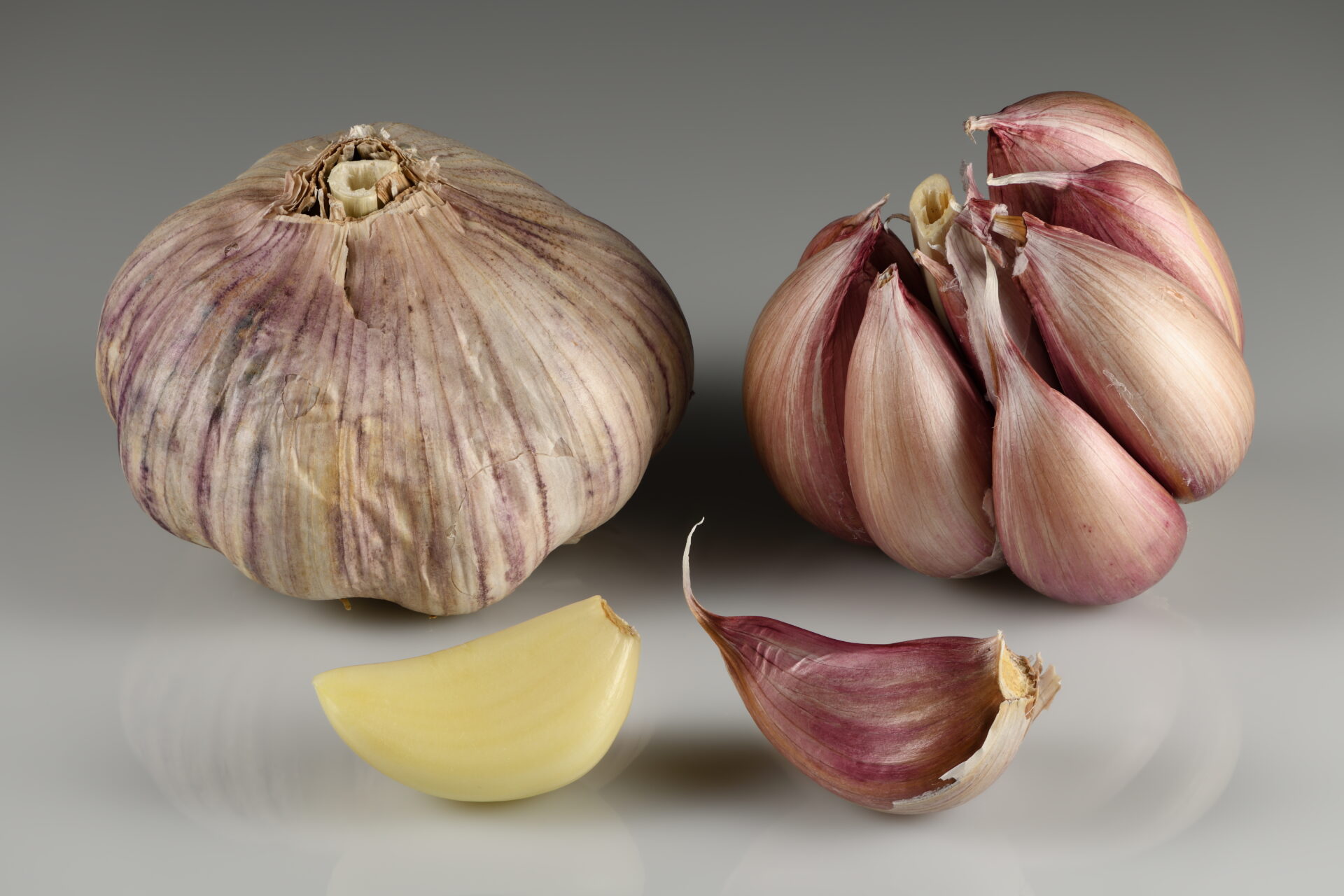
Garlic, too, is a plant in the genus Allium and uses the same alliinase enzyme as the onion, yet cutting garlic doesn’t bring on nearly as many tears. The reason lies in the precursor each vegetable stores. Garlic’s precursor is alliin (2-propenyl-L-cysteine sulfoxide), which differs from the onion’s isoalliin only in the position of a double bond in the side chain. When alliinase breaks down alliin, the intermediate produced this time is 2-propenesulfenic acid — but instead of being intercepted by LFS the way onion’s intermediate is, this one spontaneously combines two molecules together to form allicin, the compound known for garlic’s characteristic aroma and health-related properties. No study has directly proven through experiment that garlic “completely lacks” this enzyme, but several review sources note that, because the reaction in garlic does not proceed down the tear-gas-forming pathway, garlic appears to have little to no such enzymatic activity, or at most a very low level of it.
Reverse-Engineering the Chemistry: Tearless Onions
Once this reaction pathway was worked out, efforts followed to reverse-engineer it into onions that produce fewer tears. Even though the results sound similar, it’s worth distinguishing three separate lineages with different origins. First, between 2007 and 2008, Dr. Colin Eady’s team at Crop & Food Research in New Zealand, working with House Foods Corporation of Japan, used RNA interference (RNAi) technology to silence the LFS gene and produced a laboratory line, which they presented at the International Symposium on Edible Alliaceae. However, field trials reportedly did not go smoothly, and this line has never been commercialized. Second, entirely separately, a Japanese research team used neon ion beam seed irradiation — not genetic modification — to breed a mutant line that produces about 7.5 times less tear-inducing gas than normal onions, publishing the results in Scientific Reports in 2016; this too remains a research-stage approach distinct from the others. Third, the low-irritation variety actually available on the market, “Sunions,” has no connection whatsoever to these genetic-engineering studies. Breeder Rick Watson developed a line with naturally lower production of the tear-inducing compound over roughly 30 years starting in the late 1980s, using nothing but conventional crossbreeding and selection, and it has been sold as an explicitly non-GMO crop since 2018 in the United States and since 2022 in the United Kingdom (Waitrose). On top of this, sweet onions such as Vidalia achieve their mild taste through an entirely different, environmental factor unrelated to breeding or enzymes: low-sulfur soil at the growing site lowers the total amount of sulfur precursor the onion accumulates in the first place. Researchers at the University of Georgia measure this mildness using a pyruvate scale, classifying onions as sweet at 5.0 micromoles or less of pyruvate per gram of fresh weight, and as pungent at 8.0 micromoles or more. Because these are three distinct mechanisms, it is important not to conflate the sweet onions sold in stores with the genetically engineered varieties.
How to Cut Onions With Fewer Tears
Not all of these methods have been verified through rigorous controlled experiments, but the ones repeatedly recommended by outlets like the National Onion Association and various cooking and science media do have a chemical rationale behind them. Refrigerating the onion for about 30 minutes, or freezing it for 10 to 15 minutes, before cutting slows both the enzymatic reaction rate and the rate at which the gas evaporates, thanks to the lower temperature. Using a sharp knife minimizes cell rupture, reducing the amount of enzyme and substrate that end up mixing in the first place. Cutting under running water or on a wet cutting board dilutes the airborne concentration of the released gas by dissolving it in water, and leaving the root end — said to have the highest concentration of sulfur compounds — for last is also introduced as a way to reduce exposure. Turning on a ventilation fan, keeping some distance, or wearing goggles if needed are ways of blocking the pathway by which the gas reaches the eyes in the first place.
This structure — in which precursor and enzyme are stored in separate compartments and the reaction begins only at the very instant the cell is destroyed — looks like a finely engineered defense system. These sulfur compounds are known to serve a defensive function against herbivorous insects and pathogens. The fact that such precisely arranged chemical sophistication is packed into an ordinary vegetable we encounter every day without a second thought invites us to reflect once more on the careful design woven throughout creation.
References
- Nature — Imai et al. 2002, "An onion enzyme that makes the eyes water"
- Journal of Experimental Botany — "Biosynthesis of the flavour precursors of onion and garlic"
- University of Bristol, School of Chemistry — Molecule of the Month: Propanethial S-oxide
- The Conversation — Duane Mellor (Aston University), "Why onions make us cry"
- ScienceDaily — "Tearless Onion Created In Lab Using Gene Silencing" (2008)
- Nature, Scientific Reports (2016) — Neon ion beam tearless onion study
- Genetic Literacy Project — Report on the non-GMO breeding history of Sunions
- University of Georgia, CAES Field Report — Sulfur content of Vidalia onion soil
- National Onion Association — Tips for reducing tears
- Nwachukwu, Slusarenko & Gruhlke (2012), Natural Product Communications — "Sulfur and Sulfur Compounds in Plant Defence"
- Wikipedia — syn-Propanethial-S-oxide
- ExPASy ENZYME Database — EC 5.3.99.12
- Wikipedia — Pyruvate scale