
In 1871, the Russian chemist Dmitri Mendeleev left blank spaces in his table for elements that had not yet been discovered, and next to each gap he wrote down specific numbers — atomic weight, density, even the properties of its oxide. A few years later, elements that would come to fill those gaps were indeed discovered, and the measured values for what would later be called gallium, scandium, and germanium turned out to be remarkably close to the figures he had written down in advance. How could anyone know the weight of a substance that did not yet exist in the world?
A Pattern Emerges When Elements Are Lined Up
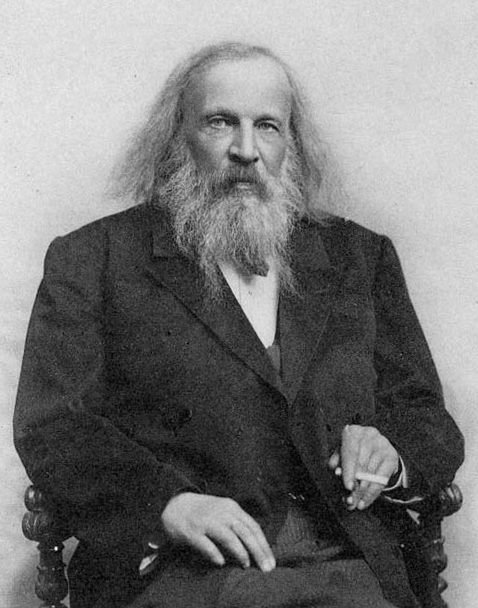
By the mid-19th century, chemists had identified around 60 elements. When these were arranged in order of atomic weight, a recurring pattern of properties appeared at regular intervals — a regularity first pointed out between 1817 and 1829 by the German chemist Johann Wolfgang Döbereiner, who identified ‘triads’ such as calcium, strontium, and barium, whose atomic weights formed a middle value among the three. Mendeleev is well known for the anecdote that he made cards listing each element’s name, atomic weight, and properties, and tested arrangements of them on his desk. But the more dramatic version of the story — that he saw the completed table in a dream and wrote it down upon waking — traces back to a secondhand account recalled by a colleague after his death, and it has been suggested that this later embellishment may have grown out of that retelling.
Not Mendeleev’s Discovery Alone
Mendeleev was not the first to notice the periodicity of the elements. In 1862, the French geologist Alexandre-Émile Béguyer de Chancourtois was the first to visualize this periodicity, arranging the elements in a spiral around a cylinder he called the ‘telluric helix’ (vis tellurique) — but because it was published in a journal oriented toward earth science and its key diagram was omitted in printing, it went almost unnoticed among chemists of the time. In 1865, the British chemist John Newlands published his ‘Law of Octaves,’ observing that properties recurred every eighth element when arranged by atomic weight. He presented it to the Chemical Society of London in 1866 as well, but the society refused to publish the paper, and he is said to have even been mocked with the suggestion that he try arranging the elements alphabetically instead. It was not until 21 years later, in 1887, that Newlands finally received belated recognition with the Royal Society’s Davy Medal.
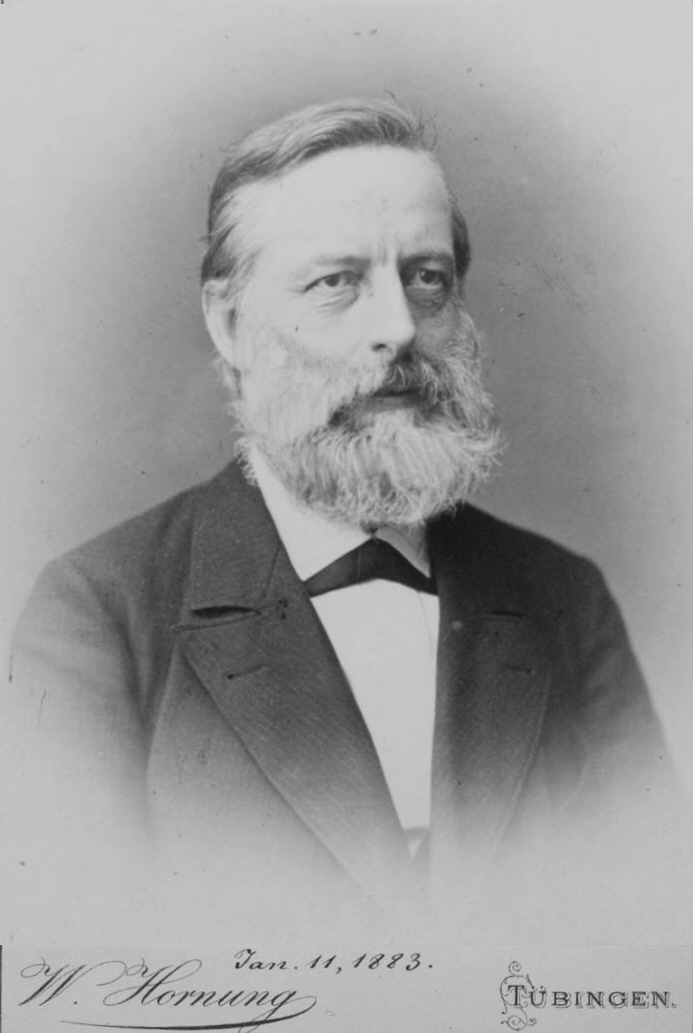
Mendeleev’s closest rival was the German chemist Lothar Meyer. Meyer included a partial table of 28 elements in a book he published in 1864, and in 1870 he published a highly refined table based on a graph of atomic weight against atomic volume.
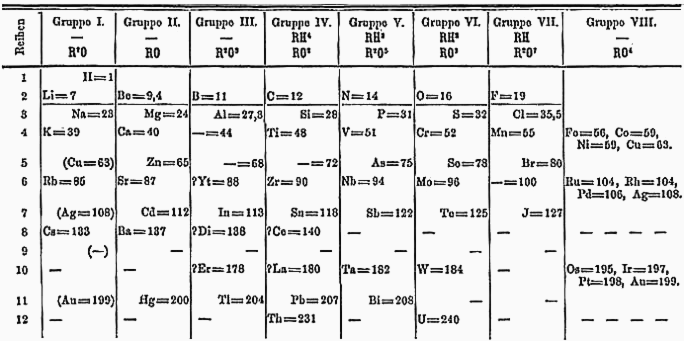
This was, however, after Mendeleev had completed his table on February 17, 1869 (Old Style), and his colleague Nikolai Menshutkin had read the paper on his behalf to the Russian Chemical Society on March 6 (Old Style). Meyer later recalled that he had been preparing a similar table since around 1868, but he never disputed Mendeleev’s priority, and in 1882 the Royal Society awarded the Davy Medal jointly to both men. The decisive difference was that Meyer did not go so far as to predict the specific properties of undiscovered elements — he is said to have later reflected that he had lacked the ‘courage’ to do so. Mendeleev is often called ‘the man who discovered the periodic table,’ but more precisely, he was not the first to notice the periodicity of the elements — he was the first to systematically leave gaps and predict their properties with specific numbers.
The Weight Written Into the Blank Spaces
This is where Mendeleev’s table stood apart. When he lined up the elements by atomic weight and a chemical property did not match its neighbors, rather than forcing it to fit, he left the space blank — and, based on the properties of the elements above, below, and beside it, he filled in specific numbers for its atomic weight and density, and even the properties of its oxide and chloride. Using the Sanskrit prefix ‘eka-,’ meaning ‘one,’ he named these gaps eka-aluminium, eka-boron, and eka-silicon.
In 1875, the French chemist Paul-Émile Lecoq de Boisbaudran discovered a new element in a zinc ore from the Pyrenees and named it gallium, after ‘Gallia,’ the Latin name for his homeland. It was eka-aluminium. The density he first measured, 4.7 g/cm³, differed sharply from the predicted value of about 6.0 g/cm³, but the story goes that impurities were suspected to have been present, and after re-purification the measured value of 5.9 g/cm³ came much closer to the prediction — though this episode survives only through later secondhand accounts, with no original document to confirm it. In 1879, the Swedish chemist Lars Fredrik Nilson discovered scandium (eka-boron) in a rare-earth mineral, and its measured atomic weight of about 44.96 nearly matched the predicted value of 44.
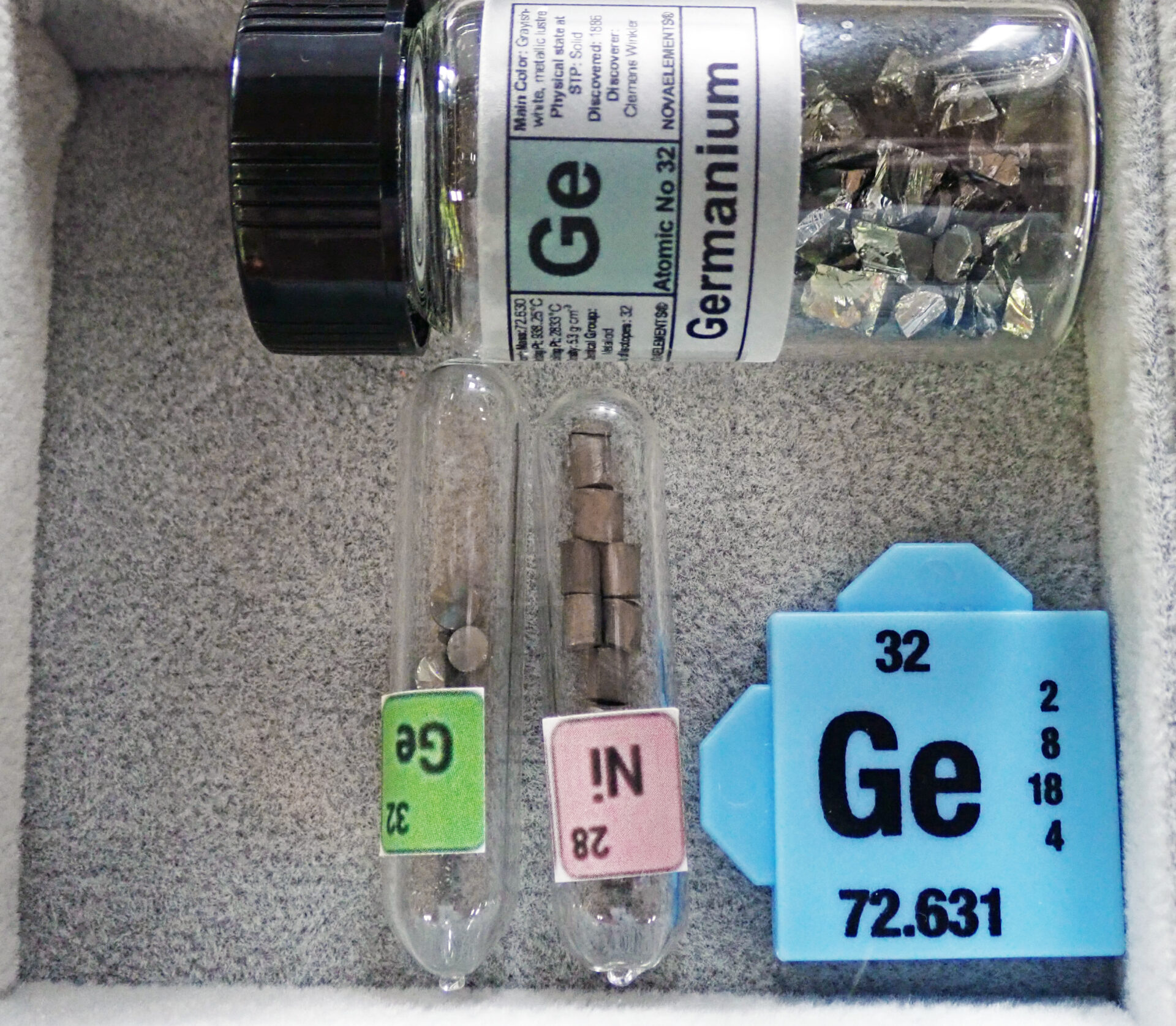
The most dramatic case is germanium (eka-silicon), discovered in 1886 by the German chemist Clemens Winkler in the silver ore argyrodite. Placing the predicted and measured values side by side, the precision is striking.
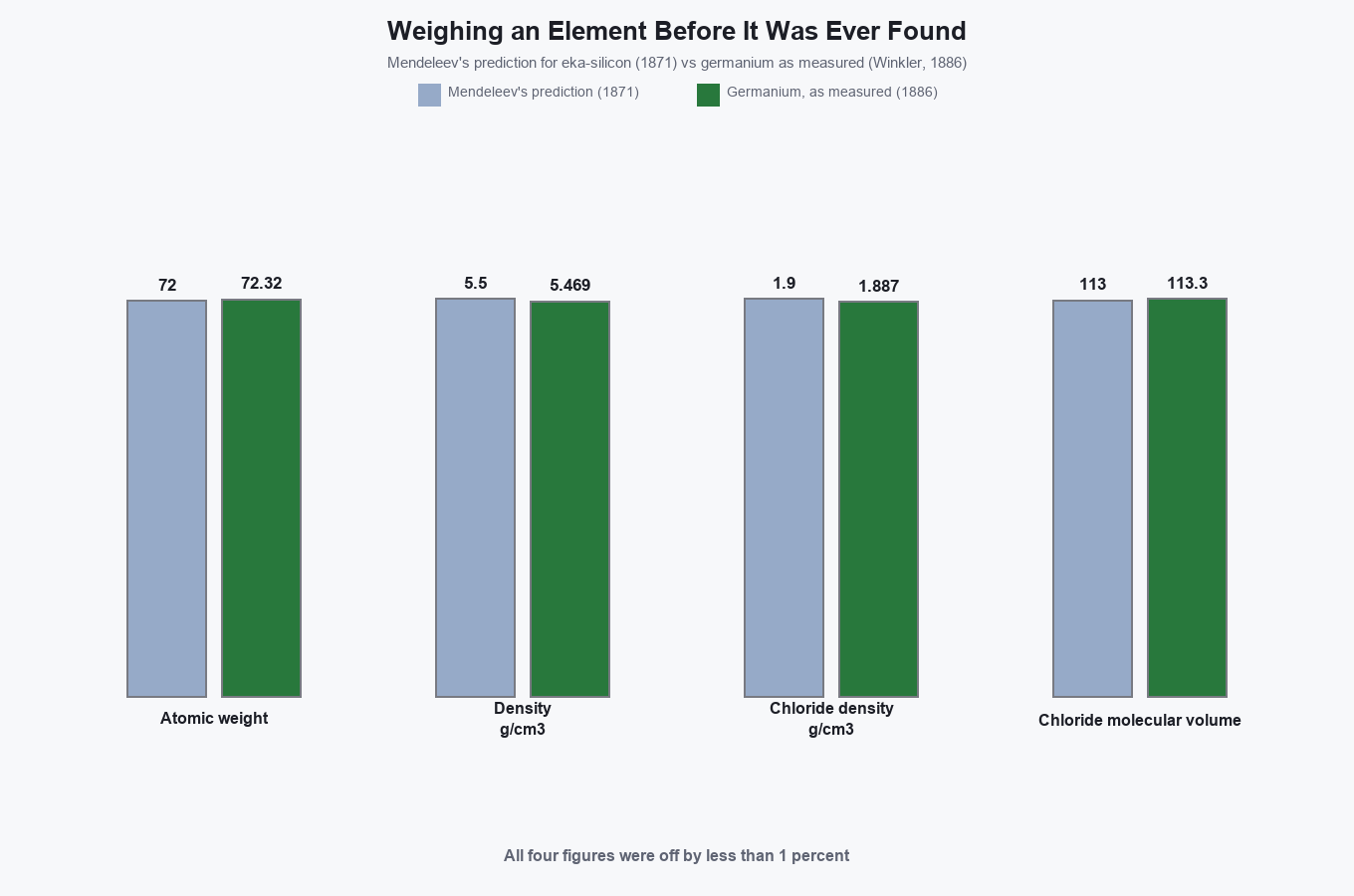
The atomic weight was predicted at 72 against a measured 72.32 (modern value 72.63); density was predicted at about 5.5 against a measured 5.469 g/cm³; the density of its tetrachloride was predicted at about 1.9 against a measured 1.887 g/cm³; and its molecular volume was predicted at 113 against a measured 113.3 — an almost exact match on every count. Even its qualitative properties matched the prediction: a highly refractory, weakly basic oxide. This precise agreement became the decisive moment that turned a skeptical chemistry community into near-unanimous supporters.
Not All the Predictions Held Up
But not all of Mendeleev’s predictions held up. The 1904 edition of his table still reserved a place for ‘coronium,’ meant to explain an unidentified green line in the spectrum of the solar corona (observed during a total eclipse in 1869), as well as a place for an ultra-light element corresponding to the luminiferous ether. Coronium’s true identity was revealed in the 1930s, when Walter Grotrian and Bengt Edlén showed that the line came from thirteen-times-ionized iron (Fe XIV); and ‘nebulium,’ once thought to be a new element observed in nebulae, was likewise shown not to exist when Ira Sprague Bowen identified it in 1927 as a signal from ionized oxygen. There were also several predictions, such as eka-manganese (technetium, not confirmed until its artificial synthesis in 1937), that took far longer to verify or were nowhere near as precise as those for gallium, scandium, and germanium, and Mendeleev’s failure to properly anticipate the placement of the lanthanides is counted as another limitation. Even so, the general assessment among historians of science is that, on balance, his successful predictions outweighed his failures.
The Trap of Atomic Weight, and Moseley’s Answer
Mendeleev’s table held another puzzle. He had made ordering by atomic weight his guiding principle, but whenever chemical properties conflicted with that order, he gave properties priority. The prime example is tellurium and iodine. At the time, tellurium’s atomic weight was measured at about 128 and iodine’s at about 127, making iodine the lighter of the two — yet placing tellurium, with its oxygen-family properties, and iodine, with its halogen-family properties, in their correct groups meant arranging them in reverse order of atomic weight.

He merely guessed that this reversal was due to measurement error, without being able to explain its underlying cause, and similar reversals were later confirmed between argon and potassium, and between cobalt and nickel.
This puzzle was solved 44 years later, in 1913, by the British physicist Henry Moseley.
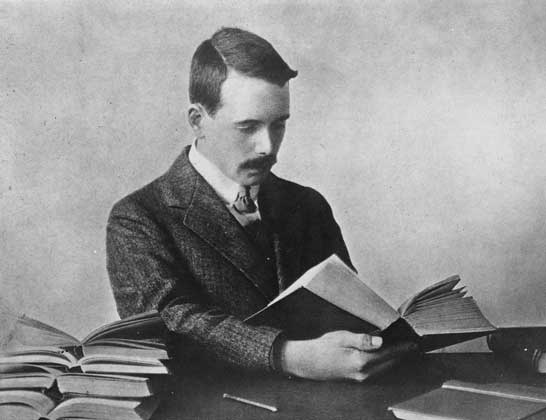
Moseley discovered that the square root of an element’s characteristic X-ray frequency is proportional not to its atomic weight but precisely to its atomic number — its nuclear charge. This naturally explained why tellurium (atomic number 52) belongs before iodine (53), and established atomic number as the true basis of the periodic law. Mendeleev had intuited the correct order but never knew why; it was Moseley, decades later, who worked out the physical reason.
The blank spaces Mendeleev left, and the numbers he wrote beside them, showed that even an element not yet in hand follows properties that are not a matter of chance but of predictable rule. Woven through the elements was an intricate physical order — atomic number. That the weight of a substance unseen in the world could be reckoned in advance shows that an intricate regularity, real within nature, was simply waiting for human observation and reasoning to find it.
References
- Wikipedia: Mendeleev's predicted elements
- Wikipedia: History of the periodic table
- Royal Society of Chemistry: Development of the periodic table
- C&EN (ACS): Periodic table turns 150 in 2019
- Springer, Foundations of Chemistry: Mendeleev's predictions — success and failure
- OUP Blog: Mendeleev's Periodic Table presented in public
- NIST: Henry Moseley and the Periodic Table of the Elements
- Wikipedia: Coronium
- Science History Institute: Julius Lothar Meyer and Dmitri Ivanovich Mendeleev
- Wikipedia: John Newlands (chemist)
- Wikipedia: Nebulium