
Almost every substance contracts as it cools and, once it solidifies, packs more tightly and sinks in its own liquid. Metals do, oils do, alcohols do. Water is different. Water expands when it freezes, and solid ice floats on liquid water. Without this strange property, the lakes and rivers of Earth would freeze solid from the bottom up every winter, leaving an environment in which aquatic life could barely survive. This article examines, as two distinct phenomena, why water expands when it freezes and how this makes it possible for life to get through winter.
First, separate the two phenomena
Water’s odd behavior is often lumped into a single story, but it is in fact a combination of two separate phenomena. Confusing the two makes the underlying principle impossible to grasp.
Phenomenon A — maximum density at 4°C (an anomaly within the liquid): Liquid water is densest at 4°C (more precisely, about 3.98°C). Above or below that, its density falls. In other words, water at 4°C is the heaviest.
Phenomenon B — volume expansion on freezing (the liquid-to-solid transition): When water freezes into solid ice at 0°C, its volume increases by about 9%. Conversely its density falls by about 8.3%, to 0.9167 g/cm³ (liquid water at 0°C has a density of 0.9998 g/cm³). That is why ice is lighter than water and floats on the surface.
※ The 9% volume increase and the 8.3% density decrease are different numbers because they have different denominators. The volume expansion is measured against the smaller quantity (the liquid’s volume), while the density decrease is measured against the larger quantity (the liquid’s density), so the figures come out differently.
These two phenomena have different causes and different mechanisms. But in the way a lake survives winter, the two work together. Let us first dig into each principle.
Xhmikos · CC0 · Wikimedia Commons · Source
Phenomenon A: why is density greatest at 4°C?
An ordinary liquid grows denser in a steady way as it cools: molecular motion slows and the molecules draw closer together. Between 100°C and 4°C, water follows this normal rule — the colder it gets, the denser it becomes.
But below 4°C this rule breaks down. In the 0–4°C range, the density actually decreases as the temperature falls further. In this range water shows negative thermal expansion: it expands as it cools.
Why? Here two effects compete.
Effect ①: normal thermal contraction — as the temperature drops, molecular kinetic energy decreases and the molecules pull closer together, tending to raise the density. This is the dominant effect above 4°C.
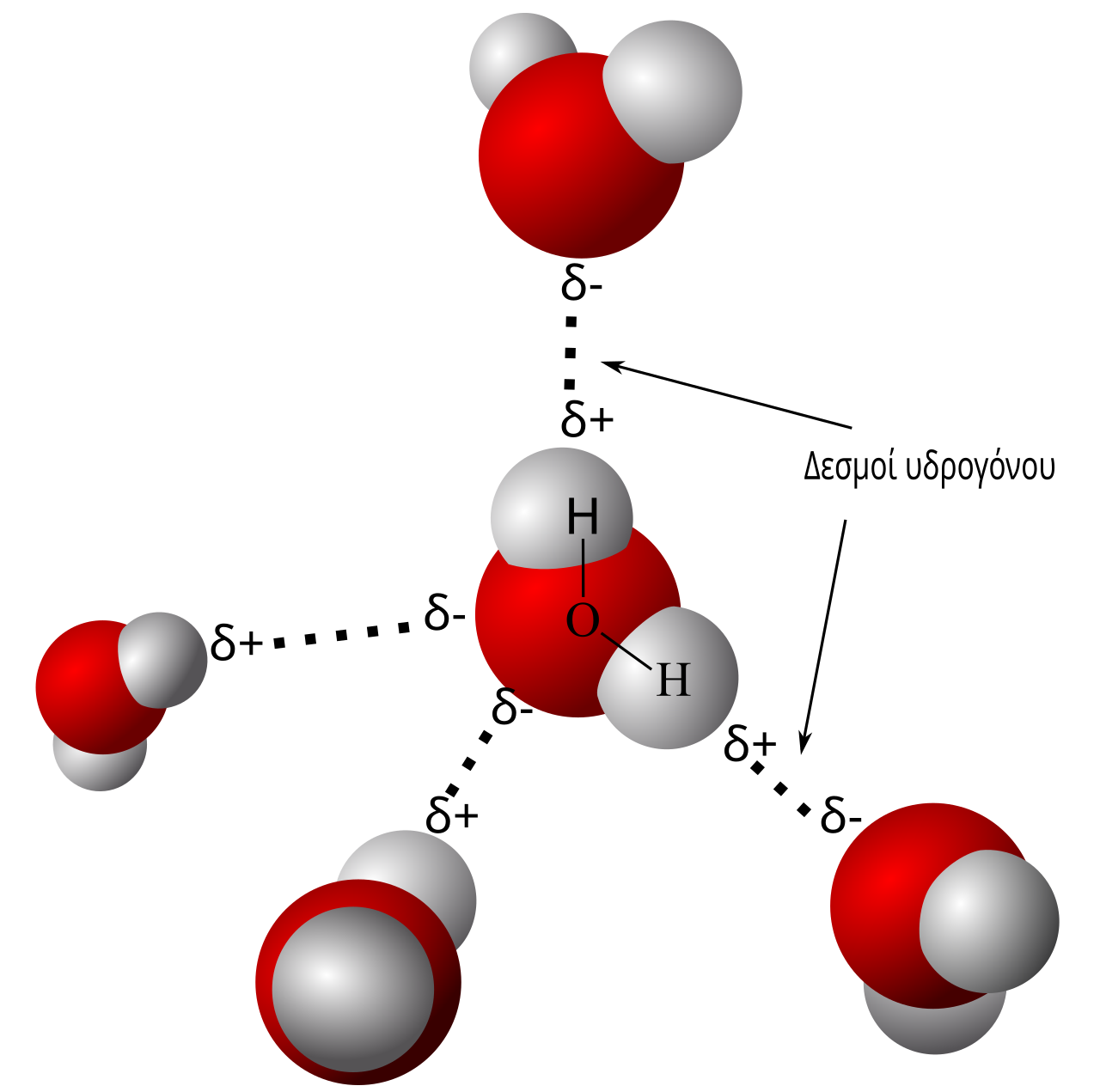
Effect ②: formation of an open tetrahedral hydrogen-bonded structure — a water molecule (H₂O) can form up to four hydrogen bonds with its neighbors. The H–O–H bond angle is about 104.5°, slightly bent from a perfect tetrahedron (109.5°) but still strongly directional. As the temperature falls toward 0°C, these hydrogen bonds increasingly organize the molecules into an orderly tetrahedral arrangement. This arrangement is an open structure resembling the hexagonal lattice of ice Ih, and it actually takes up more space than a random arrangement. The result is that the volume increases and the density decreases.
The point where these two effects balance is precisely about 3.98°C. Above this temperature effect ① dominates, so the density rises as it cools; below it effect ② dominates, so the density falls as it cools. This “mountain-shaped” density–temperature curve, peaking at 3.98°C, visually sums up water’s strange behavior. According to the IAPWS-95 international standard the maximum density is 0.999975 g/cm³ (about 999.98 kg/m³), and the precise measurement by Tanaka et al. (2001) fixed the density at 3.983035°C as 0.99997495 g/mL.
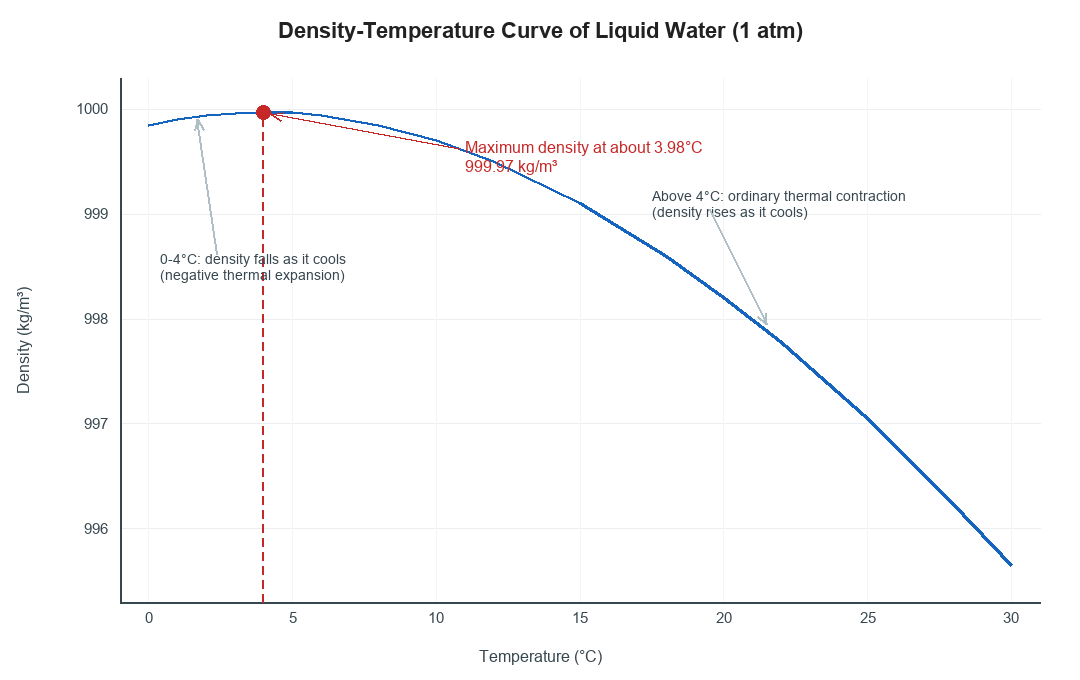
Diagram · created by glu.kr
Phenomenon B: ice’s hexagonal lattice and the 9% expansion
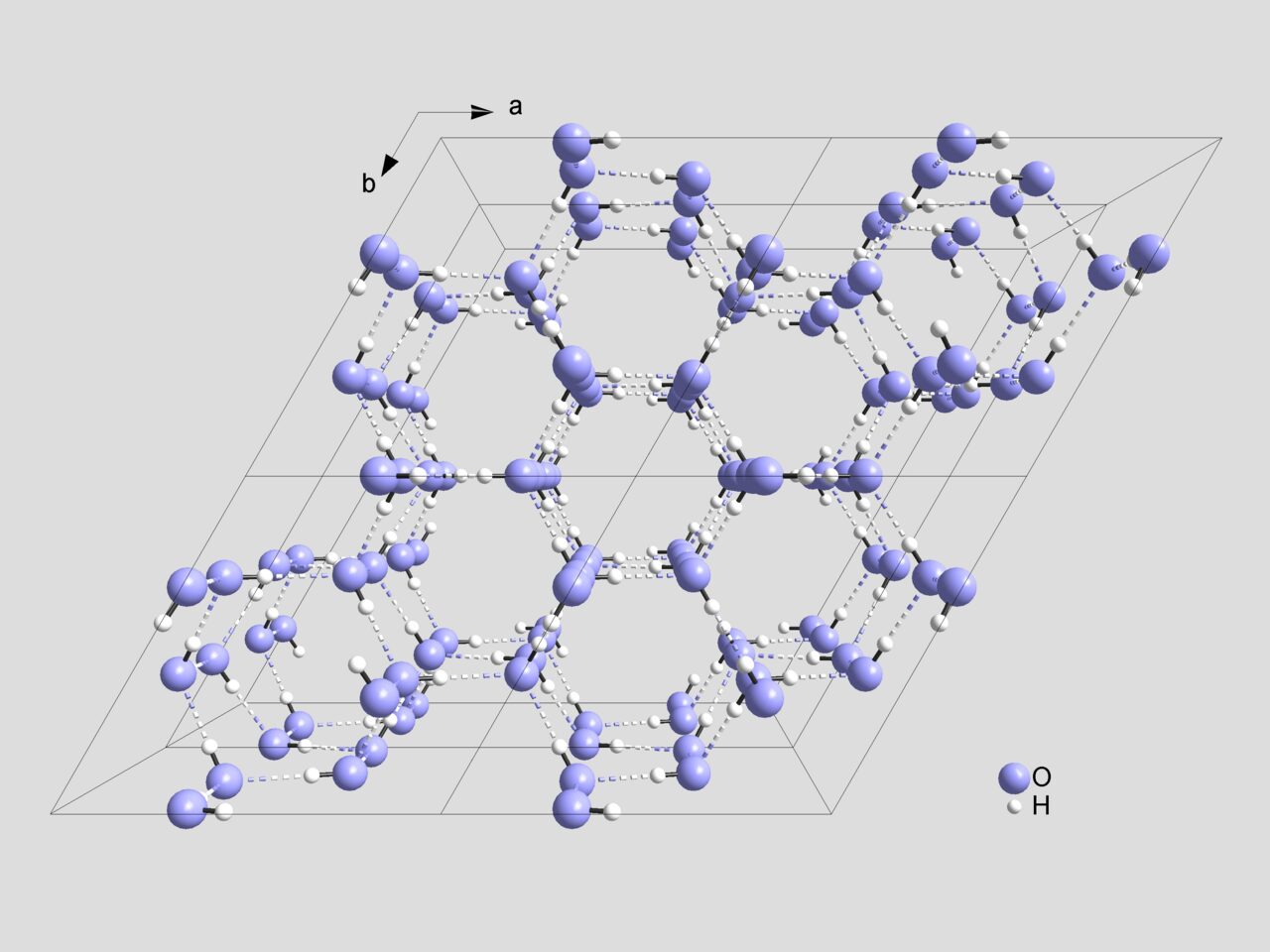
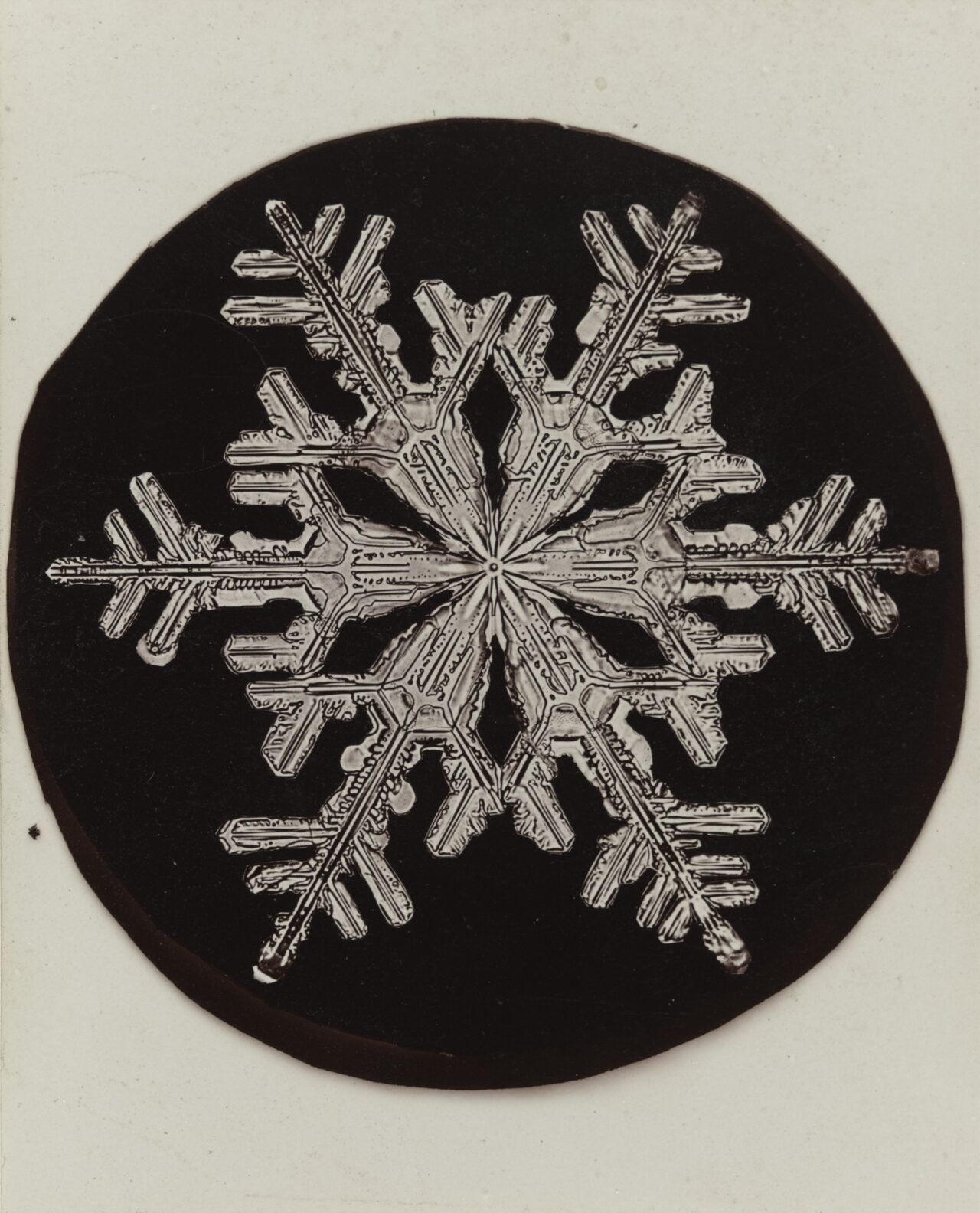
When water freezes into ice Ih at 0°C, hydrogen bonds lock every molecule into fully tetrahedral directions, forming a hexagonal open lattice. The oxygen atoms sit at the vertices of puckered hexagonal rings, and the packing efficiency of this arrangement is only about one-third — less than half that of the most tightly packed metal crystals (face-centered cubic, about 74%). The rest is left as empty space.
Because of this open structure, the density of ice falls to about 0.917 g/cm³ (at 0°C; the value cited by NIST and Wikipedia is 0.9167–0.9168 g/cm³). Compared with liquid water at the same temperature (0°C), whose density is 0.9998 g/cm³, the moment it freezes the volume increases by about 9% and the density decreases by about 8.3%.
Solid State · CC BY-SA 3.0 · Wikimedia Commons · Source
Here one misconception needs correcting. It is not true that “only water expands when it freezes.” Bismuth (+3.32%), gallium (+3.10%), germanium (about 6%), and silicon (about 10.3%) also expand in volume on solidifying. All are substances in which strong directional bonds (hydrogen bonds or covalent-bond networks) build an open crystal structure. What makes water’s freezing expansion special is not that the phenomenon is rare, but that water, the solvent of life, is everywhere on Earth.
Wilson Bentley · Public domain · Wikimedia Commons · Source
Why a lake freezes from the top down: A and B cooperate
Now let us see how the two phenomena work together. As autumn deepens and the air cools, the temperature of a lake’s surface water also drops. When the surface water reaches 4°C its density becomes greatest and it grows heavy, so it sinks toward the lake bottom. This is called the fall turnover. In this process oxygen-rich water is mixed evenly throughout the water body.
As the surface water cools below 4°C, phenomenon A (the density maximum) comes into play. In the 0–4°C range water grows less dense as it cools, so water colder than 4°C is lighter than 4°C water and stays at the surface. The water deep in the lake remains isothermal at 4°C and cools no further.
Then phenomenon B (expansion on freezing) takes over. When the surface water reaches 0°C and turns to ice, its density drops sharply to 0.917 g/cm³ and it floats on the surface. The ice layer does not merely float; it becomes an insulator that keeps the water below from cooling further. When snow piles on top, the insulating effect grows stronger still.
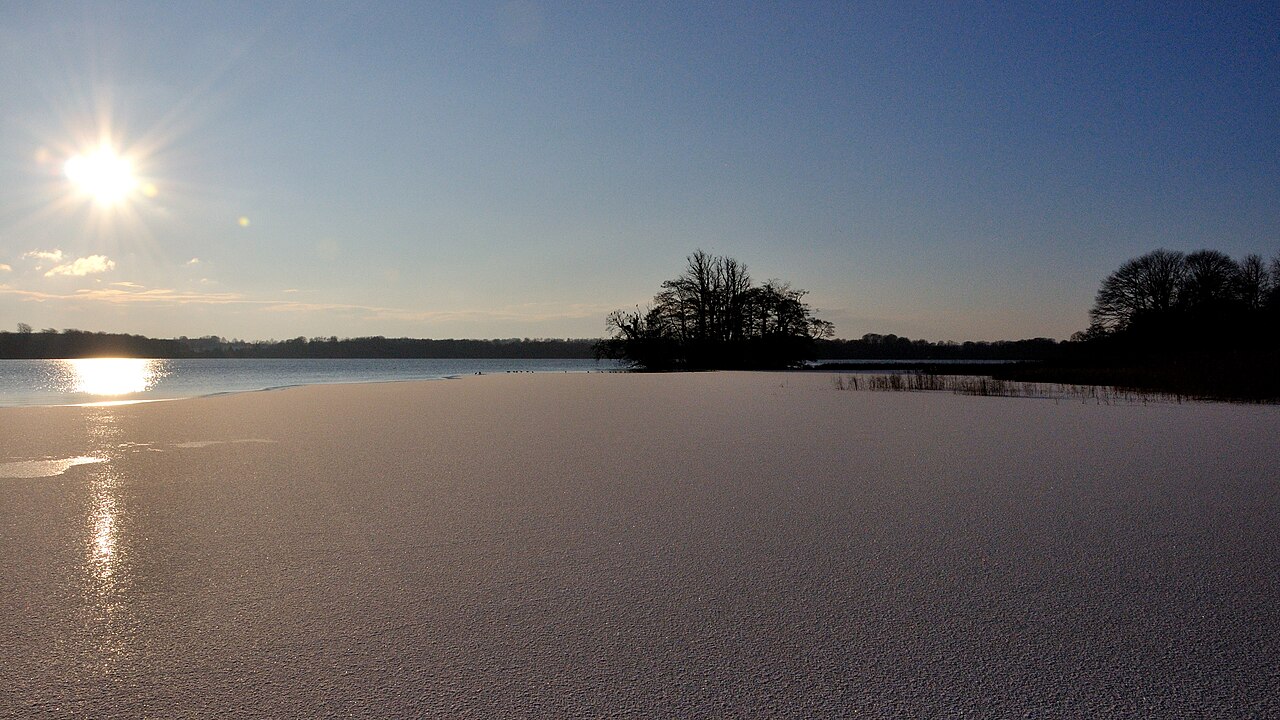
Martin Nikolaj Christensen from Sorø, Denmark · CC BY 2.0 · Wikimedia Commons · Source
As a result, even in a harsh winter when the air drops to tens of degrees below zero, the region near the bottom of a deep lake stays at about 4°C. Fish gather in this (relatively) warm bottom layer and wait for spring in a state of winter torpor, slowing their heart rate, breathing, and metabolism. Phytoplankton leave resting spores, and zooplankton leave dormant eggs in the sediment. The oxygen redistributed during the fall turnover also helps them survive.
That said, while the buoyancy of ice is clearly one of the key reasons aquatic life survives winter, it is not the only one. Water’s specific heat (about four times that of air) buffers sudden changes in water temperature, and the latent heat of fusion (334 J/g) makes freezing require an enormous amount of energy, delaying how long it takes to freeze. Only when these four properties — ① the buoyancy of ice, ② the density maximum at 4°C, ③ high specific heat, and ④ a large latent heat of fusion — work together does winter survival for life become possible.
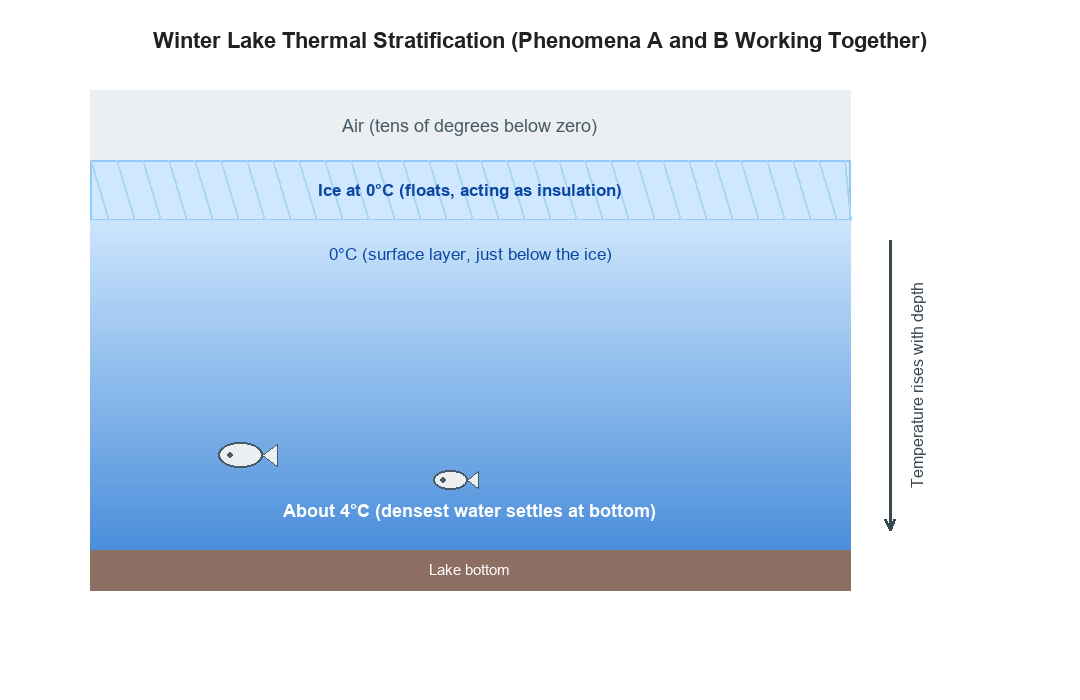
Diagram · created by glu.kr
Evidence visible in everyday life
Water’s expansion is not purely beneficial. A burst water pipe in winter is the most painful everyday evidence of phenomenon B. When the water in a pipe freezes, its volume increases by about 9%; in particular, once ice blocks the pipe, pressure of hundreds of atmospheres (thousands of psi) builds up in the liquid trapped behind it, exceeding the bursting limit of most metal pipes.
Water that seeps into cracks in rock also widens those cracks by repeatedly freezing and expanding. This frost weathering piles broken rock fragments (scree) on mountain slopes and opens potholes in roads. Frost heaving, in which the ground freezes and rises by tens of centimeters, works on the same principle.
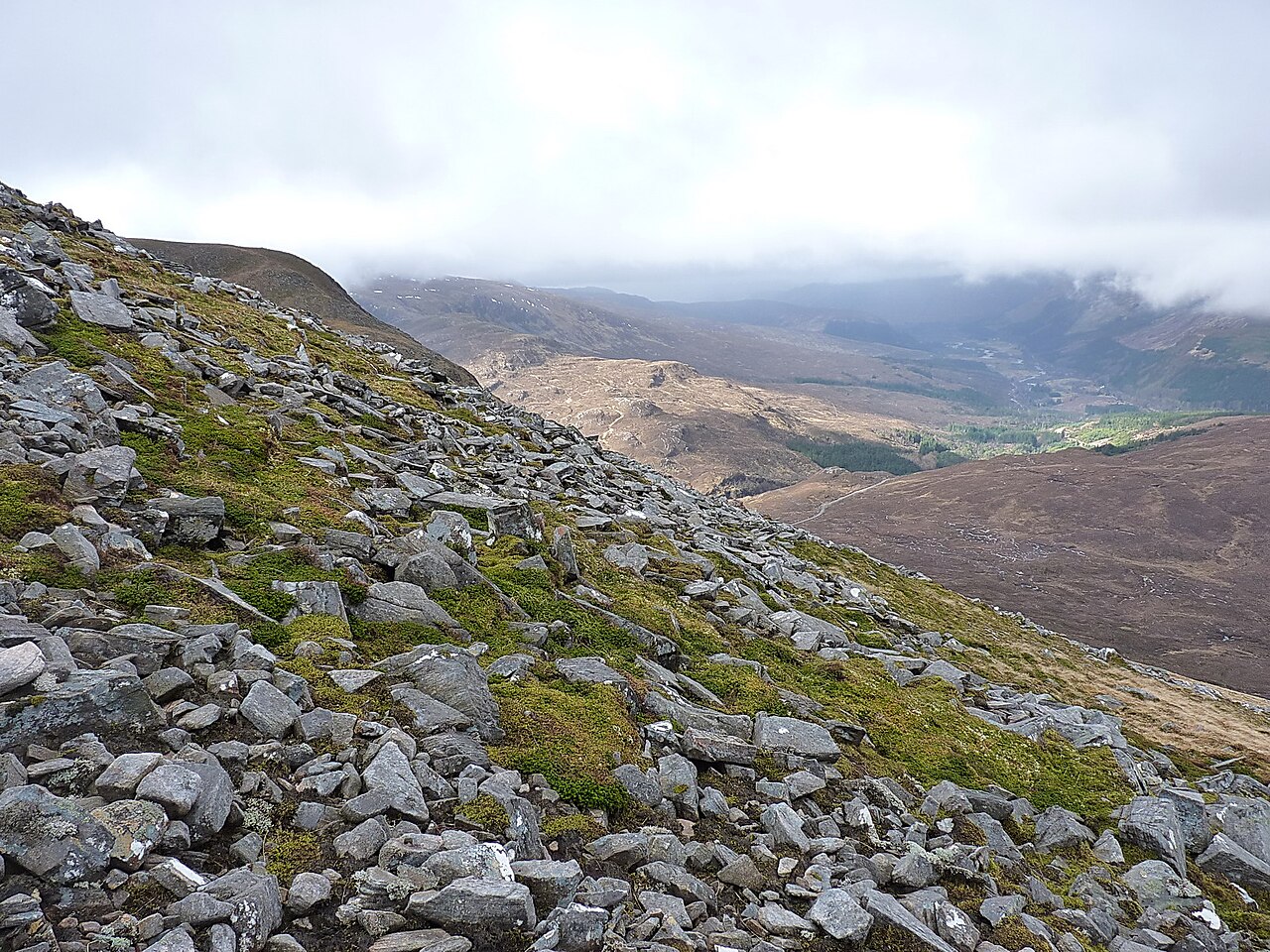
Richard Law · CC BY-SA 2.0 · Wikimedia Commons · Source
At sea, icebergs display phenomenon B on a grand scale. From the ratio of the density of ice (0.917 g/cm³) to that of seawater (about 1.025 g/cm³), only about 10% of an iceberg shows above the surface while about 90% lies submerged. What the Titanic struck was the invisible 90%.
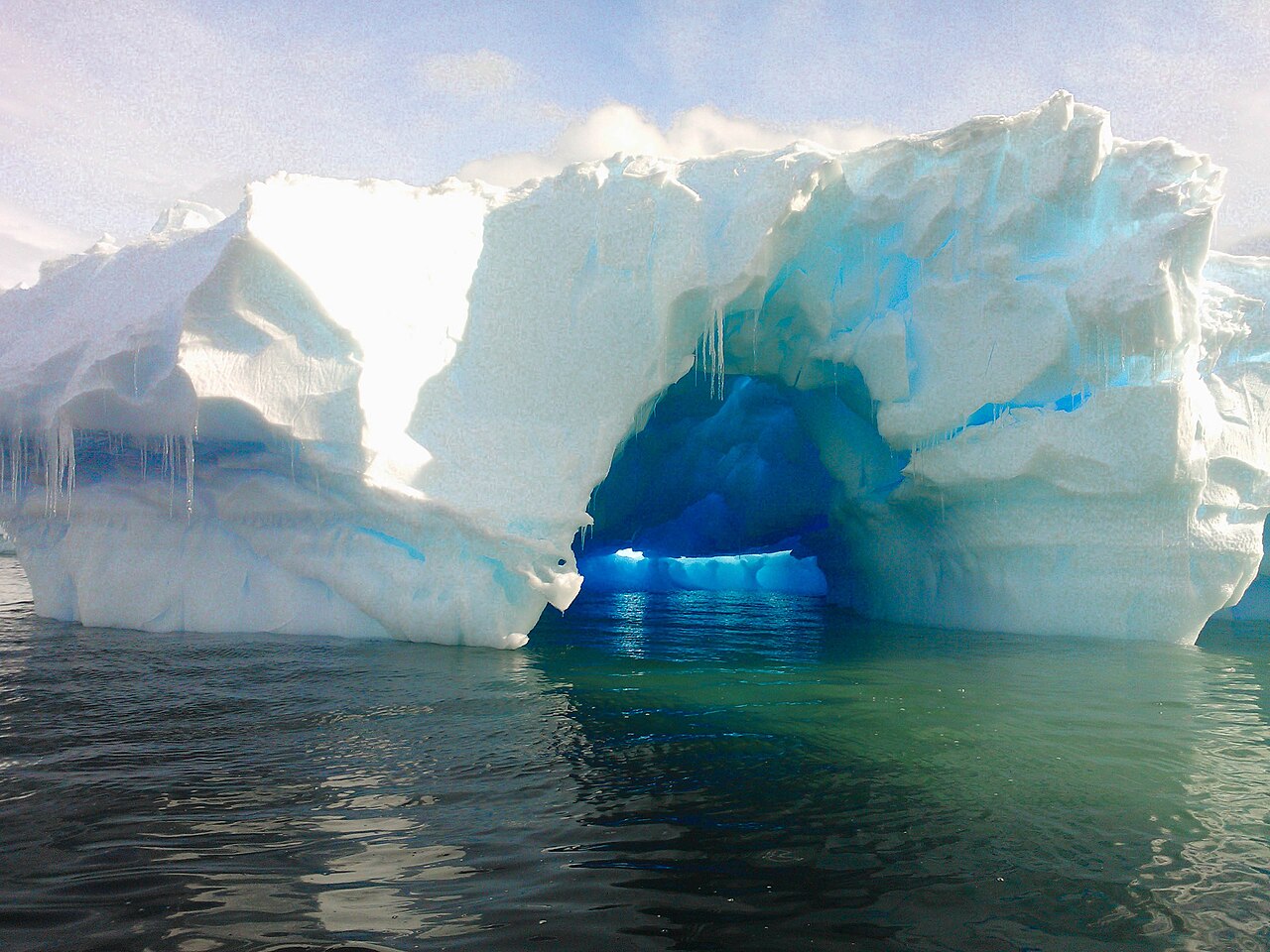
Jeroen Komen from Utrecht, Netherlands · CC BY-SA 2.0 · Wikimedia Commons · Source
If ice sank instead
A counterfactual makes water’s peculiarity stand out even more sharply. If ice were denser than water and sank to the bottom, surface water would cool and freeze → sink → fresh surface water would cool and freeze → sink again, in a repeating cycle, and the lake would eventually freeze solid from the bottom up. The sunken ice, insulated by the water above it, would scarcely melt even in summer, and it would devastate the aquatic ecosystem by destroying the habitats of water plants and animals. It would not be merely a matter of “fish having a hard time” — most temperate and cold-region freshwater ecosystems would have been fundamentally different.
Closing: the grain of a designed world
Water’s density curve cannot be captured by the superficial explanation that “it is strange simply because it has hydrogen bonds.” The balance point at 3.98°C arises from a delicate competition between the universal law of normal thermal contraction and the open tetrahedral structure that hydrogen bonds create. And the combination of this balance point with the 9% expansion on freezing provides the ecological buffer of Earth’s hydrosphere.
An H–O–H angle of 104.5°, up to four hydrogen bonds, a density maximum at 3.98°C, a 9% expansion at 0°C — these numbers mesh together like an equation designed to let life cross the winter. That water is the solvent of life on Earth may be no accident at all.
References
- Wikipedia — Properties of water (density, 4°C maximum, H-bond geometry)
- Wikipedia — Ice Ih (hexagonal lattice structure, O–O distance, tetrahedral bonding)
- Wikipedia — Ice (density 0.9167 g/cm³, 9% volume expansion on freezing)
- Tec-Science — Negative thermal expansion anomaly: density of water (3.98°C balance point)
- Chem1 Virtual Textbook — States of matter: the anomalous properties of water
- Au Sable River — Look under the ice: winter lake ecology (fall turnover, under-ice oxygen)
- Water on the Web — Lake stratification and the role of the 4°C density maximum
- Michigan State University Extension — Exploring our world: ice protecting life underwater
- NOAA Ocean Service — How do fish survive in icy cold water?
- IAPWS — Frequently asked questions: the water molecule (bond angle ~104.5°)