
If you see a sunflower in a summer field, one thing comes to mind for almost everyone: the idea that “the flower turns its head to follow the sun all day long.” Yet this common belief is only half true. It is only the “still-growing young sunflower” that chases the sun; a fully grown sunflower stops tracking and freezes facing a single direction — east. What is more, the “single flower” we point to is really a cluster of hundreds to thousands of tiny flowers, and its seeds are packed without gaps by a single rule called the “golden angle.” A single sunflower, in other words, hides both a body clock that reads time and a geometry that resembles mathematics.
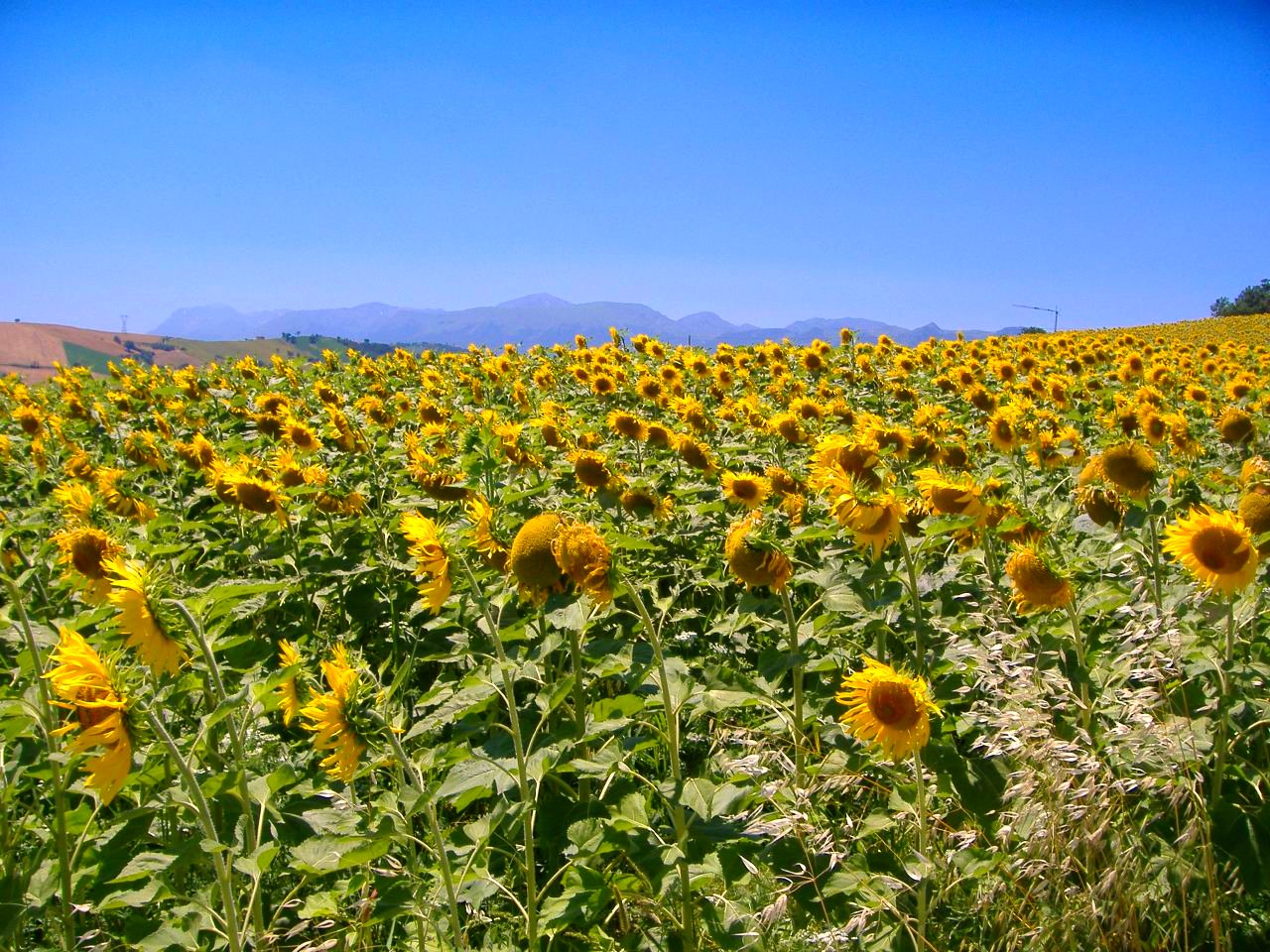
Luigi Guarino · CC BY 2.0 · Wikimedia Commons · Source
The Myth That It “Always Follows the Sun” — Tracking Belongs to Young Sunflowers
First we have to correct the common belief. The sun-following movement (heliotropism) happens not in mature sunflowers but in young ones that are still growing fast. A 2016 study by Atamian and colleagues, published in Science, laid this out clearly. A young sunflower moves the tip of its stem (the growing point) from east to west during the day to follow the sun, and overnight swings it back from west to east, taking up a posture to greet the dawn ahead of time.
The mechanism behind this movement is “differential growth that bends the stem to one side.” During the day the east side of the stem grows faster, so the tip leans west (east-to-west tracking); at night, conversely, the west side grows more, so the tip returns east (west-to-east realignment). The researchers called this the “antiphasic” elongation of the east and west sides, and a 2023 follow-up in PLoS Biology confirmed the same pattern — “the east side grows more during the day, the west side more at night.”
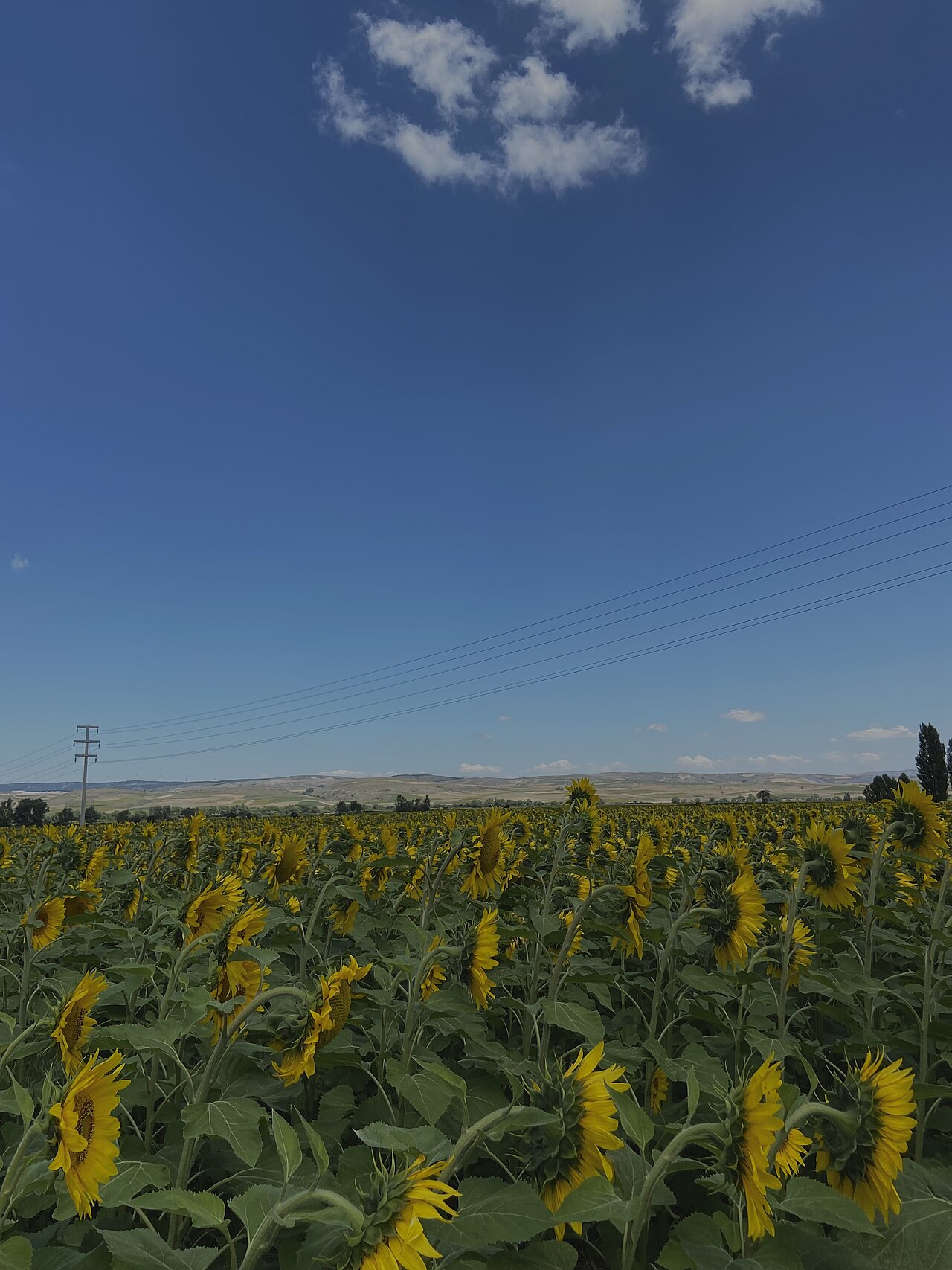
Aysegulylmaz · CC0 · Wikimedia Commons · Source
Not a Simple Light Response — The Body Clock Conducts It
Here is an even more intriguing point. This movement is not merely phototropism, “bending toward the brighter side.” When the researchers moved field sunflowers into constant conditions with a fixed overhead light, the plants kept up their east–west oscillation for several days. The rhythm continued even though the Sun’s position no longer gave any cue. This is evidence that the movement is conducted not by moment-to-moment responses to external light but by an internal circadian clock. Indeed, under artificial light–dark cycles departing from 24 hours, the tracking rhythm was disrupted.
The 2016 study reported that genes related to phototropic growth are differentially expressed on the two sides of the stem, whereas the clock genes themselves run evenly on both sides. That is, the clock flows equally on both sides, and that clock — through light and growth response pathways — creates the difference in elongation rate between the east and west sides. The 2023 PLoS Biology added another layer: heliotropism is distinct from classical phototropin-only phototropism, and several light-signaling pathways are involved in an integrated way. So lumping heliotropism together as “simple phototropism” is inaccurate. It is a refined integration woven together by the clock and multiple light pathways.
Once Grown, It Stops Tracking and Settles Facing “East”
So why does a fully grown sunflower no longer turn? The answer is already contained in the principle of the movement. The movement arises from the elongation (growth) of the stem, so once the plant matures and overall growth slows, differential elongation can no longer occur. The UC Davis team led by Stacey Harmer, who led the same 2016 study, described it this way: “As the sunflower matures and the flower opens, overall growth slows, and during the day it stops moving and settles facing east.” As tracking gradually weakens, the plant settles into an eastward orientation.
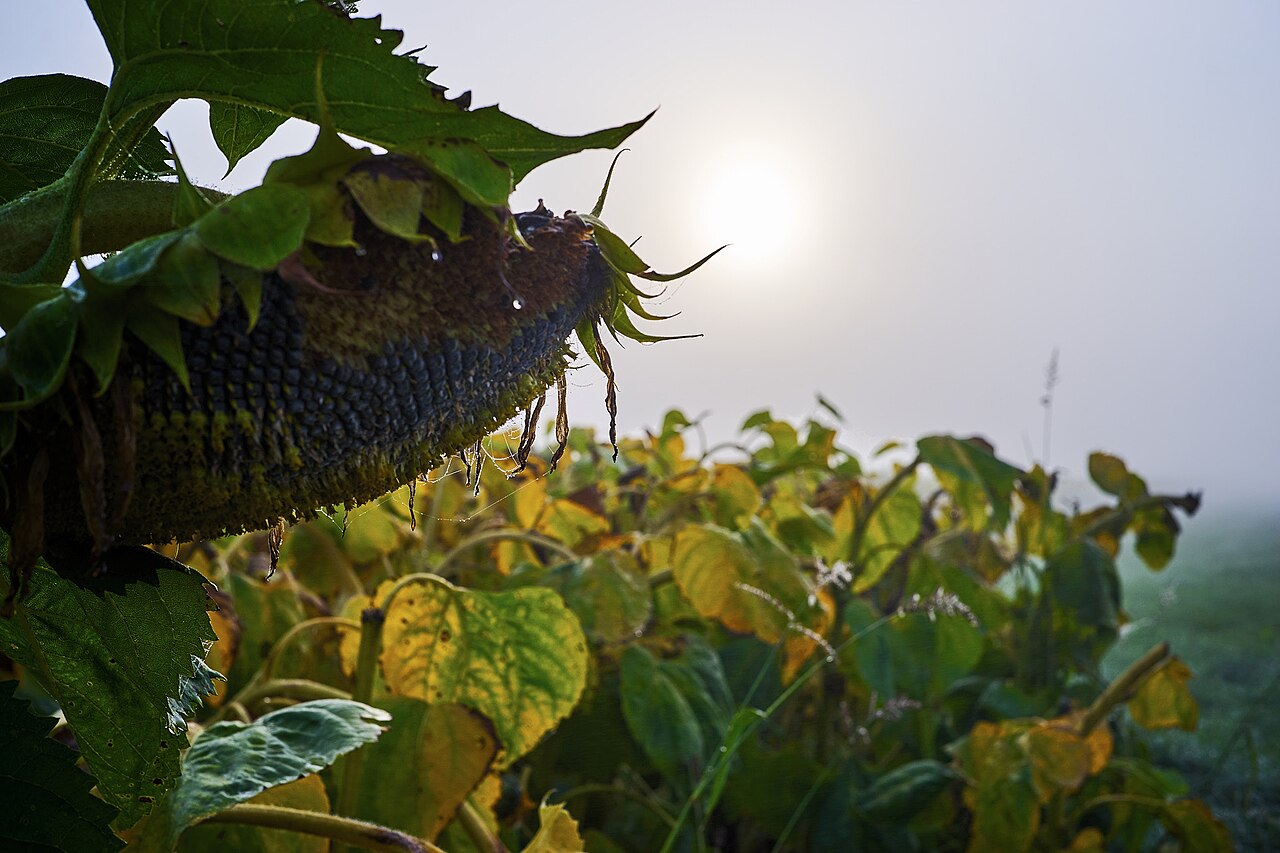
Mark Howanessian · CC BY 3.0 · Wikimedia Commons · Source
This eastward fixation brings a clear advantage. An east-facing head warms up faster in the morning sun, and a warmer head draws more pollinating insects. Atamian and colleagues reported that east-facing sunflowers received about five times as many visits from pollinating insects as those facing other directions (west in particular). Decisively, the researchers artificially warmed west-facing heads with a portable heater, and visits rose again — an experiment that directly showed the advantage of facing east comes mainly from “fast morning warming,” that is, temperature.
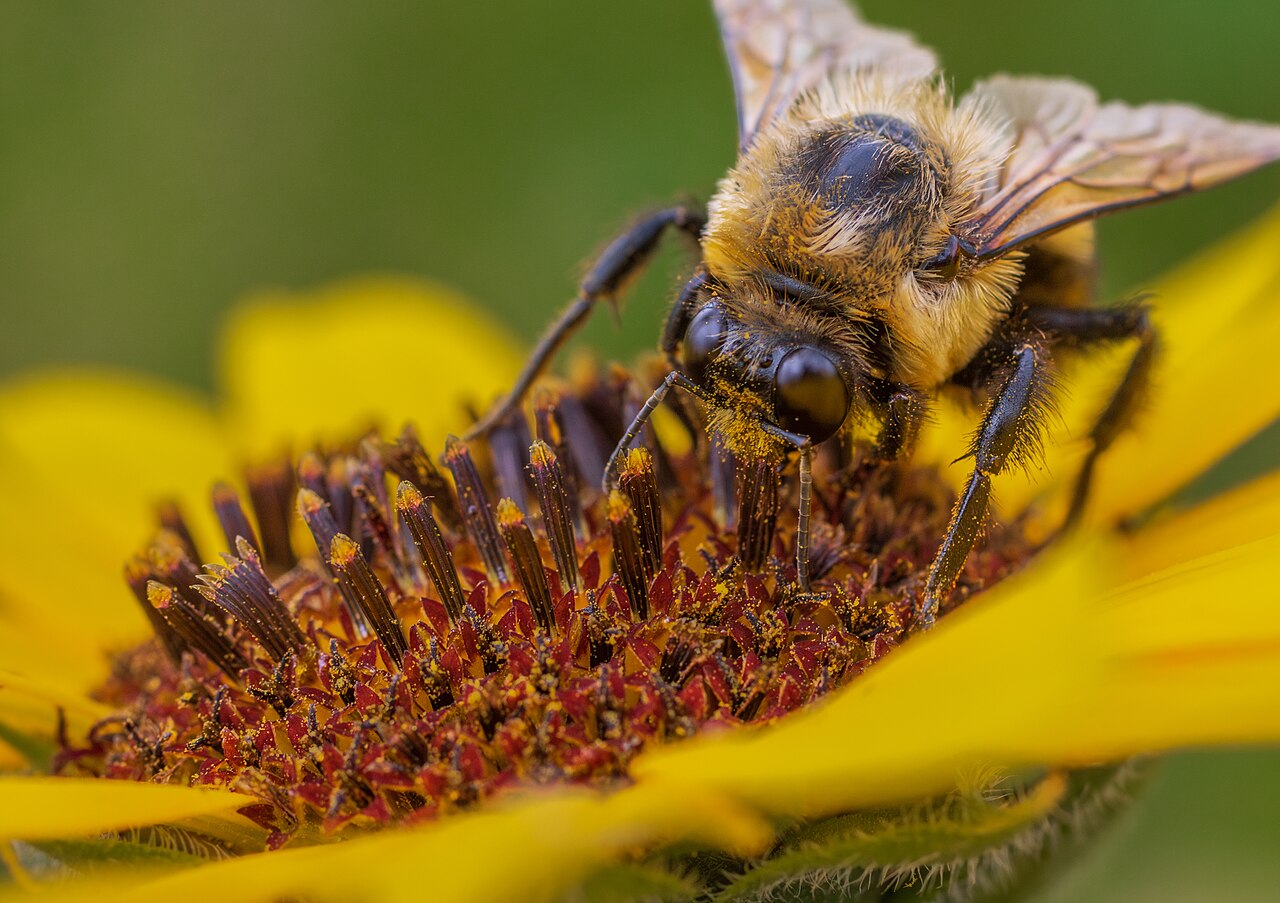
U.S. Fish and Wildlife Service – Midwest Region · Public domain · Wikimedia Commons · Source
This warmth translates into reproductive success. East-facing heads, receiving more pollinating insects, produced more offspring and heavier seeds. It was also reported that young plants allowed to track the sun had greater leaf area and biomass than plants prevented from tracking. A later field study, Takács et al. (2022), independently supported the eastward advantage, reporting that under natural conditions east-facing heads led north-, south-, and west-facing ones in both the number and mass of kernel-filled seeds.
A “Single Flower” That Is Really Thousands — The Secret of the Capitulum
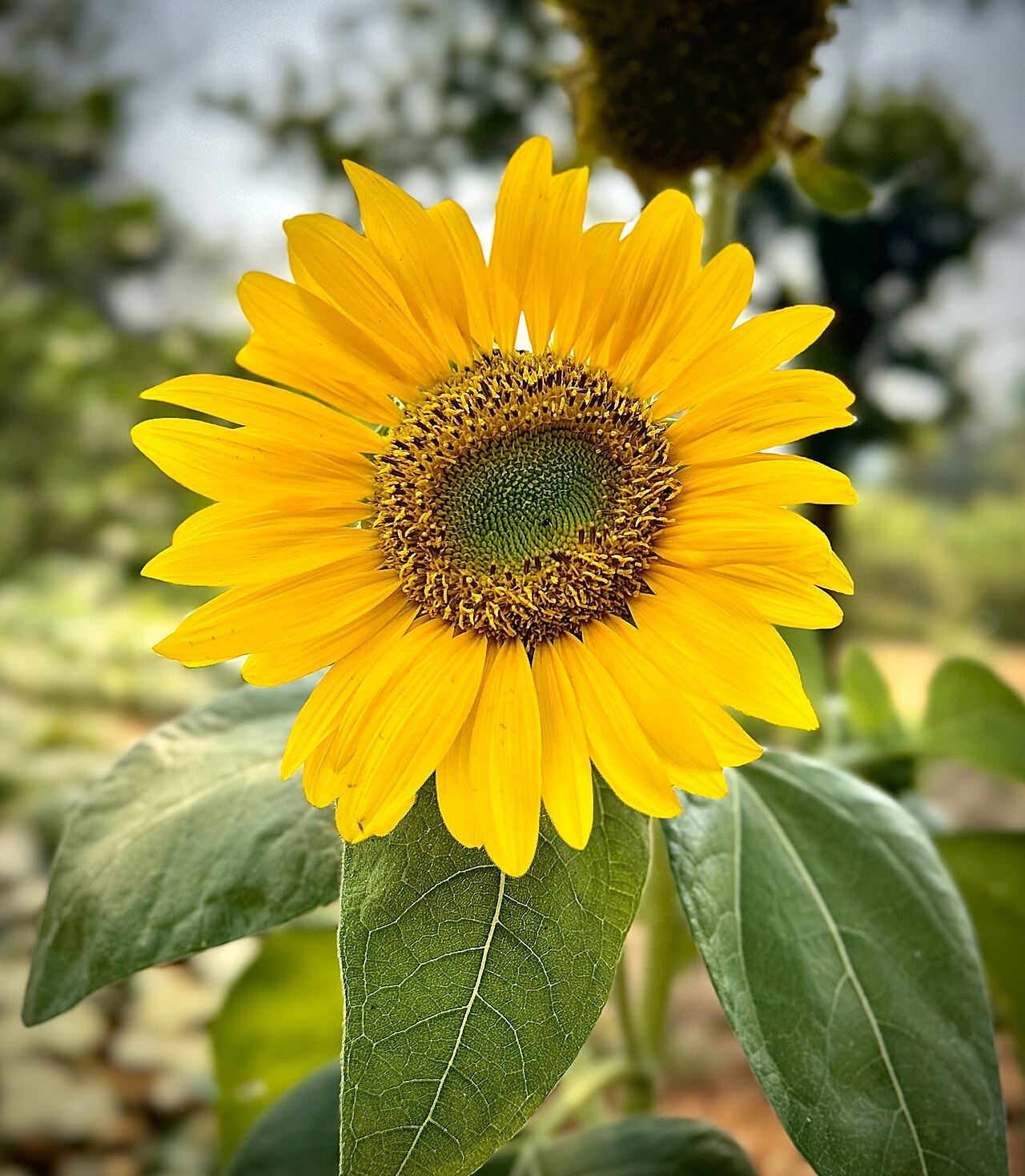
Now let us turn to the head itself. What we call a sunflower “single flower” is in fact not a single flower at all. It is a flower head — a capitulum — of the family Asteraceae: it looks like one flower, but it is really a “false flower” (pseudanthium) made of hundreds, sometimes thousands, of tiny flowers (florets) gathered on a single receptacle.
Rifat R · CC BY 4.0 · Wikimedia Commons · Source
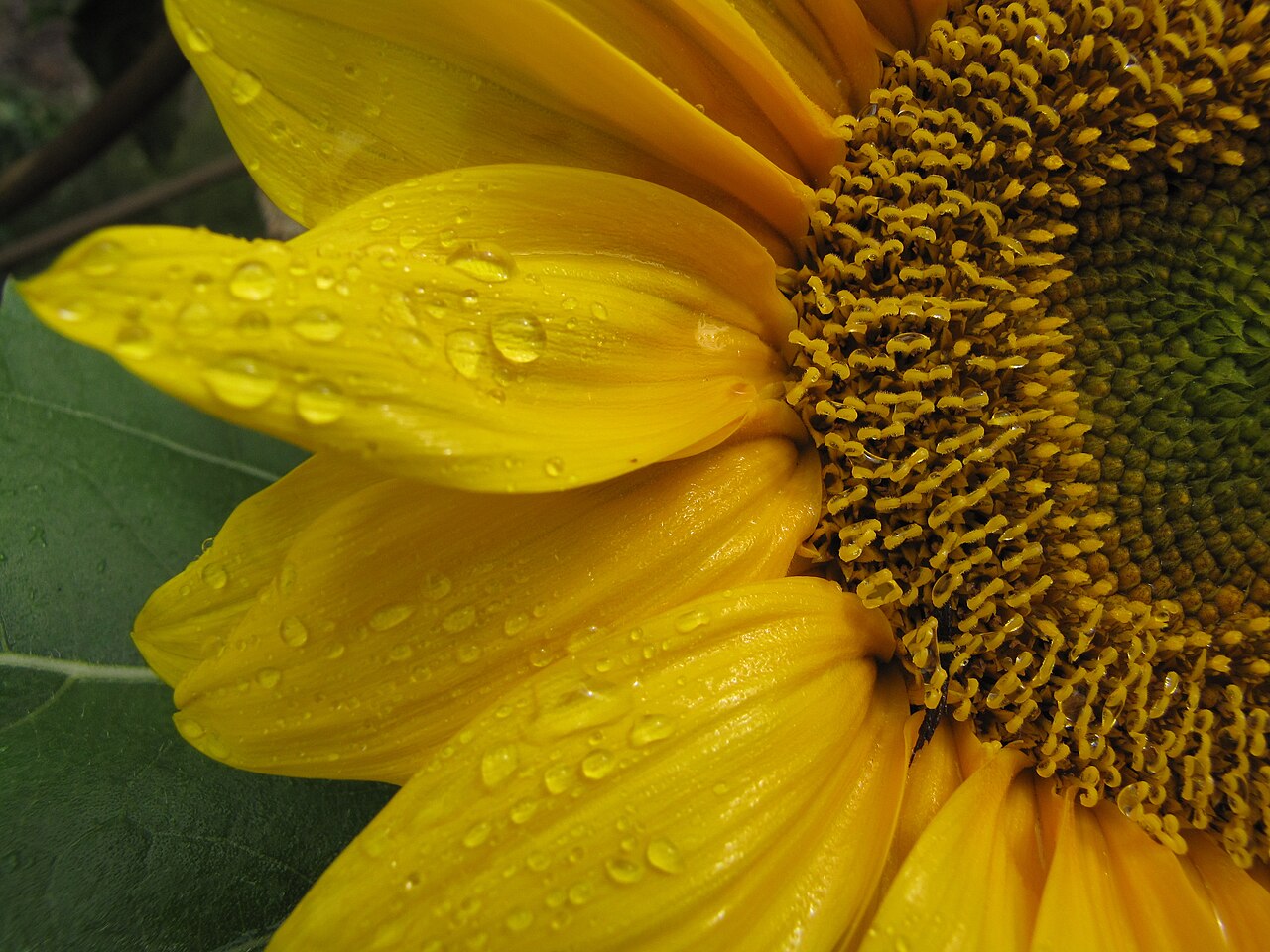
These tiny flowers come in two kinds. The showy outer parts that look like yellow petals are “ray florets,” large and bilaterally symmetric to attract insects, but in the sunflower they are usually sterile and do not become seeds. The “disk florets” densely packed at the center, by contrast, are radially symmetric with a tubular, fused corolla, and they handle pollination and seed set. Each of these disk florets grows into the sunflower seed we crack open. What looked like a single bloom is really the cooperation of thousands of flowers — the first reversal that makes us see the sunflower anew.
Forest and Kim Starr · CC BY 3.0 US · Wikimedia Commons · Source
The Golden Angle, 137.5° — A Simple Rule That Builds a Gapless Spiral
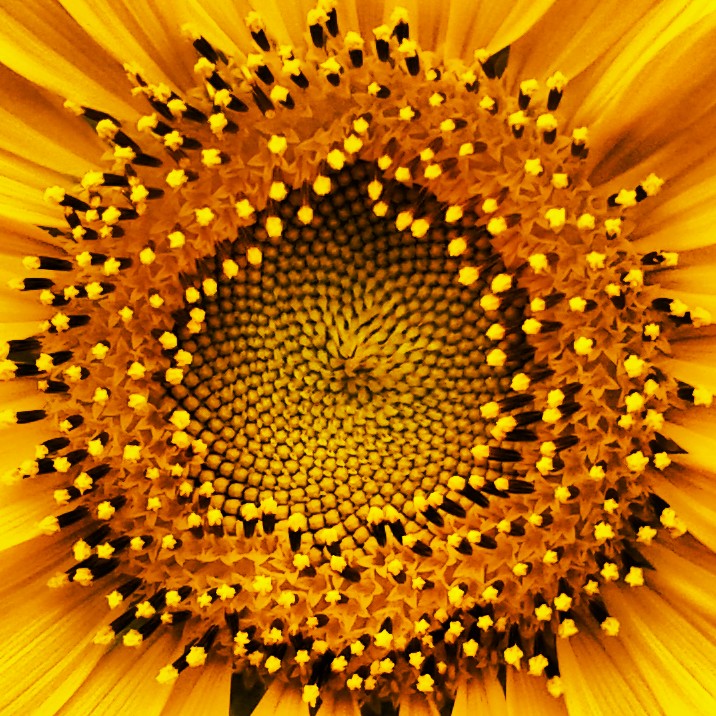
Look at how the disk florets are packed, and a second wonder appears. The seeds (disk florets) form two families of spirals interlocking clockwise and counterclockwise. A line running in one direction is called a parastichy, and if you count the number of spirals in each direction, you usually get a pair of consecutive Fibonacci numbers. In small heads it might be (34, 55), in large ones (55, 89) or (89, 144). Larger heads tend to show higher Fibonacci numbers, so not all pairs exist at once in a single head.
Runika Bordia · CC BY-SA 4.0 · Wikimedia Commons · Source
At the heart of this arrangement is the “golden angle.” Each new seed is placed at a position rotated about 137.5° from the previous one. The golden angle is the smaller angle obtained by dividing a circle’s circumference by the golden ratio — precisely 360/φ², that is 180(3−√5)°, which is about 137.5078° (commonly written as roughly 137.5°). Because the golden angle is the ratio “closest to irrational,” no matter how many seeds pile up, they almost never overlap along the same ray. So each new seed always lands in the widest empty spot, and the result is the most uniform packing with the fewest gaps. One measurement study even reported that the divergence angle of sunflower heads is fixed very precisely near about 137.508° (though there can be local deviation depending on position within the head).
The Plant Does Not “Calculate” Mathematics — Order That Emerges
Here we must address the most important misconception: the sunflower does not arrange its seeds by “knowing and calculating” Fibonacci numbers. The secret lies in a far simpler local rule. A newly formed primordium at the growing point inhibits the formation of new primordia nearby. So the next primordium forms where inhibition is weakest — that is, in the widest empty space. Historically this is the geometric–physical rule of Hofmeister and Snow; in modern molecular biology it is explained by the distribution of the plant hormone auxin. The two are merely different levels of explanation for the same phenomenon, bound by the common principle of “filling the emptiest spot.” This simple repetition alone makes the golden angle and Fibonacci spirals appear on their own. The golden angle is not a value the plant aims for, but an attractor toward which this process naturally converges.
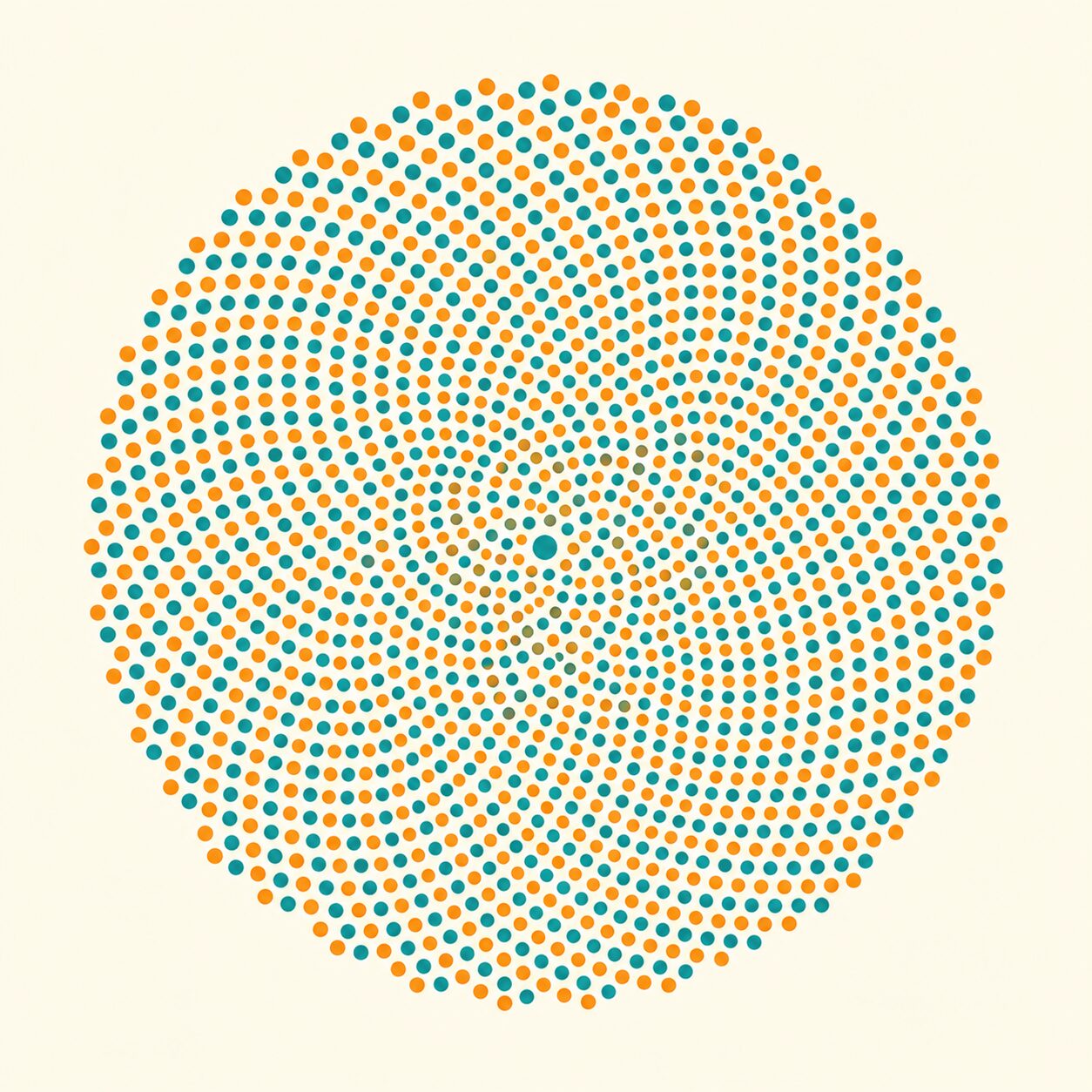
Illustration · AI-generated (Codex/ChatGPT) · golden-angle packing concept
There is a famous experiment that reproduced this emergence physically. Douady and Couder (1992) dropped drops of magnetic fluid at regular intervals onto the center of a disk in a magnetic field. The drops pushed one another and were carried outward; when the drops were introduced quickly the divergence angle was 180°, but as the introduction frequency (a single parameter described in the paper) was lowered, the divergence angle converged on the golden angle. With no intent on the part of any living thing, a single condition alone selected the golden-angle arrangement in a self-organizing way.
And Yet It Is Not Always a Perfect Fibonacci — Variation Revealed by Citizen Science
Finally, a paragraph is needed to guard against overstatement. Real sunflowers do not always follow a perfect Fibonacci pattern. Swinton, Ochu and the “MSI Turing’s Sunflower Consortium” (2016) quantified this variation in a large citizen-science experiment that analyzed 657 sunflowers in total. In the most reliable reviewed dataset, of 768 parastichy counts, 565 (about 74%) were Fibonacci numbers, and including other Fibonacci structures, 632 belonged to the Fibonacci family. In other words, about one in five (about 18%, 136 counts) was non-Fibonacci.
The kinds of variation were diverse, too. Of the 632 in the Fibonacci family, 565 were standard Fibonacci, 41 were Lucas numbers, 25 were double Fibonacci, and 1 was an F4 sequence. Among the 136 non-Fibonacci counts, “Fibonacci minus one” (49) appeared significantly more often than “Fibonacci plus one” (17) (p ≈ 3.3×10⁻⁵). Such exceptions are not fully explained by any single simple model, suggesting that a more refined model is needed. The golden angle and Fibonacci are a powerful tendency, not an absolute law.
Closing — Order Blooming from a Simple Rule
The sunflower holds two design principles in one body. One is the principle of refined timing: a body clock that reads time alternately elongates the two sides of the stem to chase the sun, and once grown, stops tracking and faces east to draw the morning’s warmth and pollinating insects. The other is the principle of emergence: from a single local rule — “fill the emptiest spot” — the orderly arrangement of the golden angle and Fibonacci spirals rises on its own, yet not always perfectly. That what looks like a single bloom is really the cooperation of thousands of flowers, and that their seeds are packed without gaps by a single simple rule, lets us glimpse one grain of the created world in which refined order blooms from simplicity.
References
- Atamian et al. (2016) Circadian regulation of sunflower heliotropism, floral orientation, and pollinator visits — Science
- Atamian et al. (2016) — PubMed 27493185 (abstract)
- Brooks, Atamian, Harmer (2023) Multiple light signaling pathways control solar tracking in sunflowers — PLoS Biology
- How sunflowers follow the sun — Berkeley News (2016)
- Sunflowers move from east to west, and back, by the clock — Phys.org (2016)
- Takács et al. (2022) East-facing Helianthus annuus has maximal number and mass of kernel-filled seeds — PMC
- Swinton, Ochu & MSI Turing’s Sunflower Consortium (2016) Novel Fibonacci and non-Fibonacci structure in the sunflower — Royal Society Open Science
- Swinton et al. (2016) Royal Society Open Science 3:160091 (DOI)
- Douady & Couder (1992) Phyllotaxis as a physical self-organized growth process — PubMed
- Golden angle — Wikipedia (137.5078°)