
The Paradox: The Secret to the Toughest Survival Is to Stop Living
The vacuum of space, heat close to boiling water, a thousand times the radiation dose that would kill a human in one shot. Tardigrades (water bears) come bundled with such superlatives, and are often called “the toughest animal on Earth” or “the indestructible immortal.” Yet this fame almost always omits one decisive caveat: a tardigrade endures those extremes only, paradoxically, when it has shut its own life processes almost completely down into a state of dry dormancy.
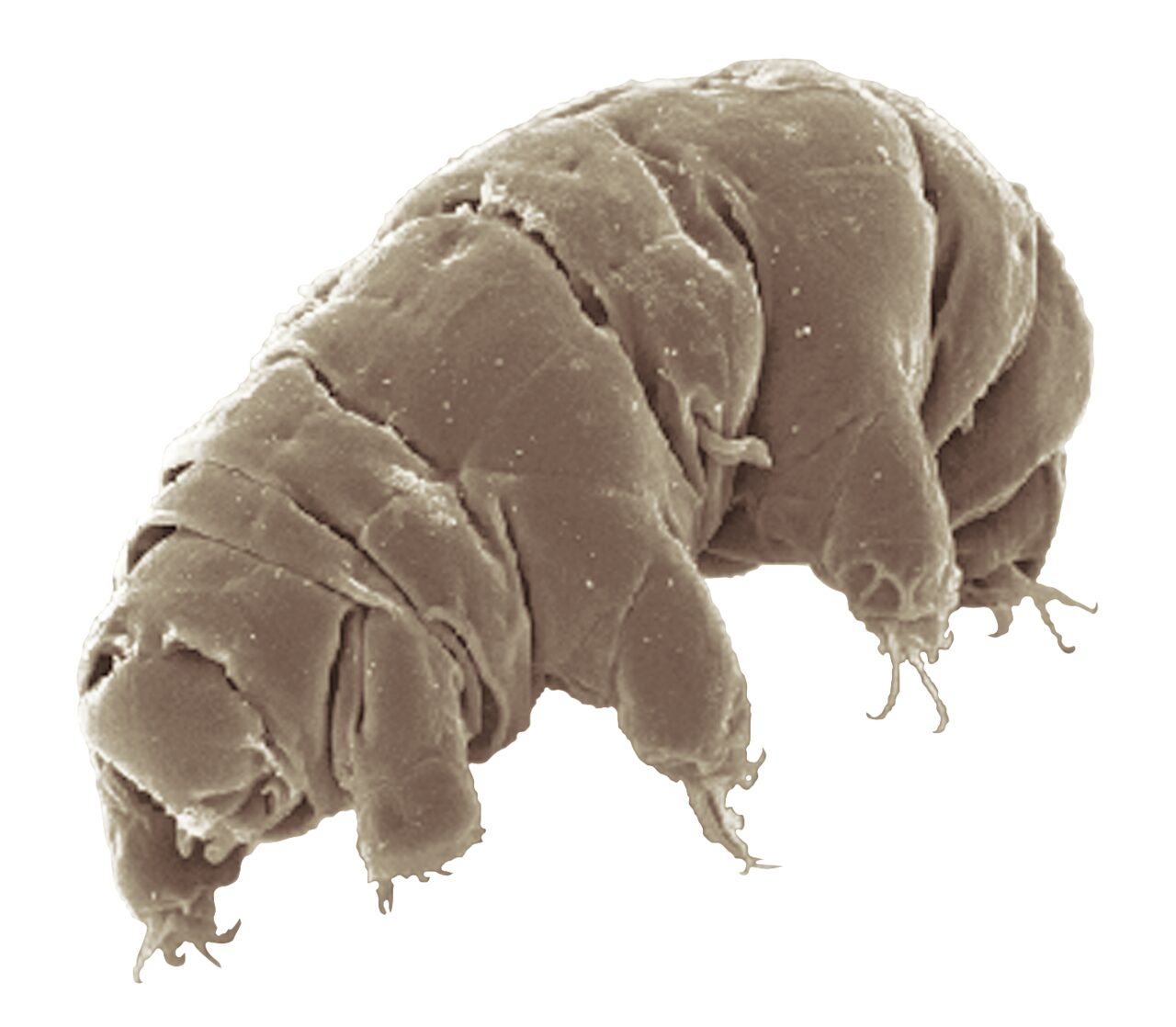
An “active” tardigrade — one that holds water in its body and moves about normally — is astonishingly, ordinarily vulnerable. It is eaten by nematodes and mites in the soil, and half of a population dies after just a single day at a temperature only a little above human body heat. The real marvel of the tardigrade is not “dying of nothing,” but the ability to pause life without switching it off, and then switch it back on. It drops its metabolism to nearly zero, holds time still, and wakes again at a single drop of water. This article follows, calmly, how that “pause switch for life” works at the molecular level, and where the facts end and the exaggeration begins.
Goldstein lab – tardigrades · CC BY-SA 2.0 · Wikimedia Commons · Source
What Is a Tardigrade — A 0.5-Millimetre Animal Phylum of Its Own
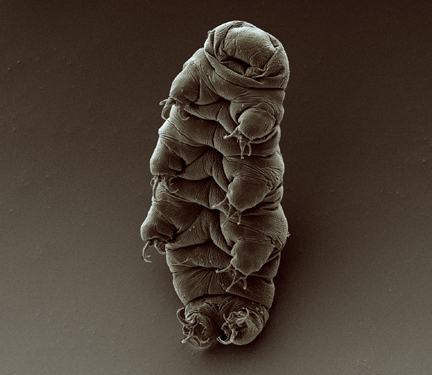
The tardigrade is a micro-animal called the “water bear” or “moss piglet” in English — names earned by its slow, bear-like walk. Scientifically, it forms an independent animal phylum of its own, Tardigrada. Together with the arthropods (to which insects and crustaceans belong) and the onychophorans (velvet worms), it makes up a larger group called Panarthropoda, and molecular phylogenetic studies regard tardigrades as a close sister group of the arthropods. About 1,488 species have been described so far (some 160 genera and 36 families, per the Degma·Guidetti·Bertolani species checklist, 2024), though the true number is thought to exceed 10,000.
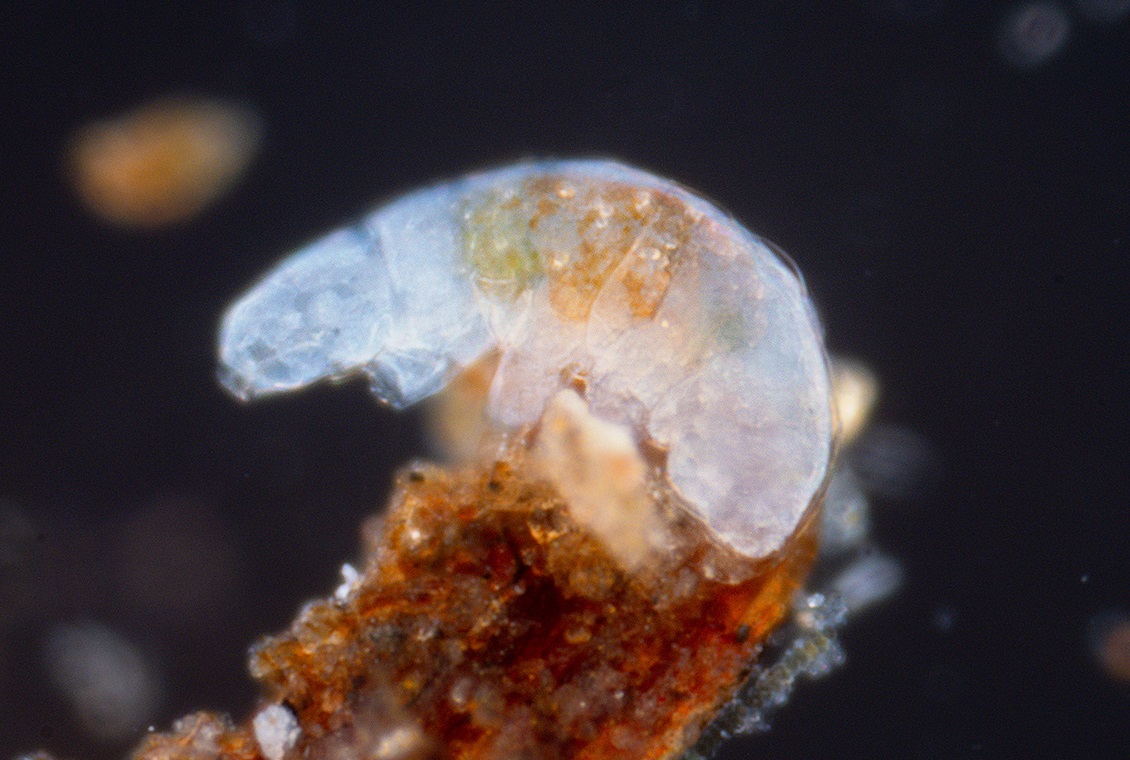
A fully grown individual is usually 0.05–0.5 millimetres, and even the largest species reaches only about 1.3 millimetres, so they are essentially invisible to the naked eye. This tiny body bears four pairs — eight — of legs, each tipped with usually four to eight claws or sticky adhesive pads. In the mouth is a pair of stylets made of calcium carbonate (aragonite), which pierce the cell walls of mosses or algae to suck out the cell fluid inside.
Thomas Shahan · CC BY 2.0 · Wikimedia Commons · Source
One misconception should be cleared up in advance. Because the tardigrade looks so simple, phrases like “it’s so tough even without a brain” are sometimes used — but this is not true. The tardigrade has a distinct, multi-lobed brain, a subpharyngeal ganglion, and a genuine central nervous system formed by a pair of ventral nerve cords linking the ganglia placed at each pair of legs. Inside the brain there are even two eyespots. Small it may be, but it is by no means an animal without a nervous system.
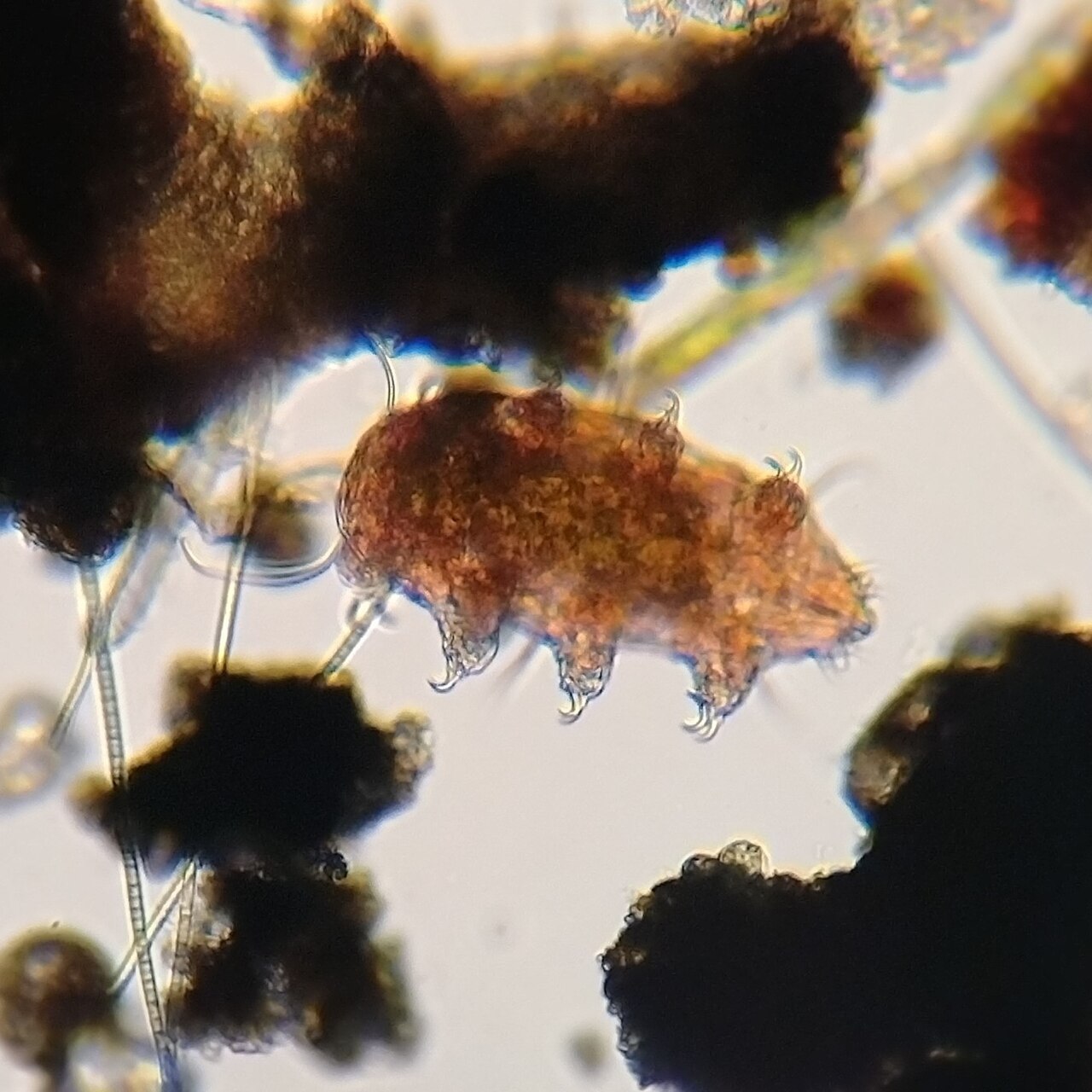
Its habitat is almost anywhere there is a film of water: moss and lichen, leaf litter and soil, of course, but also fresh water and the sea, the deep ocean, high mountains, from the Arctic to the Antarctic. They have indeed been collected at a water depth of about 4,690 metres and at Himalayan altitudes above 6,000 metres. Their ordinary lifespan, however, is surprisingly short: excluding time spent dormant, the active lifespan is roughly 3 to 30 months depending on the species. The talk of “living for decades” refers not to the normal lifespan but to records of the dormant state entered through drying or freezing (the longest revival on record is about 30 years), and the two must be kept distinct.
Robert Martin · CC BY 4.0 · Wikimedia Commons · Source
Cryptobiosis — Becoming a “Tun” to Stop Time
The central stage on which the tardigrade endures extremes is cryptobiosis, also called in Korean a state of “suspended-animation dormancy.” In 1959, Keilin defined it as “a state in which there are no visible signs of life and metabolic activity becomes hardly measurable, or reversibly comes to a standstill.” Depending on what triggers it, it divides into anhydrobiosis (by drying), cryobiosis (by cold), anoxybiosis (by lack of oxygen), osmobiosis (by osmotic stress), and so on; the most common and best-studied is dry dormancy.
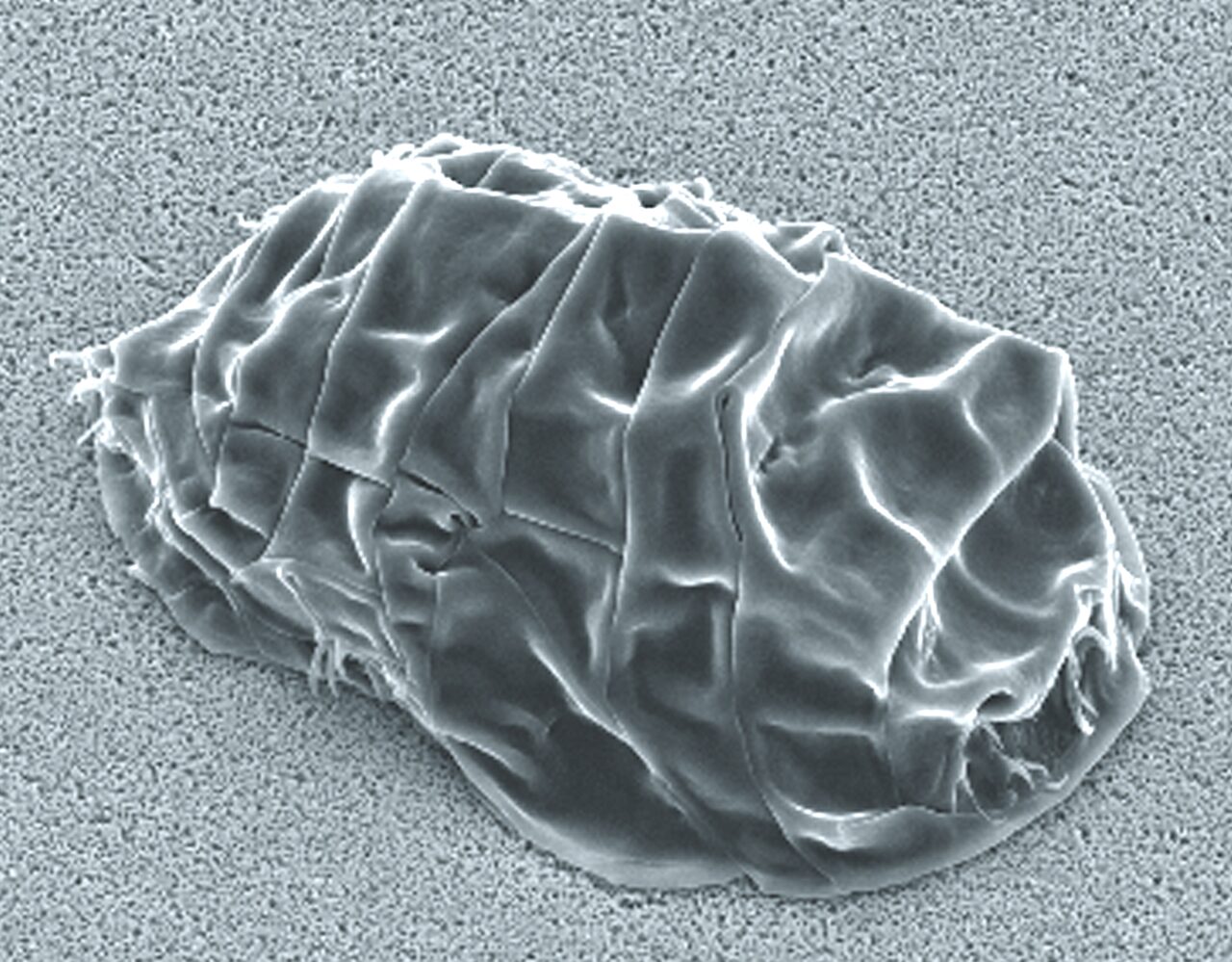
When it begins to dry slowly, the tardigrade actively contracts its body lengthwise and draws the cuticle between its legs and segments inward, shrinking into a small barrel shape with all its legs tucked away. This form is called a “tun,” a word taken from a term meaning a cask or barrel. By minimizing its exposed surface area it slows the evaporation of water, and in the process it loses up to about 98% of its body water. As a result its metabolic rate falls to less than 0.01% of normal. This figure is a detection limit: even the most sensitive technique, which tracks the carbon-dioxide release of radioactively labelled glucose down to 0.01% of normal metabolism, could not detect any metabolism in dormant individuals. In other words, life activity has stopped “below the measurable limit” (Møbjerg & Neves 2021).
Schokraie E, et al. (2012) · CC BY 2.5 · Wikimedia Commons · Source
But to have stopped is not to have died. Add water again, and the tardigrade unfolds its head and legs and resumes movement. After a brief tun stage it usually fully recovers activity within the range of minutes, though this varies with species, age, and length of dormancy. The genus Milnesium, for instance, begins to move briskly within minutes of being given water, whereas Richtersius coronifer takes longer to recover. The longer the dormancy or the older the individual, the slower the waking.
Proteins That Turn the Body to Glass — Not Just a Trehalose Story
So what is the secret to a cell that loses almost all of its water and yet is not destroyed? For a long time the accepted answer was a disaccharide called trehalose. Desiccation-tolerant organisms such as brine shrimp, some nematodes, and yeast accumulate large amounts of trehalose as they dry; it binds to membranes and proteins in place of the lost water and hardens like glass, preserving structure. This “water replacement” model was applied wholesale to tardigrades as well.
Yet when researchers actually looked into tardigrades, the situation was different. In a 2008 study comparing eight species, Hengherr and colleagues found that trehalose content varied greatly among species and was scarce even at that. Crucially, in the representative species Milnesium tardigradum, no trehalose was detected at all. Even Richtersius coronifer, which has a relatively high content, holds only about 2–5% of its dry weight — far less dependent than the desiccation-tolerant nematode Aphelenchus avenae, which accumulates 10–18%. In short, the tardigrade’s desiccation tolerance is not explained by trehalose alone.
What fills the gap is the tardigrade-unique intrinsically disordered proteins (TDPs) reported by Boothby and colleagues in Molecular Cell in 2017. In species including Hypsibius dujardini (now H. exemplaris) they identified protein families called CAHS, SAHS, and MAHS. CAHS gene expression surged 4- to 22-fold upon drying, and silencing it with RNAi sharply reduced survival after desiccation (with no effect when water was present). On drying, these proteins solidify into an amorphous solid rather than a crystal — that is, they vitrify into a glass-like state — physically holding and fixing the structures and proteins inside the cell. Much as a fragile specimen is preserved by being sealed in glass. Boothby’s team even showed that simply putting these proteins into yeast or bacteria confers desiccation tolerance.
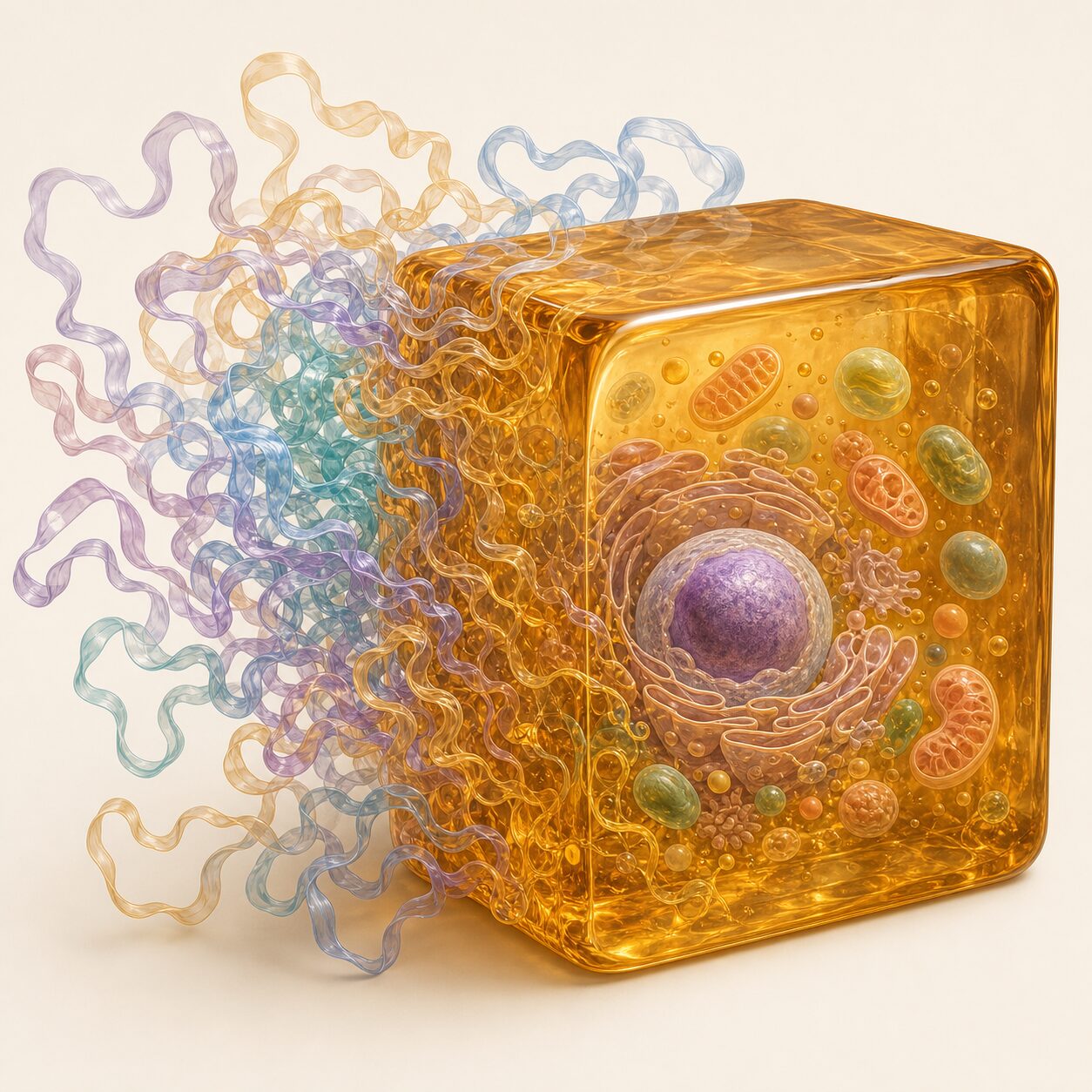
Illustration · AI-generated (Codex/ChatGPT subscription)
The important point here is that there is no single “right answer.” The most recent integrated model holds that trehalose and CAHS proteins are not mutually exclusive but synergistic. Protection is strongest when the two are present together at natural concentration ratios, and species merely differ in how much they lean on trehalose versus protein (Communications Biology 2022). For this reason the tardigrade’s mechanism must always be spoken of species by species. Milnesium has no trehalose, in Hypsibius CAHS is central, and some species use both. The one-line summary “tardigrades survive on trehalose” is therefore inaccurate.
Radiation Is the Exception — An Active Defence That Works Even in Living Cells
Everything so far has come with the caveat of “dry dormancy.” Yet there is exactly one ability that breaks that rule: radiation tolerance.
When Horikawa and colleagues irradiated Milnesium tardigradum in 2006, they reported that the half-lethal dose (LD50) at 48 hours after irradiation reached about 5,000 gray (Gy) for gamma rays. Compared with a human whole-body acute LD50 of about 4–5 Gy, that is roughly a thousandfold. But the truly striking part lies elsewhere: the tolerance of the dry state and the active (hydrated) state differed hardly at all, and if anything the active, water-bearing state was slightly stronger. Had radiation tolerance been a passive effect arising merely from “having fewer targets to damage because there is no water,” the dry state should have been far stronger. The result was the opposite. It means the tardigrade’s radiation defence does not rely on dormancy — it is an active molecular defence that works even inside living, moving cells.
Its molecular identity was revealed in 2016 by Hashimoto and colleagues. The protein, named Dsup (Damage suppressor), is a tardigrade-unique nuclear protein found in a species called Ramazzottius varieornatus. Dsup binds physically to DNA and prevents radiation and reactive oxygen species (hydroxyl radicals) from breaking the DNA strands. The team carried out an experiment expressing this gene in human cultured cells (HEK293): when irradiated with X-rays, DNA damage was reduced by about 40% compared with controls, and cell survival was higher. A human cell became sturdier thanks to a single tardigrade protein. A follow-up study (Chavez et al. 2019, eLife) went further and revealed the structural mechanism by which Dsup binds to nucleosomes and physically shields DNA from hydroxyl radicals.
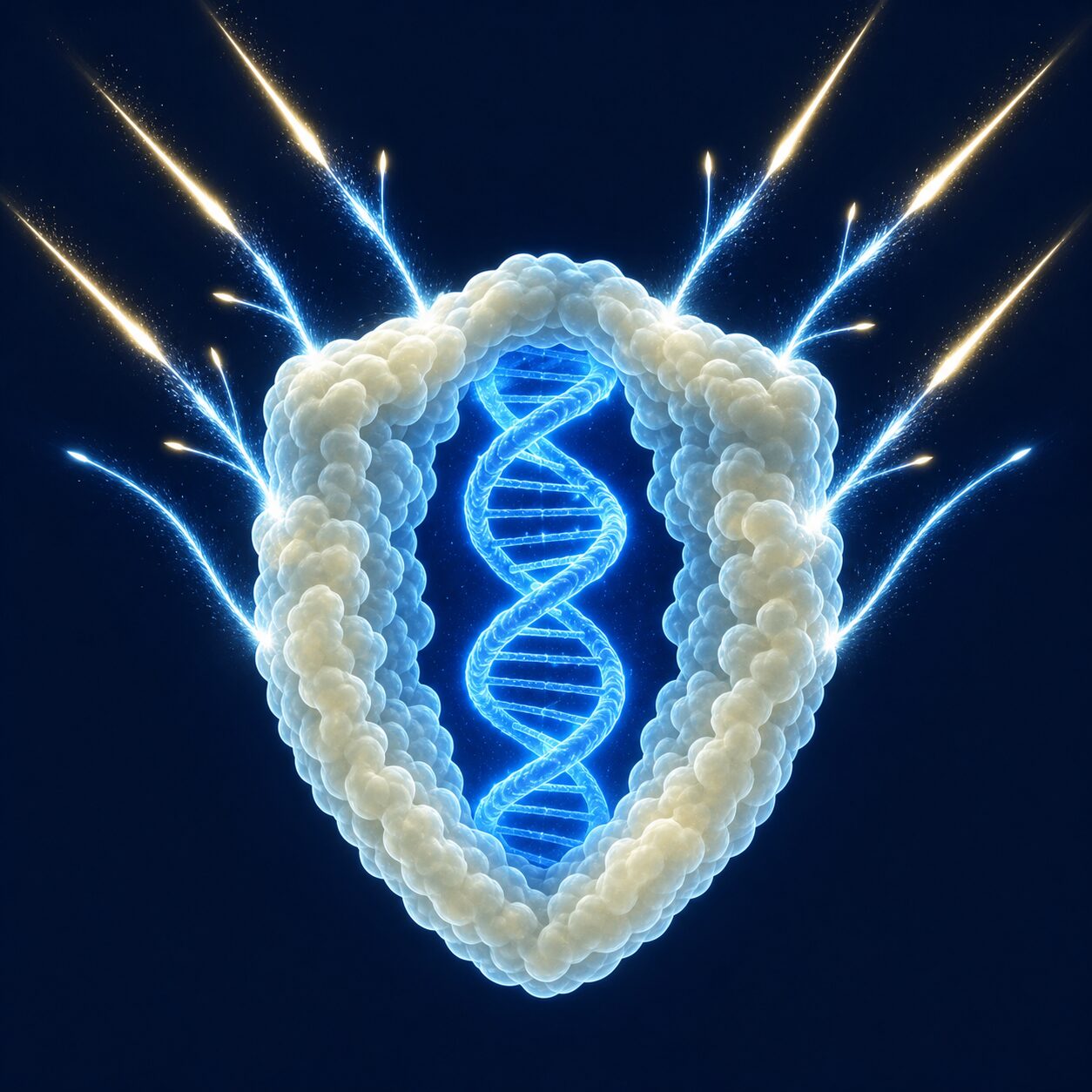
Illustration · AI-generated (Codex/ChatGPT subscription)
That said, this too must be attributed species by species. Dsup was first characterized in Ramazzottius varieornatus, and an orthologue was later confirmed in Hypsibius exemplaris, but its sequence and structure differ. Not every tardigrade carries the same Dsup, so rather than asserting that “tardigrades are (universally) radiation-resistant thanks to Dsup,” it is more accurate to limit it to “a mechanism confirmed in specific species.”
An Animal That Went to Space — It Withstood Vacuum but Fell to Ultraviolet
The event that decisively cemented the tardigrade’s fame is a 2007 space experiment. In the TARDIS (Tardigrades In Space) experiment aboard the European Space Agency (ESA)’s FOTON-M3 mission, dried tardigrades were exposed directly to open space in low Earth orbit for about 10 days (Jönsson et al. 2008, Current Biology).
The result had two faces. The vacuum of space itself was endured well. Individuals exposed to vacuum alone revived after rehydration and even laid eggs. It was the first record of an Earth animal surviving direct exposure to vacuum and cosmic radiation. But when solar ultraviolet (UV) was added, the story changed entirely. Of the Milnesium tardigradum exposed to both vacuum and the full spectrum of solar UV, only three individuals survived. Ultraviolet was far more lethal than vacuum. This is a different matter from the ionizing-radiation tolerance seen earlier, and it shows that “tardigrades live in space” is less accurate than “they briefly endured in a state of dry dormancy.”
The other extreme figures must likewise always be read together with “for how long, and in what state.” Cold tolerance is the most powerful and best-documented ability: in the dry state there are reports of revival after brief exposure to about -272°C, near absolute zero (Becquerel 1950), and a case of dried individuals in Antarctic moss waking after 30 years frozen at -20°C (Tsujimoto et al. 2015). Pressure, too, was withstood at 600 megapascals (about 6,000 atmospheres) in the dry state (Seki & Toyoshima 1998) — more than five times the pressure at the deepest point of the Mariana Trench, the deepest place on Earth (about 1,100 atmospheres). Yet every one of these figures comes, without exception, with the caveat of “the dry, dormant state.”
Correcting the Myths — Tardigrades Are Not Immortal
Now to the most widely spread misconception of all, especially about heat tolerance. The claim that “tardigrades withstand 150°C” is common online. Trace the source of that figure and it leads back to reports from the 19th and early 20th centuries (Doyère 1842, Rahm 1921). Precisely, it was exposure to 110–151°C for 30 minutes in the dry state — a historical figure never reproduced by modern quantitative experiments. It by no means implies long survival at that temperature.
Rigorous modern research paints a wholly different picture. According to a Ramazzottius varieornatus experiment reported by Neves and colleagues in Scientific Reports in 2020, even the dry dormant state sees its heat limit collapse sharply as exposure time lengthens.
- Dry state, 1-hour exposure → half-lethal temperature 82.7°C
- Dry state, 24-hour exposure → falls to 63.1°C
- Dry state, 1-week exposure → falls to about 56°C
- Active (hydrated) state, 24-hour exposure → just 37.1°C (37.6°C even after brief acclimation)
In other words, even a well-dried tardigrade has half its number die in 82.7°C water within an hour, and in the active, water-bearing state half die after just one day at about 37°C, a little above human body temperature. The researchers’ conclusion is clear: exposure time is the limiting factor on heat tolerance, and for an active tardigrade heat is in fact an “Achilles’ heel.” So “withstands 150°C” should be understood as an exaggeration descended from a 30-minute report of the 19th century.
It is not only heat. An active tardigrade is just an ordinary member of the food chain in the soil ecosystem. It is eaten by soil arthropods such as nematodes, mites, spiders, and cantharid beetle larvae, by amoebae, and even by other tardigrades such as the carnivorous genus Milnesium. It is by no means an animal that is invincible before its predators.
Schokraie E, et al. (2012) · CC BY 2.5 · Wikimedia Commons · Source
That does not, however, dull the tardigrade’s toughness. A 2017 study by Sloan, Alves Batista, and Loeb in Scientific Reports modelled three astrophysical catastrophes — asteroid impacts, supernovae, and gamma-ray bursts — and concluded that an event severe enough to boil away the entire ocean is practically unlikely to occur, so the tardigrade as a “species” would survive even such global extinction scenarios. But this means not that each individual is invincible, but that the species as a whole is extremely resistant to extinction, a statistical claim. To distinguish individual from species, and active from dormant — that is the key to understanding tardigrades accurately.
Closing — A Switch That Turns Life Off and On
To compress the tardigrade’s story into a single sentence: the tardigrade is not “an animal that cannot die,” but “an animal that knows how to pause life for a while.” While there is water and it moves about alive, it is as vulnerable as any other small animal; but when crisis strikes, it rolls its own body into a tun, drops its metabolism below 0.01%, and hardens itself like glass with unique proteins to hold time still. And then it wakes again at a single drop of water. Before the single exception of radiation, it even carries an active shield that embraces and protects its DNA while wide awake.
To lower life almost to a standstill without switching it off completely, and then restore it intact: this is a precision of design on quite a different order from mere “sturdiness.” There must be a switch to turn off and a switch to turn on; there must be a device that preserves everything from breaking while it is off; and it must be restored without damage when turned on. That all of these devices are arranged, in slightly different combinations from species to species, inside a 0.5-millimetre body shows that even within the smallest and commonest of creatures dwells a deep order we have not fully fathomed. The more we look into the world God created, the more we find that the smallest things hold the most astonishing stories.
References
- Tardigrade — Wikipedia
- Neves et al. (2020), Thermotolerance of active and desiccated Ramazzottius varieornatus — Scientific Reports
- Neves, Stuart & Møbjerg (2020), New insights into the limited thermotolerance of anhydrobiotic tardigrades — PMC
- Hashimoto et al. (2016), Extremotolerant tardigrade genome and Dsup — Nature Communications
- Chavez et al. (2019), Dsup binds nucleosomes and protects DNA from hydroxyl radicals — eLife
- Boothby et al. (2017), Tardigrades use intrinsically disordered proteins to survive desiccation — Molecular Cell (PMC)
- Trehalose and CAHS proteins work synergistically (2022) — Communications Biology
- Jönsson et al. (2008), Tardigrades survive exposure to space — Current Biology
- Sloan, Alves Batista & Loeb (2017), Resilience of life to astrophysical events — Scientific Reports
- Tardigrades in space — Wikipedia
- Cryptobiosis — Wikipedia