
Cells never stop assembling and repairing themselves. DNA replicates without error, proteins fold with exquisite precision, and wounded tissue knits itself back together. Yet physics tells us that everything in the universe drifts toward disorder as time passes. According to the second law of thermodynamics, in an isolated system — one that exchanges neither energy nor matter with its surroundings — no process can ever decrease that system’s total entropy. So is life an exception to this law?
The answer is no — because living things are not, to begin with, “isolated systems.” They are “open systems.” An open system continuously exchanges energy and matter with its surroundings. Thanks to that exchange, the entropy of the organism itself can decrease locally — but at a cost: the entropy the organism releases into its surroundings increases by even more, so the total entropy of “organism plus surroundings” still rises. This is the core mechanism this article will unpack.
What Is Entropy? The Trap of the “Disorder” Metaphor
Entropy is often introduced as “a measure of disorder.” The metaphor of a room that gets messier if you never tidy it is intuitive, but it isn’t an accurate definition. In statistical mechanics, entropy is a quantity related to W, the number of microstates (the exact arrangement of every individual particle making up the system) that correspond to a given macrostate (an observable property such as temperature, pressure, or volume). Written as a formula, this is S = k log W. A macrostate that “looks disorderly” usually just happens to correspond to a larger number of such arrangements — entropy’s actual definition is about probability, not a “feeling of disorder.”
Let’s check this with a simple example. If we consider four gas molecules and ask whether each one sits in the left half or the right half of a box, the total number of possible arrangements — the number of microstates — is 2 to the 4th power, or 16.
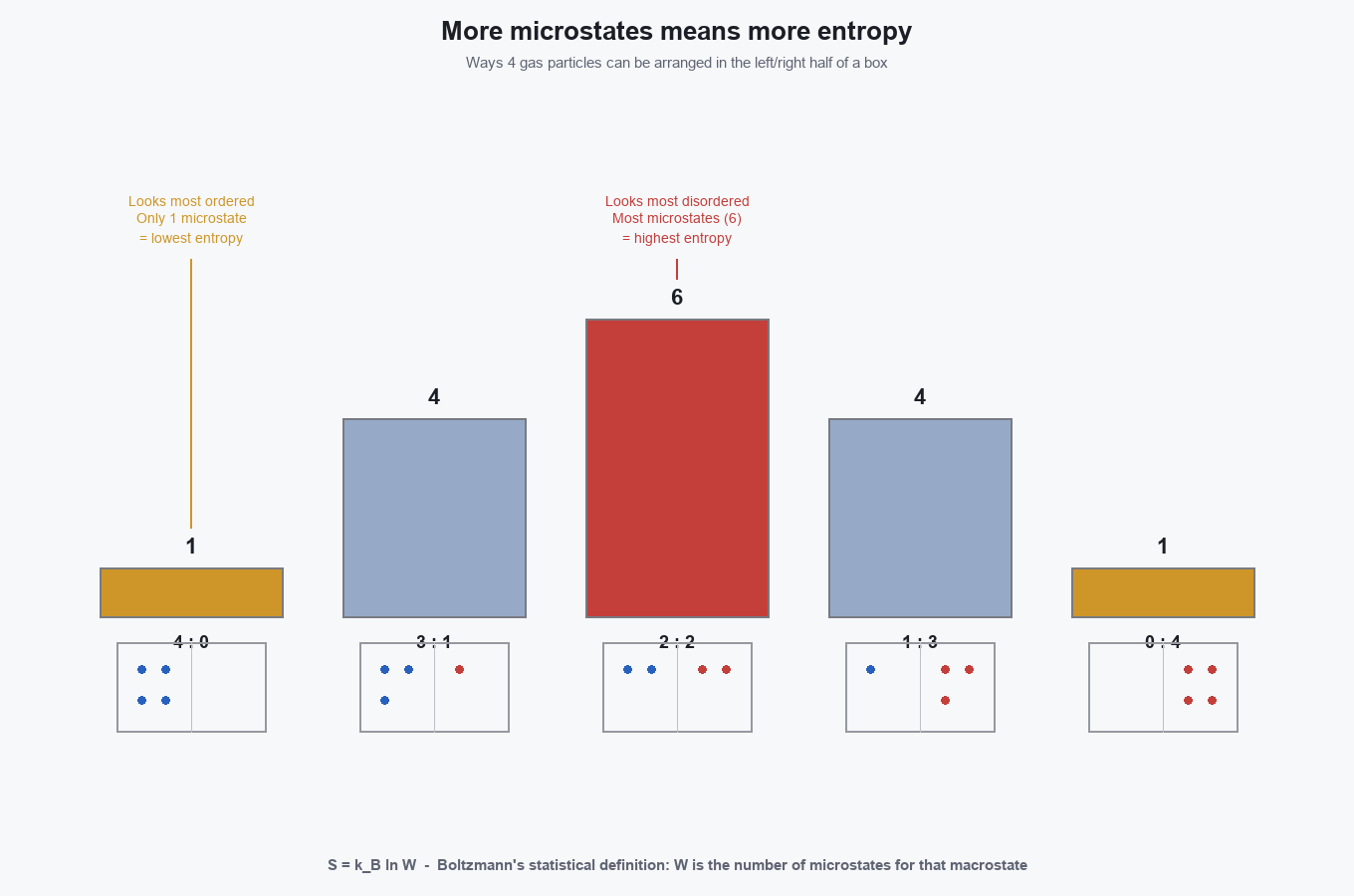
Of these, only one microstate corresponds to the macrostate “all four on the left.” By contrast, the macrostate that looks the most disorderly — “two on the left, two on the right” — corresponds to six microstates (the 3-to-1 and 1-to-3 arrangements each correspond to four). Put together, that’s 1, 4, 6, 4, 1 — summing to exactly 16. The evenly mixed state has higher entropy not because it is “disorderly,” but because the number of ways to reach that state is overwhelmingly larger.
The Law That Clausius Named
This concept took nearly half a century to take its modern shape. It began in 1824, when the French engineer Sadi Carnot, in his book Reflections on the Motive Power of Fire, showed that there is a fundamental limit to the efficiency a heat engine can achieve — what we now call the Carnot cycle and the Carnot theorem.
At this point, however, neither the concept nor the term “entropy” yet existed.
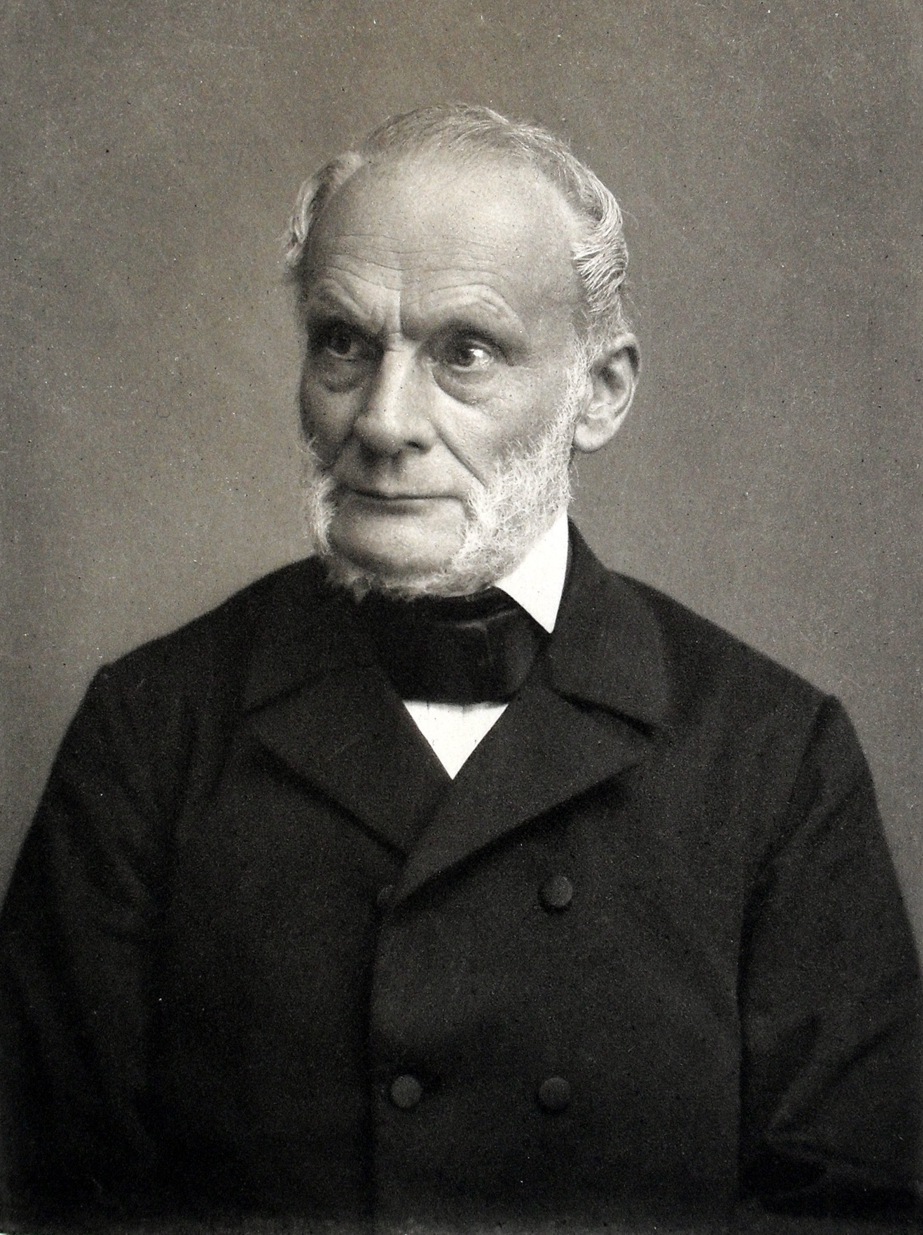
The next key figure is the German physicist Rudolf Clausius.

Around 1850, he formulated the first law of thermodynamics in precise mathematical form and went on to refine the second law. Then, in 1865, he coined a name for the state quantity he had spent roughly fifteen years working out mathematically — “entropy.” He explained that he deliberately coined the word to match the form of “energy” (Energie); its roots are the Greek “en,” meaning “into,” and “trope,” meaning “transformation” or “turning.” In other words, Clausius did not so much “discover” entropy as give an accurate name to a physical quantity he had already worked out, and formalize it in the form of an inequality.
Later, the Austrian physicist Ludwig Boltzmann added a new interpretation to entropy.

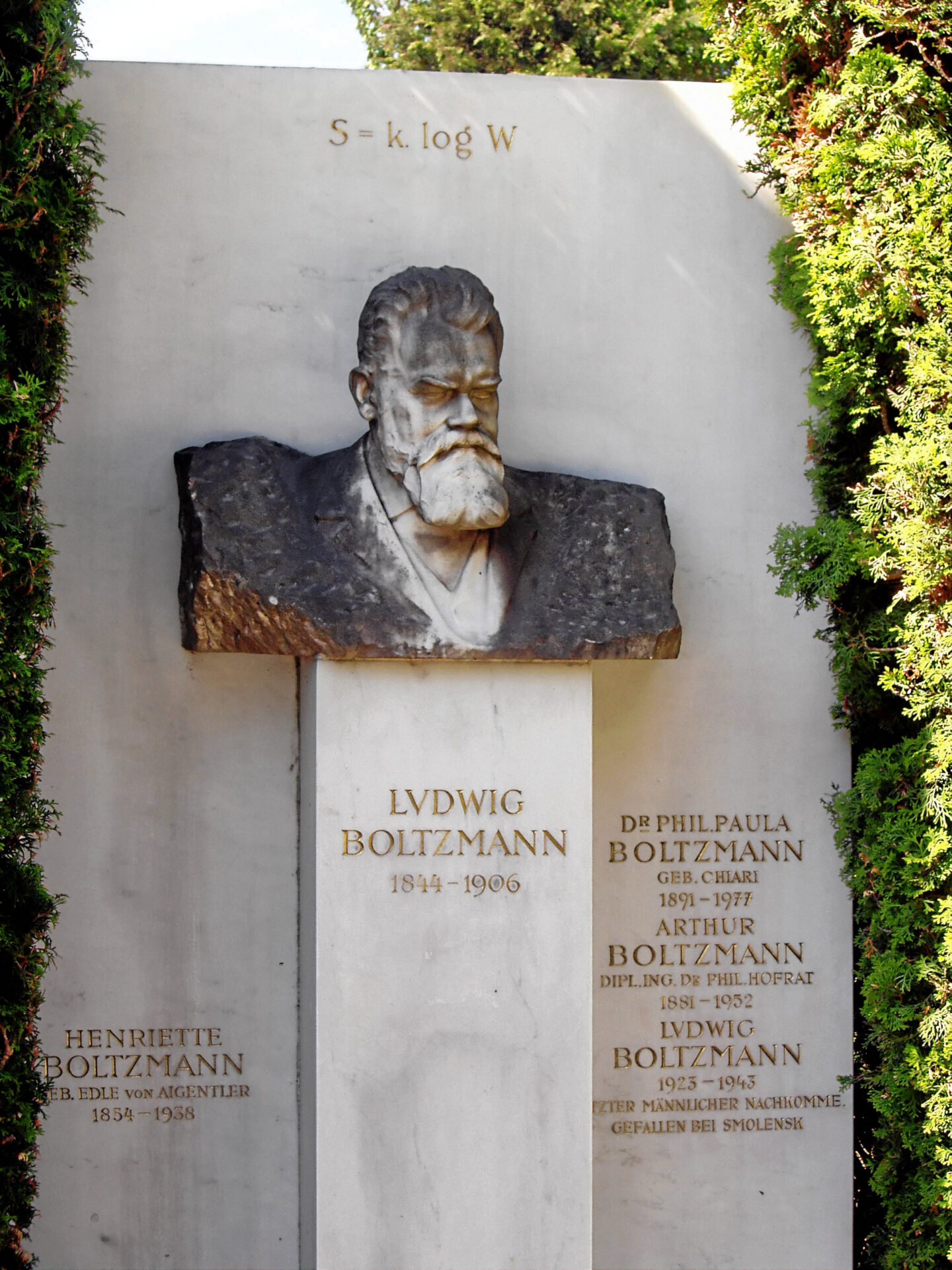
Starting with the H-theorem in 1872 and continuing through a paper in 1877, he laid the statistical-mechanical foundation for connecting entropy to the number of microstates described above. The standard account, however, is that it was not Boltzmann himself but Max Planck — around 1900 to 1901, while studying blackbody radiation — who established the now-familiar compact notation “S = k log W” and first calculated the value of the constant it contains. Planck himself made the origin clear, stating that “the logarithmic relationship between entropy and probability was first suggested by Boltzmann in his kinetic theory of gases.” The constant came to be called the “Boltzmann constant” to honor Boltzmann’s role in laying the conceptual foundation of statistical mechanics, even though it was Planck who completed the precise formula (following the 2019 redefinition of the International System of Units, its value has been fixed exactly at 1.380649×10⁻²³ J/K). Interestingly, this formula is actually engraved on Boltzmann’s tombstone at the Zentralfriedhof (Central Cemetery) in Vienna, Austria.
How Living Things Maintain Local Order
Let’s return to the question of life. As noted above, the second law of thermodynamics only requires total entropy to increase for “isolated systems.” Living things are open systems: they eat food, breathe, and release heat and waste into their surroundings.
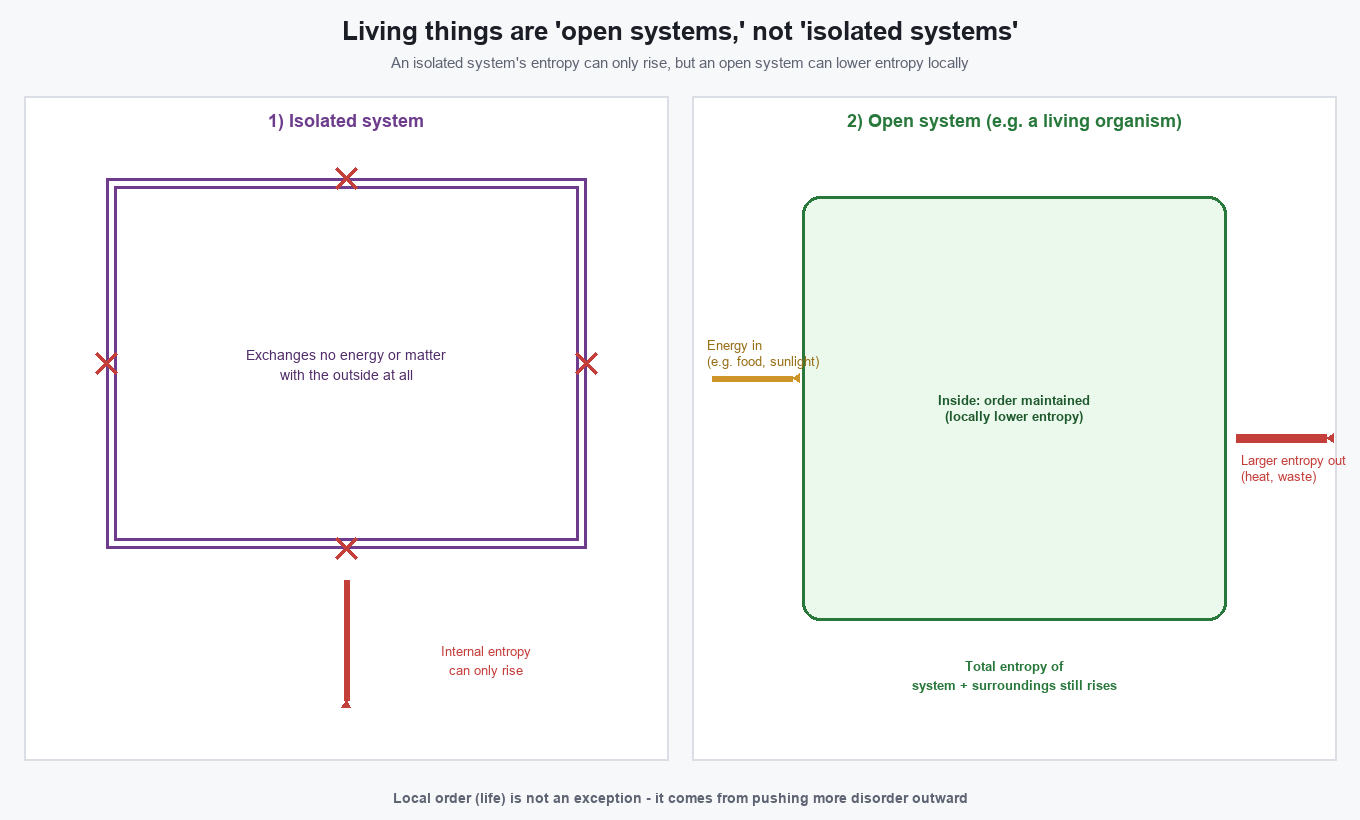
Thanks to this exchange, the interior of an organism can maintain locally low entropy — that is, intricate order. In exchange, the entropy the organism releases into its surroundings increases by more, so the total entropy of “organism plus surroundings” still rises, and this does not contradict the second law.
One of the first people to state this insight clearly was the physicist Erwin Schrödinger. In his 1944 book What Is Life?, he wrote that a living organism continually generates positive entropy while it is alive, tending to approach the state of maximum entropy — that is, death — and that it can only stay clear of that state, i.e., remain alive, by continually drawing “negative entropy” from its environment. In his own words, “What an organism feeds upon is negative entropy.” The French physicist Léon Brillouin later shortened this expression to “negentropy,” and the concept was subsequently refined further by linking it to the idea of free energy.
The person who extended this principle to the level of an entire system is the Belgian chemist Ilya Prigogine. He received the 1977 Nobel Prize in Chemistry for showing that an open system far from equilibrium can, by exchanging (dissipating) energy with its surroundings, spontaneously form coherent order of its own — what he called “dissipative structures.” From simple physical systems like convection cells to cells and ecosystems, an open system with a continuous flow of energy can give rise not to disorder but to new order.
The Universe’s Final Page — Heat Death
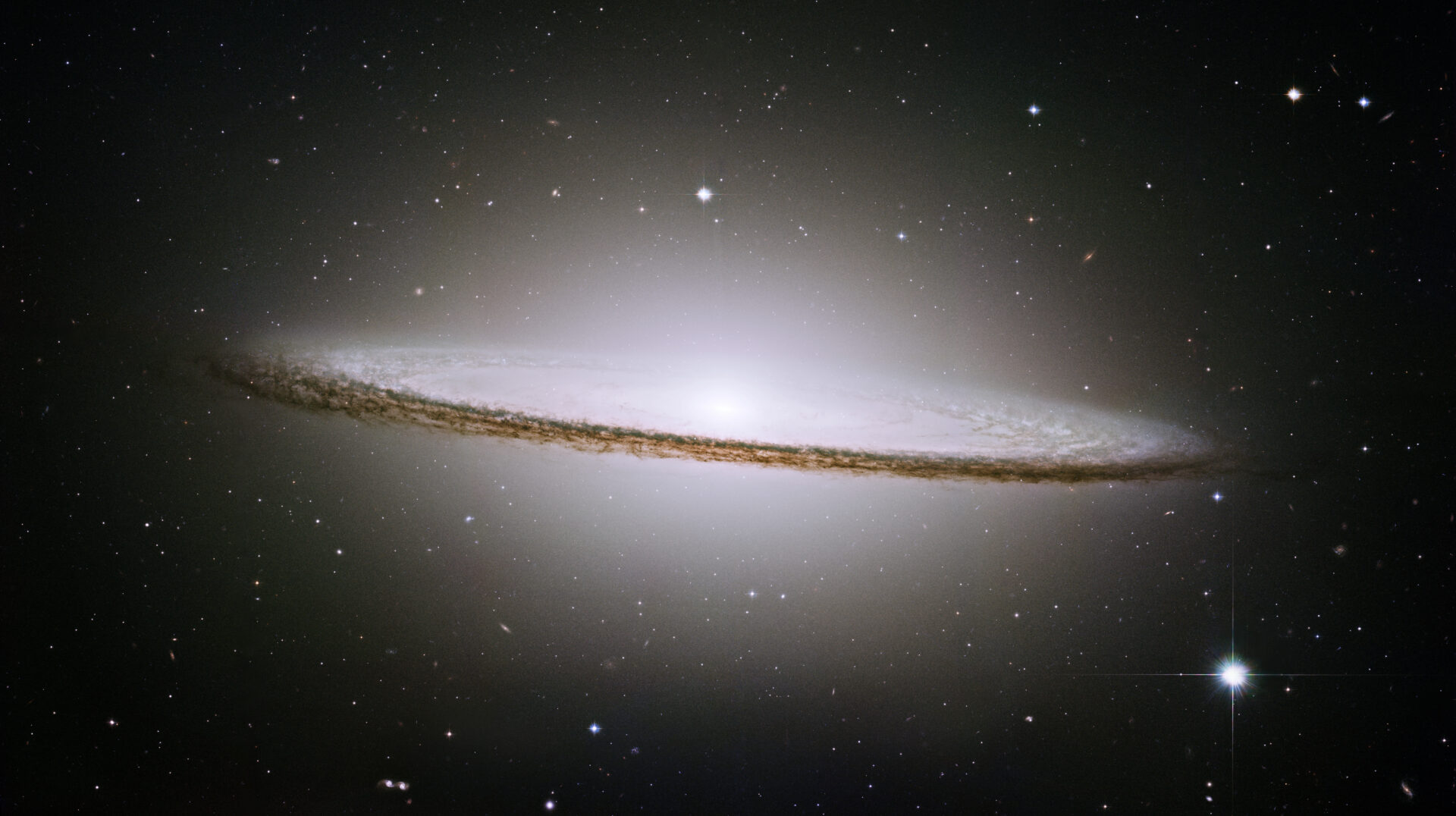
What, then, about the universe as a whole, which surrounds every living thing? If we assume the universe as a whole can be treated as an isolated system, then under the current standard cosmological model — in which dark energy behaves like a cosmological constant and the universe expands forever at an accelerating rate — it is predicted that, given enough time, energy will spread out completely evenly, reaching a state of maximum entropy in which no further work can be done: the so-called “heat death.”
This, however, is only a predicted scenario built on particular assumptions — not an irrefutable, settled conclusion. Observational results from the Dark Energy Spectroscopic Instrument (DESI), published in 2025, suggested that dark energy may not be a fixed constant but could change over time, reigniting debate over how certain this scenario really is. The literature also briefly mentions more speculative possibilities: the Poincaré recurrence theorem, under which a system could, over an extremely long time, happen to return to a state close to its initial one, or a scenario in which a metastable vacuum decays into a true vacuum of lower energy — though these, too, remain speculative. There is even ongoing disagreement among physicists over whether the concept of “the entropy of the universe as a whole” is well defined at all, and whether it is valid to treat the universe as a single isolated system.
To sum up, the universe as a whole is caught up in a vast drift toward disorder. Yet in the midst of that drift, living things — open systems constantly exchanging energy with their surroundings — assemble and repair themselves moment by moment, maintaining intricate order. This is not an exception that defies the second law of thermodynamics, but a finely tuned mechanism operating within the limits the law allows. The closer one looks at this process — each individual cell ceaselessly taking in and releasing energy to preserve its order — the more one notices, again, the intricacy of this mechanism, tuned to let life sustain itself even amid a universe drifting toward collapse.
References
- Wikipedia — Boltzmann's Entropy Formula
- Wikipedia — Boltzmann Constant
- Wikipedia — Heat Death of the Universe
- Wikipedia — Reflections on the Motive Power of Fire
- Wikipedia — Negentropy
- Wikipedia — Microstate (Statistical Mechanics)
- The Nobel Prize in Chemistry 1977
- NIST CODATA — Boltzmann Constant
- Stanford Encyclopedia of Philosophy — Thermodynamic Asymmetry in Time
- Erwin Schrödinger, What Is Life? (1944, Full Original Text)
- National Geographic — DESI Dark Energy Observations (2025)