
Is a refrigerator a machine that makes the inside cold? It’s easy to believe that, since cool air spills out the moment you open the door – but in fact, there is no device inside a refrigerator that manufactures ‘coldness.’ What a refrigerator actually does is the exact opposite. It seizes the heat already inside and forcibly carries it out to the kitchen air outside. That’s all there is to it.
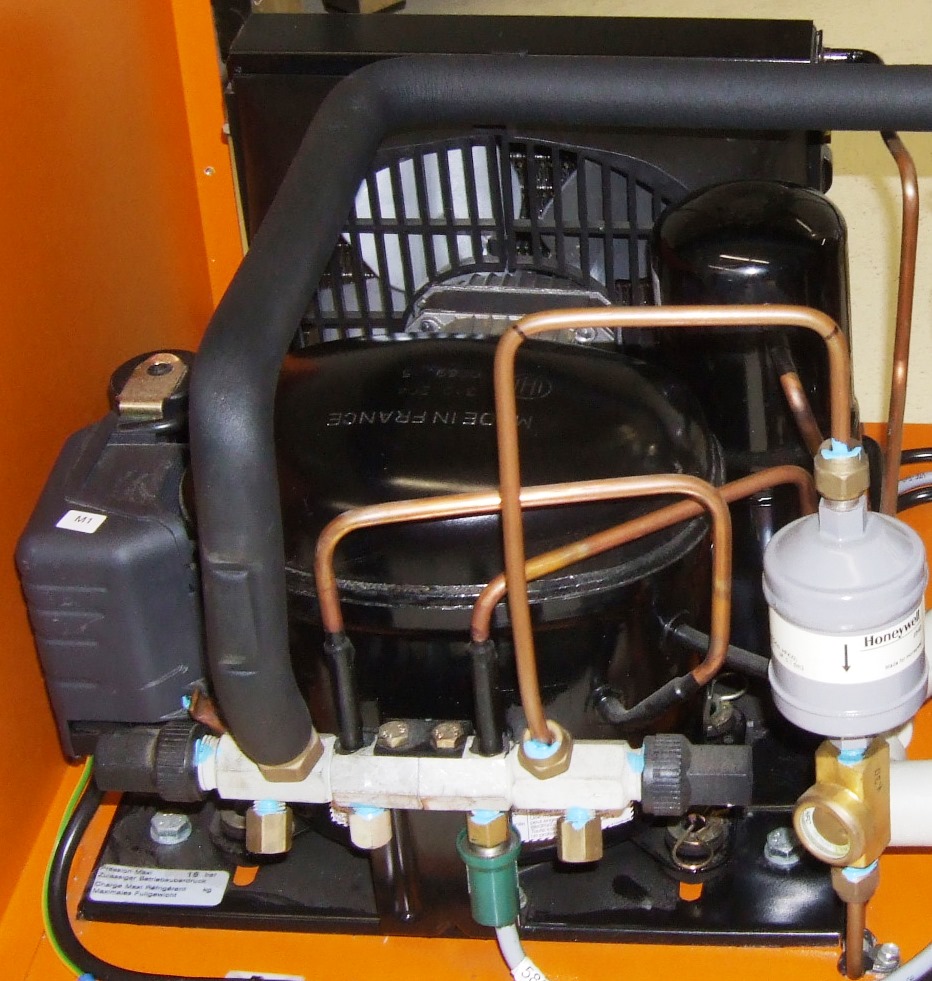
Hidden behind this ordinary-looking box is a compressor that carries out this ceaseless job of moving heat.
Why this is a remarkable feat becomes clear when you look at the second law of thermodynamics. Formulated by Rudolf Clausius in 1850, this law states that heat does not flow spontaneously from a colder body to a hotter one unless work is done on it from the outside. In other words, heat inside the refrigerator (cold) does not spontaneously cross over into the kitchen (hot) under natural conditions. A refrigerator is a device in which the compressor applies exactly this ‘work,’ using electrical energy to forcibly reverse the natural direction of flow.

Before such devices existed, people got their cold by hauling ice harvested in winter into storehouses.

As compression-based refrigeration machines emerged, this ice trade gradually gave way to them.
The specific process by which the compressor carries heat away is explained by the four stages of the vapor-compression refrigeration cycle.
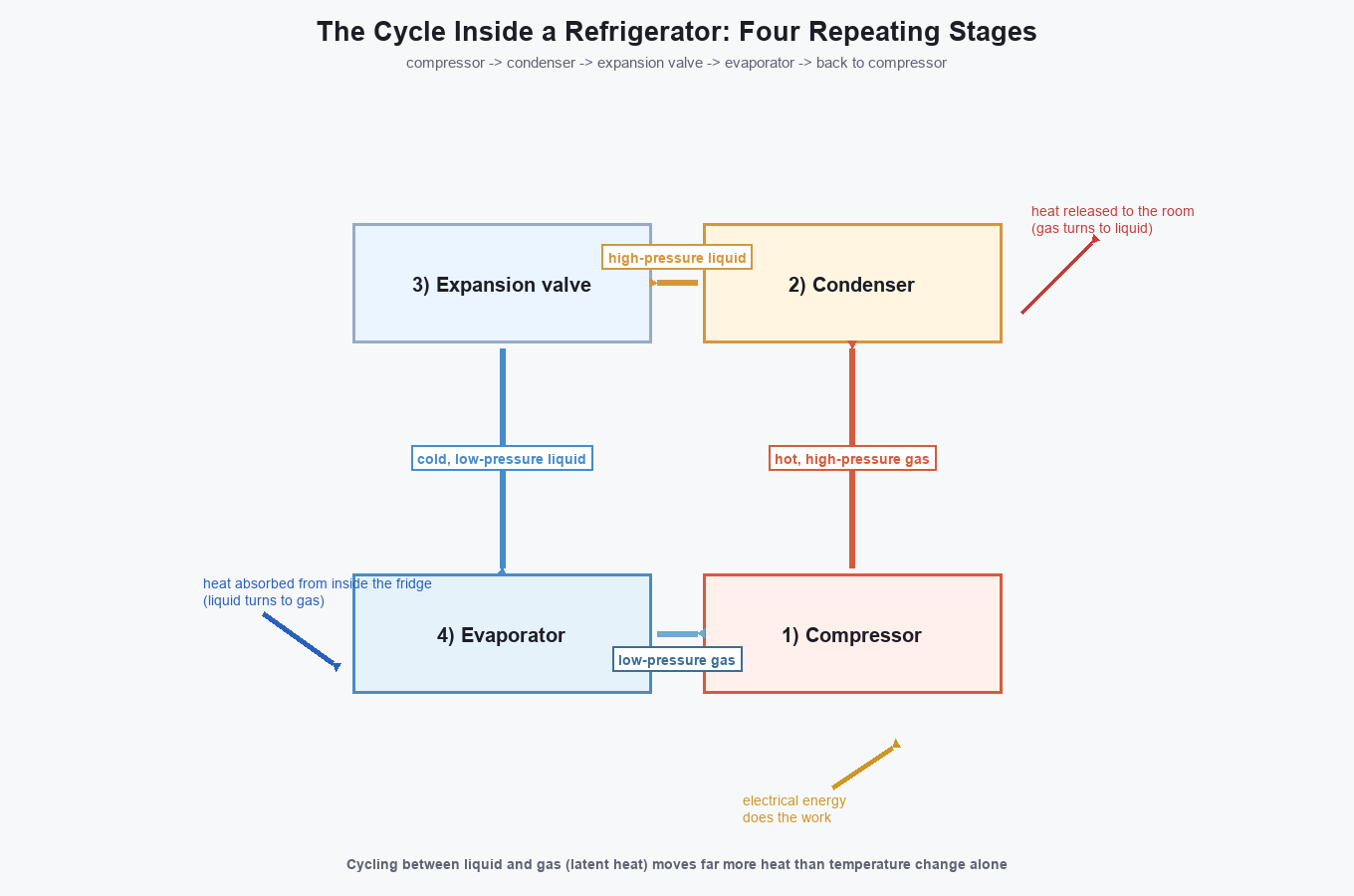
First, the compressor compresses low-pressure gaseous refrigerant into a hot, high-pressure gas. Second, this hot gas passes through the condenser, releasing heat into the room or the coils on the back of the refrigerator, and changes state into a high-pressure liquid. Third, passing through the expansion valve (a capillary tube), its pressure drops sharply, turning it into a cold, low-pressure liquid. Fourth, this cold liquid refrigerant absorbs heat from inside the refrigerator in the evaporator and evaporates into a low-pressure gas – this heat-absorbing step is exactly why the inside of the refrigerator feels cold. The now-gaseous refrigerant returns to the compressor, and the same cycle repeats.
The key to this process is that the refrigerant does not simply rise and fall in temperature – it repeatedly makes use of latent heat, the phase change between liquid and gas. The specific heat of 1 kg of water is about 4,186 J/K, whereas the latent heat of vaporization needed to turn that same 1 kg of water from liquid into gas reaches about 2.26 million joules (2.26×10^6 J) – meaning the energy that vaporizes 1 kg of water is roughly equivalent to the energy that would heat it by about 540 degrees. Because a phase change alone can move this much heat without any change in temperature, the refrigerant can absorb heat efficiently in the evaporator even in small quantities.
The History of Refrigerants – A Safety Fix, and an Unexpected Second Twist
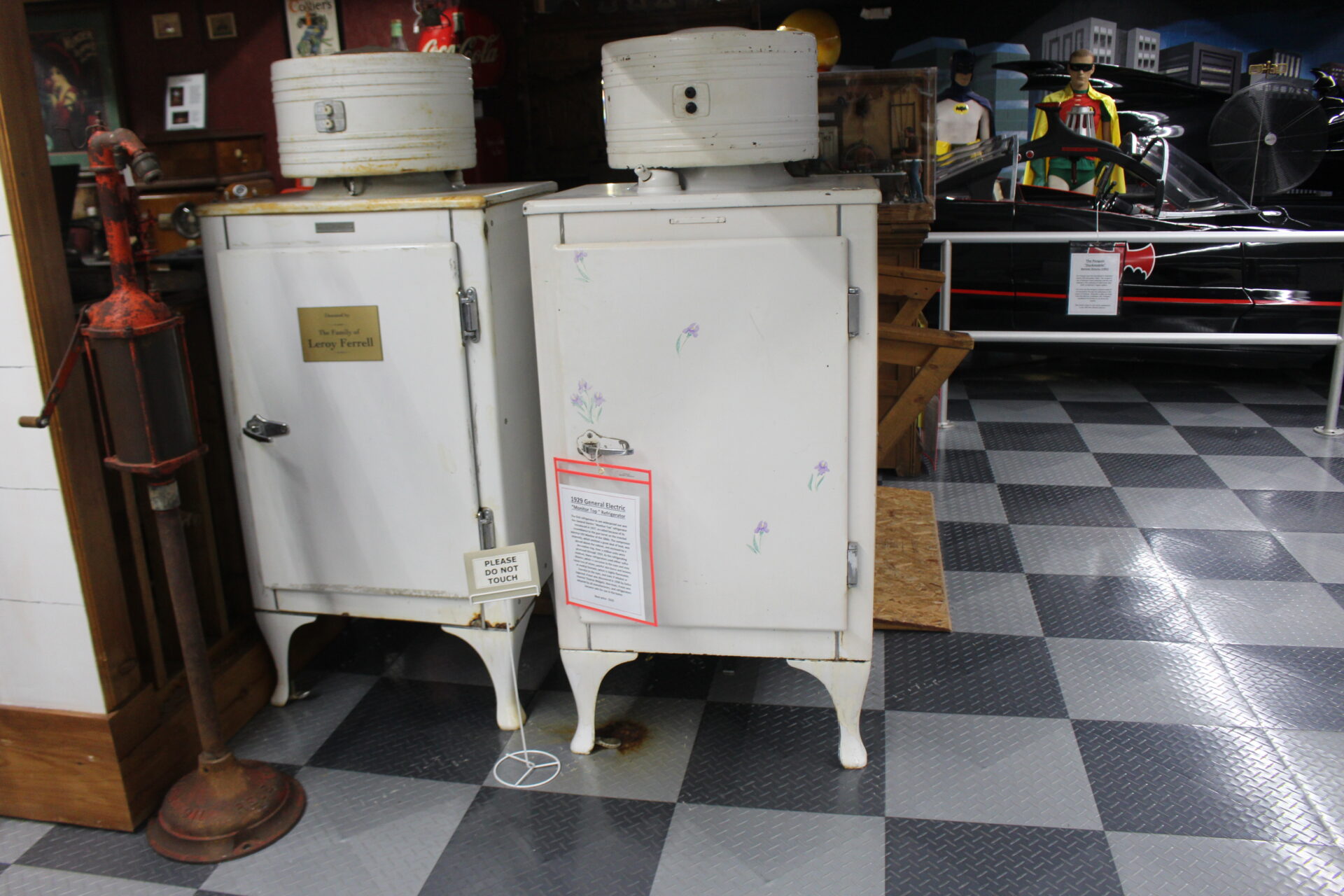
The history of vapor-compression refrigeration itself is tangled up with several competing claims to being ‘first,’ so it’s worth sorting out. In 1834, Jacob Perkins received the first patent for a closed-cycle vapor-compression refrigeration system in Britain, but it remained an uncommercialized prototype. In the late 1850s and 1860s, Ferdinand Carre’s ammonia absorption refrigeration machines were an early example widely used commercially, including in the ice-making industry, and in 1876 Carl von Linde reliably commercialized an improved compression refrigeration machine for industrial settings such as breweries. For household electric refrigerators, Fred Wolf’s Domelre of 1913-14 is counted as an early example, but the first domestic refrigerator to achieve widespread commercial success was the General Electric Monitor-Top, launched in 1927, which sold more than a million units by 1931.
The trouble lay in the refrigerants these refrigerators used. Until the 1920s, household refrigerators ran on toxic, flammable refrigerants such as ammonia, sulfur dioxide, and methyl chloride, and there were real fatalities from leaks. In 1929 in Chicago, a family lost their lives to a methyl chloride leak from their refrigerator – an incident later documented in an industrial-health report published in JAMA (Weinstein, 1937) – and this led to ordinances requiring that a leak be detectable by smell. Searching for a safer alternative, Thomas Midgley Jr., working at General Motors’ Frigidaire and Kettering research laboratories, developed the non-toxic, non-flammable refrigerant dichlorodifluoromethane – Freon-12 (CFC-12) – around 1928. At an American Chemical Society conference in 1930, he publicly demonstrated its non-toxicity and non-flammability by inhaling the gas himself and then exhaling it onto a candle to extinguish the flame. At the time, its effect on the ozone layer was completely unknown.
But there was a twist. In 1974, Mario Molina and F. Sherwood Rowland published a paper in Nature proposing that CFCs destroy ozone in the stratosphere through a catalytic reaction involving chlorine atoms (a contribution for which they shared the 1995 Nobel Prize in Chemistry with Paul Crutzen). In 1985, Joe Farman, Brian Gardiner, and Jonathan Shanklin of the British Antarctic Survey observed an actual ozone hole over Antarctica and reported it in Nature.
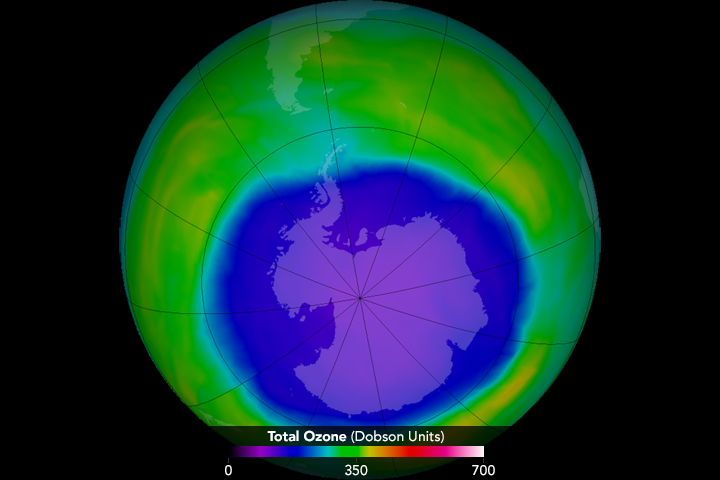
This discovery led to the 1987 Montreal Protocol (a phase-out of CFCs), which entered into force in 1989 and has since become the first treaty in UN history to achieve universal ratification, with 198 parties – 197 countries plus the EU.
But the HCFC and HFC refrigerants that replaced CFCs to save the ozone layer concealed yet another twist. Looking at ozone depletion potential (ODP, on a scale where CFC-11 is set at 1), CFC-12 is highest at about 1, the transitional refrigerant HCFC-22 (chlorodifluoromethane) is much lower at about 0.05, and HFC-134a (1,1,1,2-tetrafluoroethane) contains no chlorine or bromine at all and is effectively 0. Global warming potential (GWP, on a 100-year basis where CO2 is set at 1), however, runs the opposite way and is very high. Under the IPCC’s Fourth Assessment Report (2007), CFC-12 has a GWP of about 10,900 and HFC-134a about 1,430 – meaning the ozone layer was protected, but a new greenhouse-gas problem was created in the process. To address this, the Kigali Amendment was added to the Montreal Protocol in 2016, launching a process to phase down HFCs by more than 80% over roughly 30 years, and more recently the industry has been shifting to low-warming refrigerants such as HFO-1234yf (2,3,3,3-tetrafluoropropene), with a GWP of just 4, and isobutane (R-600a), at around 3.
Looking back over the nearly two centuries the refrigerator has spent developing, what deserves to be singled out as the true work of creation is not the machine humans built, but the physical laws that machine puts to use. The law that heat does not flow from cold to hot unless work is done, and the law that phase changes move far more heat than temperature changes alone, were both in place long before the refrigerator ever existed. Humans, through repeated trial and error, only discovered these laws belatedly and learned how to build machines that harness them.
References
- Nuclear-Power.com – Clausius Statement of the Second Law of Thermodynamics
- Nature – Molina & Rowland (1974), Stratospheric sink for chlorofluoromethanes
- Nature – Farman, Gardiner & Shanklin (1985), Large losses of total ozone in Antarctica
- NobelPrize.org – The Nobel Prize in Chemistry 1995, Press Release
- UNEP Ozone Secretariat – The Montreal Protocol on Substances that Deplete the Ozone Layer
- UNEP Ozone Secretariat – The Kigali Amendment (2016)
- US EPA – Understanding Global Warming Potentials
- US EPA – HFO-1234yf Final Fact Sheet (SNAP)
- ASME – Perkins Vapor-Compression Cycle for Refrigeration (Historic Mechanical Engineering Landmark)
- JAMA (1937, Weinstein) – Methyl Chloride (Refrigerator) Gas Poisoning: An Industrial Hazard