
This tiny hunter — hopping playfully from thread to thread — is familiar to pop culture as Spider-Man. Yet real jumping spiders have neither the stereo vision humans use to judge distance with two eyes, nor a precision lens like a camera’s. How does an animal whose body is shorter than a single finger joint, and whose neuron count doesn’t even match that of a human toe, calculate the distance to its prey and leap with pinpoint accuracy? The answer, surprisingly, lies in an eye structure that deliberately keeps part of the image out of focus.
Eight Eyes, a Brain Smaller Than a Fingernail
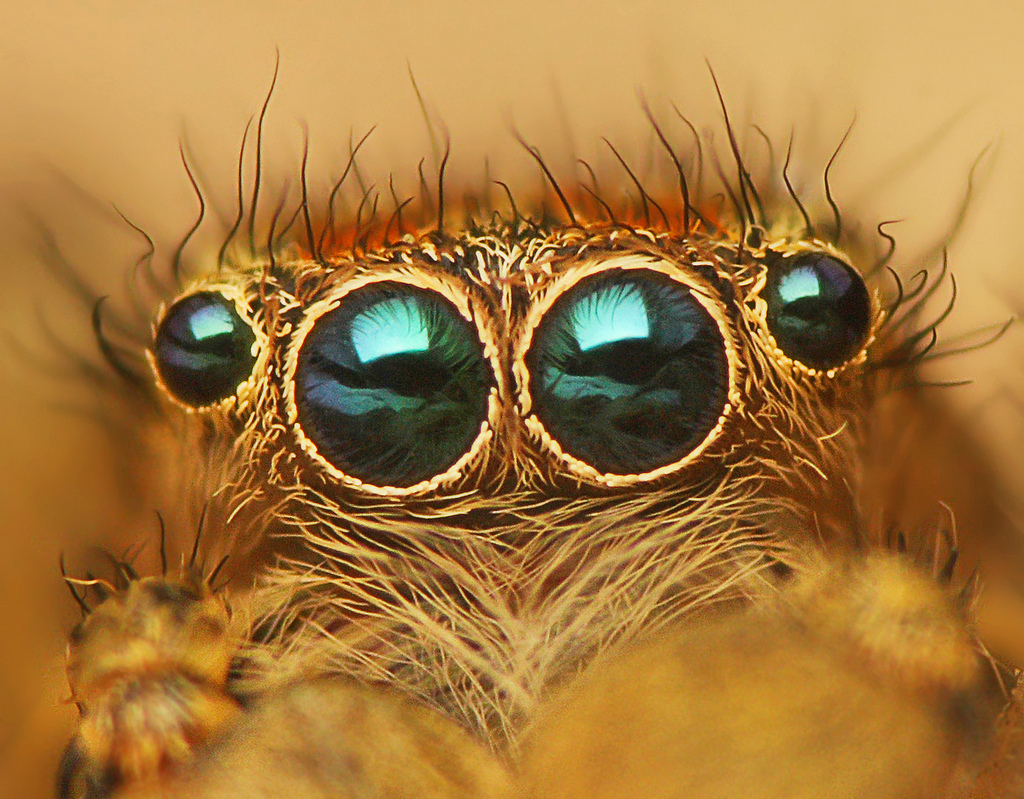
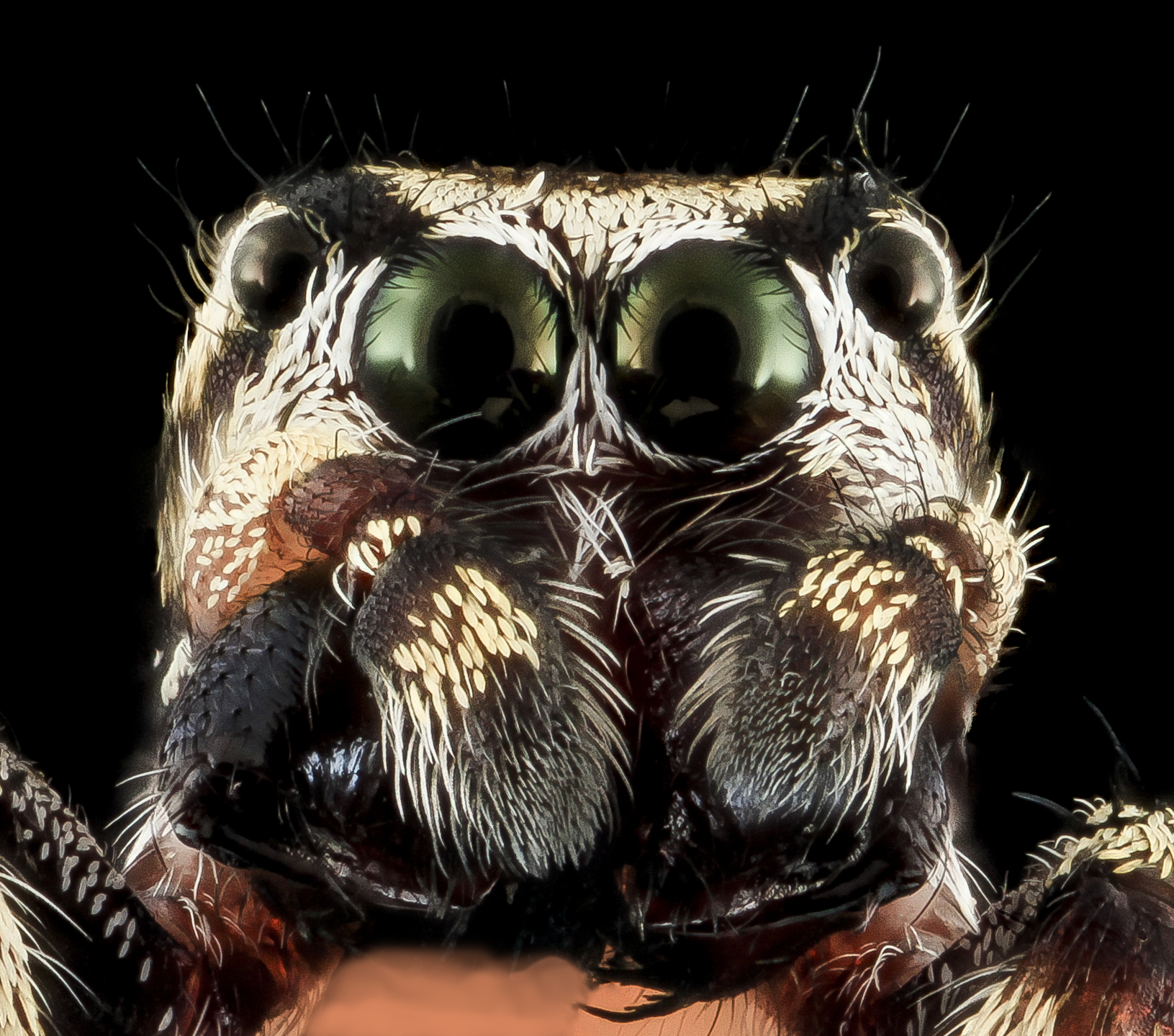
The jumping spiders’ family, Salticidae, is the largest spider family of all, with roughly 7,000 described species — about 13% of all known spider species. Their most striking feature is the arrangement of eight eyes on the face, in four pairs. The large, movable front-facing pair are the principal eyes (anterior median eyes, AME); the remaining three pairs surrounding them — the anterior lateral eyes, posterior median eyes, and posterior lateral eyes — are the secondary eyes. The secondary eyes act as a wide-angle alarm system, catching movement in the periphery, while the demanding work of sharply resolving objects and judging distance falls entirely to the two principal eyes.
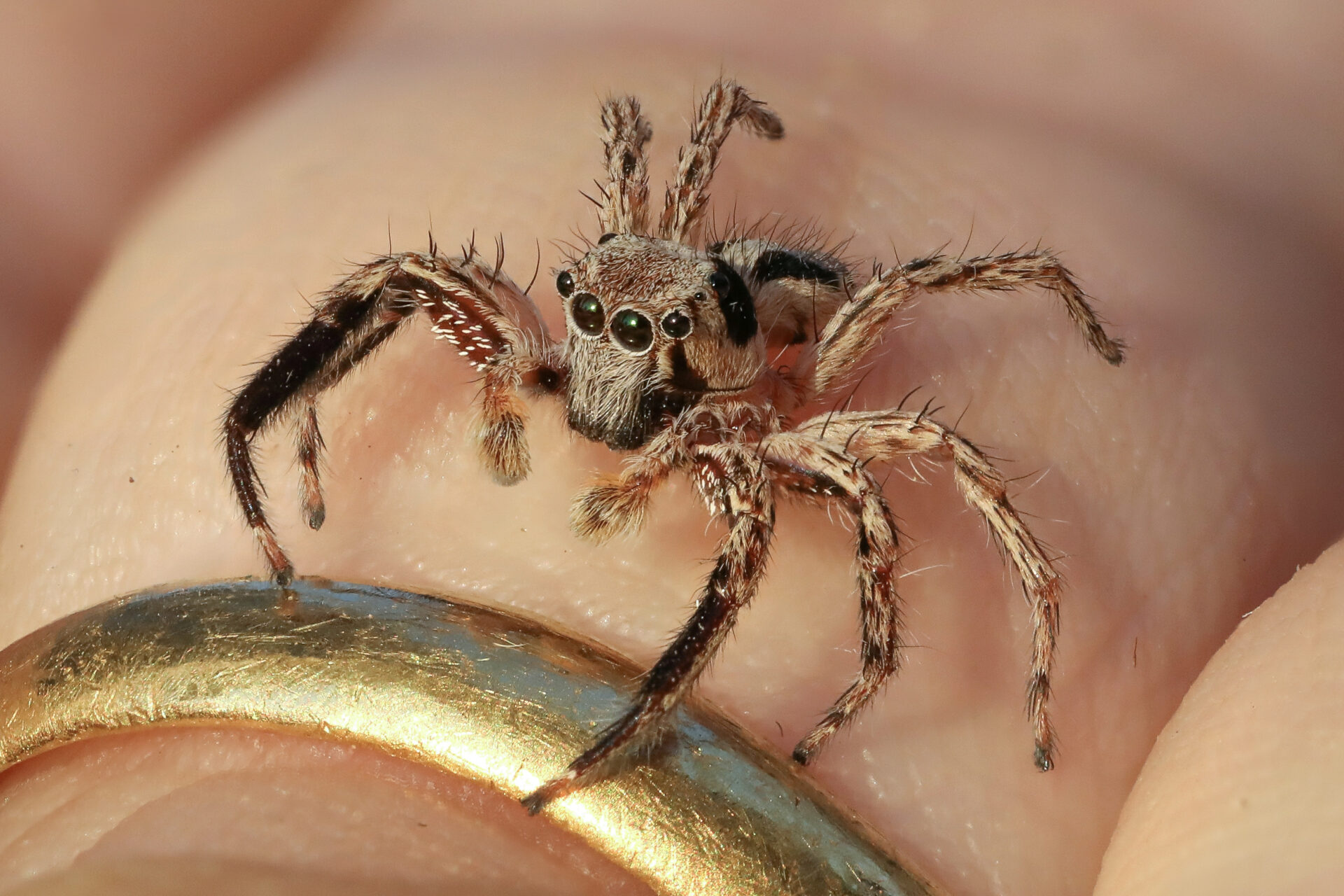
It’s worth pausing on body size here. Jumping spider body length varies by species but is generally tiny. According to researchers who study spider nervous systems, the smaller a spider’s body, the larger the share of its total volume taken up by the central nervous system — in the smallest species, the nervous system has been reported to fill much of the interior of the body and even extend into the legs. Even so, jumping spiders display complex hunting behavior: stalking prey covertly, plotting detours, and leaping with precision. Wikipedia goes so far as to describe this sophisticated behavior as “difficult to reconcile with an organism with such a small brain.” Without a two-lens camera or a large brain, where does this distance calculation actually happen?
Four Retinal Layers, and One Deliberately Out of Focus
A 2012 study by Nagata et al., published in the journal Science, supplied the key answer to this puzzle. The principal eyes of jumping spiders are built in a way that’s completely unlike the human eye. Their retina is stacked in four layers, front to back, with the lens designed so that light of different wavelengths comes into focus on different layers. The phenomenon where the focal point shifts slightly depending on the wavelength of light passing through a lens is called chromatic aberration. In a human eye this would be treated as a flaw, but the jumping spider’s eye actively puts this same chromatic aberration to work as a tool for measuring distance.
Here’s how the mechanism works. The photoreceptor cells in the innermost (deepest) layer and the layer immediately in front of it both contain the same visual pigment, sensitive to green light. But because of the lens’s optical design, green light comes into sharp focus only on the deepest layer. The layer in front of it receives the same green information yet is never in focus, so its image is always blurry. This “constant blur,” which at first glance looks like a design flaw, is in fact the key source of information. Because the degree of blur (defocus) between the two layers changes in a predictable way, governed by the laws of optics, depending on whether an object is near or far, the spider can calculate distance simply by comparing the images from the two layers — without any separate stereo vision or precision lens. Unlike a human measuring distance by triangulating with two cameras, a jumping spider places a “sharp layer” and a “deliberately blurred layer” side by side within a single camera and reads depth purely from the difference between them. Follow-up studies have since worked out the physical basis for this defocus in the absorption spectrum of the visual pigment, and even proposed computational models linking the degree of blur to actual distance, lending further support to the hypothesis.

One point is worth clarifying here. This principle is distinct from the question of color vision — whether “spiders are good at telling colors apart.” What the jumping spider’s principal eyes exploit isn’t a fine-grained ability to distinguish many colors, but simply the optical fact that a lens focuses different wavelengths at different points. In other words, these eyes don’t so much “see color” as “measure the difference in blur that color produces.” Distinguishing colors and judging distance are entirely different tasks, and the jumping spider’s story belongs to the latter.
Tricking the Spider by Changing the Color of Light
That this hypothesis is more than mere anatomical speculation was confirmed through behavioral experiments. Researchers artificially varied the wavelength of light illuminating jumping spiders and observed how far the spiders actually jumped. If the chromatic-aberration-based defocus mechanism is real, then changing the illumination’s wavelength should produce a systematic error in the spider’s distance judgment — even at the same physical distance, the degree of blur on the retina would shift. The experimental results matched that prediction exactly: changing the wavelength of the light shifted the spiders’ judgment of jump distance right along with it. Without ever looking directly at the lens or the nervous system, the researchers verified the mechanism simply by shaking the spider’s internal “ruler” with a change in the color of light.
From Stalking to a Safety Line: A Finely Interlocked Hunting Sequence
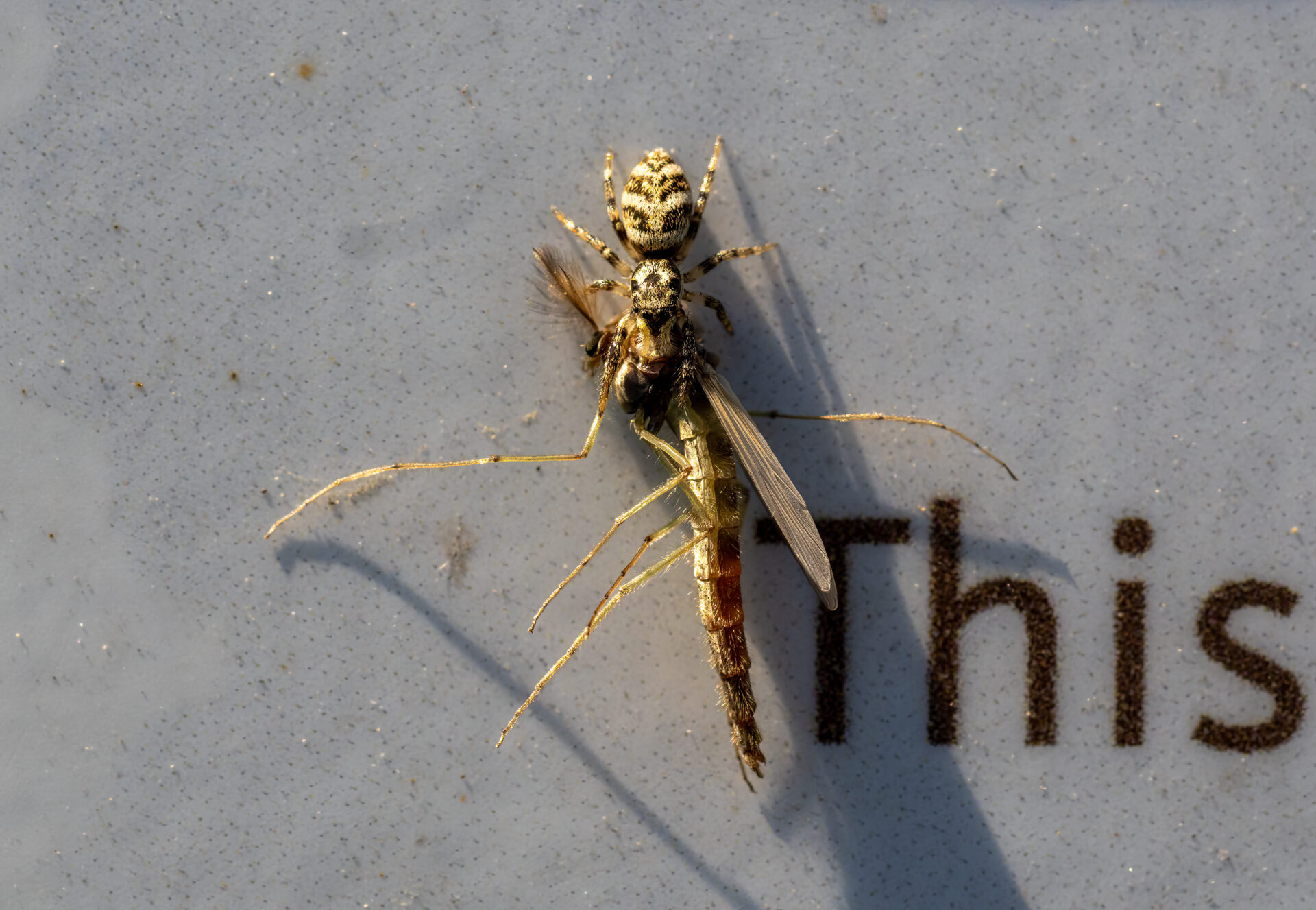
This calculated distance information feeds directly into hunting behavior. When a jumping spider spots prey, it doesn’t lunge right away — it carefully stalks closer first, then, once within jumping range, leaps with precision. Right before jumping, it always attaches a single strand of silk to itself: a safety line, or dragline. If the leap misses or the landing fails, this thread acts as insurance, keeping the spider from falling.
What stands out is that this entire process runs on vastly fewer neural resources than a human brain, though the exact ratio hasn’t been established. Implementing stereo vision requires complex neural circuitry to reconcile the images arriving from two eyes, but in the chromatic-aberration-based defocus approach, the physical design of the lens itself takes on much of that computational burden. By shifting the load of information processing from the nervous system to the optical structure, this approach offers a remarkably efficient solution to the challenge of achieving precise function with limited resources inside a tiny body. Drawing inspiration from exactly this principle, the European Space Agency (ESA) has pursued a project to develop low-power distance sensors for small spacecraft, and a Harvard University research team used metalens technology to build an ultra-compact 3D camera that measures depth from a single shot. A principle housed in an eye the size of a millimeter is now being applied to the design of spacecraft and cameras alike.
An Ingenious Design Packed Into a Tiny Eye
This eye structure — reading distance from nothing more than the blur that color produces, with no large brain and no two cameras — shows just how many different ways an intricately designed creation can solve the very same problem. By turning the lens’s own physical properties into a computing device, this design principle relieves the burden on limited neural resources. Quietly, within a body smaller than a fingertip, it demonstrates just how precise a solution can be when a task in nature demands both compactness and efficiency.
References
- Depth perception from image defocus in a jumping spider – PubMed (Nagata et al., Science 2012)
- Depth Perception from Image Defocus in a Jumping Spider | Science
- Contribution of a visual pigment absorption spectrum to a visual function: depth perception in a jumping spider – PubMed
- Coding depth perception from image defocus – PubMed
- Jumping spider – Wikipedia
- Small Spiders Have Big Brains That Spill Into Their Legs – National Geographic
- Jumping Spider Vision | ACT of ESA
- Compact single-shot metalens depth sensors inspired by eyes of jumping spiders – PMC