
Strike the Divine Bell of King Seongdeok (聖德大王神鐘) in Gyeongju once, and the sound does not vanish at once. It swells with a low “woong,” fades, revives, and fades again — a pulsing that repeats as though the bell were breathing. The reason this bell, cast more than 1,200 years ago, still sounds alive today is not mystery but physics. The key word is “beat.”

Bernard Gagnon · CC0 · Wikimedia Commons
The swelling and fading sound: what is a beat?
A beat is a phenomenon that arises when two tones of nearly the same frequency overlap. When the two waves add together the sound grows louder (constructive interference); when they fall out of step it grows quieter (destructive interference). As a result, the loudness of the sound rises and falls at a regular rhythm.
How fast the beat is depends solely on the difference between the two frequencies. If the two tones are f₁ and f₂ hertz, the beat frequency is their difference (|f₁ − f₂|), and the beat period is the reciprocal of that difference. The smaller the frequency difference, the more slowly the sound undulates.
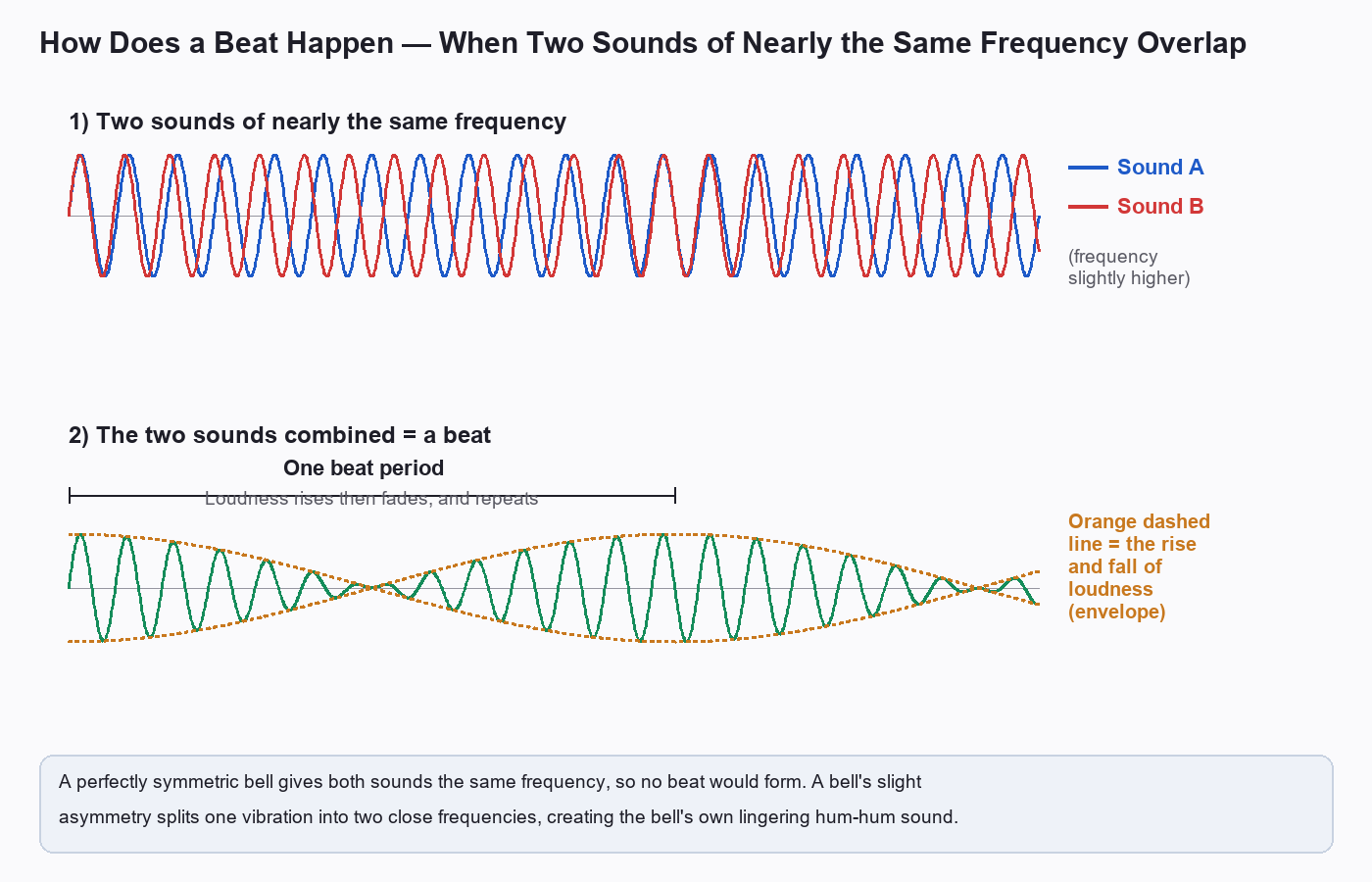
Diagram · created by glu.kr
A perfectly symmetric bell cannot produce a beat
Here is the twist. For a beat to occur, there must be two tones with slightly different frequencies. Yet in theory a bell of perfect rotational (axial) symmetry cannot produce a beat, because in a perfectly symmetric bell the same vibrational mode has only a single frequency, no matter which direction the bell is struck.
Real bells are different. Because of surface patterns and reliefs, thickness that varies from spot to spot, differences in material density, and tiny fluctuations during casting, a real bell departs ever so slightly from perfect symmetry. According to a study by the team of Kim Seok-hyun (Kangwon National University), Lee Chi-wook, and Lee Jang-moo (Seoul National University) published in the Journal of Sound and Vibration (2005), this slight asymmetry of Korean bells splits a single vibrational mode into a “mode pair” whose frequencies differ only slightly. The two split frequencies interfere with each other, and a beat is born. This is called mode splitting.
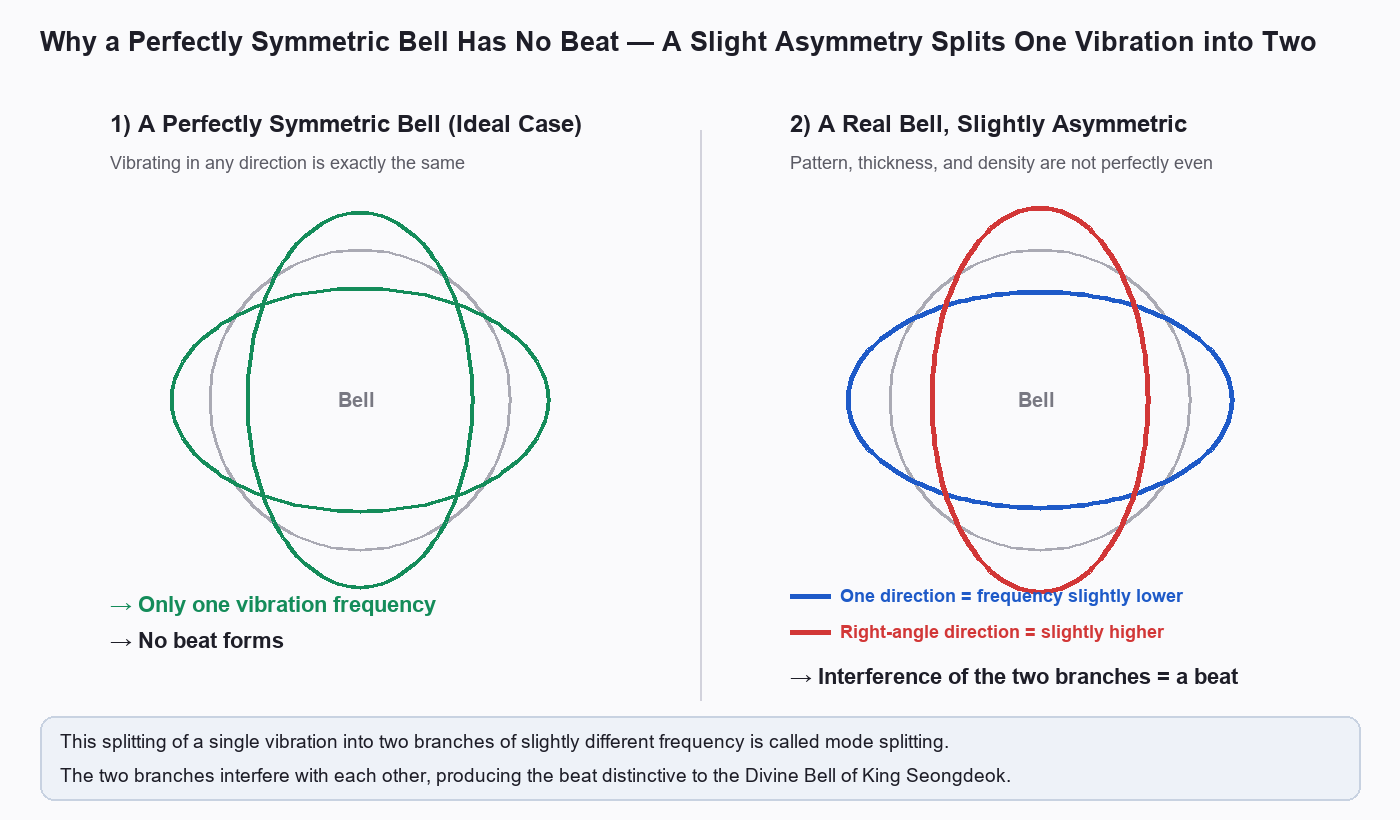
Diagram · created by glu.kr
The two rhythms of the Divine Bell of King Seongdeok
The Divine Bell of King Seongdeok is reported to have some fifty natural frequencies within 1,000 hertz. Among them, two bands lead the sound: a low hum band and a higher fundamental band. The figures reported through the press and research are as follows.
- Low tone (hum), around the 64-hertz band: it splits into 64.07 hertz and 64.42 hertz, and the roughly 0.35-hertz difference produces a beat period reported to be about 2.9 seconds (about 3 seconds).
- High tone (fundamental), around the 168-hertz band: it splits into 168.52 hertz and 168.63 hertz, and the roughly 0.11-hertz difference produces a beat period reported to be about 9 seconds (about 9.1 seconds).
In other words, on top of the quickly undulating hum with its roughly 3-second cycle, a larger wave with a roughly 9-second cycle — in which the sound nearly disappears and then revives — is superimposed. The overlap of these two rhythms creates the impression that the bell is breathing. That said, the frequency values down to the decimal have circulated mainly through press reports, and may differ slightly from the precise values in the original paper.
Asymmetry: intention or by-product?
An interesting question remains. Was the asymmetry that produces this beat deliberately introduced by the craftsmen, or did it arise unavoidably during casting? Neither scholars nor the press assert one side. In general the beat is explained as something “that arises from” the bell’s slight asymmetry, and that asymmetry is regarded as a positive element that lends the bell its mellow, richly varied tone.
On the other hand, it has been reported that the Divine Bell of King Seongdeok is so precise that the error at its striking point (the sweet spot) is only 0.3 percent, which shows the high technical skill of its makers. Yet this precision is not itself proof that “the beat was deliberately designed.” It is closer to the current evidence to see a living sound, left by asymmetry, laid over an exquisitely refined result.
The structure unique to Korean bells that amplifies the sound
The Divine Bell of King Seongdeok narrows toward the top, resembling an inverted earthenware jar. Unlike Western bells, which are struck from the inside by a metal clapper, Korean bells are struck from the outside with a wooden mallet called a dangmok (撞木). The striking spot, the dangjwa (撞座), is decorated with a lotus pattern and set in two places, front and back.

Steve46814 · CC BY-SA 4.0 · Wikimedia Commons
Korean bells have two more structures not found in the bells of other countries: the tube-shaped eumtong (音筒) beside the dragon hook (龍鈕) at the top of the bell, and the myeongdong (鳴洞), a resonant cavity made by digging into the ground beneath the bell or burying a jar there. For the eumtong, an “acoustic filter” hypothesis has been proposed — that it lets high-frequency noise escape quickly and clears the lingering tone — but several views coexist, such as a symbolic link to the “flute that calms ten thousand waves” (Manpasikjeok) or a gas-venting function during casting, and none has hardened into settled theory. The myeongdong, too, is proposed to amplify the lingering tone through low-frequency resonance, but the Encyclopedia of Korean Culture notes that research into its role is still insufficient.
Along with this acoustic structure, the body of the bell bears reliefs of apsaras (飛天像) in a posture of offering (供養). Kneeling on a lotus seat with their hands pressed together, their heavenly garments (天衣) and ornamental flowers streaming like clouds, they are counted among the finest examples of Korean apsara carving, rarely matched by other Silla bronze bells.

Josep Panadero · CC BY-SA 4.0 · Wikimedia Commons
The Emille legend and the record the bell left of itself
The Divine Bell of King Seongdeok is commonly called the “Emille Bell.” The name comes from a legend that, to complete the bell, a young child was received as an offering and cast into the molten metal, so that the bell’s sound is said to resemble a child crying “Emille” (mother) for its mother. But this human-sacrifice story contradicts the record the bell left of itself.

Josep Panadero · CC BY-SA 4.0 · Wikimedia Commons
The body of this bell is inscribed with about 1,000 characters (some 1,037 in all, said to comprise a preface of about 630 characters and a verse of about 200). Written by Kim Pil-o, a court scholar (Hallimnang), the text praises the merits of King Seongdeok and records how the bell came to be made — begun at the vow of King Gyeongdeok and completed in 771, during the reign of King Hyegong. Nowhere, however, is there any mention of a human sacrifice of a child.
Moreover, the human-sacrifice tale appears nowhere in contemporary or Goryeo-era records such as the Samguk Yusa or the Samguk Sagi. Its first confirmed appearance in print is the children’s story “Eomilne Jong” by Yeom Geun-su, published in the Maeil Sinbo on August 5, 1925 — a later folk tale put into print only in the modern era, not in the days of Unified Silla. There is scientific support as well: in 1998, at the request of the Gyeongju National Museum, the Research Institute of Industrial Science and Technology (RIST) took samples from twelve places on the bell and found no trace of phosphorus (P), the main component of bone.
Closing
This bell was first hung at Bongdeoksa (奉德寺); after that temple disappeared it was moved to Yeongmyosa (靈廟寺), then to a bell pavilion below Bonghwangdae (鳳凰臺) by the Gyeongju town wall, and in 1915 it was carried, drawn by many hands, toward the museum in Gyeongju. Having crossed more than 1,200 years while changing its place like this, the bell still rings today by the same principle.

Unknown author · Public domain · Wikimedia Commons
Completed in 771, the Divine Bell of King Seongdeok is the largest surviving Silla bell; its weight, precisely measured by the Gyeongju National Museum in 1997, is about 18.9 tons. The reason this enormous mass of bronze still sings as if breathing is no supernatural tale, but a beat created by a form that departs ever so slightly from perfect symmetry. It is a beauty explained by physics — shaped together by exquisite human skill and the tiny imperfection left upon it.
References
- Encyclopedia of Korean Culture — Divine Bell of King Seongdeok
- Encyclopedia of Korean Culture — Buddhist Temple Bell (梵鐘)
- Wikipedia (Korean) — Divine Bell of King Seongdeok
- Wikipedia (Korean) — Beat
- Kim, Lee & Lee, “Beat characteristics and beat maps of the King Seong-deok Divine Bell”, JSV 281 (2005)
- NASA ADS — bibliographic record of the paper above
- The Kyunghyang Shinmun — the beat and the sweet spot of the Divine Bell of King Seongdeok
- The Kyunghyang Shinmun — Emille: after a thousand years, the sound that stirs the heart has a secret (Do Jae-gi’s Millennial Fragrance)
- National Heritage Knowledge Portal — inscription of the Divine Bell of King Seongdeok (epigraphy DB)
- Our History Net — Divine Bell of King Seongdeok