
Look closely at a lotus leaf on a rainy day and something strange happens. Raindrops do not soak into the leaf; they turn into perfect pearls and roll around. Tilt the leaf a little and the droplets slide off, leaving not a trace of moisture behind. We usually assume this is “because the surface is smooth.” In fact it is the opposite. The secret to how a lotus leaf repels water is not that it is smooth, but that it is roughened with invisible precision.
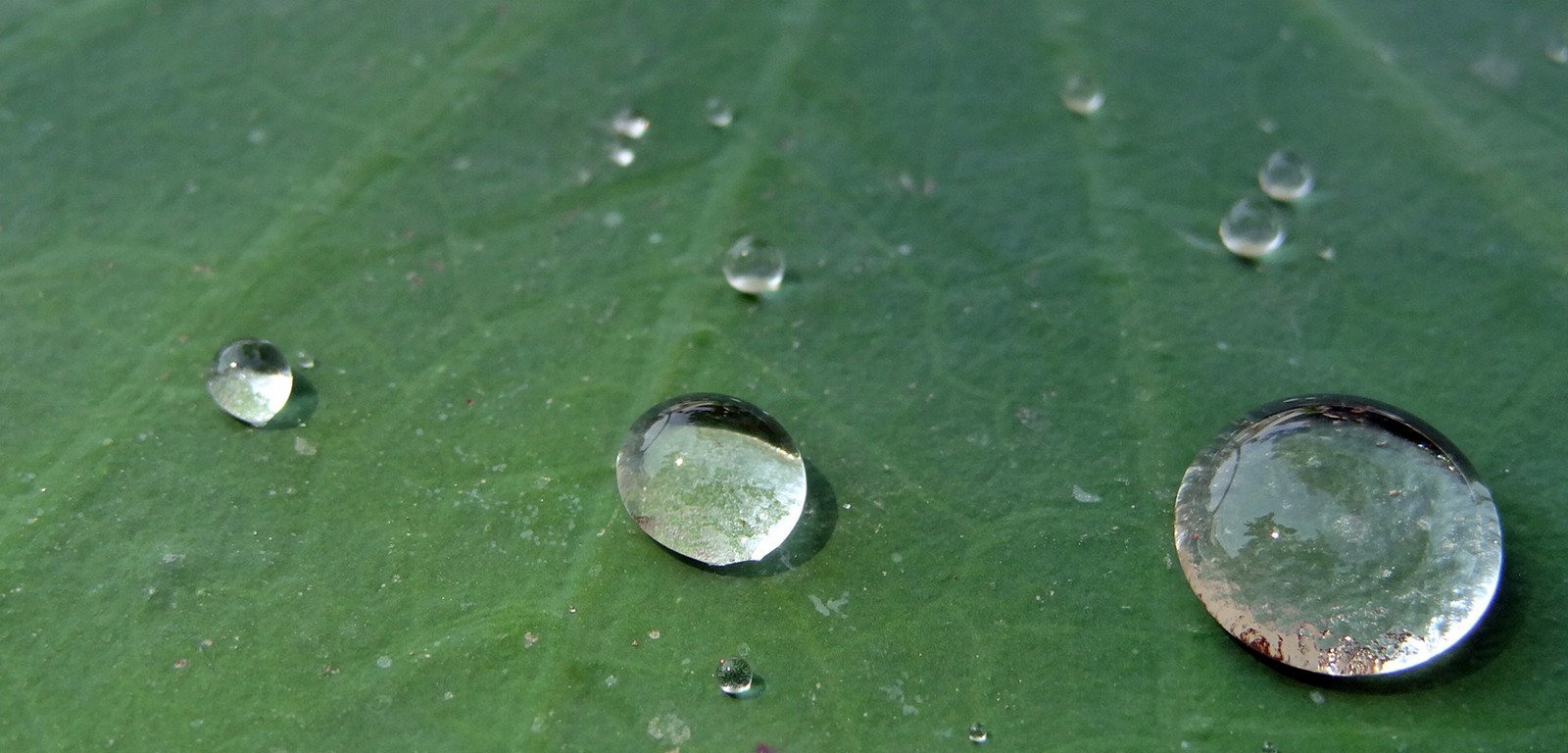
Photo: Aathavan jaffna · CC BY-SA 3.0 · Wikimedia Commons
This counterintuitive phenomenon has a name: the “lotus effect.” It refers to the self-cleaning ability of the lotus, whose leaves and flowers stay clean even while growing out of the mud. It is no accident that Buddhism and its temples have long held the lotus up as a symbol of purity — rising from the mud yet never stained. It is one of those rare cases where the symbol is backed by real surface science. In this single small leaf that God created lies a design principle that today’s materials engineering still strains to imitate.
The lotus, a leaf that rises above the mud
The lotus (Nelumbo nucifera) is an aquatic perennial in the family Nelumbonaceae, an ancient lineage of which only two species survive on Earth today. It roots in the mud, but its leaves and flowers rise above the water — it is an emergent plant. Young leaves at first bob as if floating on the surface, and once the water warms, the petiole pushes the leaf up to about 2 m above the water. The leaves are shield-shaped, 0.2–1 m across (with the petiole attached at the center of the underside), and their waxy surface repels water. The seeds are extraordinarily long-lived; there is even a record of a 1,300-year-old seed germinating.
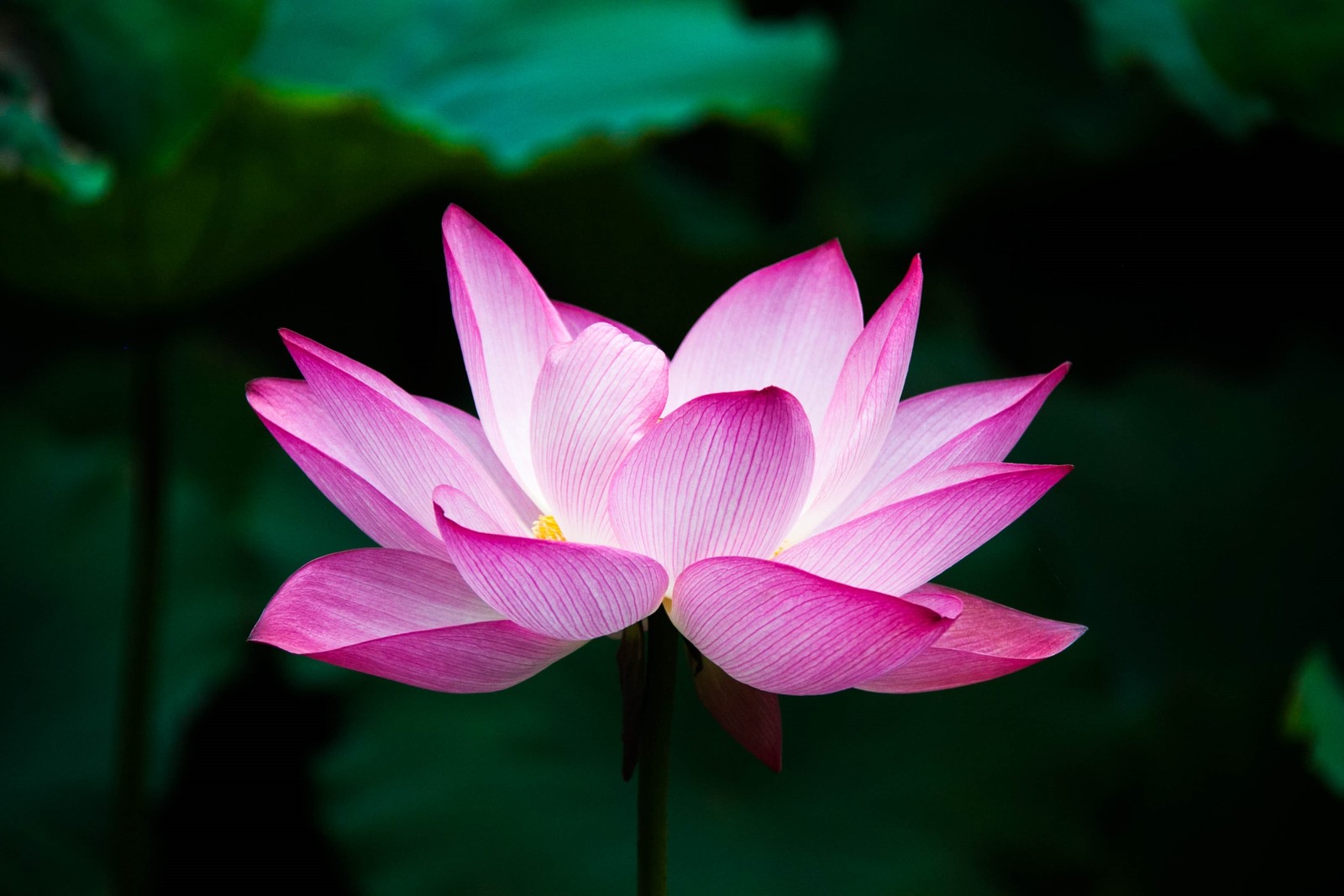
Photo: Hong Zhang · CC0 Public Domain · Wikimedia Commons
Here we should correct a common confusion. The “lotus effect” belongs to the lotus (Nelumbo), not to the water lily (Nymphaea) that people so often mix it up with. The lotus raises its shield-shaped leaves above the water and has no drainage notch; instead, its superhydrophobic surface beads raindrops into pearls and rolls them away. The water lily, by contrast, floats its leaves flat on the surface and each leaf has a distinct V-shaped notch. The two lineages diverged more than 100 million years ago, and genetically the lotus is actually closer to the plane tree and the protea than to the water lily.
What is superhydrophobicity — a large contact angle alone is not enough
When water rests on a surface, the angle its edge makes with the surface is called the contact angle. The larger the contact angle, the less the water wets the surface. Above 90° a surface is hydrophobic (water-repelling); below, hydrophilic (water-loving). But to call a surface “superhydrophobic,” it must meet two conditions together. The apparent contact angle must exceed 150°, and at the same time the contact-angle hysteresis (how much the angle fluctuates as a droplet attaches and detaches) must be below 10°. A large contact angle alone is not enough; for a droplet to actually roll off easily, the hysteresis must be low (Ensikat et al. 2011).
A lotus leaf’s measured values clear this bar with room to spare. The static contact angle cited in Barthlott and Neinhuis’s original 1997 paper is about 162°; Bhushan’s group reports about 164°, with a hysteresis of about 3°. Across surveys of many species, this 160–163° band is the most common. The roll-off angle at which a droplet begins to slide is usually cited in the literature at about 2–4° (a common figure inferred from the roughly 3° hysteresis, not a single precise measurement of record). It means the droplet slips off at the slightest tilt.
The key proposition: chemistry × structure — roughness “amplifies,” it does not “create”
Now we reach the heart of the matter. Superhydrophobicity is the product of hydrophobic wax (chemistry) and a two-tier roughness (structure). Neither alone produces it.
First, the chemistry. The epicuticular wax that coats a lotus leaf is already hydrophobic in itself. Melt the same wax as on a lotus leaf and re-solidify it into a smooth flat film, then measure the contact angle, and you get about 119° (Bhushan et al., Table 1; some reviews cite about 110°, a difference of material and measurement method). In other words, even a smooth wax plane with no roughness at all repels water to some degree. The low surface energy of the wax is the source. But 119° falls well short of the superhydrophobic threshold (150°).
Now structure is multiplied in. A two-tier roughness — nanoscale wax crystals sitting atop micrometer-scale bumps (papillae) — amplifies the already-hydrophobic wax to the extreme (over 160°). The crucial point is that what roughness does is only “amplify,” not “create.” Wenzel’s equation cosθ* = r·cosθ (with roughness factor r always at least 1) says as much. If the flat contact angle θ is already hydrophobic (above 90°), then the rougher the surface the more it repels water; conversely, if it is hydrophilic (below 90°), the rougher it is the more it wets. Bhushan/Jung’s group likewise state that “introducing roughness increases the hydrophobicity of a hydrophobic surface, but on a hydrophilic surface it decreases the contact angle.”
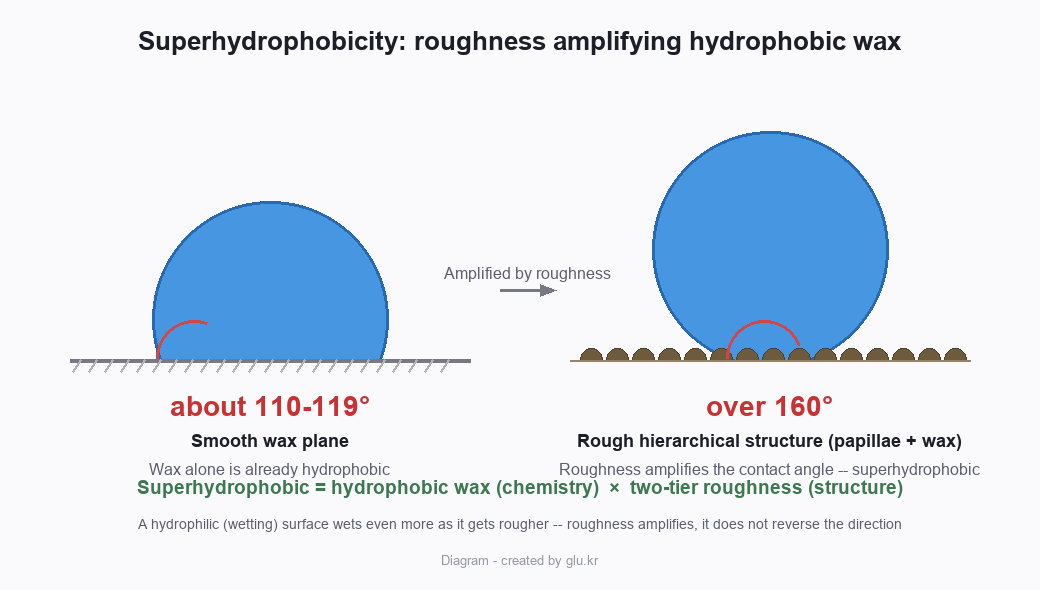
Diagram · created by glu.kr
So the claim that “anything rough repels water” is wrong. Roughness cannot flip the sign; it only magnifies the magnitude. Without the chemical foundation of a smooth hydrophobic wax, no amount of roughening will produce superhydrophobicity. The wonder of the lotus lies precisely in how these two elements — a low-surface-energy wax and a hierarchical roughness that pushes it to the limit — are so intricately designed to interlock.
Perched on air, or sunk into the gaps — Cassie–Baxter versus Wenzel
Then why does the same “roughness” sometimes repel water and sometimes grip it? The answer lies in how the droplet sits on the rough surface. There are two states.
The Cassie–Baxter state. The droplet straddles the sharp tips of the bumps (solid) and the air trapped between them (air pockets) — a composite interface. The solid area the water actually touches is minuscule. On a lotus leaf the contact angle reaches up to about 170°, and the droplet’s contact area with the surface is only 0.6% of the total. With so small a contact area, adhesion is weak and hysteresis is low, so the droplet rolls off at the slightest tilt.
The Wenzel state. Here, by contrast, water completely fills the grooves of the roughness and contacts the entire solid surface uniformly. With a large contact area, adhesion grows strong and hysteresis rises, so the droplet clings to the surface and will not come off easily.
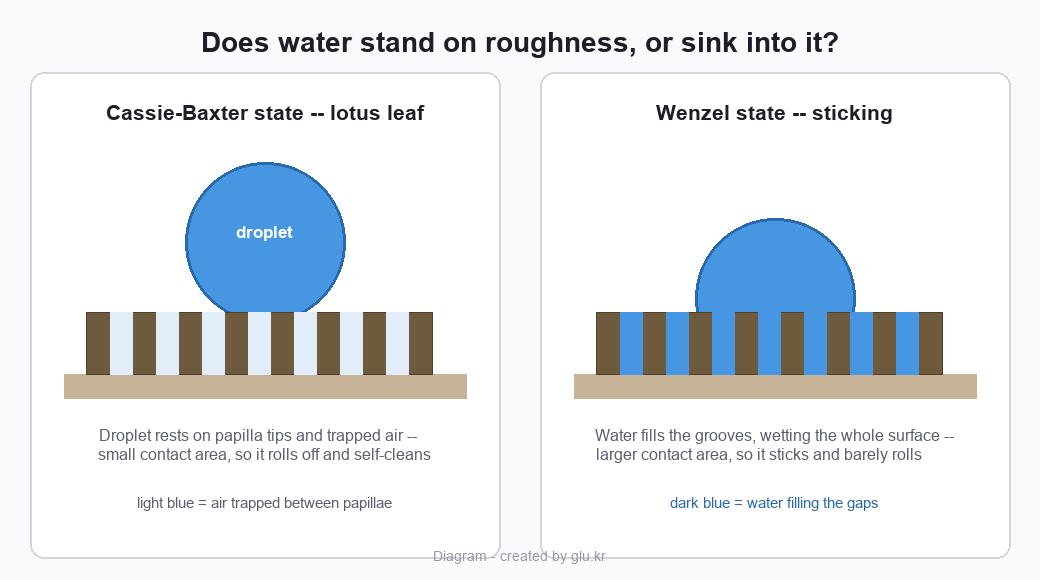
Diagram · created by glu.kr
The secret to how a lotus leaf stably maintains the Cassie–Baxter state lies in its dense nano-wax structure. The high capillary pressure created by the tightly packed nano-tubules, together with the drastically reduced contact area, holds the air layer between the papillae from collapsing. Bhushan/Jung’s group showed experimentally that on micro-patterns, once the spacing between bumps exceeds a critical value (about 30 µm), the Cassie state collapses, transitions to the Wenzel state, and the contact angle plunges. The lotus leaf’s dense hierarchical structure prevents exactly this transition, preserving the partial contact (the state of perching on air).
The topography of the microscopic world — a two-tier roughness
The lotus leaf surface that Barthlott and Neinhuis examined under a scanning electron microscope (SEM) in 1997 was a hierarchical structure — a two-layered terrain, small mountains set atop large ones.
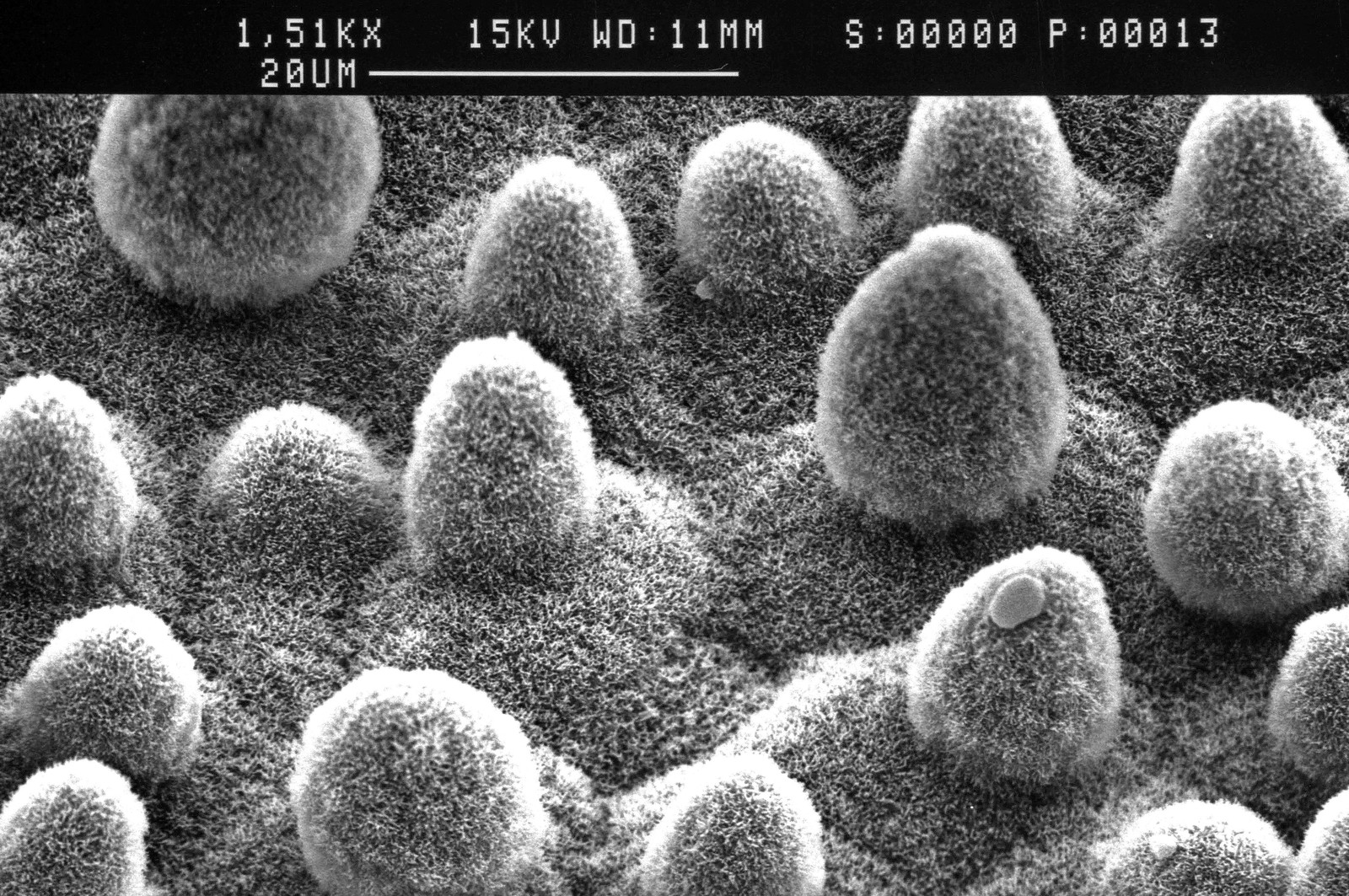
Photo: Wilhelm Barthlott & Christoph Neinhuis (Planta 1997) · CC BY-SA 4.0 · Wikimedia Commons
The first layer is the micro-papillae. Their density reaches about 3,431 per mm² (Ensikat et al. 2011), with a height and radius on the order of 10–20 µm. The second layer is the nano wax tubules that cover the surface of those papillae. On the upper leaf surface the tubules are 0.3–1 µm long and 80–120 nm thick, standing about 200 to a 10 µm² patch. The chemistry of these nano-crystals is also special. Nonacosanediols make up about 65% and nonacosan-10-ol about 22% of the main constituents, and the side oxygens of the diol molecules form hydrogen bonds that keep the molecules from packing tightly. The result is that three-dimensional tubular crystals grow, and the melting point rises to 90–95 °C, far higher than an ordinary aliphatic wax. The low surface energy of these long-chain hydrocarbons and secondary alcohols is the root of the chemical hydrophobicity.
The real principle of self-cleaning — not “washing off” but “a contest of adhesion”
The crown jewel of the lotus effect is self-cleaning, the ability to keep itself clean. But its mechanism is not, as often misunderstood, that “water washes the dust off.” The real principle is a contest of adhesion.
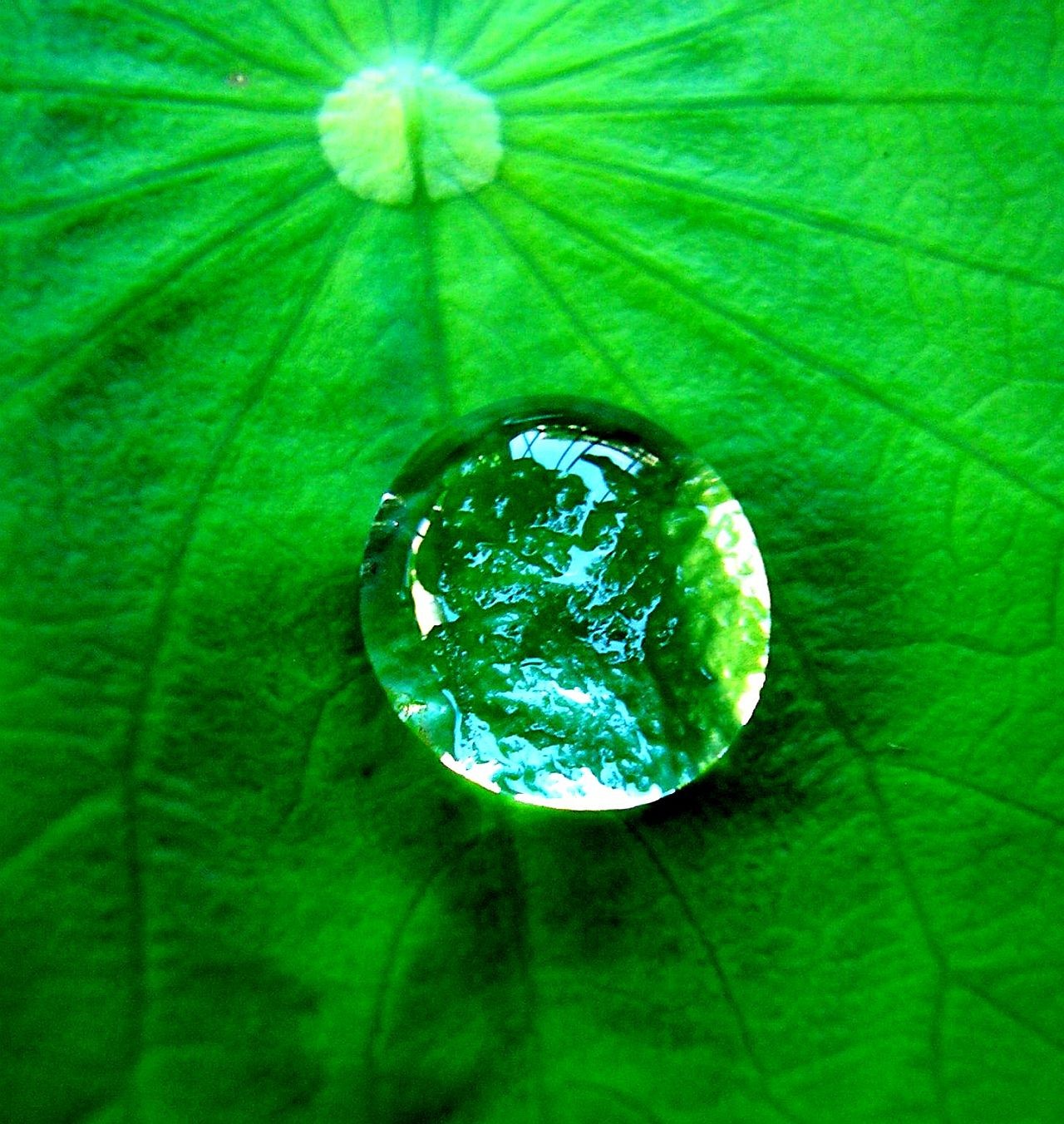
Photo: Flickr user tanakawho · CC BY 2.0 · Wikimedia Commons
On a superhydrophobic microstructure, dust particles too touch the surface over an extremely small area. With such a small contact area, the adhesion between particle and surface is weak. When a droplet then rolls up, the particle clings more strongly to the droplet than to the surface. In Barthlott and Neinhuis’s own words, “as a water droplet rolls across a contaminated surface, the adhesion between the dust particle and the droplet is greater than that between the particle and the surface.” So the particle is swept off the surface, carried away on the rolling droplet. The two researchers actually demonstrated the process experimentally — dusting a surface with contaminants and then letting water run over it, so that the leaf cleaned itself. On smooth glass, water would spread thin and leave the dust as a stain; on a superhydrophobic surface, the droplet vanishes and takes the dust wholesale with it.
Not the lotus alone — a design scattered across nature
Here we should keep our balance. Superhydrophobicity is not the lotus’s alone. The lotus is merely the representative example that gave the term its name; the same principle is scattered all across nature.
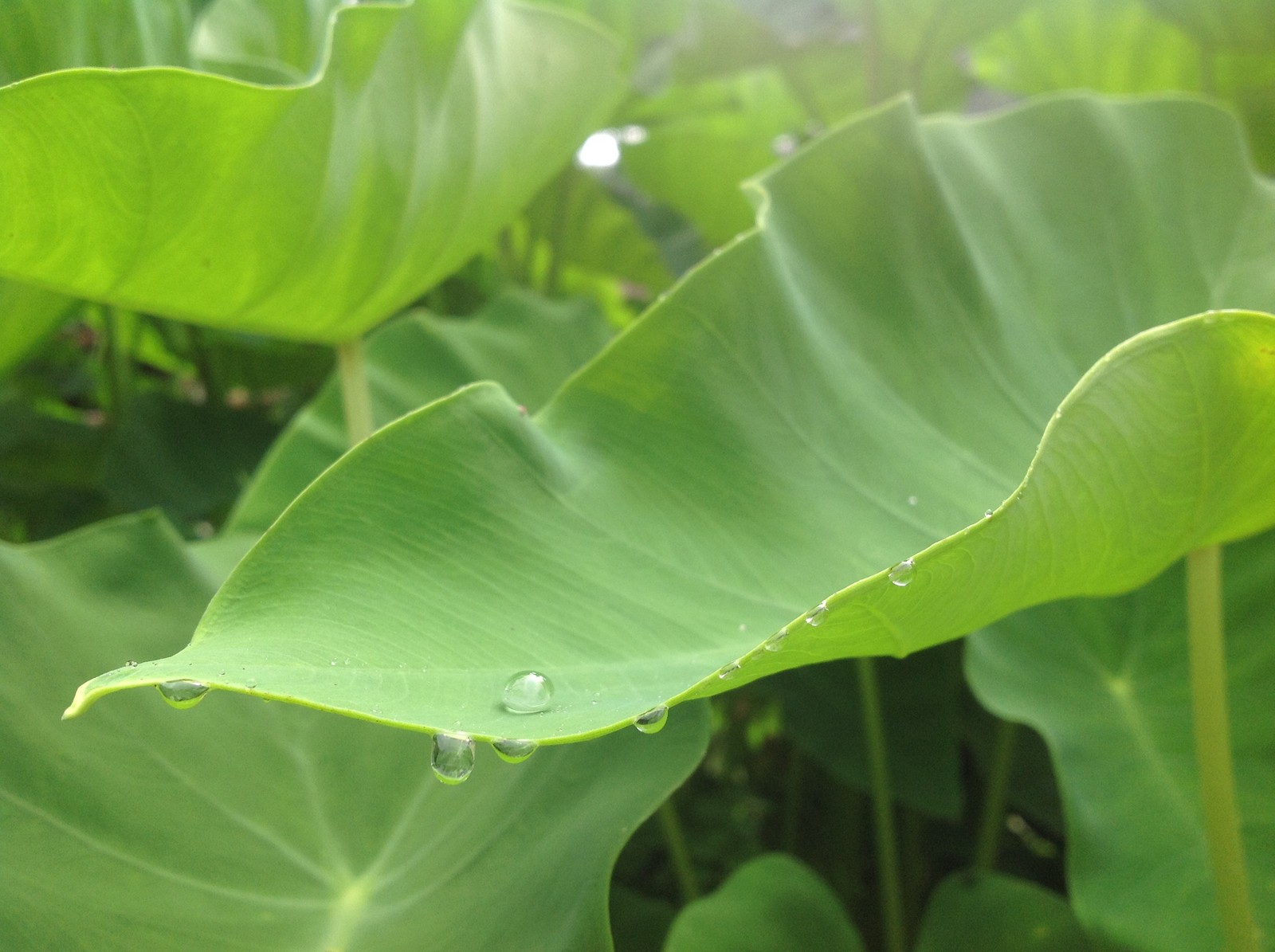
Photo: Arupparia · CC BY-SA 4.0 · Wikimedia Commons
Among plants alone, taro (Colocasia esculenta, contact angle about 148°), nasturtium, reeds and other grasses, the spikemosses, and the cacti each repel water in their own way. Turn to animals and there are the wings of butterflies and dragonflies, and the legs of the water strider, which walk on the surface of water by trapping an air cushion in nanoscale grooves. The springtail bears an “omniphobic” surface that repels not only water but oil. Especially intriguing is the Salvinia paradox. Salvinia molesta, a kind of floating fern, has superhydrophobic hairs whose tips alone are hydrophilic, so that even underwater it holds an air layer (plastron) for weeks and keeps photosynthesizing while submerged. This diversity — one principle varied to fit each different need — shows that the design embedded in creation is never uniform.
The lotus that people imitated — biomimetics and its limits
This intricate principle was carried into engineering from the late 1990s. A prime example is the self-cleaning façade paint Lotusan® (Sto). Fillers in the paint mimic the fine texture of a lotus leaf, so that dew, rain, and mist run off the wall instead of clinging, reducing the growth of mold and algae. Beyond that, applications have followed in self-cleaning glass, water-repellent fabrics, water-repellent sprays, and anti-fouling coatings for ships.
To put it in balance, though, the technology’s greatest weakness is durability. Most superhydrophobic coatings are vulnerable to abrasion. Rub, wash, or long-weather them and the microstructure wears down; as contaminants become buried in the grooves, the water-beading property gradually fades. Fabrics in particular tend to lose their water repellency after washing and friction. Yet, intriguingly, a real lotus leaf, when damaged, remakes its wax and restores its hydrophobicity on its own — a self-repair capacity that artificial surfaces still lack. How far human imitation falls short of the original, the lotus quietly reminds us.
Behind this ordinary scene of a single drop of water rolling like a pearl across a leaf hides a precise design in which chemistry and structure are multiplied together. The paradox of repelling water not by being smooth but by being rough; the wisdom of cleaning itself not by washing but by a contest of adhesion — a single small leaf that God created still leaves us something to learn today.
References
- Barthlott & Neinhuis (1997), Planta 202:1–8 — The foundational paper that first unified the ‘lotus effect’ (self-cleaning and hierarchical roughness).
- Wikipedia: Lotus effect — The self-cleaning mechanism by adhesion comparison; an overview of other superhydrophobic examples.
- Wikipedia: Nelumbo nucifera — The botany of the lotus (emergent plant, leaf form, seed longevity).
- Ensikat et al. (2011), Beilstein J. Nanotechnol. 2:152–161 — Definition of superhydrophobicity, papilla density and nano-tubule dimensions, wax chemistry and melting point.
- Bhushan/Jung, Beilstein J. Nanotechnol. — Contact angle 164°, flat wax 119°, Cassie↔Wenzel transition experiments, the amplification asymmetry of roughness.
- The Barthlott effect (2023 review), Quant. Plant Biol. — The impact of the 1997 paper and how the ‘lotus effect’ was named.
- Hierarchical structure review, Molecules — An overview of hierarchical roughness dimensions such as papilla height and radius.
- Biolin Scientific: Cassie–Baxter equation — An explanation of the Cassie–Baxter/Wenzel states and the formalism of wettability.
- Chemistry World: Superhydrophobic materials from nature — Natural superhydrophobic examples such as water striders and springtails.
- Sto: Lotusan biomimetics — A self-cleaning façade paint that mimics the lotus leaf.