
In the autumn of 2025, a visitor passed through our solar system. Not an ordinary comet born near our own Sun, but an interstellar object — one that formed beside another star, wandered for billions of years, grazed our Sun once, and left forever. Its name is 3I/ATLAS. The leading ‘I’ stands for ‘Interstellar,’ and the number 3 marks it as the third interstellar visitor humanity has confirmed.
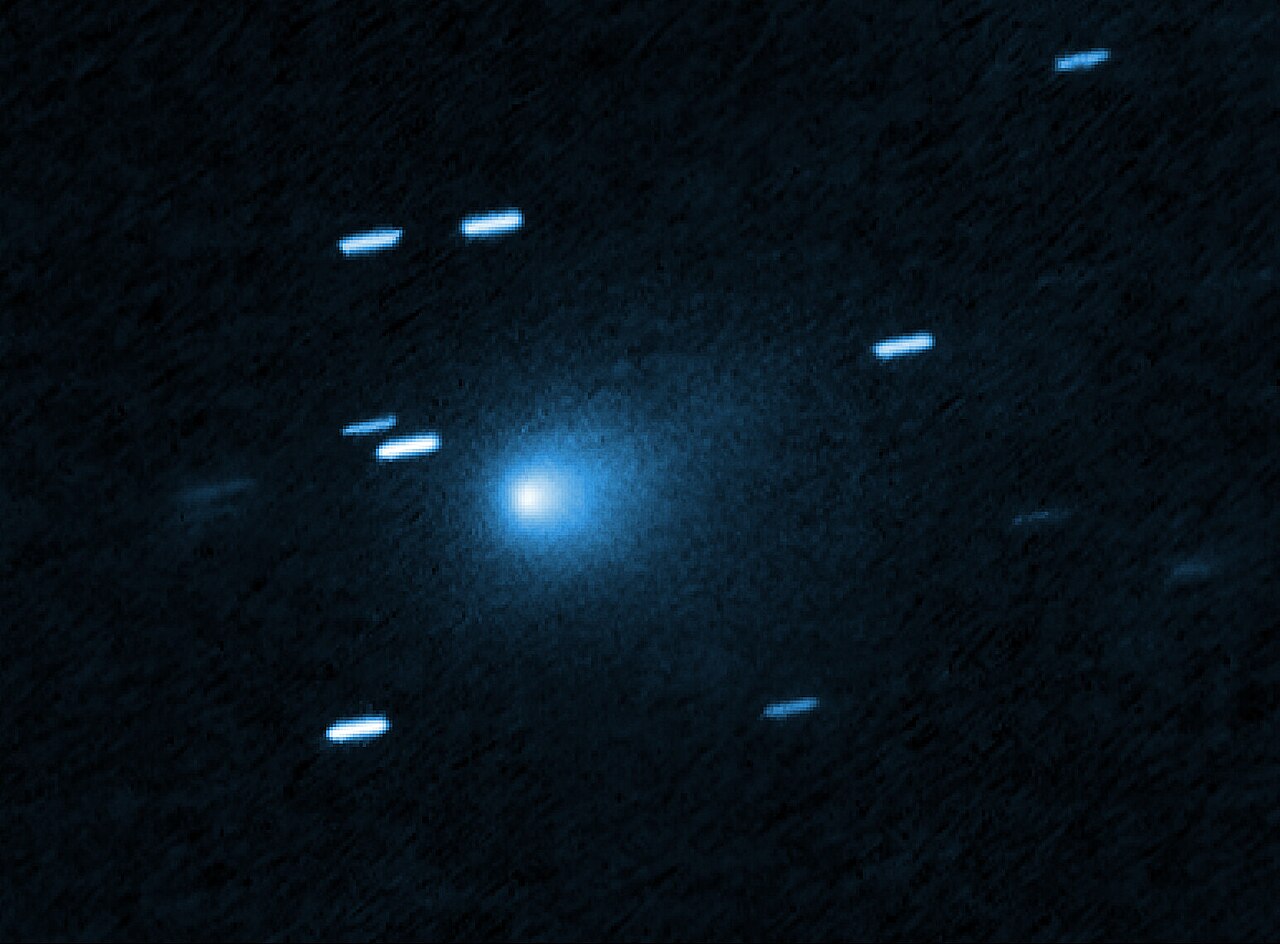
NASA, ESA, D. Jewitt (UCLA); Image processing J. DePasquale (STScI) · CC BY 4.0 · Wikimedia Commons
A natural question follows. We never went there ourselves, so how can astronomers be so certain this object “came from outside the solar system”? That question is the starting point of this article.
An Orbit That Never Closes — The Decisive Proof of an Alien Origin
The secret lies in the path the object traces — the shape of its orbit. An object born inside the solar system is held firmly by the Sun’s gravity, looping around and around on a closed ellipse. The value that describes how stretched an orbit is is called the ‘eccentricity (e),’ and a closed ellipse always has an e less than 1.
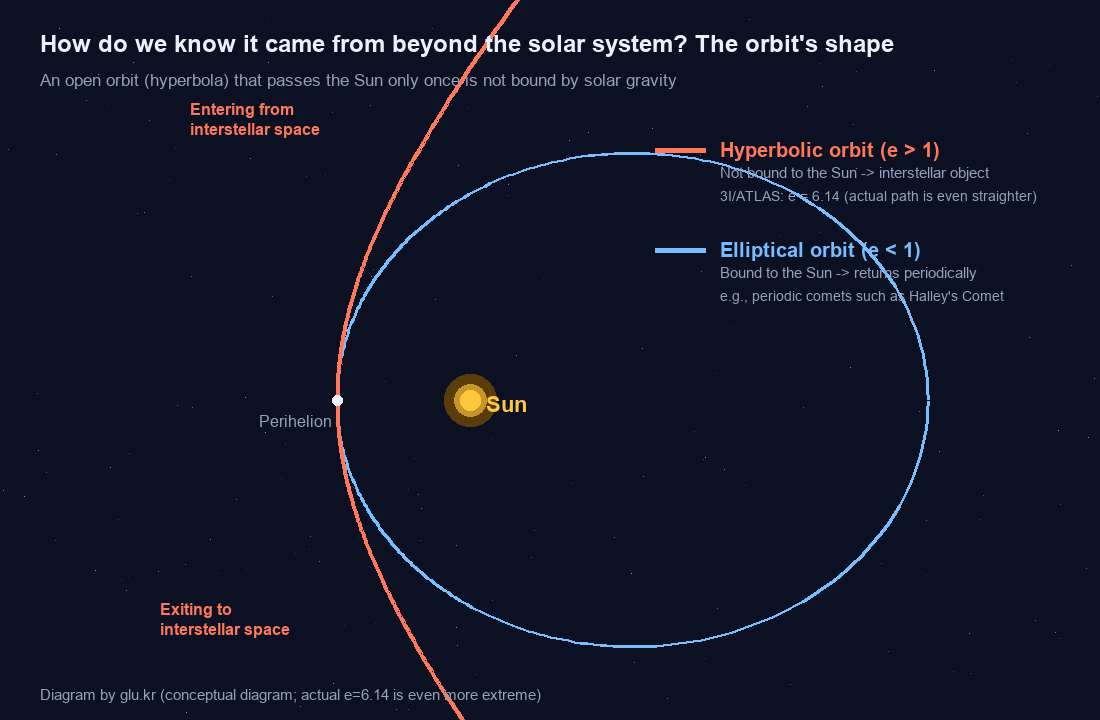
Diagram · created by glu.kr
But 3I/ATLAS has an orbital eccentricity of about 6.14 (per the precise orbital elements on Wikipedia), far beyond 1. When the eccentricity exceeds 1, the orbit no longer closes: it becomes a hyperbola that swings by once and never returns. In other words, it was never bound to the Sun. On top of that, its hyperbolic excess velocity (v∞, the speed at infinity) far from the Sun’s influence reaches about 58 km/s — a speed no Sun-bound object could have, showing it arrived with energy from outside.
Here is a simple analogy. A child running in circles around a playground belongs to that playground; but a child who crosses the playground and disappears down an alley on the far side was a visitor from another neighborhood all along. 3I/ATLAS was clearly the latter.
July 2025: A Telescope in Chile Catches It
This visitor was first spotted on 1 July 2025 by the ATLAS (Asteroid Terrestrial-impact Last Alert System) survey telescope in Río Hurtado, Chile, and reported to the IAU’s Minor Planet Center. It was briefly called by the temporary designation ‘A11pl3Z’; once cometary activity was confirmed, it also received the comet designation ‘C/2025 N1 (ATLAS).’
Intriguingly, the object had already been captured ‘unknowingly’ in earlier images from several telescopes before its formal discovery. NASA’s exoplanet hunter TESS later found 3I/ATLAS in data already recorded from early May to early June 2025 (a precovery), and the newly commissioned Vera C. Rubin Observatory provided imagery from about ten days before discovery. These earlier observations helped refine its orbit more precisely.
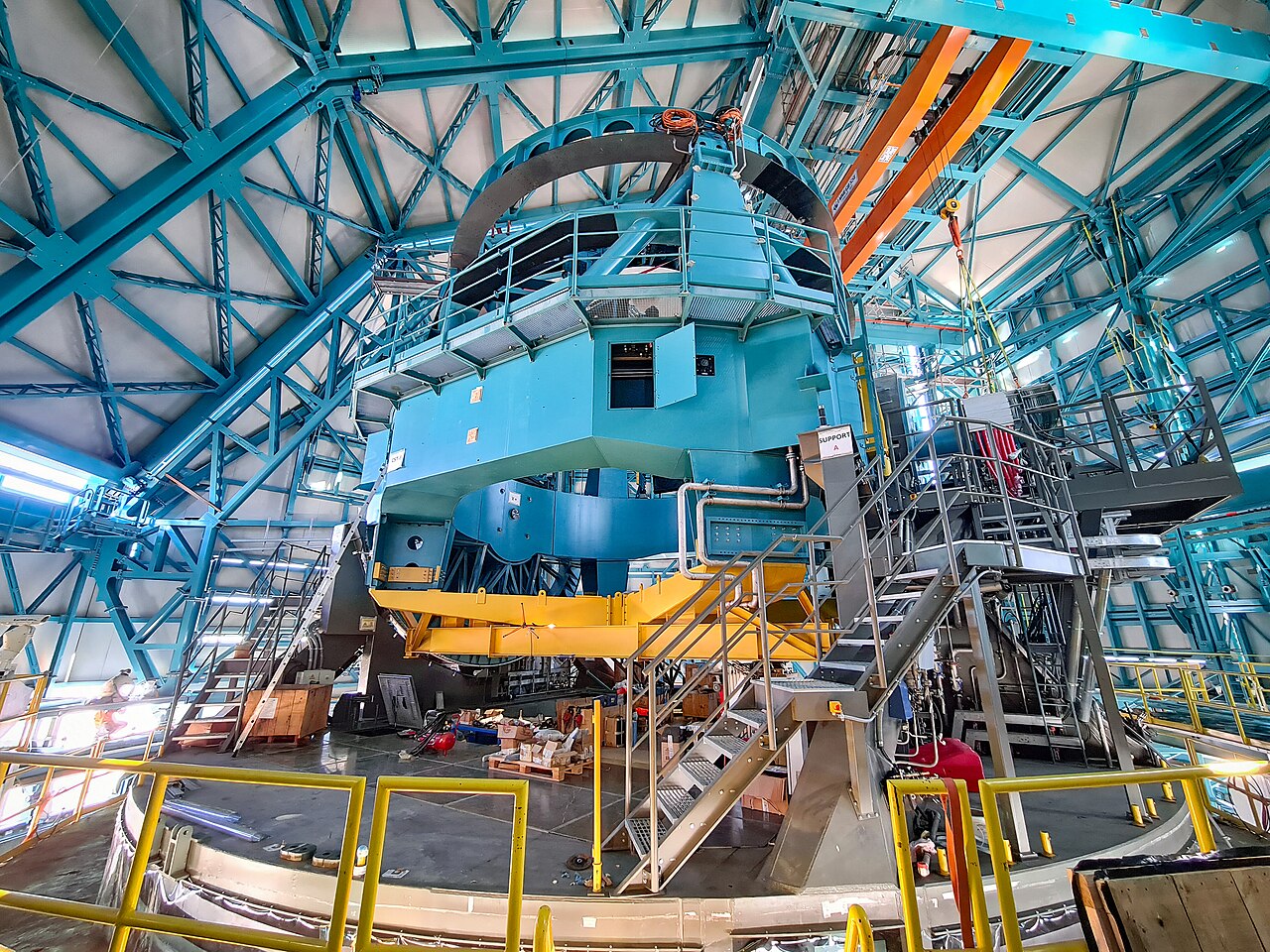
Rubin Observatory/NSF/AURA · CC BY 4.0 · Wikimedia Commons
Fortunately, there was no threat to Earth whatsoever. According to NASA, 3I/ATLAS passed at a minimum distance of about 1.8 AU (roughly 270 million km) — well clear of us. It approached the Sun in late October 2025 to about 1.4 AU (between the orbits of Earth and Mars) before receding back outward.
A Visitor Unusually Rich in Carbon Dioxide
The reason astronomers scrambled over this brief encounter was that it was a rare chance to analyze, up close, an object forged from the material of another star. The most powerful tool was the James Webb Space Telescope (JWST).
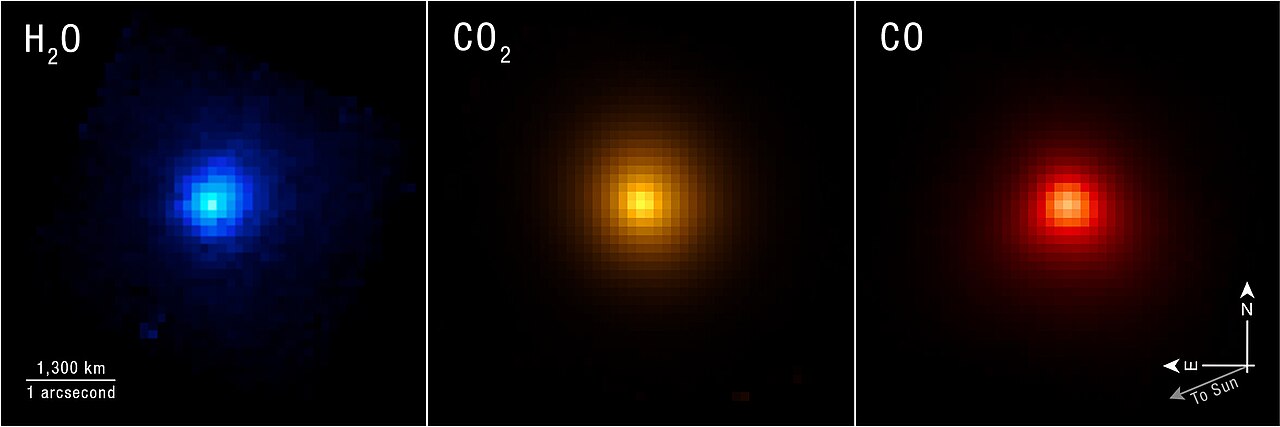
NASA, ESA, CSA, STScI, M. Cordiner et al. · CC BY 4.0 · Wikimedia Commons
JWST’s infrared spectroscopy (at a heliocentric distance of about 3.3 AU, before perihelion) showed that the coma of 3I/ATLAS — the envelope of gas and dust surrounding a comet — held overwhelmingly more carbon dioxide (CO₂) than water. The original paper (arXiv:2508.18209) reported a CO₂/H₂O ratio of about 7.6, among the highest values ever measured in a comet. Water, carbon monoxide (CO), and grains of solid water ice were also detected, while other telescopes confirmed molecules such as hydrogen cyanide (HCN) and methanol (CH₃OH). In June 2026, NASA announced that JWST had directly detected methane (CH₄) on an interstellar object for the first time.
That said, this ‘CO₂ excess’ is not a fixed property. As the object drew closer to the Sun, the evaporation (sublimation) of water surged, so the activity that had been CO₂-dominated far out shifted to a water-centered one up close. In other words, the ratio of 7.6 should be read as ‘the value measured at that moment, far from the Sun.’
Its Size — Still Only an Upper Limit
So how big is this visitor? The honest answer is “we don’t know precisely yet.” The comet’s solid nucleus is hidden by the thick coma, so even the Hubble Space Telescope could not resolve it into a single point.
That is why scientists constrain the size not as a single measurement but only as an ‘upper limit (maximum).’ According to ESA/Hubble, the nucleus is at most about 5.6 km in diameter based on Hubble observations, and could in fact be as small as about 320 m. Remember that even these numbers are ‘estimated upper limits’ that shift depending on the assumed surface reflectance (albedo). For comparison, the first visitor 1I/’Oumuamua was estimated at a few hundred meters, and the second, 2I/Borisov, at roughly 0.5–1 km in diameter.
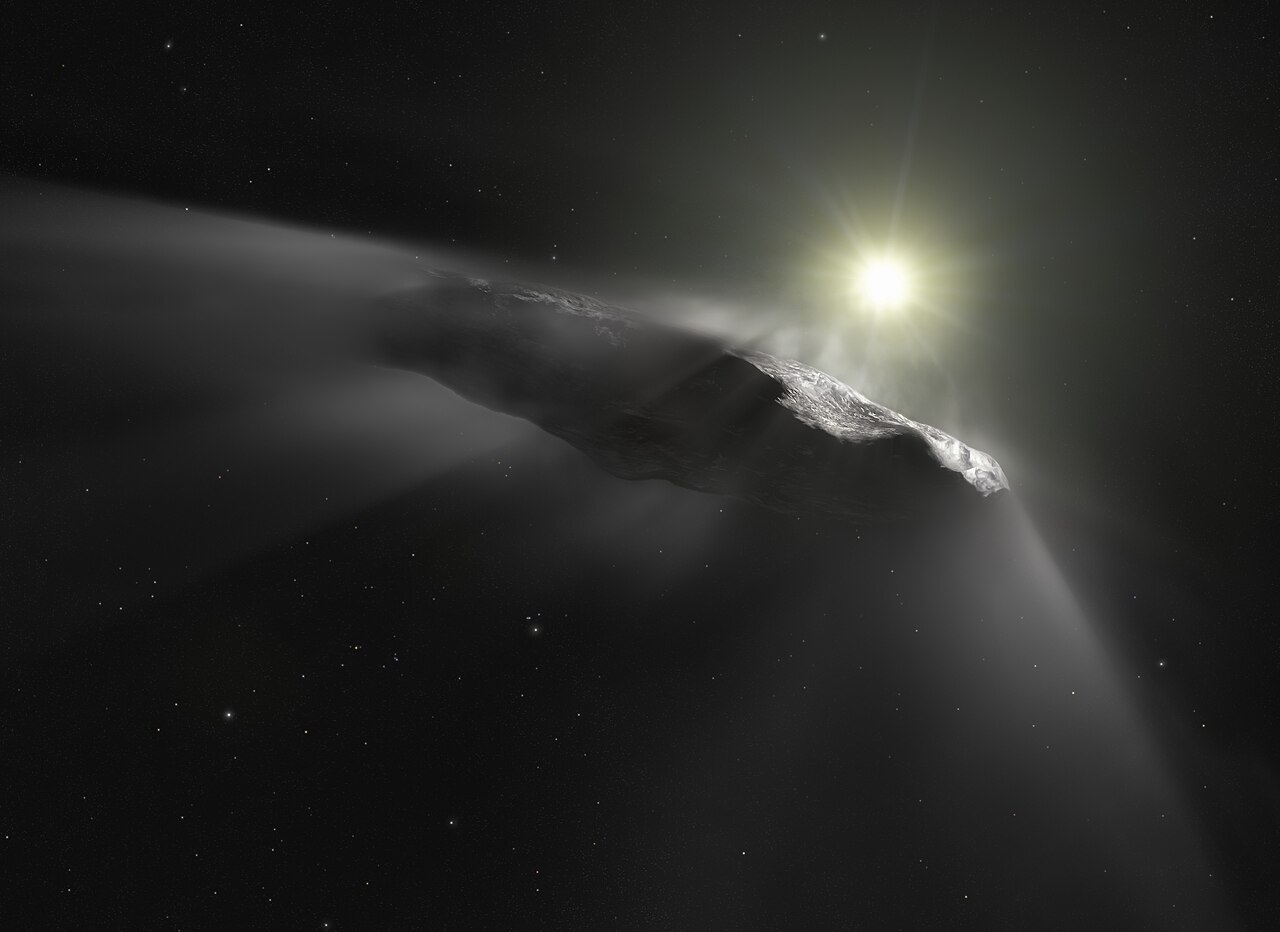
Illustration (artist’s impression) · ESA/Hubble, NASA, ESO, M. Kornmesser · CC BY 4.0 · Wikimedia Commons
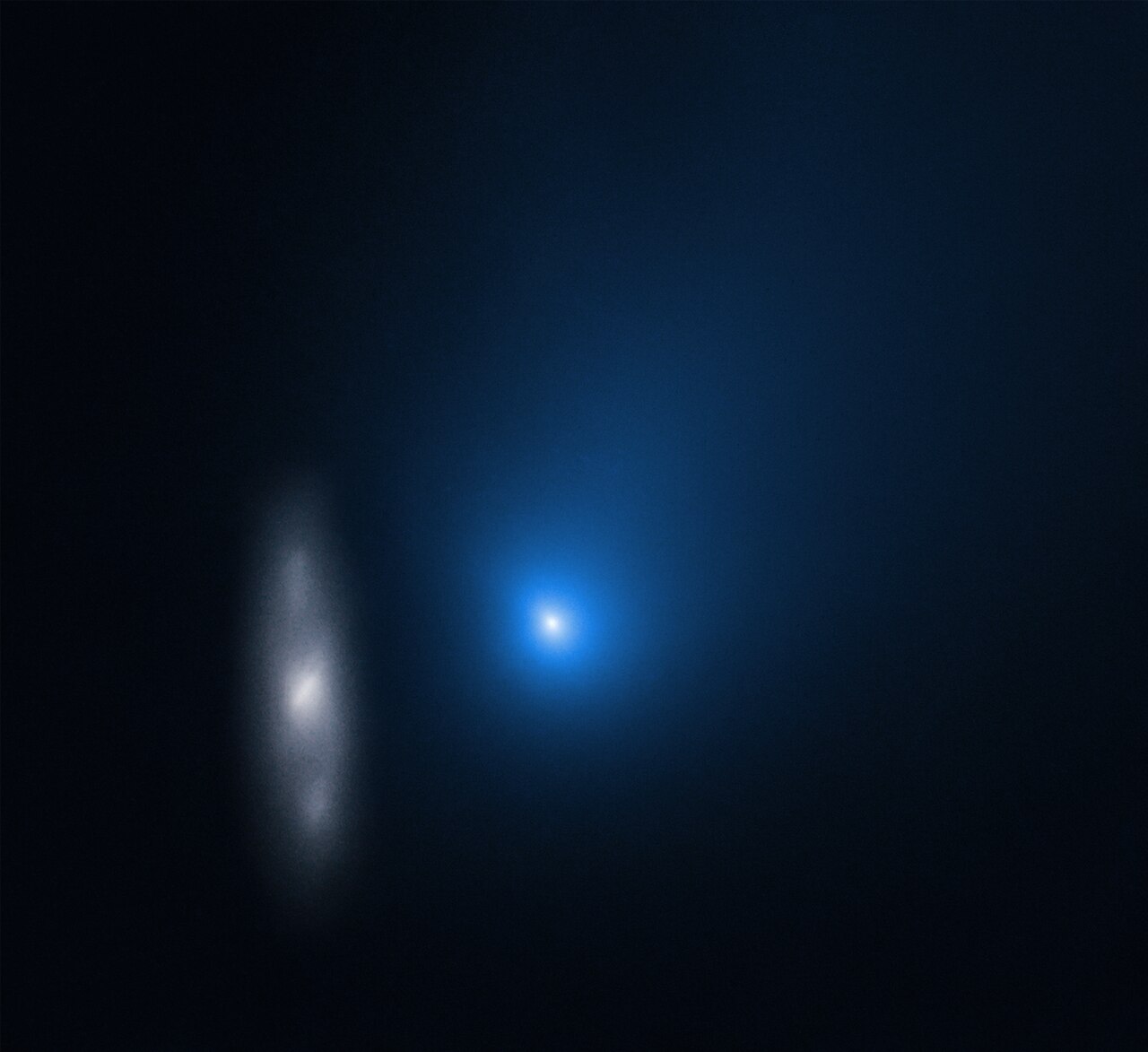
NASA, ESA, D. Jewitt (UCLA) · CC BY 4.0 · Wikimedia Commons
How Old Is This Visitor? — Possibly Older Than the Sun
Another reason this object is especially interesting is its ‘age.’ Studies analyzing the object’s direction and speed of motion suggest the possibility that 3I/ATLAS came from an old, metal-poor population of stars in our galaxy — the old stellar group often called the ‘thick disk.’
But the precise age varies from study to study. The Hopkins team estimated about 7.6–14 billion years (68% confidence interval), while Taylor & Seligman estimated about 3–11 billion years (median about 6.9 billion years). Both estimates rest on the assumption that ‘a relationship that holds for stars applies equally to this object,’ so neither can be pinned down as a definitive value. Honestly stated, then, it becomes: “estimated at about 3–11 billion years old, possibly older than the solar system (about 4.6 billion years).”
One common misconception is worth noting. The ‘13.8 billion years’ that appears in some articles is the age of the entire universe, not the age of this object. They are entirely different numbers.
“Could It Be an Alien Spacecraft?” — Hypothesis, Search, and Conclusion
Unusual traits such as the exceptionally high CO₂ content once gave rise to an intriguing hypothesis. The astronomer Avi Loeb publicly raised, in his own name, the possibility that 3I/ATLAS might be an artificial object, citing such grounds as a retrograde orbit slightly inclined to the ecliptic plane and a faint non-gravitational acceleration observed near perihelion. This was a hypothesis he put forward in a form he could test himself.
Once a hypothesis is raised, science tests it. In July 2025 the SETI Institute used the Allen Telescope Array (ATA) across five sessions, for a total of 7.25 hours, to search for artificial radio signals (technosignatures) from this object in the 1–9 GHz band. About 74 million signal candidates turned up at first, but after step-by-step filtering, the handful that remained were examined one by one and all proved to be terrestrial radio interference; not a single artificial signal worth following up was detected. The result was released through the SETI Institute in June 2026, and a separate search with China’s FAST radio telescope likewise reported a non-detection, adding to the confidence.

brewbooks · CC BY-SA 4.0 · Wikimedia Commons
One thing must be stated precisely. ‘No signal’ is not proof that ‘there is no extraterrestrial life,’ but rather an upper limit: ‘within the observed band and sensitivity, there was no artificial transmitter signal above a certain power.’ And all the subsequent evidence we saw earlier — the CO₂ excess, the developing coma and tail, the release of water molecules — pointed in one direction: that this is a natural, comet-like object. An unusual property posed a question, and a legitimate search answered it.
A Brief Encounter Watched by Many Eyes
Perhaps the greatest gift 3I/ATLAS left behind is the very fact that nearly all of humanity’s observing instruments were trained on a single object at once.
Hubble captured the coma at high resolution and constrained the nucleus size; JWST analyzed the composition by spectroscopy; the space telescope SPHEREx (NASA’s infrared all-sky survey telescope) caught the water-ice absorption and the CO₂ coma in the infrared. When the object came closer to Mars, even the Mars Reconnaissance Orbiter (MRO) and the Perseverance rover joined the observations. From the ground, the JCMT (James Clerk Maxwell Telescope) mapped hydrogen cyanide, and ALMA (Atacama Large Millimeter/submillimeter Array) mapped the asymmetric outgassing of methanol and hydrogen cyanide. (Incidentally, the idea of sending a spacecraft to chase it down was studied in papers too, but that is only a feasibility study — no mission was actually launched.)
One more thing worth adding: many of the crisp images circulating as ‘photos’ of interstellar objects are not actual photographs but artist’s impressions. The elongated, cigar-shaped picture of the first visitor 1I/’Oumuamua is a representative artist’s impression, and the real imagery of 3I/ATLAS looks more like a faint bluish smudge of coma or a color-coded spectral map.
What the Visitor Left as It Passed Through
3I/ATLAS was never caught by us. Following its hyperbolic orbit — bent just once — it has receded forever into the darkness between the stars. Yet during that brief encounter, humanity read from a single unclosing orbit that “this is a visitor from another star,” and looked into the carbon dioxide, the water, and the traces of ancient time held within it.
In a corner of the vast created cosmos, even a small lump of ice that grazed past us carried, faithfully inscribed within it, the finely ordered laws of physics. Reading that order one layer at a time may be the most honest way for us to face the universe.
References
- Comet 3I/ATLAS — NASA Science
- 3I/ATLAS — Wikipedia
- Hubble makes size estimate of interstellar comet — ESA/Hubble
- Hubble Space Telescope Observations of the Interstellar Interloper 3I/ATLAS (arXiv:2508.02934)
- JWST detection of a CO2-dominated gas coma surrounding 3I/ATLAS (arXiv:2508.18209)
- The Kinematic Age of 3I/ATLAS (Taylor & Seligman, arXiv:2507.08111)
- From a Different Star: 3I/ATLAS in the Otautahi-Oxford ISO population model (Hopkins et al., arXiv:2507.05318)
- A Search for Radio Technosignatures from 3I/ATLAS with the Allen Telescope Array (arXiv:2512.18142)
- Narrowband Radio Technosignature Search toward 3I/ATLAS with FAST (arXiv:2603.19023)
- NASA’s Webb Detects Methane on Interstellar Comet 3I/ATLAS — NASA Science
- View Interstellar Comet 3I/ATLAS Through NASA’s Multiple Lenses — NASA Science