
A large ring of light surrounds the Sun in a thinly clouded sky. A similar sight can appear around the Moon. Have the clouds gathered into a circle? 22-degree solar and lunar halos form when airborne ice crystals redirect light. [10]
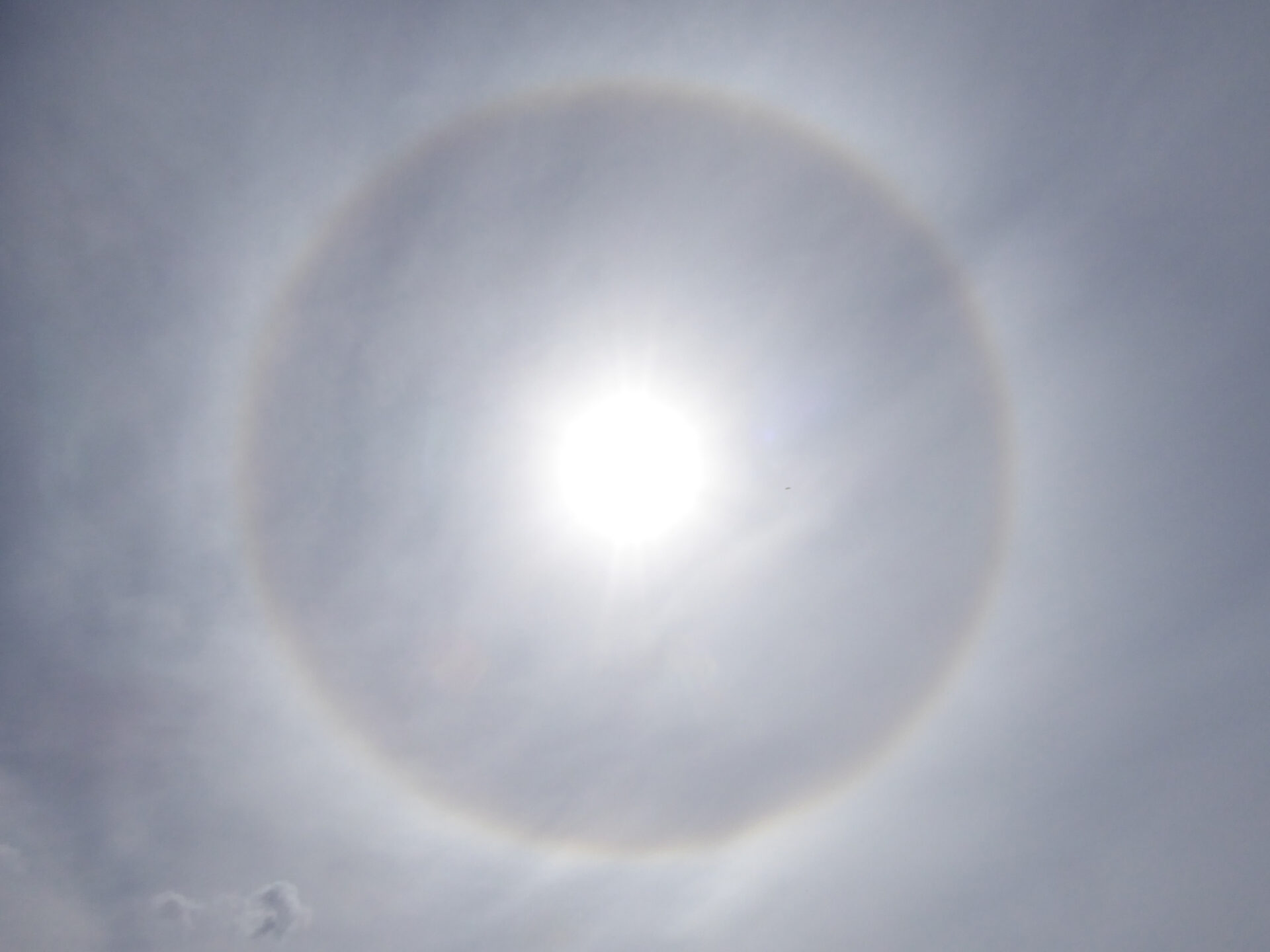
Photo · Syrio · CC BY-SA 4.0 · Wikimedia Commons
Light meets ice in thin clouds
Cirrostratus is a high cloud that spreads like a thin veil. Its ice crystals can produce halo phenomena as sunlight or moonlight passes through. Sometimes the cloud is so thin that a halo helps reveal its presence. Warm conditions on the ground do not rule out ice high above. [4]
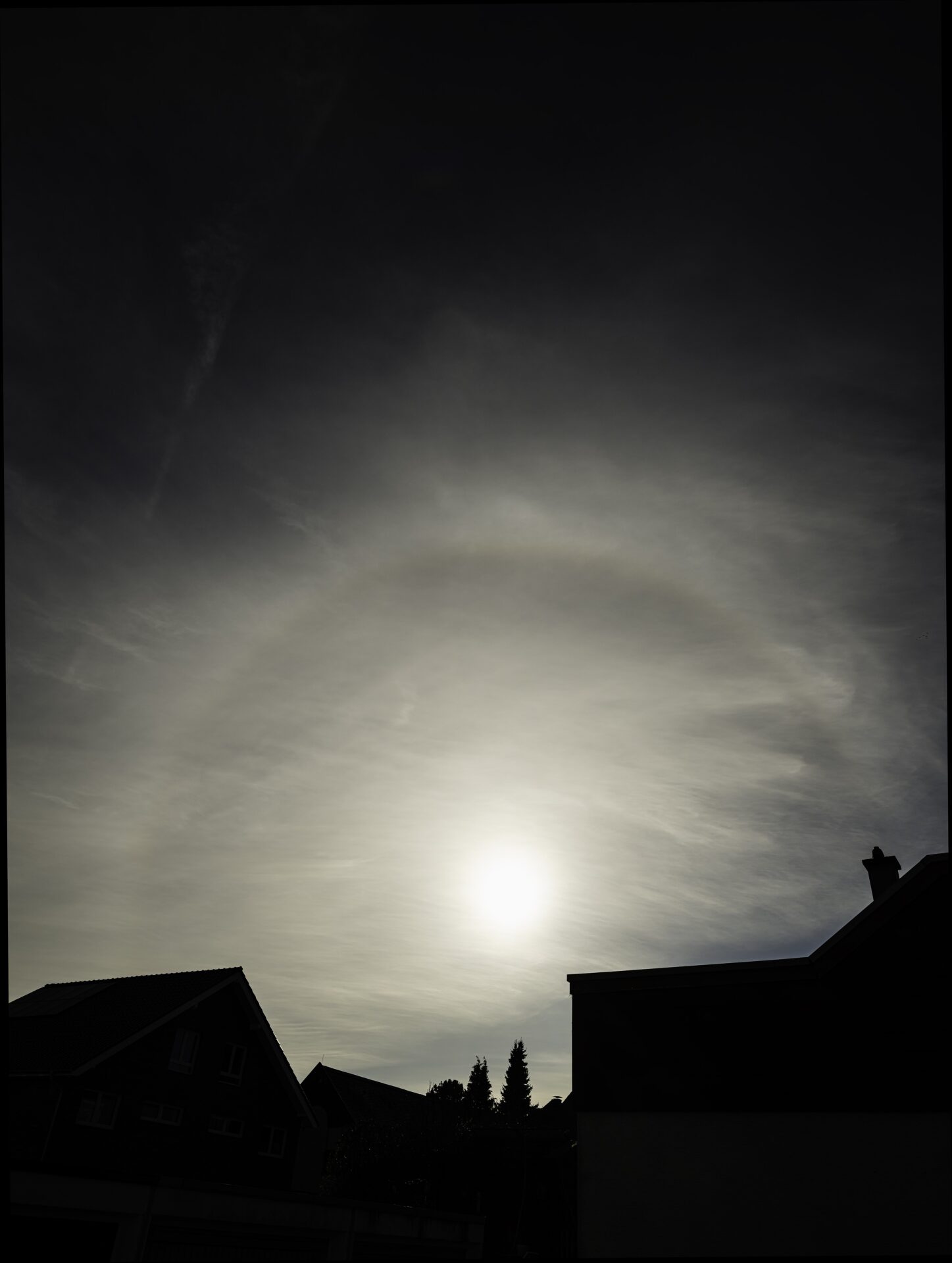
Photo · Franz van Duns · CC BY 4.0 · Wikimedia Commons
Light refracting through side faces of hexagonal ice crystals concentrates near a minimum deviation of about 22 degrees. Refraction changes light’s direction. Red light bends less than blue, forming the inner edge. [2]
Why hexagonal ice produces a circle
One crystal does not draw the entire ring for your eye. Light reaching the observer comes from crystals at different positions and orientations. Directions at a similar angular distance from the Sun trace a circle. The ice need not be arranged in a ring; the circular pattern is in the directions from which light reaches you. [2]
The 22 degrees is neither a temperature nor a crystal size. It is the angular radius: the angle between the Sun or Moon at the center and the ring. Across the center from one side to the other, the angular span is about 44 degrees. Depending on cloud coverage, only part of the circle may be visible. [1]
Why the inner edge is reddish
A solar halo is not always a vivid band of rainbow colors. The Hong Kong Observatory describes the inner edge as light red and the outer edge as violet or white. When looking for color, begin with the inner boundary rather than expecting the entire ring to show every hue. [10]
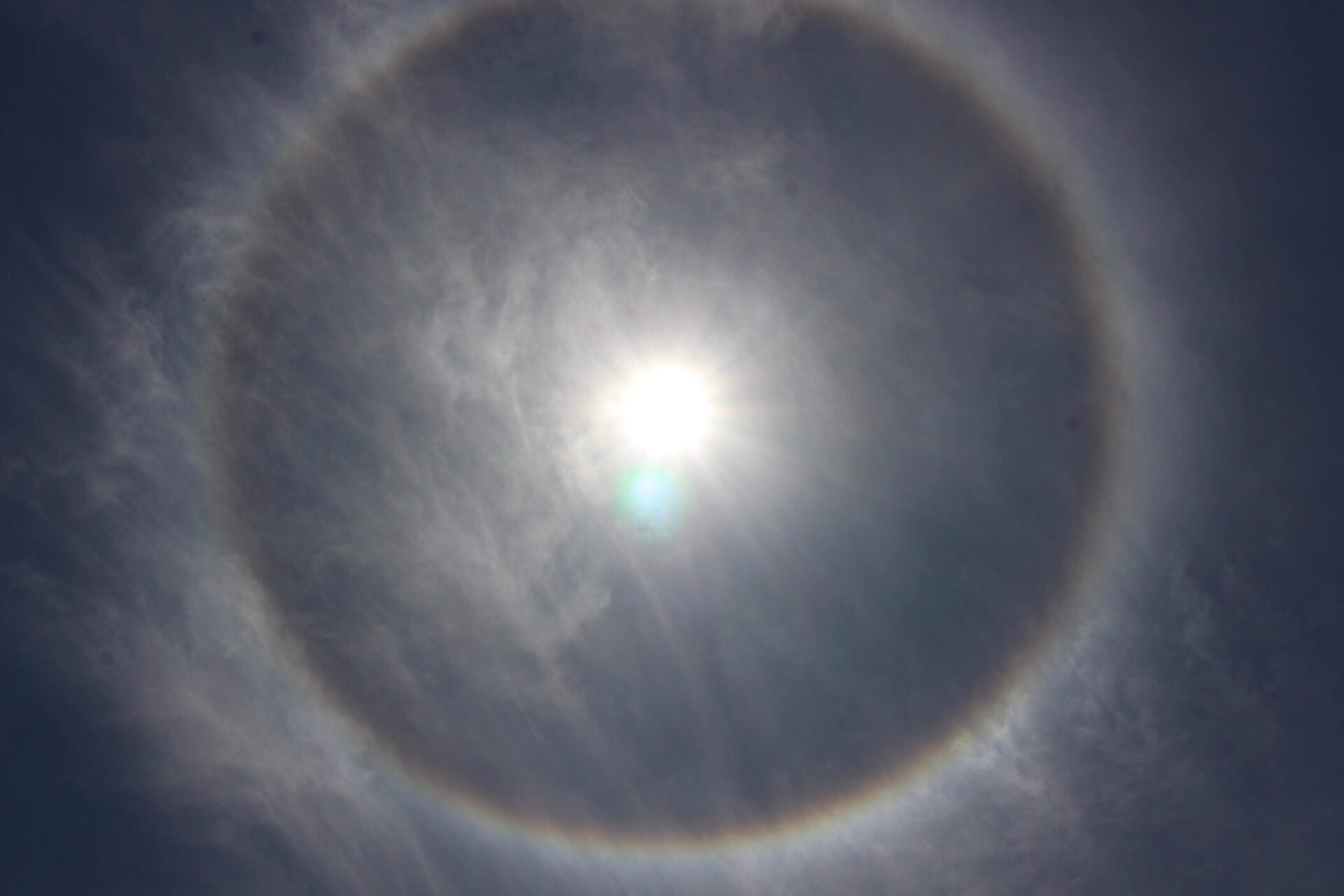
Photo · Bieverwin · CC BY-SA 4.0 · Wikimedia Commons
The World Meteorological Organization describes a darker sky inside the ring. Exposure and cloud conditions also affect a photograph, however. A dark inner area alone does not establish that it is cloud-free. [1]
At night, the same process makes a lunar halo
A lunar halo also forms when light passes through atmospheric ice crystals. The Hong Kong Observatory describes moonlight refracting through crystals in cirrostratus or cirrus to form a ring with an angular radius of about 22 degrees. Although the ring appears to surround the Moon, the optical action takes place in Earth’s atmosphere. [5]
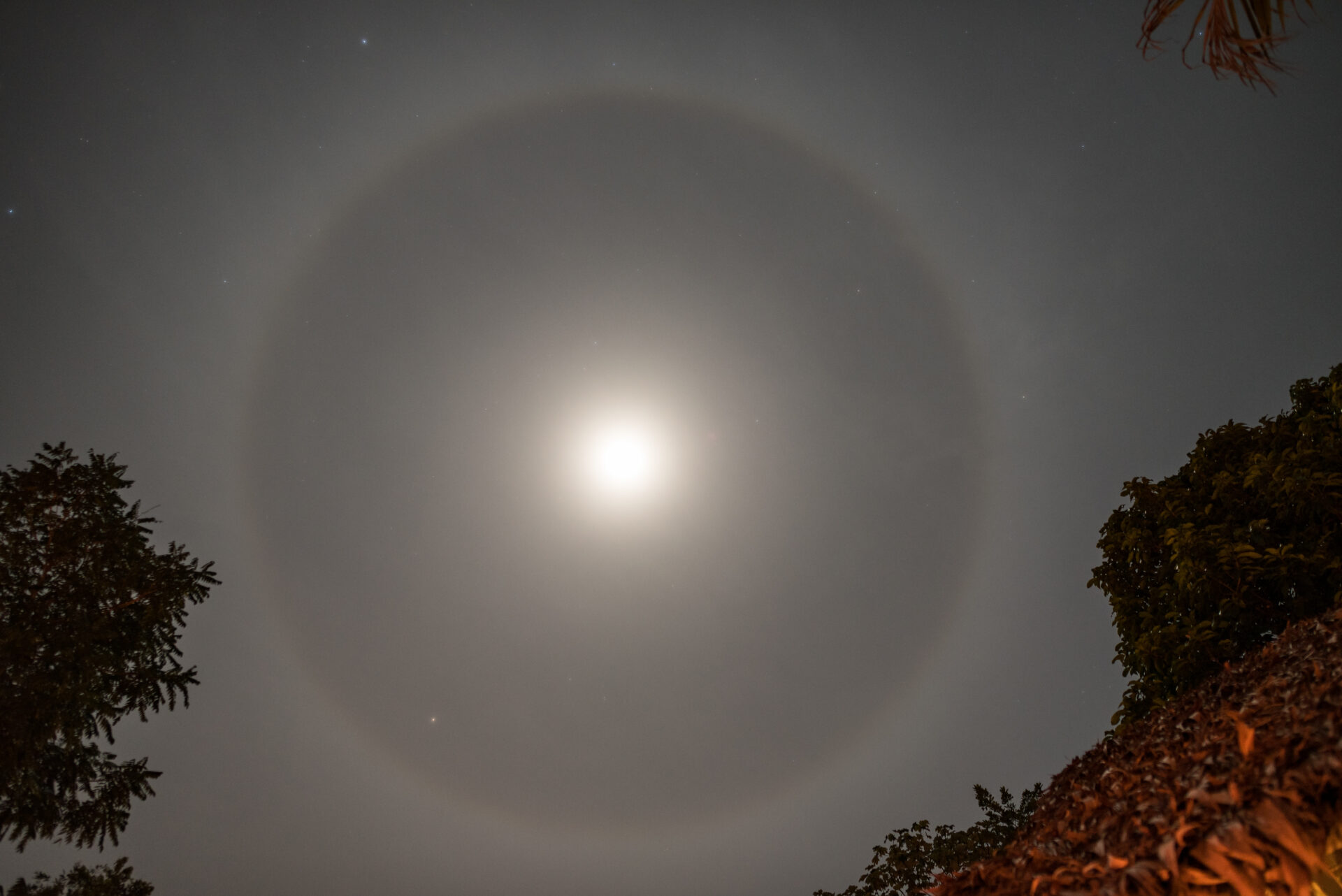
Photo · Juris Seņņikovs · CC BY-SA 4.0 · Wikimedia Commons
Lunar halos generally appear white. A difference in color from a daytime photograph does not by itself imply a different mechanism. First distinguish a broad ring centered on the Moon from a small glow close to it. Shape and apparent size are useful starting points before assigning a name. [3]
How does a halo differ from a rainbow or corona?
To see an ordinary rainbow, the Sun is behind you and water droplets are in front. Refraction and reflection inside those drops are central to its formation. A 22-degree solar halo differs in both its material and viewing direction. Having colors in common does not make them the same phenomenon. [6]

Photo · Ted.ns · CC BY-SA 4.0 · Wikimedia Commons
Small colored rings close to the Sun or Moon may be a corona. Coronas arise from diffraction by tiny droplets or small ice particles. Diffraction involves the wave behavior of light as it spreads around small particles. Ring size varies with particle size, unlike the characteristic angular radius of a 22-degree halo. [7]
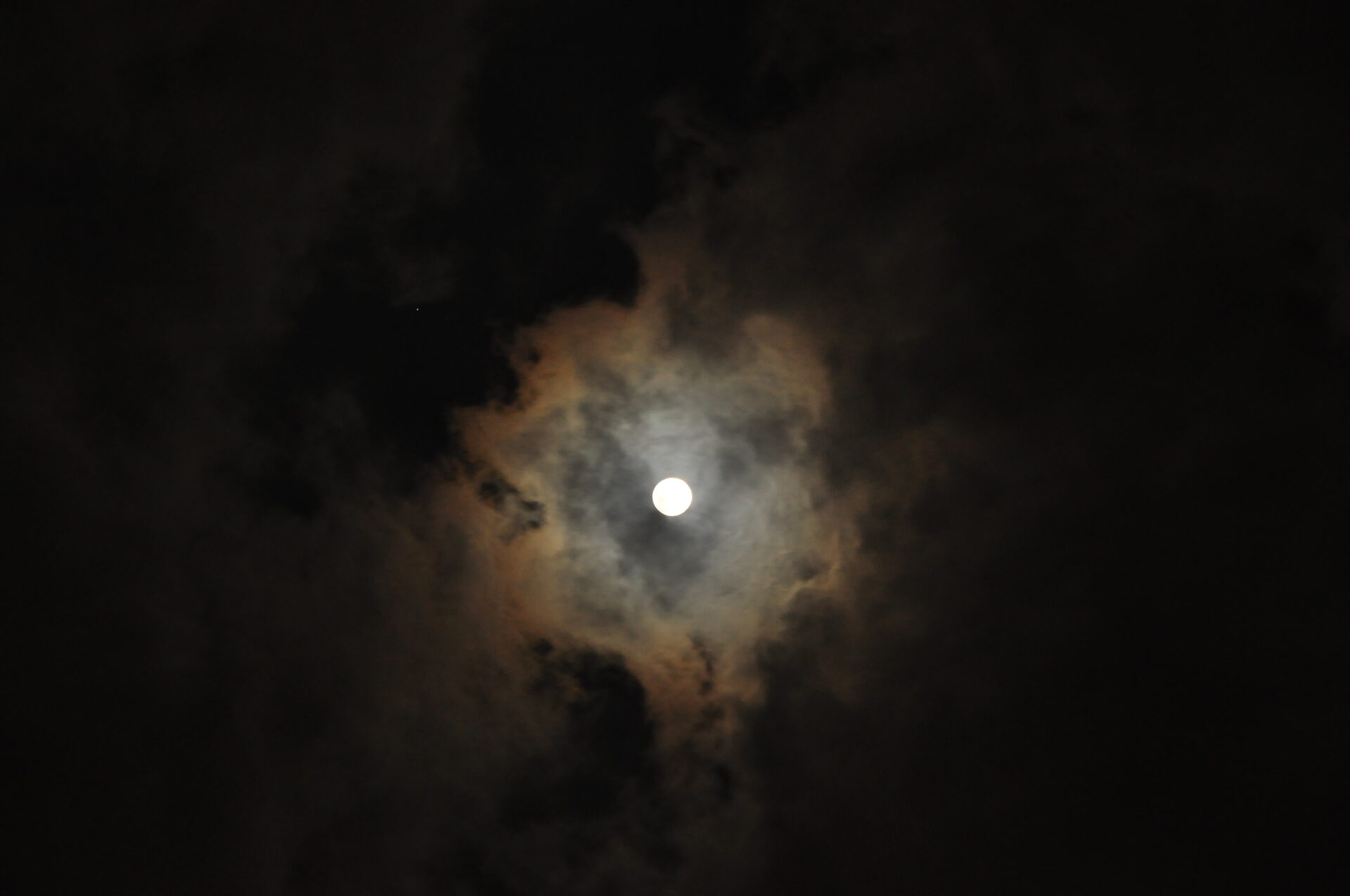
Photo · 阿爾特斯 · CC BY-SA 3.0 · Wikimedia Commons
| Display | Main material and process | Where to look |
|---|---|---|
| 22-degree halo | Refraction by ice crystals | A ring about 22 degrees from the Sun or Moon [1] |
| Ordinary rainbow | Refraction and reflection in water droplets | With the Sun behind the observer [6] |
| Corona | Diffraction by tiny droplets or ice particles | Close to the Sun or Moon; size depends on particles [7] |
The table is a starting point. Halo phenomena also include arcs and bright spots, and several displays can overlap in one sky. A ring of light in a photograph is not enough to identify every case as a 22-degree halo. [3]
Does a lunar halo guarantee rain?
The high clouds that produce halos can arrive before a weather system bringing rain or snow, making a halo a possible clue to change. But the US National Weather Service cautions that a ring does not guarantee precipitation. Observing icy cloud and predicting when or where rain will fall are different judgments. [8]
If you spot a lunar halo tonight, watch how the cloud develops and check the local forecast rather than assigning a rain time from the ring alone. A halo can begin an observation; it is not a scale that measures precipitation timing or amount. [8]
Start with the center of the ring
Do not look directly at the Sun. Observe the surrounding sky from a position where an opaque object, such as a building, completely hides the solar disc. When comparing photographs, note what blocks the Sun and how far a ring appears from the lunar disc. [9]
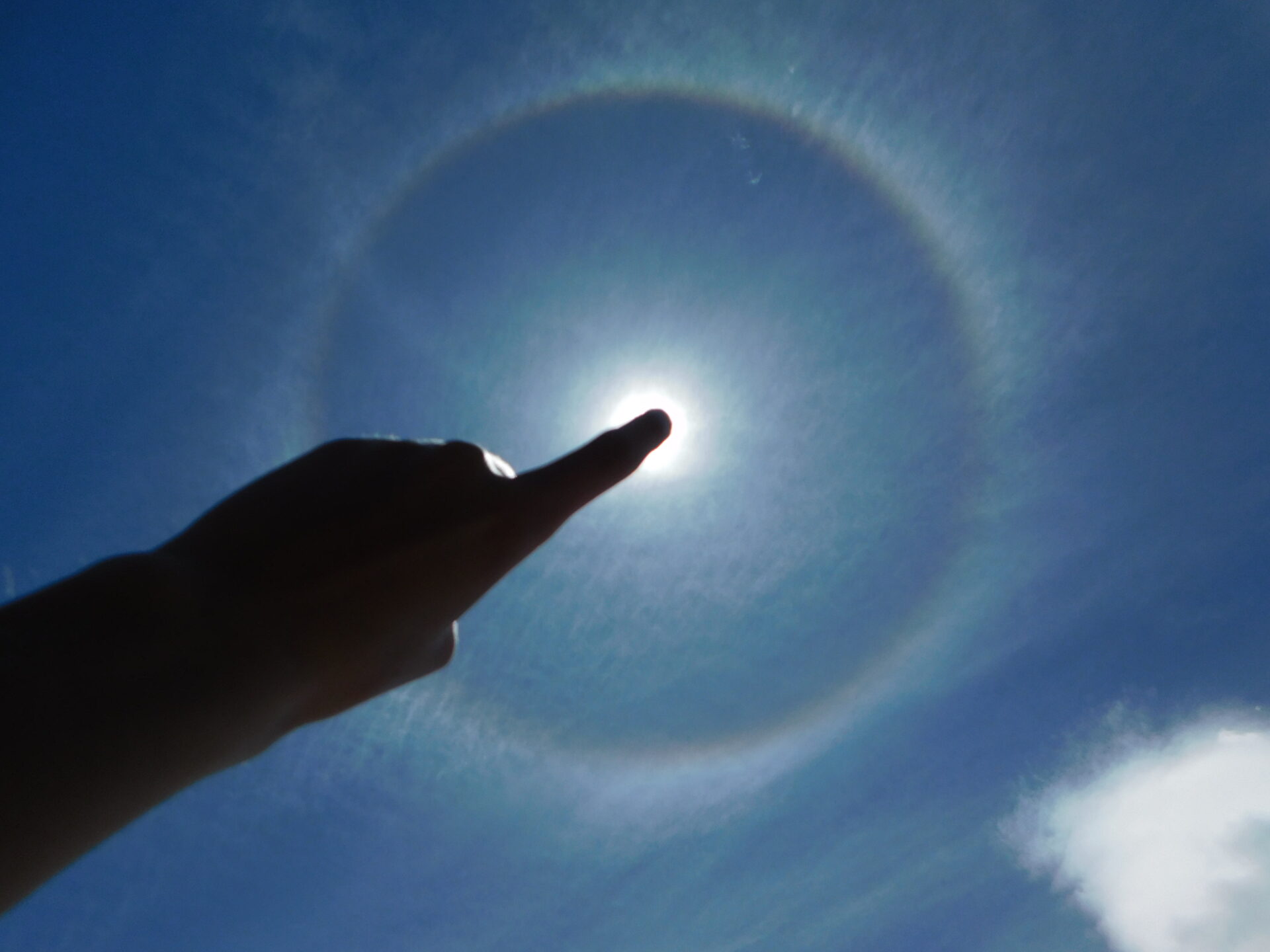
Photo · NathanScientific · CC0 · Wikimedia Commons
Finally, ask three questions in order: what is at the center, how far away is the ring, and what cloud accompanies it? These clues are more useful than color alone. The familiar sky looks different when we attend to centers, sizes and clouds. Such observation is a small starting point for discovering the intricate order of creation.
References
- 22° halo — International Cloud Atlas
- Practical Meteorology, Chapter 22: Atmospheric Optics
- Halo Phenomena — International Cloud Atlas
- High clouds
- Moon Halo
- Rainbows: optical wonders
- Corona — International Cloud Atlas
- Owlie’s Weird Weather! — 22° Halo
- Observing Halos — Getting started
- Halo Captured By The Total Sky Imager