
Watch a water strider near the edge of a pond. It pauses with its long legs spread, then glides across the surface. Surface tension is the familiar explanation, but the scene poses two different questions: what supports its body, and what sends it forward?

Photo · Trazyanderson · CC BY-SA 4.0 · Wikimedia Commons
There is no separate skin on the water
Surface tension describes a liquid surface’s resistance to being stretched. It is connected to cohesion, the attraction between water molecules. Water gathering into rounded drops and the surface supporting small objects both reveal this property. [9]
A taut membrane is a useful analogy, provided we remember that a pond has no solid rubbery skin. Cohesion between water molecules also differs from adhesion between water and another material. Understanding the insect therefore means considering both the water and the surface of its legs. [10]
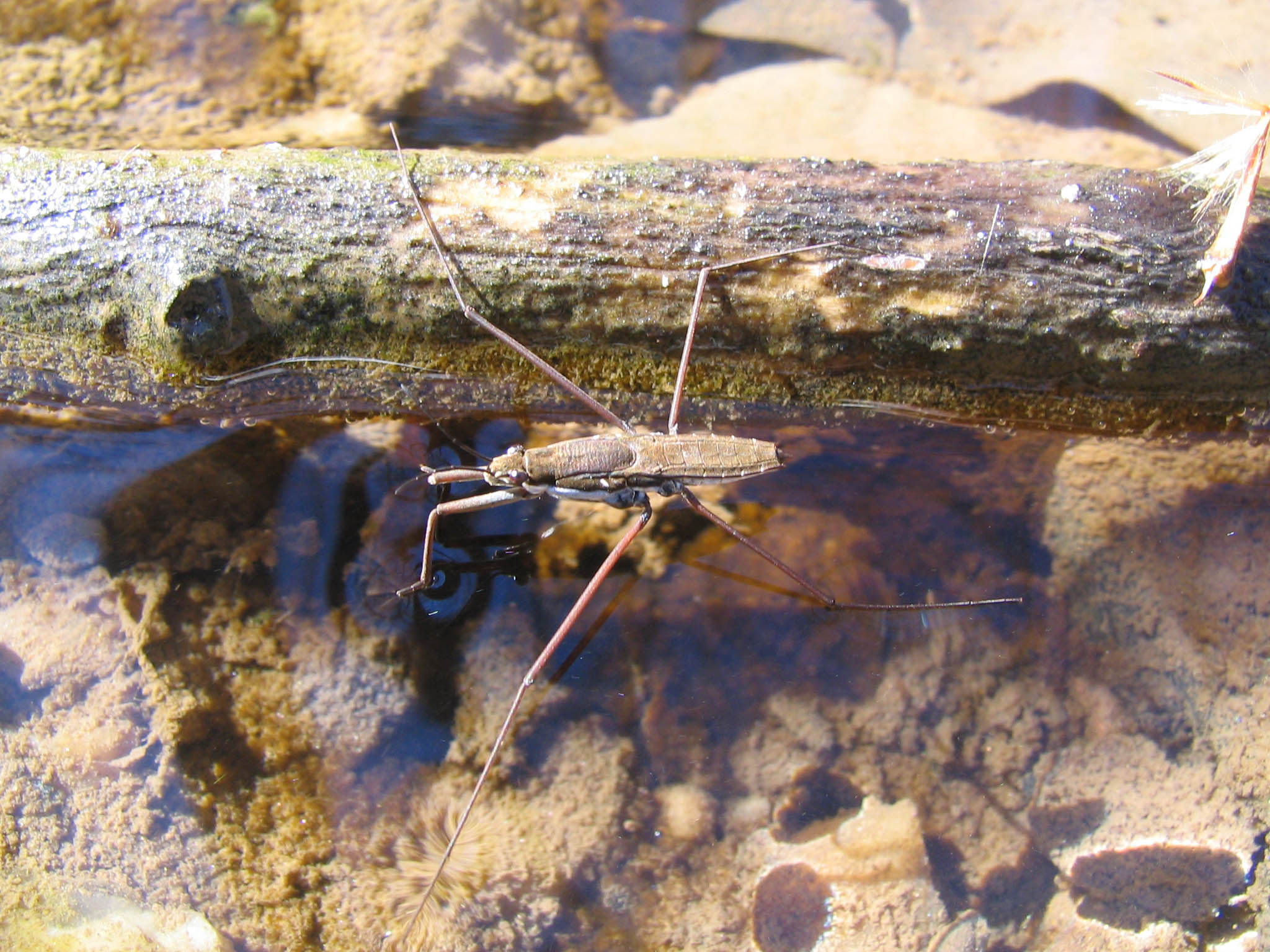
Photo · Tim McCormack (Phyzome) · CC BY-SA 3.0 · Wikimedia Commons
A dimpled surface supports the body
The legs depress the surface. Surface tension along the contact line provides upward support and dominates for slender legs, although water pressure also contributes buoyancy. [1]
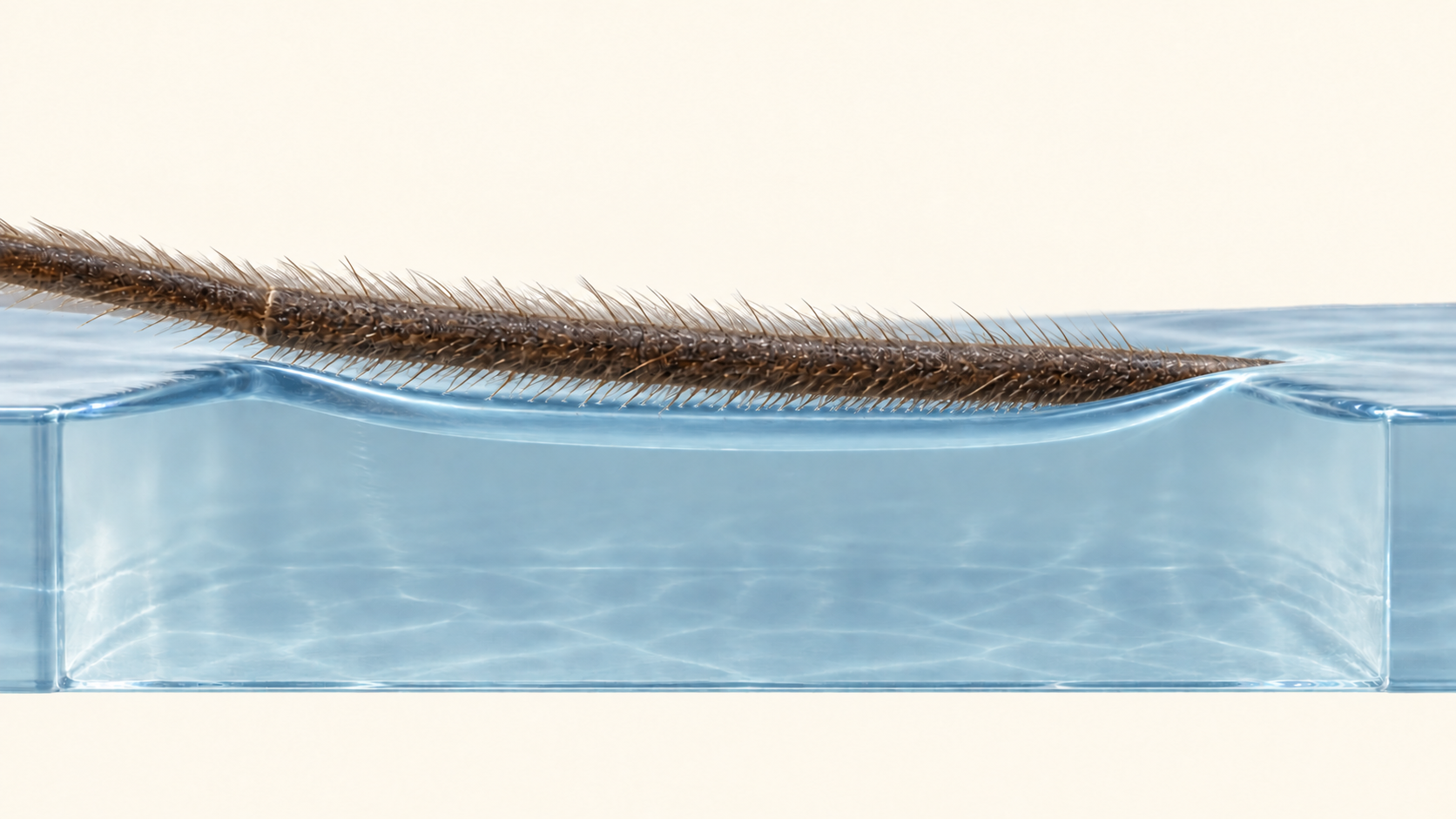
Illustration · AI-generated (Codex/ChatGPT subscription) · conceptual view of leg–water contact. Based on: [1], [8]
Several long legs share the load. The US Geological Survey describes this support as a combination of long, water-repellent legs and distributed weight. Rather than reduce the explanation to foot size alone, consider the body’s weight, the arrangement of its legs and how readily those surfaces become wet. [4]
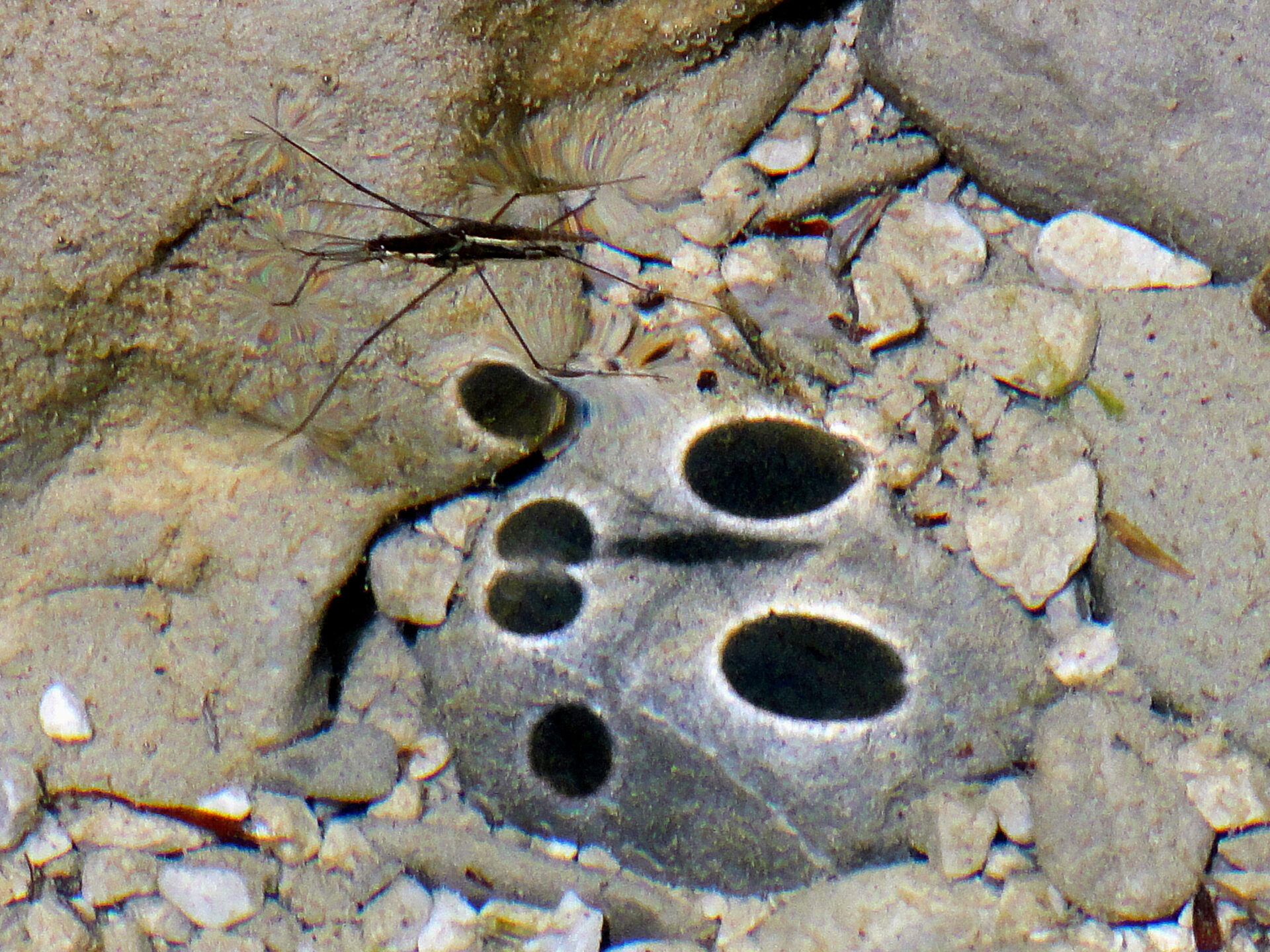
Photo · Vid Pogacnik · CC BY-SA 4.0 · Wikimedia Commons
Water-repellent legs have a fine structure
The legs’ water repellency cannot be explained simply as an oily coating. A 2004 Nature study emphasized oriented microscopic hairs with still finer grooves. These structures work alongside surface chemistry to make the legs difficult to wet. That does not mean wax plays no role. [2]
Water repellency does not eliminate contact. Air can remain among the hairs while individual hairs still meet the water. Research on directional adhesion found that tilted, curved hairs can interact with water differently depending on the direction of movement. A water-repellent surface can therefore still transmit force to water. [8]
Moving forward means pushing water back
Rowing with the middle legs pushes water back. MIT’s 2003 high-speed video and particle-tracking experiments found that momentum went chiefly into subsurface vortices rather than capillary waves. Visible ripples do not tell the whole propulsion story. [1][3]

Photo · Brocken Inaglory · CC BY-SA 3.0 · Wikimedia Commons
A photograph and a flow experiment answer different questions. Circular ripples can appear in a photograph, but they do not reveal the shape of submerged vortices or measure a force. The image above is an observation of surface ripples, not a substitute for the paper’s flow experiment.
How do the six legs share the work?
Water striders are insects with three pairs of legs. The National Park Service describes the short front legs as tools for grasping prey, the middle legs as the main driving pair, and the hind legs as involved in steering and braking. Life on the surface involves handling food as well as support and movement. [5]
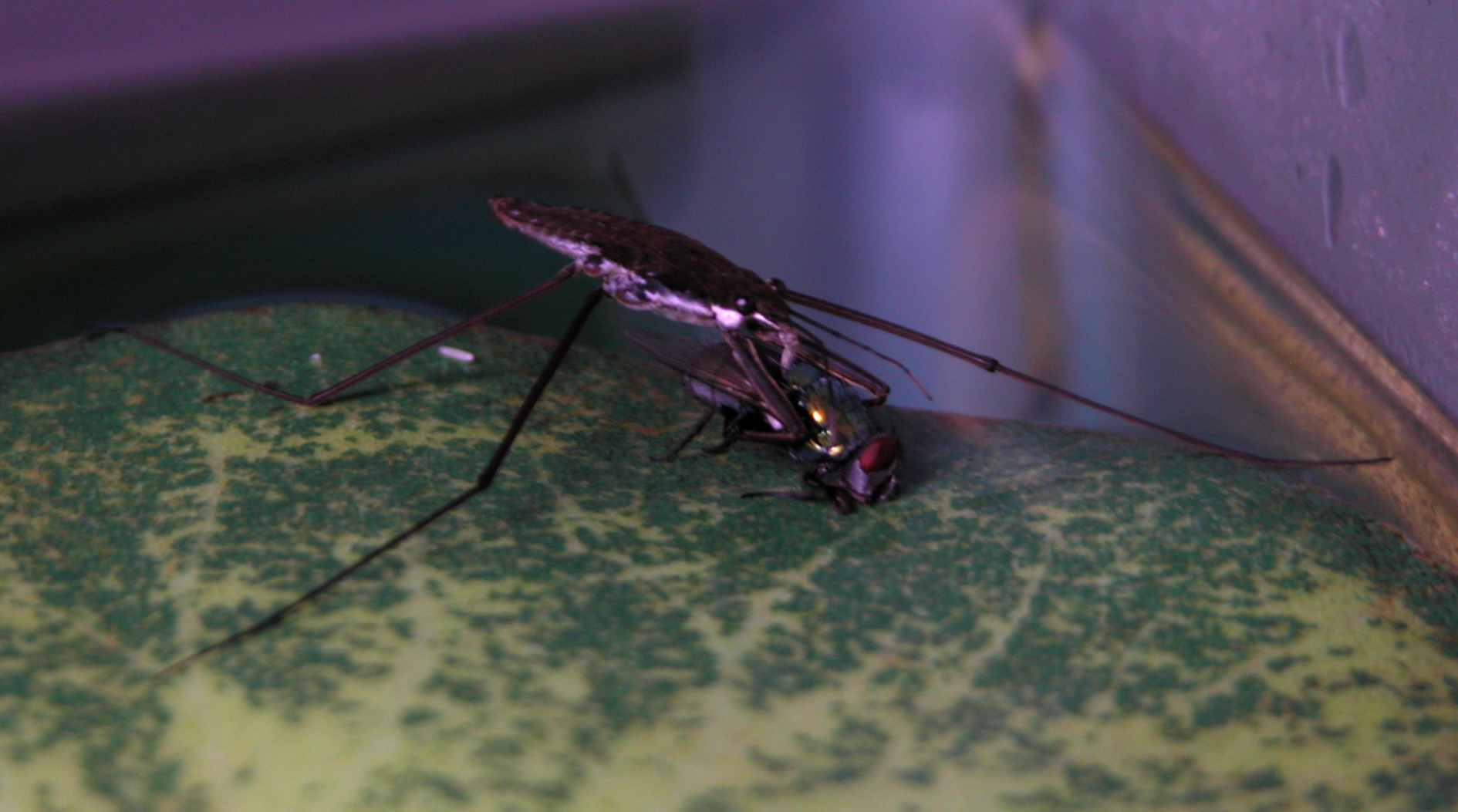
Photo · Ildar Sagdejev (Specious) · CC BY-SA 3.0 · Wikimedia Commons
These roles are not permanent job assignments. A 2024 comparison across body sizes documented different supporting-leg arrangements during the glide after a stroke. Some striders extended one middle leg forward to support the body. Which legs touch the water can vary with species, size and the phase of movement. [7]
Does water repellency mean a leg can never get wet?
What if water condenses directly on a leg? A 2015 PNAS study observed droplets entering spaces between hairs, then being expelled with help from the elasticity of bent hairs as the droplets grew. Water repellency does not mean water can never make contact. [6]
The legs were fixed in a humidity-controlled chamber. This does not guarantee dryness in every weather condition, and droplet removal should be distinguished from forward propulsion. [6]
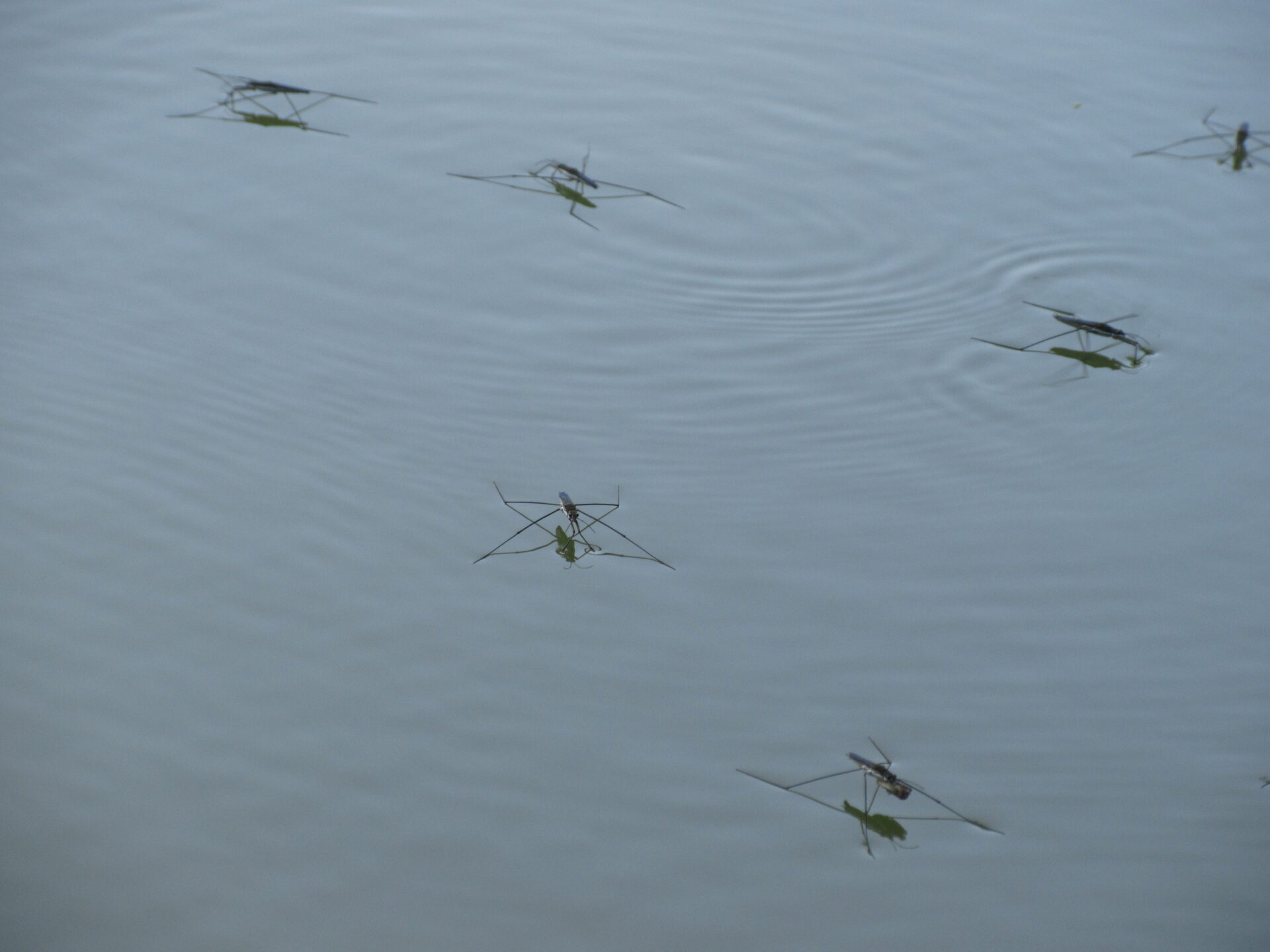
Photo · CosyCobra · CC BY-SA 4.0 · Wikimedia Commons
Three things to watch next time
First, watch a pause: how do the surface and light patterns near the legs differ from their surroundings? Then watch a movement, distinguishing the push from the glide. Finally, remember the limits of a photograph. An ordinary wide view cannot establish microscopic grooves or submerged vortices.
A water strider is a small part of creation in which the properties of water, leg surface structures and leg movements work together. Explaining support does not by itself explain propulsion. Keep those questions separate, and a brief glide across a pond becomes much more revealing.
References
- The hydrodynamics of water strider locomotion
- Biophysics: water-repellent legs of water striders
- MIT leaps to solution of walking-on-water mystery
- Surface tension allows a water strider to walk on water
- Species Spotlight – Water Striders
- Self-removal of condensed water on the legs of water striders
- Physics of sliding on water explains morphological and behavioural allometry across a wide range of body sizes in water striders (Gerridae)
- Interfacial propulsion by directional adhesion
- Surface Tension and Water
- Adhesion and Cohesion of Water