
It’s widely told that Apple ushered in the “smartphone era” when it launched the iPhone in the United States on June 29, 2007. But 13 years earlier, in August 1994, a commercial product that combined phone calls, email and fax, and a touchscreen with apps was already sitting on store shelves. It was the “IBM Simon,” built by IBM and Mitsubishi Electric and sold by BellSouth Cellular. That figure of 13 years comes from simply subtracting the two products’ launch years (2007 minus 1994). Counted down to the month, only about 12 years and 10 months passed between Simon’s August 1994 launch and the iPhone’s U.S. launch on June 29, 2007. Yet back when Simon was on sale, the word “smartphone” itself — the term now used for this whole category of device — didn’t exist. So what actually happened in those 13 years?
Simon: An Office in the Palm of Your Hand
Simon started as a small experiment led by IBM engineer Frank Canova in the early 1990s. Canova belonged to a “smaller, lighter products” development team under his boss Paul C. Mugge, and together with colleague Jerry Merckel, who worked on PCMCIA card technology, he developed the idea of packing a wireless communications chip into a device small enough to hold in one hand. The concept was first shown to the world as a prototype code-named “Sweetspot” (internally also called “Angler”) at the COMDEX trade show in Las Vegas in November 1992.
Full commercialization took nearly two more years after that. The original target was a May 1994 launch, but software problems pushed it back, and sales actually began in August 1994 through BellSouth Cellular, across service areas in 15 U.S. states. Often cited as the first commercial product to combine phone calls, apps, and a touchscreen in one device, its actual specifications were as follows.
- Price: $899 with a two-year contract, $1,099 without one (roughly $1,945-$2,378 in 2025 dollars)
- Weight: about 510g, dimensions about 200x64x38mm
- Battery: about 1 hour of talk time — cited as one of the main reasons for its commercial failure
- Sales: roughly 50,000 units over about six months
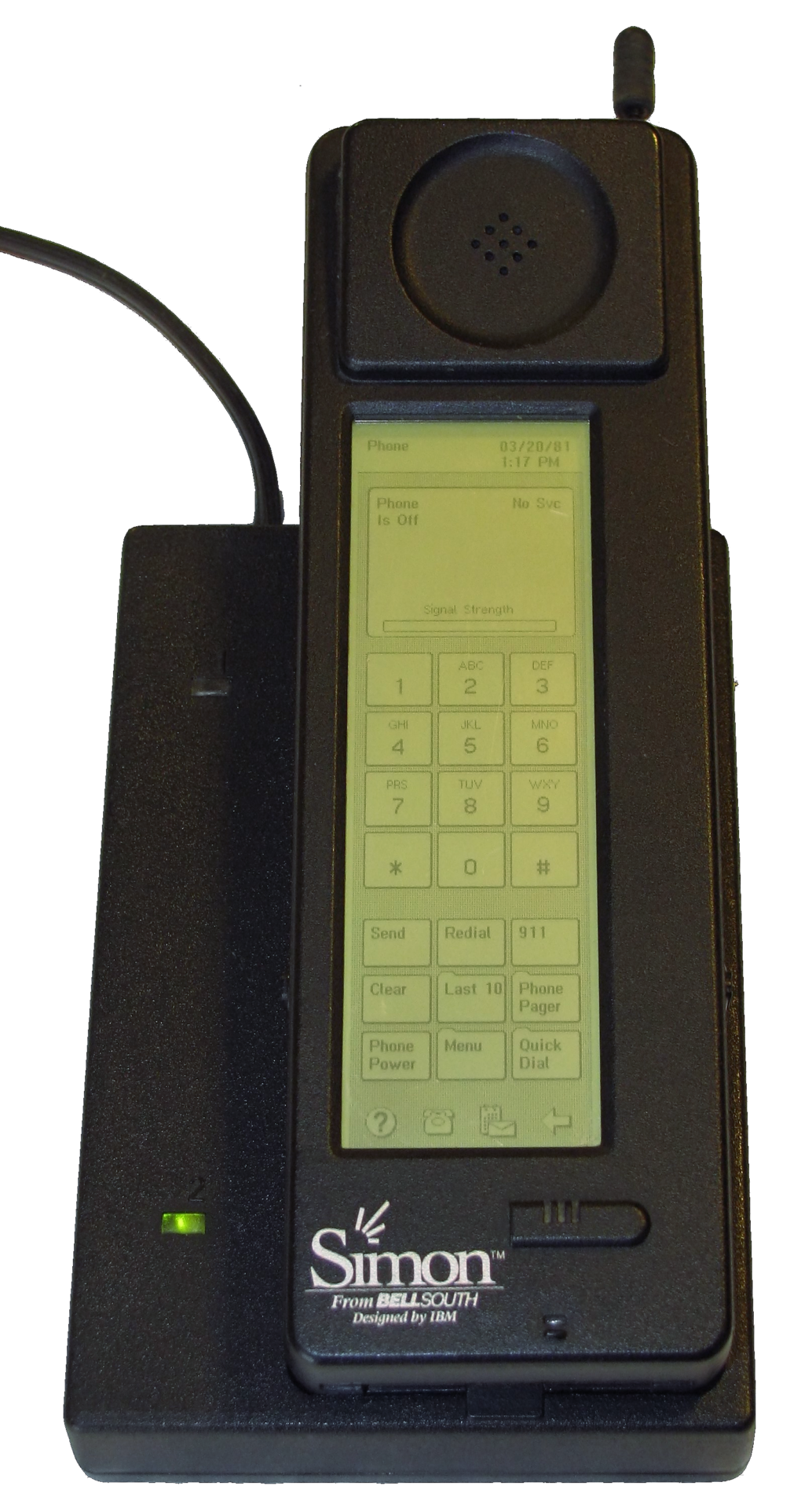
Simon had a 4.5-inch resistive touchscreen operated by pressing the screen with a finger or stylus, and it could send and receive faxes, email, and cellular pages. It came with 11 built-in programs, including an address book, calendar, scheduler, calculator, world clock, and a handwritten notepad. Even so, the market and press of the time classified the device not as a “smartphone” but as a “PDA with cellular capability.” That wasn’t because Simon fell short — it was because the name itself didn’t exist yet.
The Word “Smartphone” Didn’t Exist Yet
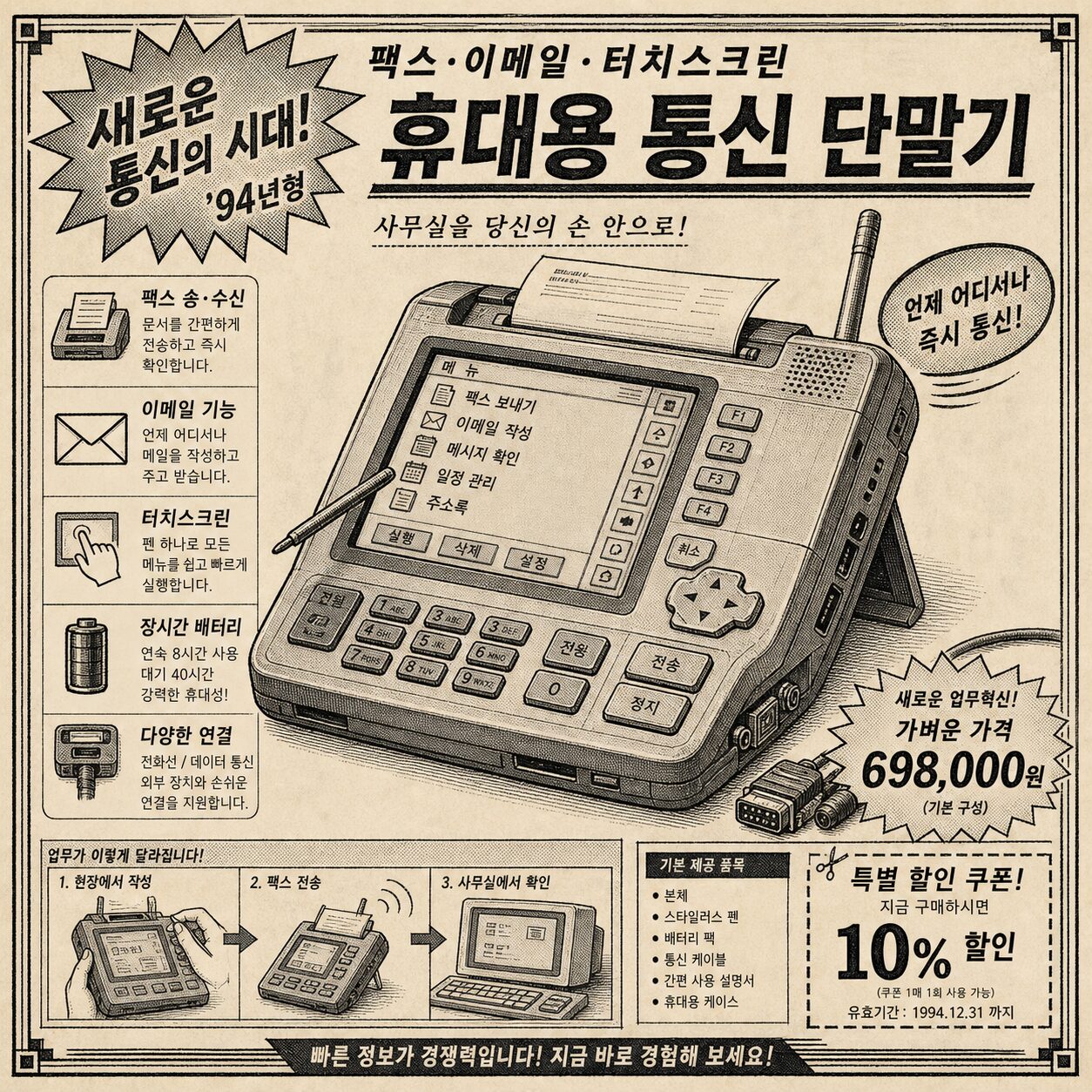
In 1994, when Simon was on sale, there was no unified name for this category of device. The next milestone came in 1996 with the Nokia 9000 Communicator. Announced at CeBIT in 1996 and launched that August 15, it packed a full QWERTY keyboard and a 640×200 monochrome LCD screen into a clamshell body, integrating GSM calling with email, fax, and a web browser. It ran on an Intel 24MHz i386 processor with 8MB of memory, launched in the UK at £1,000, and weighed 397g.

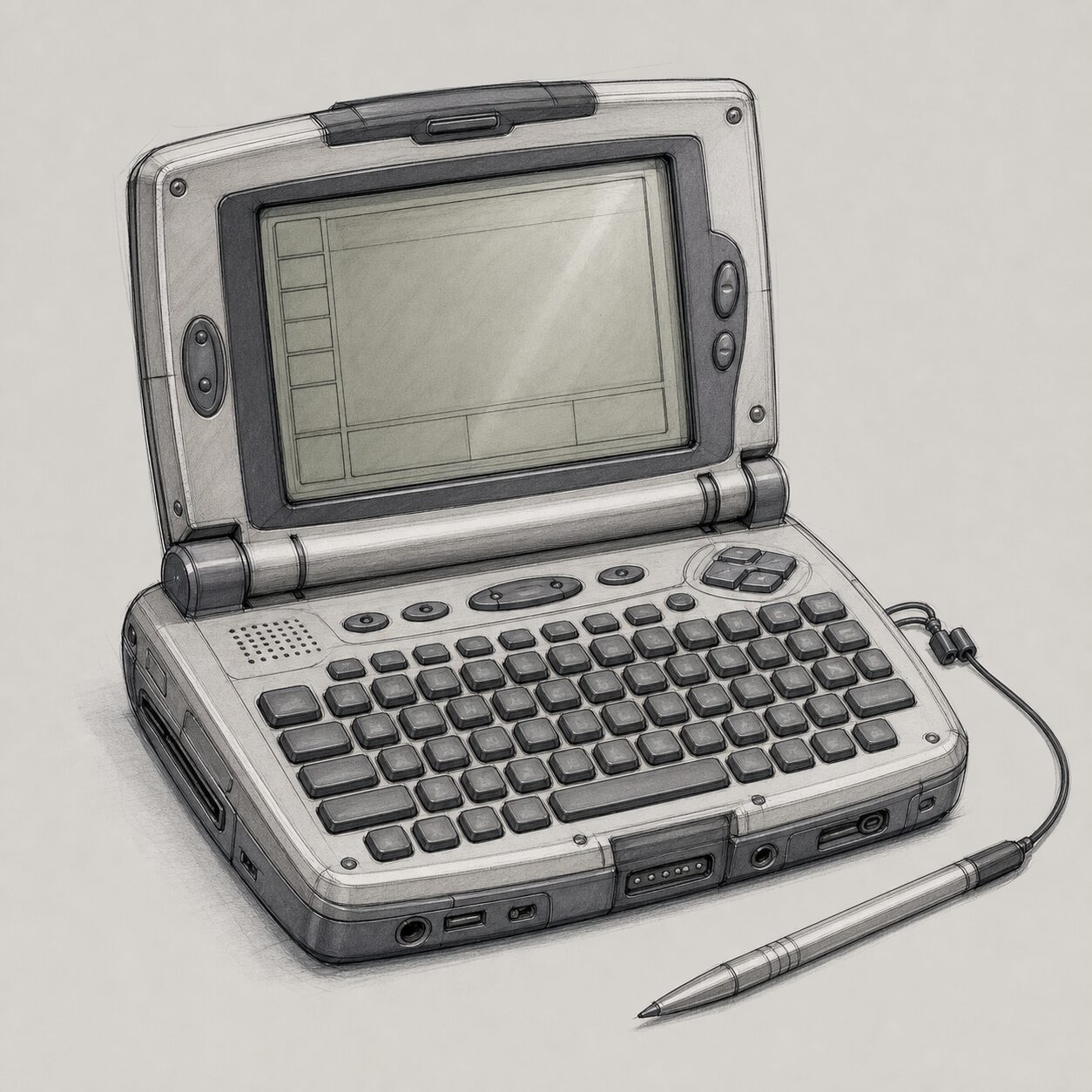
The word “smartphone” first appeared commercially the following year, in 1997. When Ericsson unveiled the prototype GS 88, code-named “Penelope,” it printed the phrase “Smart Phone” on the packaging for the first time — an expression proposed by marketing manager Mats Barbasten. The device, which had a touchscreen, QWERTY keyboard, and stylus, was never actually released commercially, however. Production was halted amid a strategic decision by Ericsson, Motorola, and Nokia to join forces and restructure the Symbian camp, and only about 200 prototype units were ever built.
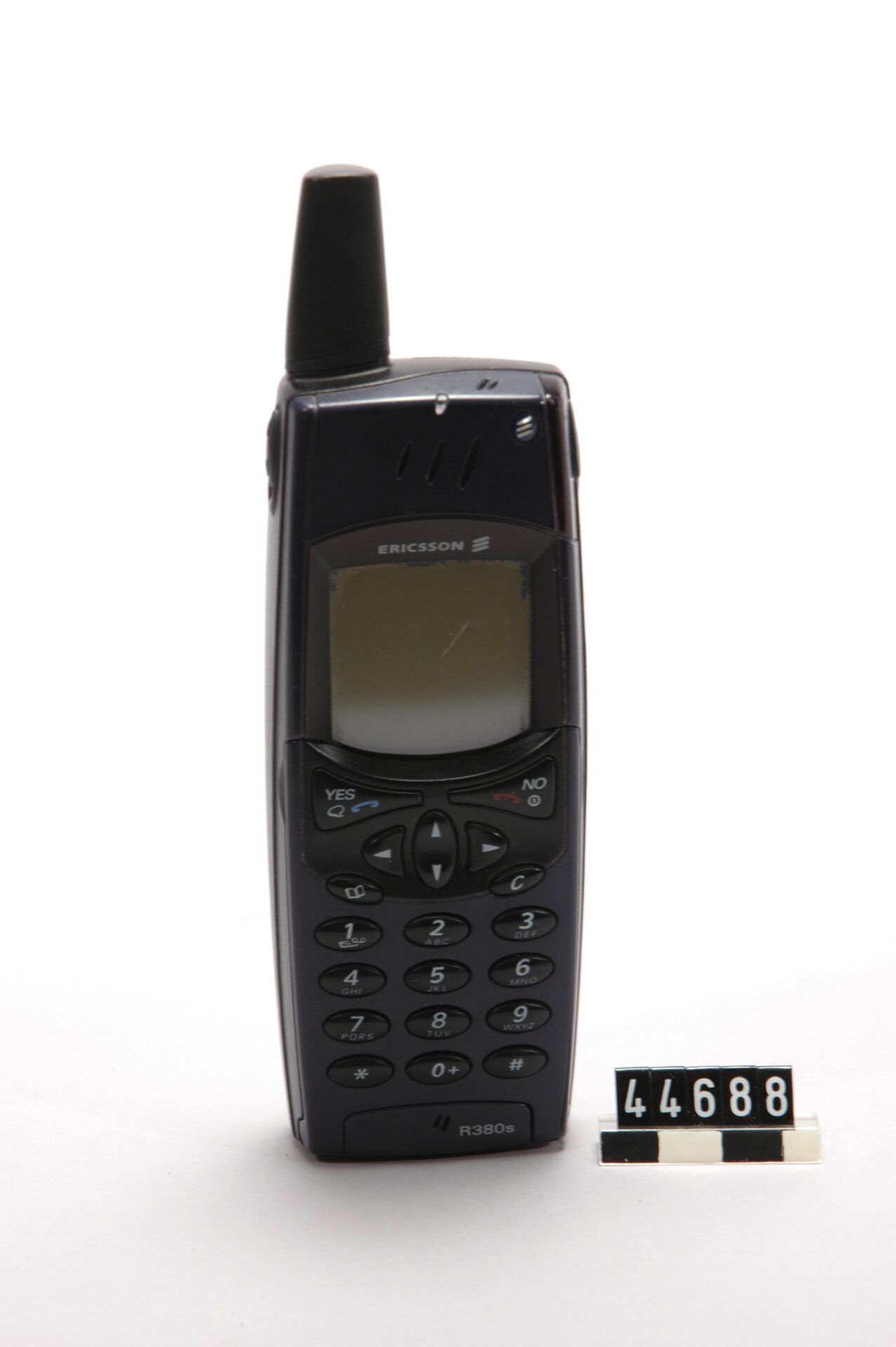
The first mobile phone actually marketed and sold commercially under the name “smartphone” didn’t arrive until three more years later, in 2000: the Ericsson R380. Unveiled at CeBIT on February 19, 1999, and launched around September 2000, it was the first device to run Symbian, though installing separate apps wasn’t possible. In other words, it took three years after Simon’s 1994 debut for the word “smartphone” to be used commercially for the first time, and three more years after that for the name to actually reach the sales floor.
What the iPhone Actually Changed
On January 9, 2007, Steve Jobs unveiled the iPhone on the Macworld stage in San Francisco, describing it as “three devices in one: a phone, an iPod with touch controls, and an internet communicator.” Its actual U.S. launch came that same year on June 29.
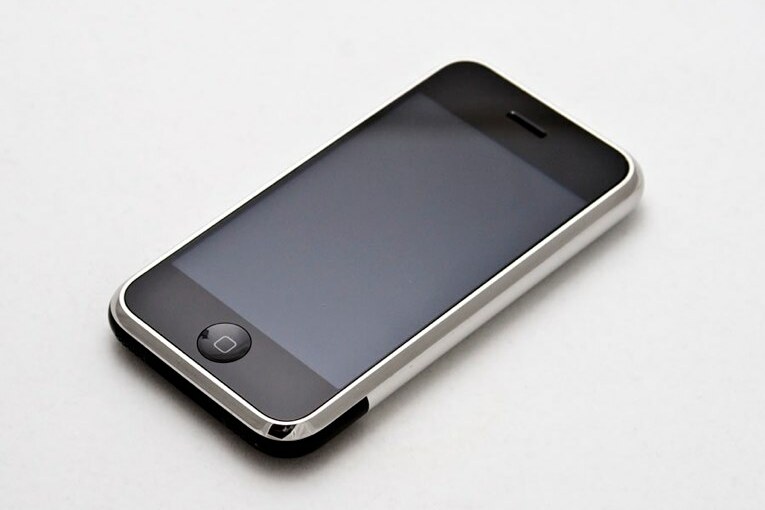
Where the iPhone actually broke from earlier devices isn’t “being the first to combine calling with a touchscreen.” That spot had already been taken 13 years earlier by Simon. The iPhone’s real design turning point was its triple-layer capacitive multitouch screen. Unlike the resistive, stylus-based approach used by Simon and the Nokia 9000, it recognized complex gestures like scrolling and tapping using fingers alone. Apple described it as “the most revolutionary user interface since the mouse.”
It’s commonly assumed that “the iPhone had an app ecosystem from day one,” but that isn’t actually true. The App Store didn’t open until July 10, 2008 — a full year after the iPhone’s launch — and it listed 500 apps at that point (about 25% of them free). Downloads passed 10 million within the first 72 hours, but when the iPhone first went on sale in 2007, no third-party app store existed at all. The iPhone’s precise place in this story isn’t “the invention of the smartphone” — it’s the turning point where a new input method, capacitive multitouch, and the app ecosystem that followed carried the smartphone into the mainstream.
Thirteen Years of Accumulated Design
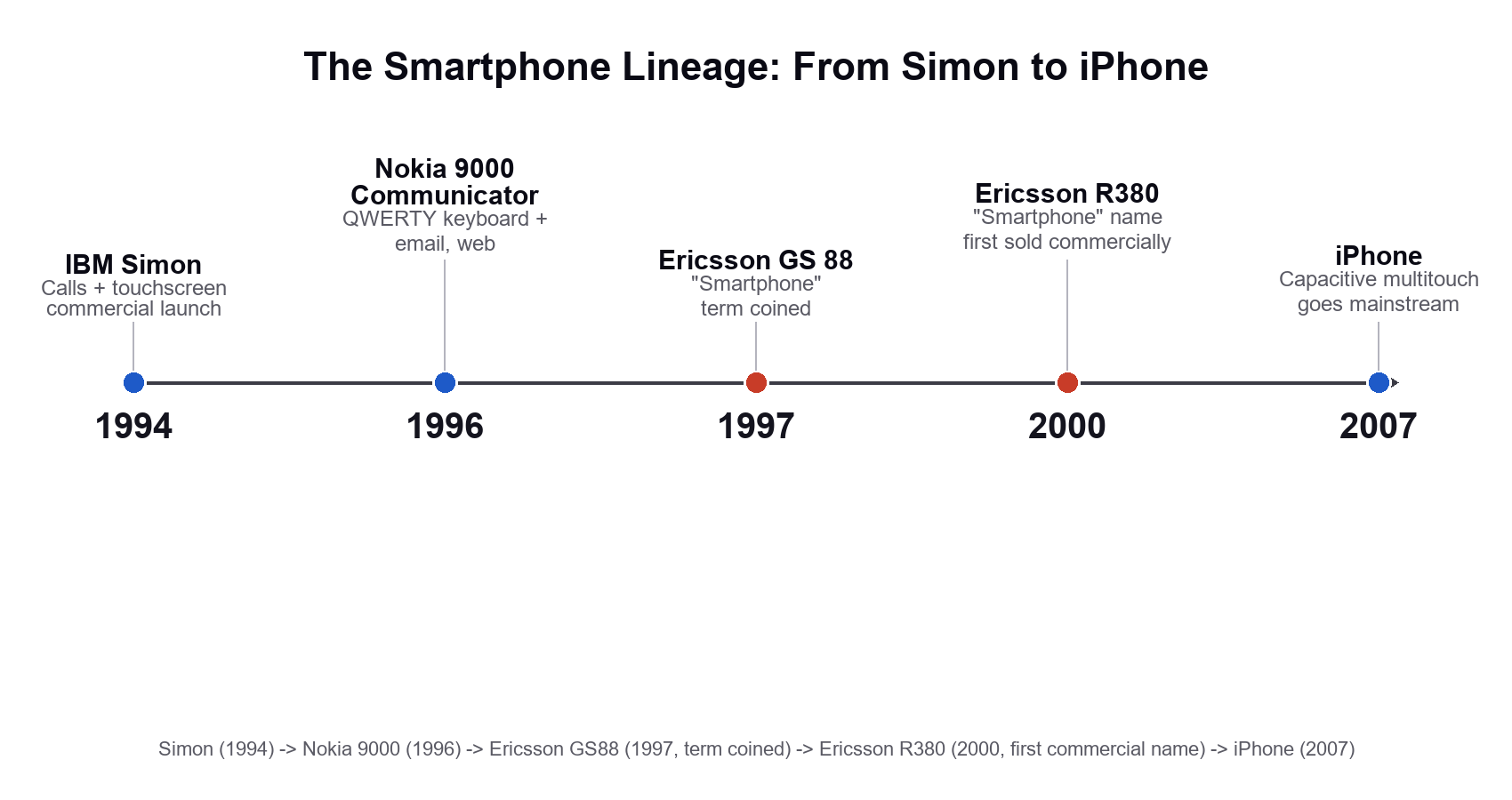
From Simon in 1994, to the Nokia 9000 in 1996, to the Ericsson GS 88 in 1997 — which got only the name — to the Ericsson R380 in 2000, the first to be sold under that name, and finally the iPhone in 2007: these 13 years weren’t a single moment of invention, but a stretch of time in which hardware, input methods, and the name itself were each refined separately. Simon wasn’t called a “smartphone” not because it lacked capability, but because the design vocabulary needed to attach that name hadn’t arrived yet. The history of the smartphone isn’t the story of one device conquering the market — it reads more like a record of accumulation, in which finely engineered parts and concepts, each shaped by its own era, fell into place one at a time.