
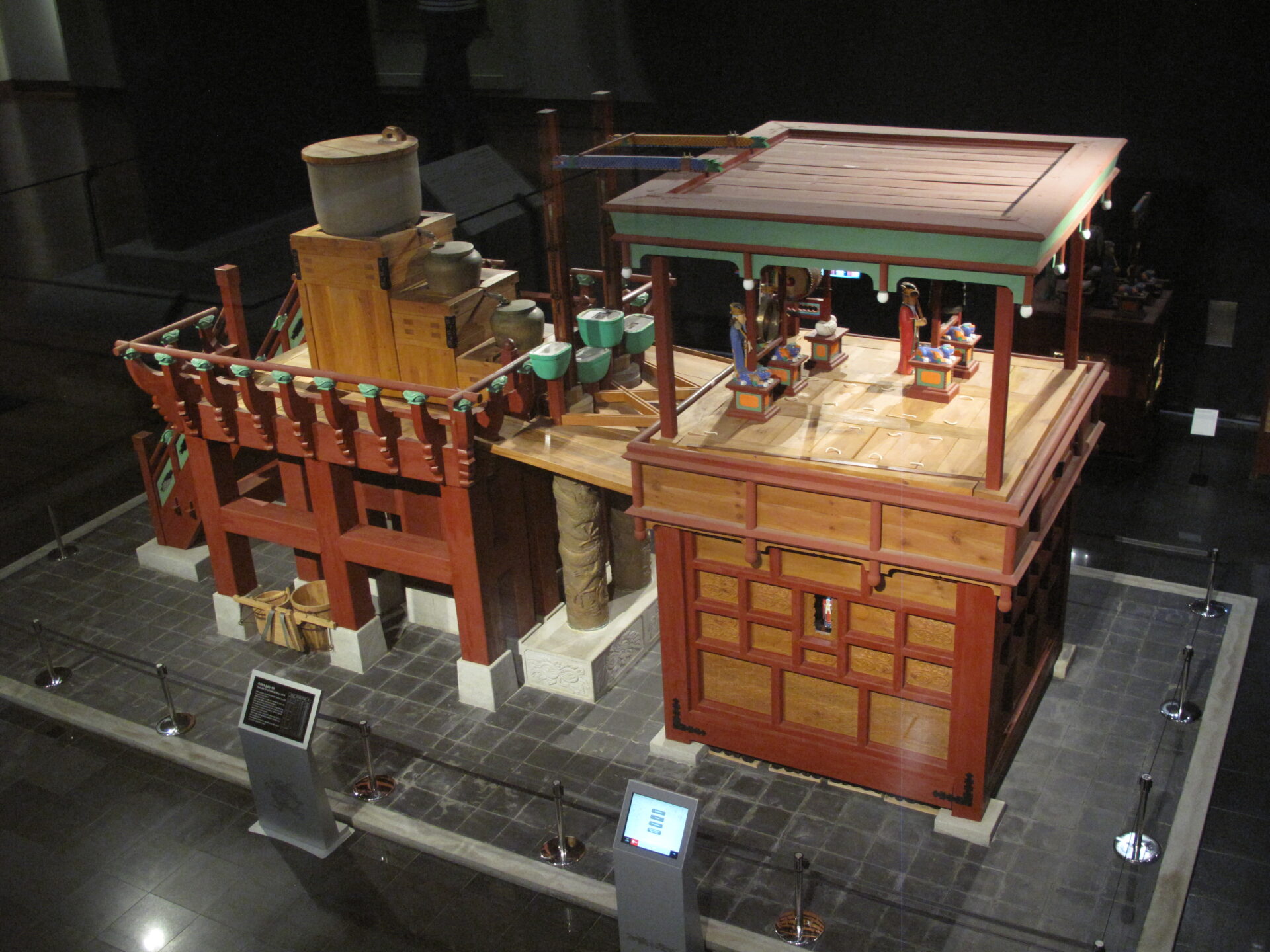
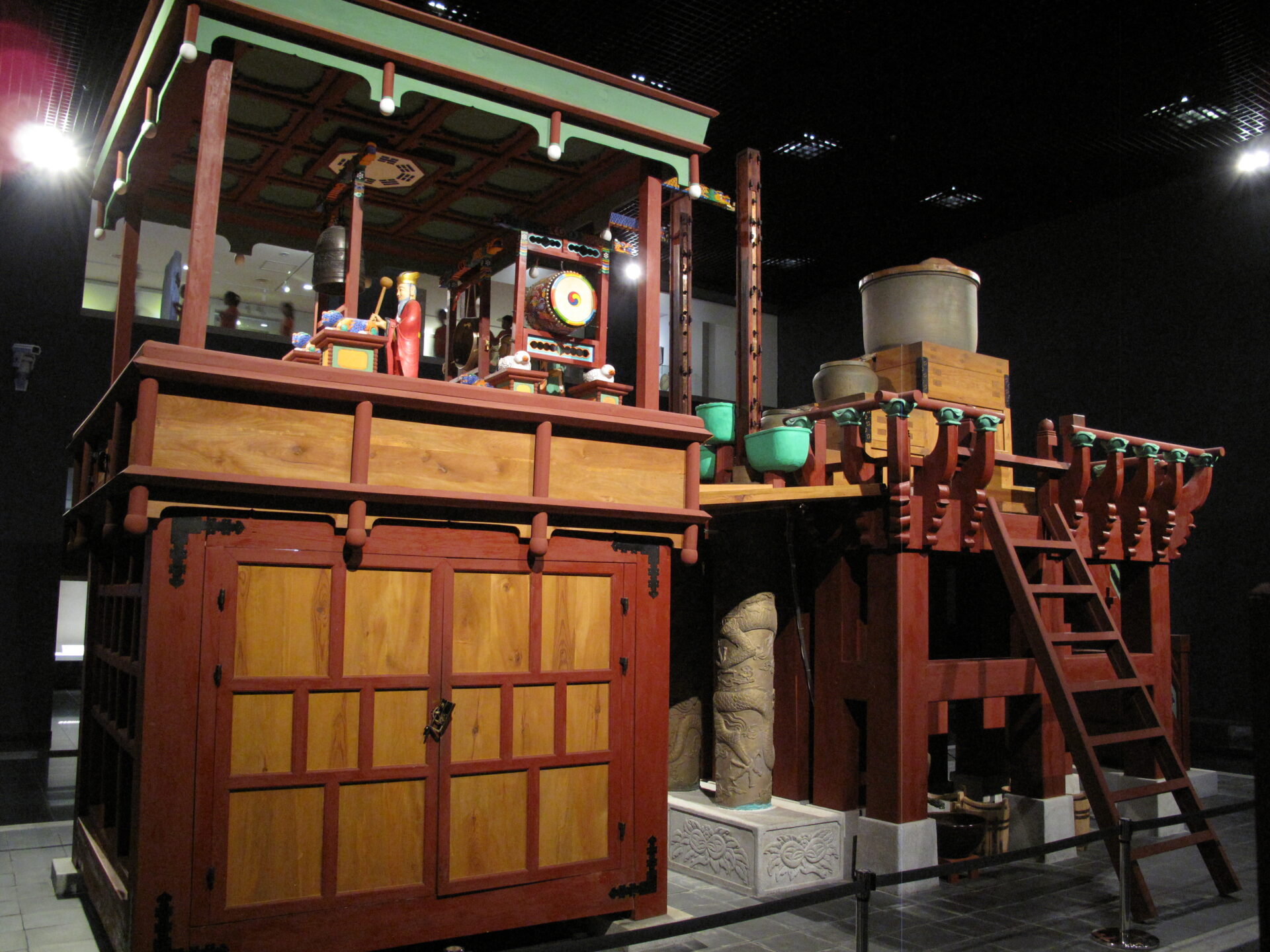
Deep in the night at Gyeongbokgung Palace, water flows quietly inside the Borugak (報漏閣). As a jar fills with water, an arrow-shaped float rises, and the moment it reaches a set mark, an iron ball rolls down with a clatter. That tiny movement nudges a lever, and at last a wooden figure raises its arm to strike a bell. Even with no one watching, every hour the bell, drum, and gong sounded on their own. This is the Jagyeongnu (自擊漏), the automatic time-announcing (自擊) water clock that Joseon built in 1434.
The “jagyeok (自擊)” in Jagyeongnu means “strikes by itself.” True to its name, it was a device that announced the time on its own, without a human hand. There is one thing to make clear, however. The original built in 1434 by Jang Yeong-sil and others does not survive today. The reason we can know its intricate working principle is that records from the period remain.
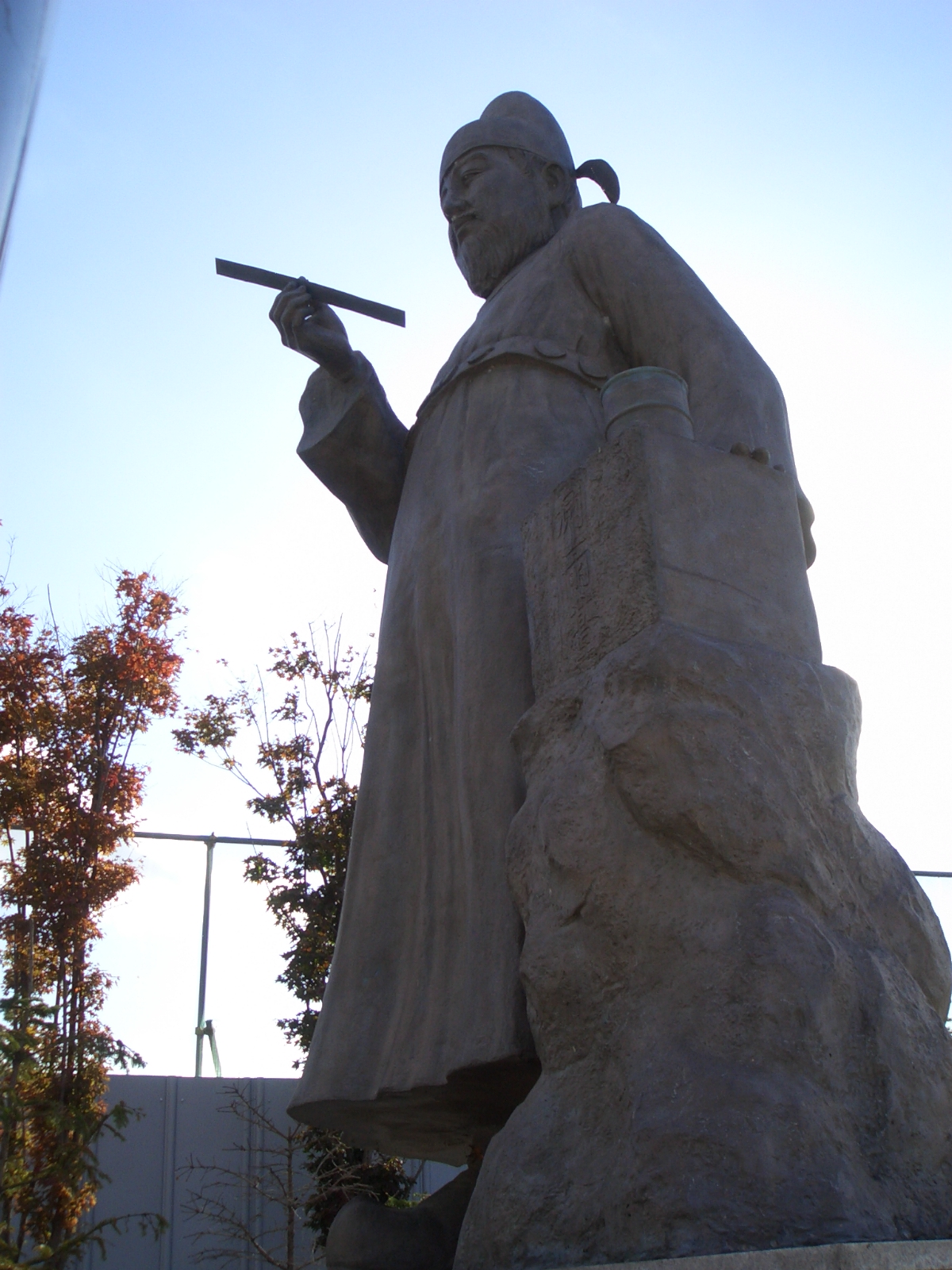
Jang Yeong-sil, from slave to Daehogun
No account of the Jagyeongnu leaves out Jang Yeong-sil (蔣英實). He came from the government-slave (官奴) class of Dongnae-hyeon; his mother was a gisaeng of the Dongnae prefecture, and his father is said to have come from the Yuan-dynasty region of China. In an age when the walls of social status ran deep, it was Sejong who recognized his talent. According to the Encyclopedia of Korean Culture and Woorihistory.net, Jang Yeong-sil was freed from servitude (免賤) around 1423, leaving the lowborn class behind, and after serving as a deputy in the Sanguiwon he took a full part in building astronomical instruments.
He rose to Hogun (senior fourth rank) in 1433 for his work on the Jagyeongnu, and after completing the Heumgyeonggak Ongnu in 1438 he was promoted as far as Daehogun (junior third rank). From slave to a junior-third-rank military officer, his life is in itself a kind of saga.
Still, it is not accurate to declare the Jagyeongnu “Jang Yeong-sil’s invention.” The Encyclopedia of Korean Culture states of the Jagyeongnu that “Jang Yeong-sil (蔣英實), Yi Cheon (李蕆), Kim Jo (金銚), and others first made the water clock.” It was a collaborative work that included Yi Cheon, who oversaw astronomical instruments as a whole, and Kim Jo (金銚), among others. Jang Yeong-sil was one of its core builders.
The Borugak at Gyeongbokgung, Joseon’s standard clock
The Jagyeongnu was completed in 1433 (the 15th year of Sejong) and came into official use the following year, in 1434 (the 16th year of Sejong), on the 1st day of the 7th lunar month (August 5 by the solar calendar). It was installed in a newly built pavilion south of Gyeonghoeru at Gyeongbokgung—the Borugak. The spot corresponds roughly to where Sujeongjeon stands today.
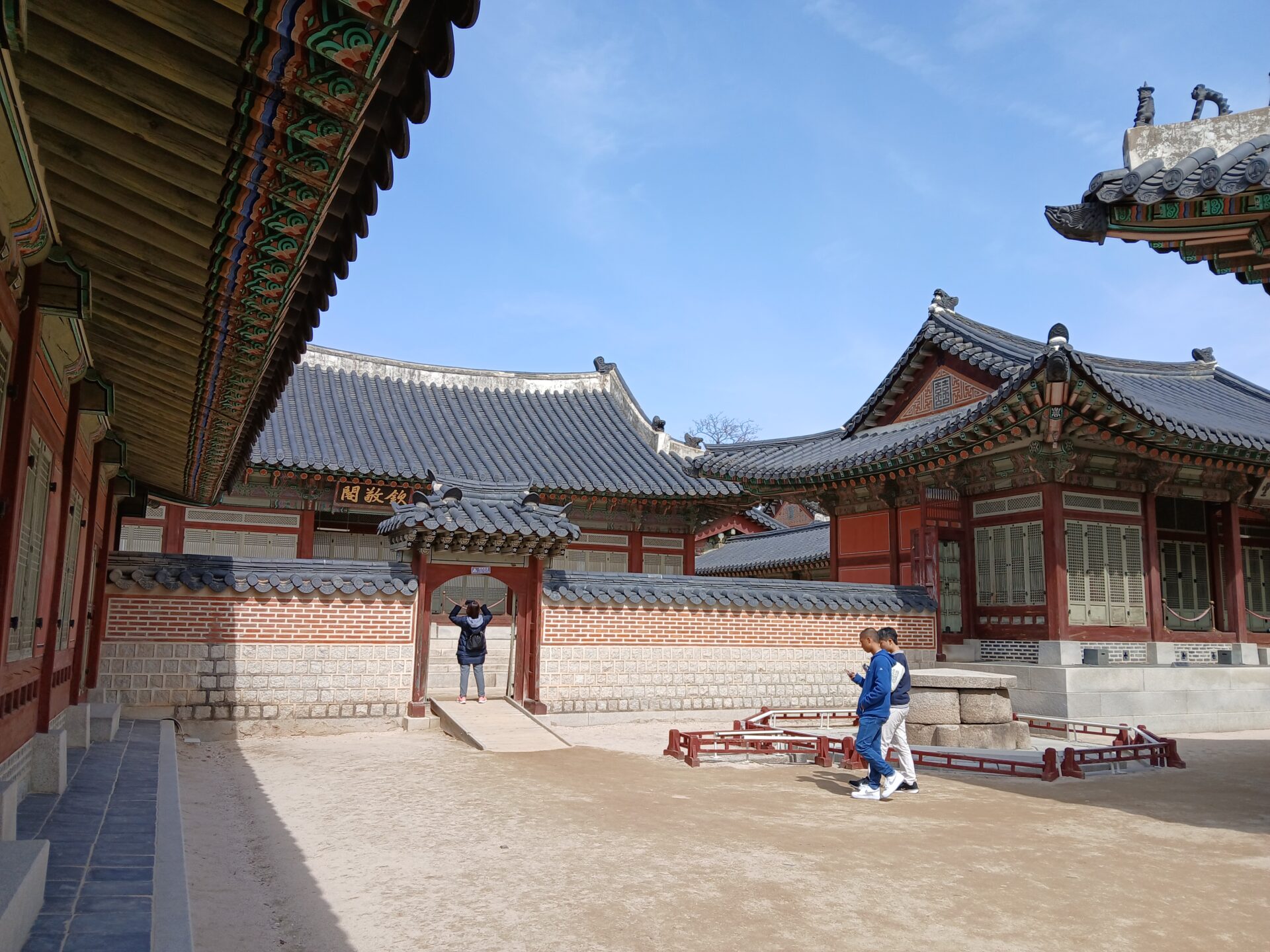
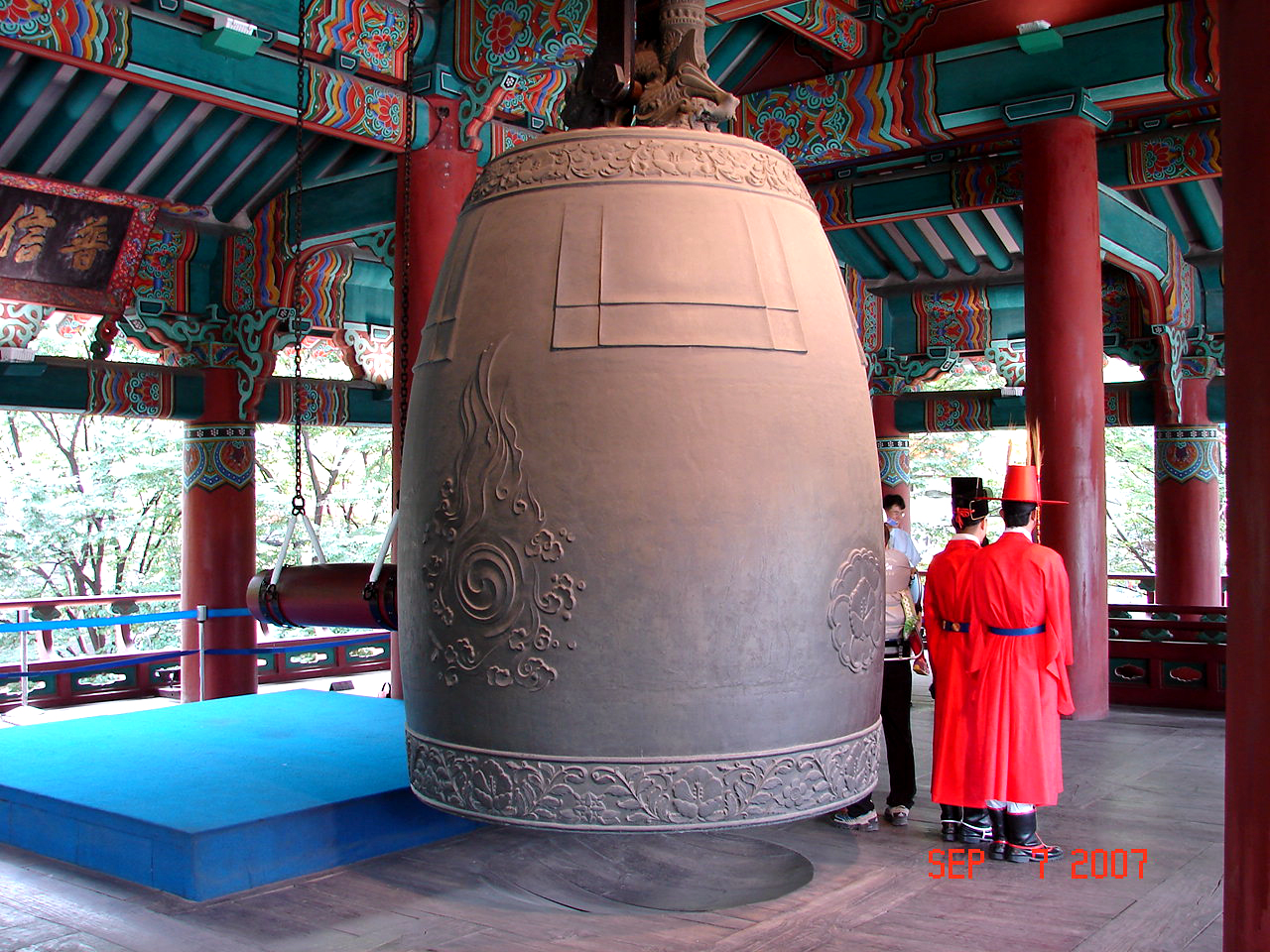
The Borugak was not a mere storehouse for a clock but a state institution that set and announced Joseon’s standard time. When the Borugak’s Jagyeongnu announced the hour, that signal was relayed to the gate tower of Gyeongbokgung, then on to the bell pavilion of the capital (today’s Bosingak). The bell pavilion struck the bell 28 times at the injeong (人定) around 10 p.m. and 33 times at the paru (罷漏) around 4 a.m. to announce the opening and closing of the capital’s gates and the nightly curfew. A single Jagyeongnu, in effect, governed the daily rhythm of the entire capital.
The motivation, structure, and working principle behind the Jagyeongnu were recorded in detail in the “Borugak-gi (報漏閣記)” written by Kim Don (金墩), a scholar of the Jiphyeonjeon. The same Borugak also bore the “Borugak-myeong (報漏閣銘)” composed by Kim Bin (金鑌). The reason we can reconstruct the inner mechanism of the Jagyeongnu today is precisely thanks to these records.
From water to sound — the principle of automatic time-keeping
Let us first note that everything from here on is a reconstruction based on records such as the Borugak-gi in the “Sejong Sillok.” This is because the automatic time-announcing apparatus survives in no extant artifact.
According to the records, the Jagyeongnu consisted of four supply jars (播水壺) that fed water and two receiving jars (受水壺) that caught it. The four supply jars, large and small, were arranged in tiers so that water flowed down at a constant pressure, and the two receiving jars were used in alternation so the clock ran without interruption all day long.
When water rose in a receiving jar, the arrow-shaped float (the nujeon 漏箭, or bujeon 浮箭) floated atop it by buoyancy. The face of the float was divided into 12 hours (時), so its risen height directly indicated the time.

The heart of it comes next. When the float reaches a set mark, it nudges a device inside the square block (方木) resting above, releasing a small iron ball. In the words of the Borugak-gi as quoted by sillokwiki: “When a small ball drops through a hole and nudges that mechanism, the mechanism opens; a large ball drops and rolls into a short tube hung beneath the seat, moving a spoon-like mechanism, and one end of the mechanism strikes up the arm of the god in charge of the hour inside the tube, so that the bell sounds.” A small ball moves a large ball, the large ball a lever, the lever the arm of a wooden figure—motion transmitted in a chain like this, finally striking the bell, is the very meaning of “strikes by itself (自擊).”
Bell, drum, and gong, and the twelve zodiac gods
The way the hour was announced differed between day and night. The 12 hours (時) common to both day and night were announced by striking the bell, while at night the gyeong (更) watches were marked by the drum and the jeom (點) subdivisions by the gong, announcing the nighttime gyeongjeom (更點法) hours. Hours by the bell, watches by the drum, subdivisions by the gong—three wooden figures (木人) each took charge of one.
It was not sound alone. Twelve zodiac god (十二神) figures divided the 12 hours among themselves, one hour (時) each, and when the corresponding hour arrived, the hole behind that god opened by itself, a Jade Maiden (玉女) came out holding the hour-tablet (時牌), and the zodiac god in question rose. The Borugak-gi records that “at the hour of the Rat (子時), the hole behind opens by itself, the Jade Maiden comes out holding the Rat-hour tablet, and the Rat God (鼠神) rises before it.” It was, in effect, a dual time-announcing device—seen with the eyes and heard with the ears.
On top of this, there was the problem that the lengths of day and night vary with the seasons. According to the records and reconstruction studies, the seasonal terms were corrected by two copper plates (銅板), left and right, inside the square block resting above the float. The Encyclopedia of Korean Culture relates that the left plate had 12 holes to receive small balls and the right plate had 25 holes to receive large balls, and that the plates were swapped according to the solar term. In 2022, the National Science Museum (Yoon Yong-hyun), drawing on a copper plate and ball-release device excavated in Insa-dong, Seoul, in 2021, reconstructed this part (the jujeon 籌箭) and held that several jujeon were used in alternation to match the solar terms. Since notation for the same device differs slightly from source to source, the fine figures are best read while weighing the sources together.
Not the world’s first — the Jagyeongnu’s place
The Jagyeongnu is often given the modifier “the world’s first automatic water clock.” But this is contrary to fact. The Su Song (蘇頌) and Han Gong-lian water-powered astronomical clock tower (水運儀象臺, 1088) of China’s Northern Song, an automatic astronomical clock driven by the force of water, predates the Jagyeongnu by about 346 years. In the Islamic world, al-Jazari left automatic water clocks—including the elephant clock—in a book he authored in 1206, likewise a precedent more than two centuries ahead of the Jagyeongnu. It resembles the Jagyeongnu in being a device whose automata produce sound every hour.
Where, then, does the value of the Jagyeongnu lie? We can gauge its place within Korea. Silla established the Nugakjeon (漏刻典) in 718 (the 17th year of Seongdeok), where specialists such as nugak doctors observed the water clock directly and announced the time. The water clocks of Goryeo, and the gyeongnu (更漏) of early Joseon, were likewise systems in which a person watched and announced. The Jagyeongnu replaced this human labor with the machine’s automatic striking. As Woorihistory.net puts it, “once the figures announced the time automatically, water clocks no longer needed anyone to measure the time thereafter.”
What can therefore be said safely is this. The Jagyeongnu was not the world’s first, but it was an intricate automatic time-announcing device that sounded the bell, drum, and gong on its own without anyone watching; it was Joseon’s standard clock installed at the Borugak of Gyeongbokgung; and unlike the water clocks of the Three Kingdoms and Goryeo, in which people announced the time, it realized automatic striking and is, by the record, the first known instance of such in Korea.
The original vanished, only the water jars remain
Sadly, the original Jagyeongnu built in 1434 by Jang Yeong-sil and others does not survive today. The Encyclopedia of Korean Culture flatly states that “the Jagyeongnu made in Sejong’s time was all lost and is gone,” and Woorihistory.net likewise records that “the one Jang Yeong-sil made does not survive now.” According to historical sources, the 1434 original broke down in King Munjong’s reign and, left unrepaired in King Danjong’s reign, was abandoned and given up. The Jagyeongnu was thereafter repeatedly remade and used, but its automatic time-announcing apparatus is said to have been lost to fire during the Imjin War.
What, then, is the Jagyeongnu we see in the museum today? It is part of a remade work that the clock-master Bak Se-ryong and others built anew in 1536 (the 31st year of Jungjong). And not even all of it—only the water-jar group survives. Three bronze supply jars (播水壺), two receiving jars (受水壺, or receiving cisterns), and a stone base are all there is. Not a single automatic time-announcing part—floats, iron balls, copper plates, wooden figures, the bell/drum/gong—remains. This is why the intricate mechanism described above can only be a “record-based reconstruction.”

The official name of this surviving artifact is “Changgyeonggung Jagyeongnu” (National Treasure No. 229), designated a National Treasure on August 9, 1985. According to Wikipedia, the bronze supply jars are 93.5 cm in diameter and 70 cm tall, and the receiving jars are 46 cm in diameter and 40.5 cm tall. (Since the dimensions vary by source, the figures of one source were followed.) During the Japanese colonial period it was moved into Gwangmyeongmun at Deoksugung and displayed there; after a roughly one-year-seven-month conservation treatment that ended from June 2018, it has been on display at the National Palace Museum of Korea since 2020.
Interestingly, during this conservation treatment, inscriptions on the surface of the receiving jars were newly deciphered, revealing the names of the 12 people who took part in the 1536 remaking. Of them, four—Yi Gong-jang, An Hyeon, Kim Su-seong, and Chae Mu-jeok—were newly confirmed at this time. It shows that even the surviving artifact was the collaborative work of several craftsmen. One must not confuse these, however: they were participants in the 1536 remaking, different people from Jang Yeong-sil, Yi Cheon, and Kim Jo who built the 1434 original.
A clock revived by records
What set the Jagyeongnu—stripped of its automatic apparatus—moving again was, in the end, records. Professor Nam Mun-hyeon of the Konkuk University Industry-Academic Cooperation Foundation, together with about 30 experts, built a working restored model based on the Borugak-gi in the “Sejong Sillok,” and unveiled it in November 2007 to coincide with the opening of the National Palace Museum of Korea. In 2022, the jujeon part was reconstructed once more on the basis of the Insa-dong finds. Writing left by people 588 years ago revived the lost machine today.
In closing — the time kept by a single line of record
The true protagonist of the Jagyeongnu may be neither Jang Yeong-sil nor the bronze jars. Sejong’s eye for recognizing the talent of a slave, the intricate design meant to announce the time automatically, and the “Borugak-gi” of Kim Don that committed it all to writing—these came together to make a single clock.
After Jang Yeong-sil was dismissed in 1442 (the 24th year of Sejong) over an accident in which the royal palanquin (the anyeo 安輿) he supervised broke, his traces vanish from the Annals of the Joseon Dynasty. The original Jagyeongnu he built also disappeared. Yet how that clock struck the bell by itself, we still know, thanks to the records. The most intricate machine, too, broke before time, but the single line of writing that set it down crossed 600 years to keep time safe.
References
- Jagyeongnu (自擊漏) — Encyclopedia of Korean Culture
- Changgyeonggung Jagyeongnu (昌慶宮 自擊漏) — Encyclopedia of Korean Culture
- Borugak (報漏閣) — Encyclopedia of Korean Culture
- Jagyeongnu (自擊漏) — sillokwiki (Academy of Korean Studies)
- Changgyeonggung Jagyeongnu — Woorihistory.net (National Institute of Korean History)
- The Making of the Jagyeongnu with Its Automatic Time-Announcing Apparatus — Woorihistory.net
- Jang Yeong-sil — Woorihistory.net
- Completion of Conservation Treatment of Changgyeonggung Jagyeongnu (National Treasure No. 229) — Korea Heritage Service Press Release
- National Treasure Changgyeonggung Jagyeongnu Nugi — Korea Heritage Portal
- Jagyeongnu — Wikipedia (Korean)
- Elephant clock (al-Jazari) — Wikipedia