
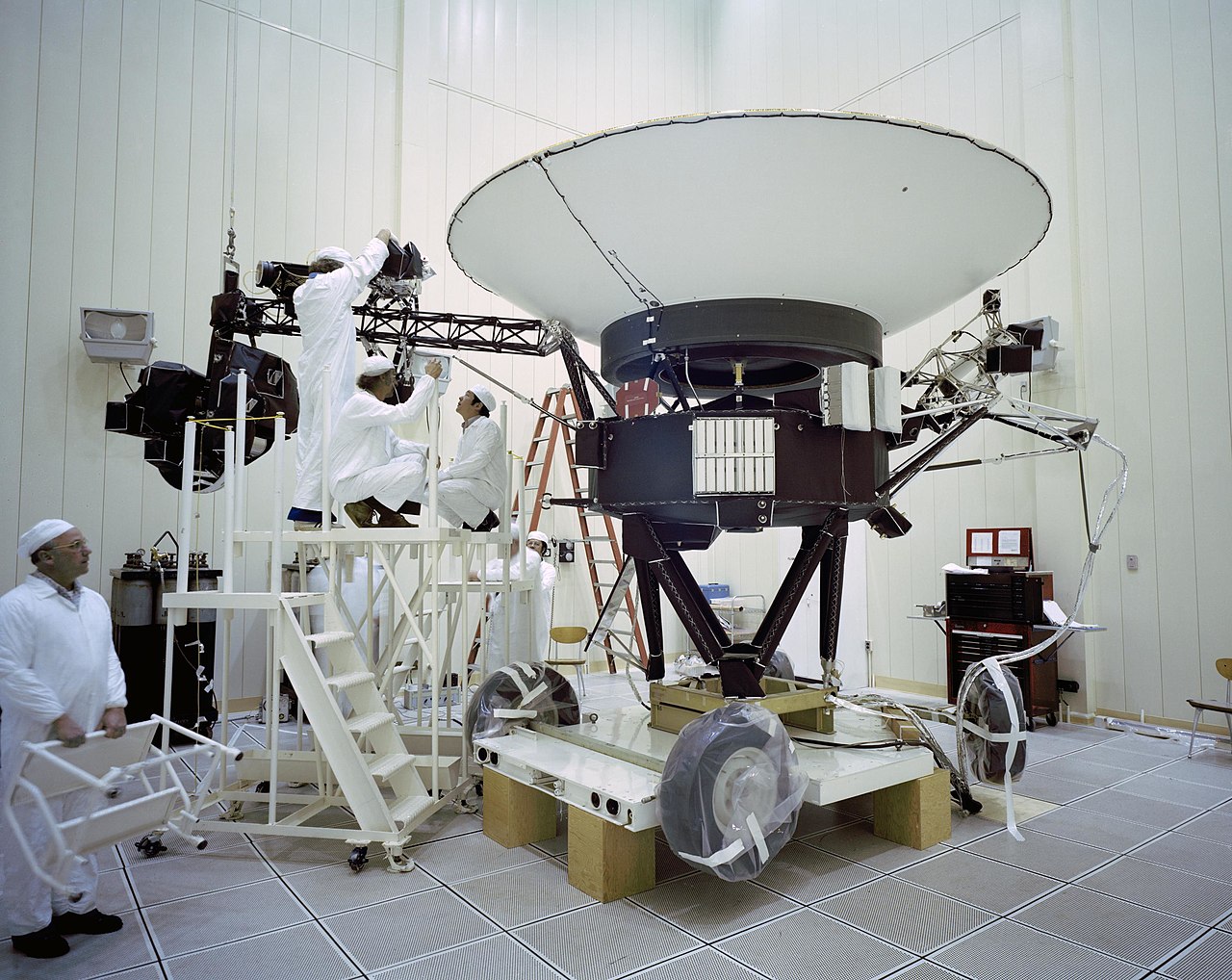
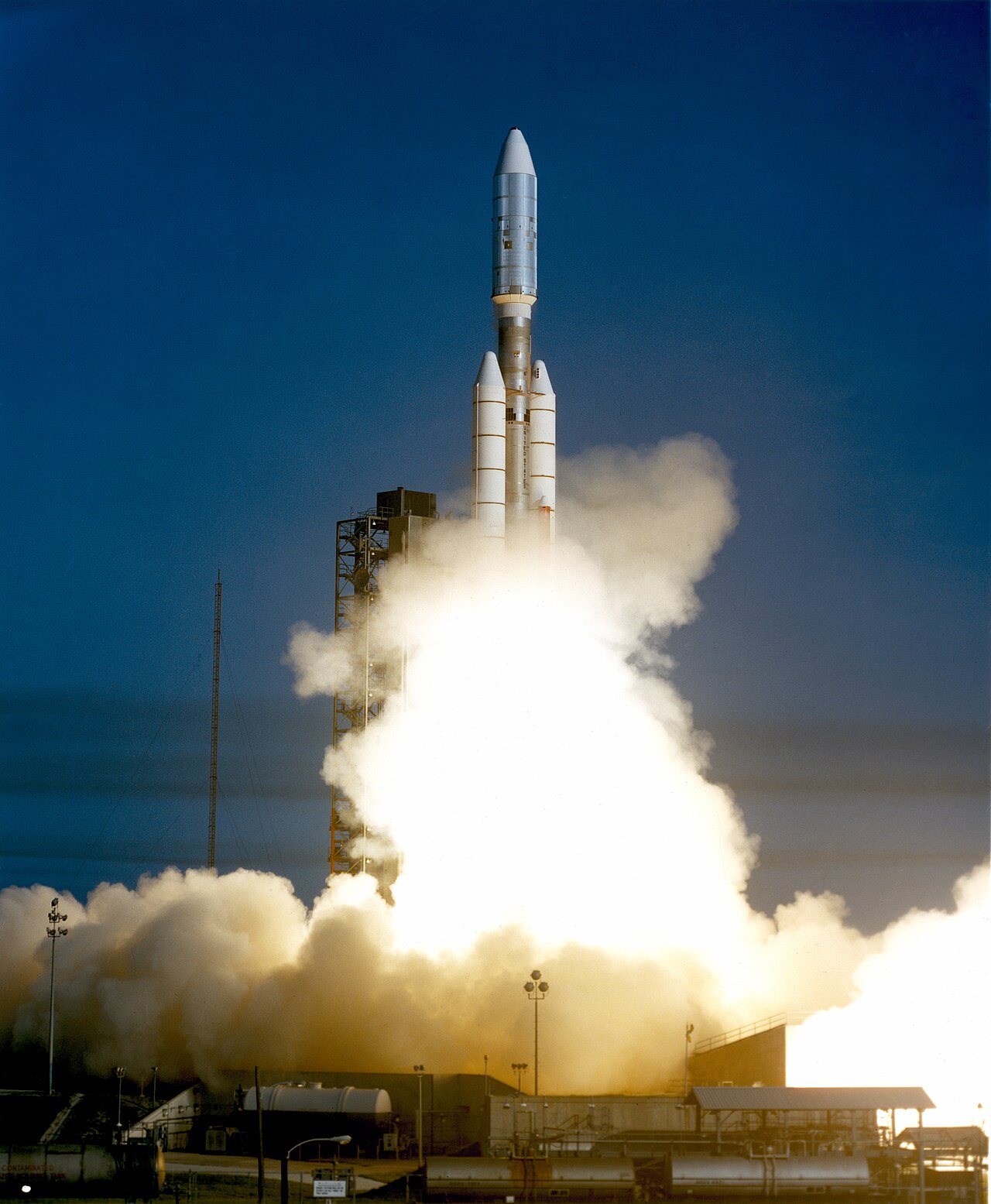
On August 20, 1977, Voyager 2 lifted off from Cape Canaveral atop a Titan IIIE-Centaur rocket, heading into space first. Sixteen days later, on September 5, its twin, Voyager 1, followed from the same launch pad. Yet the late starter overtook Voyager 2 in the asteroid belt and reached both Jupiter and Saturn first. What decided the order wasn’t chance — it was a carefully engineered trajectory.
NASA/JPL · Public domain · Wikimedia Commons
Sixteen Days Late, First to Arrive
According to NASA, Voyager 1’s faster route got it out of the asteroid belt first, and it overtook Voyager 2 on December 15, 1977. It made its closest approach to Jupiter on March 5, 1979 (around 12:05 UTC), coming within about 280,000 km of the planet’s center, and to Saturn on November 12, 1980 (around 23:46 UTC), passing about 124,000 to 126,000 km above the cloud tops. Voyager 2 reached Jupiter on July 9, 1979, and Saturn on the night of August 25, 1981 (early morning UTC on August 26).
NASA · Public domain · Wikimedia Commons
The Real Reason the Order Flipped — Trajectory Design
NASA/JPL mission records show that Voyager 1’s orbit was designed for a close flyby of Saturn’s moon Titan, putting it on a faster, more direct path. But that Titan encounter and Saturn’s gravity bent its trajectory sharply out of the ecliptic plane — the moment that happened, a trip on to Uranus and Neptune became impossible. Voyager 2, by contrast, stayed close to the ecliptic plane, flying past Uranus (January 24, 1986) and Neptune (August 25, 1989) to become the only spacecraft ever to complete a close flyby of all four giant planets — the “Grand Tour.” That difference in trajectory design is why the twin that left later got there first.
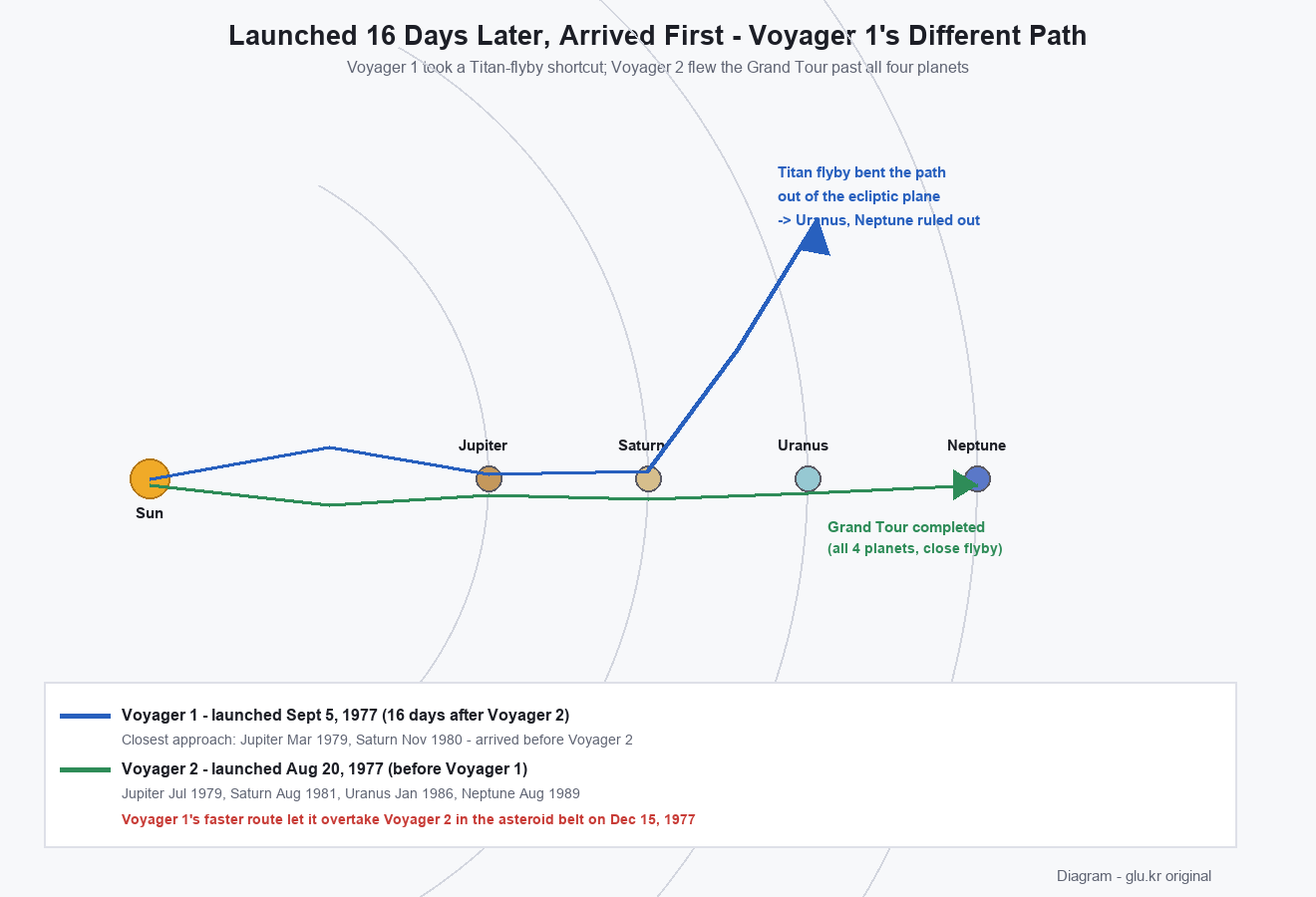
Diagram – glu.kr original
A Once-in-175-Years Alignment Made the Grand Tour Possible
Behind this journey lies a rare planetary alignment. In 1965, Gary Flandro, then a Caltech graduate student working at JPL, discovered that Jupiter, Saturn, Uranus, and Neptune would line up on one side of the Sun, letting a single spacecraft use chained gravity assists to fly close past all four. NASA’s official history records this alignment as occurring “once every 175 years.” The calculation that gravity assists could shrink the mission from roughly 40 years to under 10 became the blueprint for the Voyager program.
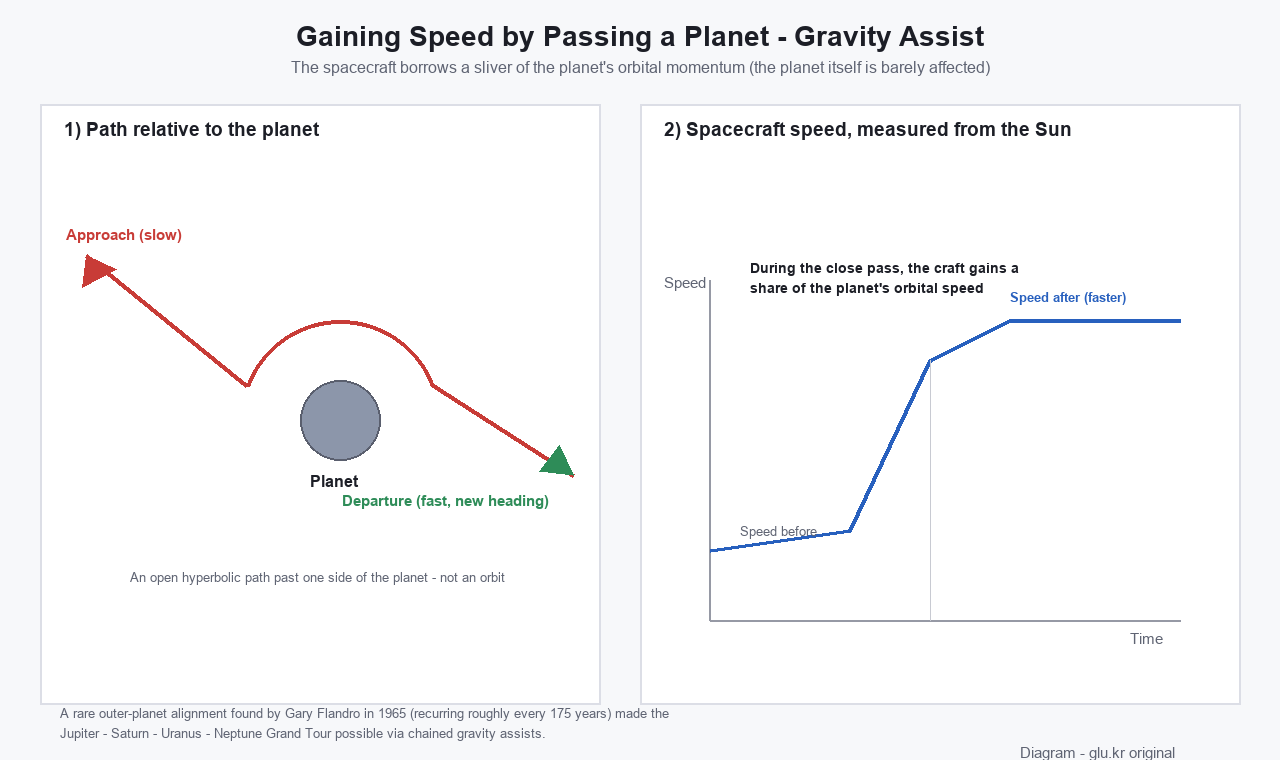
Diagram – glu.kr original
Beyond the Heliosphere, Into Interstellar Space
Once their tours of the giant planets were done, both spacecraft shifted into the Voyager Interstellar Mission, exploring beyond the heliopause. Voyager 1 is believed to have crossed the heliopause on August 25, 2012, at roughly 121-122 AU from the Sun, a crossing NASA officially confirmed the following year, on September 12, 2013 — the first confirmed case of a human-made object reaching interstellar space. Voyager 2 followed on November 5, 2018, at roughly 119-119.7 AU.
As of March 2026 (per the latest Wikipedia update), Voyager 1 is about 172.59 AU (roughly 25.8 billion km) from Earth, giving it a one-way signal delay of more than 23 hours. NASA has announced that on November 18, 2026, at 2:16 a.m. Pacific time, Voyager 1 will reach exactly 25,902,068,356 km from Earth — becoming the first human-made object to pass the distance light travels in a full day, or one light-day. Voyager 2, as of February 2026, is about 143.05-143.09 AU away (roughly 21.3-21.4 billion km), with a one-way signal delay of about 19.5 to 19.75 hours.
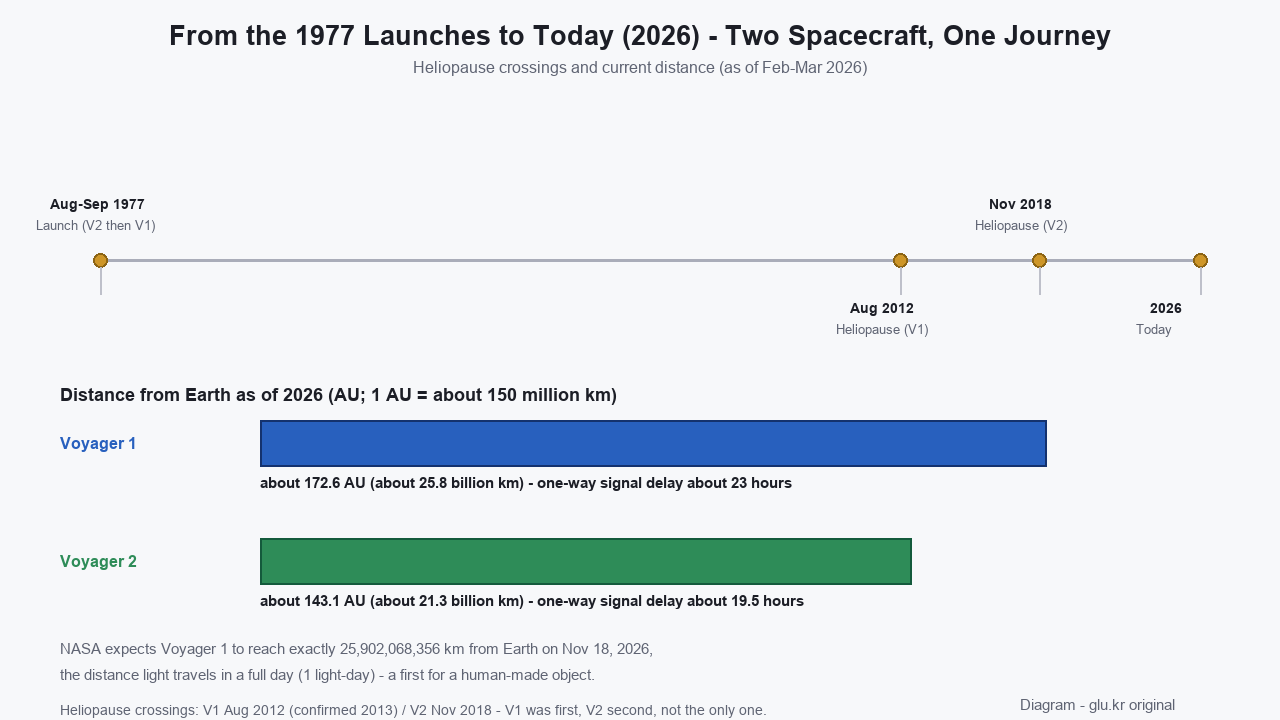
Diagram – glu.kr original
The Golden Record and the Pale Blue Dot
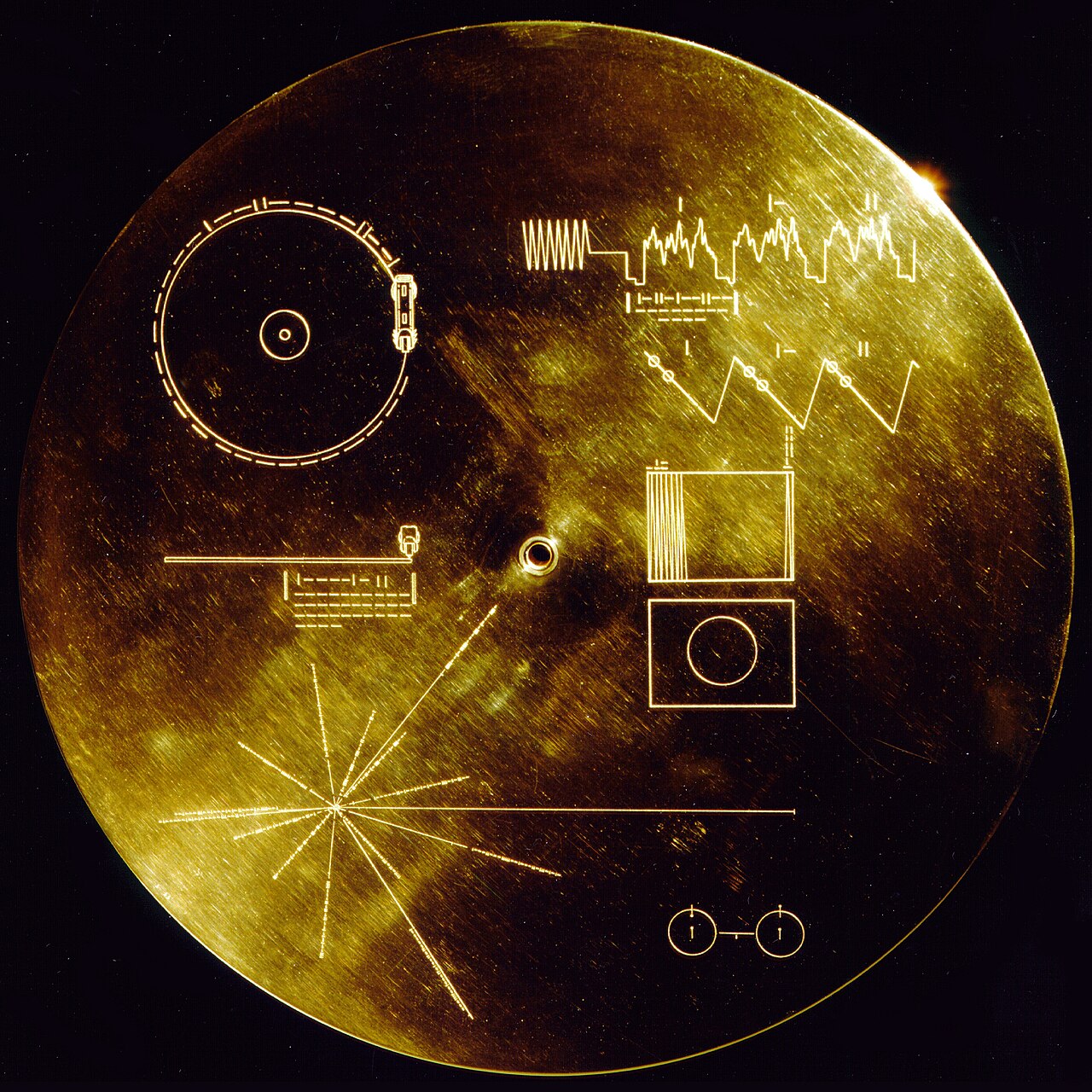
Both spacecraft carry a “Golden Record” introducing Earth. A committee led by Cornell’s Carl Sagan chose its contents, with Linda Salzman Sagan coordinating the collection of greetings. It holds 115 encoded photographs, greetings in 55 languages, about 90 minutes of music, roughly 12 minutes of a “Sounds of Earth” audio montage, and printed messages from President Jimmy Carter and the UN Secretary-General.
NASA/JPL · Public domain · Wikimedia Commons
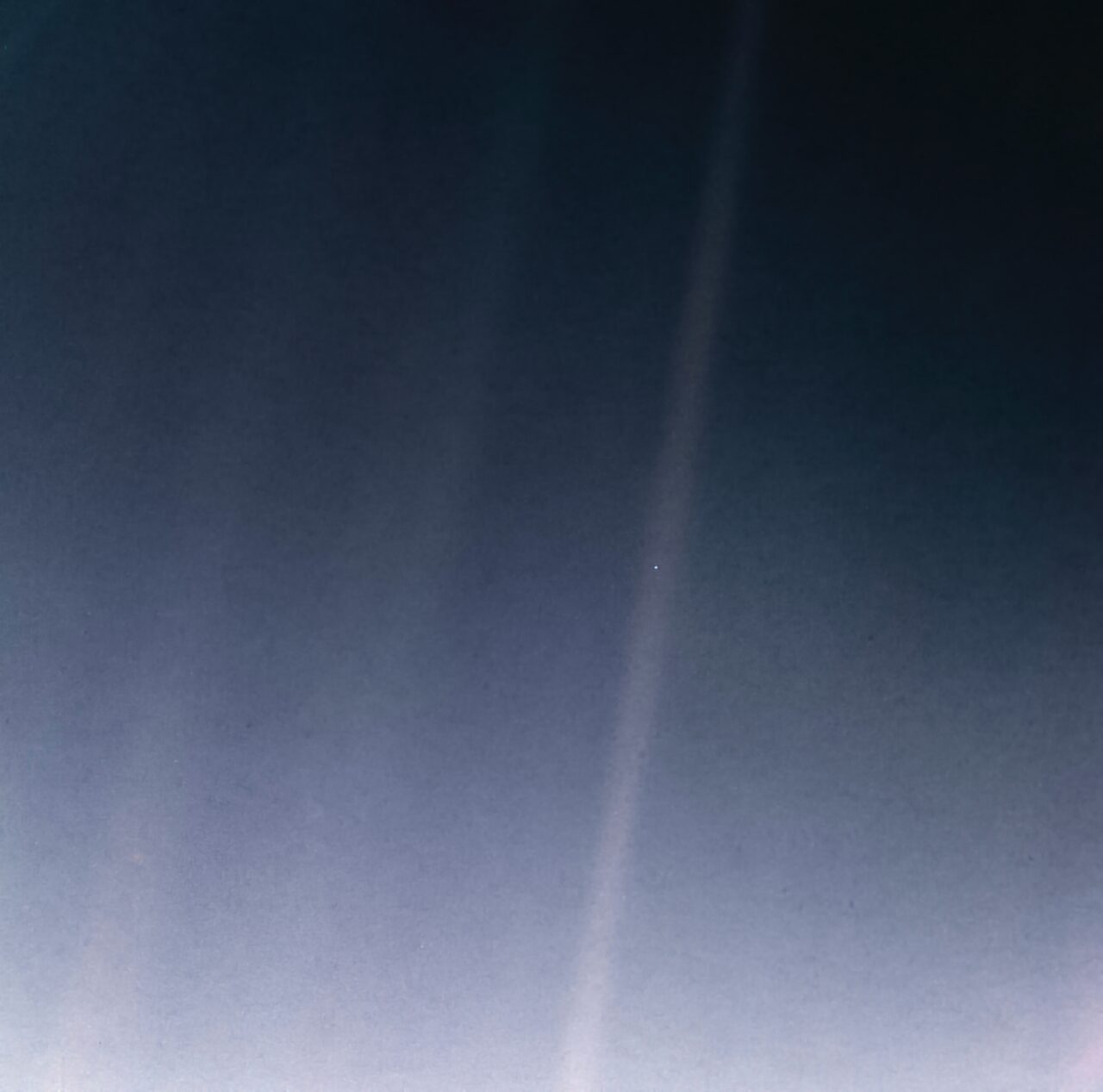
On February 14, 1990 (around 04:48 UTC), while still inside the heliosphere at about 40 AU (roughly 6 billion km) from the Sun, Voyager 1 took a “Family Portrait” that included Earth. In that image Earth appears as no more than a point of light — the photograph that would later become known as the “Pale Blue Dot.” These were the last images Voyager 1 ever sent back; afterward, the mission team powered down its camera to free up computing resources for other observations.
NASA/JPL-Caltech · Public domain · Wikimedia Commons
49 Years On, Still Sailing
Both spacecraft draw power from radioisotope thermoelectric generators (RTGs), which lose about 4 watts of output every year as their plutonium decays. To cope, the mission team has been switching off instruments one by one: Voyager 2’s plasma science instrument in October 2024, Voyager 1’s cosmic ray subsystem on February 25, 2025, and Voyager 2’s low-energy charged particle instrument on March 24, 2025. Thanks to this power rationing, both spacecraft are expected to keep at least one instrument running into the 2030s.
Back in 1977, a 16-day gap between two launches must have seemed trivial. But hidden in those few days were two precisely calculated paths, bound for different destinations. Today, both spacecraft are still pressing on into the darkness beyond the solar system — humanity’s farthest-flung envoys.
References
- NASA JPL – 45 Years Ago: Voyager 2 Begins Its Epic Journey to the Outer Planets and Beyond
- NASA Science – Voyager 1 (official mission page)
- NASA History SP-4219, Chapter 11: Voyager – The Grand Tour of Big Science
- NASA JPL – NASA’s Voyager 2 Probe Enters Interstellar Space
- NASA Science – Interstellar Mission
- NASA JPL – NASA Turns Off Two Voyager Science Instruments to Extend Mission
- NASA Science – Golden Record Contents: Greetings
- NASA JPL – ‘Pale Blue Dot’ Images Turn 25
- NASA Science – Where Are Voyager 1 and Voyager 2 Now?
- NASA JPL – 35 Years On, Voyager’s Legacy Continues at Saturn