
Prepared paper mulberry fibers are dispersed in water, yet what comes out is a thin sheet of paper. For someone watching hanji making for the first time, this is the remarkable transformation: how do scattered fibers become a sheet? And what does dakpul, the mucilage used in the process, actually do?
The key is that preparing fibers, distributing them in water, removing water, and finishing the surface are different jobs. Following traditional hanji production reveals the separate roles of paper mulberry, dakpul, and the hands moving the screen.

Cultural Heritage Administration of the Republic of Korea · CC BY-SA 2.5 · Wikimedia Commons
Long fibers inside the bark
Traditional hanji is made primarily from bast fibers in the inner bark of paper mulberry. The fibrous layer is separated from the woody core and rough outer bark. [1, 5]
Cellulose from plant cell walls is an important component of paper. Fiber length and condition influence toughness and flexibility. Still, the name “hanji” does not mean that every product has identical ingredients or properties. Traditional materials and the varied methods used in modern production also need to be distinguished. [1, 8]
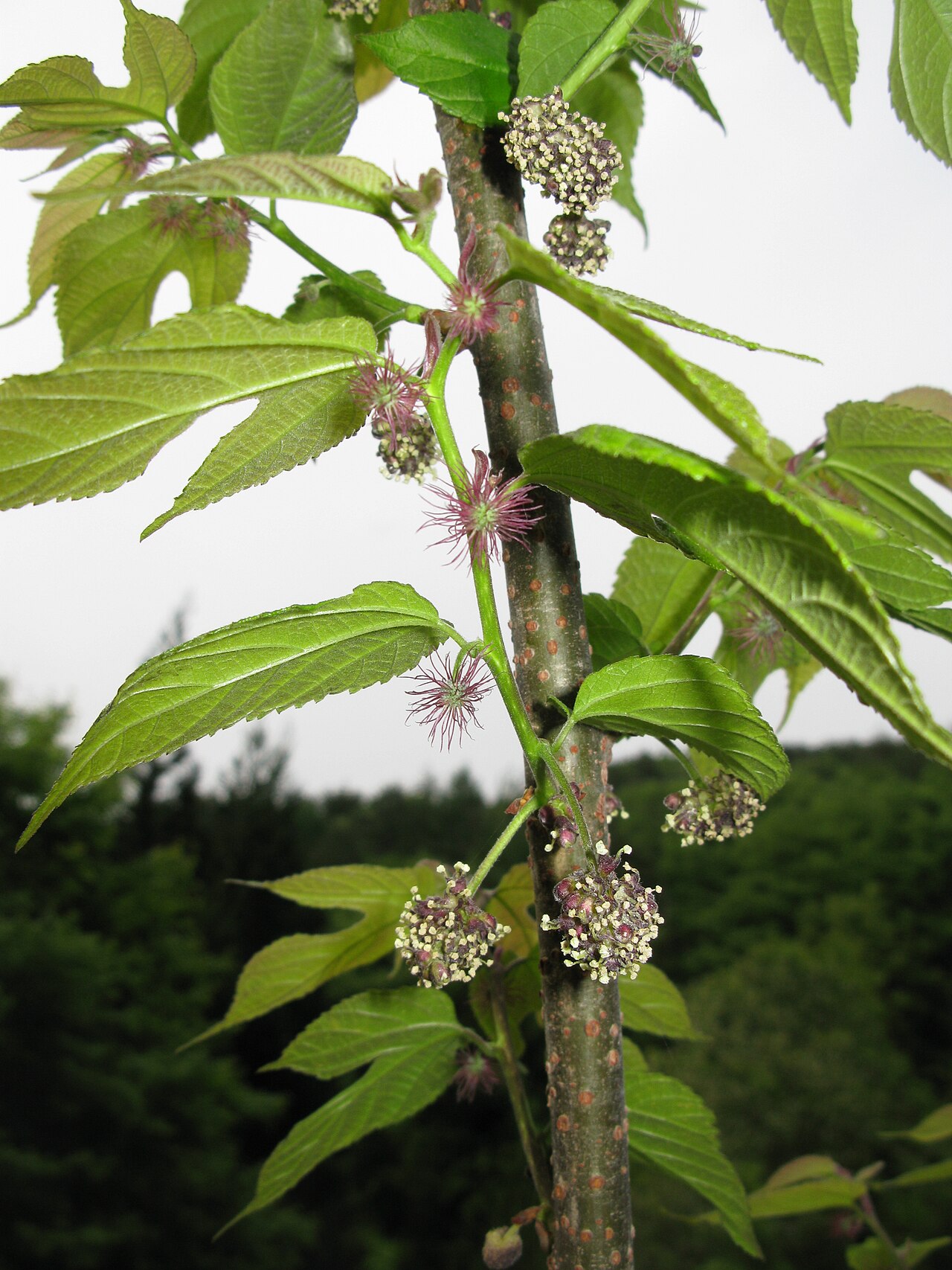
Qwert1234 · CC BY-SA 3.0 · Wikimedia Commons
Why the bark is cooked, washed, and beaten
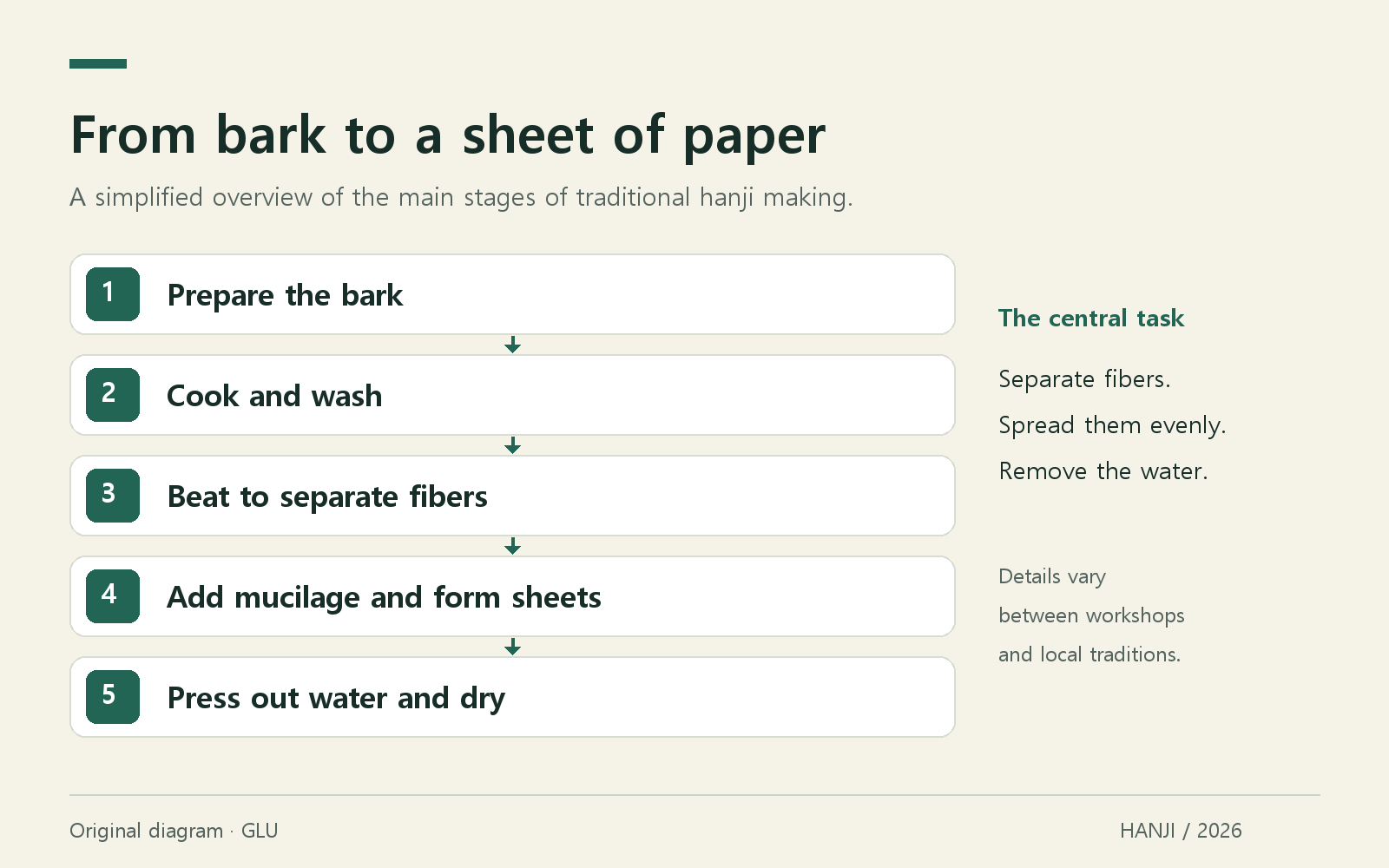
Traditionally, the inner bark is cooked in ash lye to remove substances including pectin and lignin, then washed and cleaned of remaining specks. [1, 4]
Beating with a mallet loosens the fiber bundles. This prepares the raw material, unlike dochim, which finishes the completed paper. [4]
Original diagram · GLU · CC BY 4.0 · Sources1 · Sources2 · Sources3
Dakpul gives the fibers time in the water
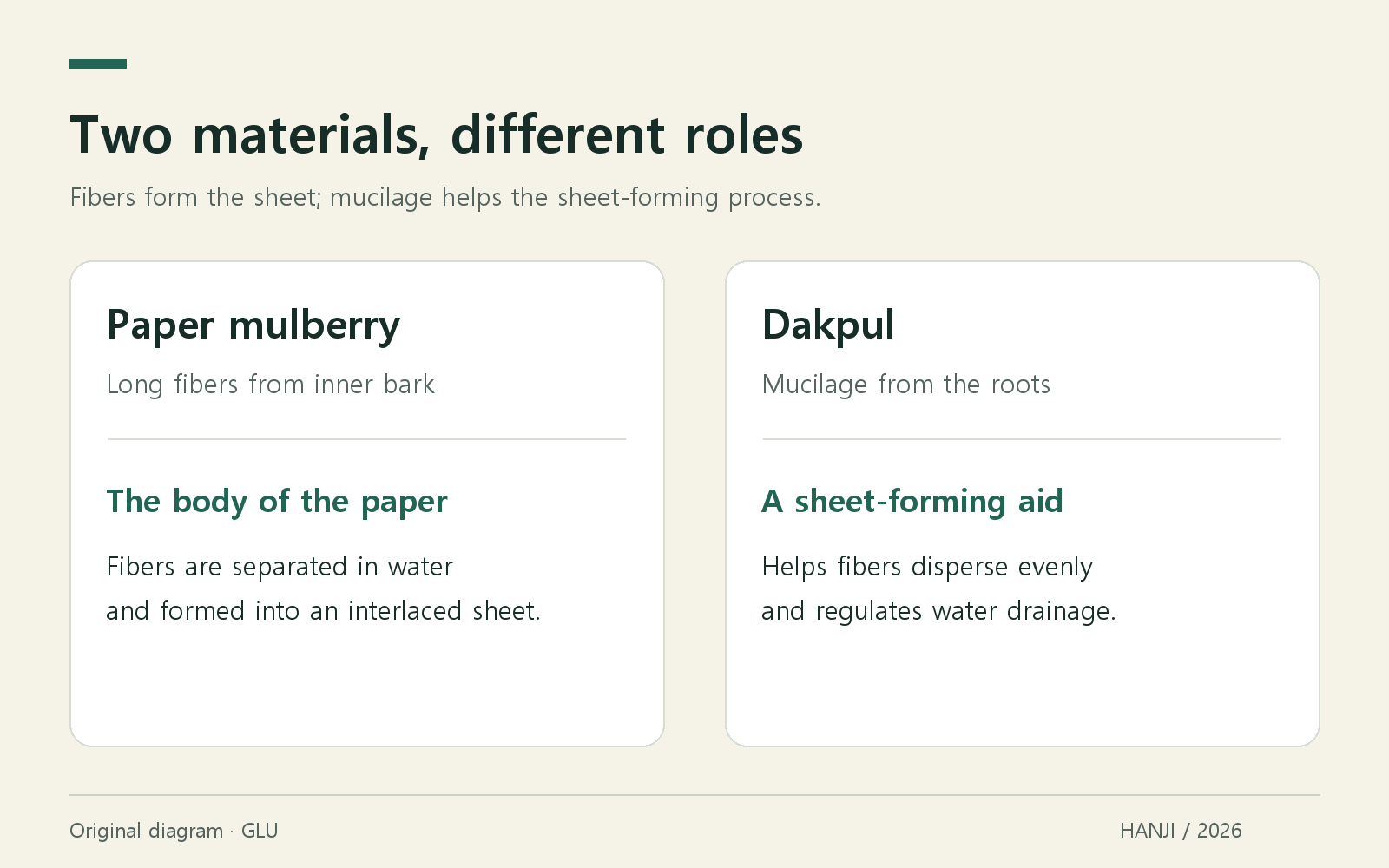
Despite their similar Korean names, dak, or paper mulberry, and dakpul are different plants. Paper mulberry supplies the fibers that become the body of the sheet. Dakpul helps sheet formation through mucilage obtained from its roots. The flowers are not crushed into the vat for this purpose. [2]

Michael Wolf · CC BY-SA 3.0 · Wikimedia Commons
A key role of dakpul is to inhibit the settling of long fibers and regulate the flow of water over the screen. This makes a well-dispersed suspension easier to handle and helps produce an even sheet. Saying only that “dakpul glues the fibers together” therefore misses an essential part of sheet formation. [2]
More is not necessarily better. According to the authors’ abstract of a 2021 study of root mucilage, increasing its dosage lengthened drainage time, but sheet uniformity and tensile strength did not improve indefinitely. Excessive additions made them worse. This was a result under specific experimental conditions, not a universal recipe for every workshop. [3]
Original diagram · GLU · CC BY 4.0 · Sources1 · Sources2
The direction of the screen matters
In one sheet-forming method, apmuljil moves water from front to back, while yeopmuljil moves it from side to side. These movements form a fiber layer on the screen. [4]
The water leaves; the fibers remain as a sheet
A newly formed sheet holds a great deal of water. Papermaker Aimee Lee’s account describes stacking wet sheets with cords marking the layers, pressing out water, then separating the sheets for drying. Sheet formation alone is not the end: dewatering and drying are also needed to produce paper that can be held in the hand. [5]
What finally holds the fibers together? Explaining paper strength as the work of hydrogen bonds alone is insufficient too. A research review on cellulose emphasizes the complex process in which fibers approach one another during drying and form contact zones. Fiber structure, contact, and several intermolecular interactions all matter. This gives a more accurate account of paper formation than treating dakpul as an all-purpose adhesive. [9]

jared · CC BY 2.0 · Wikimedia Commons
Dochim: beating the finished paper
Dochim differs from beating the raw material before sheet formation. Sheets are stacked and beaten as a finishing treatment that smooths and compacts their surfaces. It affects smoothness, gloss, and the development of a surface suited to printing. [6]
Not all hanji undergoes dochim. The encyclopedia entry describes it as an optional treatment after the paper has been dried and sorted. [4, 6]
Beyond “a thousand years”: materials and methods
Hanji’s value is not confined to its association with old paper. In a project conserving Korean paintings, the British Museum used hanji sourced in Korea as a mounting material. Hanji remains part of present-day conservation, where both materials and techniques are carefully selected. This example does not mean that every hanji is suitable for every historic object. [10]

Caroline Knox · CC BY-SA 3.0 · Wikimedia Commons
For any paper to survive well, both its composition and storage environment matter. The Library of Congress explains that moisture, acids, and light contribute to deterioration alongside factors within the paper itself. “It is hanji” is therefore not a guarantee of a thousand-year lifespan. [8]
A sheet of hanji brings together several different jobs. Paper mulberry supplies fiber; dakpul assists dispersion and drainage control; screen work forms the fiber layer. Pressing and drying may be followed by surface finishing suited to the intended use. As Korea’s Permanent Delegation to UNESCO explains, the craft is also connected to pumasi, the shared knowledge and reciprocal labor involved in preparing materials and working together. [7]
The precision of hanji making does not lie in asking one good ingredient to do everything. It lies in understanding different properties and using each material at the right stage. Within a sheet are the properties of fibers found in creation and the work of people who learned to turn them into useful objects.
References
- Classification option for Korean traditional paper based on type of raw materials, using near-infrared spectroscopy and multivariate statistical methods
- Dakpul — Encyclopedia of Korean Culture
- Effects of root mucilage dosage and temperature on hanji properties (2021; author abstract)
- Hanji makers — Encyclopedia of Korean Culture
- Hanji in the Hands
- Effects of silk-screen coating on dochim-treated traditional hanji (2017; conference abstract)
- Hanji, Korea's Traditional Paper
- The Deterioration and Preservation of Paper: Some Essential Facts
- Cellulose and the role of hydrogen bonds: not in charge of everything
- Amorepacific conservation project