
Stand beneath a stone bridge over a stream and something seems puzzling. Heavy blocks form a curve overhead, yet there is no column beneath the middle of the opening. A bridge such as Seungseongyo at Seonamsa Temple in Suncheon makes the question especially clear: why do those stones stay up?
The answer lies in the path taken by forces, rather than in a special property of one stone. A masonry arch transmits compression through contacting blocks toward its end supports. When those supports and the ground beneath them resist the forces, the central opening can remain clear. The conspicuous curve and its less conspicuous ends work as one structure.
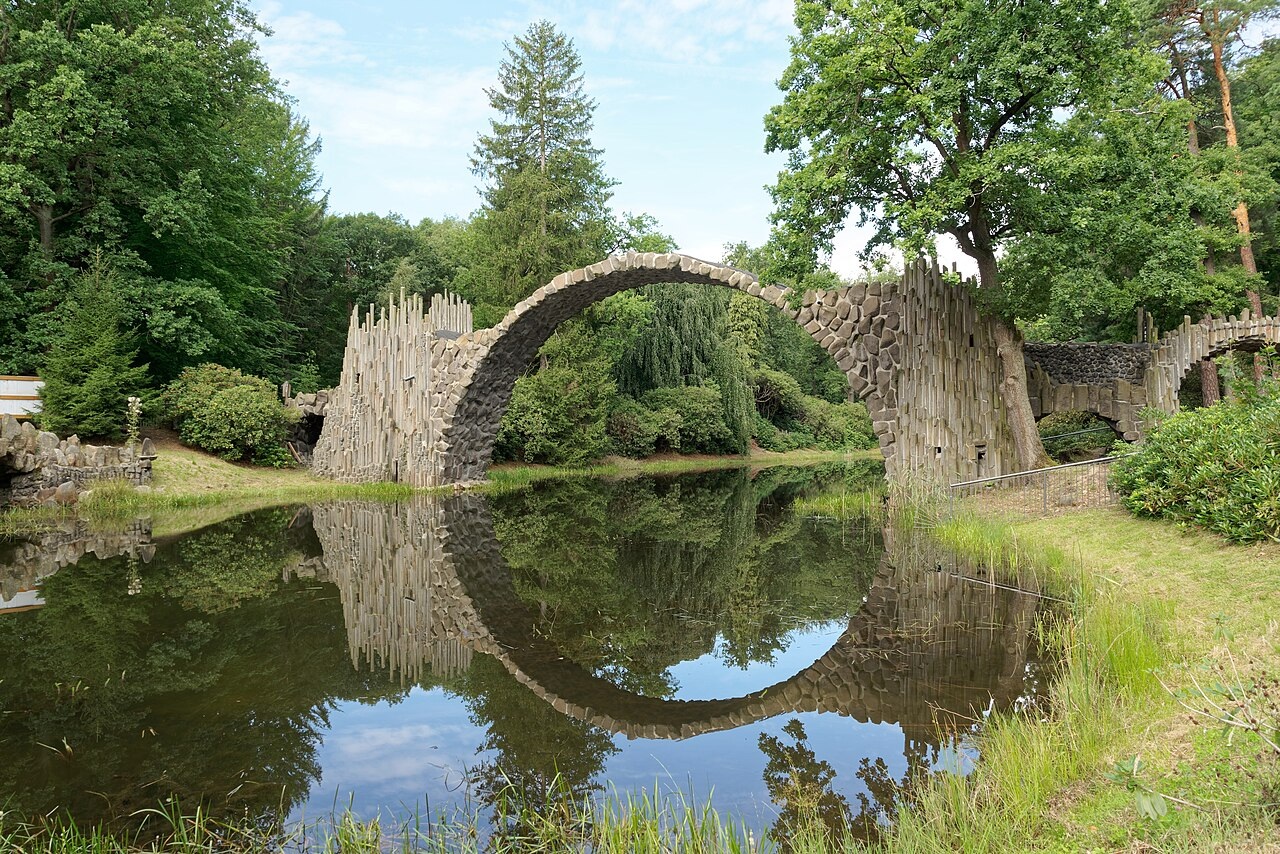
Photo · Jakub Hałun · CC BY-SA 4.0 · Wikimedia Commons
Working with stone: compression rather than tension
Place a long member across two supports and press down in the middle: it tends to bend. In a simplified picture, its upper part is compressed while its lower part tends to stretch. A material that resists being squeezed does not necessarily resist being pulled apart equally well. [1]
Stone generally performs well in compression but is comparatively weak in tension. This matters when choosing between spanning an opening with a long stone slab and arranging separate stones into an arch. An arch uses its shape to carry loads mainly through compression. The material has not changed; the way it carries force has. [2]
A real bridge also depends on load position, arch thickness, the condition of its stones and joints, and movement of the supports. It would therefore be misleading to claim that tension can never occur anywhere in an arch. Compression is the starting point for understanding the form; assessing safety requires examining the whole structure. [5]
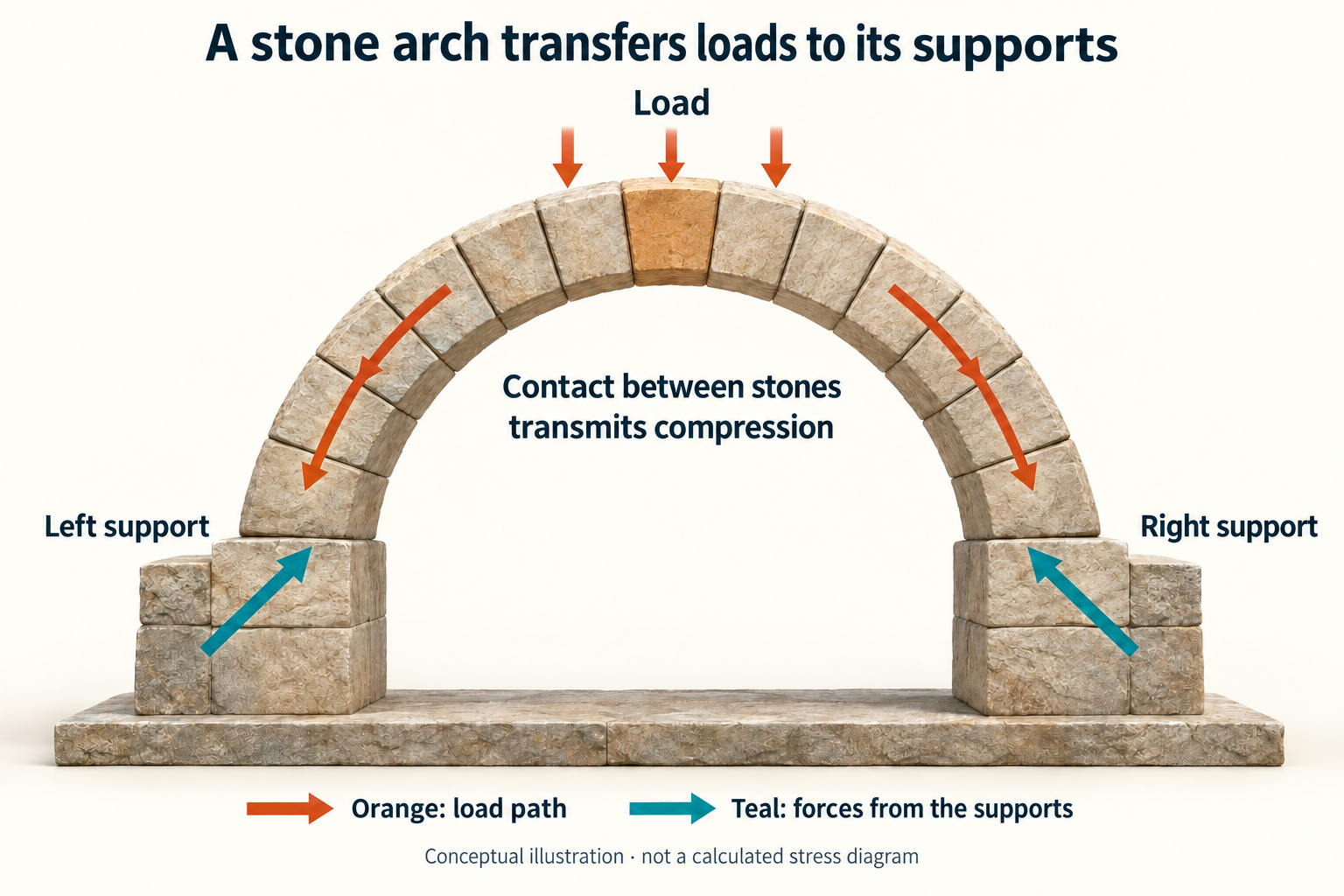
Illustration · AI-generated (Codex/ChatGPT subscription) · a dimensional concept illustration of a stone arch and its load path · Based on: TeachEngineering · University of Colorado Boulder, Science Museum Group
The keystone does not hold the bridge up by itself
Look closely at an arch and the joints may fan outward like the ribs of a folding fan. In a typical stone arch, wedge-shaped blocks called voussoirs are arranged along the curve. The block that closes the arch at its crown is commonly called the keystone. [3][6]
The idea of completing a bridge by inserting its keystone is memorable. But imagining that this one block somehow holds all the others in place misses an essential point. Forces pass between stones at their contacting surfaces. The crown block, neighboring blocks, arch ends and supports must form a stable connected system. [4]
The underside of the Pont du Gard in France offers a useful view. What initially looks like one massive curve resolves into assembled blocks. UNESCO describes the lower arches as adjacent arch rings made from voussoirs. Behind the elegant outline lies the work of shaping and fitting individual stones. [9]
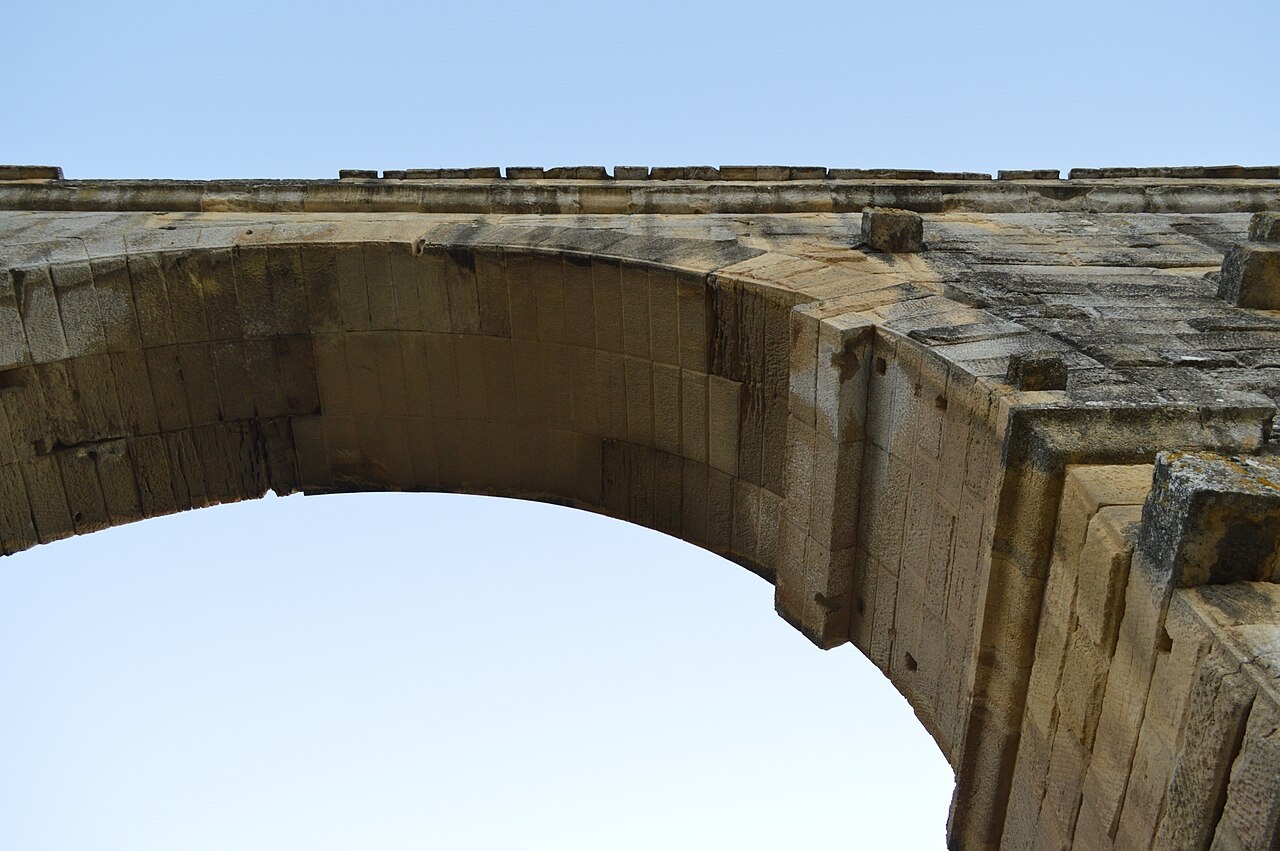
Photo · Elihbeckman · CC BY-SA 4.0 · Wikimedia Commons
An opening can be clear after construction, yet need support during it
That raises another question. Even if a finished arch can stand, what happens when only part of it has been built? Before the stones meet across the top, the same complete load path is not yet available.
A traditional solution was to erect a temporary frame shaped to the underside of the arch and build the masonry on it. This support is called centering. An English Heritage teaching resource describes a sequence of preparing foundations and supports, erecting timber centering, laying the arch stones and final keystone, and carefully removing the timber support after completion. [7]
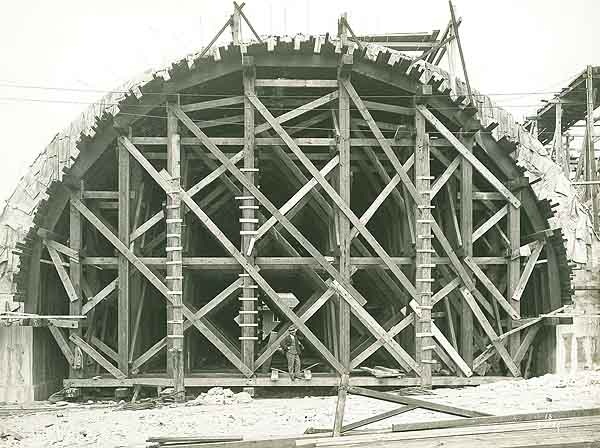
Photo · Photographic Collection from Australia · CC BY 2.0 · Wikimedia Commons
The photograph comes from a Sydney Harbour Bridge construction album and shows an arch with temporary falsework. It does not document the assembly of a traditional masonry arch, but it clearly shows how an opening can be filled during construction by supports that will later be removed.
Removing centering is more than clearing away equipment. It transfers load from a temporary structure to the completed one. The teaching resource’s instruction to remove the support carefully makes sense in light of this role. The key distinction is between the temporary frame needed during construction and the end supports still needed afterward. [7]

Illustration · AI-generated (Codex/ChatGPT subscription) · a dimensional concept illustration of a generic arch construction sequence · Based on: English Heritage
Pay attention to the ends of the arch
The force an arch transfers to its supports has an outward component as well as a downward one. This outward action is commonly called horizontal thrust. The ends must be restrained from spreading if the arch is to retain its shape. Abutments provide support at the ends of a bridge. [4]
The Academy of Korean Studies’ description of Seungseongyo notes the natural rock at the base of its arch. It is easy to follow only the bridge’s rainbow-like outline, but it is also worth looking at where that curve ends and what lies underneath. An appearance of floating over water does not mean the end supports have disappeared. [8]
This also explains why movement at the supports matters. Research on stone arch bridges examines geometry together with abutment movement. Even when the stone looks sound, changing support conditions can change the structure’s stability. A bridge’s long survival does not remove the need for inspection or repair. [5][2]
Look at how the stones meet
A close view of the aqueduct of Segovia in Spain reveals different arrangements in the arch and the masonry above it. Distinguishing the arch ring from the parts built over it reveals a structure that is easy to miss when the monument is seen merely as a mass of stone. The photograph below shows the joints around the curve alongside the masonry above it.
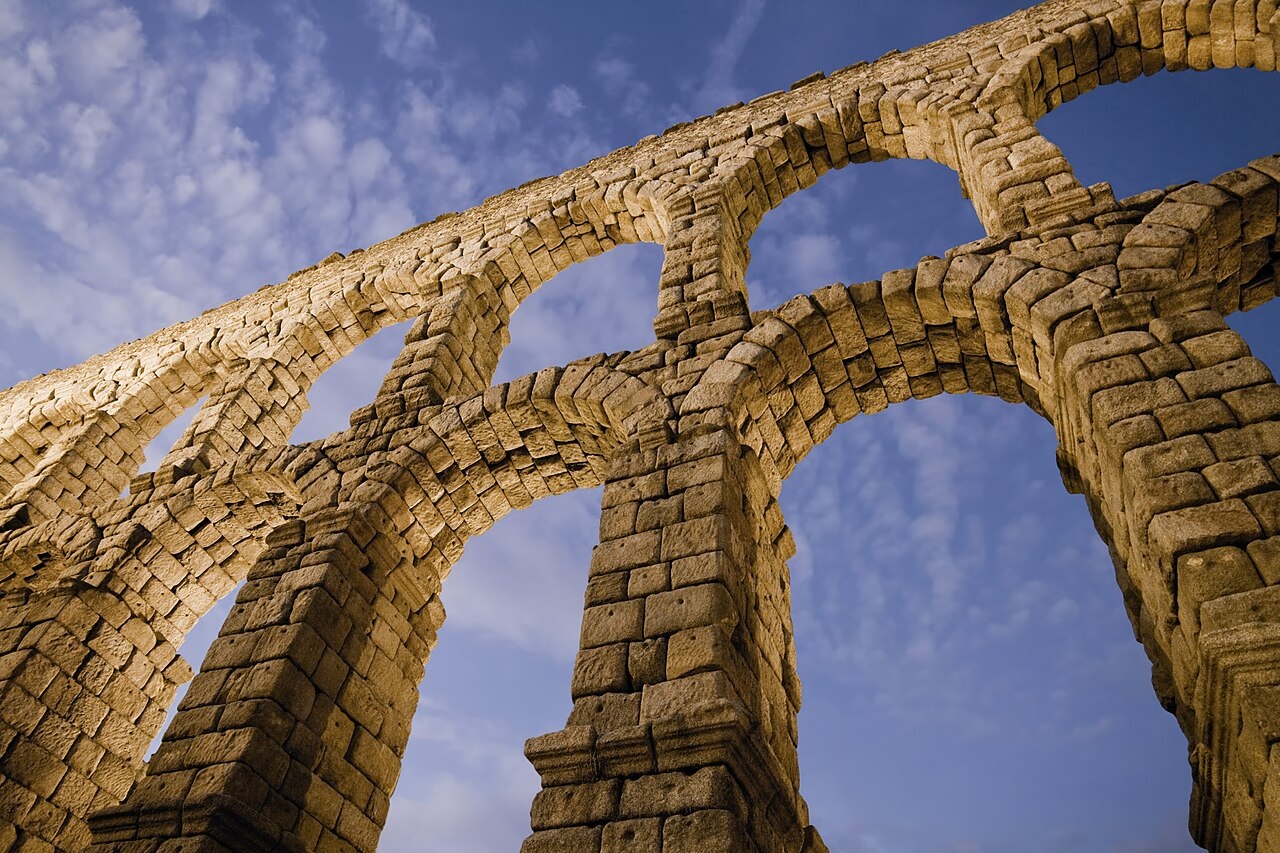
Photo · David Corral Gadea · CC BY-SA 3.0 es · Wikimedia Commons
Closely fitted masonry does not, by itself, allow a viewer to determine the presence or absence of jointing material from a photograph. Stone arch bridges can include mortar joints. The construction method of a particular monument and the way an arch transmits force are different levels of explanation. The point is not that every stone bridge uses identical materials, but that its stones, joints and supports work together. [3]
A series of arches still has supports between its openings
A wider view of Segovia shows a sequence of arches, rather than a single opening. In a structure with multiple spans, intermediate piers support the arches. The statement that there is no column in the middle applies to the clear opening of an individual arch. It would be wrong to extend it to mean that an entire long aqueduct has no intermediate supports. [10]
The same distinction matters in an aqueduct with multiple tiers of arches, such as the Pont du Gard. Another arch above does not make the load disappear. Follow the structure downward and look for the connections between arches, piers and foundations. Building a facility to carry water also required providing a route for forces to reach the ground. [9]
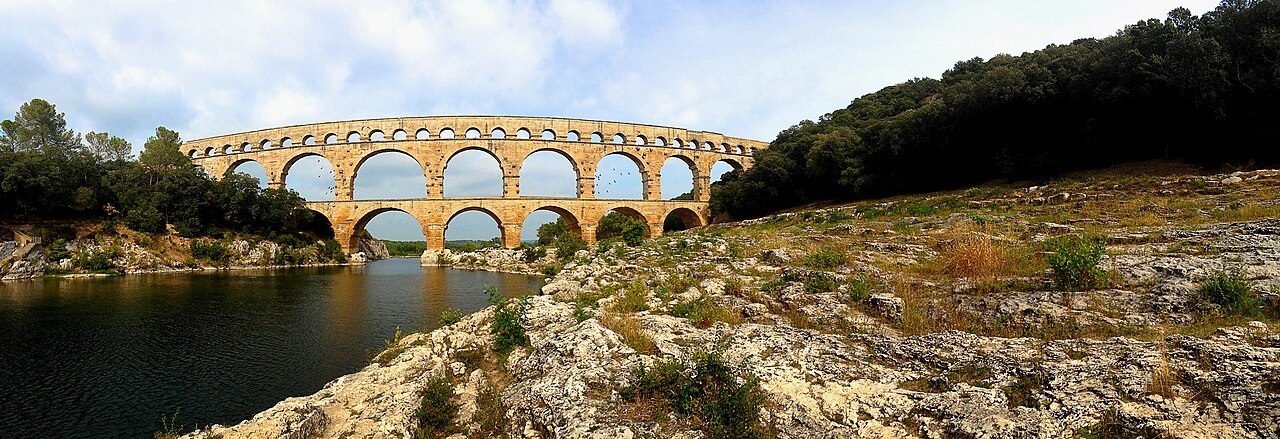
Photo · Cookie-chantilly · CC BY-SA 3.0 · Wikimedia Commons
Three places to look the next time you see a stone bridge
First, examine the blocks and joints outlining the arch: how are they arranged to form the curve? Next, follow the curve to both ends and look at the supports and what lies below them. Finally, step back and distinguish a single span from a sequence of arches separated by piers. This is a way to read a structure, not a method of certifying its safety from photographs or a glance.
The wonder of a stone bridge is not that it eliminates weight. It directs that unavoidable weight through a form suited to stone, toward the end supports and the ground. What makes the empty opening possible is the connected structure arranged around it.
References
- Bridging the Gaps — TeachEngineering · University of Colorado Boulder
- Influence of the geometry and the abutments movement on the collapse of stone arch bridges — Construction and Building Materials
- Allegheny Portage Railroad: New Support for Old Arches — U.S. National Park Service · NPSHistory.com archive copy
- Wonderlab: The science and maths behind the exhibits — Forces, Arch Bridge — Science Museum Group
- As Hangs the Flexible Line: Equilibrium of Masonry Arches — Nexus Network Journal / MIT Masonry Research
- Keystone — Chicago Architecture Center
- Richborough Roman Fort — Teachers’ Kit, Amazing Arches — English Heritage
- Seungseongyo Bridge of Seonamsa Temple, Suncheon — Academy of Korean Studies
- Pont du Gard (Roman Aqueduct) — UNESCO World Heritage Centre
- Old Town of Segovia and its Aqueduct — UNESCO World Heritage Centre