
Seventy-eight to twenty-two, written on a rice bowl
A set of bangjja yugi bowls is heavier in the hand than you expect, and the reddish golden surface throws the light straight back at you. The recipe behind it, though, is startlingly plain. Copper 78 percent, tin 22 percent. A lead-free binary bronze. In a 2024 analysis published in the Journal of Conservation Science, 14 of the 16 modern yugi pieces bought on the open market came out at that composition. The traditional recipe is handed down as “four nyang five don of tin to one geun of copper,” and since one geun is sixteen nyang that works out to 78.05 against 21.95 — the same numbers we use today. The Encyclopedia of Korean Culture, however, records the same recipe as “four nyang of tin to one geun of copper,” which gives 80 to 20, so the written record wobbles a little from source to source.
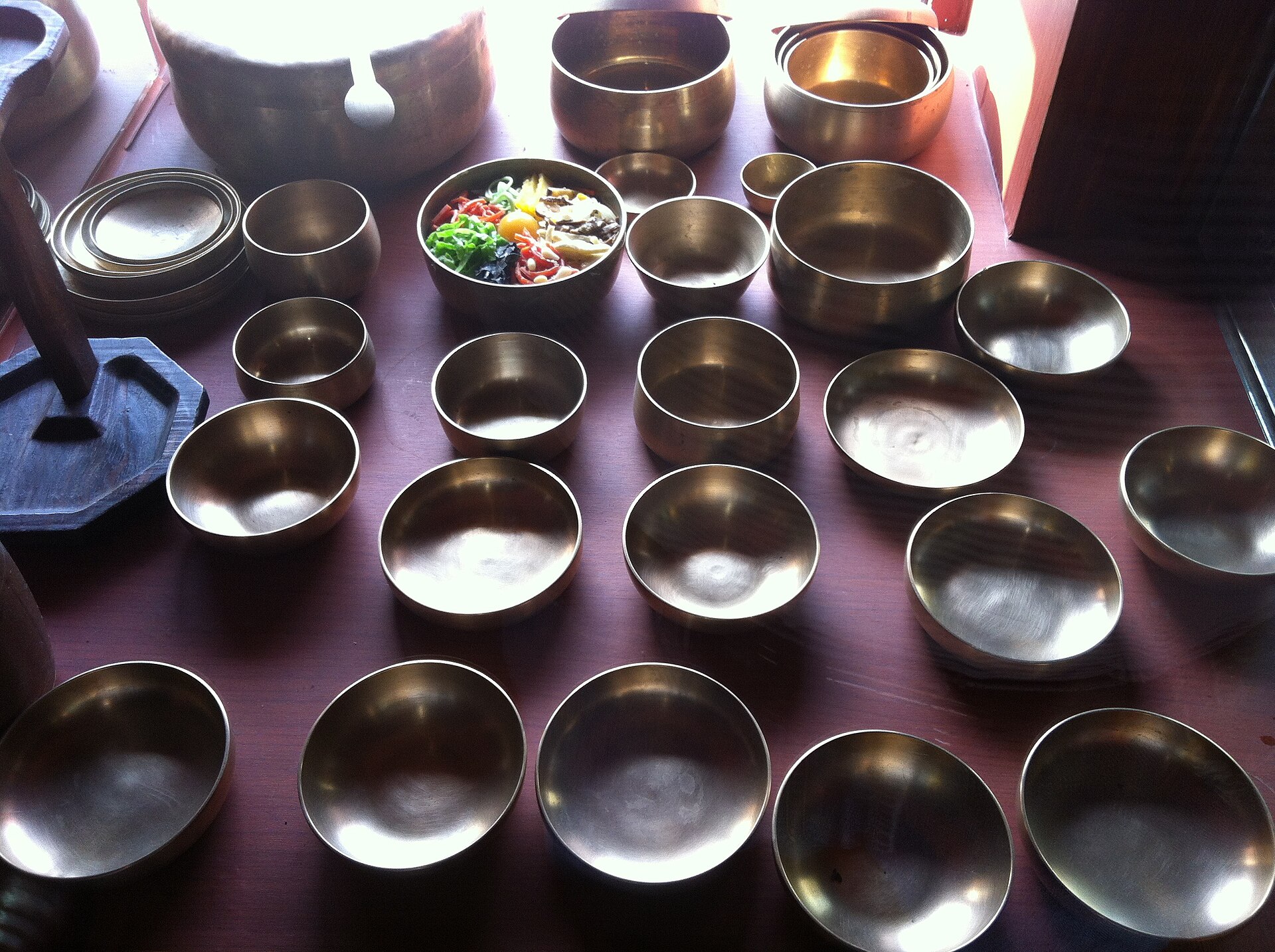
Photo solanee – CC0 – Wikimedia Commons
The real problem is that 22. Modern engineering recommends keeping tin below 10 percent in bronze meant for actual use, because the more tin there is, the more easily the metal cracks. Bangjja puts in more than twice that, heats the lump until it glows red, and beats it into a bowl with a hammer. By common sense it should shatter at the first blow.
What the word quenching brings to mind is steel, too. Plunge glowing steel into water and it hardens, but it turns brittle in the same stroke, so the smith undoes some of that hardness by tempering. Bangjja yugi is the exact opposite. Cool it slowly and it cracks; plunge it into water and it survives. There is one misunderstanding tucked in here. Bangjja can be hammered, but not because of the quench. What makes it workable is a structure that appears only at high temperature, and the quench is a final measure taken after the shape is already finished, to head off an accident that would otherwise happen while the piece cools.
The window for hammering runs from 798 to 586 degrees
In an alloy of copper and tin, the way the atoms line up changes with temperature. It is a little like a room holding the same number of people: depending on how the chairs are arranged, some rooms are easy to move through and others are jammed. Each arrangement is called a phase, and the map showing which phase appears at which composition and temperature is the phase diagram.
On the copper-tin phase diagram the beta phase is stable roughly between 798 and 586 degrees Celsius (the 2024 paper writes it as 799 to 586). Beta in that range is plastic enough to take the hammer. A “window” for hot forging is open across that band of temperature. And the equilibrium composition of the beta phase sits at about 22.9 weight percent tin. Bangjja’s 22 percent lands almost exactly on it.
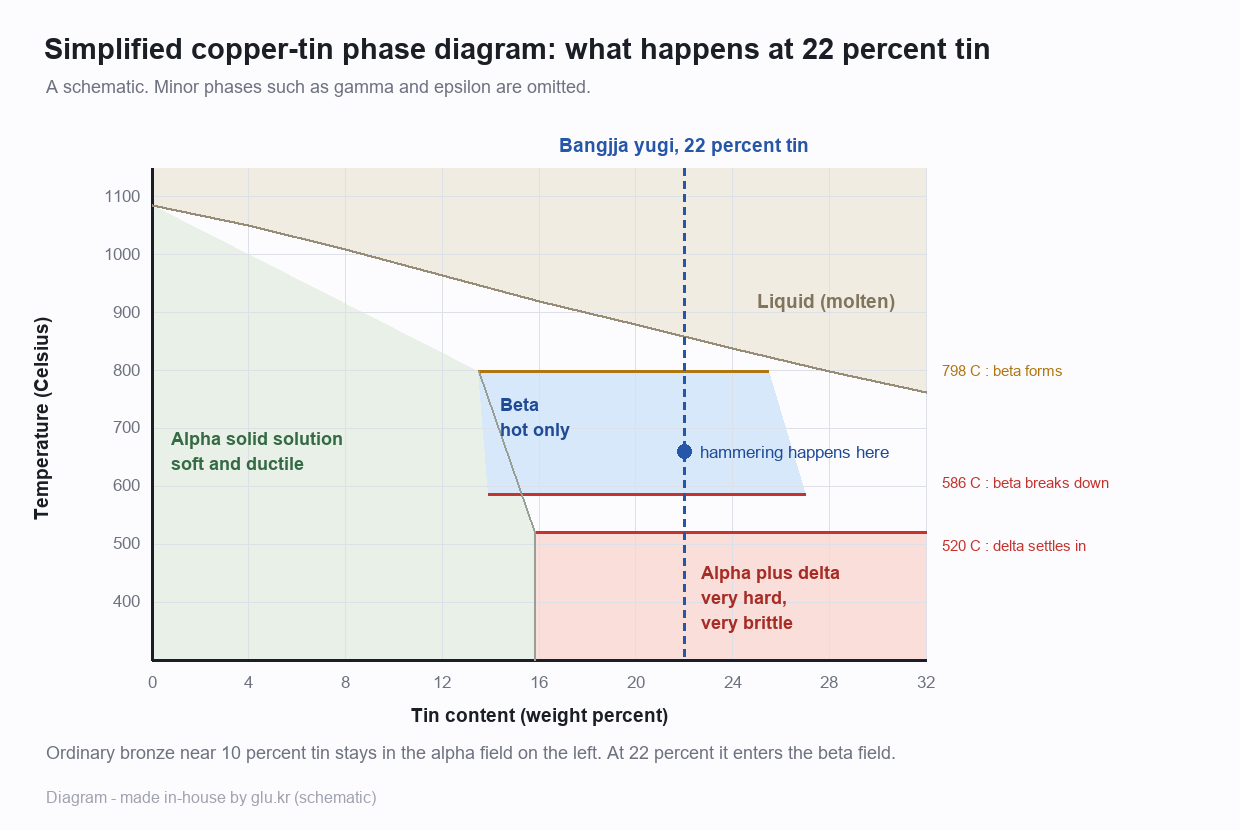
Diagram – made in-house by glu.kr (schematic)
So the 22 percent is not an amount forced in against the odds. If anything, low-tin bronzes have limited workability at high temperature, as the archaeometallurgist Sharada Srinivasan writes. Loading the alloy with tin looks less like an accident than a calculated move to prop that window open. There is a price, of course. Binary bronzes above 15 weight percent tin are brittle in the as-cast state because of the delta phase, which is why they were rare in antiquity.
The cooling path forks: the delta trap
The delta phase is one of the hardest and most brittle intermetallic compounds in the copper-tin system, corresponding to roughly 32 to 33 weight percent tin. Hard sounds like a compliment, but for a bowl it is a disaster. Once that stiff phase is spread through the structure, the metal splits on the spot the moment the hammer lands.
The important thing is that the delta phase is not there from the start — it forms as the metal cools. Cool a lump of hot beta slowly and it passes two forks in the road. At 586 degrees beta splits into alpha and gamma, and then at about 520 degrees the gamma splits again into alpha and delta. What is left when the piece reaches room temperature is alpha grains with alpha-plus-delta filling the space between them. The trap that will break the bowl is quietly assembled during the cooling.
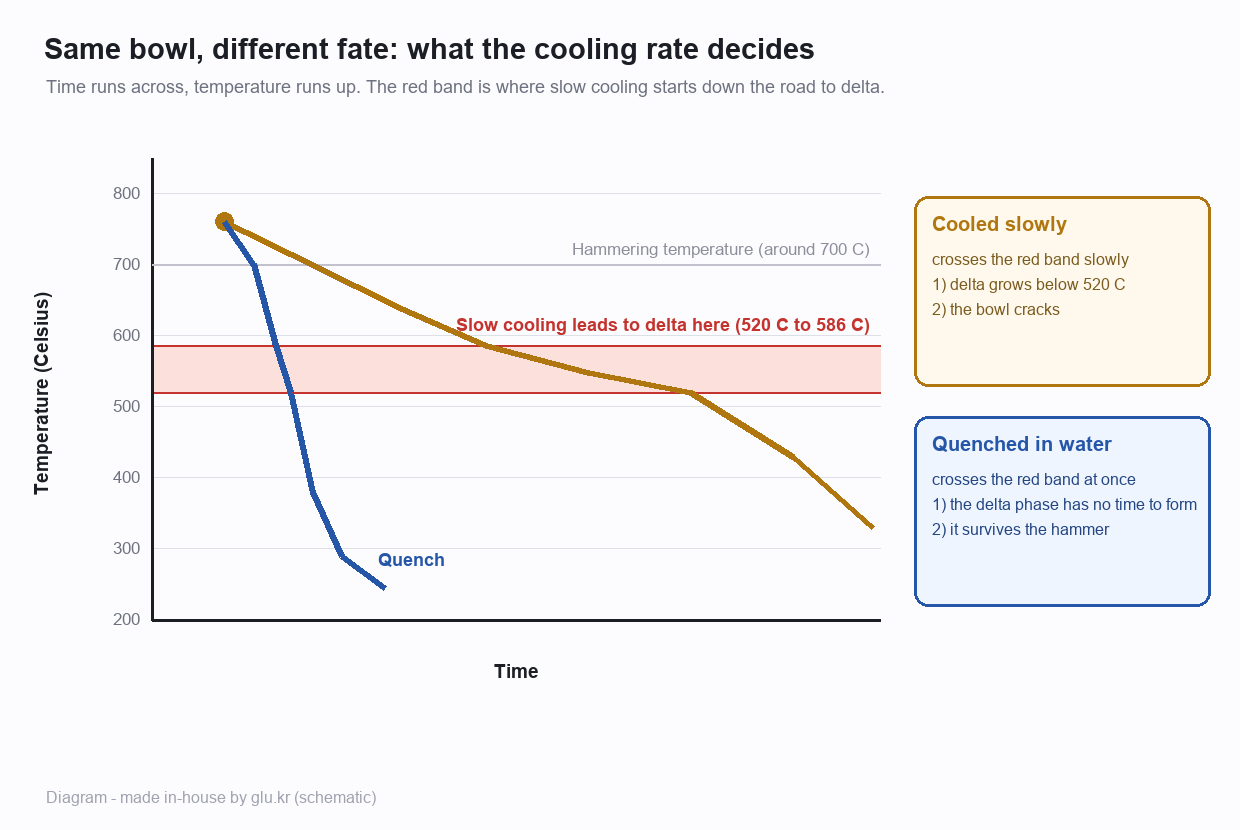
Diagram – made in-house by glu.kr (schematic)
A quench takes away the time needed to pass those forks. The role of the quench is to suppress the appearance of the delta phase, the source of the brittleness, during cooling. What remains instead is a needle-like martensitic beta, or retained gamma, and the mechanical performance improves markedly. In steel the quench brings brittleness on; in high-tin bronze the quench prevents the brittle phase from forming at all. The standard quenching temperature is the beta field above 600 degrees, but the moment of plunging varies from piece to piece in real artefacts and products, and some are found to have gone into the water in the gamma range between 586 and 520 degrees. Beta field or gamma field, skipping the eutectoid decomposition that produces delta is enough to achieve the purpose.
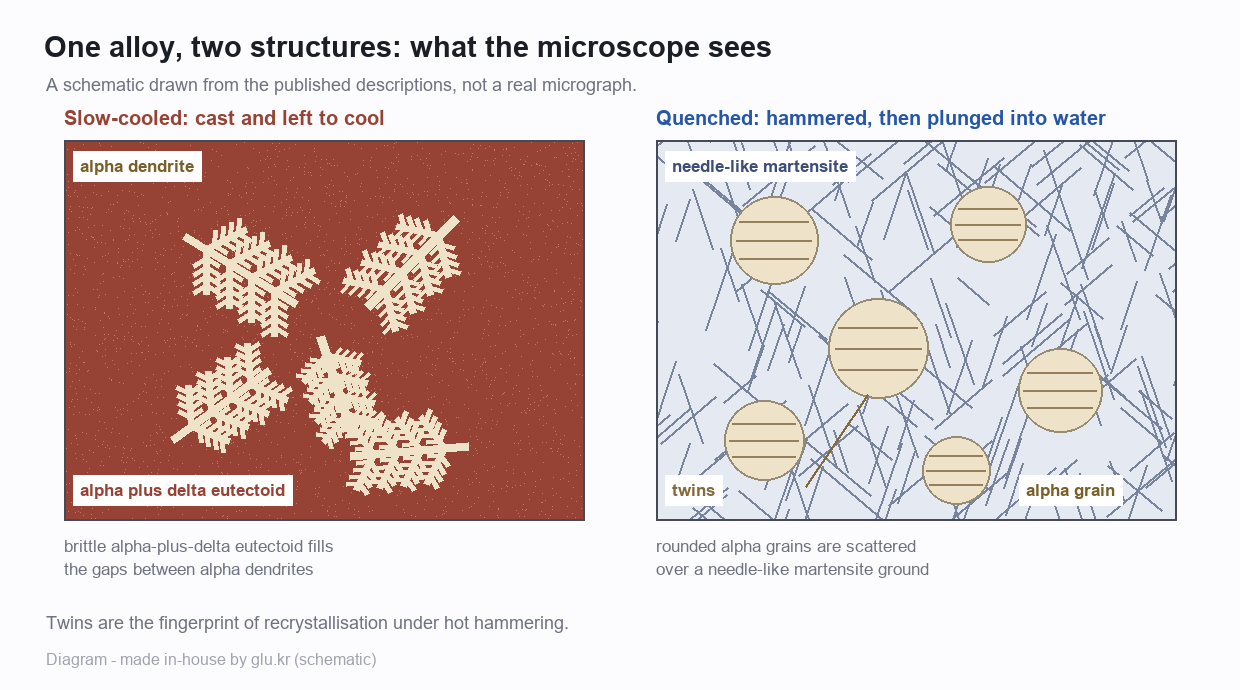
Diagram – made in-house by glu.kr (schematic)
The quench comes last
The order of the steps makes the story plainer. For bowls, bangjja yugi goes through melting, then nepimjil, ugimjil, naemjil, dakchimjil, jejil and quenching, byeoreumjil and gajil. Melting is done above 1200 degrees, and the round lump made by pouring the molten metal into a water mould is called baduk, or badegi. Nepimjil, it is said, usually takes a team of eleven who heat the baduk on a pine charcoal fire and beat it thin with hammers.
The names of the steps change with the object being made. A spoon is divided into ten stages, beginning with mujilgarak, which corresponds to the casting, then the handle, the base, ppogaemjil and ugeumjil, then the quench, and finally gwangnaegi, the polishing. What is worth noticing is the position. The quench sits at stages seven to nine of ten, after all the heating and hammering is over. The reason the explanation “you can hammer it thanks to the quench” cannot stand is already written into the process chart.
The use of gansu, the brine, was passed down by word of mouth for a long time before an experiment confirmed it. The order is what usually gets misunderstood. The brine treatment is not the same act as the quench but a separate step that comes before it — around the time the hammering has finished the shape, the piece is dipped briefly in room-temperature brine and taken out, and only then is it heated again and plunged into cold water for the quench. A 2012 study in the Journal of Conservation Science, combining reconstruction in a working yugi shop with controlled laboratory trials, showed that the role of the brine is not hardness at all but stripping off the black oxide layer that forms on the surface at high temperature. The component doing the work is the chlorine in the salt water; the sodium made no notable contribution. At the 22 percent tin composition the oxide came off regardless of whether the piece had been forged, as long as the brine was at least 0.5 percent by weight. Craftsmen have also said that brine “softens the material so it cuts more easily,” but the researchers noted that while the removal of surface grime was confirmed by eye, the effect on the material itself has not been verified. After that comes byeoreumjil, which straightens the shape that has gone out of true, and finally gajil, shaving off the oxide layer and the flaws to bring out the brass colour.
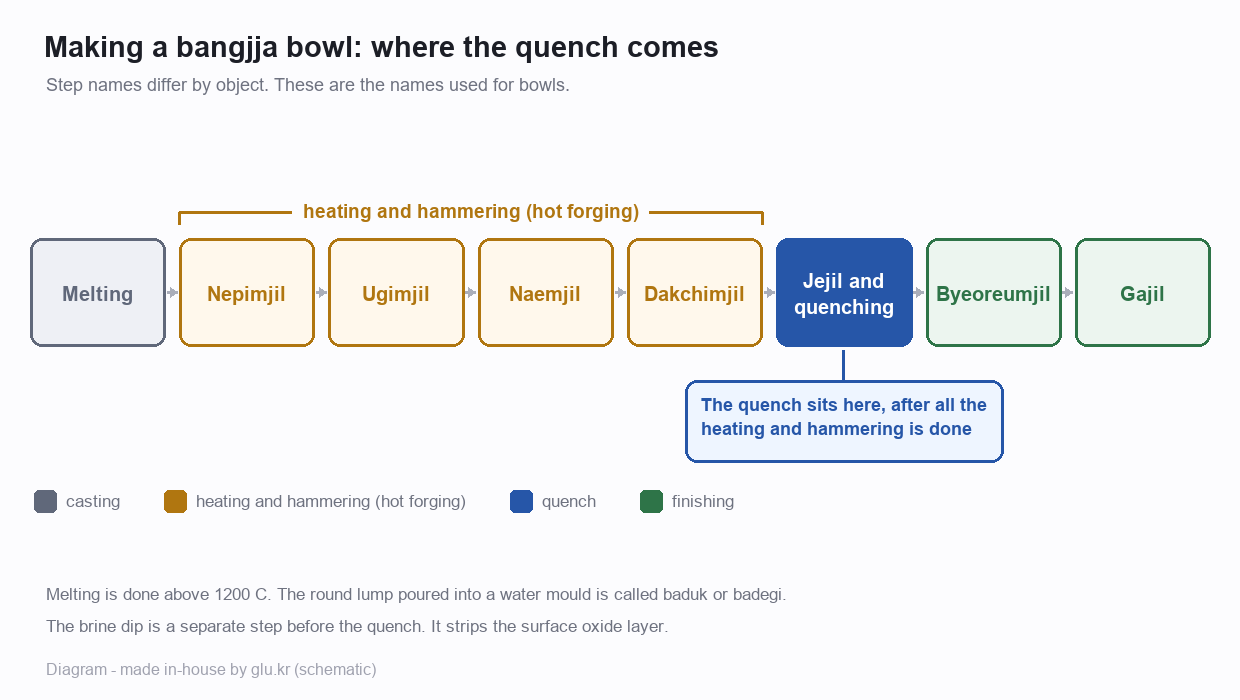
Diagram – made in-house by glu.kr (schematic)
A 2018 reconstruction experiment moved these hand movements under the microscope. A copper alloy with 22 percent tin was heated at 700 degrees for about ten minutes, taken out and struck about twenty times, and this hot forging was repeated through three rounds. After the first round there were no twins; from the second round adjacent alpha grains merged into one another and twins appeared; and by the third round most of the structure left over from casting had disappeared. The researchers noted that two rounds of forging in the laboratory correspond to one round in a working yugi shop.
Fingerprints left in the artefacts, a craft carried on by instruments
A Joseon-era bronze spoon held by the Gyeonggi Provincial Museum was analysed at 77.96 weight percent copper and 22.04 weight percent tin, with no lead detected. Its microstructure was alpha grains and twins scattered over a needle-like martensite ground — direct evidence that a Joseon spoon really had been quenched. Bronze vessels from the site of Sanoesa temple, a Goryeo-period temple, belong to the same family. The forged pieces used as everyday vessels were a lead-free alloy of 80 copper to 20 tin, and alpha phase together with quenched structure was observed in them, so they are thought to have been heat treated. Cast ritual vessels found at the same site turned out to be an entirely different alloy containing about 20 percent lead. Researchers date the appearance of this technique — 22 percent tin plus hammering plus quenching — as early as the Three Kingdoms period, and hold that it was applied without interruption to bronze making through Unified Silla and into early Goryeo.
More striking still are the mejaguk, the hammer marks. The same hammer marks, and the same lateral fold line on the back of the handle, are found both on spoons from traditional workshops and on bronze spoons excavated from archaeological sites. It means a body of technique that was never written down was handed on from hand to hand. At the same time that fold line is a weak spot where alpha phase and impurities gather, and in ancient bangjja spoons it is precisely there that cracks are found. An honest trace that the craft was not perfect.
Bangjja is not only a technique for bowls, either. The jing and the kkwaenggwari and the jwajong are made from the same alloy by the same process. A kkwaenggwari is cast as a disc of brass and then beaten so that the centre bulges, and on an instrument byeoreumjil is not the correction of shape but jaeureum, the process of tuning the sound. Whether the quenched structure is good for the sound, however, is something the literature disagrees on and cannot be stated flatly. Even in the same bronze, the Divine Bell of King Seongdeok was not hammered but poured whole, a cast temple bell, so its process is entirely different.
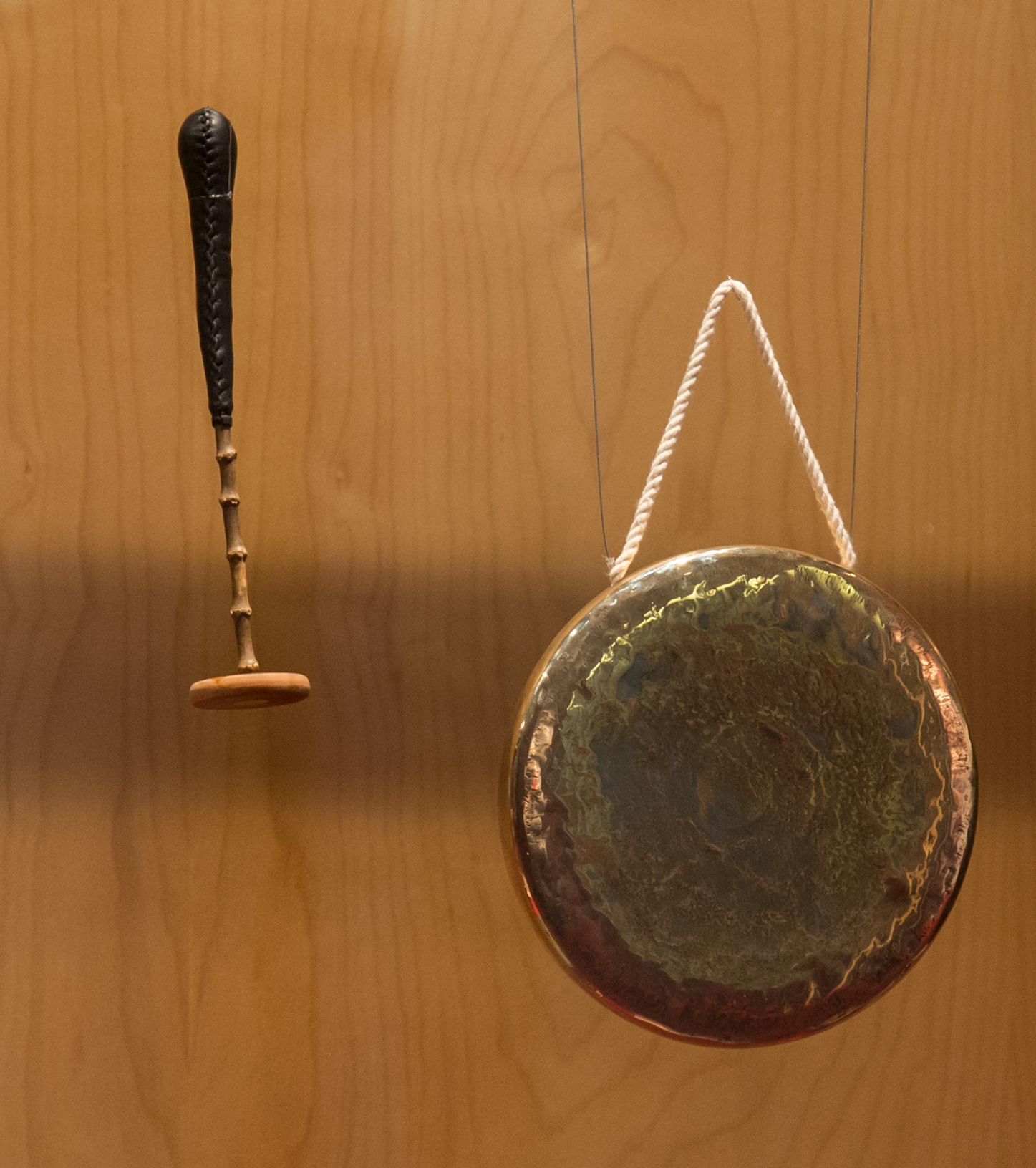
Photo Sguastevi – CC BY-SA 4.0 – Wikimedia Commons
Yugijang, the brassware-making craft, was designated a National Intangible Heritage on 1 June 1983 (formerly Important Intangible Cultural Property No. 77), and the designation covers both hammered bangjja yugi and cast jumul yugi. Napcheong in Jeongju, North Pyongan Province, is the representative home of bangjja, and Anseong in Gyeonggi Province of cast yugi — the two are often confused, but the Anseong of the phrase “anseong-matchum” is the casting side. Lee Bong-ju, the holder for the bangjja discipline, was born in Jeongju in North Pyongan Province in 1926, came south in 1948 and learned the craft in a workshop run by artisans from Napcheong; he was recognised as a holder in 1983 and became an honorary holder in 2013. The pieces he made and collected over a lifetime were donated, and the Daegu Bangjja Yugi Museum opened in 2007.
Bowls in Kerala, mirrors in Aranmula
It is hard to call this a Korean technique alone. In Kerala, in southern India, the tradition of hammering high-tin “beta bronze” vessels at 23 percent tin and then quenching them ran on unbroken into the late twentieth century. Srinivasan first recorded it metallurgically in 1991 at Payangadi in the Palghat district, and those vessels too show the martensitic beta phase produced by quenching. It is, in effect, the same structure as bangjja.
The roots are not shallow either. Thin vessels 0.2 to 1.0 millimetres thick from first-millennium BCE burials at Adichanallur in Tamil Nadu and in the Nilgiri hills, and dishes of the Chola dynasty from the tenth to twelfth centuries, were all analysed as beta bronze of 23 to 25 percent tin, forged and then rapidly cooled. The Kansari artisans of Odisha in India have been beating ingots in rhythm in teams and reheating them repeatedly to make vessels since the eleventh century. The arrangement is almost the same as nepimjil.
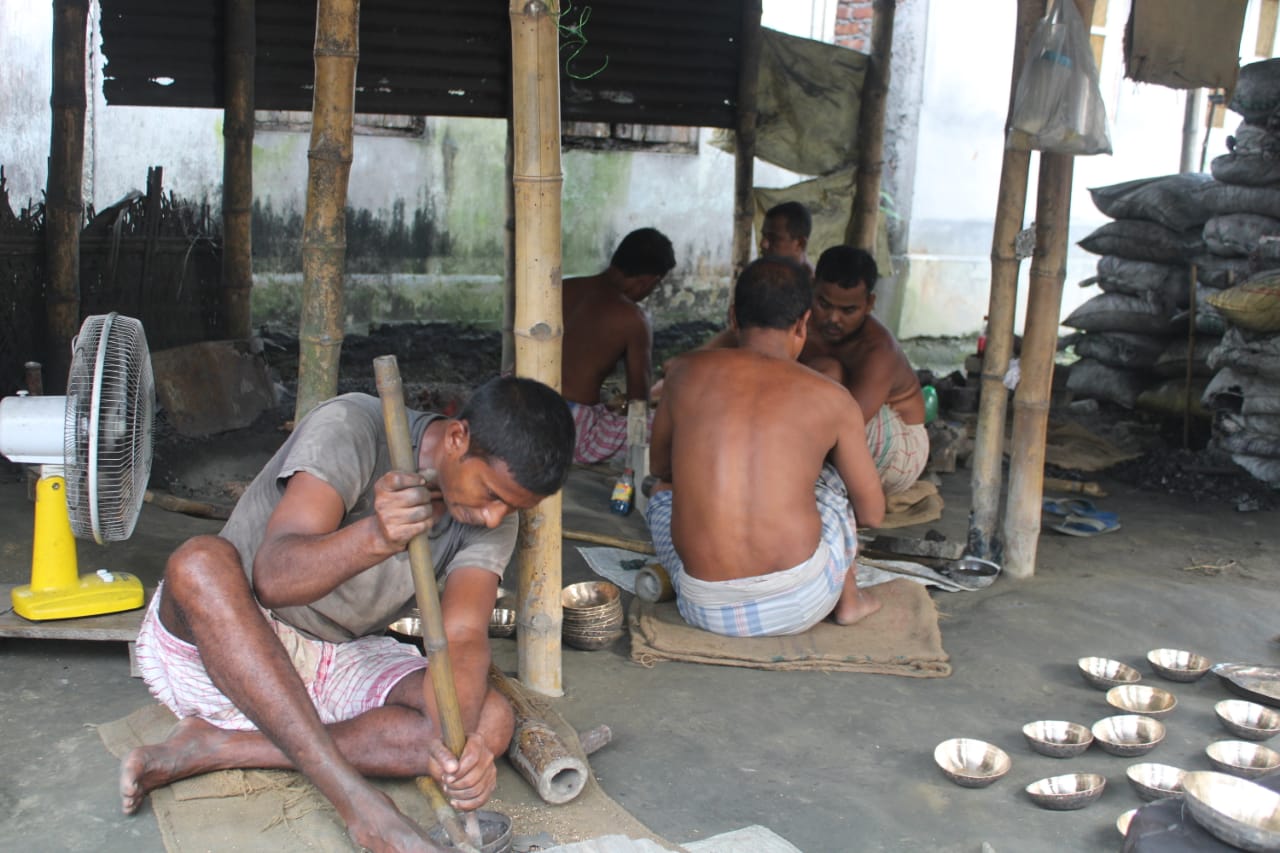
Photo Dhruba Jyoti Deka – CC BY-SA 4.0 – Wikimedia Commons
In the Philippines quenched high-tin bronze gongs have been reported, and in Ban Don Ta Phet in Thailand prehistoric high-tin bronzes.
Korean research points the same way. Thirteen forged high-tin bronze objects from archaeological sites in Bagan, Myanmar were found to be 76 copper to 24 tin, hot forged and then quenched, and because the quenching temperature differed from sample to sample, martensitic beta, gamma and delta each turned up in different pieces. A Korean researcher who had analysed bangjja yugi confirmed the same technique in Myanmar. On origins, opinion divides. The Bagan paper takes the technique to have begun in Persia and travelled through India to China and the Korean peninsula, while Srinivasan raises the possibility of an indigenous South Asian tradition reaching back to the Indus civilisation. Neither is settled.
Inside the same Kerala there is a branch that runs the other way. The Aranmula metal mirror is cast from delta bronze of 32 to 33 percent tin and then polished; it is never hammered. The very phase that bangjja spends its whole process avoiding is what the mirror takes as its raw material. Hard and brittle is a disaster in a bowl, but in a mirror it becomes the advantage of taking a fine specular polish.
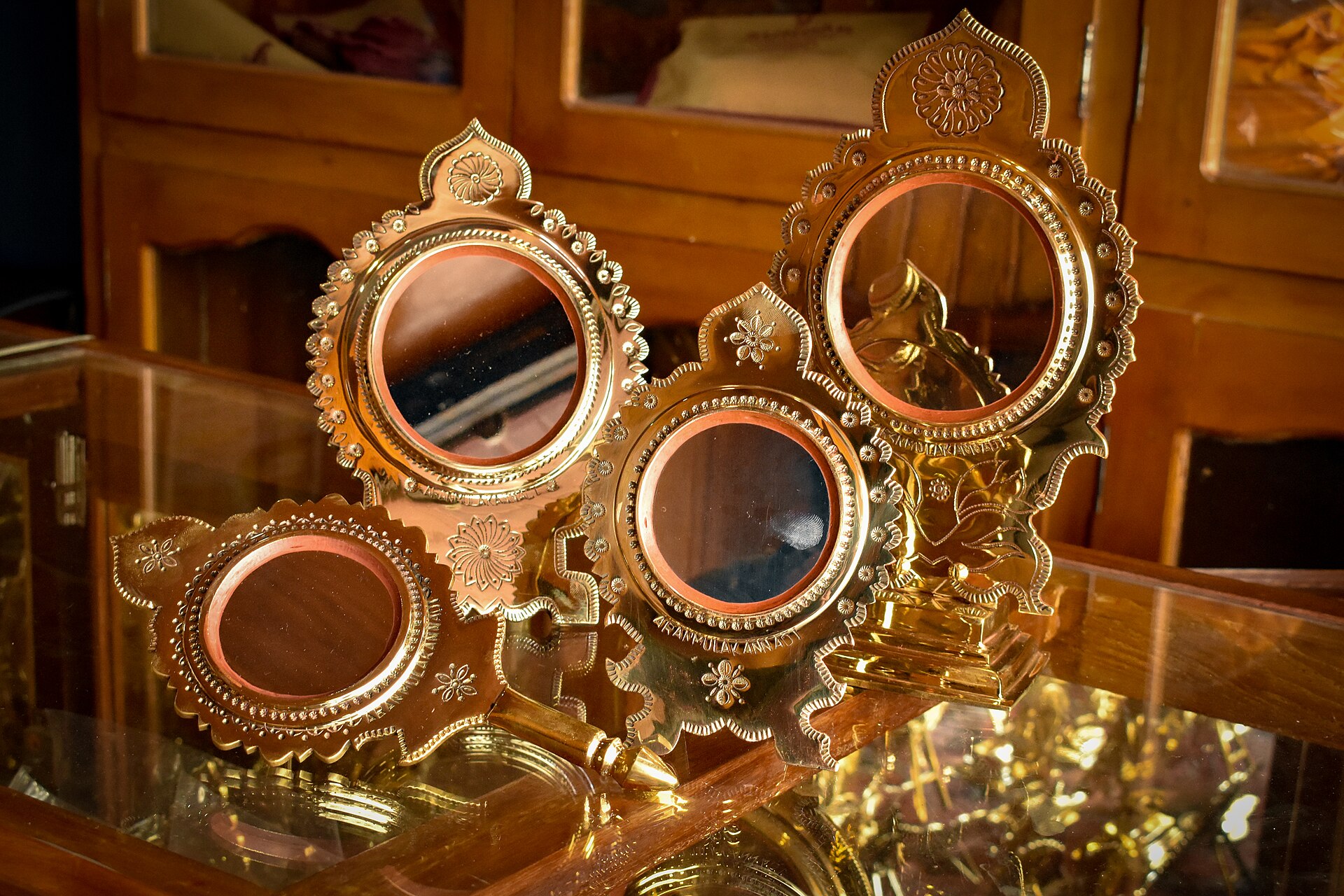
Photo Prasanth Prakash – CC BY-SA 4.0 – Wikimedia Commons
One thing learned today
The secret of bangjja yugi lies less in what goes in and how much, than in how it is cooled. The 22 percent tin that looks so risky was a choice made to open a window of temperature in which the metal could be hammered, and the final plunge into water was not an attempt to make the bowl hard but a measure to deny the structure that would break it the time to grow. The craftsman drew no phase diagram, yet arrived at the same conclusion with his hands and his eyes, and the microscope confirmed that judgement centuries later. There is no need to wrap an old technique in mystery. That it was a design refined by careful observation and exact repetition is astonishing enough on its own.
References
- Microstructural Change by Hot Forging Process of Korean Traditional Forged High Tin Bronze (Lee Jae-sung, Jeon Ik-hwan, Park Jang-sik), Journal of Conservation Science 34(6), 2018 — Korean Society of Conservation Science for Cultural Heritage
- Effect of Brine Treatment Applied in the Manufacture of Traditional Forged High Tin Bronzes of Korea (Lee Jae-sung, Jeon Ik-hwan, Kwak Seok-chul, Park Jang-sik), Journal of Conservation Science 28(4), 2012 — Korean Society of Conservation Science for Cultural Heritage
- The Metallurgical Characteristics of Modern Brassware by Manufacturing Techniques (Seok Yu-ran, Bae Go-un), Journal of Conservation Science 40(4), 2024 — Korean Society of Conservation Science for Cultural Heritage
- Metallurgical Study of Bronze Relics Excavated from Sanoesa Temple, Chongju (Kwon Hyuk-nam, Yu Hye-sun, Ahn Byung-chan), Journal of Conservation Science 9(1), 2000 — Korean Society of Conservation Science for Cultural Heritage
- Manufacturing Techniques of Ancient Forged High-tin Bronze Wares from Archaeological Sites in Bagan, Myanmar, Journal of Conservation Science 39(5), 2023 — Korean Society of Conservation Science for Cultural Heritage
- Kansari Brass and Bell Metal Ware (the forged bell-metal craft of the Kansari community in Odisha, India) — MAP Academy
- A Study on the Traditional Forged High Tin Bronzes and the Rivet Joints in Korea (Lee Jae-sung, Kim Won-soo, Park Jang-sik), Korean Journal of Metals and Materials 46(1), 2008
- Megalithic High-tin Bronzes and Peninsular India’s ‘Living Prehistory’ (Sharada Srinivasan, 2010), in 50 Years of Southeast Asian Archaeology — NIAS Repository (PDF, HTTP only)
- The Archaeometallurgical Implications of New Findings of Traditional Crafts of Making High Tin ‘Delta’ Bronze Mirrors and ‘Beta’ Bronze Vessels in Kerala (Srinivasan & Glover), MRS Proceedings 462, 1996
- Copper Tin Alloys: The Bronzes (the copper-tin phase diagram, the eutectoid reactions and the properties of the delta phase) — Total Materia
- Bangjja, in which a remarkable bronze technique is dissolved (the recommended ceiling of 10 percent tin for practical vessels) — KISTI Science Scent
- Yugijang, National Intangible Heritage — Korea Heritage Portal
- Heritage Stories: Yugijang Lee Bong-ju (the order of the steps for bowls, and the history of Napcheong) — Korea Heritage Agency
- Daegu Bangjja Yugi Museum, Reconstruction Room (works donated by Lee Bong-ju and a reconstruction of a 1930s Napcheong village workshop) — Daegu Bangjja Yugi Museum
- Bangjja Yugijang — Encyclopedia of Korean Culture, Academy of Korean Studies
- Anseong Matchum Museum, Yugi Exhibition Hall (Anseong as the home of cast yugi) — Anseong City Culture and Tourism
- Kkwaenggwari — Encyclopedia of Korean Traditional Music, National Gugak Center