
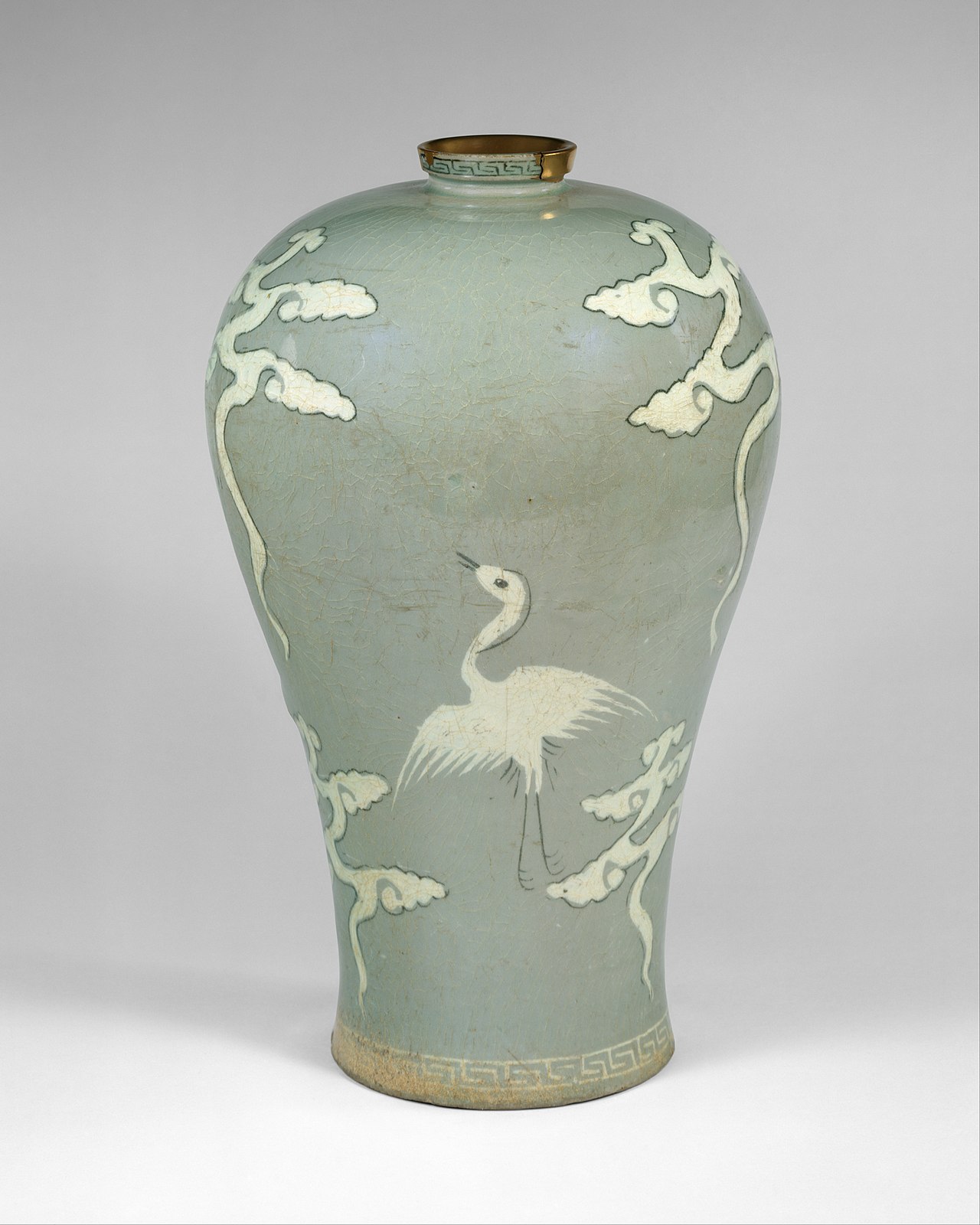
Sixty-nine cranes soar across a blue sky. The cranes inside the round rings face upward, while those outside the rings face downward. This is the scene carved into the surface of the National Treasure “Celadon Maebyeong (Prunus Vase) with Inlaid Cloud and Crane Design,” held by the Kansong Art Museum. Yet these cranes and clouds are not painted with a brush. They are patterns the potter created by carving out the surface of the vessel, point by point, and filling each hollow back in with clay of a different color. Let us look at how this idea—scraping away clay only to fill it back with other clay, an approach that at first glance seems impossibly laborious—became an art that represents twelfth-century Goryeo.
“They Call It Bisaek” — The Blue-Green the Song Envoy Admired
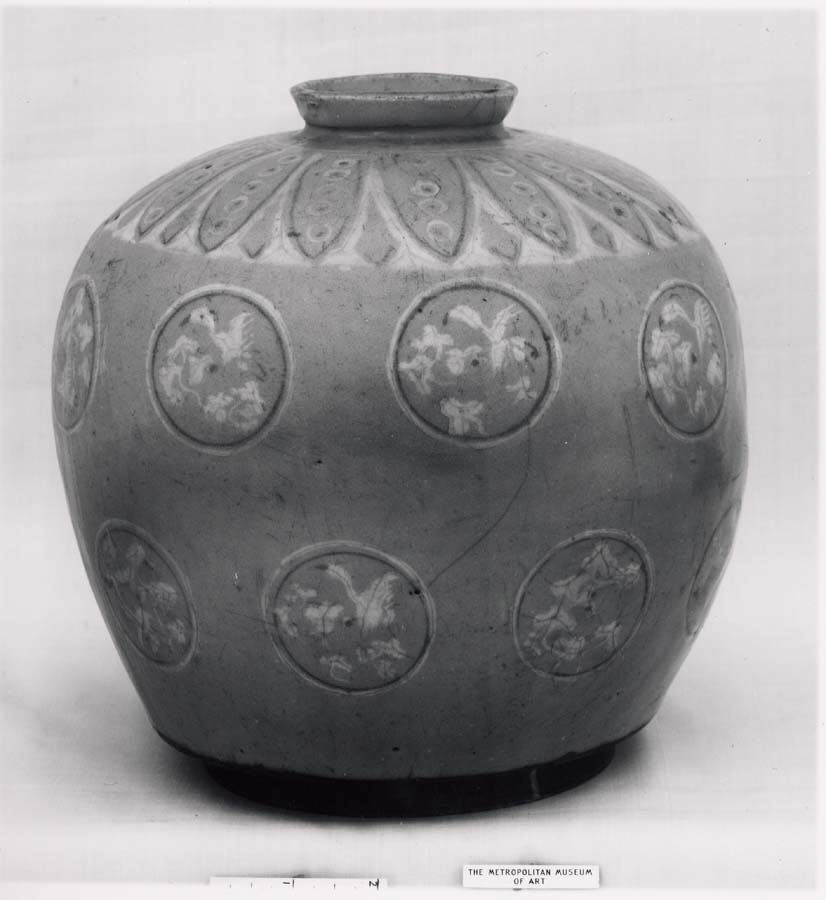
Goryeo celadon began with imitation. Adopting the techniques of the Yuezhou kilns (越州窯), which fired the celadon of Wuyue (吳越) in China, Goryeo too began making celadon from around the early tenth century. At first this celadon had almost no decoration and a somewhat dark color. But the Goryeo potters did not stop at simply copying. Using smaller clay kilns to control the firing temperature delicately, and applying thick glaze before firing again, they eventually perfected a translucent blue-green glaze resembling jade (玉).
The fame of this blue-green crossed borders. Seo Geung (徐兢), a Song envoy who came to Goryeo in 1123, wrote in his account Goryeo dogyeong (高麗圖經, Illustrated Account of Goryeo): “The Goryeo people call the blue-green color of the pottery bisaek (翡色, kingfisher color), and of late the craftsmanship has grown so refined that the color has become even finer.” It is a record in which a Chinese official—who would have taken great pride in his own country’s ceramic tradition—directly praised the color of Goryeo celadon. Bisaek celadon reached its peak in the first half of the twelfth century.
How to Draw with Clay — The Birth of Sanggam (象嵌) Inlay
Bisaek alone was beautiful enough, but the Goryeo potters went a step further. Around the middle of the twelfth century, the “sanggam” (象嵌) technique—carving patterns into the surface of the celadon—appeared in earnest. Sanggam was originally a term from metalwork, referring to a decorative method of inlaying other materials such as gold, silver, or mother-of-pearl into the surface of an object to form a design. The Goryeo potters transferred this idea to clay. Wikipedia and other sources mention the possibility that they took a hint from najeon (mother-of-pearl) lacquerware, and the very idea of carving out clay and filling it with other clay to form a pattern can be traced in other East Asian crafts as well; but combining it with celadon and raising it to a distinctive aesthetic was the achievement of the Goryeo potters.
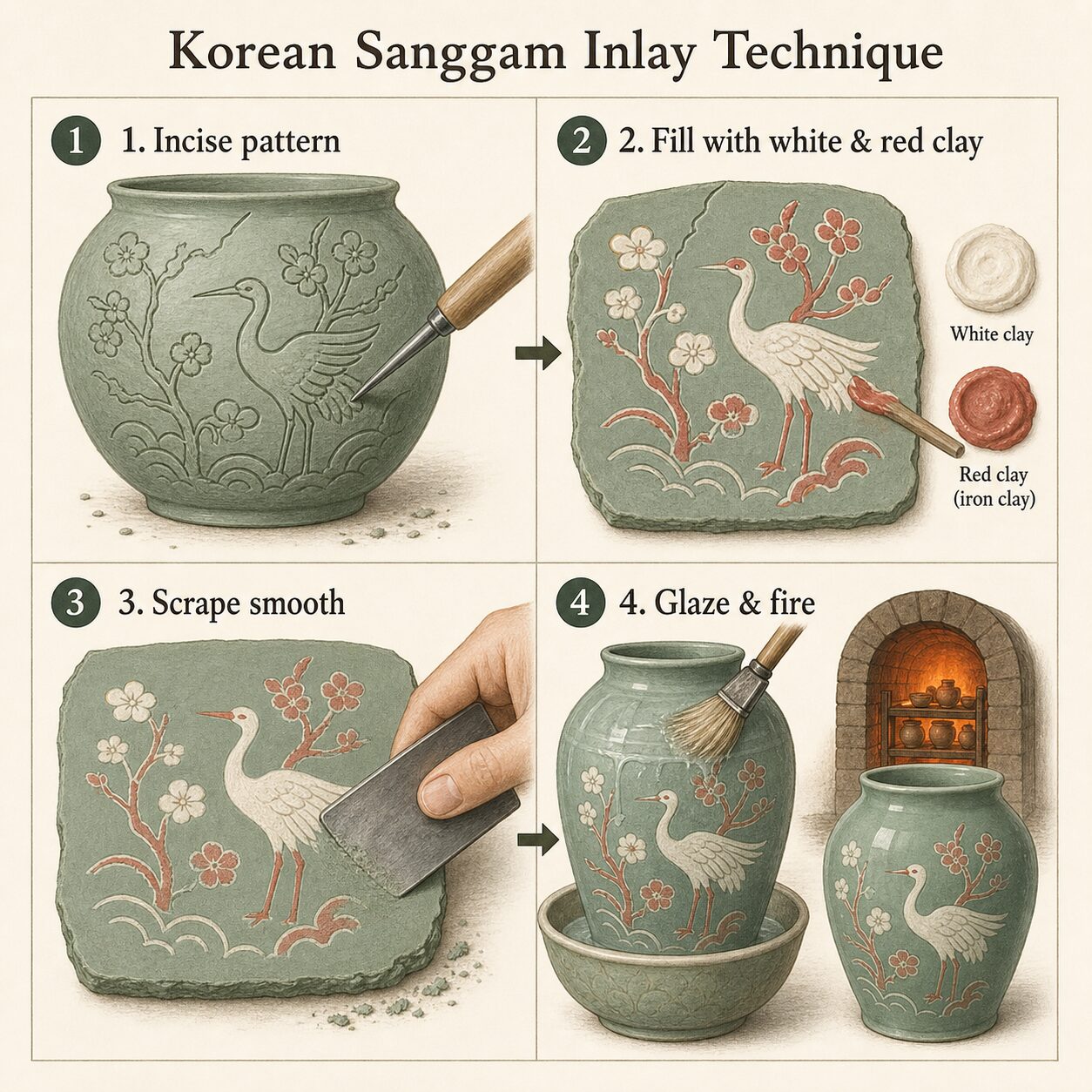
The process demands patience. Let us follow the explanation of the Encyclopedia of Korean Culture. First, the vessel is shaped and left until it is half-dry (leather-hard); then the pattern is incised (陰刻) into the surface with a carving knife. Next, the carved grooves are filled in with a brush using white clay (baekto) or red clay (jato). After the clay dries, the excess clay smeared on the surface is scraped away, so that clay remains only in the incised areas and the pattern stands out clearly. The vessel filled with the pattern this way is dried completely and bisque-fired; then it is coated with celadon glaze (靑瓷釉) and fired once more in a final glaze firing.
Baekto Turns White, Jato Turns Black
Here lies the real charm of sanggam celadon. After enduring the high heat of the kiln, baekto develops into white and the red jato into black. And the pattern then rises up, softly visible through the translucent celadon glaze. The cloud-and-crane maebyeong seen earlier is a good example. The black concentric rings are filled with jato, and the white cranes and clouds are filled with baekto. This principle—color diverging according to the type of clay—can be confirmed directly on the actual National Treasure. The Gwangju National Museum describes this technique as “a creative technique that may be called epochal in the history of East Asian ceramics.”

Gangjin and Buan: The Kilns That Shaped the Golden Age
This delicate work was not carried out just anywhere. By the middle of the dynasty, Goryeo celadon production was concentrated in the areas of Gangjin County in South Jeolla Province and Buan County in North Jeolla Province. In particular, the kiln sites around Daegu-myeon in Gangjin County (Sadang-ri, Yongun-ri, and others) were designated a Historic Site in 1963; the Yongun-ri kilns are early sites from the tenth and eleventh centuries, while the largest number at Sadang-ri date from the first half of the twelfth century through the thirteenth century. The course of celadon developing and ripening is inscribed in the kiln sites themselves.
Alongside Gangjin, another center was the Yucheon-ri area of Boan-myeon in Buan County, North Jeolla Province. The celadon kiln site here is also designated as a separate Historic Site, and it is said that in the first half of the thirteenth century even more celadon was produced at Buan. The Kansong Art Museum’s National Treasure maebyeong examined earlier is also presumed to have been made at this very Buan Yucheon-ri kiln. Standing 42.1 cm tall, this maebyeong is classified as a work of the late twelfth century of Goryeo, and as an artifact collected by Jeon Hyeong-pil (Kansong) during the Japanese colonial period, it was designated a National Treasure on December 20, 1962. For reference, this work was long called “National Treasure No. 68,” but from November 19, 2021, the Korea Heritage Service decided to stop using designation numbers for National Treasures and Treasures, so it is now denoted by name alone, without a number. The perception that designation numbers ranked cultural heritage, along with criticism that the numbers had been assigned during the Japanese colonial period, lay behind the abolition.
Decline, and the Current That Flowed On into Buncheong Ware
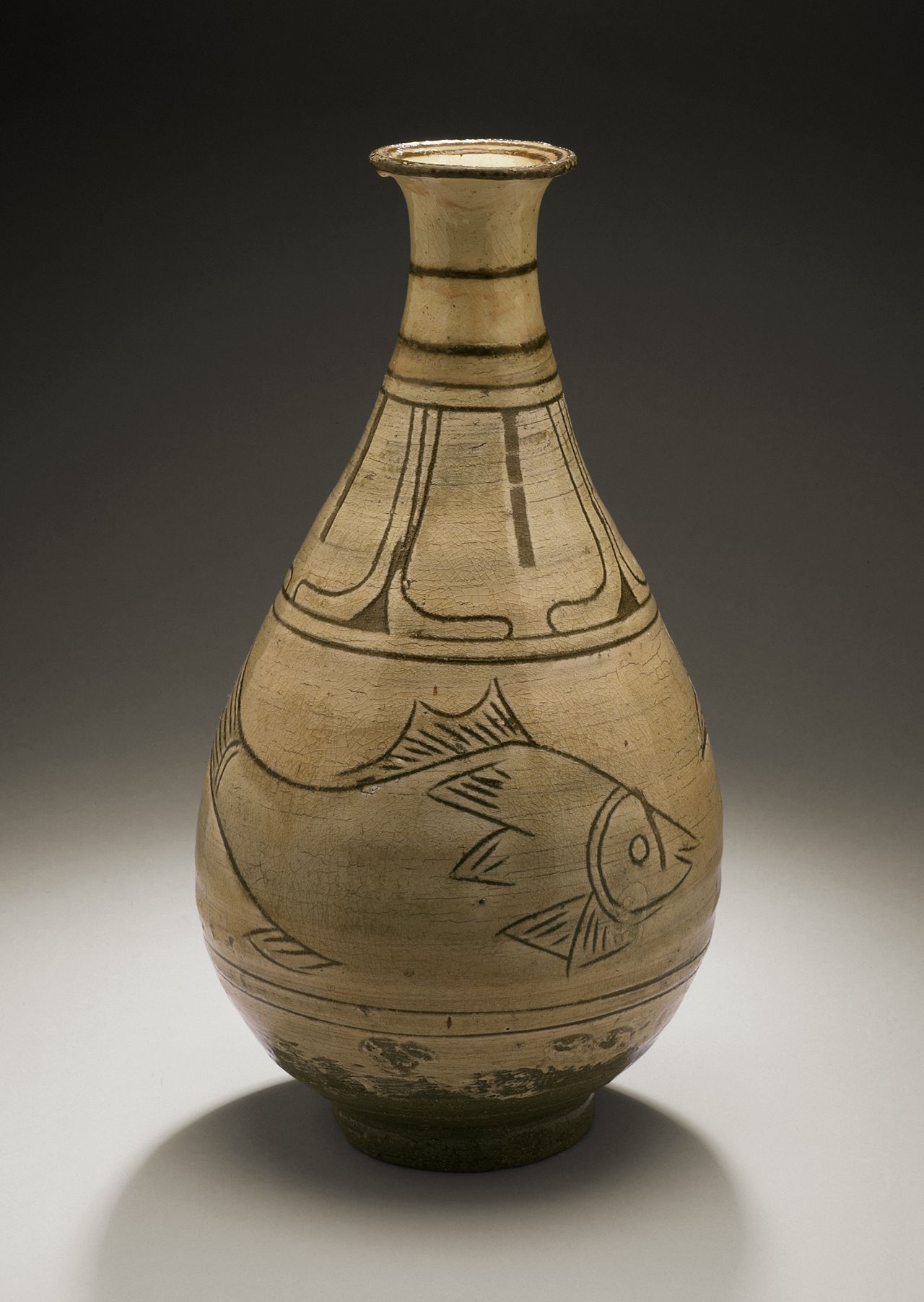
Every golden age has its end. From the mid-thirteenth century through the fourteenth century, Goryeo celadon entered a period of decline. As the invasions and rule of the Mongols (Yuan) continued, traditional celadon contracted, and the glaze lost its bisaek and began to take on a yellow-green tone. The once-refined sanggam patterns also gradually grew loose and crude, drifting toward the mechanical repetition of the same motifs.
Yet the technique did not vanish entirely. The sanggam celadon that declined at the end of Goryeo carried over into the early Joseon period, transforming and developing into buncheong ware. In step with a new ruling class centered on Confucianism, which preferred frugal, practical vessels over ornate ones, buncheong ware was in fashion for some two hundred years from the reign of King Taejong of Joseon. The blue glaze of celadon had faded, but the very idea of carving out clay and filling it back in to form a pattern crossed over into the next era.
What We See Today
In 2012 the National Museum of Korea held the special exhibition “Goryeo Celadon, the Best Under Heaven,” bringing together representative masterpiece celadons including 18 National Treasures and 11 Treasures. It was the first large-scale exhibition of its kind in 23 years, since 1989. When you stand before a single maebyeong and count its sixty-nine cranes, what you face is not merely an old vessel. It is the tenacity of an age that took in others’ techniques yet did not stop there—that chose the laborious path of carving out clay and filling it back in, and in the end perfected a beauty all its own. In a single color-name, bisaek, and in a single maebyeong from which cranes seem to rise, that tenacity is preserved in full.
References
- Goryeo Celadon — Wikipedia (Korean)
- Goryeo Celadon — History Net (National Institute of Korean History)
- The Making of Sanggam Celadon — History Net (NIKH)
- The History of Goryeo Celadon — Goryeo Celadon Museum
- Gangjin Goryeo Celadon Kiln Site — Encyclopedia of Korean Culture
- Sanggam (Inlay) — Encyclopedia of Korean Culture
- Celadon Maebyeong with Inlaid Cloud and Crane Design — Encyclopedia of Korean Culture
- Sanggam Celadon — Gwangju National Museum
- National Treasure: Celadon Maebyeong with Inlaid Cloud and Crane Design — Korea Heritage Portal
- Buncheong Ware and White Porcelain — History Net (NIKH)