
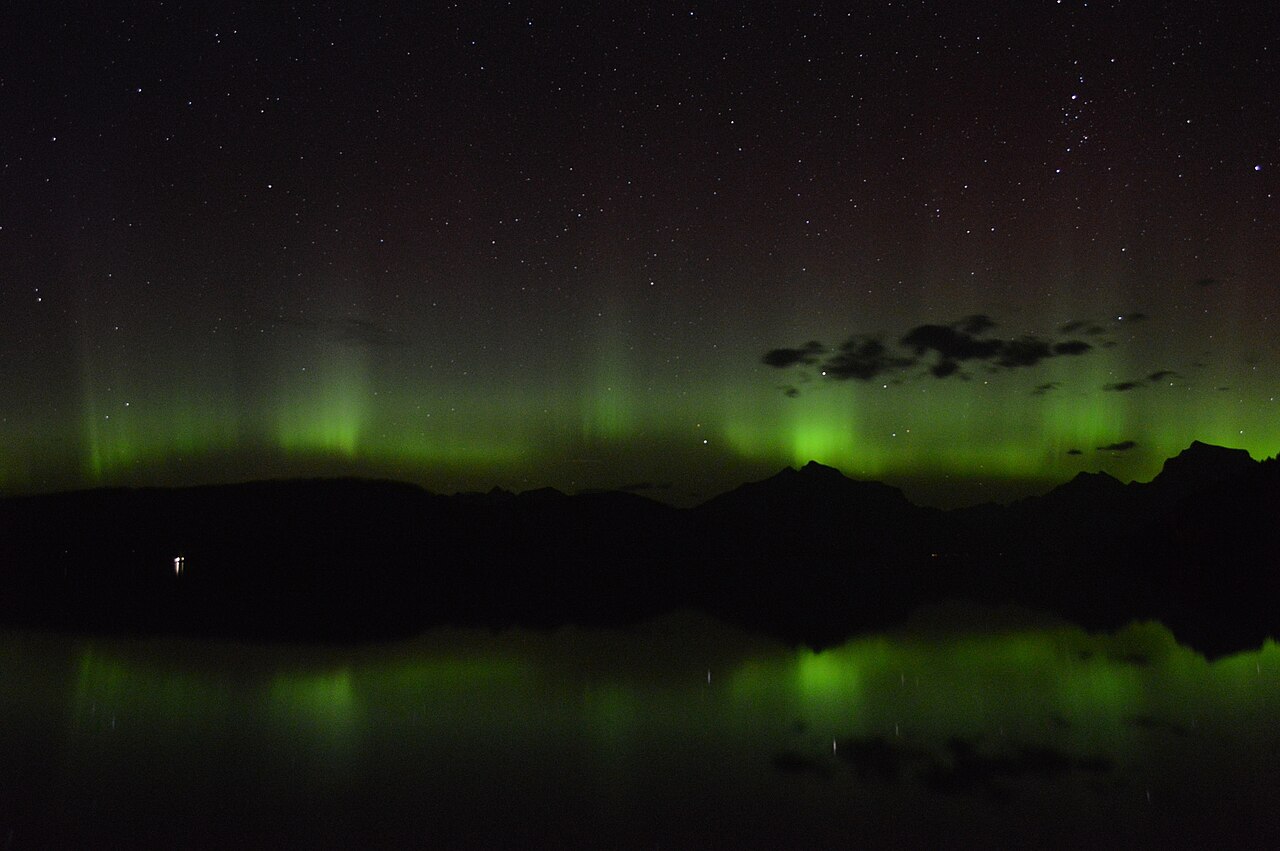
On a winter night, a curtain of green light slowly ripples across the northern sky. It is a wondrous sight that almost everyone has seen in a photograph. Yet it is surprisingly little known that this light is, in fact, a picture drawn by particles that traveled some 150 million km from the Sun and met Earth’s magnetic field and atmosphere. An aurora is not merely a “color in the sky” but a single connected phenomenon that the Sun, the Earth, and the atmosphere paint together.
NPS (US National Park Service) · Public domain · Wikimedia Commons · Source
It All Begins with the Sun
An aurora’s starting point is the Sun. The Sun ceaselessly emits the solar wind, a stream of charged particles (electrons and protons) moving at roughly 300–500 km per second. This wind spreads out into space at all times, but now and then the Sun produces a far more violent event: a coronal mass ejection (CME). In a CME, a vast blob of plasma — reaching up to about 2,000 km per second — pours out all at once and reaches Earth in as little as one to three days.

Steve Jurvetson (NASA/SDO) · CC BY 2.0 · Wikimedia Commons · Source
Earth’s Shield, and Its Gap
Fortunately, Earth has a shield. Its magnetosphere is a protective barrier that deflects most of the solar wind to the side. Yet there are moments when a subtle “gap” opens in this shield. When the interplanetary magnetic field (IMF) points southward, magnetic reconnection occurs on Earth’s dayside, and the field lines are dragged toward the long tail on the night side — the magnetotail. Through this process, energy steadily builds up.
When the energy in the magnetotail exceeds a threshold, magnetic reconnection occurs once more and the particles are accelerated. The electrons and ions flung back toward Earth pour down along the field lines into the upper polar atmosphere. This phenomenon is called an auroral substorm, and it is precisely when the dazzling feast of light we see unfolds.
The Moment It Becomes Light
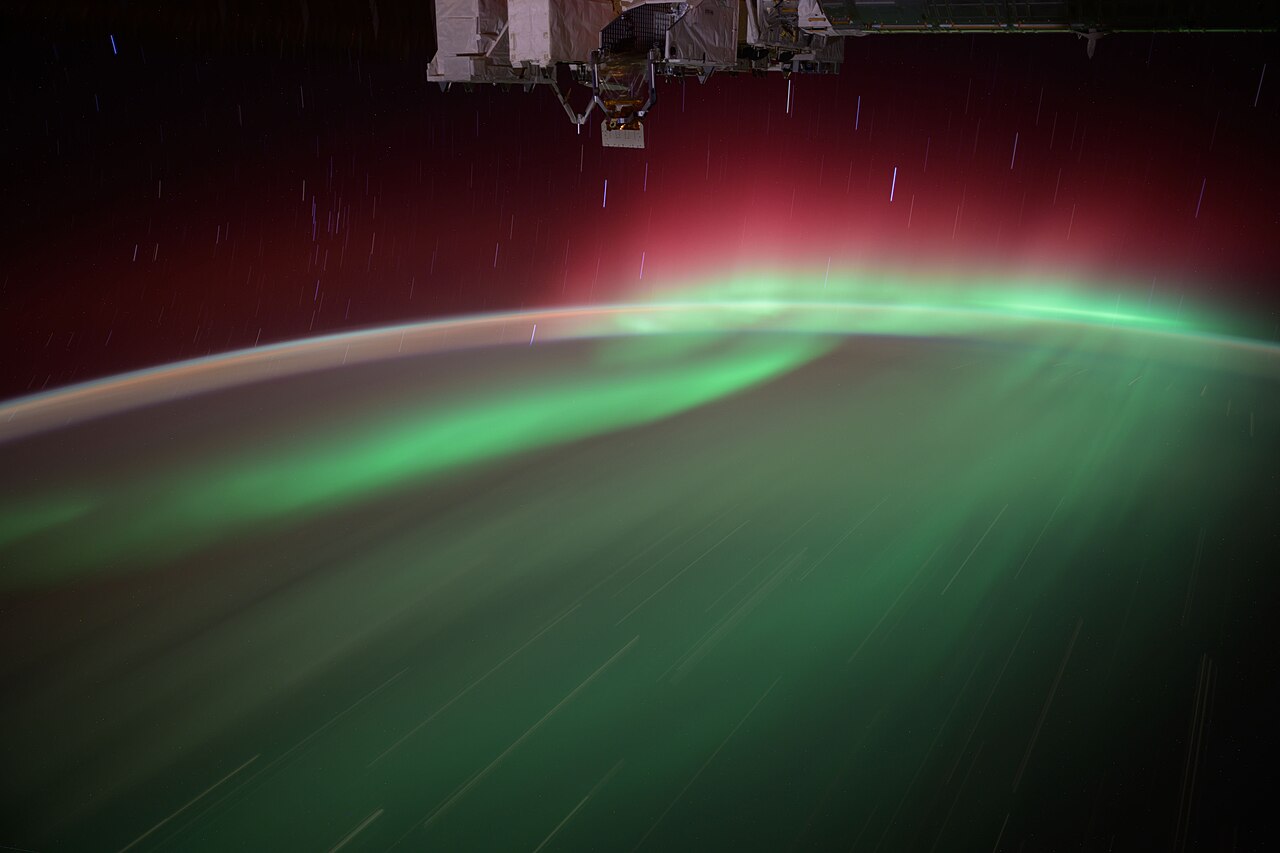
The electrons raining into the polar atmosphere collide with oxygen and nitrogen atoms and molecules, raising them into an “excited state.” As the excited particles return to their stable ground state, they release the energy as light — and the color depends on which particle shines, and at what altitude.
NASA Johnson Space Center · Public domain · Wikimedia Commons · Source
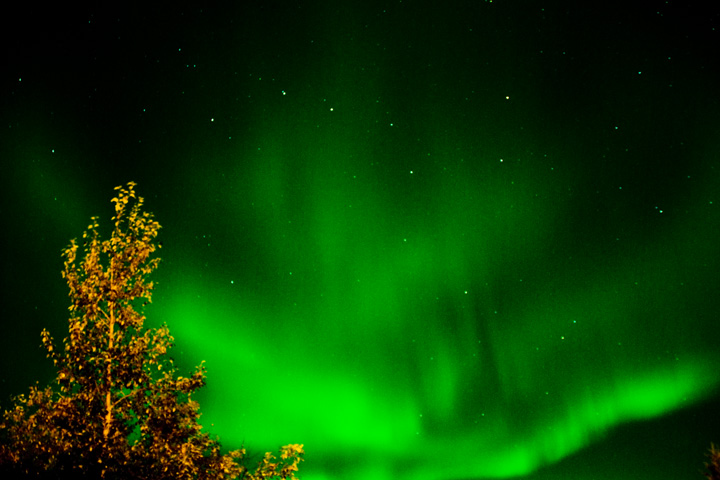
The most commonly seen green is the 557.7 nm light emitted by oxygen atoms. It arises as oxygen’s excited 1S state transitions in about 0.7 seconds, and appears mainly at altitudes of roughly 100–150 km (observational studies put the average peak altitude at about 114.8 km). Because oxygen is so abundant and the transition is fast, green becomes the aurora’s “default color.”
Zheng Xu · CC BY 2.0 · Wikimedia Commons · Source
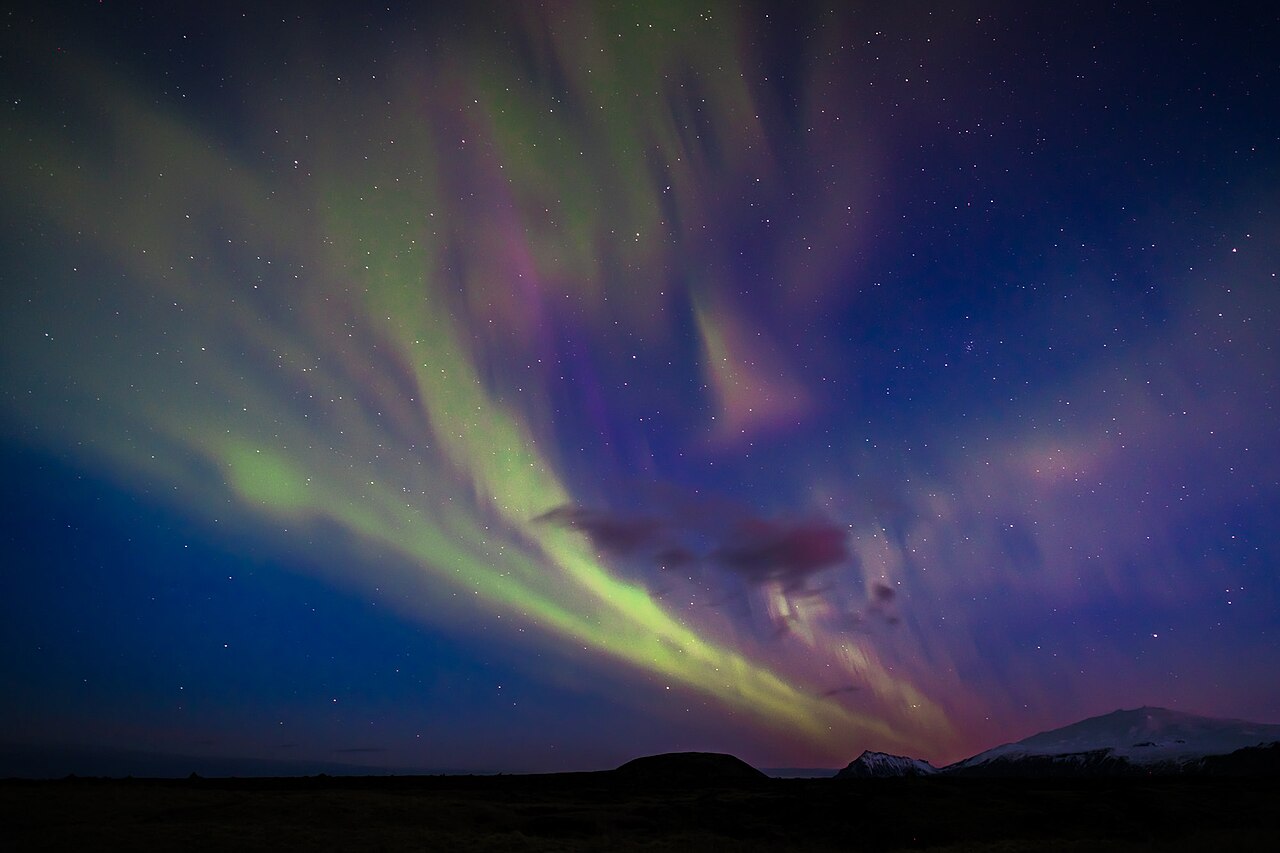
Much higher up, red appears. Red (630.0 nm) comes from oxygen’s 1D state, whose lifetime is very long — about 110 seconds. So it survives to shine only in the thin atmosphere above roughly 200 km, where the collisions (quenching) that would rob it of energy are rare. Meanwhile, molecular nitrogen ions emit a 427.8 nm blue-violet, adding a purple tinge to the edge of the green curtain.
Giuseppe Milo · CC BY 3.0 · Wikimedia Commons · Source
Curtains and Coronas — What the Shape Tells Us
There is a reason auroras look like vertically hanging curtains: charged particles spiral down along the magnetic field lines as they precipitate. So an aurora’s shape directly reveals the form of the field lines. An arc can stretch thousands of km from east to west, yet be only 1–10 km wide — an extremely thin sheet of glowing light.
This light occurs in the thermosphere, at altitudes of about 90–300 km. There are no observed cases below 70 km, only about 6.5% occur above 150 km, and the most frequent emission altitude is around 100 km (values established by Størmer’s triangulation). When you look up at a curtain from directly beneath its zenith, the light appears to fan out in every direction — a spectacle called a corona.
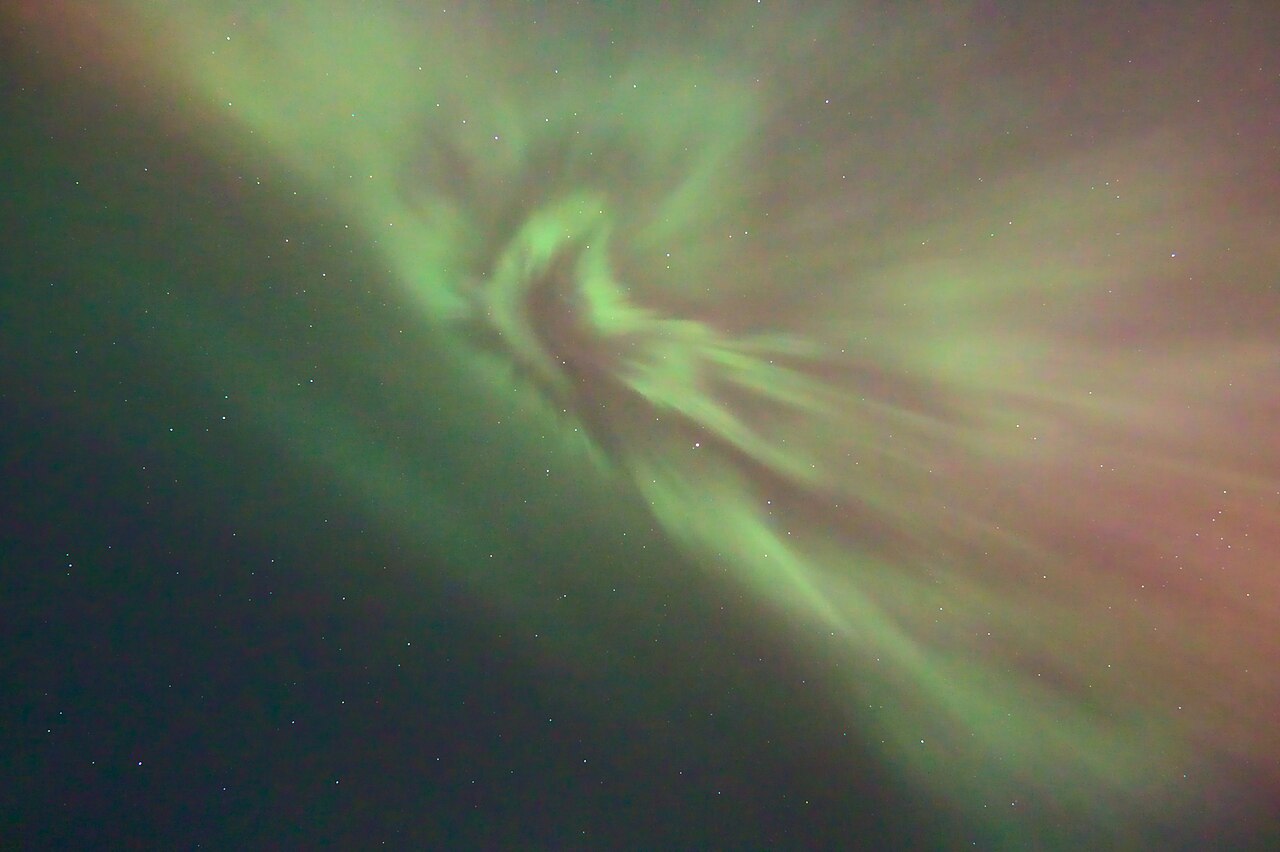
StormChaserAmelia · CC BY-SA 4.0 · Wikimedia Commons · Source
Where and When You Can See It
Auroras are not visible just anywhere. They occur along a ring-shaped auroral oval centered on geomagnetic latitudes of about 65–75 degrees, whose center line sits near geomagnetic latitude 67 degrees. Intriguingly, the aurora borealis (northern lights) and the aurora australis (southern lights) are magnetically conjugate, appearing symmetrically: when one becomes active, the opposite side of the Earth grows active at the same time.
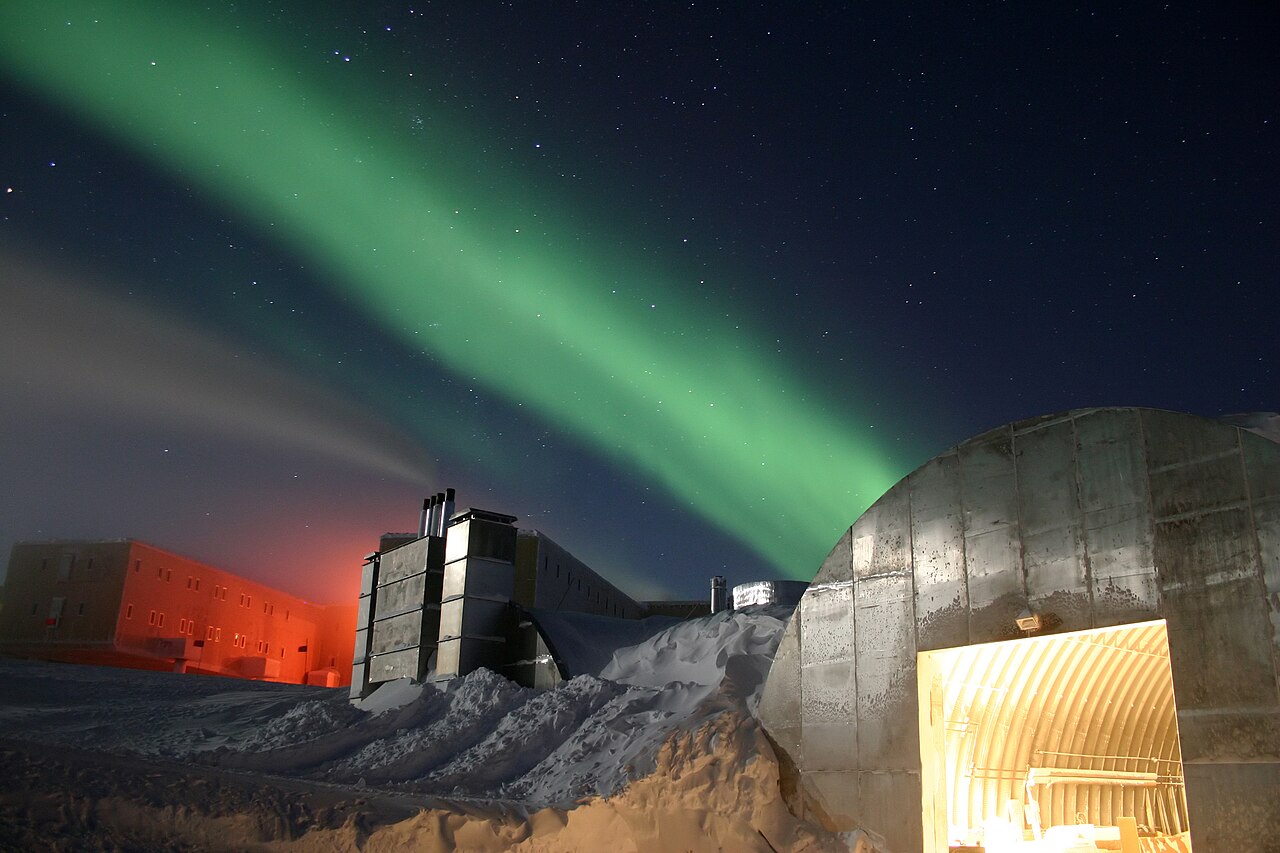
Chris Danals, National Science Foundation · Public domain · Wikimedia Commons · Source
Auroral activity follows the Sun’s rhythm. Solar activity repeats a cycle of maxima and minima about every 11 years, and large geomagnetic storms are most frequent around solar maximum — so auroral activity peaks then too. The higher the Kp index, moreover, the farther toward lower latitudes the auroral oval expands. At Kp 5 (G1) it reaches about magnetic latitude 55 degrees, and at Kp 9 (G5) observation becomes possible down to magnetic latitude 30 degrees or below. Indeed, the G5-class geomagnetic storm of May 2024 pulled the aurora to unusually low latitudes, and NOAA rated it among the strongest auroras in 500 years.
Renowned viewing spots include Tromsø in Norway, Fairbanks in Alaska, Yellowknife in Canada, Iceland, and Lapland in Finland. At the very best locations, it is said you can encounter auroras more than 200 times a year.
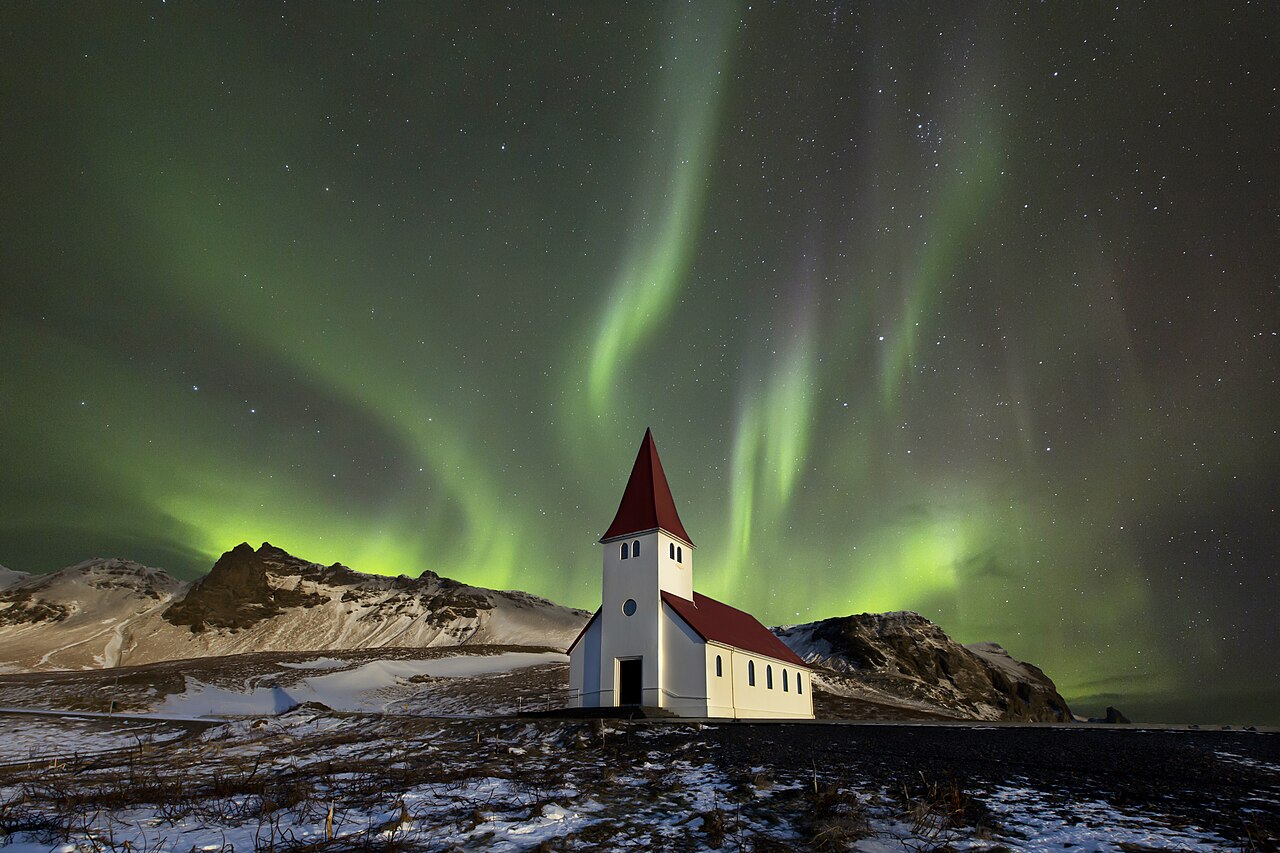
AstroAnthony · CC BY 4.0 · Wikimedia Commons · Source
A Light People Named and Recorded
The name “aurora borealis” combines Aurora, the Roman goddess of dawn, with Boreas, the Greek god of the north wind. One account credits Galileo with using it around 1619, while another holds that Pierre Gassendi popularized it.
Humanity’s records of auroras are astonishingly old. The earliest surviving dated record is a cuneiform account in the Astronomical Diaries from Babylonia dated to 567 BC, describing “a red glow in the west.” Judging from its duration and the local terrain, a ground fire was ruled out and it was classified as an aurora. China’s Bamboo Annals (竹書紀年) also records a celestial phenomenon thought to date to the late reign of King Zhao of Zhou, around the 10th century BC, regarded as an aurora candidate — possible because the north magnetic pole then lay closer to China than it does today.
The most dramatic event in recent history is the Carrington Event of 1859. During this solar storm, one of the strongest on record, auroras were seen even at low latitudes such as Cuba and Colombia, and the telegraph system — then the cutting edge of communications — was paralyzed. On some lines, operators reportedly transmitted and received for about two hours using only the aurora-induced current, with their batteries disconnected. Richard Carrington and Richard Hodgson’s observation of a flash on the Sun’s surface on September 1, 1859 remains the first documented record of a solar flare.
Norse mythology saw auroras as light shimmering from the armor of the Valkyries, or as the rainbow bridge Bifröst (recorded as norðrljós in The King’s Mirror around 1230), while Inuit tradition regarded them as the spirits of ancestors dancing.
One Connected Picture
The particles that set out from the Sun; the Earth’s magnetic field that both blocks and releases them; and finally the oxygen and nitrogen of the upper atmosphere that give off the light. An aurora is one connected picture that these three paint together. That a distant celestial body and the air beneath our feet are tied by invisible threads into a single sheet of light quietly reveals how intricately the created world is interlocked. The next time you see a photograph of an aurora, it is worth recalling that every streak of green and red holds a long journey, from the Sun all the way to the atmosphere.
References
- Aurora — Wikipedia
- Auroras — NASA Science
- Aurora — NOAA Science On a Sphere
- Aurora Tutorial — NOAA Space Weather Prediction Center
- Magnetic Reconnection — ESA Science (Cluster)
- The altitude of green 557.7 nm and blue 427.8 nm aurora — Annales Geophysicae (2023)
- Auroral ovals at the two geomagnetic poles — Royal Belgian Inst. for Space Aeronomy
- Aurora Australis Observed from the ISS — NASA Earth Observatory
- Earliest datable records of aurora-like phenomena (Babylonia) — PMC
- Carrington Event — Wikipedia