
1377, Cheongju: A Book Printed 78 Years Before Gutenberg
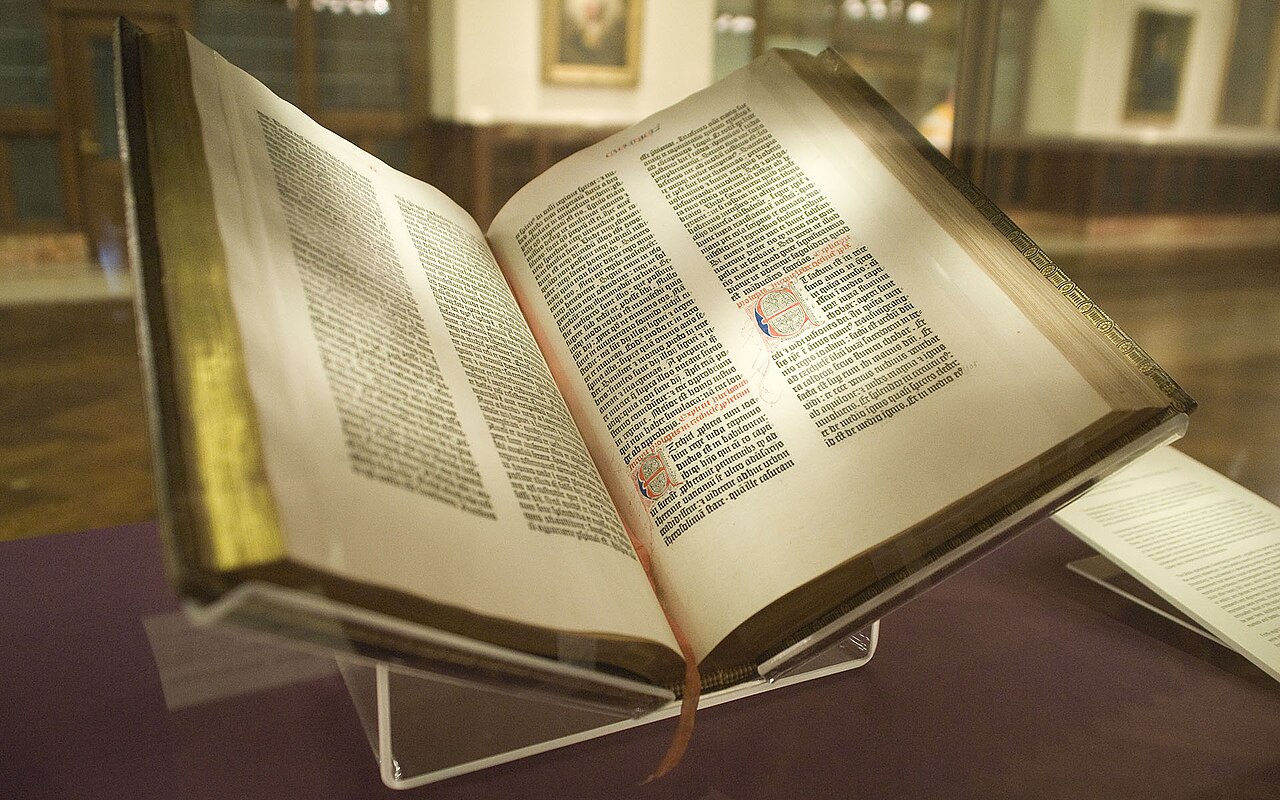
Johannes Gutenberg of Mainz, Germany, printed his 42-line Bible (B42) with movable metal type around 1452–1455. A contemporary account—that in March 1455 the man who would later become Pope Pius II saw a leaf of it in person—survives as the basis for that dating. Yet fully 78 years earlier, in 1377, a book had already been printed with movable metal type at a provincial temple in Goryeo. It was the 白雲和尙抄錄佛祖直指心體要節, printed at Heungdeoksa(興德寺) temple in Cheongju(淸州), Chungcheong Province—known in short as Jikji(直指), or the Jikji Simche Yojeol.
This book is recognized today as the oldest surviving book in the world printed with movable metal type. UNESCO describes it as ‘the world’s oldest extant book printed with movable metal type’, and the Bibliothèque nationale de France (BnF), which holds the Jikji, likewise calls it the ‘oldest known book printed with movable metal type’.
One thing must be clarified at the outset. The Jikji is often introduced as ‘the world’s first type printing’, but strictly speaking that is not true. Its precise standing is not ‘the first’ but ‘the oldest surviving’. This subtle yet decisive difference is the single most common misunderstanding about the Jikji—and it is the very knot this article most earnestly sets out to untie.
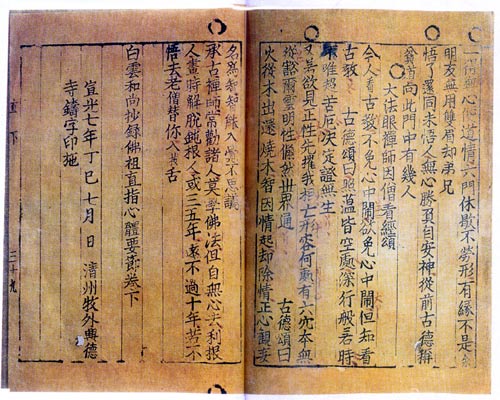
Compiled by Baegun Gyeonghan (photo: Wikimedia Commons) · Public domain · Wikimedia Commons · Source
What Is the Jikji — A Master’s Distillation of Awakening
The Jikji was compiled by Baegun Gyeonghan(景閑, 1298–1374), a Seon(禪僧) monk of late Goryeo. A senior master trained in the Seon style of the Linji(臨濟宗) school, he was past seventy in 1372 when he personally selected and gathered the passages holding the essence of Seon(禪) from the recorded sayings and verses(偈頌) of past buddhas and patriarchs(祖師). In Chinese characters, this work of selecting and gathering is called chorok(抄錄).
The book’s full title, ‘Buljo Jikji Simche Yojeol’, means ‘the essential passages on the true substance of the mind(心體) pointed to by the buddhas and patriarchs’. The ‘Jikji(直指)’ of the title comes from the famous Seon Buddhist motto 直指人心見性成佛—’point directly at the human mind; see one’s nature and become a buddha’. The Seon spirit of looking straight into the mind to reach awakening, unbound by the letters of scripture, became the very name of the book. The Jikji, then, is not a work with a storyline but a kind of collection of dharma sayings(法語集)—an assembly of Seon sayings(語錄) and verses that lead one toward awakening.
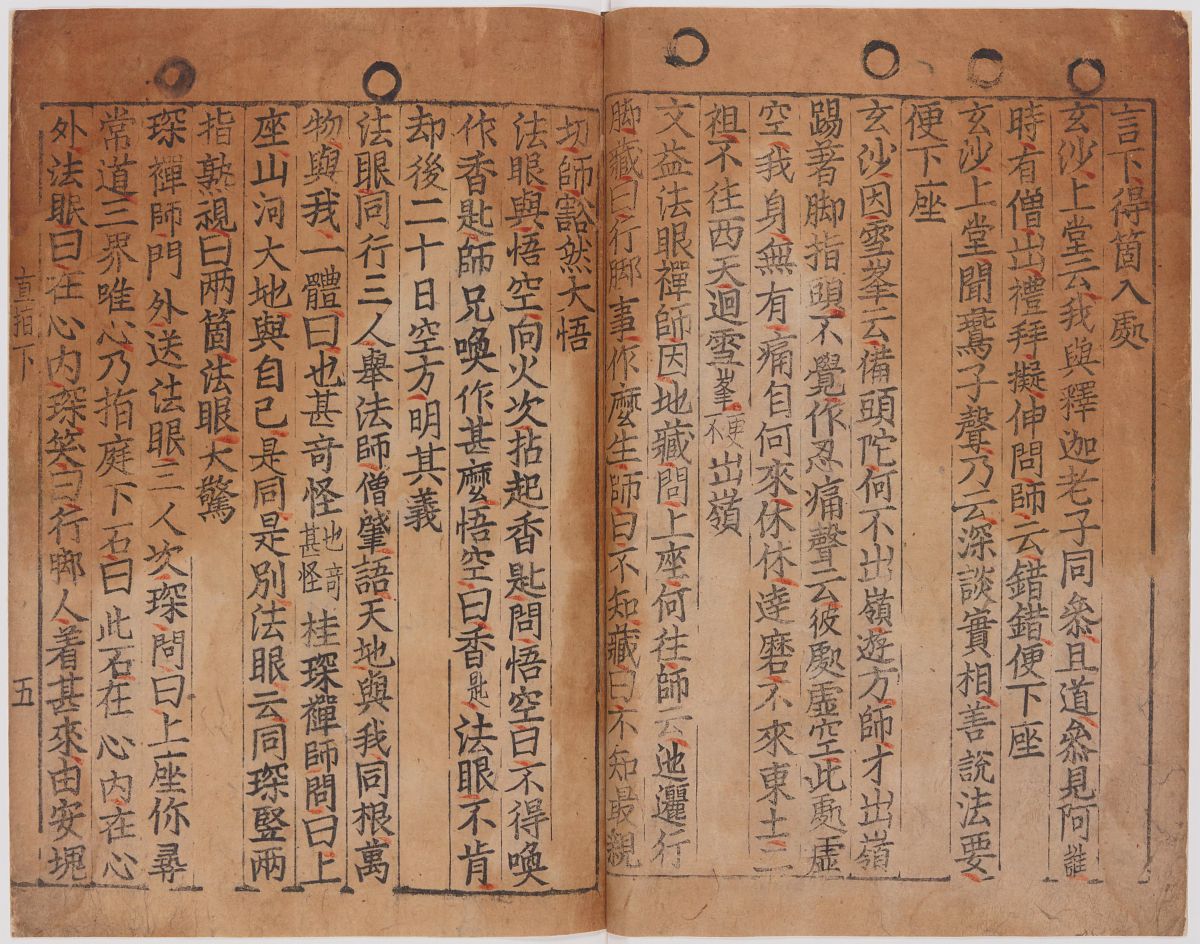
Unknown author · Public domain · Wikimedia Commons · Source
After Gyeonghan selected and compiled the text in 1372, and three years after his death(入寂), in the seventh month of 1377 (the 3rd year of King U of Goryeo), his disciples Seokchan(釋璨) and Daldam(達湛) honored their master’s wishes by publishing the book with movable metal type. The help of the nun Myodeok(妙德), who came forward as a patron(施主), was considerable. The book was originally made in two volumes, upper and lower, but among the editions struck in movable metal type, only the lower volume, a single book, survives today. Even that is not whole: of its 39 leaves the first leaf has been lost, leaving 38. That single book now rests in the Bibliothèque nationale de France.
What Movable Metal Type Was, and How It Was Made
Broadly, there are two ways to print a book: woodblock(木版) printing and type(活字) printing. A woodblock carves an entire page(面) onto one whole block. Since the letters never shift position, it is fine for printing the same book again and again—but every new book requires carving all the blocks anew from scratch. Type, by contrast, makes each letter individually in advance, arranges them on a forme to match the needed text and prints, then breaks them apart to reuse for the next book.
This rearranging and reusing of individual pieces of type is the heart of type printing. The more characters and the larger the volume of a book—and the more varied the books one must print—the more the efficiency of type shines. With a single set of cast type, one can swap between this book and that, printing them all.
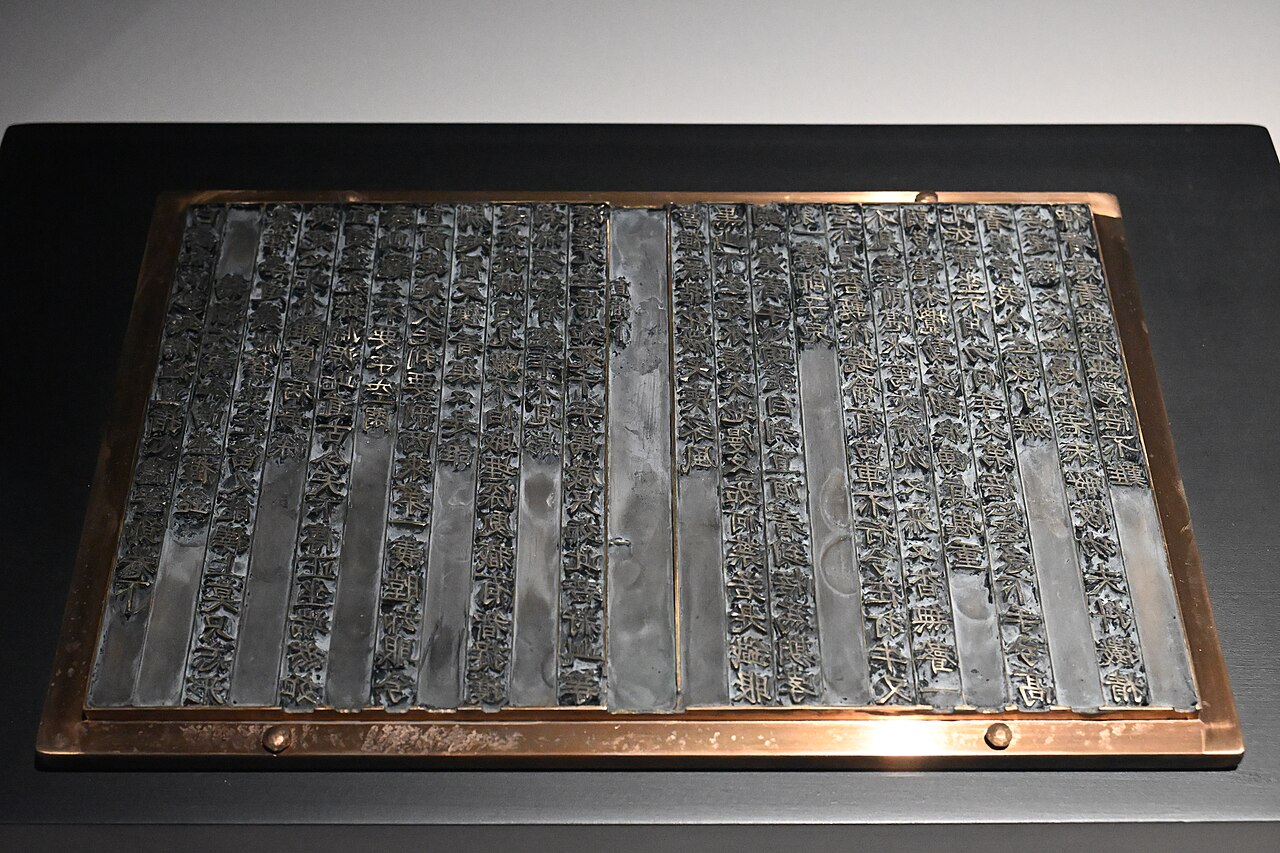
Kjoonlee · CC BY 4.0 · Wikimedia Commons · Source
So how did the people of Goryeo make metal type? The technique used for the Jikji is known as the beeswax casting method(蜜蠟鑄造法). The process runs thus. First, a letter is carved in relief(陽刻) onto a stick of beeswax(蜜蠟, the soft wax obtained from a honeycomb) to make a mother-type—the model letter that serves as the parent. This wax mother-type is then wrapped tightly in casting sand(鑄物砂, the sandy clay used for molds) and hardened, after which heat is applied to melt and drain the wax inside. What remains within the mold is an empty space in the exact shape of the letter. Pour molten bronze into that void and let it cool, and a metal type of the identical shape is cast where the wax once stood.
What is fascinating is the root of this technique. Melting out the wax and pouring metal in its place to draw out a form is the very same principle as the old bronze-casting tradition by which temples made Buddha statues(佛像) and temple bells(梵鐘). In other words, the temples of Goryeo applied the metal-casting know-how with which they had shaped great buddha images and bells directly to type small as a fingernail. The craft of religious art crossed over into the craft of printing.
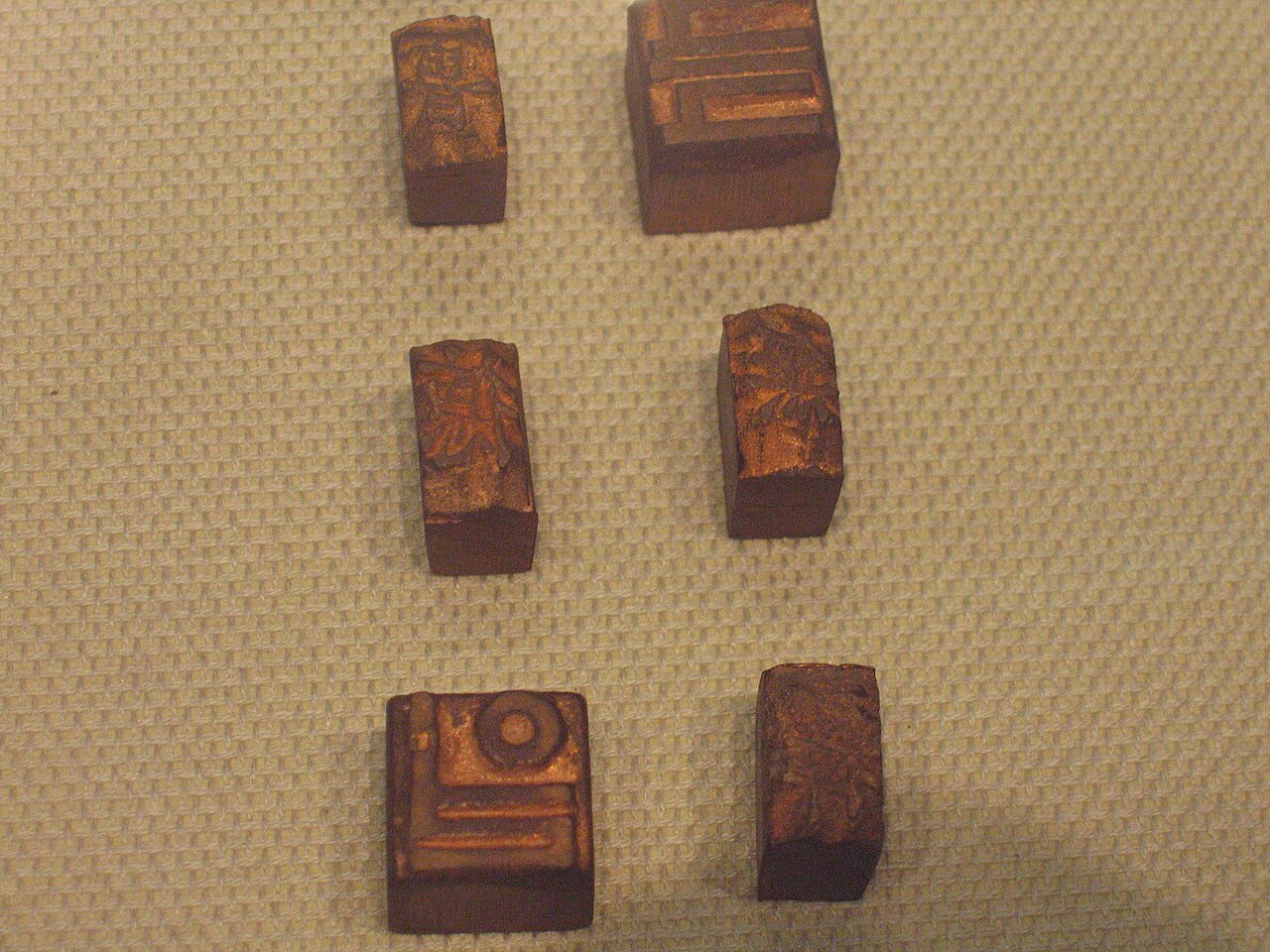
Ken Eckert · CC BY-SA 4.0 · Wikimedia Commons · Source
How this beeswax casting method actually worked was directly verified in modern times. From 2011 to 2015 the Cheongju Early Printing Museum reconstructed roughly 30,000 pieces of metal type—the kind that would have been used to print the Jikji—by exactly this beeswax casting method. They revived the old technique and demonstrated it in tangible, hold-in-your-hand type.
The Precise Meaning of ‘Oldest Surviving’ — Why It Is Not ‘The First’
Now to untie the most important knot. The reason the Jikji is not ‘the world’s first’ is that there were clearly earlier cases—of type printing and of metal type alike—that preceded it.
First, the very origin of type printing traces back to China. Bi Sheng(畢昇) of the Northern Song(北宋) devised ceramic type(膠泥活字)—that is, baked-clay type—around 1040. This is clearly recorded in the 夢溪筆談 (Dream Pool Essays) by the Song scholar Shen Kuo(沈括). The very idea of type had appeared in East Asia fully some 300 years before the Jikji.
Even narrowing to metal type, the Jikji is not the first. In Goryeo, around 1234, a record tells that the 50-volume ritual text(禮書) 詳定古今禮文, compiled by Choe Yun-ui(崔允儀) and others, was printed in 28 copies with cast type(鑄字, metal type). This is preserved in the 東國李相國集, the collected works of the Goryeo literary giant Yi Gyu-bo(李奎報), and it precedes the Jikji by fully some 140 years. So why is the Jikji, and not the Sangjeong Gogeum Yemun, called ‘the oldest’? The answer is simple yet decisive. Not a single physical copy of the Sangjeong Gogeum Yemun survives. A book that exists only in record, its physical form gone, cannot qualify as ‘extant(現存)’.
Right here lies the boundary between ‘first’ and ‘oldest extant’. The Jikji is not the first instance of humanity printing something with metal type. But among books printed with metal type, it is the oldest of those whose physical form has survived to this day, that one can hold and verify. ‘First’ points to the beginning of time, records included; ‘oldest extant’ points to the beginning among the things that physically exist before our eyes now. This is exactly why UNESCO and the BnF never leave out the words ‘extant’ and ‘known’.
NYC Wanderer (Kevin Eng) · CC BY-SA 2.0 · Wikimedia Commons · Source
Once this boundary is made clear, the comparison with Gutenberg also becomes precise. Gutenberg’s 42-line Bible is a product of around 1455 and the Jikji of 1377, so the gap—1455 minus 1377—is 78 years. That is, the Jikji is ‘the oldest surviving book printed with metal type, 78 years ahead of Gutenberg’. This is not, however, to belittle Gutenberg’s achievement. His printing—coupled with the screw press, oil-based ink, and a system of mass typesetting—spread explosively across all of Europe and drove the popularization of knowledge. It is closer to the truth to view these two printing civilizations, each blossoming in its own context in East Asia and in Europe, not as superior and inferior but as parallel achievements.
Heungdeoksa and the Lost Temple Site
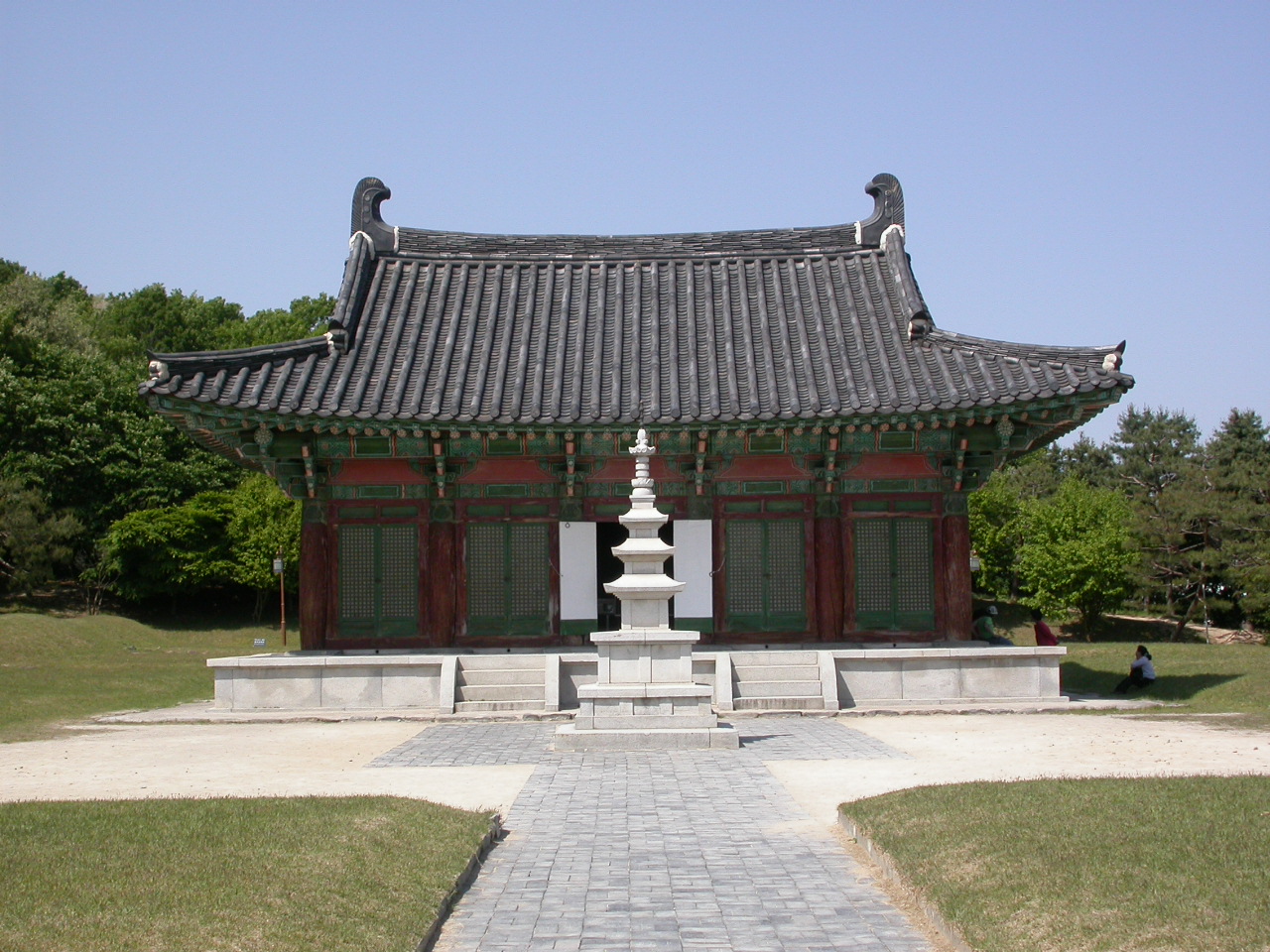
Let us return to where the Jikji was printed—Heungdeoksa. At the end of the Jikji’s lower volume is a colophon(刊記) stating the circumstances of publication, and it clearly records the gist that ‘it was printed with movable metal type at Heungdeoksa in Cheongju in the seventh month of 1377’. Yet for a long time no one knew exactly where this Heungdeoksa had stood. The name survived in the colophon, but the temple itself had vanished into history.
Lawinc82 · CC BY-SA 3.0 · Wikimedia Commons · Source
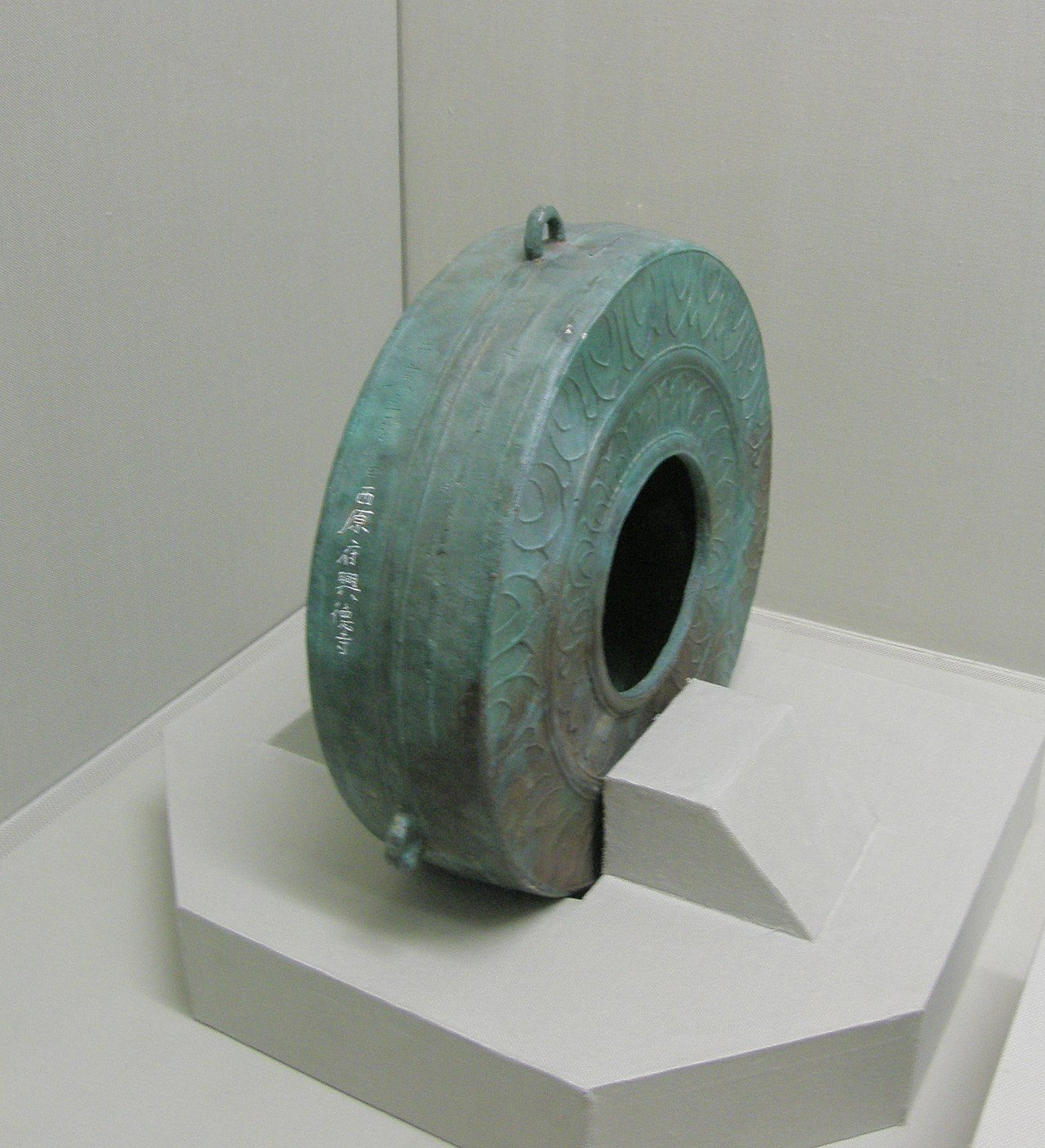
The lost temple site revealed itself in 1985. While the Cheongju University Museum was excavating the Uncheon-dong area of Cheongju, a bronze gong(禁口, the bronze gong a temple struck to mark the hours) bearing the inscription(銘文) ‘西原府 興德寺’ was unearthed. From the same site came other bronze relics inscribed with the date ‘the 10th year of Hwangtong(皇統)’ (1150), which corroborated the temple’s history. Seowonbu was the old name for Cheongju, so the characters ‘興德寺’ on the gong were none other than the name of the very temple that had printed the Jikji. It was the moment when the reality of Heungdeoksa—recorded only in a colophon—was confirmed after more than 600 years by a bronze inscription drawn up out of the earth.
Forcoolife · CC BY-SA 3.0 · Wikimedia Commons · Source
The results of the excavation came quickly. The site was designated a Historic Site(史蹟) in 1986, and restoration and maintenance proceeded from 1987. And right beside the Heungdeoksa site arose the Cheongju Early Printing Museum, honoring the Jikji and Korea’s printing culture. A temple that had survived only as a name was reborn as a real historic site—and as a living space that revives and studies that printing tradition. The reconstruction of roughly 30,000 pieces of Jikji metal type mentioned earlier was the work of this very museum.
The Jikji’s Journey to France, and a Librarian’s Rediscovery
So how did the lower volume of the Jikji, printed in Cheongju, end up in a library in Paris? This passage is often flatly labeled ‘plunder’ or ‘theft’, but the actual course is not so simple and deserves to be examined neutrally.
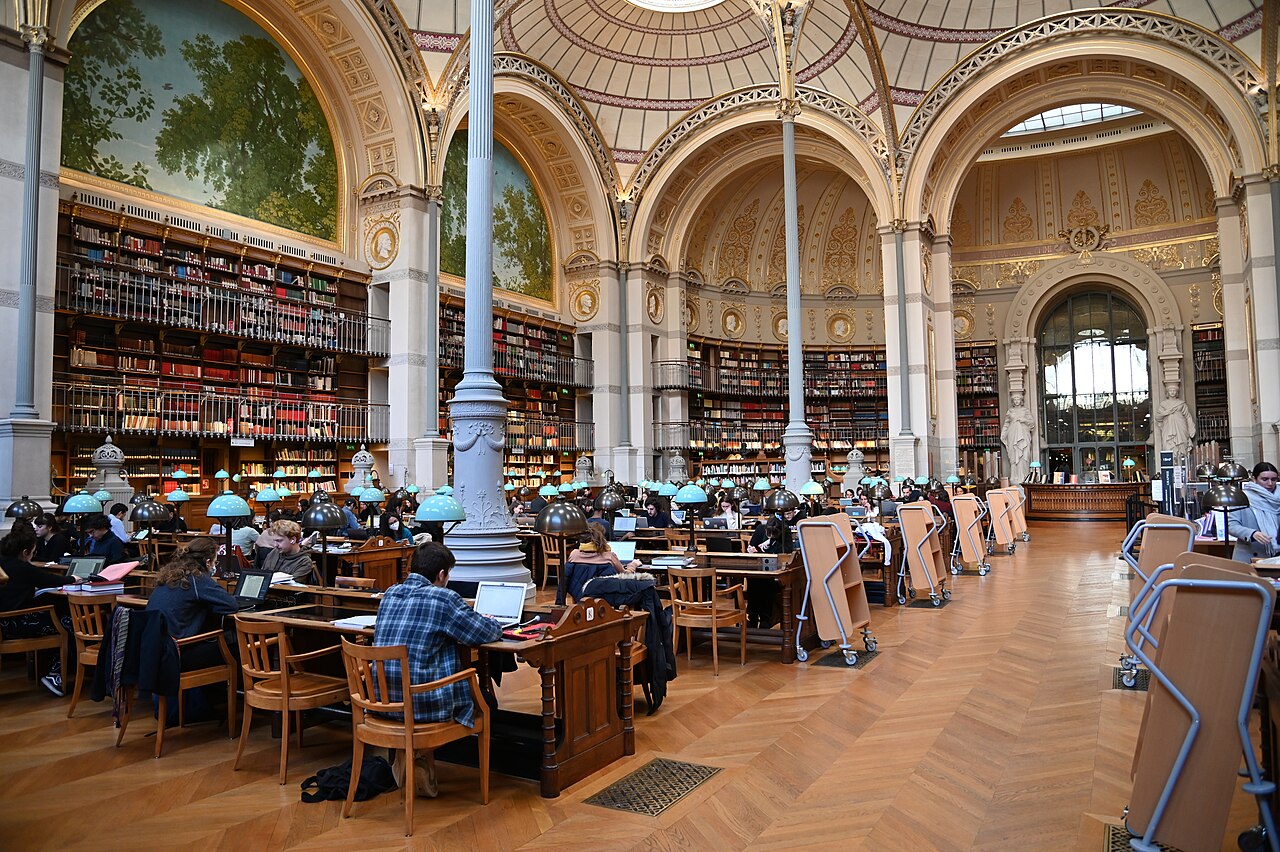
The story goes back to the late 19th century. Victor Collin de Plancy, a French diplomat posted to Korea, was stationed in Seoul around 1888 and collected several hundred volumes of old Korean books(古書), among which was the lower volume of the Jikji. His collection later left his hands and flowed into the auction market. In March 1911, at the Drouot auction house in Paris, the Jikji was knocked down for 180 francs to Henri Vever, a jeweler and bibliophile. Then in 1950, by his will (a bequest, 遺贈), Vever donated the Jikji in his keeping to the Bibliothèque nationale de France, and in 1952 it was formally incorporated into the BnF’s holdings.
In other words, the process by which the Jikji came to be in France consisted of a chain of events: ‘collection → auction sale → bequest donation’. Rather than nailing it down as plunder or theft, it is more accurate to describe it as that chain of facts just as it was.
Stefan Drößler · CC BY 4.0 · Wikimedia Commons · Source
Yet the Jikji that had crossed over to Paris had its true worth buried for some time. The one who drew that value up before the world was the Korean-French librarian Dr. Park Byeong-seon(朴炳善). Working as a librarian at the Bibliothèque nationale de France from 1967, she took note of the Jikji that lay dormant in the library, and she identified and established by scholarship that it was not merely an old book but a print struck in movable metal type. Then in 1972, the ‘International Book Year’ designated by UNESCO, she brought the Jikji to the international stage through an exhibition held in Paris. It was the moment when the oldest surviving movable-metal-type print, predating Gutenberg, first clearly revealed its existence before the world’s scholars.
Dr. Park’s scholarship and efforts finally led to international recognition. On 4 September 2001 the Jikji was inscribed on UNESCO’s Memory of the World Register. Furthermore, in 2004 the ‘UNESCO/Jikji Memory of the World Prize’—awarded to those who have contributed to preserving documentary heritage—was established, and the name Jikji became, beyond a single book, a symbol honoring humanity’s documentary culture.
One Thing for Today — What the Jikji Leaves Us
The Jikji tells us two things clearly. One is the precision of fact. The Jikji is not ‘the world’s first type printing’ but ‘the oldest surviving book in the world printed with movable metal type’. The idea of type already belonged to Bi Sheng of the Northern Song, and the earlier record of metal type to Goryeo’s Sangjeong Gogeum Yemun. Yet in the place where those physical objects vanished, only the single volume printed by Heungdeoksa in Cheongju in 1377 survived to reach our hands. To remember that precise placement—’oldest surviving’ rather than ‘first’—is the one thing we can carry away from the Jikji today.
The other is a story not yet finished. The lower volume of the Jikji is still in the Bibliothèque nationale de France. In Korea, voices calling for its return—that the Jikji should belong to its country of origin(起源國)—continue, while the French side maintains that it is already lawfully held as part of the common heritage of humanity. Between these two views, neither of them light, the return of the Jikji remains an unresolved issue. The book of awakening that an old Seon master selected and compiled more than 700 years ago still quietly sets before us, even today, the weighty questions of the origins of printing civilization and the ownership of cultural heritage.
References
- Wikipedia (Korean) — Jikji Simche Yojeol
- Wikipedia (English) — Jikji
- BnF — Jikji, a treasure of the world of printing
- Encyclopedia of Korean Culture — Jikji Simche Yojeol
- Encyclopedia of Korean Culture — Park Byeong-seon
- Wikipedia (English) — Bi Sheng(畢昇)
- Wikipedia (English) — Choe Yun-ui(崔允儀 · 詳定古今禮文)
- Wikipedia (English) — Gutenberg Bible
- Wikipedia (English) — Movable type
- Google Arts & Culture — Goryeo movable metal type and beeswax casting