
On an afternoon when the rain has cleared, turn your back to the Sun and a rainbow hangs across the far sky. But something is odd about it. A rainbow always appears at the same size, no matter when or where you see it. Walk toward it and it does not grow; step back and it does not shrink. Tell the person beside you, ‘Look, the end of the rainbow touches that tree,’ and in their eyes the rainbow sits in a slightly different place. A rainbow has no fixed ‘location.’
A rainbow always appears at the same angle (about 42 degrees), it is in fact not a semicircle but a full circle, and each person sees their own rainbow — all three facts are explained by a single thing: the geometry of light passing through one water droplet. Let us follow that exquisitely ordered design hidden inside a drop of water.

Photo: Graham Horn · CC BY-SA 2.0 · Wikimedia Commons
A rainbow is not ‘scattered light’
First, one common misconception. The sky is blue because air molecules scatter the shorter (blue) wavelengths in every direction (Rayleigh scattering). It is easy to assume a rainbow forms the same way, from light ‘scattering,’ but the principle is different. A rainbow is not light scattered by air molecules; it is light that refracts (bends), reflects off the back, and refracts again inside a water droplet, splitting into colors on the way out.
When sunlight enters a spherical droplet it refracts once, reflects once off the inner back surface, and refracts again as it exits the front. Between those two bends — on entry and on exit — the light bends by slightly different amounts depending on its wavelength (color). This property of ‘bending differently by color’ is called dispersion. It is the same principle by which a prism spreads white light into a spectrum; each droplet is a tiny prism and mirror in one.
Why exactly 42 degrees — the angle where light piles up
Sunlight striking a droplet hits it dead center for some rays and grazes the edge for others. Since the rays strike at every position, you might expect the light emerging after refraction and reflection to scatter across every angle too. In fact the emerging light spreads from 0 degrees up to about 42 degrees. But then something interesting happens. The exit angle does not change smoothly with the entry position; near about 42 degrees the direction ‘folds back,’ and the light piles up densely there. In other words, unusually much light returns near 42 degrees.
In the 17th century Descartes calculated the rays entering a droplet one by one and was the first to derive this angle. The angle at which light is bent the least on its way back out is called the minimum deviation, and the ray emerging at that angle is named the Descartes ray after him. Because the light leaving the droplet stacks up near this angle, that direction looks to our eyes like an unusually bright band — a rainbow. The key point is that the rainbow is not light that emerges ‘only at 42 degrees,’ but light that piles up most densely near 42 degrees and so looks bright.
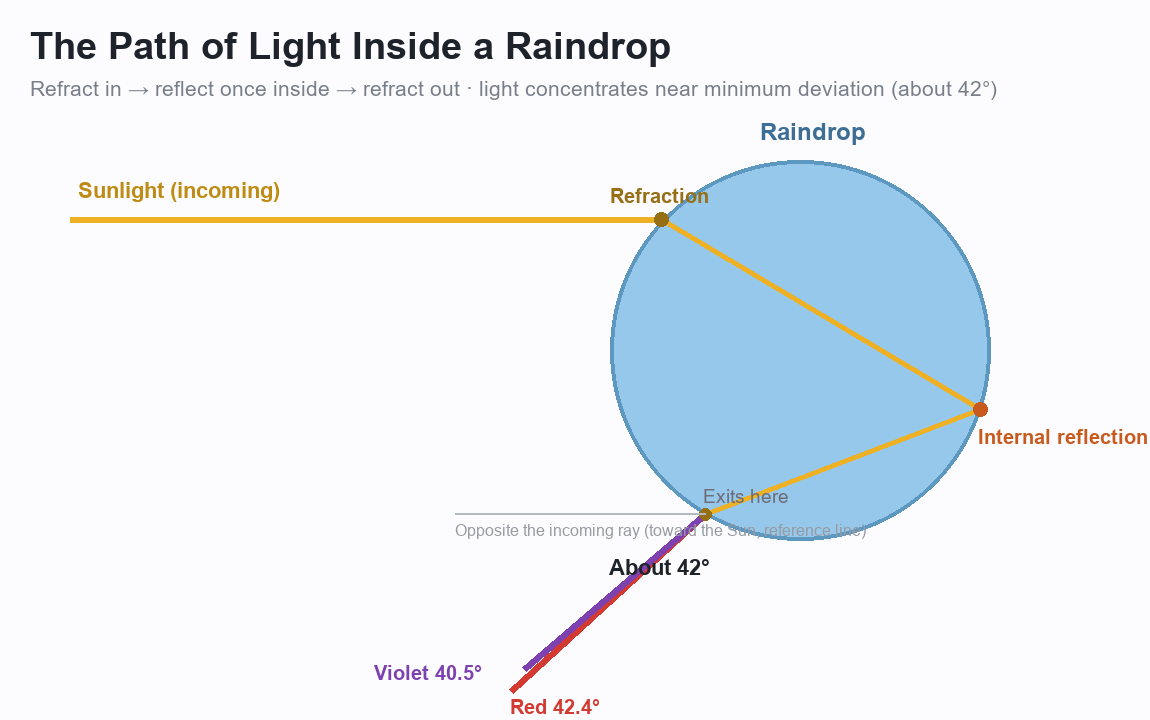
Diagram · created by glu.kr
How the colors split apart
Water’s refractive index differs slightly with the color (wavelength) of light: about 1.330 for red light and about 1.343 for violet. A higher index means the light bends more, so violet bends a little more than red. As a result, the minimum deviation is slightly offset for each color. Red piles up at about 42.4 degrees, violet at about 40.5 degrees. The difference is under 2 degrees, but that narrow gap, spread across the sky, becomes the band of colors we see.
So in the primary rainbow red sits on the outside (top) and violet on the inside (bottom). Red, at the larger angle, hangs higher; violet, at the smaller angle, hangs lower. The order we memorize as ‘red-orange-yellow-green-blue-indigo-violet’ is simply the difference in the angles at which a single droplet returns each color, laid out across the whole sky.
A rainbow is not a semicircle but a ‘circle’
Now we can answer why a rainbow is always the same size. Its center is not the Sun but the direction of your own head’s shadow — the antisolar point, directly opposite the Sun. Among all the droplets, only those for which the angle formed by ‘your eye–droplet–Sun’ is exactly 42 degrees send rainbow light to you. Those droplets lie on a cone of half-angle 42 degrees centered on the antisolar point. Seen with the eye, that cone becomes a single circle.
Standing on the ground, though, we usually see only the upper arc, because the lower half of the circle is hidden below the horizon. That is why a rainbow looks like a ‘semicircle.’ From a place where droplets also lie below you — a mountaintop or an aircraft — the hidden lower half appears and a full circle emerges. Because the rainbow’s angular radius of 42 degrees stays constant regardless of droplet size or the Sun’s height, a rainbow neither grows as you approach nor shrinks as you retreat. It is not an object ‘located’ at some point in the sky, but an arrangement of light that appears wherever your line of sight makes an angle of 42 degrees.

Photo: Steve Kaufman · CC BY-SA 3.0 · Wikimedia Commons
Your own rainbow
The fact that a rainbow is not an object at a fixed place leads to a surprising conclusion. The droplets that make your rainbow are not ‘those particular droplets’ but whichever droplets lie at 42 degrees along the axis from your eye to the antisolar point right now. Step one pace to the side and that axis moves with you, so different droplets make the rainbow anew.
Therefore the person standing right beside you is seeing a rainbow made of slightly different droplets — strictly speaking, a different rainbow. Even your left eye and right eye see minutely different rainbows. A rainbow is not a single object hanging out there; it is an image drawn separately for each viewer. The small rainbow in a waterfall’s spray or a garden hose’s mist works the same way — sunlight, droplets, and the viewer’s position: get these three right and a rainbow appears anywhere.

Photo: Fir0002/Flagstaffotos · CC BY-SA 3.0 · Wikimedia Commons
Double rainbows and Alexander’s dark band
Sometimes a fainter rainbow appears outside the bright one. This secondary rainbow is light that has reflected twice inside the droplet. With one extra reflection, some light leaks away so it is dimmer, and its exit angle shifts to about 51 degrees. Crucially, the extra reflection flips things once more, so the color order is reversed — in the secondary rainbow red is on the inside and violet on the outside (red at about 50.4 degrees, violet at about 53.4 degrees). That is why, in a double rainbow, the red bands of the two bows face each other.
Look closely at the sky between the two rainbows and you will find an unusually dark band. Light from the primary rainbow barely emerges beyond 42 degrees, and light from the secondary barely emerges inside 51 degrees. So between them (about 42 to 51 degrees) relatively little light is returned by the droplets, and the sky looks dark. This band is named Alexander’s dark band, after the ancient Greek philosopher who first recorded it.

Photo: Matt Biddulph · CC BY-SA 2.0 · Wikimedia Commons
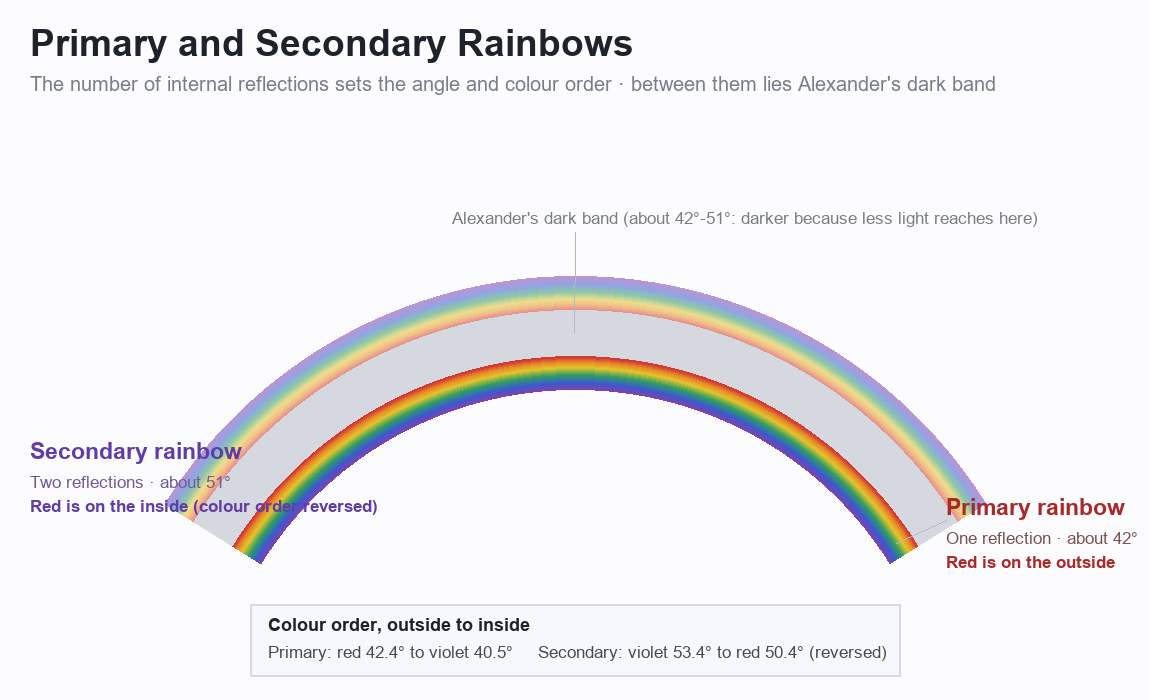
Diagram · created by glu.kr
Faint stripes inside the rainbow — the wave nature of light
Rarely, faint pink, purple, and pale-green stripes appear layered inside the primary rainbow. These are called supernumerary rainbows, and remarkably, the geometry of refraction and reflection described so far (geometric optics) cannot explain them. These stripes form when the light waves that took slightly different paths inside the droplet interfere with one another, producing bright and dark fringes.
Supernumerary rainbows show up best when the droplets are small — about 1 millimeter across — and uniform in size. In 1804 Thomas Young explained these fringes through the wave nature of light, and their very existence became one of the first clues that light is a wave. A single rainbow, then, holds both faces of light — the geometry of rays traveling in straight lines, and the wave nature that interferes like ripples.

Photo: Mika-Pekka Markkanen · CC BY-SA 4.0 · Wikimedia Commons
The promise of seven colors
Finally, is a rainbow really ‘seven colors’? The color a droplet returns changes continuously with angle. There is no sharp boundary between red and orange, or blue and indigo. It was Newton who divided the rainbow into seven, and it is often said that he counted seven colors by analogy with the harmony of the seven notes of a musical scale. In other words, ‘seven colors’ is less a boundary set by physics than a cultural convention named by people. The real rainbow is a band of countless hues flowing seamlessly into one another.
That a rainbow always appears at 42 degrees, that it is in fact a full circle, and that each viewer sees a different one — all of these follow from the simple, exquisite geometry of the path of light inside a single droplet. Long ago the rainbow was read as a sign of a covenant set between heaven and earth (Genesis 9). Perhaps the reason that symbol still moves us today is that even a single drop of water holds a design this orderly.
References
- Rainbow — Wikipedia
- Alexander’s band — Wikipedia
- Supernumerary rainbow — Wikipedia
- Antisolar point — Wikipedia
- Atmospheric Optics — Primary Rainbow (Les Cowley)
- Atmospheric Optics — Secondary Rainbow (Les Cowley)
- HyperPhysics — Rainbow (Georgia State University)
- Rainbows — UK Met Office (meteorology)
- Refractive index of water — Wikipedia (Optical properties of water)
- Thomas Young / wave theory of light — Wikipedia