
This fish is not actually an eel
Despite the “eel” in its name, the electric eel does not belong to the same group as the eels we know. Taxonomically it is not a member of the eel order (Anguilliformes) but a South American knifefish of the order Gymnotiformes, and by lineage it is actually closer to carp and catfish. Its long, eel-like body is simply a shape that arose separately in an entirely different lineage; it is far removed from a true eel. This large freshwater fish, which lives in the murky waters of the Amazon and Orinoco basins, grows up to about 2.5 meters and 20 kilograms.
But the real reason this fish is famous is that its body is itself one enormous electrical device. The electric eel turns its whole body into a “living battery” to generate hundreds of volts of electricity. How on earth can a fish made of muscle and flesh produce a voltage strong enough to cause a shock? The answer is astonishingly simple and yet precise.

Photo: Stan Shebs / CC BY-SA 3.0 / Wikimedia Commons
The body is a battery — cells stacked in series
The secret lies in a special cell called the “electrocyte.” Originally derived from muscle cells, this cell gave up its ability to contract and instead specialized entirely in producing electricity, packing its membrane densely with ion pumps, acetylcholine receptors, and sodium channels. When a single electrocyte discharges, the potential difference it produces is only about 0.15 volts — a value so tiny it could barely light a flashlight.
Here the elegance of the design in this created being becomes clear. In the electric eel’s main organ, roughly 6,000 of these electrocytes are stacked in series. Just as connecting several dry cells in a single row adds up their voltages, stringing together 6,000 cells of 0.15 volts each reaches, in theory, 900 volts — a value that fits well with the 600 to 860 volts actually measured. Along the sides of the body, about 35 of these cell stacks are also arranged in parallel, and a parallel connection increases not voltage but current. Thanks to this, the electric eel can push out currents of up to about 1 ampere.
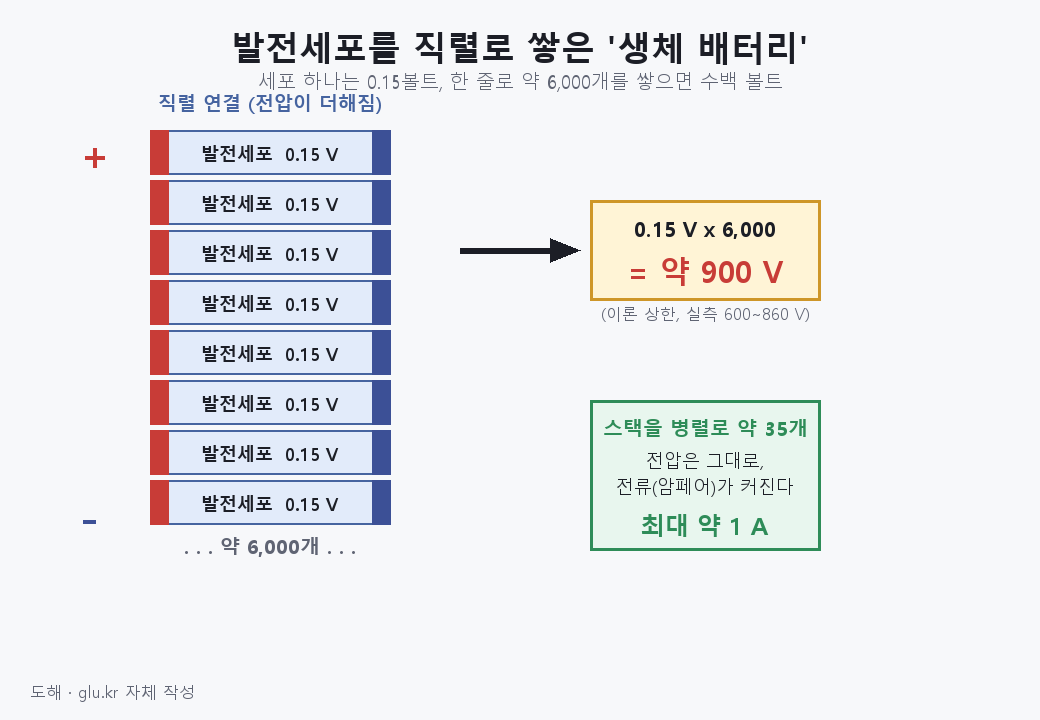
Diagram / created by glu.kr
The discharge happens in an instant. When the brain gives the command, acetylcholine is released from the nerve endings, the sodium channels of the electrocytes open all at once, and momentary depolarization occurs. Each cell then develops a potential difference of about 0.15 volts, and because the nerve impulse fires thousands of cells almost simultaneously, those voltages sum in series to hundreds of volts. A single discharge lasts about 2 milliseconds, far shorter than the blink of an eye. It is less a story about a voltmeter than about a single, precisely wired battery circuit.
Three electric organs, two lives
Inside the electric eel’s body are three different kinds of electric organ. The main organ and Hunter’s organ, which take up most of the body — about 80 percent — handle high voltage. This is the source of the strong electricity used to subdue prey when hunting and to defend against threats.
The Sachs’ organ, by contrast, does something entirely different. It gently emits low-voltage pulses of just over 10 volts at up to about 25 times per second, and with these it “sees” its surroundings through electricity. In water so murky that its eyes are of little use, the electric eel senses changes in this weak electric field to read the nearby terrain, objects, and the positions of other individuals. Thanks to this sense and communication ability — called electroreception — the fish does not lose its way even when it cannot see ahead.

Diagram / created by glu.kr
In short, the electric eel lives in two modes. Most of the time it navigates quietly, surveying its surroundings with low voltage, and in a moment of hunting or defense it unleashes high voltage. Having both a navigational sense organ and a weapon-grade generator designed into a single body is in itself an economical and exquisite arrangement.
Why doesn’t it shock itself?
A natural question arises here. While producing hundreds of volts inside its own body, why does the eel itself remain unharmed? Several reasons overlap. First, because the electric organs fill most of the trunk and tail, the discharged electricity flows straight out into the surrounding water rather than through the tissue. Since water conducts electricity better than body tissue, the current takes the lower-resistance outer path. Second, as we saw, a single discharge is very brief — about 2 milliseconds — so not enough current flows to damage the large body as a whole. It is lethal to small prey but of little consequence to the large body.
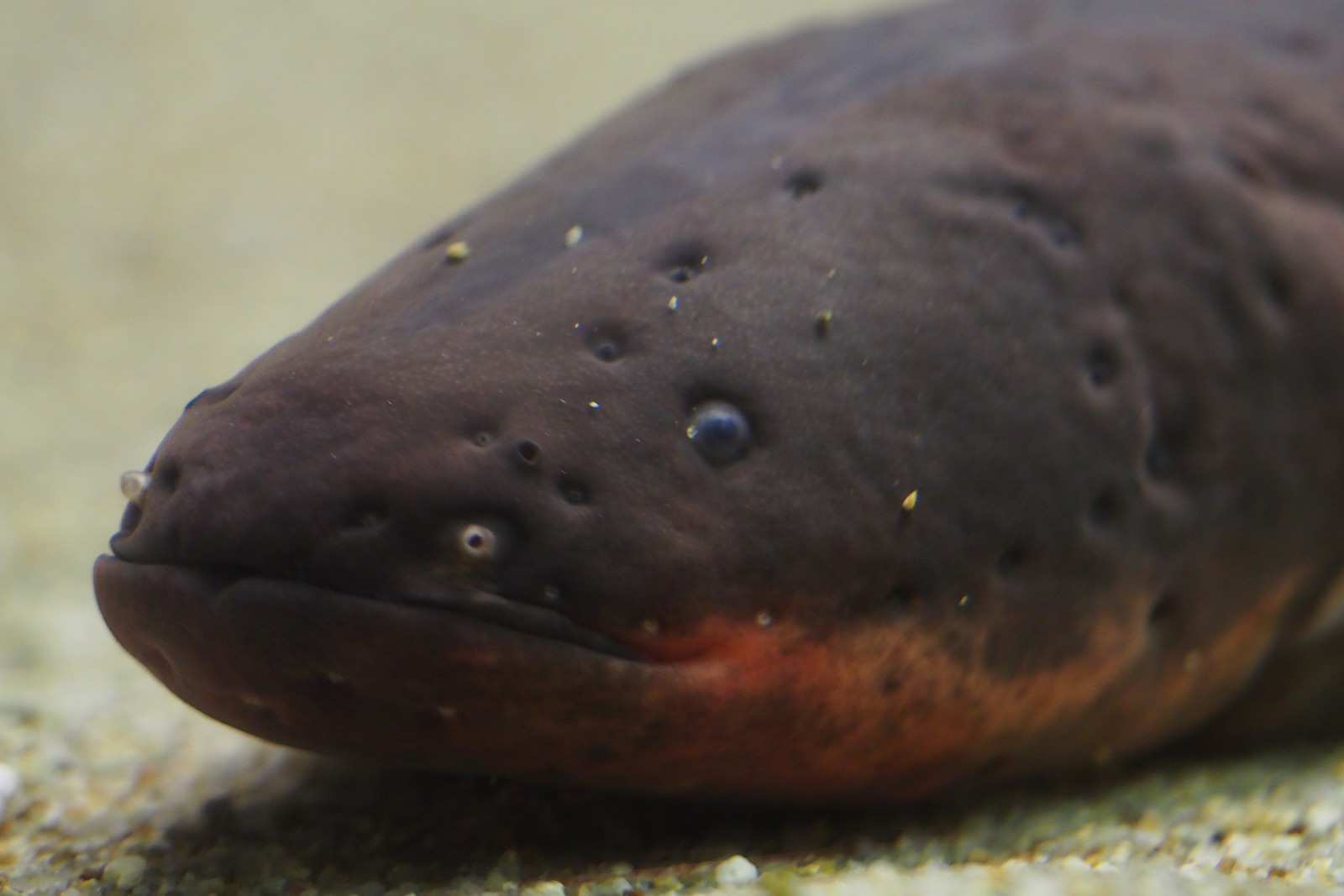
Photo: harum.koh / CC BY-SA 2.0 / Wikimedia Commons
That said, the immunity is not complete. There are reports that the electric eel itself reacts slightly to very large discharges. So to be precise, it is not that it “does not get shocked” but that it is “designed so as to almost never get shocked.” In building a dangerous tool, even a safety device protecting the user has been inscribed into the body.
Volta’s pile, and Humboldt’s horses
This series-battery structure of the electric eel is also entangled with the history of human electricity. But as is often misunderstood, to say “Volta’s pile came from the electric eel” is to narrow the truth. In 1800, Alessandro Volta, inventing the battery (the voltaic pile), called it an “artificial electric organ,” and the object he drew inspiration from was not the electric eel but the electric organ of the torpedo (the electric ray). Volta stated this analogy directly in a letter to Joseph Banks. There is a reason the torpedo’s electric organ became the model. This fish’s electric organ is a structure of hundreds of vertical columns stacked layer upon layer like piles of coins, so it maps directly onto the form of the voltaic pile, with its discs stacked one atop another. This stands in contrast to the electric eel, whose electric organs run lengthwise, horizontally along the body. So it is more accurate to say that the natural original Volta’s pile modeled itself on was the torpedo, and the electric eel is the case that most dramatically displays the same “series-stacking” principle in nature.
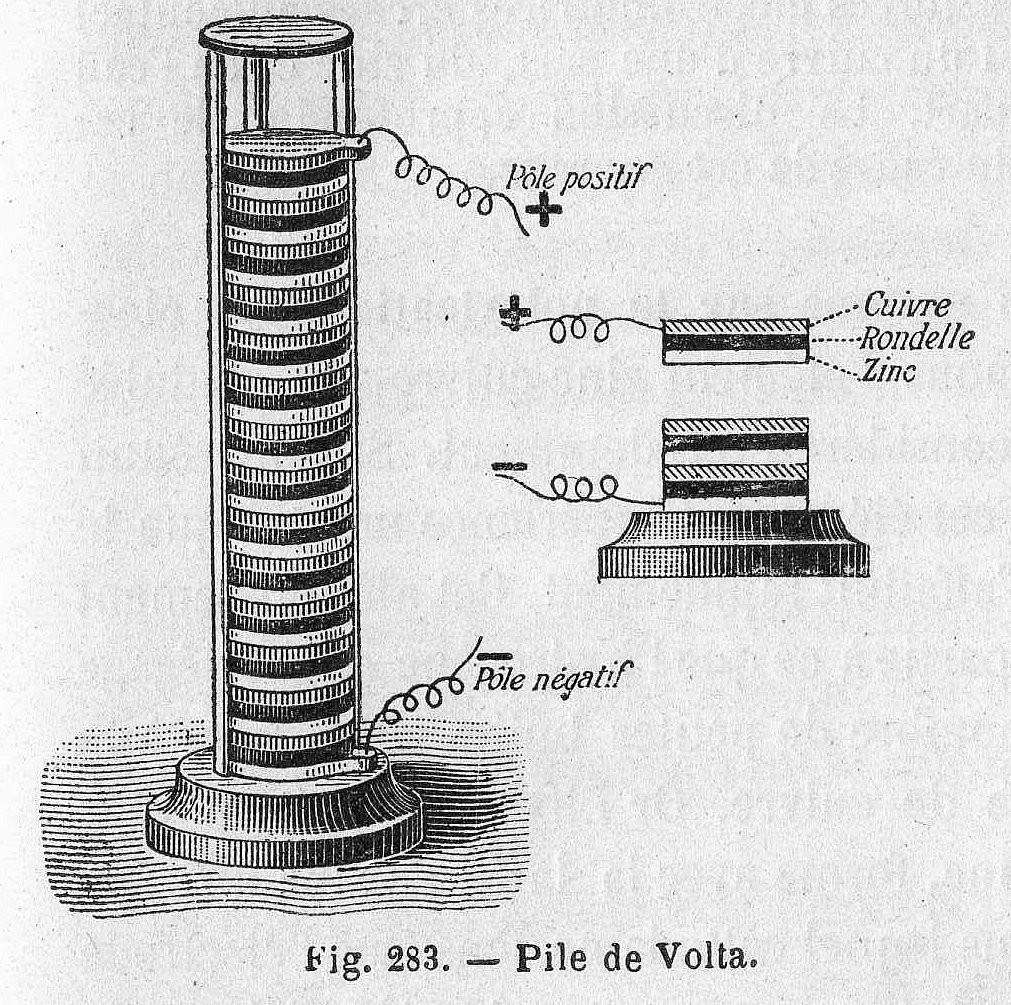
Plate: Gillard / Public domain / Wikimedia Commons
The famous historical scene in which the electric eel is the protagonist is a separate one. In that very year of 1800 when Volta was inventing the battery, the naturalist Alexander von Humboldt witnessed, in a pool in Calabozo, Venezuela, local people driving horses and mules into the water. The startled electric eels would discharge electricity at the horses until they exhausted themselves, and only then could the spent fish be safely lifted out — a method of collection. This dramatic account was doubted as an exaggeration for nearly 200 years.
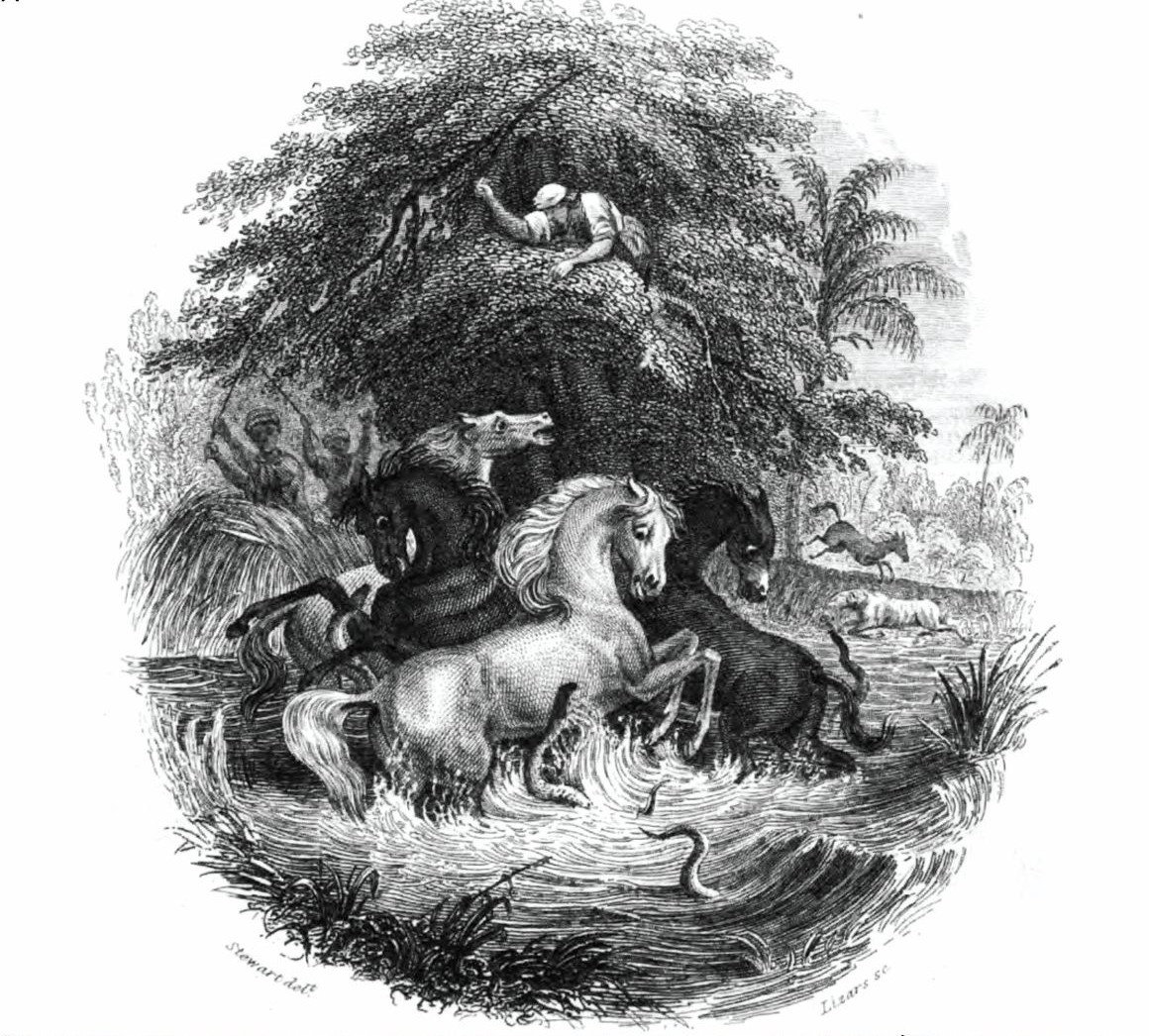
Engraving: James Hope Stewart (drawing), Alexander von Humboldt (original) / Public domain / Wikimedia Commons
The leaping attack — the experiment that revived Humboldt
What overturned the skepticism was the work of Kenneth Catania. In 2016 he experimentally captured a leaping attack in which the electric eel presses its chin against a threat partly protruding from the water and springs its body up above the surface, pouring out high voltage. The higher the fish rises, the shorter the circuit becomes and the greater the current that flows through the threat. It is interpreted as a behavior for defending itself in the small, shrinking pools of the Amazon dry season, and this result actually supported Humboldt’s “battle with the horses” story, which had been regarded with suspicion for 200 years.
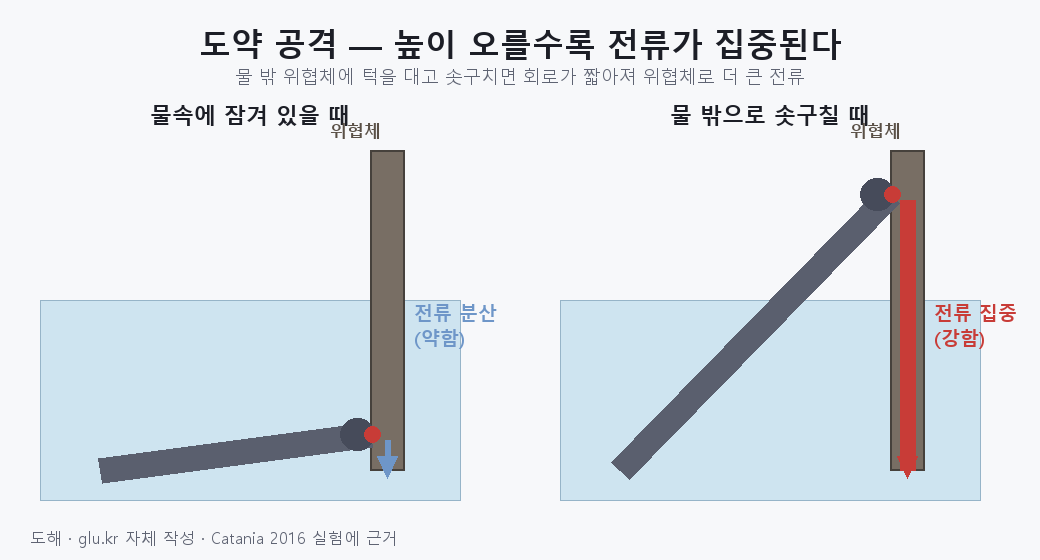
Diagram / created by glu.kr / based on Catania 2016 experiments
Catania also uncovered the hunting method. When catching prey, the electric eel curls its body into a J shape, bringing the positive pole near its head and the negative pole near its tail to opposite sides of the prey, concentrating the electric field. The high-voltage pulses it emits then remotely force the prey’s muscles to contract, revealing the position of hidden prey or paralyzing it outright. It is a kind of remote-controlled hunting, manipulating another animal’s body without touching it.
And when it comes to voltage, one must speak species by species. The traditionally well-known Electrophorus electricus reaches up to about 600 volts, and Electrophorus varii, described alongside it in 2019, up to about 572 volts. Electrophorus voltai, revealed as a new species that same year, recorded up to about 860 volts — the highest voltage of any animal known to date. That this fish, named in honor of Volta, should come to share its name with humanity’s inventor of the battery is exquisite for a coincidence.
A great design held in a tiny cell
The reason the electric eel’s story is so striking is that it produces an astonishing result by repeatedly stacking extremely simple parts. A single 0.15-volt cell looks trivial. But only when all these conditions align at once — aligning thousands of them in series, bundling them again in parallel to raise the current, firing thousands simultaneously by nerve command, and cutting the discharge time short to 2 milliseconds to protect itself — is a living battery finally complete. Remove any one of them and the device does not work.
The principle of series-stacking, which humans only grasped upon arriving at Volta’s pile, was already implemented in a far more refined form within the created being that is the electric eel. This fish, whose body is at once a battery, a sense organ, and a weapon, quietly shows what power is born when small things are stacked up in order.
References
- de Santana et al. (2019), Nature Communications — three electric eel species, up to 860 V
- Catania (2016), PNAS — the electric eel’s leaping attack and Humboldt’s account
- Wikipedia — Electric eel
- Wikipedia — Electrophorus voltai
- Wikipedia — Voltaic pile
- JSTOR Daily — Electric Fish and the First Battery (how the voltaic pile was inspired by the torpedo’s electric organ)
- Wikipedia — Electric organ (fish)
- Natural History Museum — How do electric eels work?
- Britannica — Electrophorus (fish genus)
- Vanderbilt University — Electric eels make leaping attacks (Catania, 2016)