
On a winter day in January 1917, in a room inside London’s Admiralty building, two codebreakers fell silent over a bundle of German ciphered cables. As the words “Texas,” “New Mexico,” “Arizona,” and “Japan” surfaced one by one out of the strings of numbers, they sensed at once what they were holding. It was a telegram in which the German Foreign Secretary secretly proposed to Mexico an alliance aimed at the United States. Yet to say that this single cable pushed America straight into a world war would be an oversimplification. What truly makes the story taut is the double concealment Britain carried out before the document ever reached the public, and the twist by which the sender himself finally admitted its authenticity.
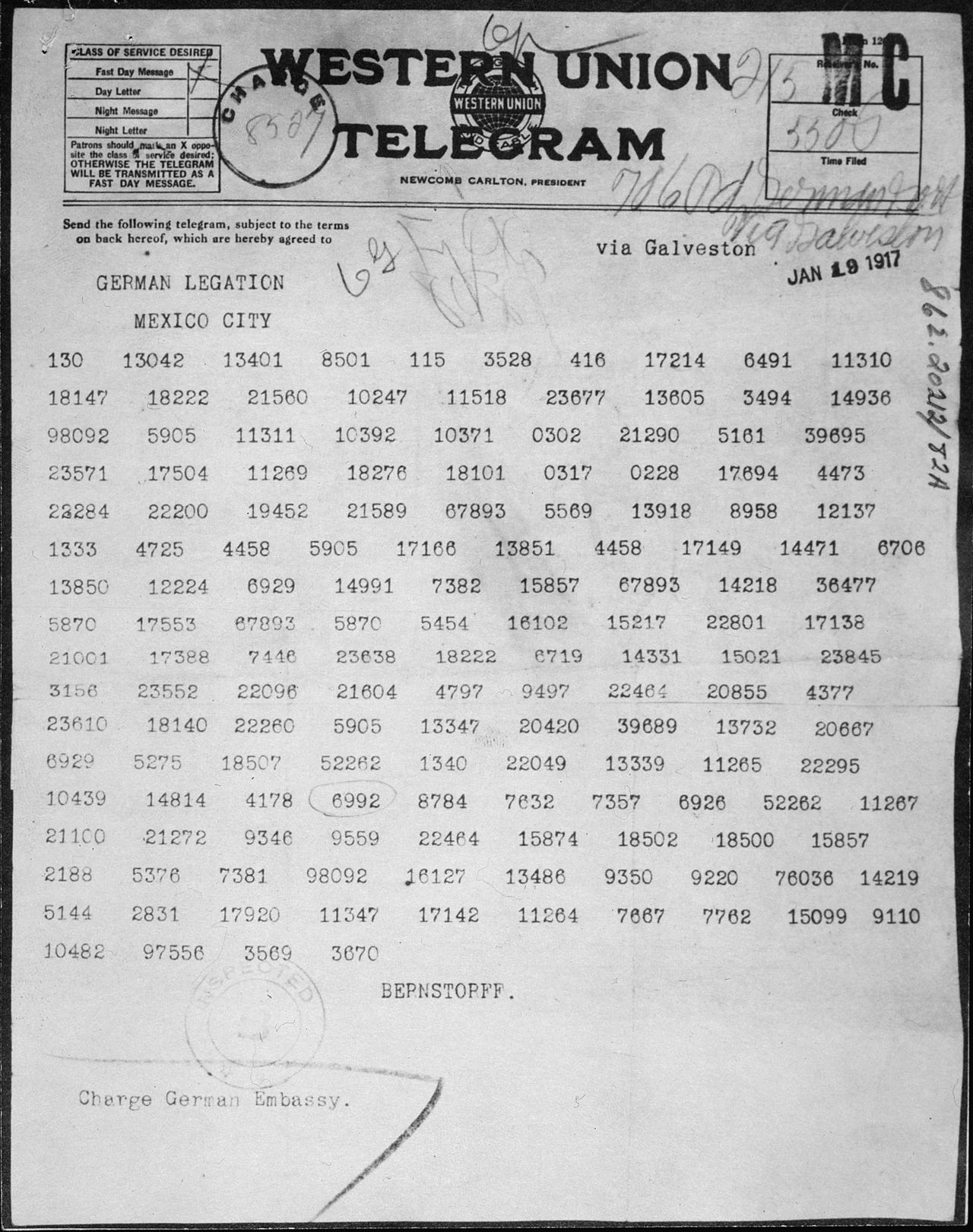

The Proposal Berlin Handed to Mexico
The man who sent the telegram was Arthur Zimmermann, Foreign Secretary of the German Empire. On 16 January 1917 he dispatched the ciphered message along three routes to Johann von Bernstorff, the German ambassador in Washington, who was in turn to relay it onward to Heinrich von Eckardt, the German minister in Mexico City (NARA).
The proposal rested on three points. First, from 1 February Germany would resume unrestricted submarine warfare. Second, it would nonetheless strive to keep the United States neutral, but should that fail, it would propose an alliance to Mexico. Under the principle of “make war together, make peace together,” it promised generous financial support and an understanding that Mexico was to recover the lost territory of Texas, New Mexico, and Arizona. Third, it asked the Mexican president to invite Japan into the alliance on his own initiative and to mediate between Germany and Japan (U.S. Department of State, Office of the Historian).
One common misconception needs correcting here. Germany did not guarantee those three states as a “gift”; rather, it offered to support and endorse Mexico’s own “reconquest” of them. Nor does the original text mention California. Texas, New Mexico, and Arizona were the southwestern lands Mexico had lost as a result of the Mexican-American War of 1846 to 1848 (National WWI Museum).
Room 40 Breaks the Wall of Numbers
The organization that intercepted the telegram was Room 40, the codebreaking unit of British naval intelligence. Established in October 1914, Room 40 is known to have decrypted some 15,000 German communications over the course of the war (Wikipedia). Behind this lay the fact that, at the outbreak of war, Britain had severed Germany’s Atlantic undersea cables, forcing Germany to rely on roundabout telegraph routes (National WWI Museum). Deprived of its cables, Germany had to borrow the telegraph networks of neutral countries and even American diplomatic lines to send messages across the Atlantic, and much of that detour happened to pass through Britain. The net of interception was drawn that tightly.
Two cipher systems were entangled in the telegram. The Berlin-to-Washington leg used the newer code 0075, which Germany believed secure, while the version relayed from Washington to Mexico City used the older 13040 series. Room 40 had already reconstructed much of this older code. The cryptanalyst Nigel de Grey and William Montgomery, a clergyman by background, labored over the partial decipherment for days (Wikipedia).
The dramatic tale often repeated is that “a codebook a German agent abandoned in Persia was what cracked the telegram,” but specialist research treats this cautiously. The accepted view is that Room 40’s decryption drew its main strength not from any single codebook but from partial reconstruction accumulated over a long time and from pure cryptanalytic solving (UK Government History Blog).

A Disguise to Hide Two Secrets
Britain was in an awkward position. In truth it was doing more than breaking German ciphers; it was also eavesdropping on American diplomatic cable lines. President Wilson had allowed Germany to use American cables for peace negotiations, and Germany had loaded this very telegram onto that channel. To release the cable at once would have exposed two facts simultaneously: that Britain had tapped American cables, and that it had broken German ciphers.
To conceal both secrets, Britain created a cover route. A British agent known as “Mr. H”, believed to be Thomas Hohler, the British minister in Mexico, bribed a clerk at the Mexican telegraph office and obtained the version that had arrived in Mexico City (in the older code 13040). By presenting this Mexican copy as its source, Britain could hide both the code-breaking and the cable-tapping (Wikipedia).
As a result, though Britain had already grasped the contents in mid-January, it let some five to six weeks slip by. Only once the cover route was in place did it finish preparing to hand the document to the United States.
The Exposure, and the Sender’s Confession
On 23 February 1917, Britain passed the decrypted text to Walter Hines Page, the U.S. ambassador in London, and the next day, 24 February, Page delivered it to President Wilson. When the telegram’s contents were made public through the American press on 1 March, opinion boiled over (NARA).
Naturally, suspicion followed that “Britain had fabricated it to drag America in.” Yet this doubt was laid to rest in an unexpected way: the sender, Zimmermann himself, publicly admitted its authenticity. He did not deny the telegram before American reporters on 3 March, and he confirmed it again in a Reichstag speech on 29 March. The forgery theory thus collapsed on its own (National WWI Museum).
Why he conceded so readily is still not clearly explained. What is clear, though, is the effect his few words produced. The voices within America that opposed entering the war and suspected “a British ruse” lost their footing in the face of the sender’s own admission.

Mexico’s Cool Calculation
Germany had its reasons for choosing Mexico of all partners. It reckoned that Mexico, stripped of vast southwestern land in a war half a century earlier, might be swayed by a proposal to recover the territory it had lost. But this Berlin calculus failed to properly gauge the reality Mexico faced.
How did Mexico, the recipient of the proposal, actually respond? Mexican president Venustiano Carranza referred the matter to a military commission for review. The commission concluded that the alliance was unfeasible.
The reasons were cool and practical. The military gap with the United States was overwhelming, and because of the British naval blockade there was no way for the support Germany promised to reach Mexico. Even if it “recovered” the three states, integrating English-speaking inhabitants would be difficult, and friction with other Latin American nations was a further burden. Mexico officially declined the proposal and remained neutral to the end (Wikipedia).
Not One Telegram, but Combined Pressure
So what led the United States into the war? Not the telegram alone. In the same period Germany resumed unrestricted submarine warfare on 1 February as it had warned, American merchant ships were sunk one after another, and on 3 February the United States broke off diplomatic relations with Germany. The telegram settled onto this current as a decisive catalyst.
The telegram’s unique contribution lay in reshaping the landscape of public opinion. Even the sentiment of the Midwest and of German Americans, who had until then favored neutrality and isolation, turned in the face of Germany’s attempt to draw neighboring Mexico onto its side. Wilson asked Congress for war before a joint session on 2 April; the Senate approved it 82 to 6 on 4 April, and the House 373 to 50 on 6 April. Wilson signed the declaration of war that same day (Wikipedia).
The cryptologic historian David Kahn remarked of this episode that “no other single cryptanalysis has had such enormous consequences.” Many institutions rank it as the greatest intelligence victory Britain achieved in the First World War (National WWI Museum). It was also an early demonstration that unseen signals intelligence can sway the course of a war no less than the guns of the battlefield.
The story of the Zimmermann Telegram is no mere spy yarn. It shows how a single document, interlocking with another pressure in unrestricted submarine warfare, drove an enormous turn, and what an intelligence service hid and what it revealed to bring that turn about. A few lines of numeric cipher ended up changing a war across the ocean, and its aftermath reached as far as the redrawing of the twentieth century’s international order. That a handful of symbols, traced by beings made to shape meaning and to unravel it, could move a history this vast is a reminder of how much weight a single small choice can bear.
References
- The Zimmermann Telegram (U.S. National Archives)
- FRUS 1917, Supplement 1, Document 158 (U.S. Department of State, Office of the Historian)
- Zimmermann Telegram (Wikipedia)
- The Zimmermann Telegram (National WWI Museum and Memorial)
- Room 40 (Wikipedia)
- The Zimmermann Telegram and Room 40 (UK Government History Blog)
- United States declaration of war on Germany (1917) (Wikipedia)
- Zimmermann Telegram (Encyclopaedia Britannica)