
In the early 1930s, a young Polish mathematician who had never once touched an actual machine reconstructed the internal wiring of the German military’s cipher device using nothing but permutation theory and a handful of classified documents. Nearly a decade later, in a weathered manor house at Britain’s Bletchley Park, hundreds of electromechanical machines ran day and night, reading the positions of U-boats crossing the Atlantic. Between these two scenes lies a single continuous story — the record of an intellectual war fought over the cipher machine known as “Enigma,” a war that began in Poland and was completed in Britain. This article follows that story in order: from the machine’s technical principles, through the Polish Cipher Bureau’s pioneering achievements, the contributions of Bletchley Park and Alan Turing, the concrete outcomes that “Ultra” intelligence produced on actual battlefields, and finally the fate Turing himself was made to endure.
Technical Principles — Why Enigma Was Hard to Break
Enigma was an electromechanical cipher machine built around rotors. Each rotor was a disc roughly 10 cm in diameter with 26 electrical contacts on each face, and its internal wiring substituted one letter for another. As with a typewriter, every keystroke turned at least the rightmost rotor one position, changing the contact path — so that even the same letter typed repeatedly was enciphered to a different letter each time, producing a polyalphabetic substitution. This was a different order of complexity from a simple alphabet substitution table.
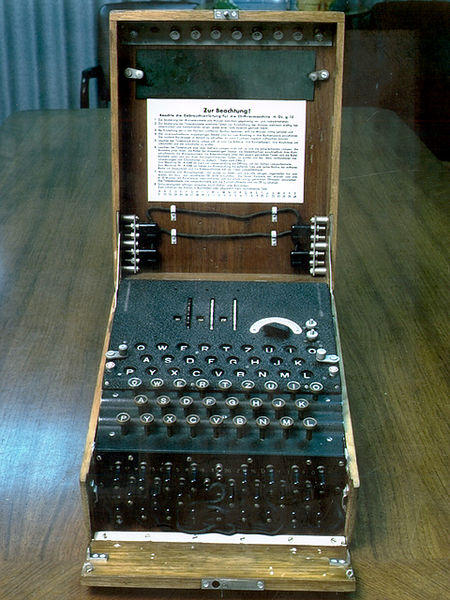
Beyond this there was the plugboard (Steckerbrett), a device that swapped pairs of letters before and after the current passed through the rotors — an addition that was cryptographically more powerful than adding another rotor. Up to 13 pairs could be plugged in, though in wartime practice usually 10 pairs were used, and the plugboard settings alone produced roughly 150 trillion possible combinations. Adding in rotor selection, rotor order, and starting positions, the total number of possible daily settings came to roughly 1.59×10²⁰ — approximately 1.59×10^20 in all.
Finally, there was the reflector (Umkehrwalze). This component sent the current back through the rotors along a different path after it had passed through the last rotor, meaning that two Enigma machines with identical settings could decrypt a message enciphered on one simply by typing it into the other — a self-reciprocal design in which encryption and decryption were the same operation. But this design had one fatal side effect: because of the reflector, Enigma never, ever enciphered a letter as itself. Later, when codebreakers worked through “probable plaintext fragments,” this quirk would become a decisive clue.
Enigma’s settings — rotor order, starting positions, plugboard connections, and so on — were distributed via codebooks and typically changed daily. Each message went through a double procedure layered on top of the day’s base setting, reusing a randomly chosen starting position — and a flaw in this procedure, particularly the practice of transmitting the message key twice, would go on to give the early Polish codebreakers a decisive foothold.
Poland’s Pioneering Contribution — The People Who Opened the First Door
It is not accurate to remember the history of breaking Enigma as Britain’s story alone. It was Poland that opened the first door. In January 1929, Poland set up a cryptology course at Poznań University grounded not in linguistics but in pure mathematics, and one of the students selected for it was Marian Rejewski. He graduated in March 1929 at age 23 and joined the General Staff’s Cipher Bureau, working there while also continuing to teach.
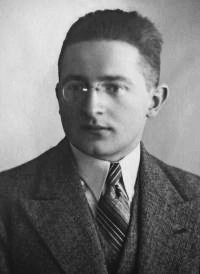
By the end of 1932, Rejewski had succeeded in mathematically reconstructing the internal wiring of the German military Enigma without ever having seen an actual machine. One of the first people to apply permutation theory and group theory to cryptanalysis, he was able to greatly narrow down the unknowns thanks to classified documents from German Cipher Office employee Hans-Thilo Schmidt, passed along through French intelligence — material obtained around December 9–10, 1932. This was, in the end, a case of Polish mathematical talent completing a lead that French intelligence had secured and handed over.
The Polish Cipher Bureau’s achievements continued to build after that. In 1934–35, Rejewski devised the “cyclometer,” which indexed the cyclic structure of permutations, along with a card-catalog method, and by around January 1938 his team was decrypting roughly 75% of intercepted Enigma traffic. In October 1938, the “bomba” that Rejewski designed — a device that electrically linked six Enigma machines together — appeared, and by mid-November of that year it could find a day’s key in about two hours. But on January 1, 1939, Germany increased the number of plugboard connections from five-to-eight up to seven-to-ten, and the bomba’s effectiveness collapsed; Poland, with limited funding, could not build enough additional bombas to keep pace. In response, Henryk Zygalski devised a manual alternative that did not depend on the number of plugboard connections — the so-called “Zygalski sheets” (perforated sheets).
Then came the decisive moment. On July 25, 1939, five weeks before the outbreak of war, the Polish Cipher Bureau met French and British intelligence delegations at Pyry, near Warsaw, and generously disclosed the entirety of their work — their reconstructed Enigma replica, the bomba design, and the Zygalski-sheet technique. On the Polish side were Cipher Bureau chief Gwido Langer, Rejewski, Zygalski, and Jerzy Różycki; on the French side, Gustave Bertrand and Henri Braquenié; and on the British side, Alastair Denniston and Dilly Knox, among others. The Pyry meeting is judged to have laid the foundation that made Bletchley Park’s later success possible — so much so that, without it, Britain’s breaking of Enigma would likely have been delayed considerably.
Rejewski’s journey continued even after Poland’s fall. He carried on cryptologic work at PC Bruno near Paris, France (October 1939–June 1940), then at Cadix in Vichy France (September 1940–November 1942), before finally reaching Britain on August 3, 1943, by way of Spain and Portugal. From that point on, however, he was assigned not to Enigma but to lower-level hand-cipher work on German SS and SD traffic. Demobilized on November 15, 1946, he returned to Poland, where political conditions under Soviet rule forced him to stay silent about his achievements for nearly two decades; only in 1967 was he able to provide his memoirs to the Polish Military Historical Institute. He died on February 13, 1980, and was buried at Powązki Military Cemetery in Warsaw.
Bletchley Park and Turing — Carrying On the Work by a Different Path
Alan Turing was recruited in 1938 and, after attending several preparatory courses, arrived at Bletchley Park on September 4, 1939 — the day after Britain declared war on Germany. Within a few weeks of his arrival he had begun designing the electromechanical “Bombe.”
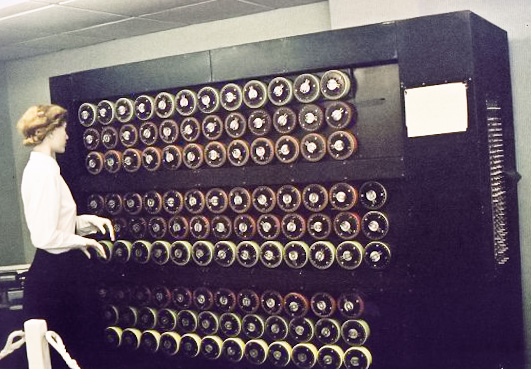
There is an important fact worth noting here. Turing’s Bombe was clearly a development of Poland’s bomba, but its underlying approach was fundamentally different. The Polish method relied on a procedural weakness in which the Germans transmitted the message key twice, and once Germany changed that procedure in 1938–39, the Polish-style attack stopped working. Turing instead designed the Bombe around an entirely new method of attack using the “crib” — a fragment of plaintext expected to appear at a specific position. Exploiting the reflector property that meant Enigma never enciphered a letter as itself, he narrowed the range of possible rotor settings by eliminating, one by one, the positions where a crib could not sit. He built on Poland’s legacy, but found an entirely different path at the very point where Poland’s method had run into a wall.
In 1940, Gordon Welchman added the “diagonal board” to the Bombe. This device, which exploited the symmetry of Enigma’s plugboard connections, greatly boosted the Bombe’s processing power, allowing valid results to be obtained even from shorter cribs. The first Bombe — named “Victory” — was installed and began operating at Bletchley Park on March 18, 1940. In late 1941, Turing and other codebreakers wrote directly to Prime Minister Churchill appealing for more staff and resources, and Churchill responded immediately with the instruction “ACTION THIS DAY.” By the end of the war, more than 200 Bombes were in operation, staffed by hundreds of Women’s Royal Naval Service (WRNS) personnel and Royal Air Force personnel.
Ultra in Action — Moments Where Codebreaking Changed the Battlefield
The high-level decrypted intelligence produced this way was given the name “Ultra.” Used by British military intelligence from June 1941 onward, the name signaled that this material was considered more sensitive than Britain’s highest security classification at the time.
The concrete difference Ultra made on the battlefield can be seen in several specific episodes. On May 9, 1941, the British destroyer HMS Bulldog captured the German submarine U-110 and seized its Enigma machine and codebooks. This contributed to Britain’s first break of naval Enigma, and starting May 15 of that year, Bletchley Park began supplying the Operational Intelligence Centre (OIC) with decrypted information on the positions and movements of German U-boats and surface vessels. Convoys used this information to reroute around danger zones, and U-boat attacks fell sharply over the summer of 1941.
But the victory did not last. In February 1942, the German navy introduced a four-rotor Enigma — code-named “Shark” or “Triton” — and Bletchley Park entered a blackout period in which it could no longer read U-boat traffic. What broke that blackout was, once again, a capture operation that cost lives. On October 30, 1942, the destroyer HMS Petard, roughly 70 nautical miles north of Port Said, Egypt, drove U-559 to the point of flooding and near-capture after a ten-hour depth-charge attack. Lieutenant Francis Fasson and Able Seaman Colin Grazier boarded the sinking submarine and recovered the short weather cipher book and short signal book, which 16-year-old canteen assistant Tommy Brown then passed out of the vessel. But the submarine suddenly began sinking again, and Fasson and Grazier were unable to escape in time and drowned.
The documents they recovered at the cost of their lives reached Bletchley Park on November 24, 1942, and on the strength of them, the “Shark” cipher was broken again on December 13, 1942. With the Royal Navy able to track U-boat positions once more, convoys were rerouted, and convoy losses in January–February 1943 fell by half. Fasson and Grazier were posthumously awarded the George Cross, announced in the London Gazette on September 14, 1943.
Ultra intelligence was put to use beyond the Battle of the Atlantic as well — in advance warning of air raids during the Battle of Britain, in the North African campaign under Montgomery and Wavell, in sinking Axis supply lines in the Mediterranean, and in preparations for the Normandy landings, among other episodes. That said, it is difficult to credit the victory in the Battle of the Atlantic to Ultra alone. Historians still disagree over how much weight to give other technical factors, such as the jointly developed British-American centimetric radar that entered service in the spring of 1943. In a lecture given on October 19, 1993, at the Babbage Lecture Theatre of the Cambridge University Computer Laboratory, Sir Harry Hinsley, the official historian of British intelligence history, stated: “My conclusion is that [Ultra] shortened the war by at least two years, and probably by four — in the Atlantic, the Mediterranean, and Europe.” This was ultimately Hinsley’s own personal estimate, and other Bletchley Park veterans have since raised objections to both its basis and its details.
All of this remained thoroughly secret for roughly 29 years after the war ended. It was only with Frederick Winterbotham’s 1974 book The Ultra Secret that Bletchley Park’s breaking of Enigma was first revealed to the public, an event that opened up an entirely new field of historical study: intelligence history.
Turing’s Final Years — Silence After Victory
What awaited Turing after the war was not honor but criminal prosecution. In 1952, he was charged with and convicted of homosexual acts (“gross indecency”). Sexual acts between men were illegal in Britain at the time. To avoid prison, he accepted hormone treatment — a procedure commonly referred to as “chemical castration” — and the conviction cost him his security clearance, ending his ability to continue the codebreaking work to which he had contributed so much during the war.

On June 7, 1954, Turing died of cyanide poisoning at age 41. The inquest ruled it suicide, but biographers and acquaintances have disputed that conclusion, and some have pointed out that the surviving evidence is also consistent with accidental death — a question that remains unresolved either way.
Vindication came only after a long time. In 2009, British Prime Minister Gordon Brown issued a formal apology for how Turing had been treated, saying he had been “treated so inhumanely.” In December 2013, Queen Elizabeth II exercised the rarely used royal prerogative of mercy to grant Turing a posthumous pardon, acting on a request from Justice Secretary Chris Grayling. Then in 2017, the so-called “Turing Law” was enacted, retroactively pardoning other men who had been convicted under historical laws against homosexuality.
Legacy — A Victory Two Nations Completed Together
At Bletchley Park stands a Polish Memorial honoring three men: Marian Rejewski, Henryk Zygalski, and Jerzy Różycki. They broke Enigma for most of the 1930s, laying the foundation for the success Bletchley Park would later achieve, and it is judged that without their work, Britain’s breaking of Enigma might have been delayed for years — possibly indefinitely. Bletchley Park’s own official record likewise states that Poland’s Enigma research in the 1930s played a critically important role in British codebreaking, and that the sheet system Zygalski developed identified a weakness in the German message procedure that became the foundation for Britain’s successful break of Enigma in January 1940.
In the end, the story of Enigma is not a victory tale belonging to any single nation. If the relentless reconstruction work of Polish mathematicians that began in a Poznań classroom had never happened; if Poland had not generously handed over everything it had that summer afternoon at Pyry; if Turing and Welchman at Bletchley Park had not picked up the baton with a new crib-based method; and if people like Fasson and Grazier, who plunged into a sinking submarine with barely a name to their credit, had never existed — this story might have ended very differently. This record, in which different nations, different eras, and different methods converged into a single achievement, continues to be told today as an example of how knowledge and courage can carry across borders.
References
- Wikipedia — Enigma machine, en.wikipedia.org/wiki/Enigma_machine
- Wikipedia — Marian Rejewski, en.wikipedia.org/wiki/Marian_Rejewski
- Wikipedia — Bombe, en.wikipedia.org/wiki/Bombe
- Wikipedia — Ultra (cryptography), en.wikipedia.org/wiki/Ultra_(cryptography)
- Wikipedia — Alan Turing, en.wikipedia.org/wiki/Alan_Turing
- Wikipedia — Colin Grazier, en.wikipedia.org/wiki/Colin_Grazier
- GCHQ — Alan Turing, gchq.gov.uk/person/alan-turing
- Bletchley Park — Polish Memorial, bletchleypark.org.uk/markers/polish-memorial
- Bletchley Park — Early Days / 6 Facts About the Bombe, bletchleypark.org.uk/our-story/early-days
- Warfare History Network — The Codebreakers’ War in the Atlantic, warfarehistorynetwork.com
- Sir Harry Hinsley, “The Influence of ULTRA in the Second World War” (text of the 1993 Cambridge lecture), cix.co.uk/~klockstone/hinsley.htm