
Plants, we tend to say, are passive beings. They soak up sunlight and grow in silence, swaying in the wind but never quite “deciding” anything for themselves. Yet in a narrow stretch of wetland in the southeastern United States lives a plant that flatly defies this assumption. Its leaf tips gape open like little mouths, and the moment an insect steps inside they snap shut in barely a tenth of a second. We know it by the name Venus flytrap — Dionaea muscipula.
And the most fascinating thing about this plant is not, in fact, that its trap closes quickly. The truly astonishing point is that a single leaf — with no brain, no nerves, no muscles — is “counting” something. The Venus flytrap tallies how many times it has been stimulated, and based on that number it decides, step by step, whether to close the trap, whether to secrete digestive fluid, and whether to draw in more nutrients. The one thing for you to take away today is this: without any nervous system, the Venus flytrap counts the “number” of stimuli, and uses the result of that counting to switch its own behavior and metabolism on and off.
David J. Stang · CC BY-SA 4.0 · Wikimedia Commons · Source
The plant that made Darwin pause
The list of people captivated by this plant includes Charles Darwin. In his 1875 book Insectivorous Plants, he called the Venus flytrap “one of the most wonderful plants in the world.” It is often rendered in the absolute form — “the most wonderful plant in the world” — but Darwin’s original wording is firmly “one of.” The naturalist who founded the theory of evolution gave this small wetland plant a special place among countless wonders.

Photo by Julia Margaret Cameron · Public domain · Wikimedia Commons · Source
What seized Darwin was the speed and force of the movement. In the same book he proposed a hypothesis: that the spikes lined along the trap’s margins form a “horrid prison” that cages an insect the instant the trap shuts. A mid-sized insect is locked inside this cage of spikes, while a very small one slips out through the gaps — sparing the plant from wasting digestive energy. Intriguingly, this “horrid prison” hypothesis was only experimentally confirmed in 2018. Darwin’s intuition, it turns out, was proved right well over a century later.
Anatomy of the trap — two palms made from a single leaf
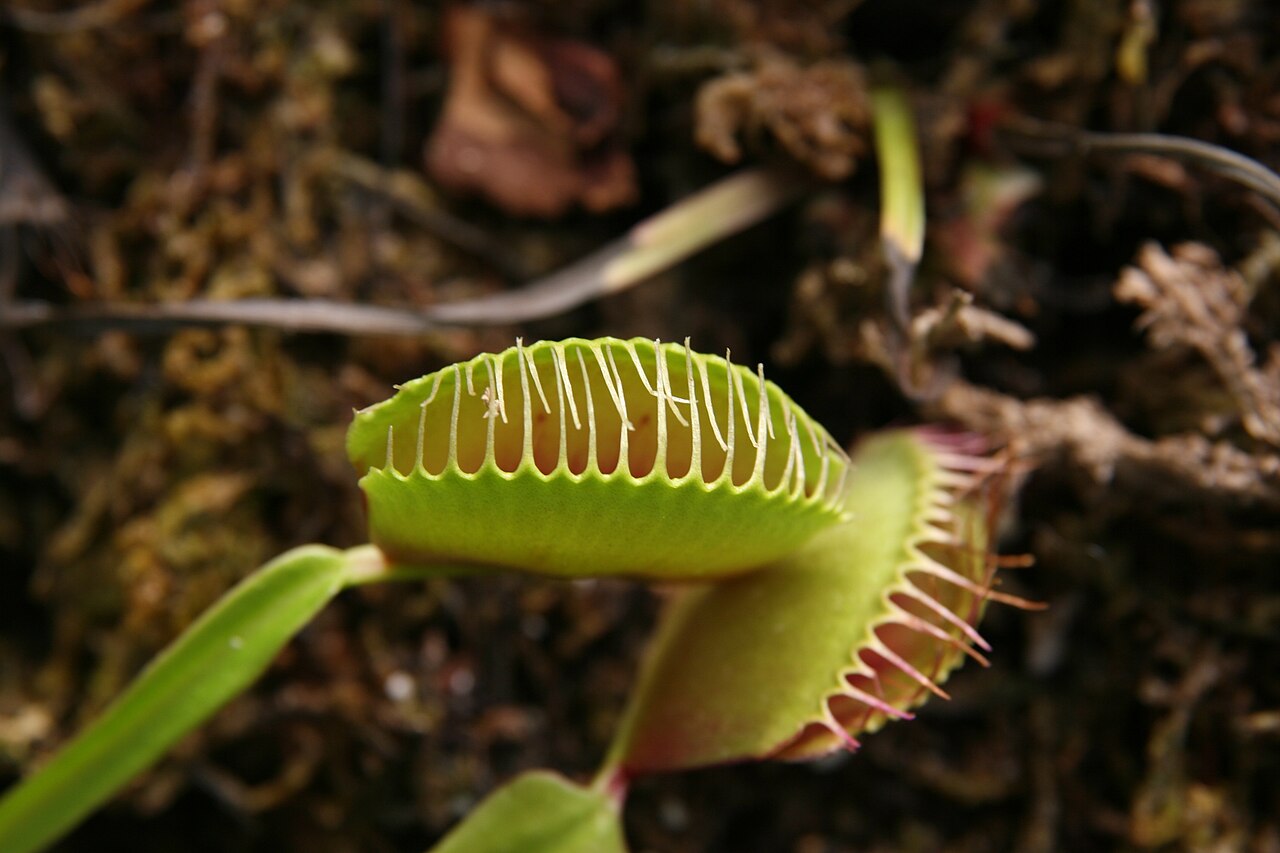
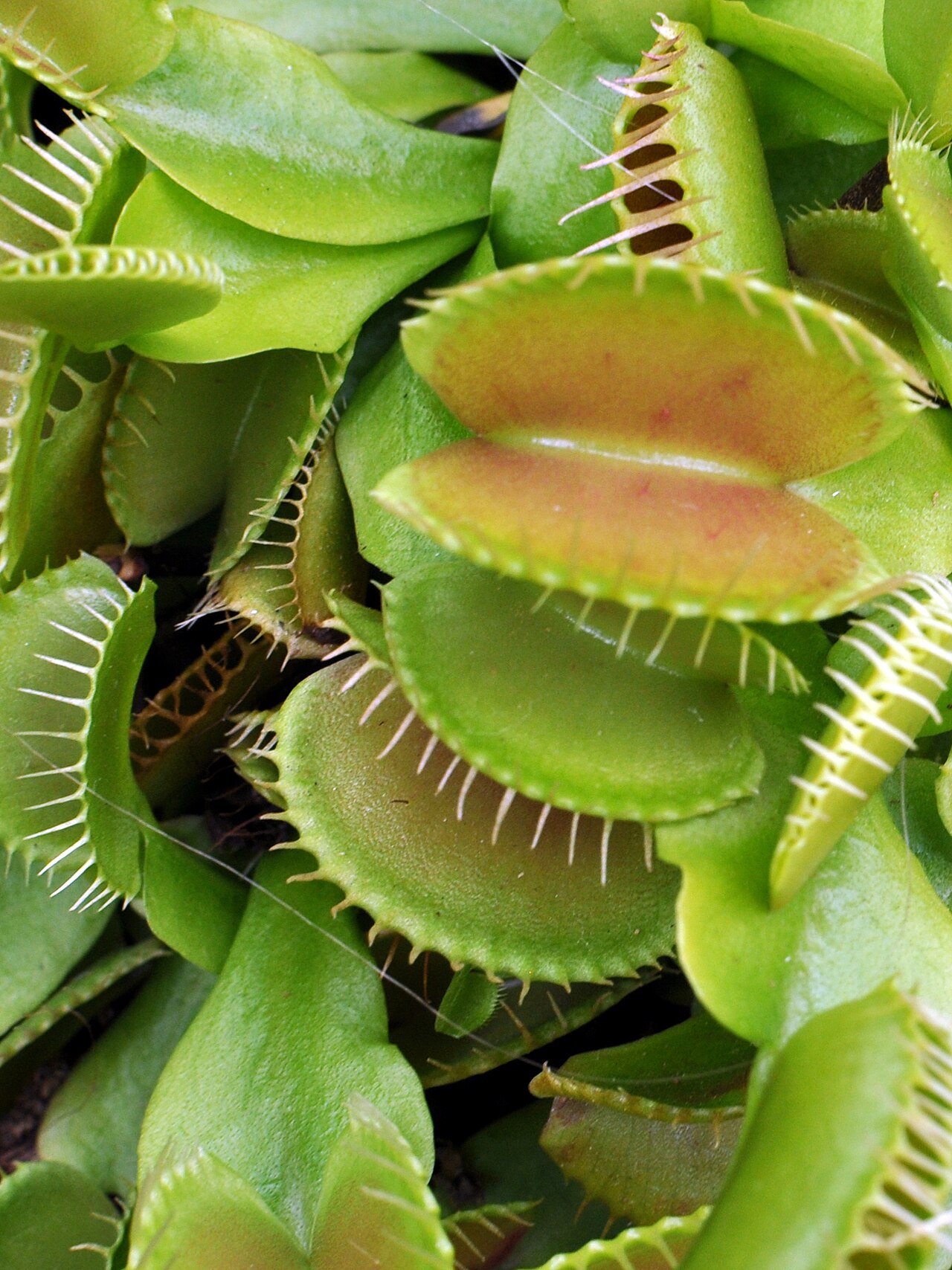
The trap is not actually a separate organ; it is the tip of a single modified leaf. The end of the leaf blade develops into two lobes, and the two lobes fold along a central midrib that acts as a hinge. It closes much the way two palms come together along the crease in the middle.
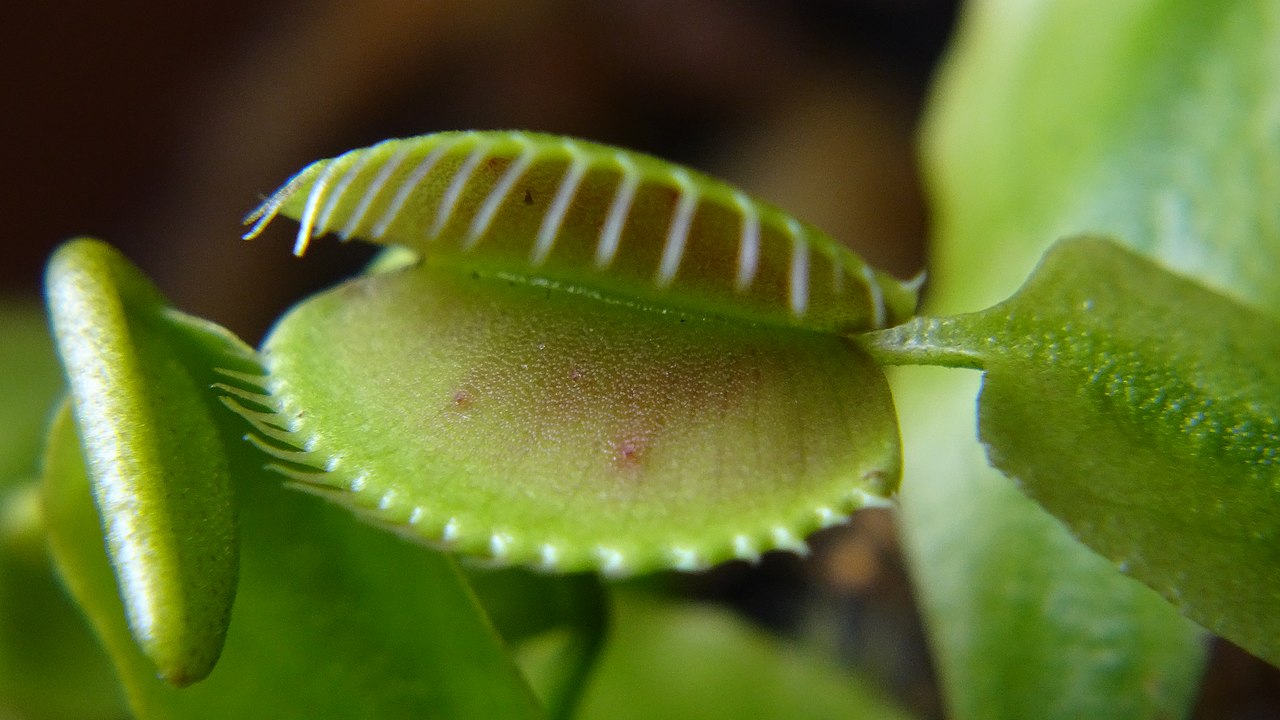
Along the margin of each lobe runs a row of long, pointed spikes (cilia), arranged like the teeth of a comb. When the trap shuts, the spikes on either side interlock like clasped fingers, forming a “cage” that holds the prey inside. As the Royal Botanic Gardens, Kew, put it, the interlocking teeth lined along the leaf edge seal the trap. These spikes are precisely the bars of Darwin’s “horrid prison.”
Tippitiwichet (Flickr) · CC BY 2.0 · Wikimedia Commons · Source
And on the inner face of each lobe stand the plant’s key devices: the trigger hairs. Commonly there are three on each lobe, so six per trap is taken as the standard. But this is not a strictly fixed number. Scholarly sources sometimes describe how “each half of the bilobed trap is fitted with 3–5 mechanosensory hairs arranged in a semi-triangular shape,” so a variation of three to five per lobe is reported depending on the individual or the leaf. In other words, “three per lobe” is the most common typical value, not an absolute law. These few tiny hairs are the starting point of all the “counting” we are about to discuss.
Why twice, and not once?
There is a clear rule for closing the trap. An insect must touch the trigger hairs twice within about 20 seconds before the trap will shut. It does not matter whether the same hair is touched twice in a row, or two different hairs are touched in turn. What matters is the condition: “twice within 20 seconds.”
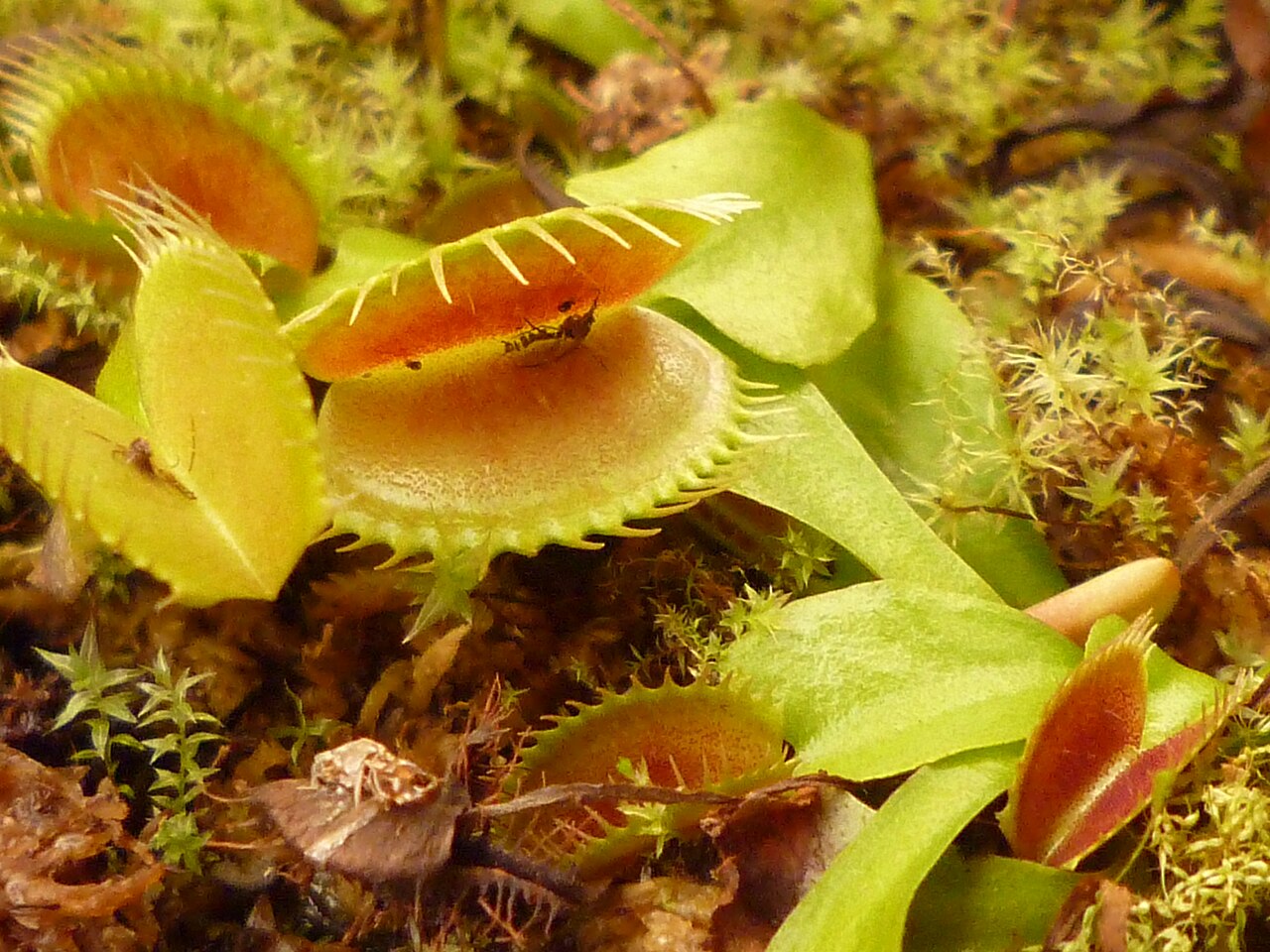
Why two times? The answer lies in the plant’s “economics.” Raindrops fall in the wetland, and wind-blown grains of sand or scraps of leaf can tumble into the trap. If a single touch were enough to close it, the Venus flytrap would squander enormous energy closing and reopening a hard-built trap over a raindrop that is no food at all. So a first stimulus alone usually does not trigger closure. Instead, the information from that first touch is “stored” within the plant for about 20-odd seconds. That is why scientists call it a kind of short-term memory.
Sylvain Bezy · CC BY-SA 3.0 · Wikimedia Commons · Source
When the second stimulus arrives within this 20-second window, the plant finally judges, “this is not a chance scrap but something alive and moving,” and fires the trap. Once may be coincidence, but twice in a short span is not. A single leaf, with no nervous system, measures time and counts touches to tell “real prey” from “a false alarm.”
What it really means for a leaf to “count”
Here is the heart of the story. When a trigger hair is bent, an electrical signal called an action potential is generated at its base. This signal is an electrical pulse much like the one an animal’s nerves use to relay information. And it is exactly these electrical pulses that the Venus flytrap “counts.”
The word “counts” is, of course, a metaphor. It in no way means the Venus flytrap has a concept of numbers or any consciousness. It only means that the way the plant’s cells switch on different biochemical reactions, step by step, according to the accumulated number of electrical signals works as precisely as if it were tallying numbers and climbing the steps. The work that lifted this metaphor into established scientific fact is a 2016 study by Rainer Hedrich’s group at the University of Würzburg in Germany. The very title of the paper, published by J. Böhm and colleagues, declares it: “The Venus Flytrap Dionaea muscipula Counts Prey-Induced Action Potentials to Induce Sodium Uptake” (Current Biology, vol. 26, no. 3, pp. 286–295).
User:Citron · CC BY-SA 3.0 · Wikimedia Commons · Source
The stages of counting that the team uncovered are remarkably distinct.
- Signal 2 — the trap closes. The “twice within 20 seconds” mentioned earlier corresponds to this second action potential. Once two electrical pulses have accumulated, the trap fires.
- Signal 3 — a hormone is released. From the third signal on, the plant begins to make jasmonate, a “touch hormone.” As the captured prey struggles and keeps brushing the trigger hairs, this hormone issues the order to prepare for digestion.
- Signal 5 — digestion switches on in earnest. By the fifth signal, the digestive glands are activated, digestive enzymes are secreted, and the machinery that absorbs the sodium (Na⁺) released from the prey kicks in.
The beauty of this system is that it is quantitative. The more violent the struggle — that is, the larger the prey — the more often the trigger hairs are touched, and the more action potentials pile up. Böhm’s team showed that as the number of stimuli rises, the number of expressed transcripts of the sodium-transporter gene (DmHKT1) increases proportionally. A larger meal mobilizes that much more digestive enzyme and absorption machinery. There is no need to lay out a grand banquet for a tiny morsel, so the plant invests digestive resources precisely in proportion to the size of the prey. This refinement — counting stimuli and tying the result to its metabolism — is exactly why the Venus flytrap is called “one of the most wonderful plants.”
The secret of a tenth of a second — how does a leaf close so fast?
Even once the second signal arrives and the decision to “shut” is made, the slow movement of water within plant cells alone cannot explain that speed. Simple water movement is a sluggish process that unfolds over minutes. Yet an adult Venus flytrap’s trap closes in about 100–300 milliseconds — that is, 0.1–0.3 seconds. Kew describes it as “about one-tenth of a second.” The blink of an eye.
The secret lies in physics. Ordinarily the two lobes of the Venus flytrap are bowed outward in a convex shape, held taut and brimming with elastic energy thanks to turgor pressure. Like a plastic lid bent to the very brink of flipping inward, or a toy pressed just before it pops over. The instant this stored tension (prestress) crosses a critical point, the curvature of the lobes flips all at once from convex to concave, explosively releasing the elastic energy it was holding. Scientists call this phenomenon snap-buckling instability.
In other words, the trap’s closing motion is an exquisite combination of “active hydraulic actuation” and “passive elastic snapping.” The plant receives the signal and nudges a little cellular water to tip the critical point; the rest is handled in an instant by the physical structure of the bent leaf. It is a clever shortcut for producing fast motion with little energy.
One thing, however, must be made clear. The 0.1-second speed is often cited as a prime example of fast plant movement, but it is not “the fastest movement in the plant kingdom.” The suction traps of the bladderwort (Utricularia), another carnivorous plant, operate on the order of about 0.5 milliseconds (0.0005 seconds) — hundreds of times faster than the Venus flytrap. So to call the flytrap’s speed “the best among plants” runs counter to the facts. Let us simply say that the figure of 0.1–0.3 seconds is impressive enough on its own. For the record, a young trap freshly grown from seed can take up to five seconds for the same motion. Becoming a fast trap, it seems, also takes growing up.
A leaf that becomes an external stomach — the time of digestion
Once the trap has closed and the fifth signal has come in to switch on digestion mode, the two lobes press together even more tightly, making a nearly sealed chamber. This closed trap effectively becomes the plant’s external stomach. Into it pour hydrolytic enzymes. Enzymes such as chitinases (of the GH18 family), which break down the chitin that makes up an insect’s exoskeleton, dissolve the prey bit by bit.
Digestion takes a fair amount of time. Kew explains that the trap “reopens around 10 days later, once the insect has been digested,” and another study puts the average for the whole cycle at about seven days. Depending on the size of the prey and the individual, the range is roughly 5–12 days. When digestion is finished, only the chitin exoskeleton — the insect’s empty husk — remains, and the trap opens again. That is why an empty insect shell is sometimes found inside a closed trap.
And what happens with a false alarm — when the trap is fooled by a raindrop or a scrap and closes with no prey inside? In that case there is no reason to stay shut for days, so it reopens within about 16–44 hours. The plant gauges for itself whether there is anything to digest and adjusts how long it stays closed. Here, too, the Venus flytrap’s consistent principle shows through: it does not waste energy.
Despite the name, it rarely eats flies
The name “Venus flytrap” — a trap for flies. Yet look into this plant’s actual diet and the name rings hollow, for flies and other winged insects make up less than 5% of the prey it catches.
According to the prey composition compiled by Ellison and Gotelli in 2009, ants account for about 33%, spiders about 30%, beetles about 10%, and grasshoppers and their kin about 10%, while winged insects come to under 5%. A separate field study (Hutchens and Luken, 2006) surveyed 580 traps across three seasons over nine months and reported spiders at 31%, ants at 26%, and beetles at 12%. Both studies say the same thing with one voice: the Venus flytrap’s main prey is not flying insects but crawling arthropods on the ground. Given that the traps grow close to the soil, this only makes sense. The traps gape near the ground, so crawling ants and spiders are the ones most easily caught.
A 2018 study at North Carolina State University went a step further and revealed a delightful fact. Of the visitors that came to the Venus flytrap’s flowers, 87% were flying insects, whereas 80% of the prey caught in the traps could not fly. In other words, the Venus flytrap scarcely eats the very insects that pollinate it. It blooms its flowers at the top of a tall stalk and keeps its traps down low, spatially separating its prey from its pollinators. That is why researchers joked that the plant might better be called the “Venus Spidertrap.” Even a single name carries how fragmentarily we have come to look at nature.
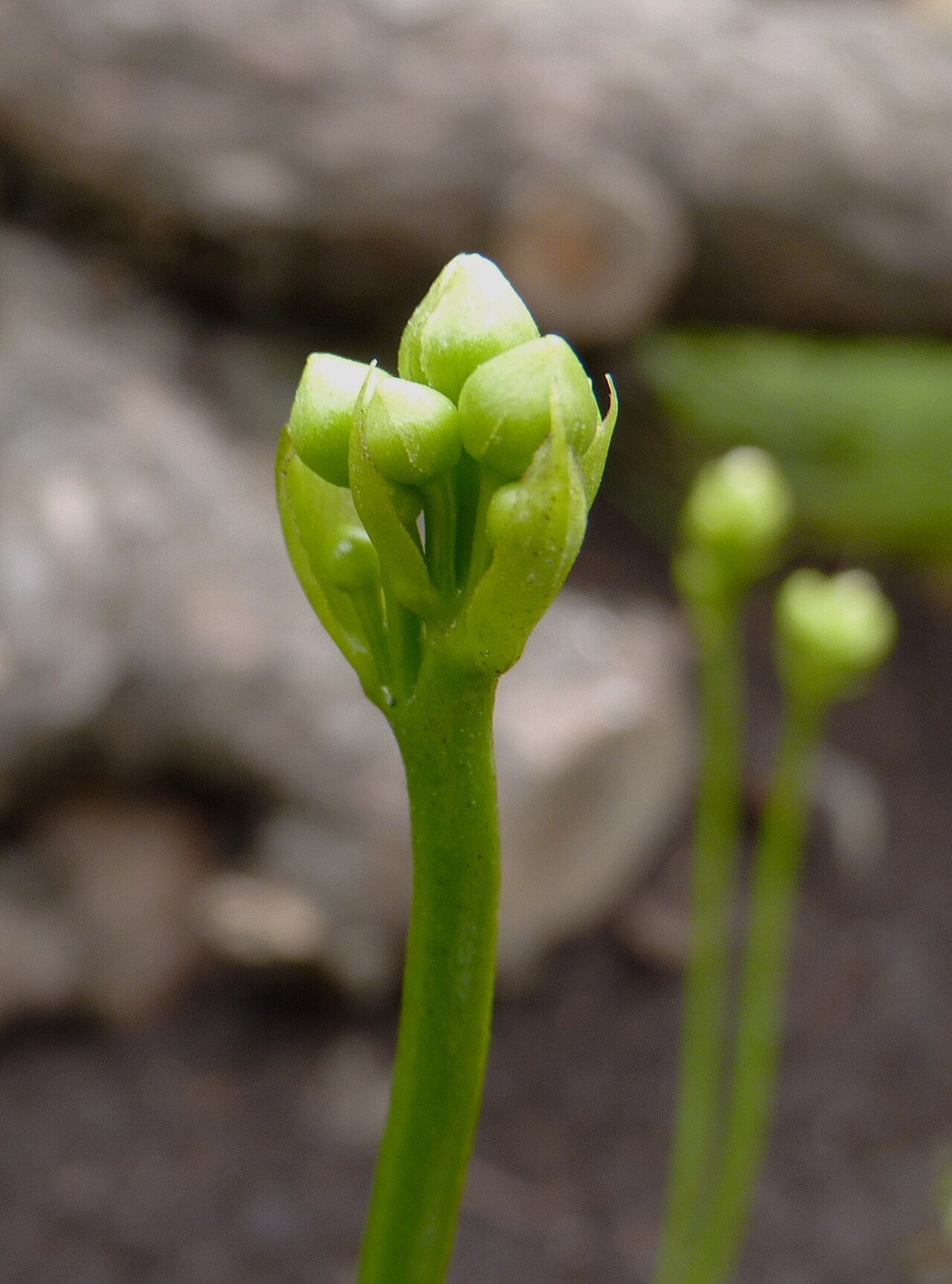
Michal Klajban · CC BY-SA 3.0 · Wikimedia Commons · Source
Why take up eating insects at all?
Here a fundamental question arises. Why would a perfectly good green plant that photosynthesizes choose the troublesome path of eating insects? The Venus flytrap is plainly a plant that photosynthesizes normally, and insects are by no means its energy source. It gets carbon and energy from sunlight and photosynthesis, just like any other plant.
The secret is in the ground they live on. The Venus flytrap’s native habitat is acidic wetland critically short of nitrogen (N) and phosphorus (P). A plant needs nitrogen to build proteins, but this nutrient-poor soil cannot supply enough of it. So the Venus flytrap is designed to “supplement” the missing nitrogen and phosphorus from the bodies of insects. The insect is not a meal but a kind of “nutritional supplement.” Indeed, one study explains that “the influx of the limiting nutrients absorbed from prey — namely nitrogen and phosphorus — enhances photosynthesis.” The nitrogen and phosphorus gained from insects feed back into raising photosynthetic capacity. The sodium uptake seen earlier is likewise part of this response to a nutrient-poor environment.
Carnivory is not the Venus flytrap’s invention alone. In flowering plants (angiosperms), carnivory is thought to have evolved independently at least six times. To the same problem of nutrient-poor ground, different plant lineages arrived at a similar answer. The strategy of “borrowing scarce nutrients from animals on barren land” was apparently effective enough to appear again and again across different lineages.
The world’s narrowest homeland, and a precarious future
Famous as it is, the Venus flytrap’s wild home is astonishingly small. In all the world it grows native only on the coastal plain of North and South Carolina, and every known native site falls within a radius of about 90 kilometers (56 miles) of Wilmington, North Carolina. The true wild range of a plant we routinely meet in flowerpots is, on a map, no more than a circle the size of a palm.

ncwetlands.org · CC0 · Wikimedia Commons · Source
Even within that circle the Venus flytrap is demanding. Acidic soil poor in nitrogen and phosphorus, in longleaf pine savannas and bogs. Damp, acidic ground mixed with sand and peat. And above all, strong sunlight: it grows only in nearly full sun, typically where canopy cover (tree shade) is under 10%. The margins of the oval wetlands known as “Carolina bays” are a favorite spot as well.
Paradoxically, this plant depends on fire. Small and slow-growing, the Venus flytrap declines from lack of sunlight when tall competing plants cast shade over it. But when fires that occur every three to five years periodically burn away that competing vegetation, sunlight again reaches the ground and the Venus flytrap flourishes. Fire is its friend. So when people suppress wildfire too thoroughly, the flytrap’s habitat is, paradoxically, buried in shade and lost.
The trend in wild numbers is worrying. The wild Venus flytrap population, estimated at about 4.5 million in 1979, was counted at roughly 302,000 in a 2019 survey. More than 90% disappeared in 40 years. The twin axes of the threat are habitat destruction and poaching. That people keep illegally digging up wild plants — even though tissue-cultured, mass-propagated specimens are readily bought on the horticultural market — is a bitter irony. North Carolina classified Venus flytrap poaching as a felony in 2014, and in real cases a man who dug up 970 plants received a 17-month prison sentence, while in 2019 another man was charged with 73 counts of poaching with bail set at $750,000.
As for conservation status, the IUCN Red List classifies the Venus flytrap as “Vulnerable,” and international trade is regulated under CITES Appendix II. At the U.S. federal level, a 2016 petition to list it under the Endangered Species Act (ESA) was filed, but in July 2023 the U.S. Fish and Wildlife Service (USFWS) finally ruled it “not warranted,” judging that eight “highly resilient” populations are being protected and managed. North Carolina’s threatened-species status and the felony poaching rule, however, remain in place. The Venus flytrap stands today in a delicate spot — “all right for now, but by no means safe to relax about.”
A record of discovery — from a governor’s letter to the trap of Venus
This plant first entered the European record in 1759. In a letter sent that year on April 2 to the British naturalist Peter Collinson, the colonial governor of North Carolina, Arthur Dobbs, wrote that “there is a kind of sensitive catch-fly that closes upon anything that touches it; it grows in latitude 34 but not in 35” — the earliest known description. In a follow-up letter the next January, he went further, describing how the trap’s margins were jagged like a “spring fox-trap” and “shut suddenly,” and calling it a “Fly trap Sensitive.” Native and colonial nicknames of the time included names such as “Tipitiwitchet,” which may have come from a Lenape-family word meaning “those that wind around (the leaves).”
The scientific and English names we use today came from the British naturalist John Ellis. In a letter to Carl Linnaeus in 1768, he described the plant and proposed the scientific name Dionaea muscipula and the English common name “Venus’s Flytrap.” The genus name Dionaea, “daughter of Dione,” is an epithet for Aphrodite (Venus), the goddess of beauty, and the species name muscipula is Latin for “mousetrap” or “flytrap.” Ellis described the plant to Linnaeus as “a rat trap with teeth.” The goddess of beauty and a fearsome trap coexist in one name — a curiously fitting bit of naming.

Mary Vaux Walcott · Public domain · Wikimedia Commons · Source
Ever since, the Venus flytrap has become the most widely known and most cultivated of carnivorous plants. In Wikipedia’s words, it is “by far the most commonly recognized and cultivated carnivorous plant.” Most specimens sold in pots are propagated by tissue culture rather than taken from the wild. Yet the fact that this horticultural popularity coexists with precariousness in the wild prompts us to look again at the gap between the way we “consume” a living thing and the way that living thing actually “lives” in nature.
What a single leaf can teach us
Picture the Venus flytrap once more. A single leaf — with no brain, no nerves, no muscles — counts the number of electrical signals from bending trigger hairs, closing at “two,” releasing a hormone at “three,” and switching on digestion at “five.” It ignores one raindrop and seizes two genuine touches; it mobilizes more enzymes the larger the prey, and reopens early when nothing is inside. All of this happens without consciousness or intent, by nothing but the electrochemical rules of cells.
We tend to treat words like “count,” “remember,” and “decide” as the exclusive property of animals and humans. Yet the Venus flytrap leaves us no choice but to lend that metaphor to a plant. This, surely, is why Darwin paused before this small wetland plant and wrote, in his book, that it was “one of the most wonderful plants in the world.” That life can perform something close to “counting” even without a nervous system — that it is far cleverer and more refined than our imagination allows. That is the single sentence this little trap hands us today.
References
- The Venus Flytrap Dionaea muscipula Counts Prey-Induced Action Potentials to Induce Sodium Uptake — Böhm et al., Current Biology (2016)
- How Venus flytrap triggers digestion — University of Würzburg
- Venus flytrap: How does it work? — Royal Botanic Gardens, Kew
- Shapeshifting in the Venus flytrap (Dionaea muscipula) — Frontiers in Plant Science / PMC9478607
- How the Venus flytrap snaps — Forterre et al., Nature (2005)
- Energetics and the evolution of carnivorous plants — Darwin’s ‘most wonderful plants in the world’ — Journal of Experimental Botany
- Venus Flytraps Don’t Eat The Insects That Pollinate Them — NC State News
- Venus flytrap — Wikipedia
- Successful Protection and Management Efforts Keep Venus Flytrap off the Endangered Species List — U.S. Fish & Wildlife Service
- Venus Flytrap — Dobbs’ “Catch Fly” — NC DNCR