
Have you ever rubbed a blueberry gently between your fingers? As the pale, dusty film on its smooth, deep navy skin disappears, what’s revealed underneath is a skin that’s actually closer to reddish purple. The blue of this small fruit we meet every day at the grocery store isn’t made the way common sense would suggest. The blue in blueberries isn’t a pigment. Anthocyanin, the pigment in the skin, is actually closer to deep red or purple, and the blue we see comes from a structural color: the microscopic crystal structure of a thin wax layer on the surface scattering blue and ultraviolet light in every direction.
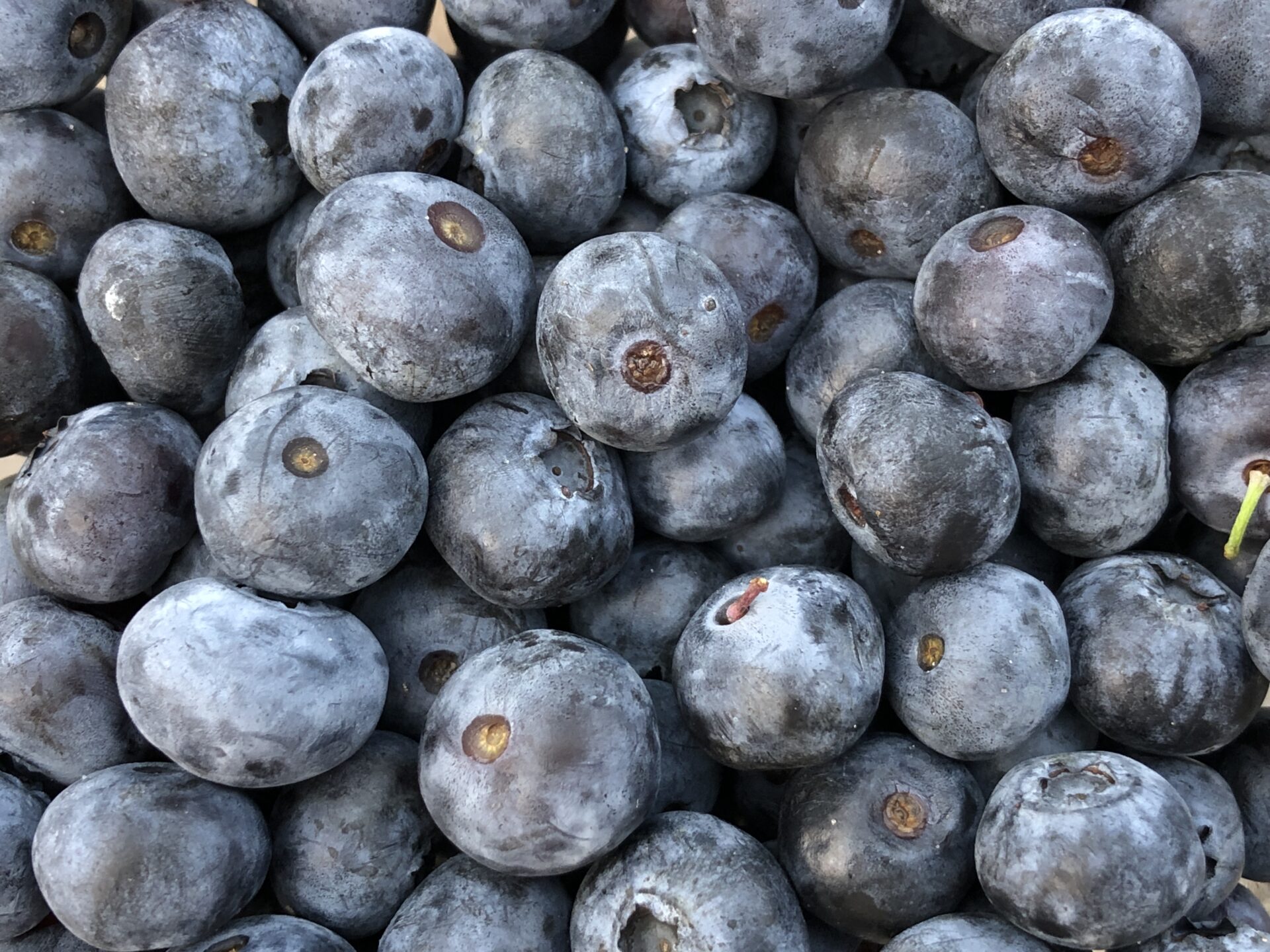
Photo: Famartin, CC BY-SA 4.0, Wikimedia Commons
Peel Back the Pigment, and the True Color Appears
There really is a pigment in blueberry skin. It’s anthocyanin, a water-soluble phenolic compound commonly found in many fruits, including apples, grapes, and plums. The problem is the color of the pigment itself. The anthocyanin held in the skin’s cells produces a color that runs from deep red to purple. If you rub the white powder off a blueberry’s skin, or press the flesh to squeeze out juice, you can see that reddish-purple color for yourself. The deep indigo-blue we see on the shelf — so-called “blueberry blue” — can’t be explained by this pigment alone.
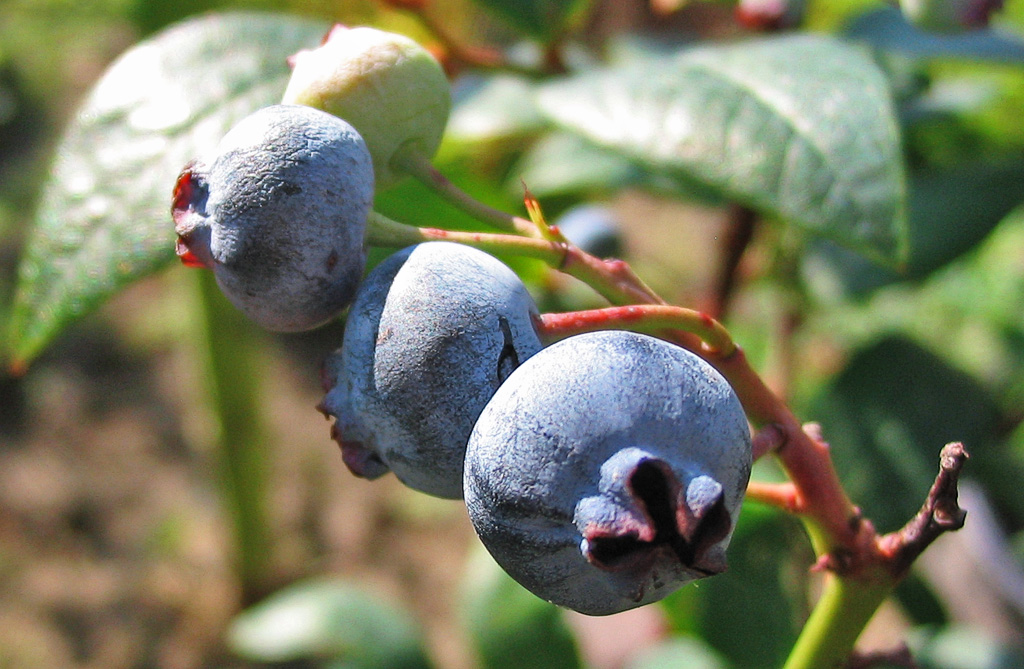
Photo: Darkone, CC BY-SA 2.5, Wikimedia Commons
Melt the Wax, and the Color Disappears Completely
Half of the answer lies in the white powder covering the skin’s surface — the wax layer known as the “bloom.” A 2024 paper in the journal Science Advances by researchers at the University of Bristol peeled back the identity of this bloom step by step through experiments. The researchers first scraped the wax off a blueberry’s surface and dissolved it in chloroform solvent. The result was clear: the dissolved wax solution was transparent across the entire visible spectrum — meaning the wax itself contains no pigment component that produces color at all. If it were a pigment, its color should have remained in the solution once dissolved, but the wax lost its color completely the moment it melted.
Let It Harden Again, and the Blue Comes Back
The truly interesting part comes next. The researchers placed 2mg of the melted wax in an aluminum crucible, heated it to 120 degrees Celsius under vacuum, and held it at that temperature for roughly 30 minutes to an hour while it re-solidified. The originally colorless, transparent crucible surface then showed the same blue-to-ultraviolet reflected color seen on a blueberry’s skin. By melting the wax and letting it re-solidify, the reproduction experiment directly demonstrated that the color isn’t a pigment at all — it’s produced as the wax molecules spontaneously reassemble into a microscopic crystal structure.
Nanocrystals Stacked Without Order Scatter the Light
So how do these wax crystals produce color? When the researchers examined the bloom’s microstructure under an electron microscope, they found nanometer-scale crystal grains packed densely into a thin layer roughly 2 to 4 micrometers thick. But these crystals weren’t arranged at regular intervals like a tight lattice. When the researchers analyzed the structure, they found no consistent spacing — no periodicity — between neighboring particles, and no reflectance peak stood out at any particular wavelength. In other words, this color is produced in a fundamentally different way from colors built by regularly stacked layers: it comes from scattering by a random, non-periodic arrangement. Short-wavelength blue and ultraviolet light bounce off these irregular nanocrystals in every direction, producing the reflected light that appears blue to our eyes.
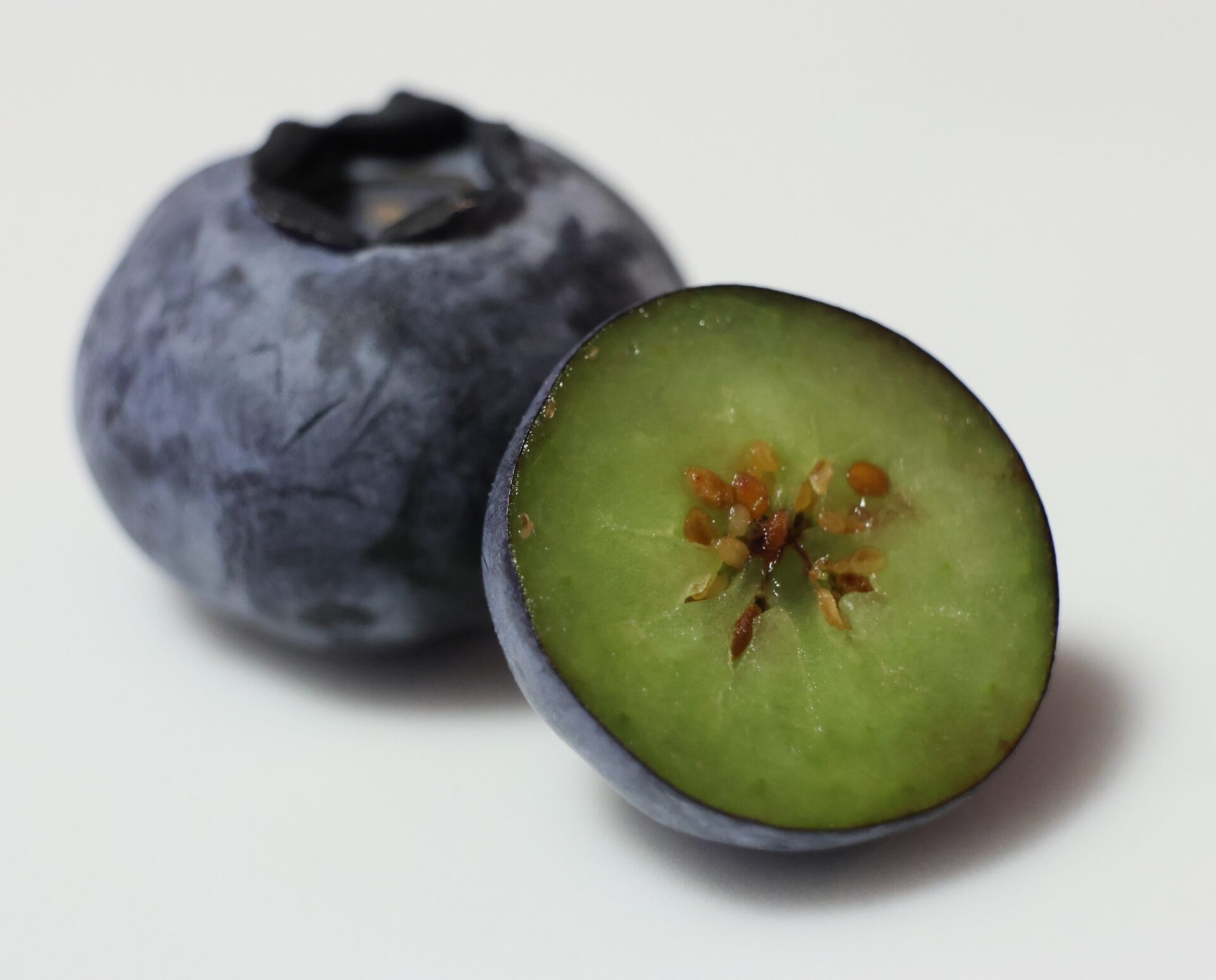
Photo: Slashme, CC0, Wikimedia Commons
Scattering Alone Doesn’t Produce Blue — The Secret of the Two-Layer Structure
One question remains here. If randomly scattered nanocrystals scatter blue and ultraviolet light, why is the anthocyanin pigment needed at all? The answer lies in the nature of structural color itself. The scattering produced by the wax layer returns light without absorbing it. But this non-absorbing scattering alone doesn’t produce a saturated blue. Place the same wax structure on white paper, and the scattered blue light mixes with light of other wavelengths and washes out to something closer to white. The researchers explain that structurally produced color only registers as color if there’s a dark, light-absorbing background beneath it. In blueberry skin, it’s the deep red-to-purple anthocyanin pigment layer that plays this absorbing-background role. Because the anthocyanin layer absorbs the remaining wavelengths that aren’t scattered, pressing the background dark, only the scattered blue-to-ultraviolet light above it stands out as a saturated blue. In other words, anthocyanin isn’t an irrelevant pigment that has nothing to do with the color blue — it’s actually a necessary condition for this structural color to exist at all. Blueberry skin turns out to be an elaborately engineered two-layer structure, with a random nanocrystal scattering layer on top working together with an anthocyanin absorbing layer underneath.
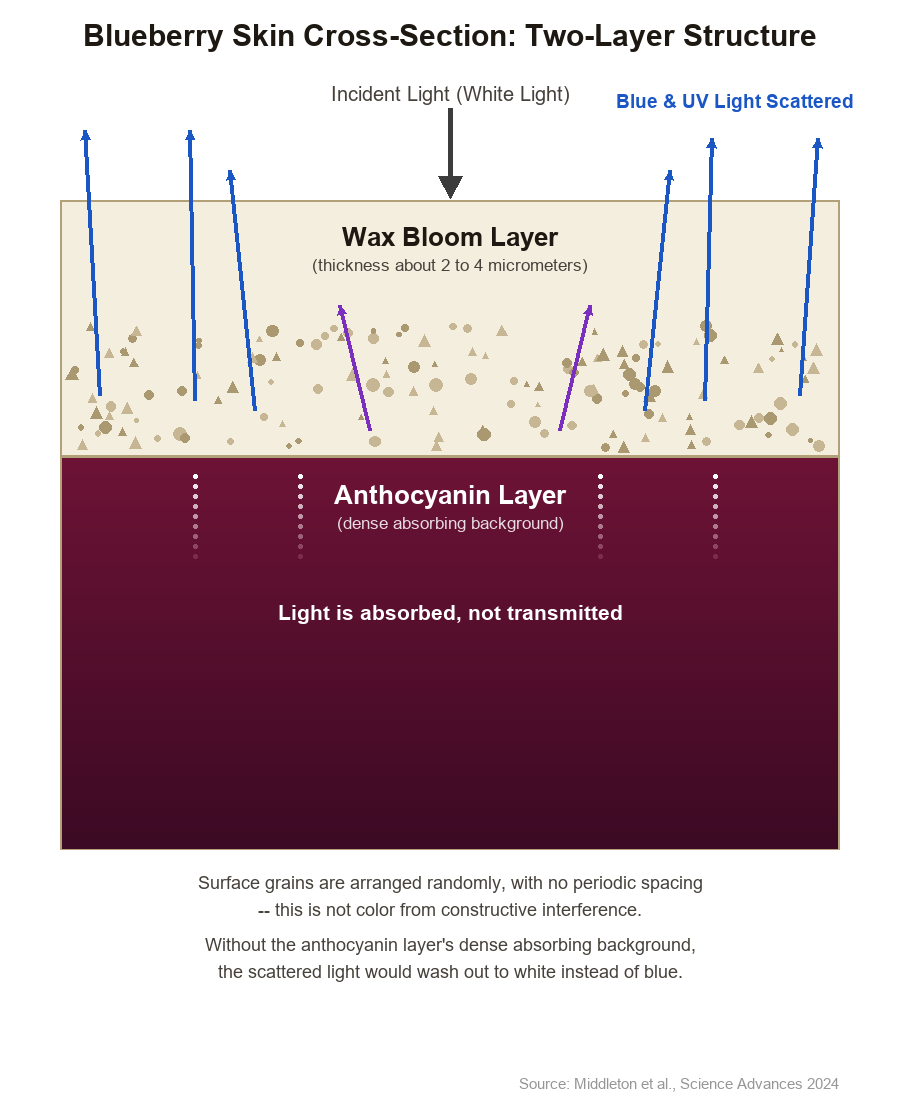
Diagram: glu.kr original illustration (concept diagram based on Middleton et al. 2024)
Not Just a Blueberry Thing
This wax bloom isn’t some special device unique to blueberries. The pale powder on a grape’s surface, the hazy sheen on plums or kale leaves, and the soft blue-white surface of succulents and blue spruce are all the same family of phenomenon — a cuticular wax self-assembling into a microscopic crystal structure. In fact, the title of the 2024 paper itself addresses not a single species but “fruit wax bloom” broadly. A separate academic study showing that the wax bloom on grapes also originates from a crystalline structure in the cuticle supports the idea that this wax-scattering phenomenon is a common thread running across many plants. Much of the hazy white surface we encounter every day on various fruits and plants, it turns out, isn’t pigment at all — it’s a nanoscale optical device.
Why Blue, of All Colors? A Cautious Hypothesis
So why did this structure end up scattering blue and ultraviolet light specifically? There’s no settled answer to this question yet. In their paper, the researchers propose the hypothesis that blue could act as a chromatically salient — unusually eye-catching — signal to seed dispersers such as birds that hunt for food by sight. The idea is that blue might stand out clearly against other background colors for animals that spot fruit visually and spread its seeds by eating it. This remains a hypothesis that still needs further verification, and it’s entirely possible that it works alongside the roles more commonly cited as the wax bloom’s original functions, such as limiting water loss or blocking pathogens.
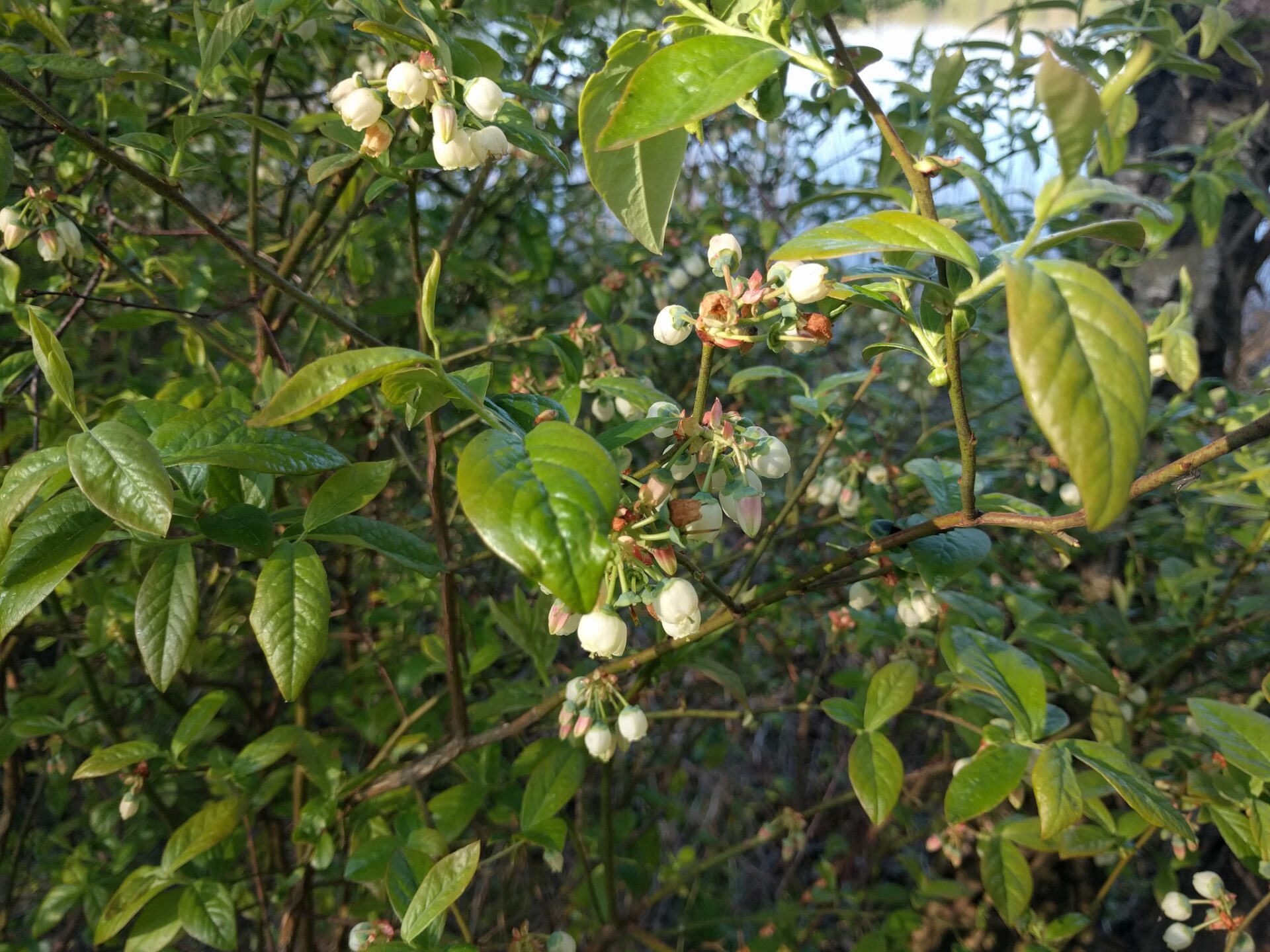
Photo: Michel Langeveld, CC BY-SA 4.0, Wikimedia Commons
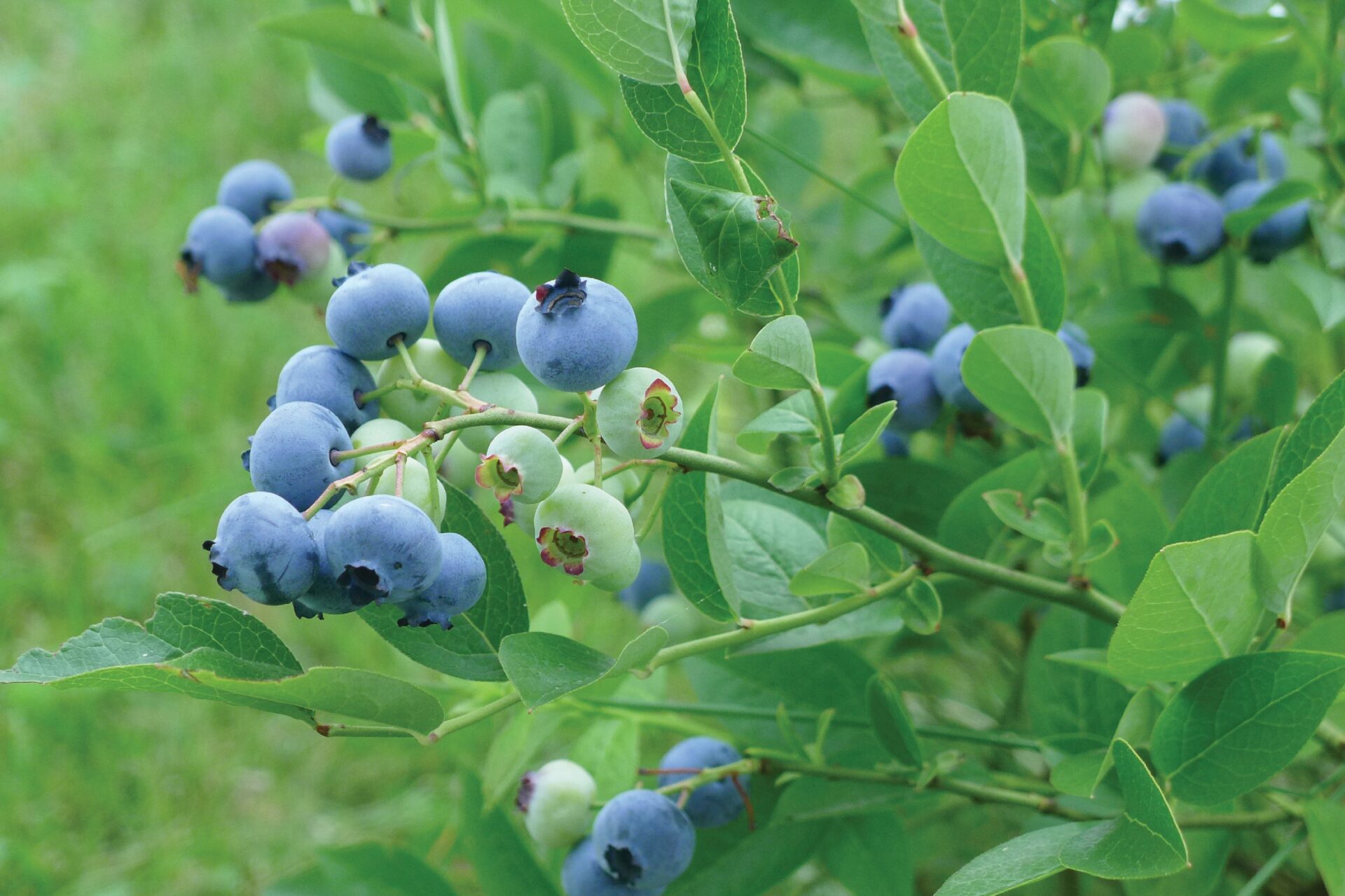
Photo: Glysiak, CC BY 4.0, Wikimedia Commons
A Common Fruit for Just Over a Century
The cultivated blueberry we now find year-round at the grocery store — the highbush blueberry (Vaccinium corymbosum) — wasn’t actually a widely cultivated crop for very long. This fruit is native to North America, and turning a wild-foraged berry into a cultivable crop only happened in the early 20th century. USDA botanist Frederick Vernon Coville (1867-1937) began experiments in 1905 on a farm he set up in New Hampshire, and between 1906 and 1910 established that blueberries only grow in acidic soil (roughly pH 4.5 to 4.8). Pinning down this soil requirement was the decisive breakthrough that turned blueberries from a foraged crop into a cultivable one. Coville then began collaborating in 1911 with Elizabeth Coleman White, a horticulturist in Whitesbog, New Jersey. White mobilized local pickers and residents to find and mark wild shrubs bearing unusually large berries, then collected them herself and supplied them to Coville as breeding stock. Their collaboration continued for nearly 26 years, until Coville’s death in 1937, and as a result, the first highbush blueberries bred through controlled crossing and managed cultivation went to commercial market in 1916.
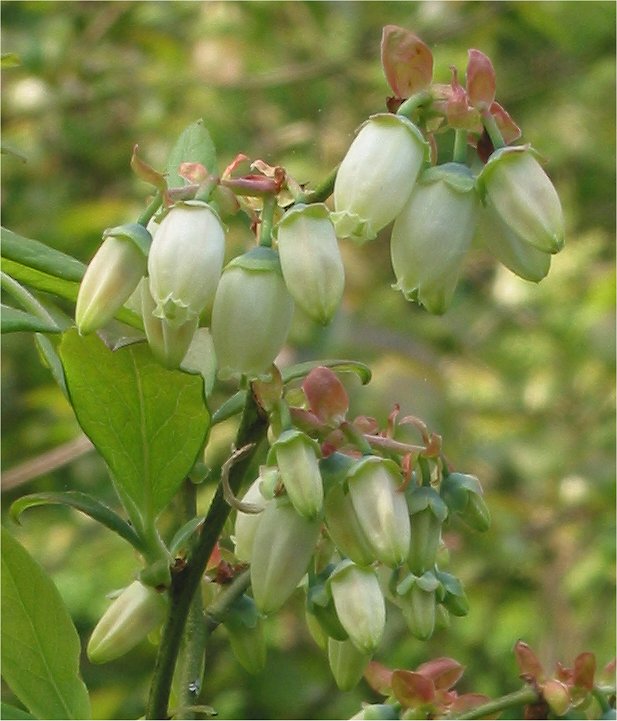
Photo: Rasbak, CC BY-SA 3.0, Wikimedia Commons
Korea’s “Native Blueberry” Is a Different Species
Korea also has native plants belonging to the genus Vaccinium. The most notable are jeonggeum-namu (Vaccinium oldhamii), which grows in the mountains of the central-southern region, and deuljjuk-namu (Vaccinium uliginosum), found on Jeju’s Hallasan and in the high-altitude regions of the north. Of these, jeonggeum-namu is managed by Korea’s Ministry of Environment as a species requiring approval for export. These trees, however, are not the same species as the cultivated blueberry sold at the grocery store. The cultivated blueberry (Vaccinium corymbosum), as noted above, is native to North America, while jeonggeum-namu and deuljjuk-namu are separate species entirely. Both plants merely belong to the same genus, Vaccinium — the phrase “Korea’s native blueberry” should be understood strictly as referring to related trees in the same genus, not the same species.
An Elaborate Nanostructure Inside a Common Fruit
Even a small fruit that lands on the breakfast table every morning hides an optical device this elaborate: a dense absorbing background built from anthocyanin, and above it, a scattering layer of randomly stacked nanocrystals that scatter blue and ultraviolet light. Once you understand the design principle behind this two-layer structure, the next time you rub a blueberry between your fingers, that hazy powder will feel newly remarkable — not simple dust, but an invisible, nanoscale structure.
References
- Middleton, R. et al., “Self-assembled, disordered structural color from fruit wax bloom”, Science Advances (2024) — https://pmc.ncbi.nlm.nih.gov/articles/PMC10849586/
- “Frederick V. Coville and the History of North American Highbush Blueberry Culture”, Rutgers University Libraries — https://rucore.libraries.rutgers.edu/rutgers-lib/45986/record/
- “Celebrating the 100th anniversary of highbush blueberry domestication”, International Society for Horticultural Science (ISHS) — https://www.ishs.org/ishs-article/1180_19
- Nongupin News, “Jeonggeum-namu, the native blueberry good for preventing adult diseases” (citing the Ministry of Environment’s export-approval species designation) — https://www.nongupin.co.kr/news/articleView.html?idxno=42733
- “The most interesting layer of wax in the world”, The Botanist in the Kitchen — https://botanistinthekitchen.blog/2012/12/28/the-most-interesting-layer-of-wax-in-the-world/
- “Developmental pattern of grapevine (Vitis vinifera L.) berry cuticular wax”, PMC — https://www.ncbi.nlm.nih.gov/pmc/articles/PMC7894928/
- “Anthocyanins”, UC Davis Waterhouse Lab — https://waterhouse.ucdavis.edu/whats-in-wine/anthocyanins
- “Anthocyanidins and anthocyanins: colored pigments as food, pharmaceutical ingredients”, PMC — https://www.ncbi.nlm.nih.gov/pmc/articles/PMC5613902/