
A blow leaves the round head of a glass drop intact. Break its slender tail, however, and the whole object scatters into tiny pieces. Why can touching different parts of the same piece of glass produce such different results?
The secret of a Prince Rupert’s drop is the stress left inside it. Compression at the surface makes cracks harder to open, while the interior remains under tension. The resilient head and sudden fragmentation are two consequences of the same cooling process.
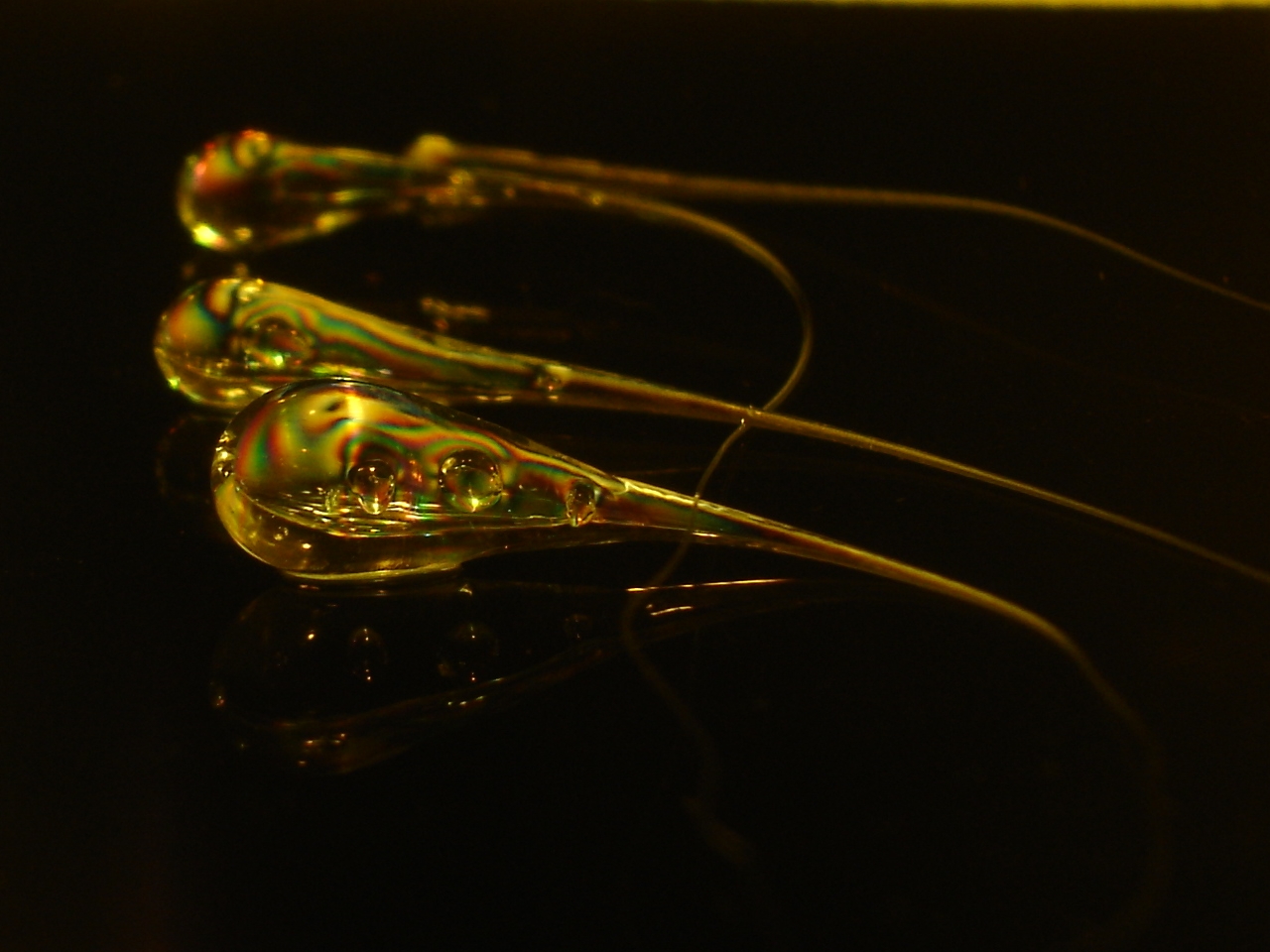
Photo: Mg3kc at English Wikipedia · Public domain · Wikimedia Commons
A glass drop named after a prince
A Prince Rupert’s drop is a tadpole-shaped piece of glass made by rapidly cooling hot glass in water. Its rounded head and long, thin tail form one continuous object. Its unusual fracture behavior still attracts scientific study.
According to Royal Society records, Prince Rupert introduced the drops to the English Court in 1660, and the Society investigated them in 1661. The name does not mean that he invented them: similar drops were already known in continental Europe. Those early records document observations of a curiosity; they should be distinguished from modern stress measurements. [1]

Video still: Purdue Engineering · CC BY 3.0 · Wikimedia Commons · 01:36 · Frame extracted and cropped from video
The outside and inside cool at different times
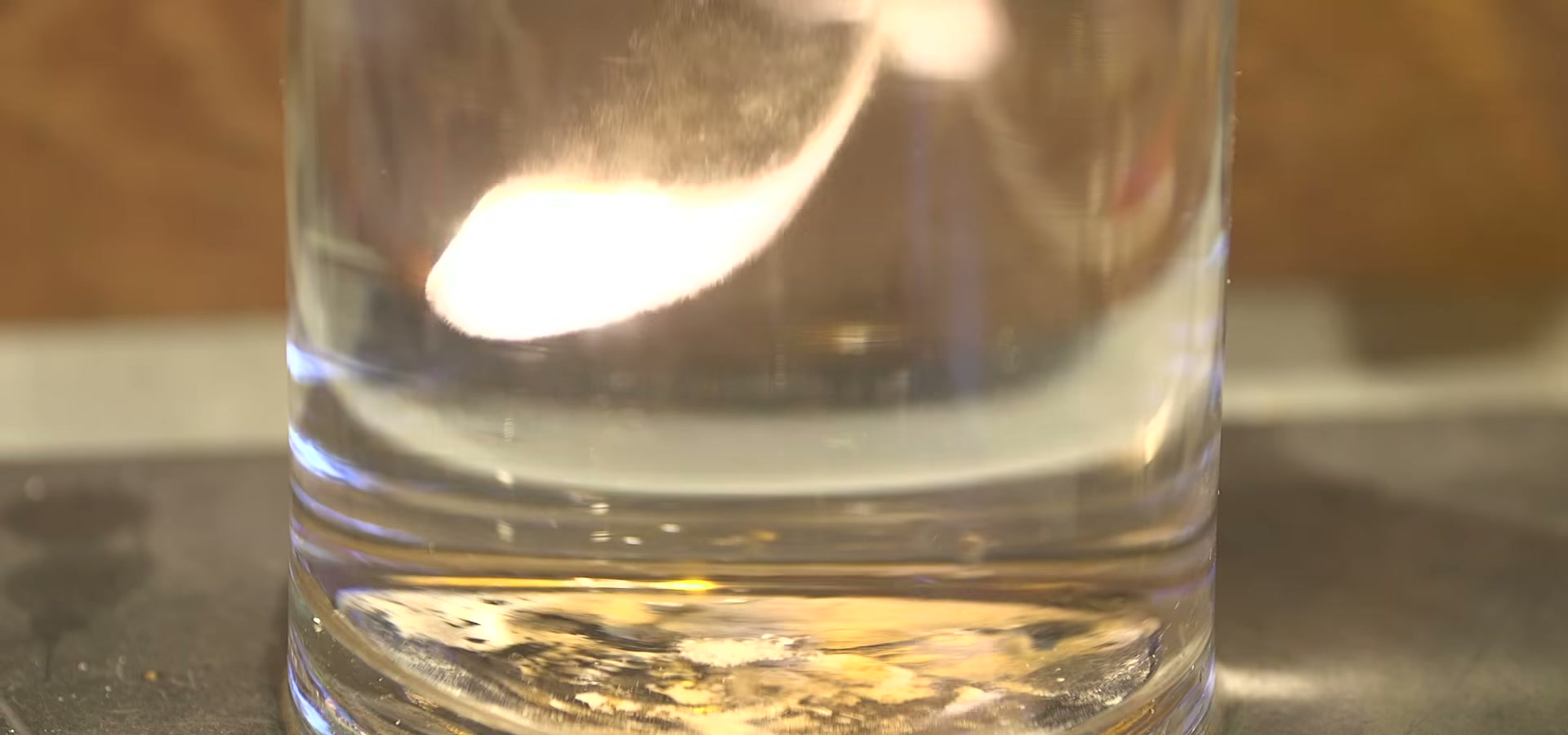
The key is rapid cooling, or quenching. When a hot drop meets water, its surface cools and becomes rigid before its interior. The interior contracts as it cools later, but cannot shrink freely because it is attached to the rigid exterior. Compression remains at the surface and tension inside. Stress that persists without a continuing external push or pull is called residual stress. [7, 8]
Video still: Purdue Engineering · CC BY 3.0 · Wikimedia Commons · 01:43 · Frame extracted and cropped from video
Compression means a material is squeezed; tension means it is stretched. These regions are not separately fitted components. They are a balancing stress distribution within one piece of glass. Composition and cooling conditions matter, so not every drop should be assumed to behave identically. A 1992 study examined residual stress and fracture in several kinds of glass. [2]
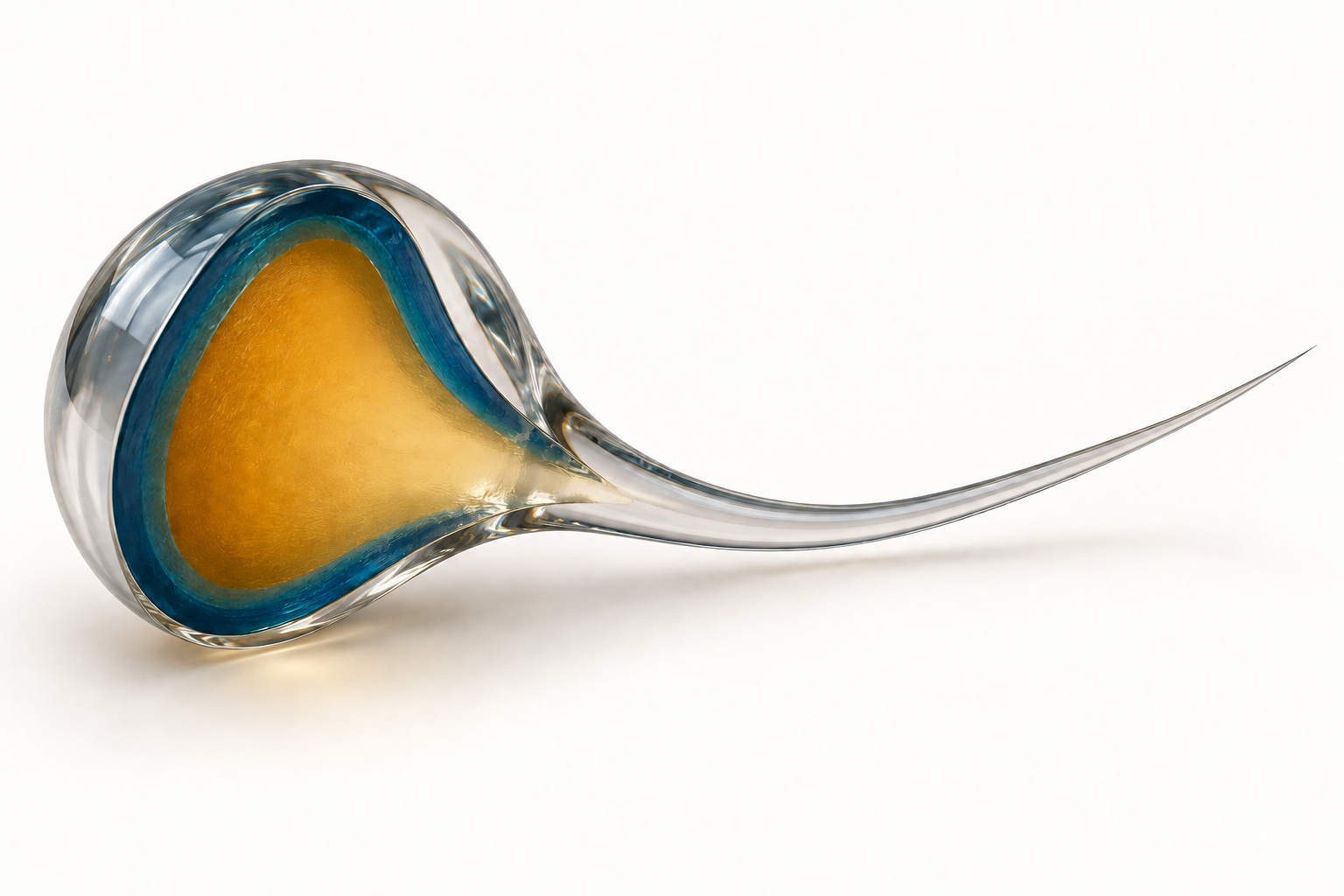
Illustration · AI-generated (Codex/ChatGPT subscription). Created to explain otherwise invisible stress regions.
The head is protected by stress that resists crack opening
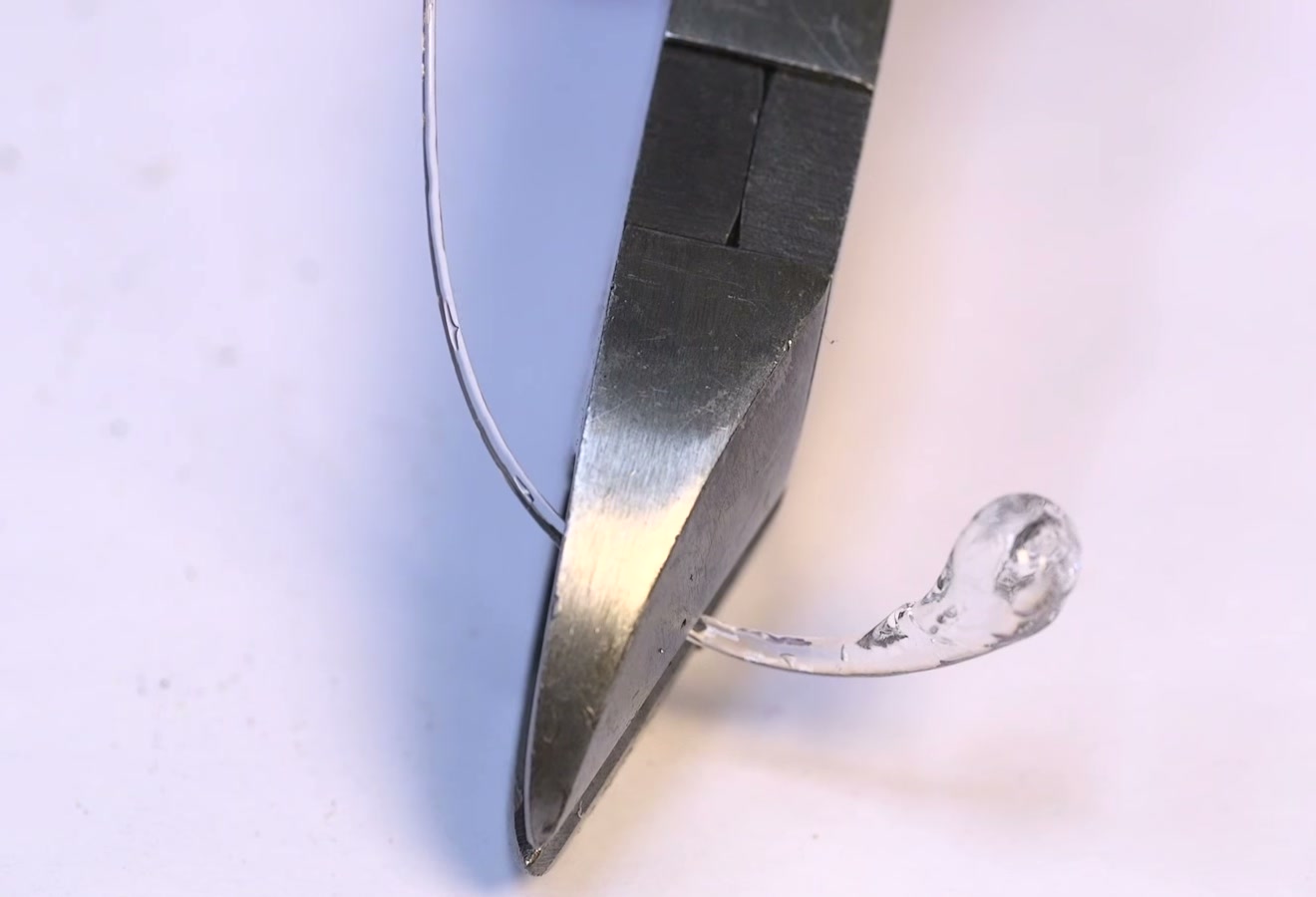
Glass fracture often involves a crack growing from a small flaw. Surface compression makes that crack harder to open. This compression helps the head of a Rupert drop withstand substantial loading. Its strength is not simply a consequence of being round, nor does the glass become a different substance. [6]
In 2016, researchers investigated the stress distribution using integrated photoelasticity. They measured changes in polarized light passing through the glass and used mathematical analysis to identify the compressed exterior and tensile interior. A colored optical pattern is not, by itself, a direct reading of stress values. [6]

Video still: Purdue Engineering · CC BY 3.0 · Wikimedia Commons · 01:12 · Frame extracted and cropped from video
This does not make the glass unbreakable. Strength depends on where and how a load is applied and on defects. A successful test on one head cannot guarantee resistance to every impact.
The thin tail provides a route into the interior
The situation changes when a tail fracture reaches the tensile interior. Stress that tends to open cracks, together with stored elastic energy, helps the fracture advance. High-speed photography shows a fracture front moving from the tail toward the head and branching. A 1994 study recorded this advance; a 1998 study used a refractive-index-matched liquid to observe branching more clearly. [3, 4]
In a 2009 soda-lime-glass experiment, the fracture front advanced at about 1.7 kilometers per second. This is the speed of fracture propagation, not the speed at which fragments fly away. It is not a fixed value for every drop, either. [5]
Video still: Purdue Engineering · CC BY 3.0 · Wikimedia Commons · 00:26 · Frame extracted and cropped from video
Saying that a tiny impact on the tail creates an enormous amount of energy misses the point. The damage supplies a starting condition; energy stored during quenching contributes to the subsequent fracture. This is distinct from an explosion involving combustion or a chemical reaction. [8]
Small fragments preserve a record of fracture
In 2021, researchers used X-ray microtomography to examine the fragments of a broken drop. They identified more than 20,000 pieces from one drop. That result belongs to a particular specimen and measurement resolution; it is not a rule that every drop breaks into the same number or size of pieces. [7]
A 2022 study found that fragment-size distributions varied with the surrounding medium, including air, water and syrup. Saying that a drop shattered is therefore only a starting point. Comparing observations properly also requires knowing the glass, its cooling history and the environment in which it broke. [8]
A related principle in toughened glass
Industrial thermally toughened glass also uses surface compression balanced by internal tension. Manufacturer Pilkington identifies compression created by heat treatment as the reason for the increased strength. When the glass breaks, its relatively small fragments help reduce the risk of injury. That does not make the fragments harmless. [9]
A Rupert drop and a sheet of glass differ in geometry and product requirements. A stress value or fracture speed measured in a drop cannot simply be assigned to a window. What connects them is a materials-design principle: surface compression makes crack growth harder.
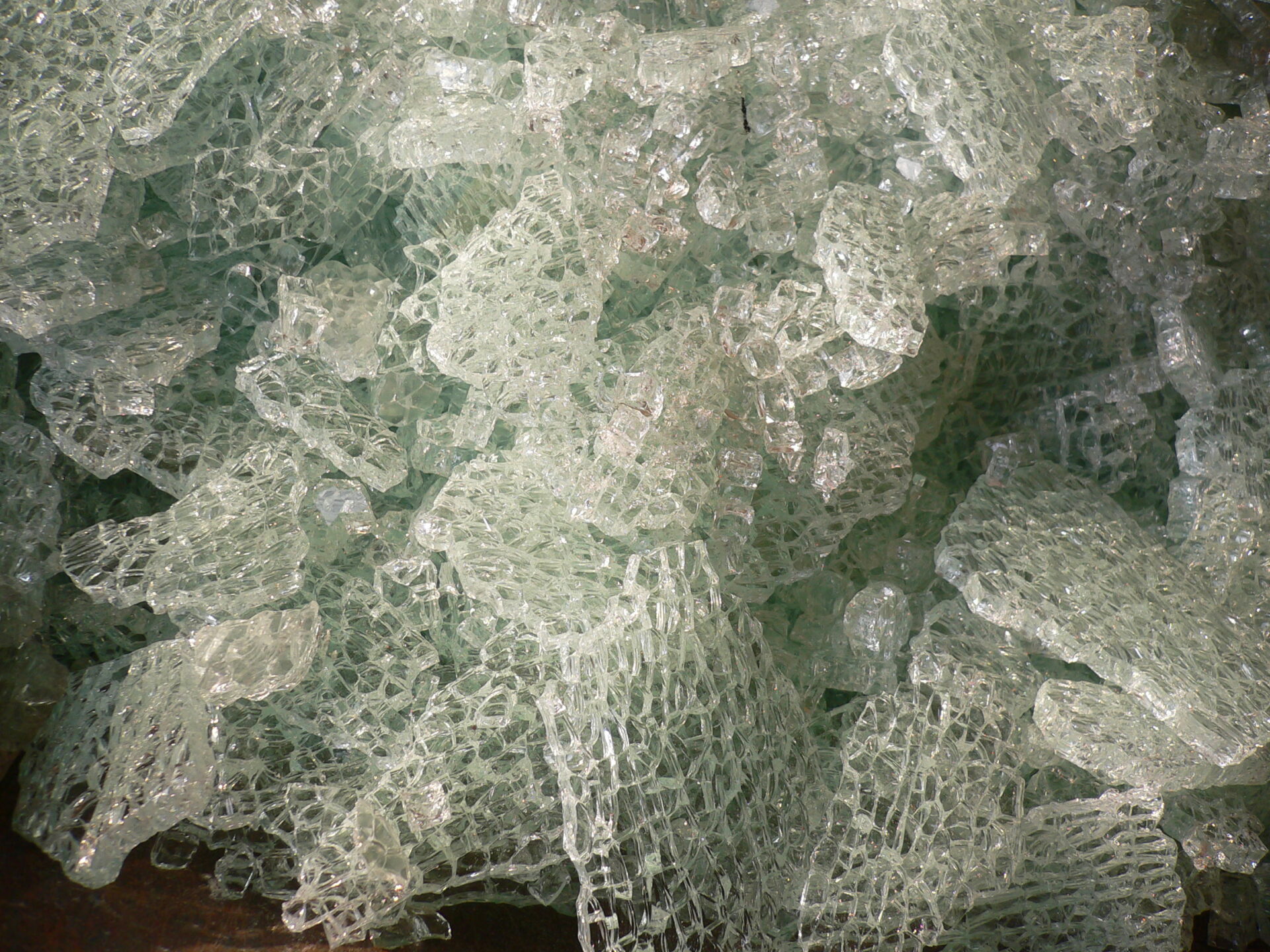
Photo: Georg Slickers · CC BY-SA 3.0 · Wikimedia Commons
One process produces both strength and fragility
A Prince Rupert’s drop shows why the statement “glass is weak” needs qualification. Cooling history, the location of stored stress and the place where a crack begins matter alongside composition. Residual stress explains both why the head resists fracture and why a broken tail can bring down the whole object.
The experimental scenes in this article explain research evidence. Hot glass and sharp fragments are best observed through records of experiments with protective equipment, rather than by attempting them at home.
References
- Prince Rupert’s drop (Royal Society picture-library record for 1671 manuscript)
- Rupert’s glass drops: Residual-stress measurements and calculations and hypotheses for explaining disintegrating fracture (Johnson and Chandrasekar, 1992)
- The explosive disintegration of Prince Rupert’s drops (Chandrasekar and Chaudhri, 1994)
- Crack bifurcation in disintegrating Prince Rupert’s drops (Chaudhri, 1998)
- The role of residual stress in a Prince Rupert’s drop of soda-lime glass undergoing a self-sustained and stable destruction/fracture wave (Chaudhri, 2009)
- On the extraordinary strength of Prince Rupert’s drops (Aben et al., 2016)
- Explosive fragmentation of Prince Rupert’s drops leads to well-defined fragment sizes (Kooij et al., 2021)
- Prince Rupert’s Drops: An analysis of fragmentation by thermal stresses and quench granulation of glass and bubbly glass (Cashman, Liu and Rust, 2022)
- Pilkington Toughened Glass — surface compression and fracture behavior