
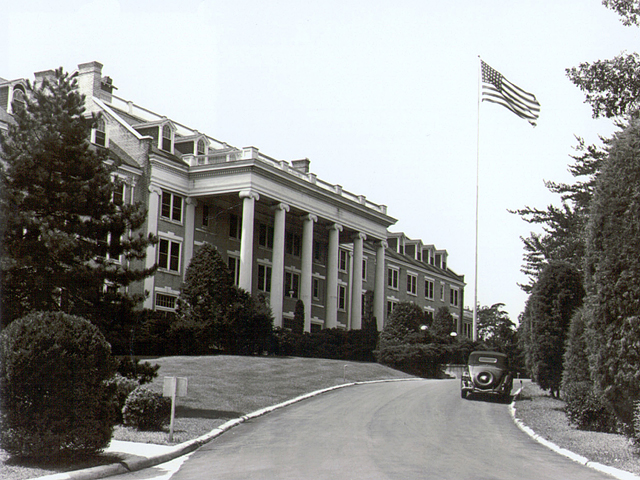
In February 1943, a branch of the US Army’s Signal Intelligence Service quietly opened its doors in an old girls’ school building in Arlington, Virginia. Its purpose was to look into Soviet diplomatic communications. At stake was a cipher considered theoretically unbreakable — the one-time pad, designed to be used once and then discarded. Yet a single small mistake made by the Soviets themselves opened the door to 37 years of interception and decryption work, a result that would reshape the course of American Cold War counterintelligence history. This effort would later be given the codename “Venona.”
Background: The Colonel Who Didn’t Trust Stalin
The Venona project was officially launched on February 1, 1943, by the US Army’s Signal Intelligence Service. Project headquarters were set up in a former girls’ school building in Arlington, Virginia, known as “Arlington Hall.”
The man who ordered the project was Colonel Carter W. Clarke, deputy chief of Army Intelligence (G-2). Clarke fundamentally distrusted Soviet leader Joseph Stalin. His greatest fear was a scenario in which the Soviet Union struck a separate peace with Germany. If the Soviets and Germany ended the war independently of the Allies, Germany would be free to redirect the forces tied down on the Eastern Front entirely to the west, against Britain and the United States. Clarke judged that intercepting and analyzing Soviet diplomatic communications was necessary to detect any such move in advance.
The project that began this way targeted intercepted cables from Soviet intelligence agencies — chiefly the NKVD (People’s Commissariat for Internal Affairs) and the GRU (military intelligence) — that had been accumulating since 1939. The project continued throughout the entire Cold War before it finally concluded on October 1, 1980, after a total of 37 years.
The Unbreakable Cipher: Cracks in the One-Time Pad
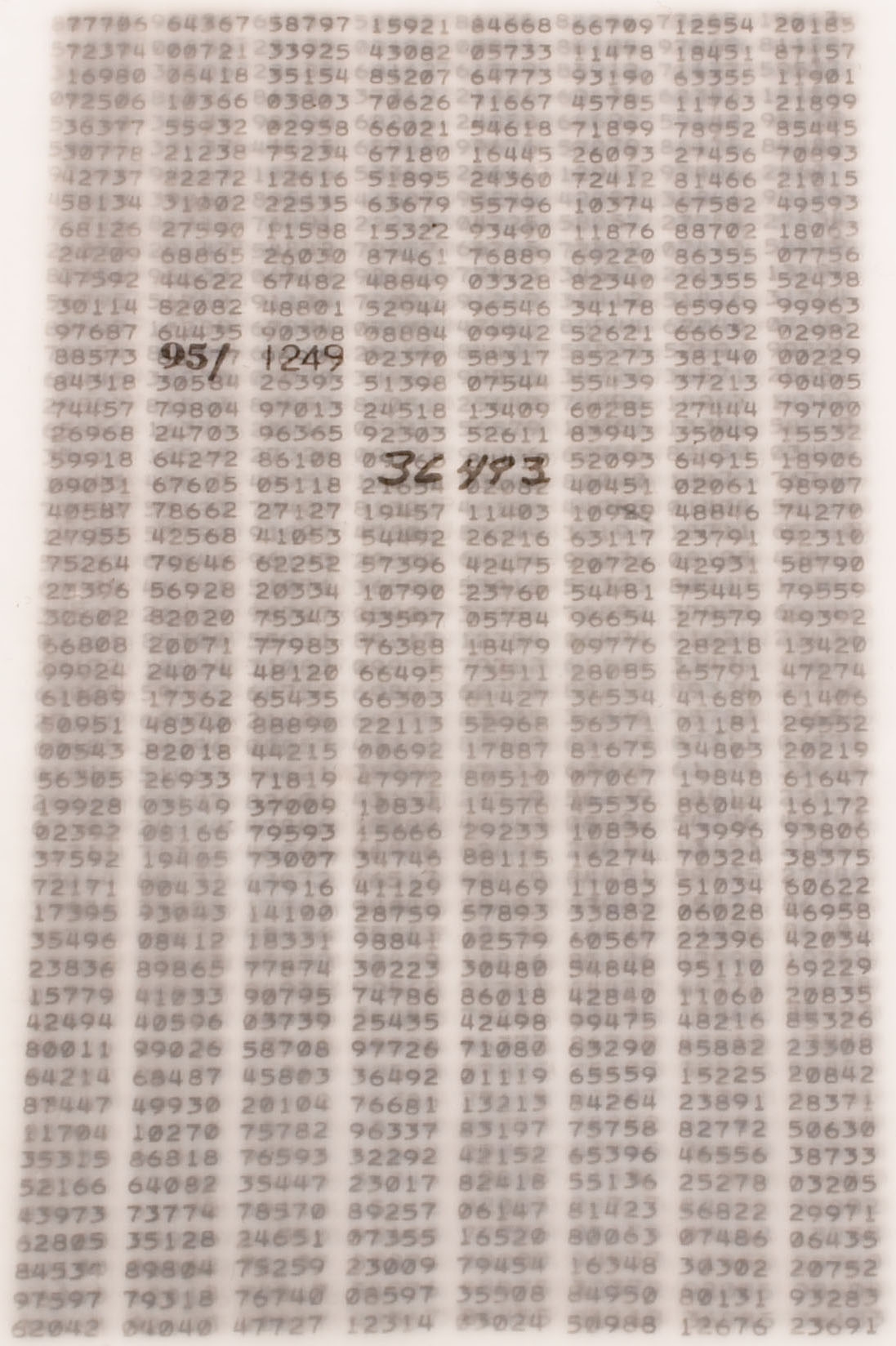
The one-time pad is regarded in cryptography as a method with theoretically perfect security. By combining a randomly generated key (K) with plaintext (P) to produce ciphertext (C) — C = P XOR K — and using that key exactly once before discarding it, an attacker cannot recover the original text no matter how much ciphertext is collected. The catch is that this security holds only as long as the premise of being “used exactly once” is actually honored.
In early 1942, the Soviet Union broke this premise itself. As German forces advanced on Moscow, the Eighth Directorate, the Soviet intelligence unit responsible for producing the key pads, was under severe shortages of materials and personnel. Under that pressure, roughly 35,000 pages of key material (cipher addition tables) were mistakenly duplicated, and these identical key pages ended up being distributed to different recipients. It was about the worst mistake that could happen in cipher production — the equivalent of using the same key to lock two different padlocks.
The first person to notice this crack was Lieutenant Richard Hallock, an analyst at Arlington Hall. In the fall of 1943, while analyzing Soviet “Trade”-related cables, Hallock detected an anomaly indicating that two different messages had been statistically encrypted with the same key. Confirmation of this phenomenon, which cryptologists call “depth,” revealed for the first time that the Soviets had reused a key.
XORing two ciphertexts that share a reused key cancels out the key component, leaving only a combined mixture of the two plaintexts. Analysts then applied linguistic regularities and expected phrases (cribs) to this mixture, reconstructing the plaintext letter by letter. It was grueling, slow work, but it was the first crack in a cipher that was supposed to be theoretically unbreakable.
Breakthrough: Meredith Gardner and the Manhattan Project Cable
Linguist Meredith Gardner, who joined the Venona team in January 1946, was the figure who created a decisive turning point in this arduous decryption effort. He discovered a pattern in which the Soviets inserted markers reading “spell” and “endspell” into the code whenever they transmitted unfamiliar names or technical terms. Using this clue as a foothold, Gardner worked backward to reconstruct the portion of the codebook corresponding to English spelling.
This effort culminated on December 20, 1946. Gardner succeeded in decrypting a KGB cable that had been sent two years earlier, in 1944, which contained a list of scientists involved in the Manhattan Project — the United States’ program to develop the atomic bomb. It is regarded as one of the standout achievements in early Cold War American counterintelligence history.
By the time the project ended, roughly 2,900 to 3,000 Soviet intelligence cables had been decrypted in whole or in part. This represented only a small fraction of the total volume actually intercepted. Most of the successfully decrypted messages had been sent between 1942 and 1945, with some dating as late as 1948.
The Shape of a Spy Network: Rosenberg and Fuchs
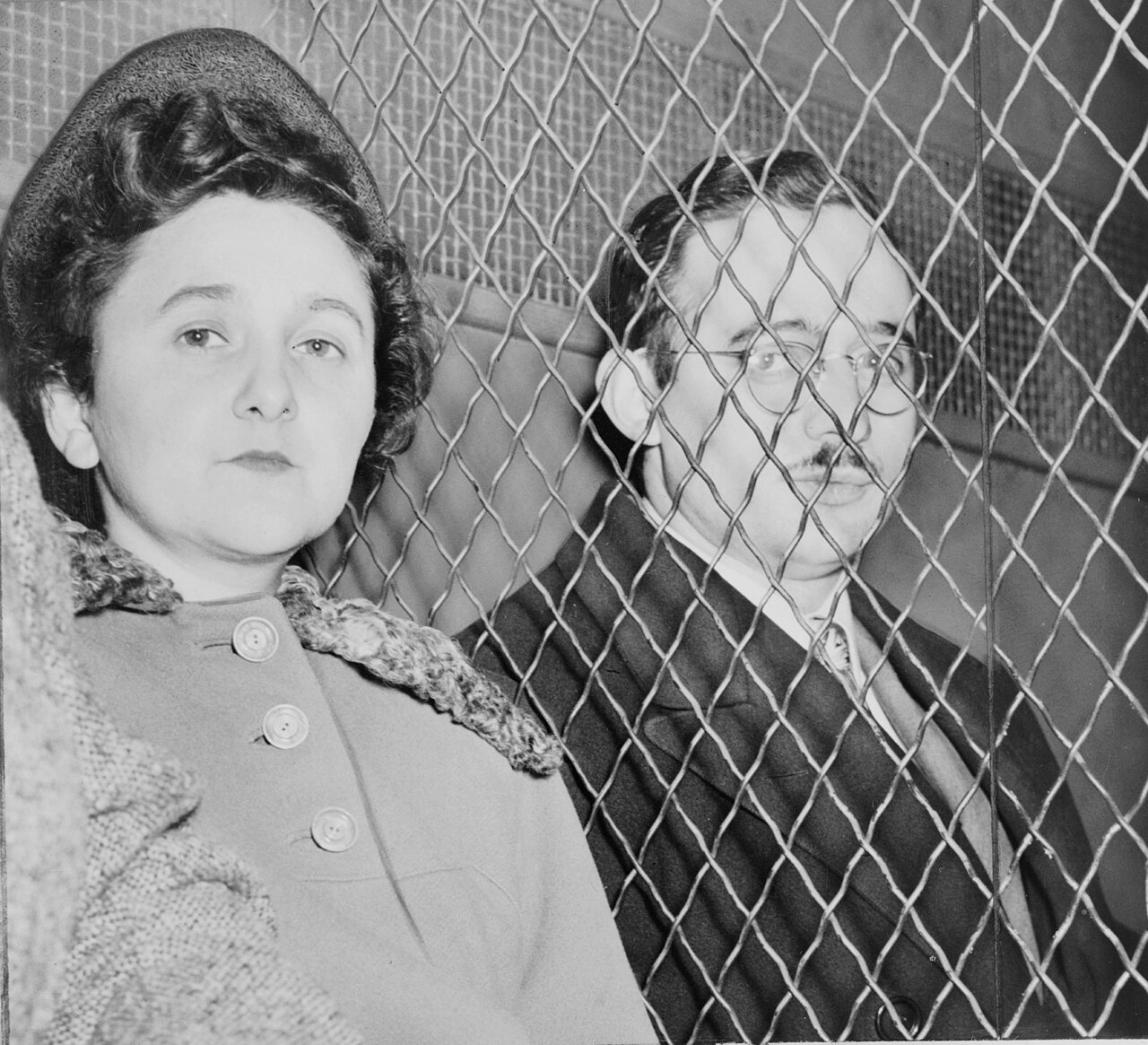
The most widely known case exposed by Venona decrypts is the Rosenberg espionage case. Venona cables support the conclusion that Julius Rosenberg was the key link connecting couriers from Los Alamos to the KGB — in other words, that he ran a spy network. Yet at the 1951 Rosenberg trial, Venona material was never presented as evidence at all. Because the project itself was top secret, prosecutors faced a dilemma: the moment they introduced it in court, they would have to reveal the project’s very existence.
The general assessment based on the material that later came to light is that his wife Ethel Rosenberg’s degree of involvement was comparatively weaker than Julius’s. One Venona document, a cable sent in 1944, mentions the recruitment of Ruth Greenglass, wife of David Greenglass, but no content directly identifying Ethel has been confirmed. For this reason, some scholars have suggested that had the Venona material been made public at the time of the trial, Ethel might not have been sentenced to death.
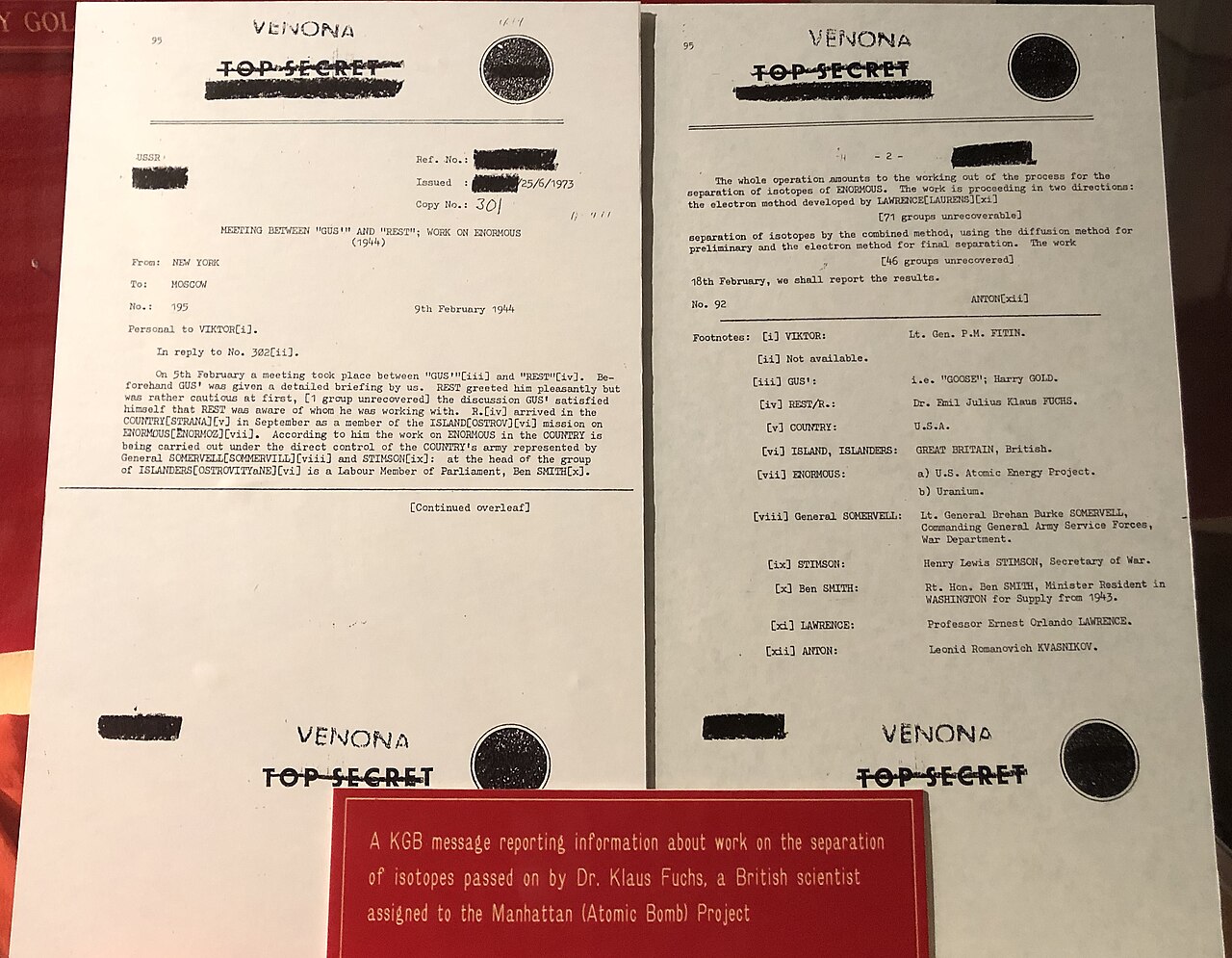
Another case involves the physicist Klaus Fuchs. When the Soviet Union successfully tested its first atomic bomb in August 1949, the United States and Britain began tracing how the information had leaked. Venona decryption of a 1944 cable revealed that technical information about the atomic bomb from Los Alamos had flowed to Moscow, and on this basis the FBI and British intelligence identified the leak as Klaus Fuchs. Fuchs confessed on his own on January 27, 1950. He admitted that he had been passing information to the Soviets since 1942.
A Name Still in Dispute: Alger Hiss
Not every name Venona brought to light was identified as clearly and conclusively as Rosenberg’s or Fuchs’s. A prime example is the dispute surrounding senior State Department official Alger Hiss.
Venona cable No. 1822, sent from Washington to Moscow on March 30, 1945, refers to a Soviet agent under the cover name “ALES.” When the NSA released its English translation of this cable in 1996, a footnote stated that ALES was “probably” Alger Hiss. This, however, was presented not as a definitive conclusion but as an inference based on circumstantial evidence.
Debate among historians over this identification continues to this day. Eduard Mark and others have lent weight to the identification with Hiss, arguing that the cable’s context makes it clear that ALES was part of Secretary of State Edward Stettinius’s delegation to Moscow. John Lowenthal and others, by contrast, dispute the identification, pointing out that the cable describes ALES as someone who had continuously handled military intelligence for eleven years, from 1935 to 1945, whereas Hiss’s relationship with government witness Whittaker Chambers had ended by 1938 at the latest, and what Hiss handled was State Department documents rather than military intelligence.
Even compilations that list the Americans named on the basis of Venona documents state explicitly that how deeply these individuals were actually involved in Soviet intelligence activity remains a matter of dispute. Many of the names do not appear directly in the cables, or lack conclusive grounds for identification, and so rely on researchers’ inferences. For this reason, the accurate way to understand the Alger Hiss case is not that “Venona proved it,” but that “Venona suggests it, while scholars still dispute it.”
Declassification: An Archive Opened After Half a Century
The Venona documents remained top secret for a long time until, on July 11, 1995, the NSA first released them to the public on the recommendation of the Commission on Protecting and Reducing Government Secrecy — commonly known as the “Moynihan Commission” — a body under the US Congress. Further releases followed sequentially in October 1995, March 1996, July 1996, and October 1996, five releases in total.
Senator Daniel Patrick Moynihan, who led the commission, believed that now that the Cold War had ended, it was time to reexamine the United States’ vast classification system, which had persisted for 45 years. In the commission’s report, he presented the release of Venona as a prime example of a “declassification success story” — showing that even information once classified at the highest level of national security can, over time, lose its protective value and be safely released.
The original materials related to the Venona project — project plans, case files, decryption copies, and more — are now held at the US National Archives (Record Group 457) and the Library of Congress. The NSA also makes available, through its own declassification and transparency initiative page, a number of official historical materials and explanatory guides, including an introductory history and guide to the translations written by Robert Louis Benson.
What Remains: Half Truth, Half Dispute
The Venona project is not a finished story. Of all the Soviet communications intercepted, only a small fraction was ever successfully decrypted, and even among those, many cases remain where the context is broken or the real person behind a cover name was never confirmed. In some cases, like Rosenberg and Fuchs, later confessions or circumstantial evidence backed up what Venona suggested; in others, like Hiss, scholars still cannot reach a conclusion even decades later.
Even so, what Venona left behind is clear. A single small error in Soviet cipher management, through a 37-year journey of interception, analysis, and declassification, partially exposed the reality of American Cold War counterintelligence history. And that archive is still being read, and still being reinterpreted, today, through materials made available by the National Archives, the Library of Congress, and the NSA.
References
- Wikipedia — Venona project
- The Cipher Museum — VENONA Project
- Cryptologic Foundation — This Day in History: Meredith Gardner Broke Into KGB Message re: Manhattan Project
- Spartacus Educational — Meredith Gardner
- Atomic Heritage Foundation — The Rosenberg Trial
- NBC News — Key Evidence in Rosenberg Case to Stay Secret
- MI5 — Klaus Fuchs
- Famous Trials (UMKC) — The VENONA Files and the Alger Hiss Case
- Intelligence and National Security (Taylor & Francis) — Venona and Alger Hiss: A Follow-up
- EBSCO Research Starters — Venona Cables Are Declassified
- Library of Congress — Venona Project Records, 1940-1996
- NSA — Declassification & Transparency Initiatives: Venona
- Wikipedia — List of Americans in the Venona papers
- Federation of American Scientists — Moynihan Commission Report, Chapter 3