
In a burrow amid the coral, a small crustacean with an olive body, orange legs, and a leopard-spotted carapace fixes its gaze on a snail. The next instant, a red forelimb shoots out faster than the eye can follow and shatters the shell in a single blow. This is the mantis shrimp. Despite the “shrimp” in its name, the mantis shrimp is not actually a true shrimp. Unlike the shrimp, crabs, and lobsters of the order Decapoda, the mantis shrimp belongs to a separate lineage, the order Stomatopoda. Fossil and molecular studies estimate that these two lineages split about 400 million years ago (Encyclopedia.com; Wikipedia). Its very name overturns a first piece of common knowledge.
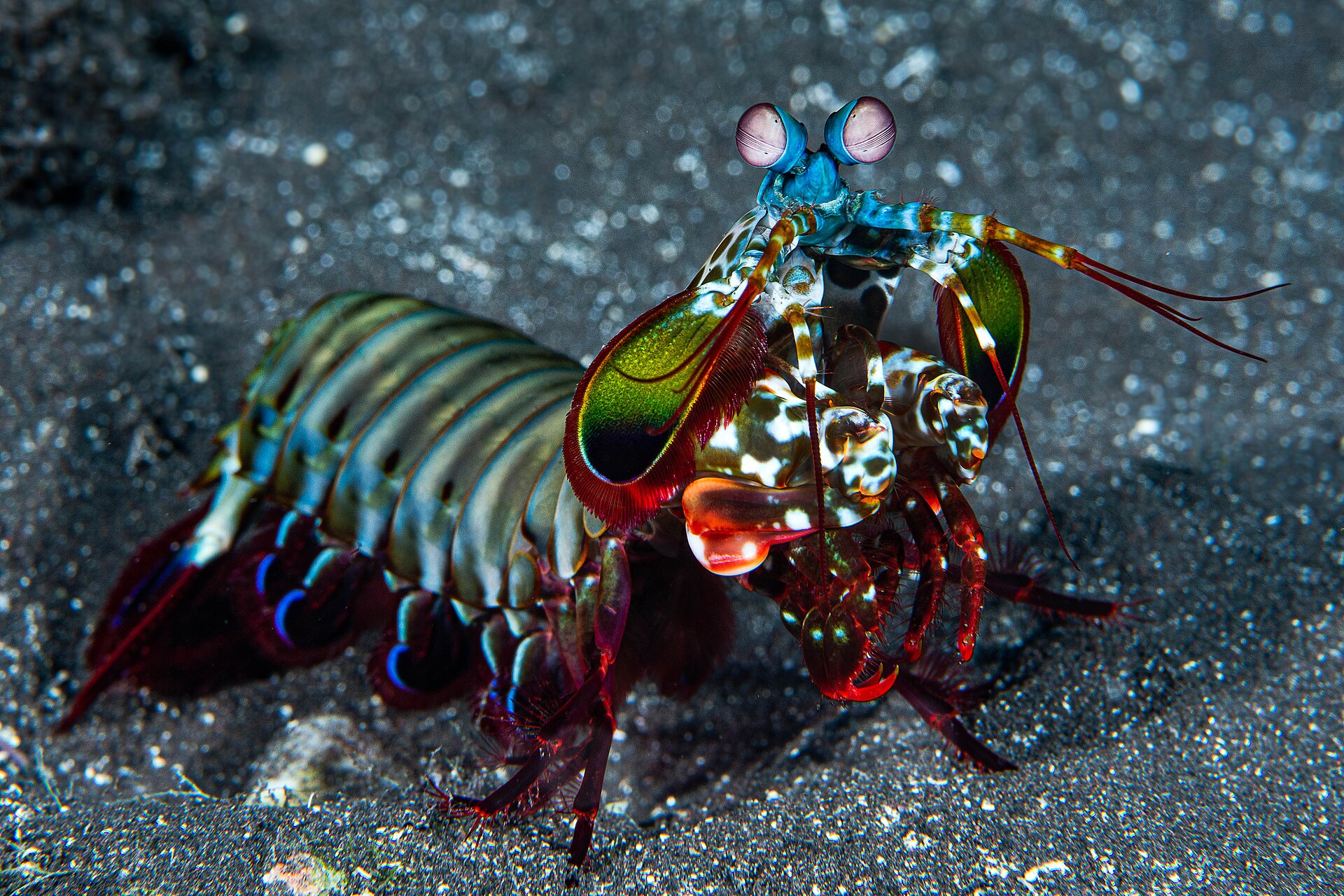
Photo · Cédric Péneau, CC BY-SA 4.0, Wikimedia Commons
Mantis shrimp fall broadly into two groups. There are smashers, which “hammer” hard-shelled prey apart with a blunt club, and spearers, which thrust a spined forelimb like a harpoon to impale soft prey such as fish (Wikipedia). The ultrafast punch discussed below belongs entirely to the smashers, and in particular to their representative species, the peacock mantis shrimp (Odontodactylus scyllarus). The two groups differ in both prey and hunting method, so lumping the physics of the punch onto spearers as well would be inaccurate.
A speed muscles cannot produce — the design of a spring and a latch
The peacock mantis shrimp’s club is launched through water at about 12–23 m/s (roughly 43–83 km/h) (Patek, Korff & Caldwell 2004, Nature). The crucial point is that this is a speed attained by driving through water — far denser than air — not through air. Its acceleration exceeds 100,000 m/s², that is, more than ten thousand times gravity (>10,000g). Several sources liken this acceleration to the launch acceleration of a small-caliber bullet, and Patek (2019) too wrote that the “strike acceleration rivals that of a bullet” (though this is only an analogy to convey scale, not a precise comparison).
The problem is the muscle. However strong a muscle is, its contraction speed has a physical limit, so it cannot produce such a speed directly. The mantis shrimp’s solution is a power-amplification structure that “winds up slowly” with the muscle and “releases” in an instant. In the forelimb’s exoskeleton there is a saddle-shaped spring — a saddle spring in the form of a hyperbolic paraboloid. While the muscle presses on this saddle to store elastic potential energy, a mineralized latch holds the forelimb in place. The moment the latch releases, the stored energy is discharged all at once and the club is launched — the same principle as slowly drawing a crossbow and firing an arrow with a single trigger pull, or a catapult (Patek, Korff & Caldwell 2004; Patek 2019).
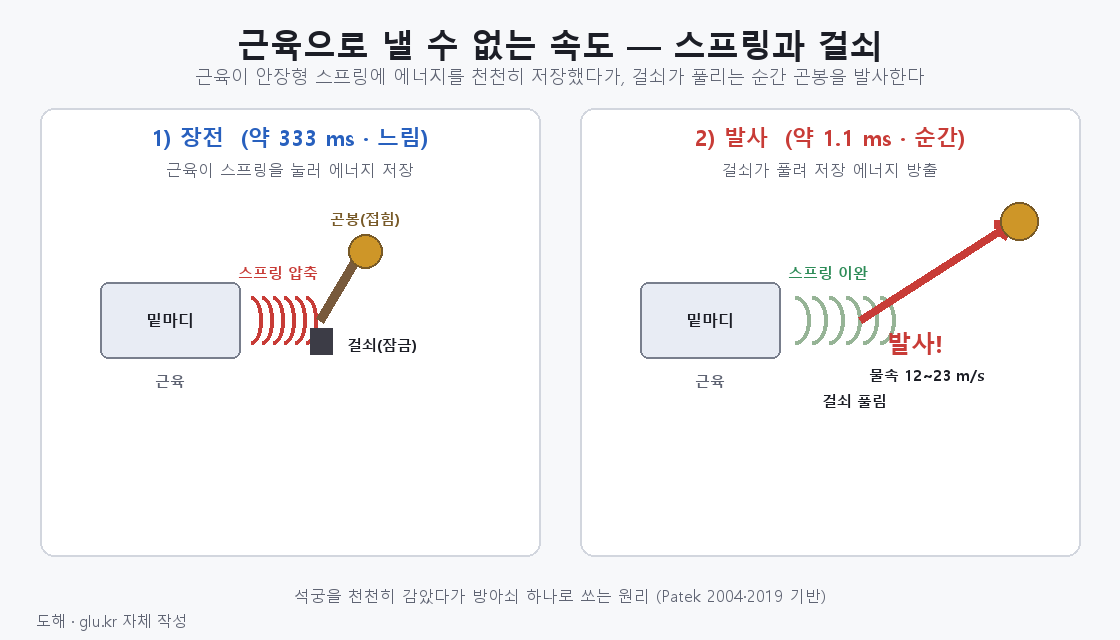
Diagram · glu.kr original
The timing makes this “wind-up and release” design even clearer. The loading phase that stores the energy is slow, taking about 333 ms — roughly 90% of the whole cycle — but the strike itself, from the latch releasing to the club reaching top speed, is about 1.1 ms, finishing within a few milliseconds (Patek 2019). It winds up slowly and releases in an instant; it does not “wind up and release within a few milliseconds.”
A fist that boils water — one punch, two strikes
The result this speed produces is what made the mantis shrimp famous. Because the club moves so fast, the pressure of the water ahead of it drops locally, and a vapor bubble forms as the water momentarily vaporizes. This is cavitation. This bubble then collapses violently, creating a second impact. In effect, a single punch strikes twice — first the direct collision of the club, second the bubble’s collapse. Depending on the surface geometry, the two force peaks follow one another roughly 390–480 μs apart (Patek & Caldwell 2005, J. Exp. Biol.). The high-speed footage in Patek’s 2004 Nature paper directly captured a vapor bubble forming and vanishing beside the prey.
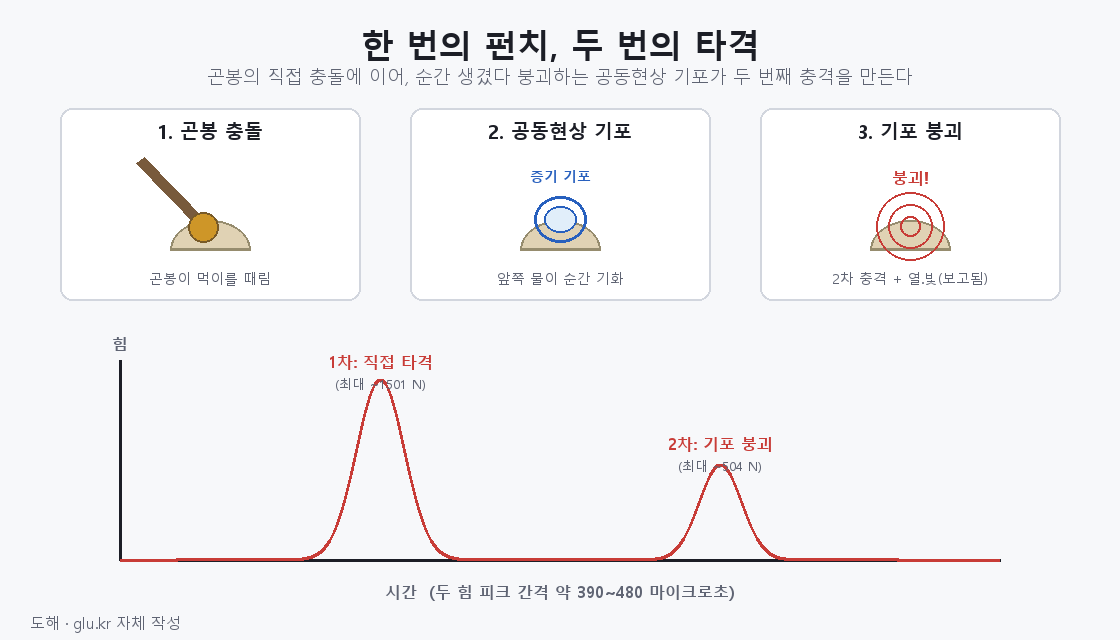
Diagram · glu.kr original
The magnitude of the force is considerable too. The club’s direct impact force reaches about 400–1501 N depending on surface geometry, and the secondary force from the bubble’s collapse was measured at up to about 504 N (Patek & Caldwell 2005). This suggests that even if the club does not touch the prey directly, the collapse impact alone can cause damage. At the extreme instant of collapse, a brief flash of light (sonoluminescence) is reported to be emitted along with heat. However, this flash is extremely brief and faint, invisible to the naked eye underwater, and the exact mechanism of the light and heat itself has not yet been fully resolved — popular expressions like “it emits visible light” or “it is hotter than the Sun” are closer to exaggeration. All told, the mantis shrimp’s punch ranks among the fastest and most powerful movements known in the animal kingdom.
A club that does not shatter itself — the wisdom of twisted plywood
One question remains. If it repeatedly shatters snail shells like this, why doesn’t the club — its own weapon — break? The answer lies in the material design inside the club. The club is a composite in which bundles of chitin fibers are combined with crystalline hydroxyapatite (calcium phosphate) mineral, and its inner fiber layers are arranged in a Bouligand (“twisted plywood”) structure, each layer rotated slightly (about 5°) from the one below (Weaver et al. 2012, Science). Even if a microcrack forms, it twists and turns as it travels along this helix, preventing the catastrophic, straight-line fracture. This principle has become a leading biomimetic example for the design of impact-absorbing materials such as aircraft composites, helmets, and body armor.
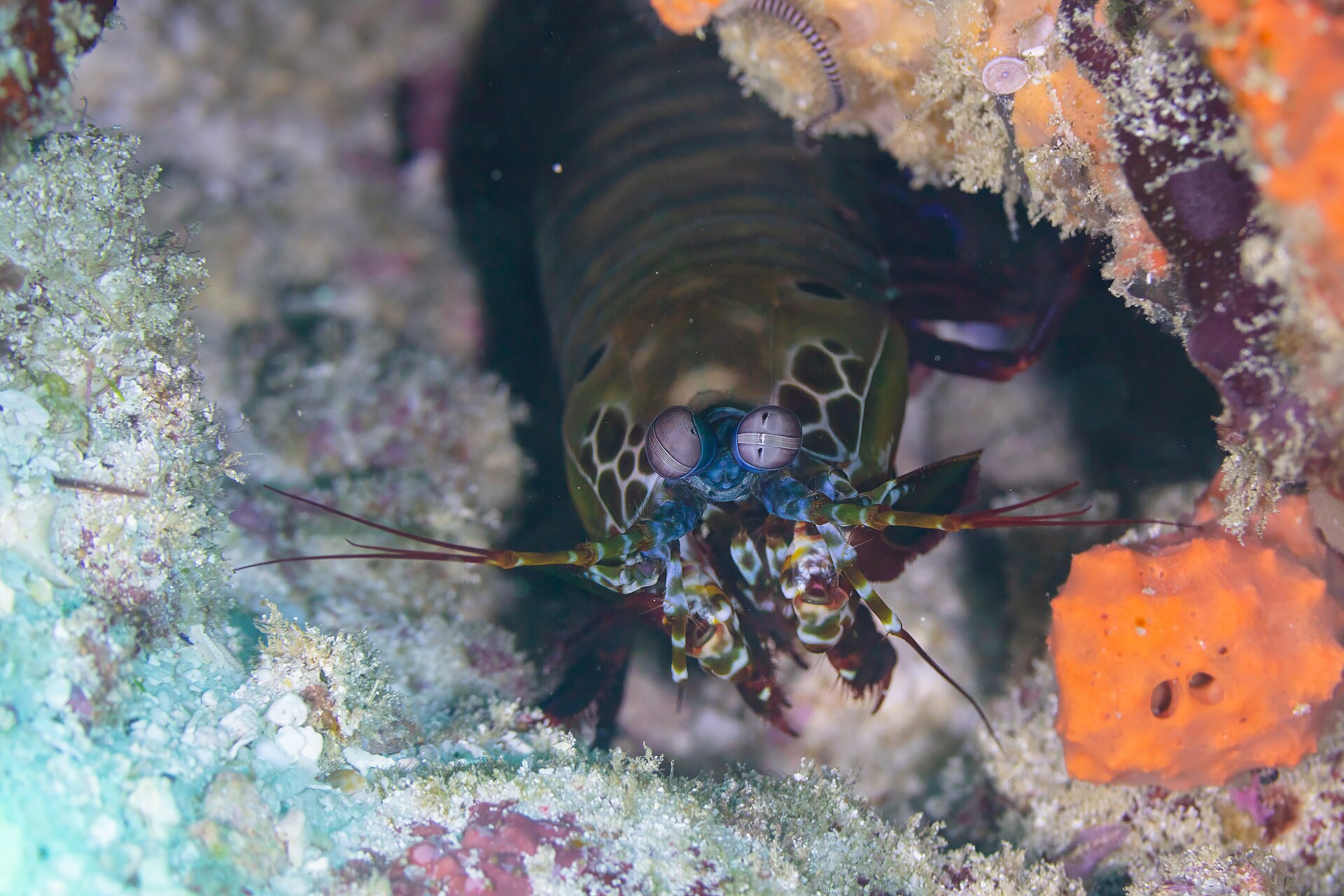
Photo · Diego Delso, CC BY-SA 4.0, Wikimedia Commons
Overturning a second common belief — the paradox of the dazzling eye
The mantis shrimp’s other claim to fame is its eyes. Mounted on stalks and moving independently of each other, each eye has its own trinocular vision, gauging distance with a single eye alone (humans need both eyes combined for stereopsis). And above all, the mantis shrimp has a remarkable 12 classes of color photoreceptors. It divides a broad spectrum, from ultraviolet (300 nm) to far red (720 nm), into 12 narrow bands, each handled separately — in contrast to humans, who have only 3 classes of color receptors (Thoen et al. 2014, Science).
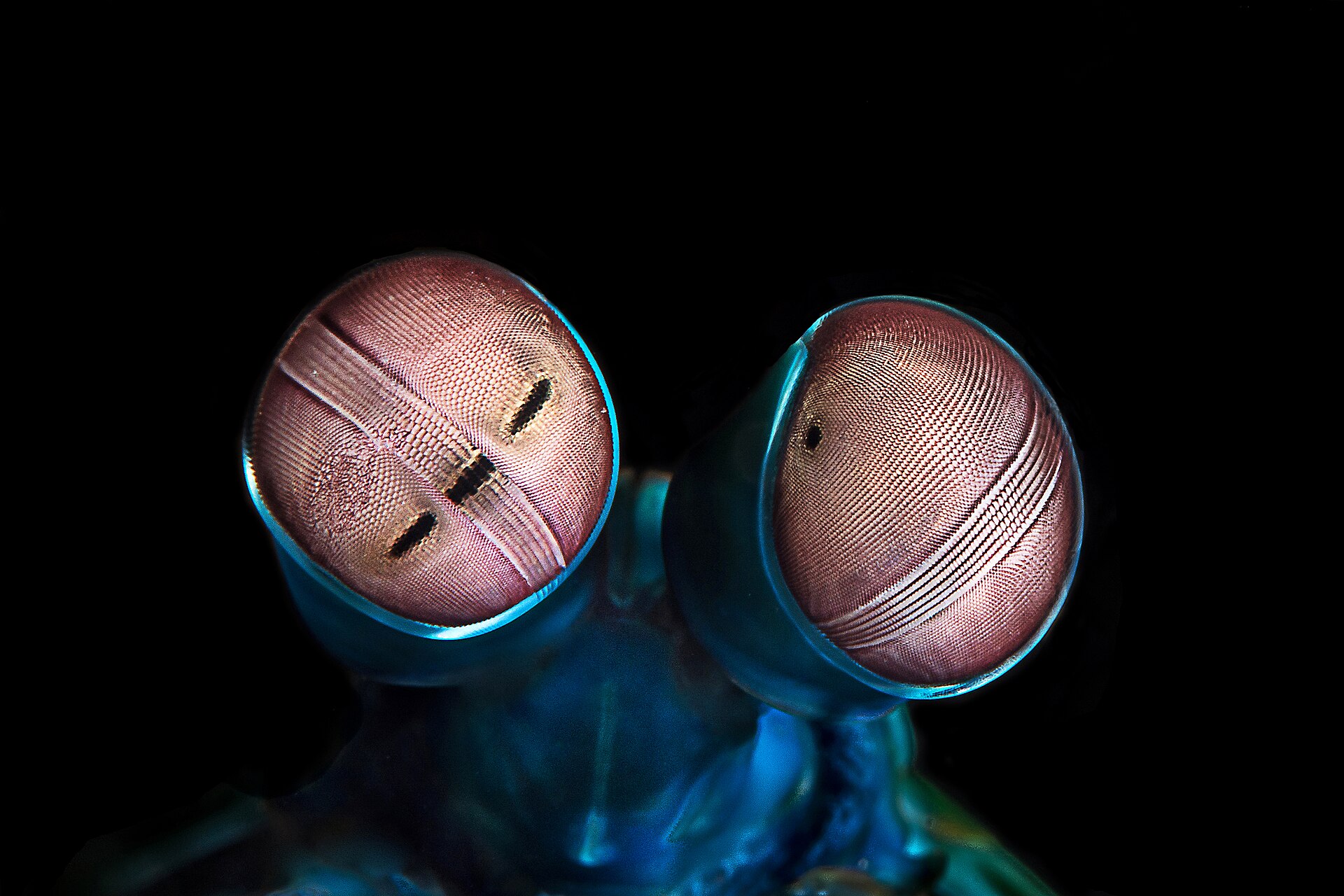
Photo · Cédric Péneau, CC BY-SA 4.0, Wikimedia Commons
From here spread the common belief that “the mantis shrimp sees 16 colors” or “sees color better than anything in the world.” But this is a misconception. First, to set the number straight, the canonical count of channels handling color is 12. If you add up all the channels handling ultraviolet and polarization as well, the number of photoreceptor types reaches about 16 in total — but this 16 is not “the number of colors it sees”; it is “the number of photoreceptor types.”
The more astonishing reversal is in performance. When Thoen et al. (2014) measured wavelength discrimination (Δλ) in behavioral experiments, the mantis shrimp’s ability to distinguish similar colors was “surprisingly poor” — actually worse than a human’s. That a mantis shrimp with 12 classes discriminates color worse than a human with 3 is the exact opposite of common sense. This poor performance leads to one conclusion: the mantis shrimp does not use the method humans and many animals use — color-opponent coding, in which the outputs of multiple receptors are subtracted and compared by downstream neurons. In the paper’s words, the poor performance “rules out color vision that makes use of the conventional color-opponent coding system.” This much is a fact established by experiment.

Diagram · glu.kr original
So why be equipped with as many as 12 channels? Thoen et al. offer a hypothesis. Instead of precisely comparing channel outputs in the brain, the mantis shrimp combines up-and-down scanning eye movements with temporal signaling to “recognize” color rather than “discriminate” it — an entirely different method. Rather than fine discrimination, the explanation goes, it is a strategy for quickly “recognizing” color without the brain’s comparison computations. But as the paper’s own verb — “suggest” — shows, this scanning mechanism is not an established fact but a leading hypothesis proposed to explain the negative result above. It cannot be stated as a confirmed mechanism.
Even invisible light — circular polarization vision
The mantis shrimp’s eyes see beyond color, all the way to polarization. In particular they detect circularly polarized light — light that rotates like a helix — and Chiou et al. (2008, Current Biology) described and behaviorally demonstrated this ability in an animal for the first time. Given that the paper uses qualifiers like “for the first time” and “never anticipated in the animal kingdom,” this is best understood as “the only animal group known so far to detect circular polarization” — not something to assert as absolute uniqueness. The mechanism is elaborate. A cell at the top of the ommatidia in a specific row of the midband (R8) acts as a biological quarter-wave plate, converting circularly polarized light into linearly polarized light, which the cells beneath then detect. This polarization-vision principle has also inspired the design of polarization cameras and cancer-detection imaging sensors that reveal tumor margins more clearly (IEEE Spectrum).
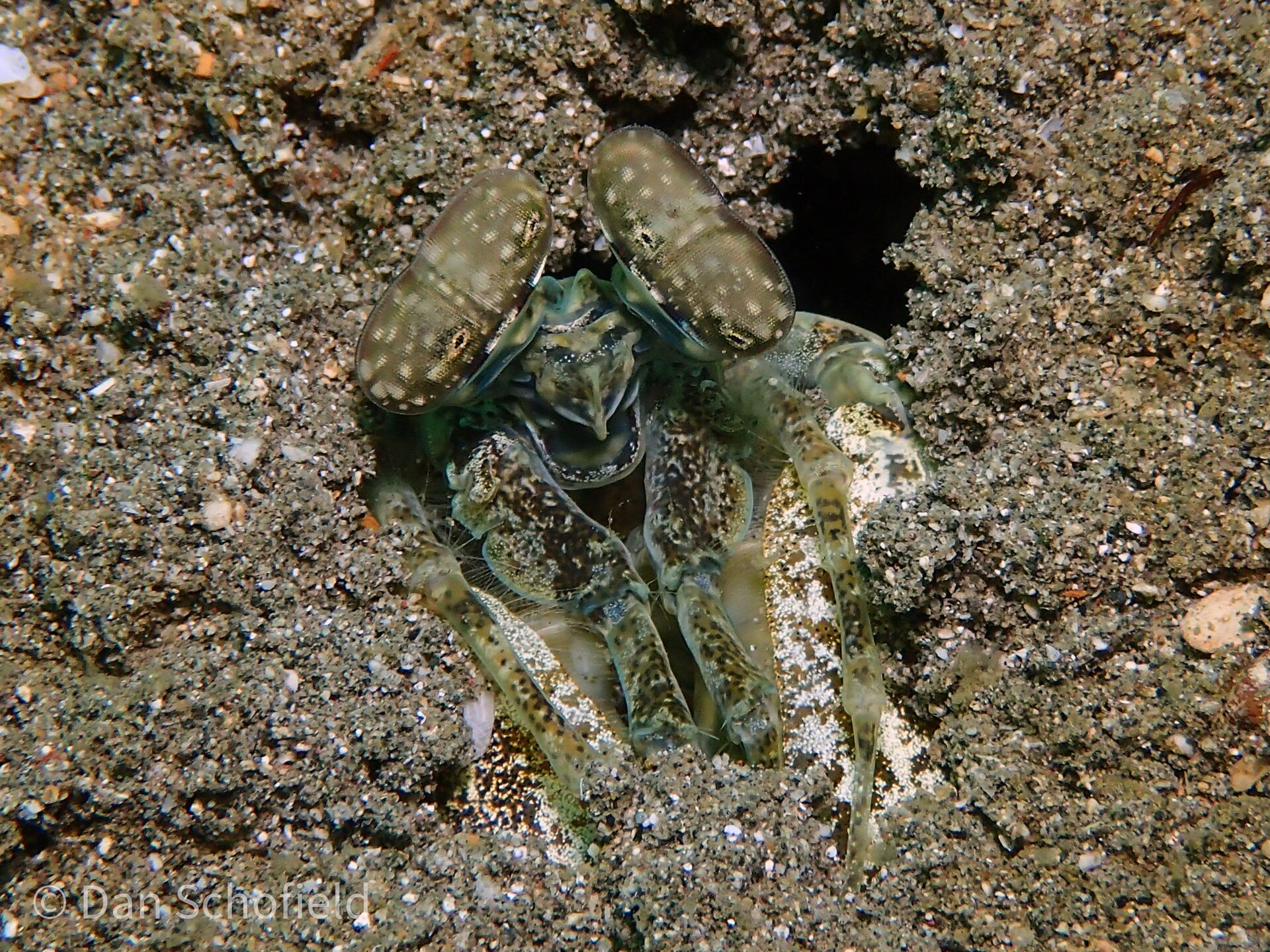
Photo · Dan Schofield, CC BY 4.0, Wikimedia Commons
Two designs in a small creature
The mantis shrimp surprises us twice. Once with an ultrafast fist that boils water — an intricate design that overcomes the muscle’s limits with a spring and a latch, armed with a material that does not shatter itself. And once again with the paradox that its famously dazzling eye is actually poor at distinguishing color, overturning our assumption that “more is better.” Whether it is the physics of a weapon or the optics of an eye, the fact that such intricate principles are layered, one upon another, inside a single crustacean no bigger than a fingernail reminds us once more that the deeper we look into the created world, the deeper our wonder grows.
References
- Patek, Korff & Caldwell 2004, Nature 428:819 (Deadly strike mechanism of a mantis shrimp) — Duke Patek Lab
- Patek & Caldwell 2005, J. Exp. Biol. 208(19):3655 (Extreme impact and cavitation forces of a biological hammer)
- Patek 2019, Integr. Comp. Biol. 59(6):1573 (The Power of Mantis Shrimp Strikes)
- Weaver et al. 2012, Science 336:1275 (The Stomatopod Dactyl Club: A Formidable Damage-Tolerant Biological Hammer)
- Thoen et al. 2014, Science 343:411 (A Different Form of Color Vision in Mantis Shrimp) — University of Bristol
- Chiou et al. 2008, Current Biology (Circular Polarization Vision in a Stomatopod Crustacean) — PubMed
- deVries et al. 2012, J. Exp. Biol. 215:4374 (Strike mechanics of an ambush predator, the spearing mantis shrimp)
- Wikipedia — Odontodactylus scyllarus (peacock mantis shrimp)
- Wikipedia — Mantis shrimp (Stomatopoda)
- IEEE Spectrum — Mantis Shrimp Eyes Inspire Cameras to See Cancer (polarization-vision biomimicry)