
Pour on liquid nitrogen until it steams white, and a small metal disk rises silently into the air above a magnetic track. But this disk does not merely float. Tip it with your hand and it stays put at exactly that angle; flip the whole track over and the disk hangs upside down beneath the magnet without falling. It is as if the disk were frozen to a single invisible point in space. After a 2011 demonstration by Tel Aviv University spread around the world, people came to call this sight “quantum levitation” or “quantum locking.”
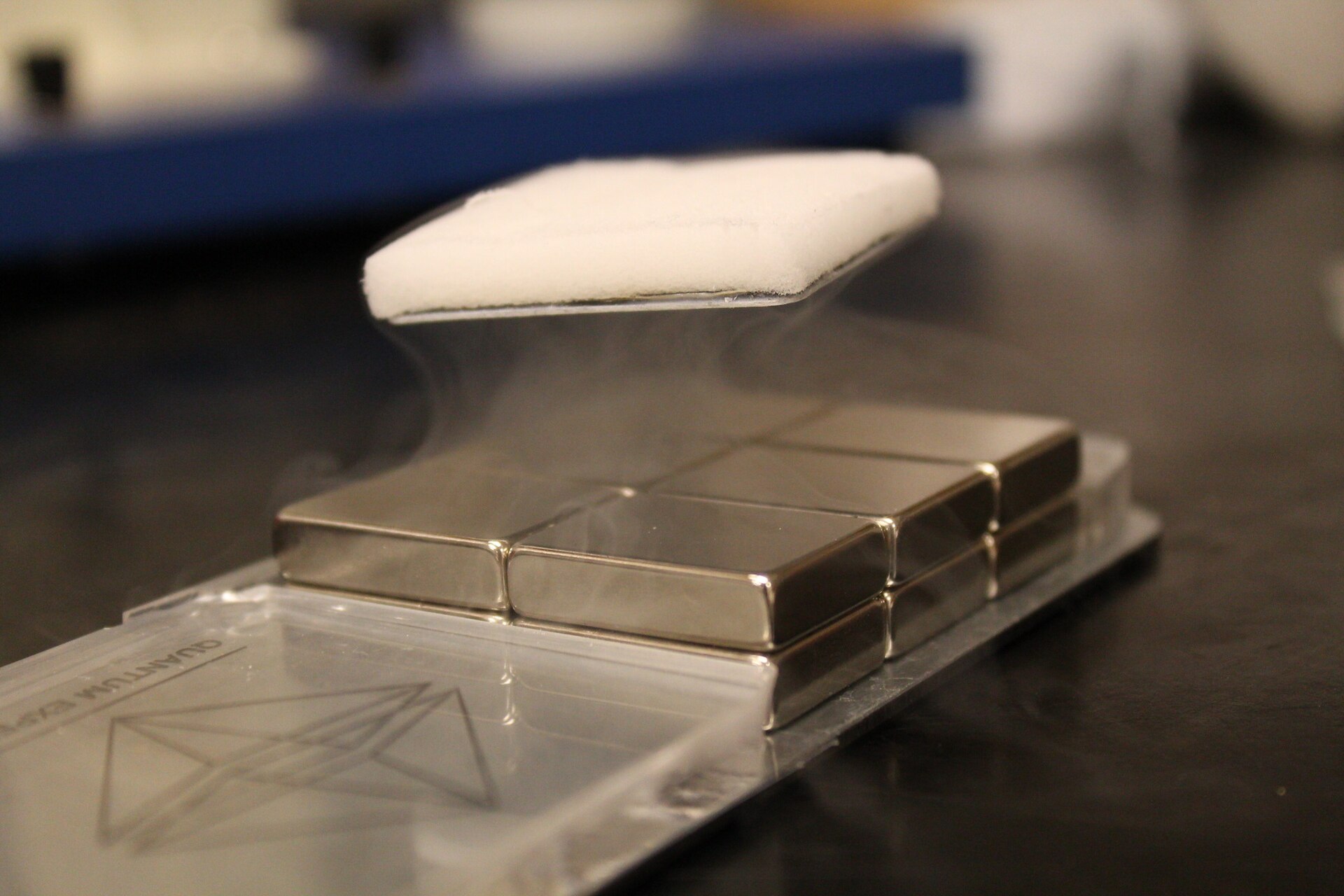
Photo · Garrett Pennell, CC BY-SA 3.0, Wikimedia Commons
Bring two permanent magnets together with like poles facing, and they repel — but the balance is precarious, and the slightest nudge sends one sliding off to the side. This superconducting disk, however, neither slides away nor tips over and falls. What is different? To find the answer we must start from the discovery that resistance vanishes, and arrive at a key fact: the reason it floats and the reason it locks in place are two different mechanisms.
The moment resistance hits zero — yet this alone will not make it float
The story begins in extreme cold. Heike Kamerlingh Onnes of Leiden University in the Netherlands was the first in the world to liquefy helium, in 1908, opening up the cryogenic realm of about 4.2 kelvin (K, roughly −269°C). Then on 8 April 1911 he observed that the electrical resistance of mercury immersed in this liquid helium suddenly vanished completely below about 4.2 K. It was the discovery of superconductivity. Onnes received the 1913 Nobel Prize in Physics, though the official citation was not “the discovery of superconductivity” but “his investigations on the properties of matter at low temperatures which led, among other things, to the production of liquid helium.”
Zero resistance is a remarkable property: a current, once started, keeps circulating without losing energy. But the mere fact of having no resistance does not explain why the disk floats above a magnet. Zero resistance was only one of superconductivity’s several faces. The truly decisive property would not emerge for another 22 years.
The Meissner effect — a superconductor “pushes the magnetic field out”
In 1933 the German physicists Walther Meissner and Robert Ochsenfeld, while measuring the distribution of the magnetic field outside superconducting tin and lead samples, discovered something unexpected. The instant a sample cooled below its critical temperature and turned superconducting, the magnetic field inside it was almost completely expelled. A superconductor does not merely let a field pass through; it actively pushes it out, driving the internal field to nearly zero — it is a “perfect diamagnet.” Today we call this the Meissner effect.
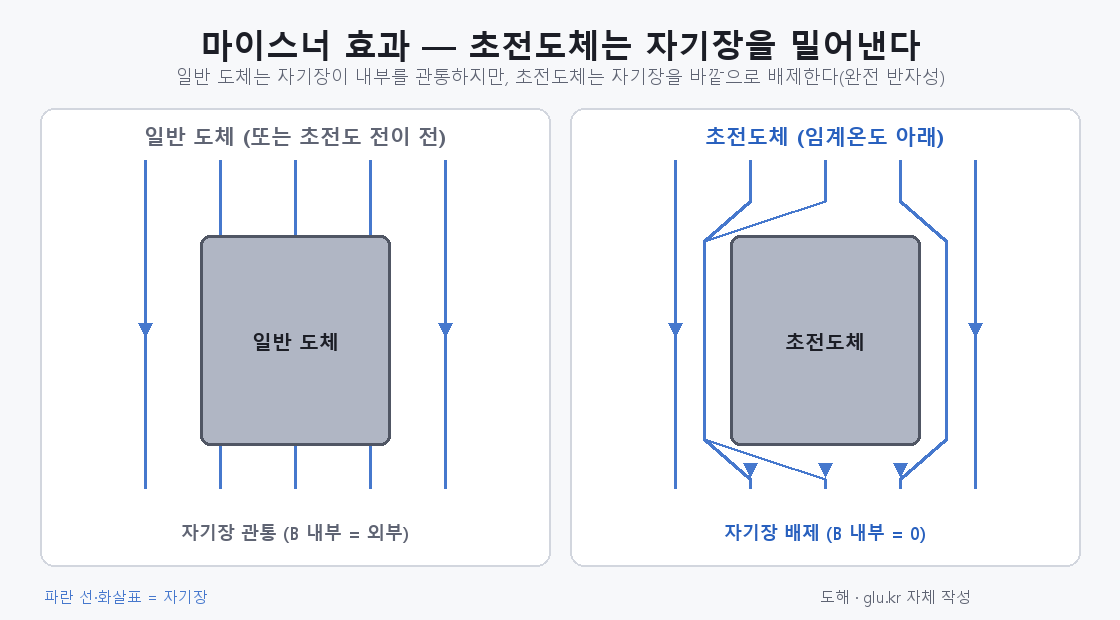
Diagram · glu.kr original
Here comes this article’s most important correction. People often summarize a superconductor as “just a perfect conductor with zero resistance,” but that is physically inaccurate. A hypothetical “perfect conductor (a mere zero-resistance conductor)” and a genuine superconductor behave in decisively different ways.
Consider a thought experiment. First turn on a magnetic field and then cool the material (field cooling). A hypothetical perfect conductor would, by Lenz’s law, drive induced currents to oppose “any change in flux,” and so it would trap the field that was already inside. A genuine superconductor, by contrast, expels even the field that is already inside at the very moment it turns superconducting. The internal field is excluded regardless of cooling history. This difference cannot be explained by “zero resistance” alone; it requires the superconductor’s distinctive electromagnetic response (described by the London equations, formulated by the London brothers in 1935).
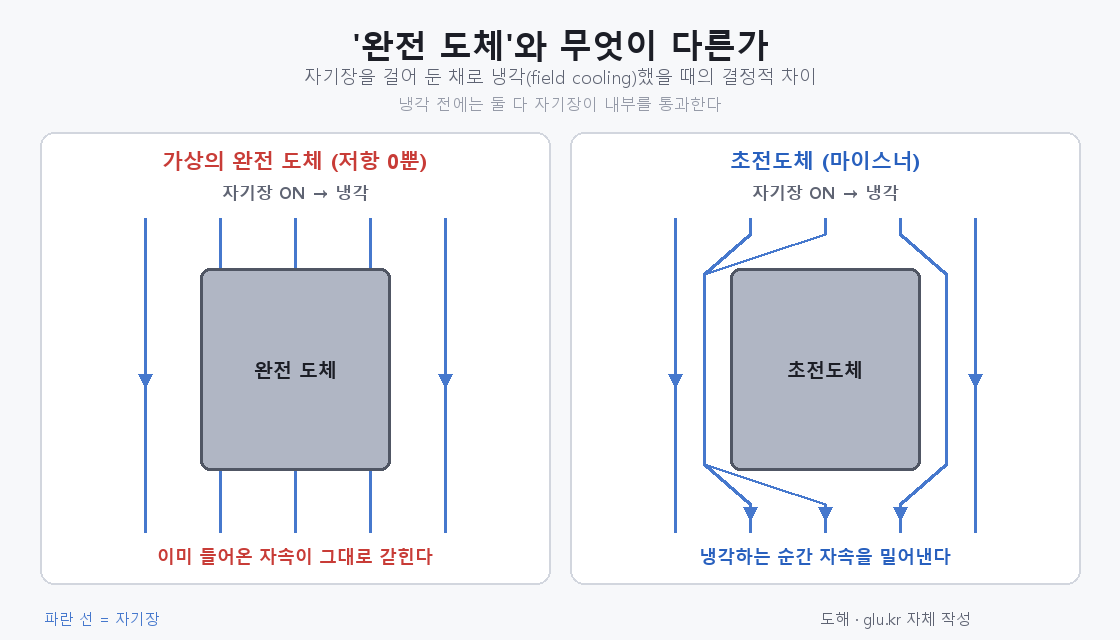
Diagram · glu.kr original
A superconductor, in other words, possesses two separate hallmarks together — zero resistance (Onnes, 1911) and perfect diamagnetism (Meissner, 1933). The physical thing that expels the field in the Meissner effect is a “screening current” flowing without resistance on the superconductor’s surface, generating a field in exactly the opposite direction that cancels the external one. The field is not cut off sharply at the surface as if by a knife; it seeps inward, decaying exponentially over the “London penetration depth” (roughly 50–500 nanometers, varying by material). It is in this thin surface layer that the screening current flows.
Why it floats — and why it “locks”
This expelled field creates a repulsive force (a magnetic pressure) between the magnet and the superconductor. Because the superconductor pushes away the magnet’s field, the reaction pushes the two apart and the disk floats. The crucial point is that this lifting force is not the pole-to-pole repulsion of two permanent magnets, but an “induced diamagnetism” arising from screening currents induced to cancel the incoming field. A superconductor is not a magnet with fixed north and south poles.
Yet Meissner repulsion alone cannot hold the disk stably in place. By Earnshaw’s theorem, no arrangement of static magnetic fields can produce stable levitation on its own — the slightest disturbance breaks the balance and the object slides or falls. Indeed, a superconductor that merely expels all field (the Type-I we will meet shortly) has no restoring force to hold it laterally, so the disk soon spins or vibrates its way out of position. With the Meissner effect alone, stable floating is difficult, let alone hanging upside down.
Here the second mechanism, flux pinning, enters. And this is the real reason the disk is locked in three-dimensional space.
Flux pinning — vortices caught on defects lock the disk in place
There are two kinds of superconductor. A Type-I superconductor has a single critical field (Hc): below it, all field is expelled, and once that critical field is exceeded, superconductivity collapses all at once — there is no “gap” for the field to enter. A Type-II superconductor, by contrast, has two critical fields, lower and upper (Hc1, Hc2), and in the “mixed state” between them the field penetrates the interior in the form of quantized vortices (flux vortices, fluxons).
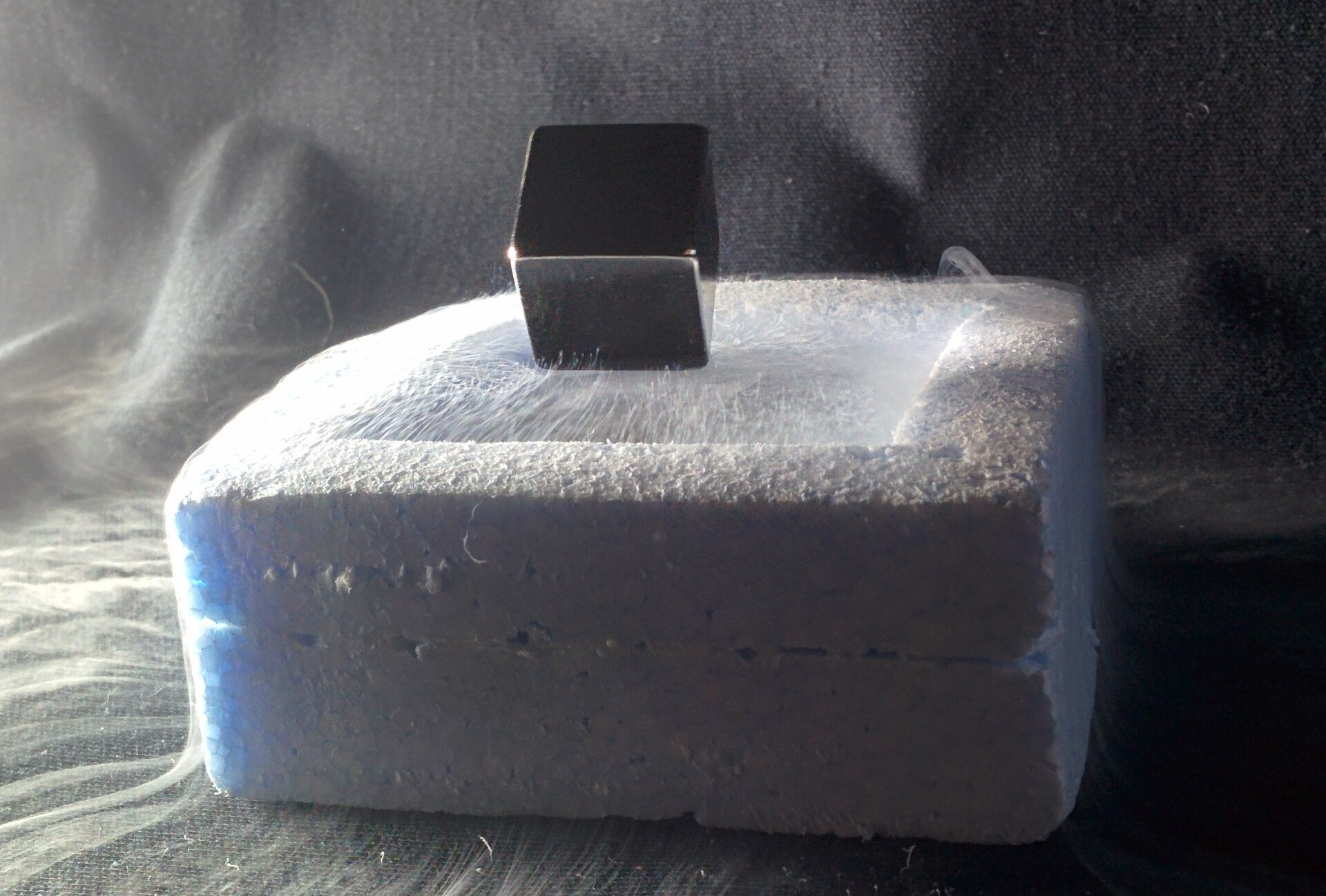
Photo · Maxim Bilovitskiy, CC BY-SA 4.0, Wikimedia Commons
These vortices are special. The flux threading a superconductor cannot take just any value; it exists only in integer multiples of the smallest unit, the “flux quantum” (Φ₀ = h/2e ≈ 2.07 femtowebers). One vortex carries exactly one flux quantum. The 2e in the denominator — twice the electron charge — reflects the fact that superconducting current is carried not by single electrons but by pairs of electrons, the “Cooper pairs” (a value fixed by nature, confirmed experimentally by two independent teams in 1961). Each vortex is a thin normal core, where superconductivity is locally broken, wrapped by a whirl of superconducting current.
Cool a Type-II superconductor cold enough and these vortices become stuck, unable to move, caught on defects and impurities in the crystal. This is flux pinning. Each vortex is tied to a defect in the material and, at the same time, lodged at a particular spot within the magnet’s field. So a disk threaded by the vortices is fixed in both position and orientation. Tip the disk and the vortices would have to be rearranged to that angle, which the defects will not allow, so the disk stays put at the tilt. Flip it over entirely and the vortices still hold on, so it does not fall. The term “quantum locking” often used in demonstrations is simply the popular name for this flux-pinning phenomenon.
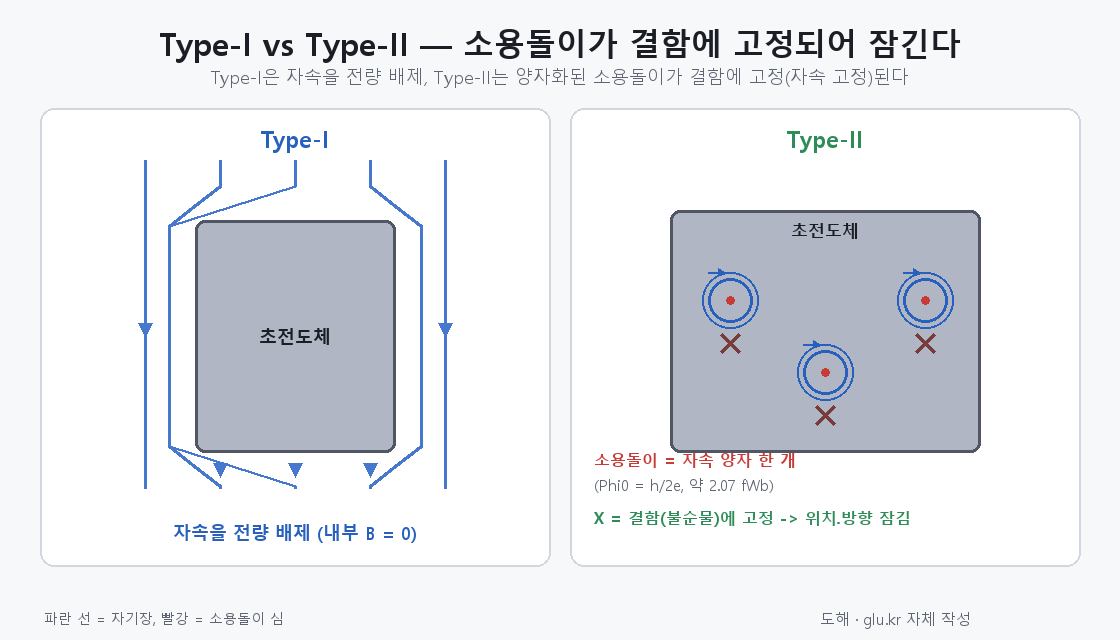
Diagram · glu.kr original
To sum up, the force that lifts (Meissner repulsion) and the force that locks it in place (flux pinning) are two different mechanisms. What keeps it from falling even when hung upside down is flux pinning, not Meissner repulsion, and this stable three-dimensional locking appears only in Type-II superconductors that host vortices (notably the YBCO we will meet shortly). Diamagnetism sidesteps the prohibition of Earnshaw’s theorem, and flux pinning adds a restoring force, so the disk locks stably into the very configuration in which it was cooled. In the Tel Aviv demonstration, a 500-micrometer sapphire wafer was coated with a thin layer of YBCO precisely so that, with the superconducting layer kept thin, flux vortices could pass through weak spots and be pinned.
The root of it all — Cooper pairs and a macroscopic quantum state
Why does current flow without resistance, and why is flux quantized? The microscopic root was revealed by the BCS theory, formulated in 1957 by John Bardeen, Leon Cooper, and John Robert Schrieffer. In their account, one electron passing through the lattice of positive ions tugs the lattice slightly toward itself, and that distortion draws in a second electron of opposite spin, so that the two electrons form a “Cooper pair” mediated by lattice vibrations (phonons). These pairs condense into a single giant quantum state and move as one body, so there are no individual electrons to scatter and lose energy, and resistance becomes zero. The 2e in the denominator of the flux quantum, too, appears because the protagonists are Cooper pairs of charge 2e. The three received the 1972 Nobel Prize in Physics (for Bardeen it was a second Nobel, after the transistor).
It was long taken for granted that superconductivity required extreme cold. That barrier was greatly lowered by the discovery of high-temperature superconductivity. In 1986 Bednorz and Müller at IBM’s Zurich laboratory observed superconductivity at about 35 K in a lanthanum-based copper oxide, raising the record in a single leap (a Nobel Prize followed the very next year, in 1987); soon after, in 1987, Paul Chu’s group achieved a critical temperature of about 92–93 K (roughly −180 to −181°C) in yttrium barium copper oxide (YBCO). This was the first superconductor that could be cooled with cheap liquid nitrogen (boiling point 77 K). Once superconductivity could be seen with liquid nitrogen — far cheaper than liquid helium — the tabletop quantum-locking demonstrations we saw earlier became possible at last.
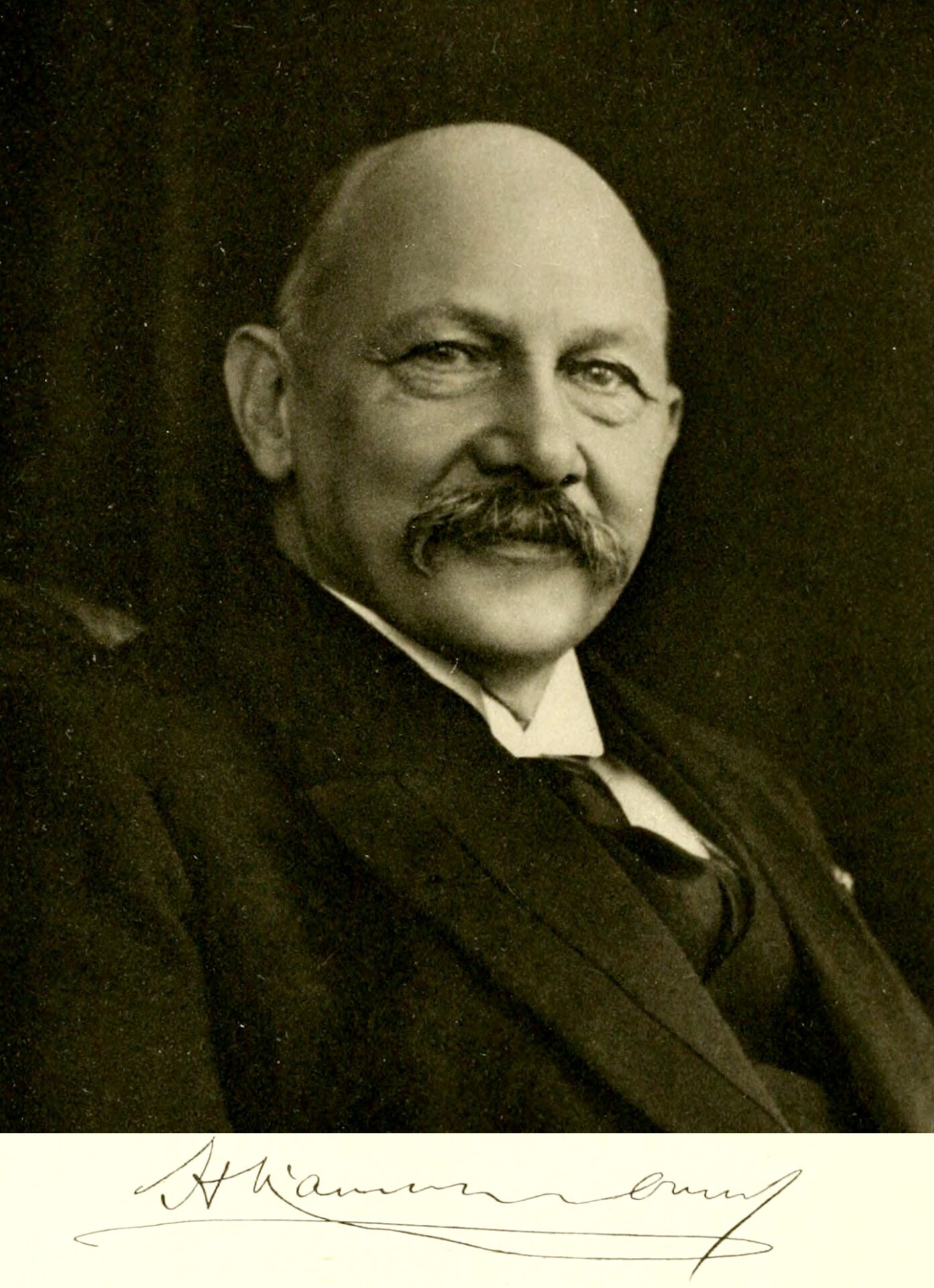
Photo · Nobel foundation, public domain, Wikimedia Commons
One thing must be stated honestly, however. Macroscopic phenomena like the Meissner effect and flux pinning are well-established, settled physics. But the microscopic mechanism of why Cooper pairs form at such high temperatures in copper-oxide high-temperature superconductors remains an open problem, with no agreed-upon theory even after decades of research and a vast literature. BCS theory explains conventional low-temperature superconductivity well, but it is not a complete microscopic account of high-temperature superconductivity. Furthermore, superconductivity at room temperature and pressure remains an unverified research goal to this day, and several recent claims have ended in failed replication or retracted papers. The principle this article addresses — floating and locking above a magnet — is established physics, but we should not speak as though everything in the unsolved terrain beyond it has been figured out.
Out of the lab — the technologies superconductivity holds up
These principles are not confined to curious demonstrations. Today the MRI (magnetic resonance imaging) machines in hospitals generate strong magnetic fields with superconducting electromagnets made from niobium-titanium coils immersed in liquid helium (about 4.2 K). At CERN, the Large Hadron Collider (LHC) uses 1,232 superconducting dipole magnets, each 15 meters long and weighing 35 tonnes, to create an 8.3-tesla field, running more than 10,000 amperes without resistive loss to bend the particle beams.

Photo · Hisagi, CC BY-SA 4.0, Wikimedia Commons
Maglev trains are another flagship application, but the common belief that “maglev means superconductivity” is only half right. Shanghai’s Transrapid levitates by attraction using ordinary (non-superconducting) electromagnets, whereas Japan’s JR Central SCMaglev carries superconducting magnets aboard the vehicle. This SCMaglev’s L0 series set the maglev speed record on 21 April 2015, reaching 603 kilometers per hour on the Yamanashi test line (certified as a Guinness World Record that June) — a test-line record, with commercial operating speeds lower than this. Elsewhere too, wherever loss-free current and strong magnetic fields are needed — NMR spectroscopy, and the quantum computers that use superconducting qubits — superconductivity is quietly at work.
A point frozen in mid-air
The superconducting disk that hangs motionless upside down above a magnet is, in truth, the result of two different laws acting at once. One actively pushes the magnetic field out to lift the disk; the other catches quantized vortices on defects to lock the disk in place. Two separate properties — zero resistance and perfect diamagnetism; the quantization by which vortices exist only in integer multiples of the flux quantum; the macroscopic quantum state in which electrons pair up and flow as one body — are layered, one atop another, in a single simple act of levitation. We made the material, but the order it so obediently follows is not something we invented; it is something we discovered. A metal disk frozen to a point in mid-air quietly shows just how intricately and beautifully that discovered order is designed.
References
- Meissner effect — Wikipedia
- Flux pinning — Wikipedia
- Type-II superconductor — Wikipedia
- Magnetic flux quantum — Wikipedia
- BCS theory — Wikipedia
- History of superconductivity — Wikipedia
- Heike Kamerlingh Onnes — Wikipedia
- Yttrium barium copper oxide — Wikipedia
- Earnshaw’s theorem — Wikipedia
- Tel Aviv University quantum levitation demonstration — New Atlas / Refractor
- SCMaglev — Wikipedia
- CERN — Superconducting electromagnets