
Look at a photograph of a reactor core or a spent-fuel storage pool and you will see an eerie blue glow seeping through water that is otherwise as clear as glass. The scene — as if the water itself were giving off light — has become one of the iconic images of nuclear power. And two misconceptions usually cling to that light. One is that “this is the color of radioactivity”; the other is that “something is moving faster than light, and that is where the glow comes from.”
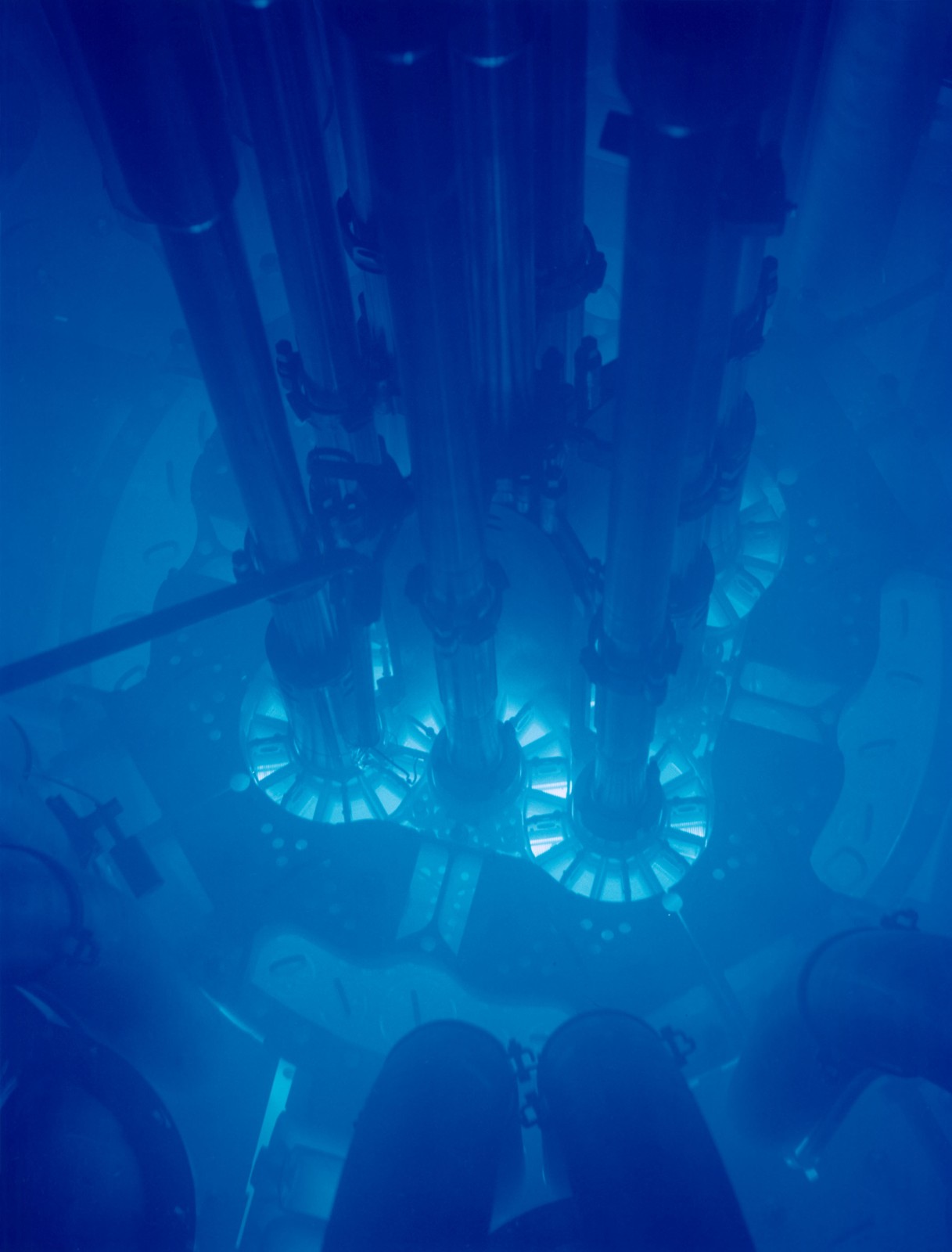
Photo · Argonne National Laboratory, CC BY-SA 2.0, Wikimedia Commons
Neither explanation is correct. This blue glow has a name — Cherenkov radiation — and behind it lies a densely woven set of finely designed natural rules. Radioactivity does not inherently take on this color, and relativity is not being broken. On the contrary, the phenomenon elegantly shows how the phrase “faster than light” can hold true while the absolute rule of special relativity remains perfectly intact. Let us take it apart one piece at a time.
Faster Than Light? More Precisely, Faster Than Light in a Medium
Let us first clear up the biggest misconception. Nothing can exceed the speed of light in a vacuum, c (exactly 299,792,458 meters per second). This is the absolute cosmic ceiling set by special relativity, and Cherenkov radiation does not violate it in the slightest. So it has nothing whatsoever to do with tachyons or faster-than-light communication.
The secret is that the phrase “the speed of light” refers to two different values. In a vacuum light always travels at c, but once it enters a medium such as water or glass, light slows down. Inside a medium the phase velocity of light becomes c divided by the refractive index n, that is c/n. Water’s refractive index for visible light is roughly n≈1.33, so the phase velocity of light in water drops to c/1.33 — about 0.75c (roughly 225,000 kilometers per second).
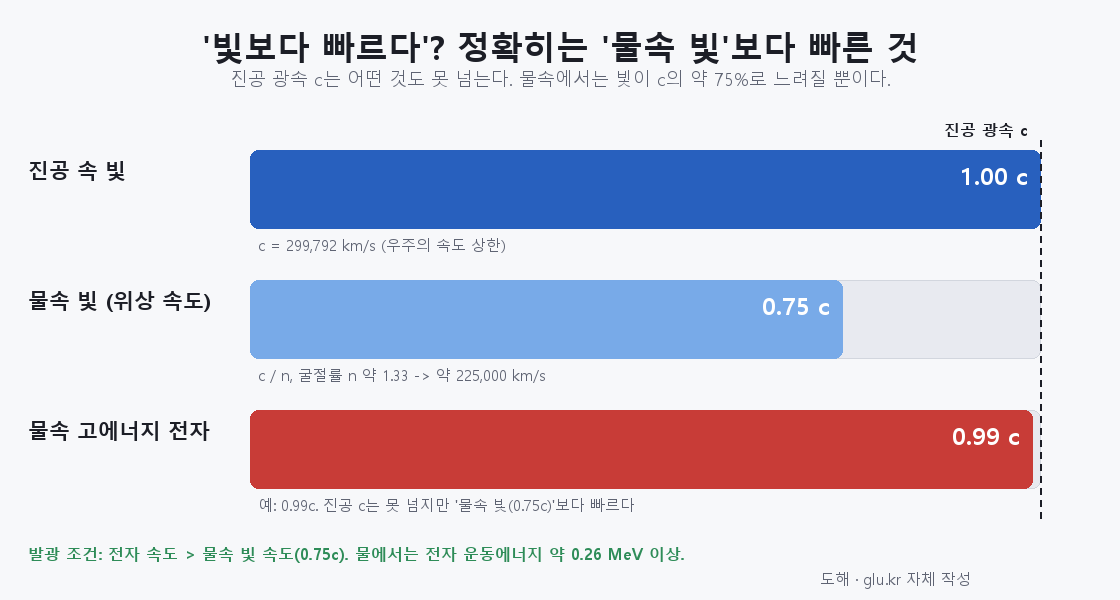
Diagram · created by glu.kr
This is exactly where a gap opens up. The vacuum light speed c still cannot be exceeded by anything, but light passing through water only crawls along at 0.75c, slower than c. That leaves room for a particle moving through water to be faster than that slowed-down light while still being slower than the vacuum speed c. In fact, a high-energy electron ejected from a nuclear reaction such as beta decay can race through water at, say, 0.99c. This electron never exceeds the vacuum speed c (β<1 always holds), yet it easily overtakes the slowed phase velocity of light in water, 0.75c.
To put it plainly: the phrase “faster than light” holds only in the sense of “exceeding the phase velocity of light in the medium, c/n.” The moment a particle crosses this threshold, the water announces the fact to us as a blue glow. Einstein’s rule remains intact from start to finish.
An Optical Sonic Boom: A Cone-Shaped Shock Wave
So why does a particle faster than light in a medium give off light at all? The best analogy is the sonic boom. Cherenkov radiation is, in effect, an “optical sonic boom” — the same thing happening with light instead of sound.
As a charged particle passes through a medium, its electric field momentarily polarizes the molecules along its path and then releases them. As the disturbed molecules relax back to their original state, each briefly emits an electromagnetic wave. If the particle moves slower than light in the medium, these ripples are out of phase with one another and cancel out, leaving no distinct light escaping outward.
But if the particle races faster than light in the medium, the story changes completely. As the particle outruns the ripples it creates, the wavefronts spreading behind it line up in phase along a cone-shaped surface and undergo coherent constructive interference. The result is a cone-shaped shock front. This is mathematically identical to the Mach cone made by a supersonic jet, or the bow wave a fast boat leaves on the water. Ripples slower than the boat scatter away, but when the boat moves faster than the ripples a sharp V-shaped wake stands out — the same principle.
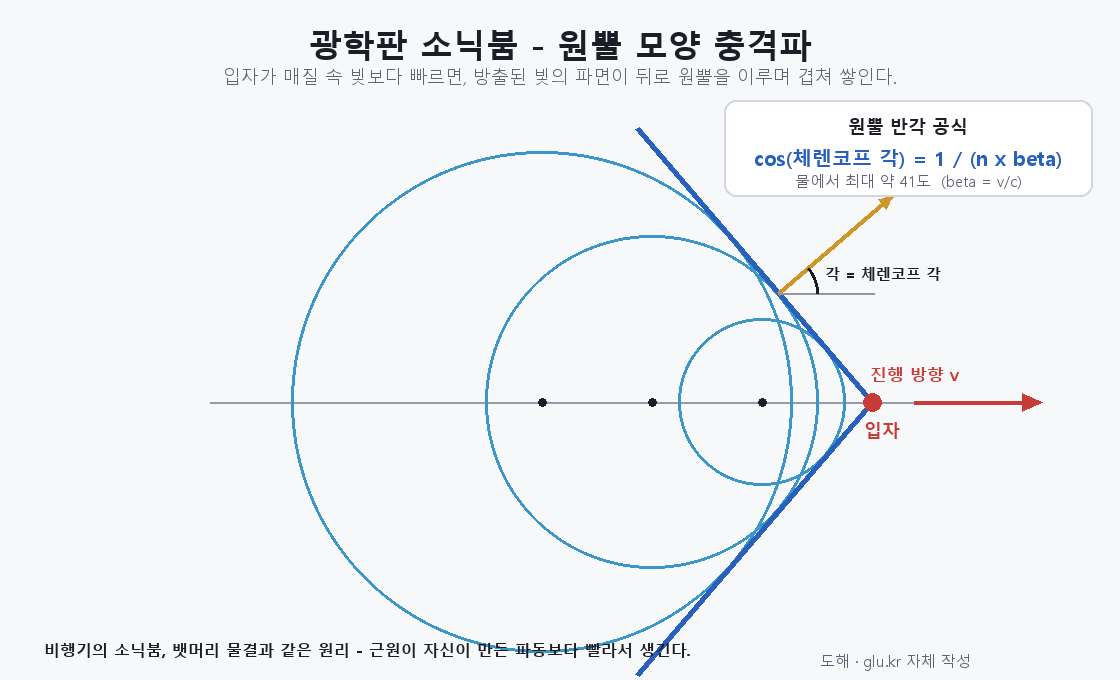
Diagram · created by glu.kr
There is a clean formula for the angle of this cone. If the half-angle of the cone is θ_c, then cos θ_c = 1/(nβ), where n is the refractive index of the medium and β is the particle speed divided by the vacuum speed of light (β=v/c). As a particle approaches the vacuum speed of light (β→1), cos θ_c in water approaches 1/1.33, and the maximum half-angle reaches about 41°. Practical detector literature for instruments like Super-Kamiokande often adopts a slightly different value for water’s refractive index and writes this maximum angle as “about 42°”; both refer to the same physics, a value somewhere around 41–42°. Conversely, right at the emission threshold the cone angle starts at 0° and widens as the particle speeds up. In other words, how wide the cone opens tells you how fast the particle is — a point that becomes important again when we turn to detectors.
The Threshold Where Light Begins
Not every particle emits this light at just any speed. The emission condition is clear: the particle’s speed must exceed the phase velocity of light in the medium. Written as a formula, v > c/n, that is β > 1/n (equivalently βn > 1). For water, converting this threshold into the electron’s kinetic energy gives about 0.26 MeV (literature values are 0.261–0.264 MeV). An electron with less energy than this emits no Cherenkov light no matter how it moves through water. The higher a medium’s refractive index, the lower the threshold, so even slower particles can emit light.
Why Blue, of All Colors?
Now to the question of color. Why is the light in a reactor pool blue rather than red or green? The answer lies in the Frank–Tamm formula. According to it, the number of photons emitted per unit wavelength as the particle travels a unit length is inversely proportional to the square of the wavelength, that is 1/λ², so it piles up strongly toward shorter wavelengths.
In other words, Cherenkov radiation is emitted with its photons and intensity already skewed toward short wavelengths (high frequencies). Most of it, in fact, lies in the ultraviolet, invisible to our eyes. Ultraviolet is the strongest component, but the human eye simply cannot detect it. So what we actually see is the most dominant component within the visible range — blue. Add the human eye’s sensitivity to this, and the net result is the vivid blue glow we perceive.
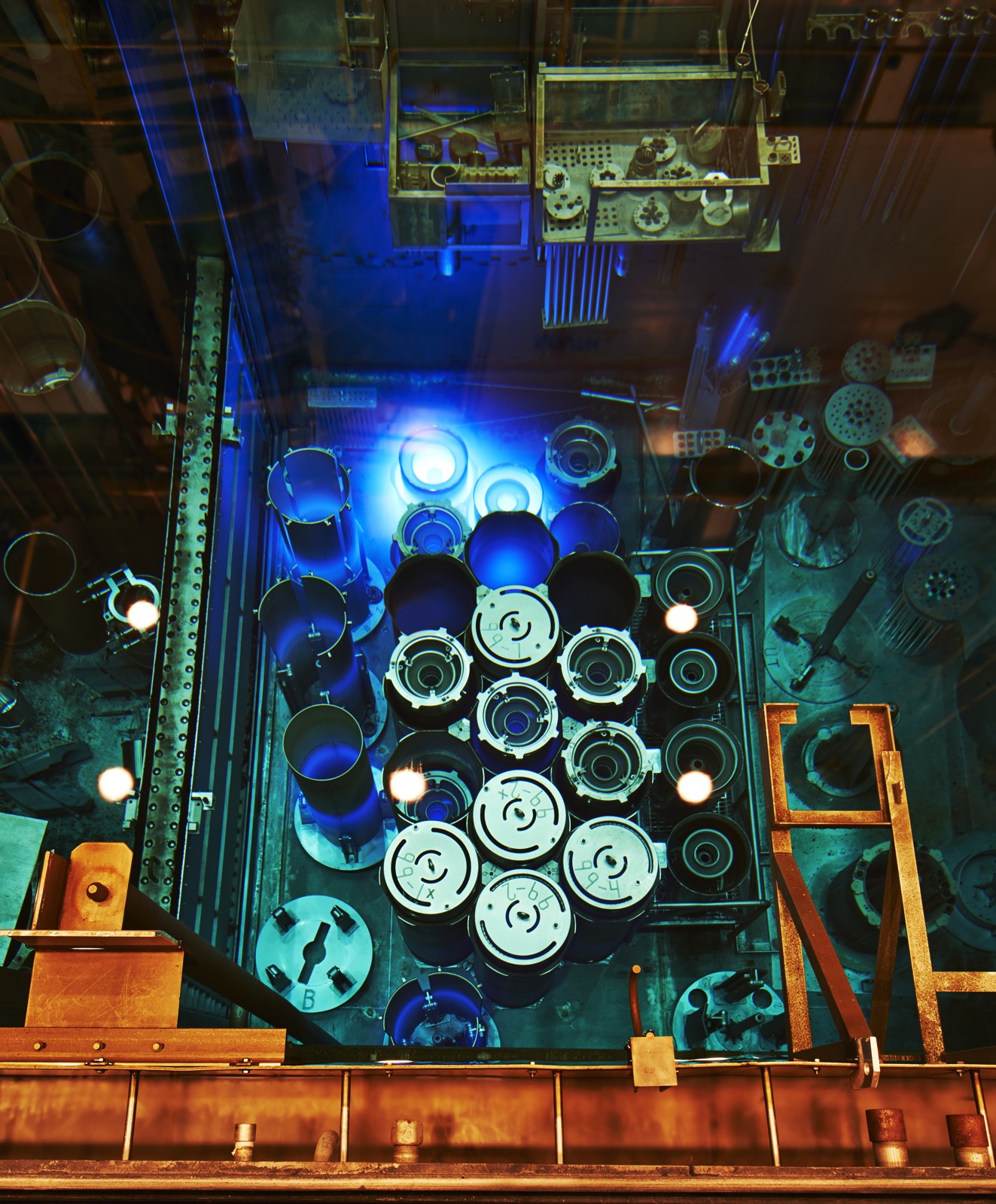
Photo · Oak Ridge National Laboratory, CC BY 2.0, Wikimedia Commons
One point must be stressed here. This blue is fundamentally different in mechanism from the familiar “reason the sky is blue.” The sky’s blue is the result of Rayleigh scattering, in which atmospheric molecules scatter sunlight; its scattering intensity is proportional to 1/λ⁴, so shorter wavelengths are “redistributed” more strongly — a scattering phenomenon. Cherenkov’s blue, by contrast, is not the result of something scattering light but an emission phenomenon in which the emitted light’s spectrum is itself concentrated toward short wavelengths as 1/λ² from the outset. Both lead to the same conclusion that “short wavelengths are stronger,” but one is scattering (1/λ⁴) and the other is emission (1/λ²), and even the exponents differ — the two must not be confused.
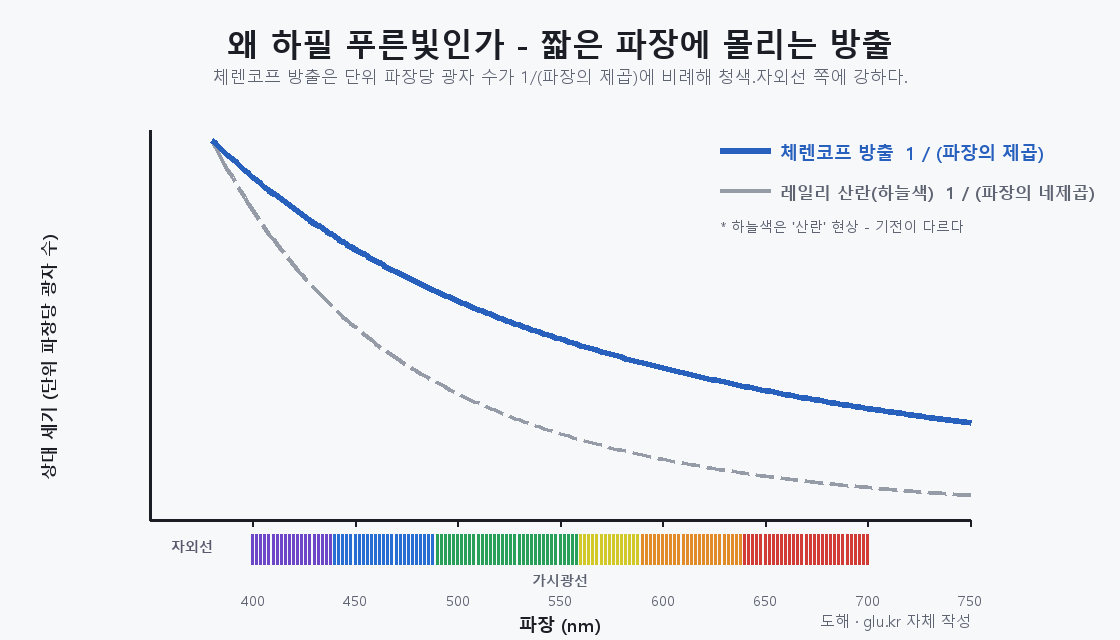
Diagram · created by glu.kr
The Story of Its Discovery and the Nobel Prize
The first to properly capture this faint light were Soviet physicists in the early twentieth century. In truth, a few people had glimpsed it before. Marie Curie saw a faint blue glow in a concentrated radium solution in 1910, but she did not pursue its cause and took it for mere phosphorescence; and around 1926 the Frenchman Lucien Mallet described the continuous-spectrum luminescence given off when radium illuminated water, yet went no further. Both observations were less discoveries than unfinished sightings that never reached an explanation.
The one who grasped the phenomenon systematically was Pavel Cherenkov. In 1934, at the Lebedev Institute and under the supervision of Sergey Vavilov, he carefully distinguished the faint blue glow emitted when radiation passes through a liquid from fluorescence. More than merely seeing the light, he established experimentally that it was a distinct phenomenon with properties different from fluorescence.
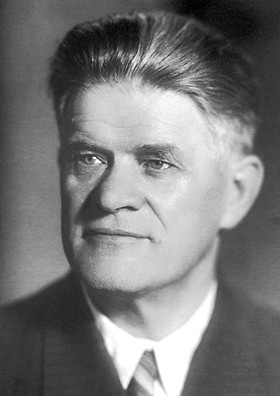
Photo · Nobel foundation, public domain, Wikimedia Commons
Where there was an observation, a theory followed. In 1937, Ilya Frank and Igor Tamm completed the phenomenon mathematically within the framework of special relativity. The Frank–Tamm formula introduced earlier was the fruit of that work. For this achievement, in which experiment and theory came together, Cherenkov, Frank, and Tamm shared the 1958 Nobel Prize in Physics.
One detail is worth noting. Vavilov, who supervised the discovery, is not on the Nobel list. He died in 1951, and the Nobel Prize is not awarded posthumously. Even so, in the Russian-speaking world the phenomenon is called “Vavilov–Cherenkov radiation” in honor of his decisive contribution. That is the story behind the small discrepancy between the list of Nobel laureates and the phenomenon’s formal name.
An Eye for Ghost Particles: Detectors and Reactor Monitoring
Had Cherenkov radiation remained merely a curious glow, it would never have become this famous. The real power of this light is that it makes invisible particles visible.
The nearest example is the very reactor pool we began with. The reason a core and a spent-fuel storage pool glow blue is Cherenkov radiation emitted by high-energy charged particles from beta decay and the like as they exceed the phase velocity of light in water. So the intensity and distribution of this blue glow serve as a visual indicator of the level of radioactivity and the cooling state. In a sense, one can read the state from the color of the water alone, without any instrument panel.
A more dramatic use is the observation of neutrinos. Neutrinos barely interact with matter — hence their nickname “ghost particles” — and pass through even the Earth as if it were not there. The way to catch these ghosts is precisely Cherenkov radiation. On the very rare occasion when a neutrino strikes an atom in water, a high-energy charged particle is knocked out, and as it travels faster than light in water it leaves a cone of Cherenkov light. By analyzing the cone angle (cos θ_c = 1/(nβ)) and the ring pattern of this light captured on the detector wall, one can work backward to compute the direction and speed of the invisible particle. As noted, the angle depends on the particle’s speed, so the size of the ring becomes a yardstick for its speed.
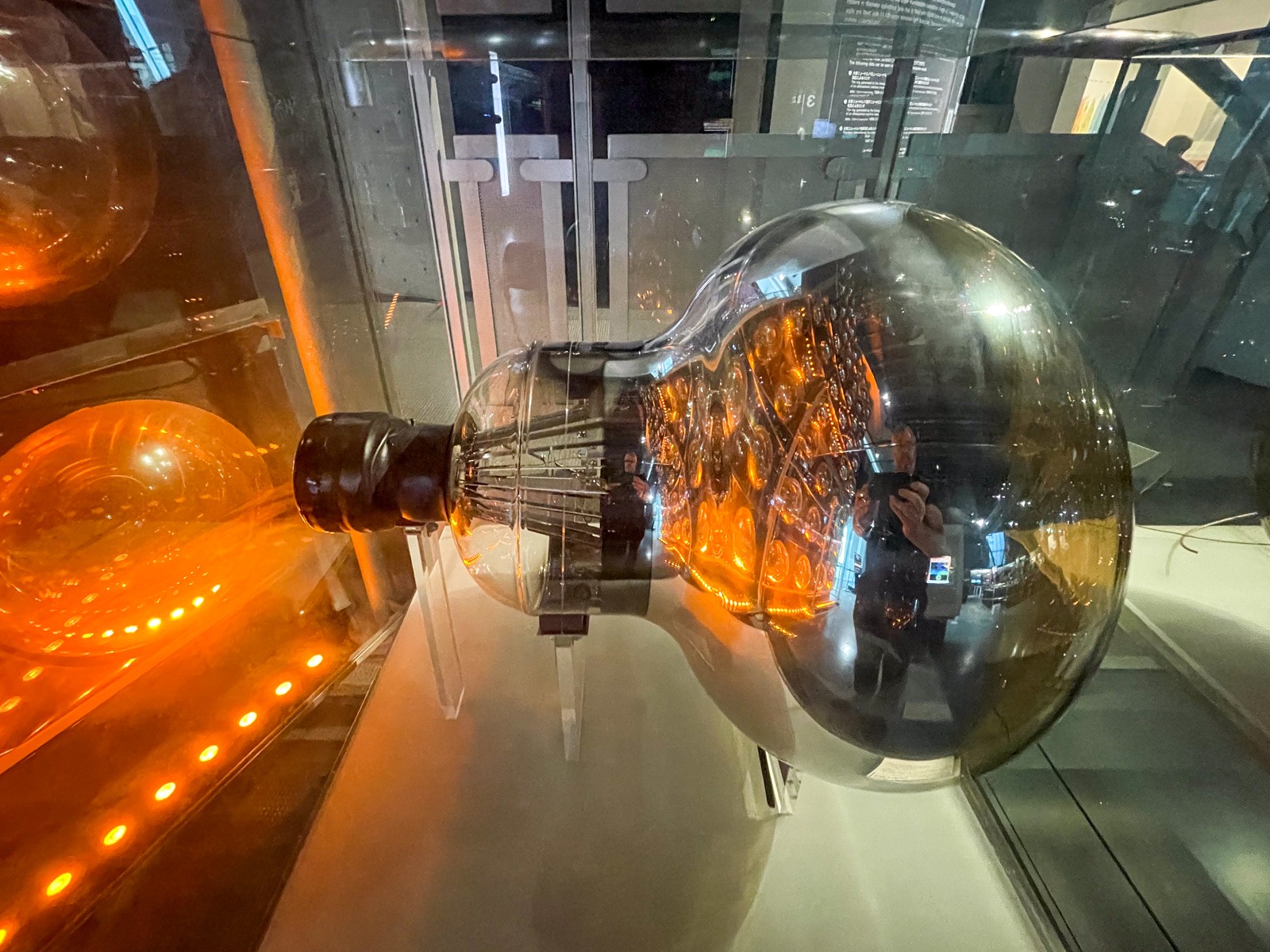
Photo · Mike Peel, CC BY-SA 4.0, Wikimedia Commons
A representative detector is Super-Kamiokande, located about 1,000 meters underground in the Kamioka mine in Gifu Prefecture, Japan. A gigantic stainless-steel cylinder 39.3 meters in diameter and 41.4 meters tall is filled with about 50,000 tons (50,220 tons) of ultrapure water, and the inner detector wall is densely lined with 11,146 photomultiplier tubes (PMTs) 50 centimeters in diameter (with a further 1,885 20-centimeter PMTs in the outer detector) to catch the faint Cherenkov light flashing in the water without missing any. Observations of atmospheric-neutrino oscillation with this water Cherenkov detector revealed that neutrinos have mass, and for this work Takaaki Kajita received the 2015 Nobel Prize in Physics.
Scale it up further and one can even turn nature itself into a detector. The IceCube Neutrino Observatory, buried in the ice near the South Pole, uses a full cubic kilometer (1 km³) of glacier at depths of roughly 1,450–2,450 meters as its detection medium. 5,160 optical sensors hung on 86 cables detect the Cherenkov light emitted when a charged particle, produced by a neutrino collision, travels faster than light in the ice. Water or ice, the principle is exactly the same as that blue glow in the reactor pool.
In Closing
The blue glow of a reactor pool was neither the color of radioactivity nor evidence that relativity had broken. It was a “sonic boom of light” left by a particle that, while fully respecting the absolute ceiling of the vacuum speed of light, outran the light slowed down inside a medium. A spectrum skewed toward the short-wavelength side in inverse proportion to the square of the wavelength arrives at our eyes as blue, and the angle of the cone even tells us the speed of the invisible ghost particle. That special relativity, the optics of media, and finely designed natural rules should overlap so densely within a single faint blue glow is a piece of cosmic craftsmanship that grows more astonishing the more one looks.
References
- Cherenkov radiation — Wikipedia
- Frank–Tamm formula — Wikipedia
- More light on the Cherenkov effect — CERN Courier
- Cherenkov Radiation overview (threshold energy in water) — ScienceDirect
- Super-Kamiokande — Wikipedia
- Detector — IceCube Neutrino Observatory
- What is Cherenkov Radiation? — IAEA
- Cherenkov Radiation Explained — U.S. Department of Energy
- The Nobel Prize in Physics 1958 — NobelPrize.org
- The 2015 Nobel Prize in Physics Press release — NobelPrize.org