
At Haeinsa Temple in Hapcheon, more than 80,000 wooden blocks stand packed on shelves. This is the Tripitaka Koreana — more precisely the re-carved canon (再雕大藏經). These blocks were carved in the mid-13th century, so they have endured roughly 770 years. That wood should hold up this well against damp, mold, wood-boring insects, and fire is remarkable in itself. How was this possible in an age with no special chemical treatment and no climate-control machines? The answer is not one thing but many: the way the blocks were made and the design of the building that houses them, layered together.
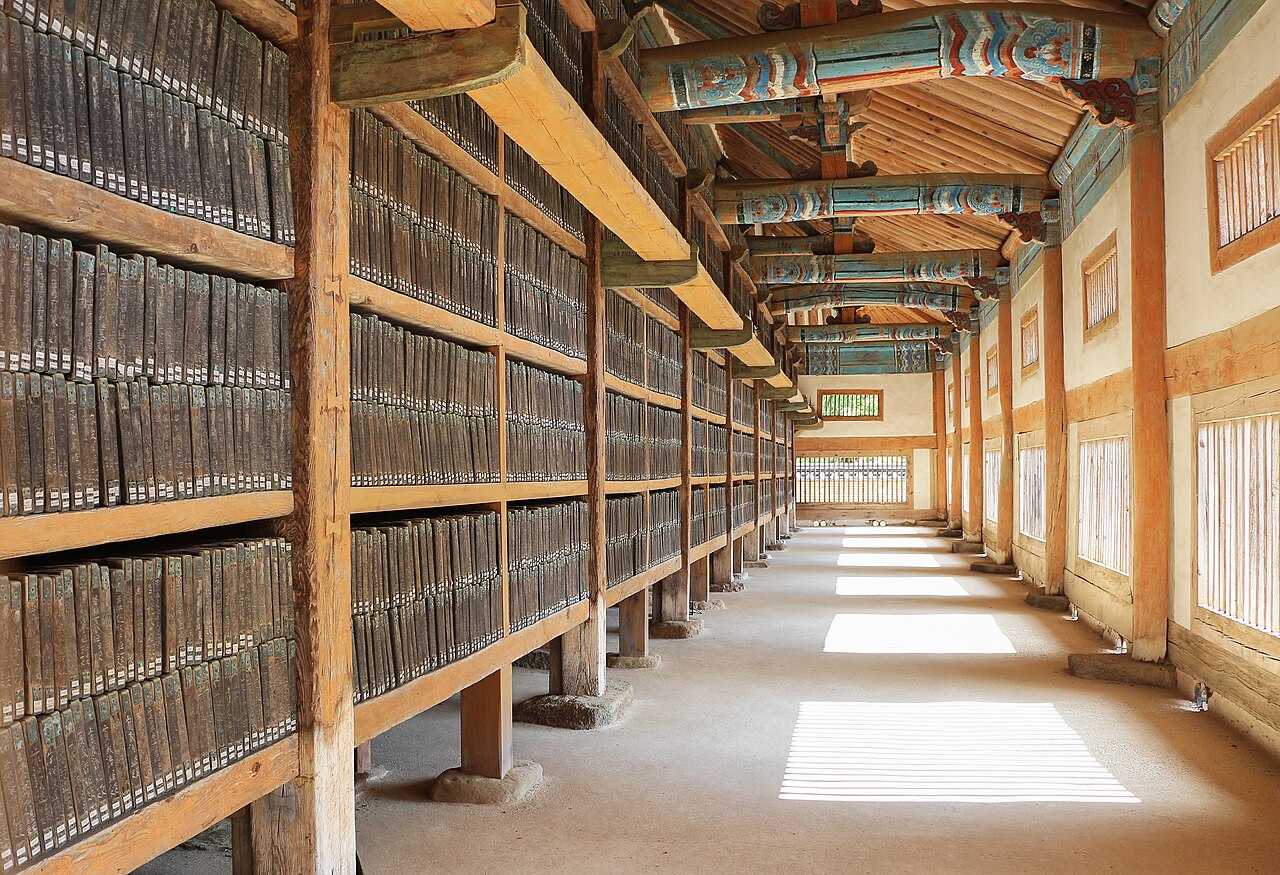
First, the scale — “80,000” is no exaggeration
The number of blocks is commonly cited as 81,258 — the figure used for the UNESCO Memory of the World listing and widely cited by the Korea Heritage Service. But the count varies by source: the figure the Korea Heritage Service reached after its 2000 digital imaging and 2014 comprehensive conservation survey is reported as 81,352. Depending on how far one includes the replacement blocks re-carved during the Japanese colonial period, the count splits into 81,137, 81,258, or 81,352 — there is no single canonical number. The name ‘eighty-thousand’ (八萬) itself comes from this block count.
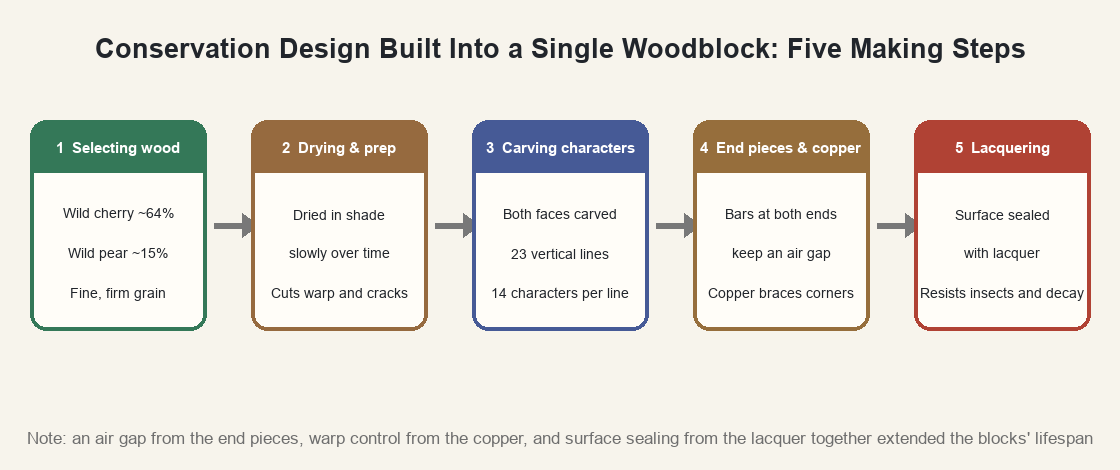
The blocks were carved on both faces. Each face has 23 vertical lines of 14 characters, about 322 characters per face, roughly 644 across both faces. The total comes to about 52 million characters (the precise figure often cited is 52,330,152), holding 1,514 titles in 6,815 volumes of Buddhist scripture. Work began in 1236 (the 23rd year of King Gojong) with the establishment of the Directorate for the Tripitaka on Ganghwa Island and — together with a branch directorate in Namhae — was completed over 16 years, in the ninth month of 1251 (the 38th year of Gojong). The actual carving is generally dated to 1237–1248.
Secrets of the woodblocks ① — choosing the wood
It is commonly said that the Tripitaka Koreana was made of birch, but this is not so. When Professor Emeritus Park Sang-jin of Kyungpook National University examined about 209 block samples under a microscope down to their cell structure, the most-used wood turned out to be wild cherry at about 64%, with wild pear at about 14–15%; together these two made up about 80%. Birch was only about 9%, and the rest was a mix of more than ten species — Manchurian birch and dogwood about 6%, maple (including Korean maple) about 3%, machilus, and others.
Wild cherry and wild pear have a fine, firm grain well suited to carving. If the grain is too soft the strokes smear; if too hard the knife will not cut. These woods struck the balance of being carvable yet durable. A single block is mostly about 68 or 78 cm long, about 24 cm wide, 2.6–4 cm thick, and about 3–4 kg.

The story of soaking in seawater
There is a widely told story that ‘the timber was soaked in seawater for several years, boiled in salt water to draw out the sap, and dried in the shade.’ It is plausible that boiling and steaming in salt water draws out sap, stabilizes drying, and repels insects. But the specific procedure of ‘three years of soaking and salt-water boiling’ is not a fact confirmed by primary sources; it is closer to a semi-tradition passed down as ‘it is said.’ What can be stated with confidence is that slow shade-drying to reduce warping and cracking was central to the blocks’ longevity.
Secrets of the woodblocks ② — end pieces and lacquer
After the carving was done, one more step followed. To each end of a block was attached a bar of wood thicker than the block, the so-called maguri. The maguri served as a handle and, when the block was shelved, kept the carved faces from touching so a gap remained for air to pass. The four corners were then fixed with copper plates to keep the wood from warping over time.
Finally, the block surface was lacquered. Lacquer is a finish that wards off insect damage and decay, and lacquering a printing woodblock is introduced as a rare practice worldwide. Spacing the blocks for airflow, holding the warp in check with metal, and sealing the surface with lacquer — these three are the conservation design built into each single block.
Precision of the carving — is “not a single error” true?
That the script across tens of thousands of blocks looks almost as if carved by one hand is often noted; it is said the scribes were trained for about a year to unify the calligraphy. But ‘not a single character in error’ is a popular misconception. Actual surveys find missing and mistaken characters. That the errors found among about 52 million characters are extremely few does show remarkable precision — but it is not ‘flawless.’ UNESCO rates this edition as the most accurate of the canons written in classical Chinese, and Japan chose it as the base text for the modern Taishō Tripitaka (1922–1934), a mark of the trust it earned.
And the building — Janggyeong Panjeon, home of the woodblocks
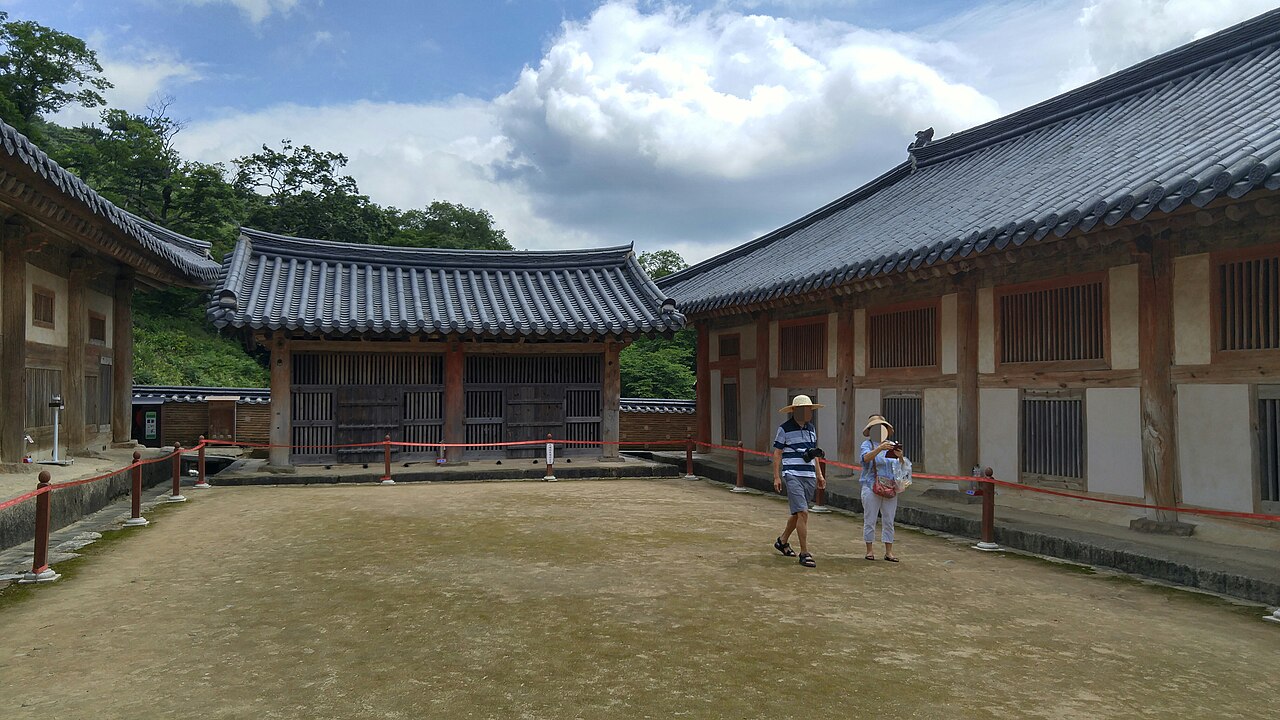
However well the blocks were made, if the space storing them is damp they will eventually rot. Here the layers of time must be kept clear. The blocks were carved in the Goryeo period (1236–1251), but the Janggyeong Panjeon building that now houses them was built in the Joseon period. By the UNESCO listing, the blocks were carved in 1237–1248 while the depository was built in the 15th century — about two centuries apart. The building’s founding date is uncertain, but it was greatly rebuilt in 1457 (the 3rd year of King Sejo), and a record says that in 1488 (the 19th year of King Seongjong) the monk Hakjo rebuilt it with royal patronage and named it Boandang; Sudarajang was later repaired in 1622 and Beopbojeon in 1624.
The finished blocks, stored on Ganghwa Island, were moved in 1398 (the 7th year of King Taejo of Joseon) by way of the Han River, passing through Jicheonsa in Yongsan, Seoul, and that autumn to Haeinsa in Hapcheon, where they remain to this day.
Siting — the best spot on the mountain
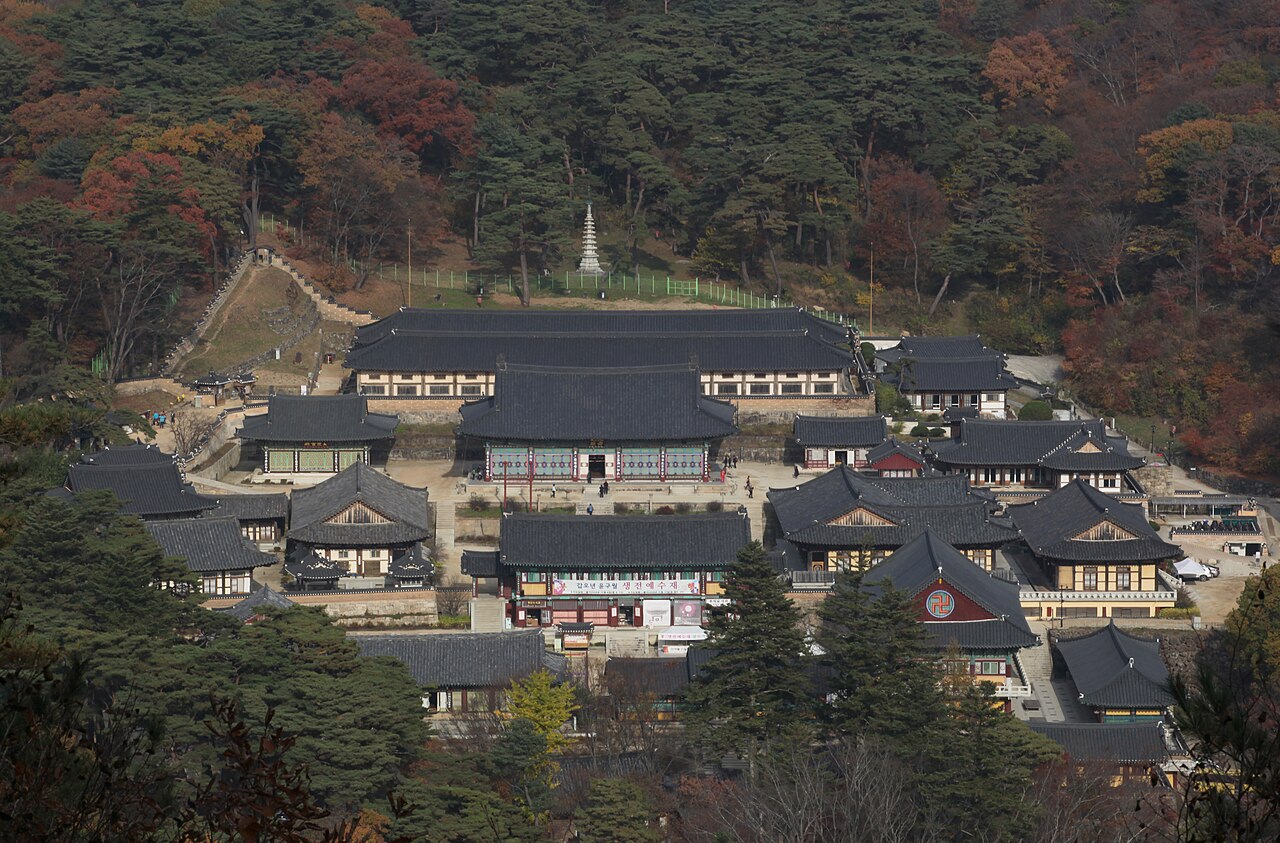
Janggyeong Panjeon sits at Haeinsa’s highest point, about 655 m above sea level. It is said to have been set facing southwest so as to avoid the damp southeasterly winds rising from the valley, while the northern peaks block the cold north wind. The spot was chosen for even sunlight through all four seasons and good natural ventilation. Even before building, the very choice of ‘where to build’ already had conservation in mind.
Lattice windows — flipped top to bottom
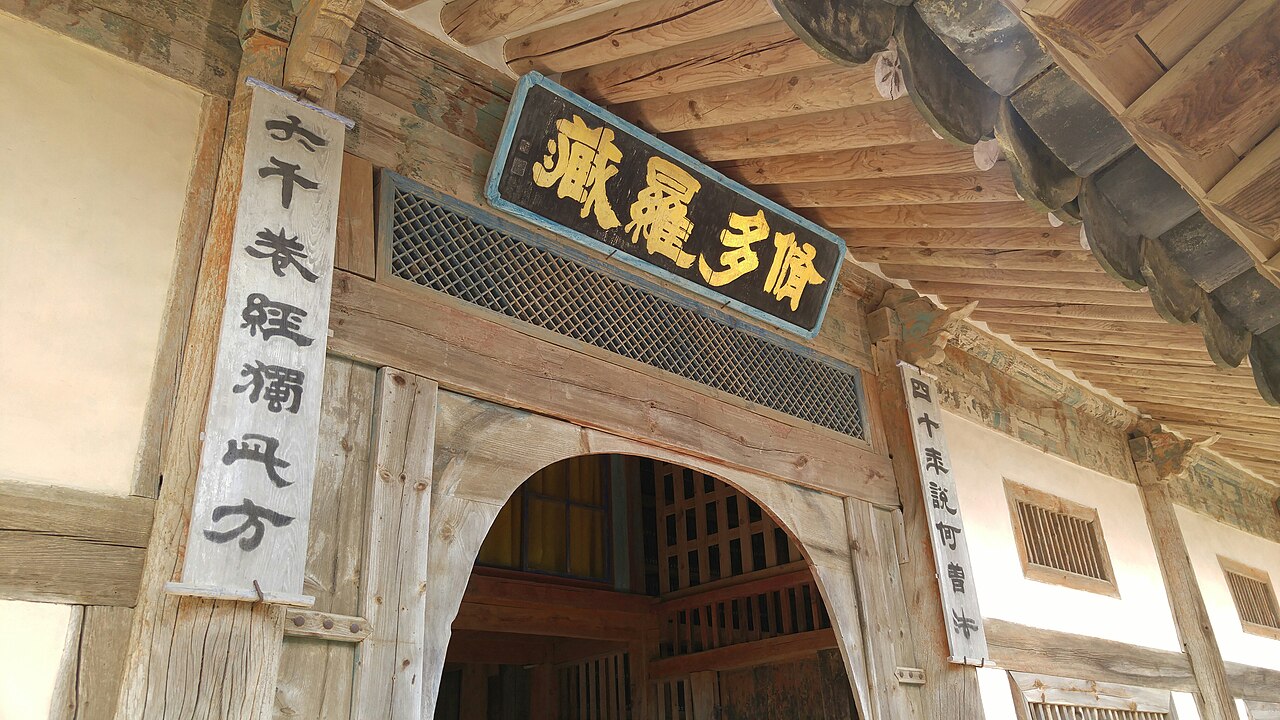
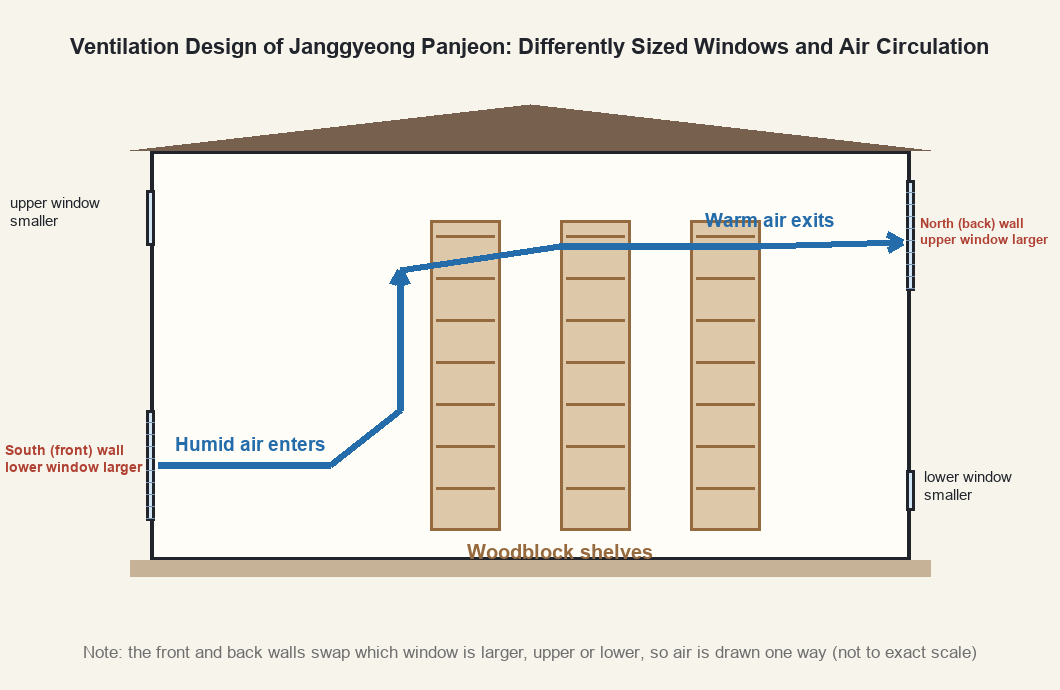
The most talked-about feature of Janggyeong Panjeon is the lattice windows in its walls. The two parallel main halls (Sudarajang to the south, Beopbojeon to the north) have windows of differing sizes set high and low in their front and back walls — and the size relationship is reversed between front and back. By the Korea Heritage Service’s account, on the front (south) the lower window is larger than the upper, while on the back (north) the upper window is larger than the lower, so the top-bottom relationship is flipped. Making the upper and lower windows differ in this way is understood to guide incoming air to flow one way and circulate naturally. The UNESCO listing likewise states that ‘different sized windows on the north and south sides of both main halls are used for ventilation, utilizing principles of hydrodynamics.’
The floor layer — a widely told story and its limits
No account of Janggyeong Panjeon omits the floor. It is said the earthen floor was packed with charcoal, salt, lime, sand, and clay. The UNESCO listing too states that the clay floors were filled with charcoal, calcium oxide (quicklime), salt, lime, and sand, absorbing excess moisture when it rains and releasing it in the dry winter to lower humidity.
But here caution is warranted. The causal claim that ‘the floor layer absorbs moisture when damp and releases it when dry, regulating humidity by itself’ is a notion repeated consistently by the Korea Heritage Service, Wikipedia, and others — yet no survey report quantitatively verifying this automatic humidity regulation against a control could be found in publicly available material. In other words, the strong phrasing ‘it automatically regulates humidity’ is a widely told account, more accurately understood as a descriptive framing of traditional knowledge than as a scientifically demonstrated fact. The Korea Heritage Service’s framing of Janggyeong Panjeon as ‘a symbol of Joseon atmospheric-science research’ carries the same commemorative character.
In sum, the building’s preserving power is not the magic of any single device but the combined working of a high, well-ventilated site, careful orientation, convection through differently sized windows, and a moisture-holding floor. This building is indeed regarded as having kept a temperature and humidity suited to preserving the blocks fairly stably even as the seasons change.
What exactly is remarkable — clearing away the exaggeration
A few common misconceptions are worth correcting. First, the Tripitaka Koreana is not ‘the world’s first Buddhist canon.’ Among woodblock-printed canons, the Northern Song Kaibao Canon (開寶藏, 971–983) came first, and Goryeo’s own initial canon (Chojo Daejanggyeong, 1011–1087) also predates it. The blocks of that initial canon, enshrined at Buinsa on Palgongsan in Daegu, burned during the second Mongol invasion (1232, the 19th year of Gojong); the canon re-carved afterward is the re-carved canon — that is, the Tripitaka Koreana.
So what is the defensible standing? The UNESCO Memory of the World nomination describes the Tripitaka Koreana as ‘the only complete canon still extant on the mainland of Asia’ and ‘the oldest complete canon of Buddhist scripture.’ In other words, not ‘the first’ but ‘the most complete and oldest extant set of classical-Chinese (漢譯) canon woodblocks’ is the accurate phrasing.
Second, ‘not a single block rotted’ is also an exaggeration. The UNESCO nomination states that nearly all are intact apart from a very few worn blocks, and records conservation treatments such as repair of oxidized wooden handles (maguri) and surface cleaning. The accurate line is that over roughly 770 years most have been kept intact, with some cases of wear and repair.
In addition, UNESCO’s two listings are different things. In 1995 the building that houses the blocks, ‘Haeinsa Temple Janggyeong Panjeon,’ was inscribed as a World Heritage Site (No. 737); in 2007 the blocks themselves, the ‘Printing Woodblocks of the Tripitaka Koreana and Miscellaneous Buddhist Scriptures,’ were inscribed in the Memory of the World. Janggyeong Panjeon had earlier, in 1962, also been designated National Treasure (No. 52).
Closing
That the Tripitaka Koreana has endured over 770 years is less a miracle than an accumulation of design. Blocks of well-grained wood, selected and slowly dried, spaced for airflow by their end pieces, held against warping by copper, and sealed on the surface with lacquer. And a building set on the highest, driest spot in the mountains, oriented with care, with air drawn through windows of differing sizes and a floor that holds moisture. No single element did the job; layers of countermeasure devised by people held out together. Not some dazzling new technology but this old wisdom — a reading of the nature of materials, place, and wind — still quietly guards 80,000 wooden blocks today.
References
- UNESCO World Heritage — Haeinsa Temple Janggyeong Panjeon (No. 737)
- UNESCO Memory of the World — Tripitaka Koreana nomination (PDF)
- UNESCO Memory of the World — Printing woodblocks of the Tripitaka Koreana
- Korea Heritage Service — Tripitaka Koreana wood species and making
- Korea Heritage Service, Monthly Heritage Love — Janggyeong Panjeon design
- Making process — end pieces, copper fixing, lacquer
- Wikipedia (Korean) — Haeinsa Janggyeong Panjeon
- Wikipedia — Tripitaka Koreana
- Wikipedia — Kaibao Canon
- Encyclopedia of Korean Culture — Chojo Daejanggyeong (the initial canon)