
On any clear night, all of us look up at the Moon. But isn’t it strange? The “rabbit pounding rice cake” pattern you saw as a child looks exactly the same decades later. No matter where on Earth you stand, no matter how many years you watch, the Moon always turns the same face toward us. The Earth spins like a top once a day, and the Moon busily circles the Earth — so why have we never once seen the Moon’s “back of the head”?
Here the most common misconception appears. “Isn’t it because the Moon doesn’t rotate that we only see one side?” Remarkably, the answer is precisely the opposite. For the Moon to keep showing us the same face, the Moon must rotate.
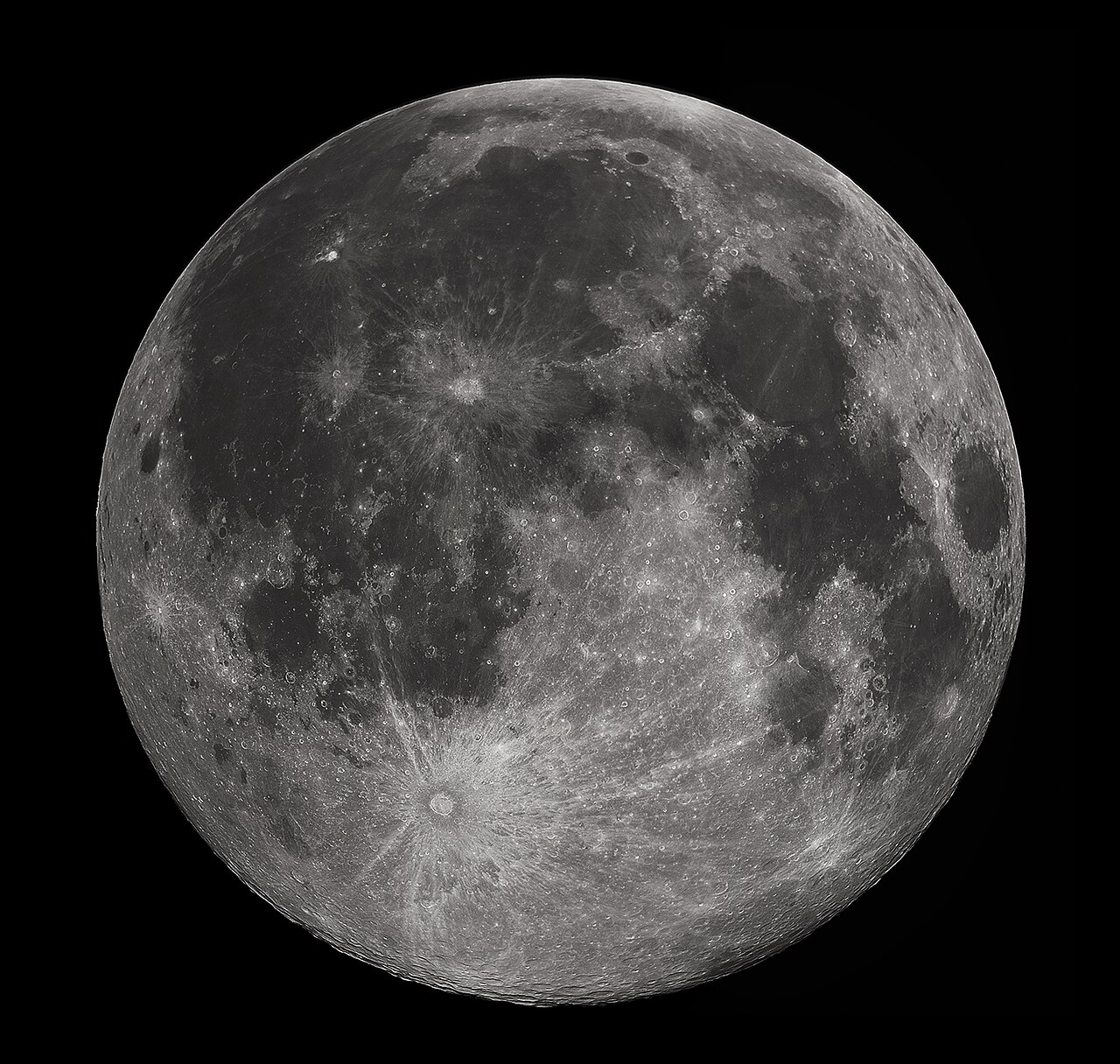
Photo · Gregory H. Revera, CC BY-SA 3.0, Wikimedia Commons
Not because it “doesn’t rotate,” but because it rotates just right
Let’s run a simple thought experiment. What if the Moon circled the Earth once without rotating at all? At each point in its orbit the Moon would keep facing the same direction in space, and as a result an observer on Earth would see the Moon’s front, side, and back in turn. In other words, if it did not rotate we would actually get to see every side of the Moon.
The reason the Moon always shows the same face is that it rotates exactly once during each single orbit around the Earth. This state, in which the beat of the orbit and the beat of the rotation match perfectly, is called synchronous rotation. So the precise statement is not “same face = no rotation” but “same face = rotation perfectly synchronized with the orbit.”
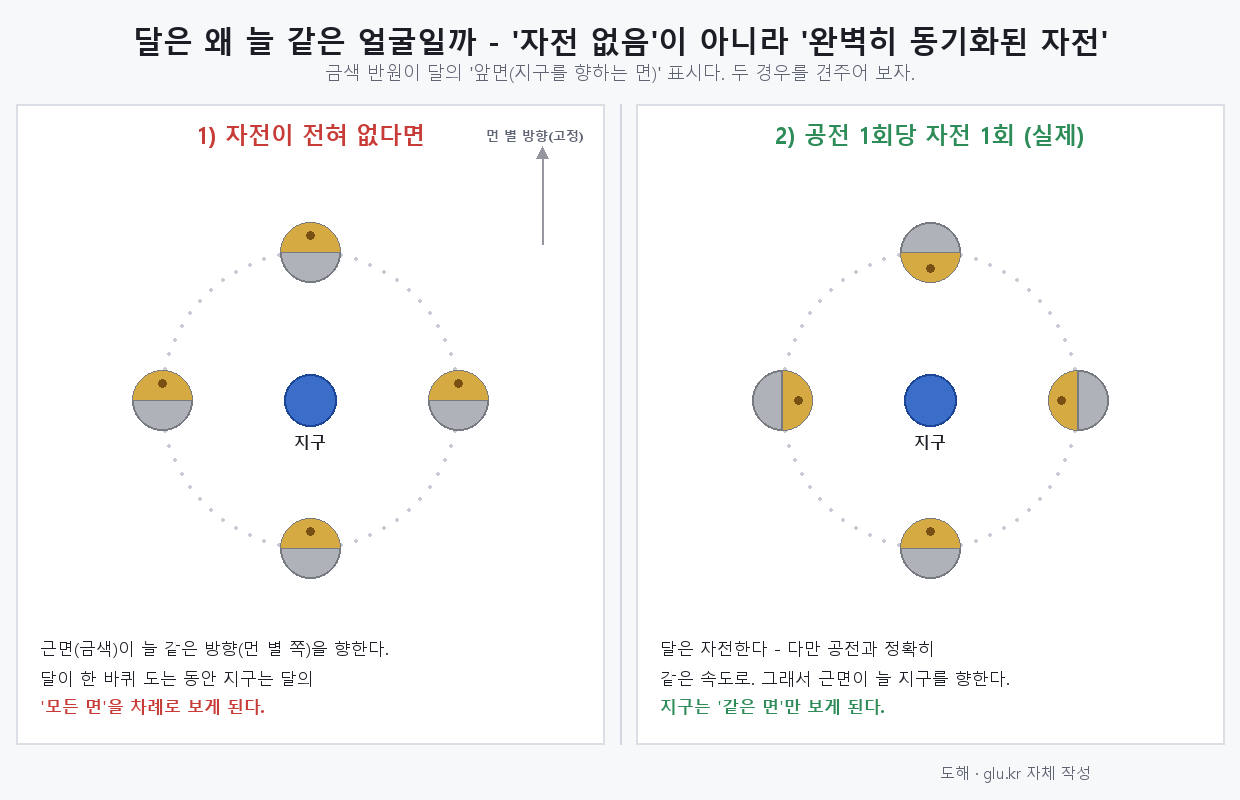
Diagram · Created by glu.kr
Then exactly how long is that “one turn”? The Moon’s rotation period, which equals its orbital period, is the sidereal month of about 27.32 days. This is easy to confuse with the “month” we usually know. The cycle of the Moon’s phases, which we count from one full moon to the next, is the synodic month of about 29.53 days — a bit more than two days longer. Because the Earth and Moon travel around the Sun together, even after the Moon has returned to the same place against the stars, it must go a little farther to reach the same phase relative to the Sun and Earth. In synchronous rotation, the reference is always the sidereal month of 27.32 days.
There is no “dark side” — a tale of the far side and the near side
In English there is a custom of calling the Moon’s far side the “dark side.” Popularized by a famous album title, the expression is not scientifically accurate. The correct term is the far side. The Moon’s far side is simply not visible from Earth; it experiences day and night over the synodic cycle exactly as the near side does. In other words, sunlight pours onto the far side just as it does onto the near side. “The side we cannot see” and “the side without light” are entirely different things.
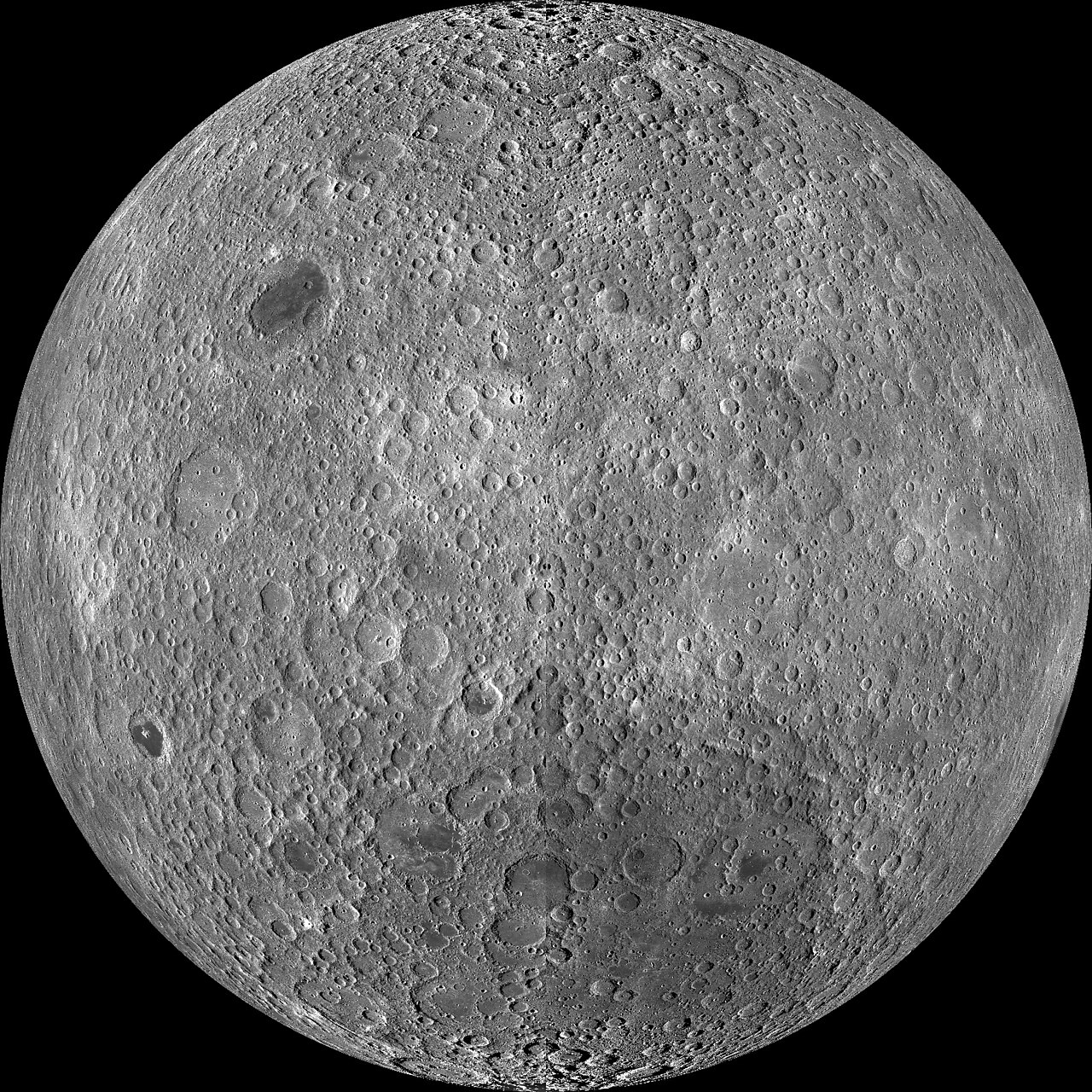
Photo · NASA/GSFC/Arizona State University, Public Domain, Wikimedia Commons
And yet, when we actually looked at this far side, it turned out to have a quite different face from the near side. On the near side, the dark basaltic plains called “seas (maria)” cover about 31.2% of the surface, but on the far side such seas make up only about 1%, and it is filled with bright highlands and craters. Moreover, according to NASA’s GRAIL gravity-field survey, the crustal thickness also differs greatly: the near side is about 20–30 km thick, while the far side is far thicker at about 50–60 km. The fact that this near–far asymmetry exists is a clear observational result.
Its cause, however, remains an unsolved puzzle. Several hypotheses have been proposed. There is the idea that more heat-producing elements gathered on the near side, thinning its crust; a tidal-heating family of ideas in which the freshly formed, hot young Earth warmed the near side so that the far side cooled first and formed a thicker crust; and the idea that a small second moon collided with and merged onto the far side. That last merger hypothesis, though, has been challenged on the grounds that the far side’s chemical composition does not fit its predictions well. None of these has yet been established as the settled explanation.
How can it match so precisely — the principle of tidal locking
The precise interlocking of orbit and rotation is not a coincidence but the result of a physical process called tidal locking. The Earth’s gravity pulls on the near and far sides of the Moon with different strengths, and that difference stretches the Moon ever so slightly into a rugby-ball shape. This bulged-out portion is called the tidal bulge.
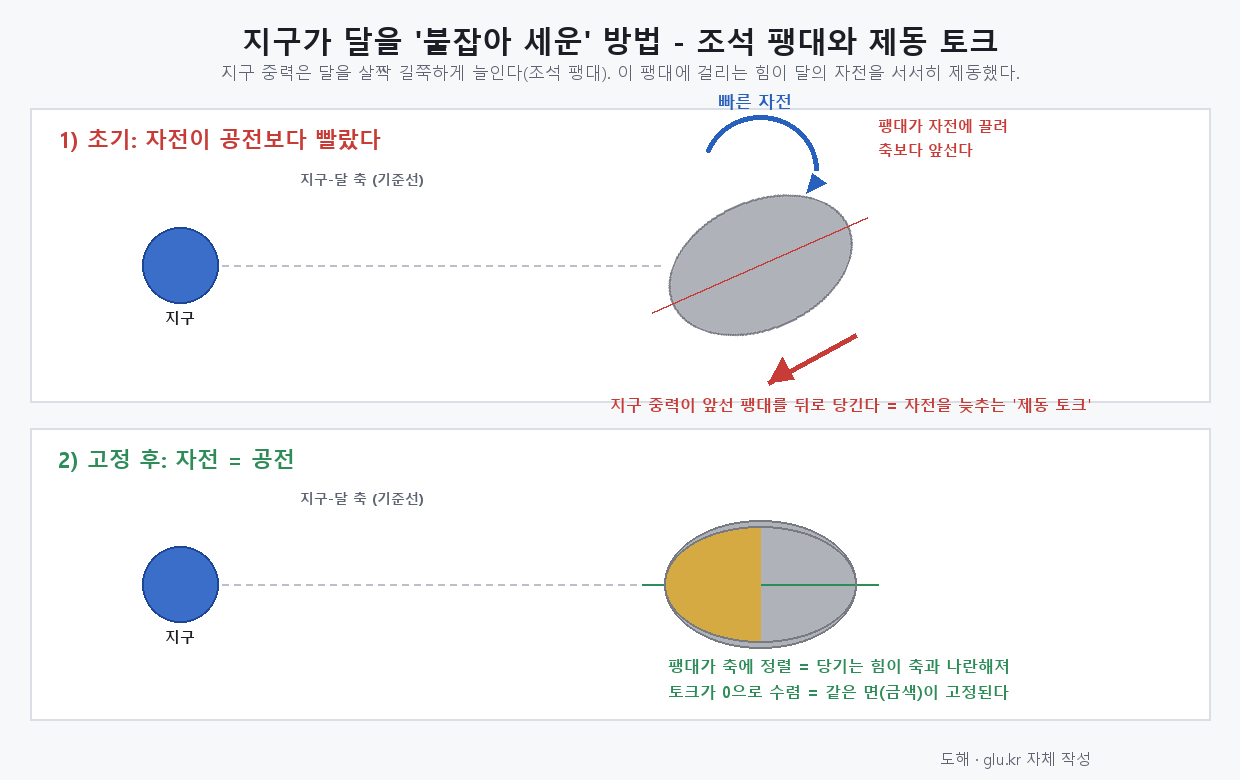
Diagram · Created by glu.kr
The early Moon rotated far faster than it does today. So the tidal bulge did not sit neatly on the line joining the Earth and the Moon; dragged along by the fast rotation, it ran slightly ahead in the direction of rotation. The Earth’s gravity then acted on this misaligned bulge as a torque (a force that slows the rotation), pulling it back. Like grabbing a handle to slow a spin, the Earth gradually braked the Moon’s rotation over a very long time, a process called despinning. And finally, once the Moon’s rotation period became equal to its orbital period, the bulge aligned along the Earth–Moon axis, the misalignment vanished, and the torque converged to zero. From that moment on, the synchronization has held stably to this day.
This tidal locking is not a special event unique to the Moon but a natural phenomenon widespread across the Solar System. Pluto and its moon Charon are in “mutual tidal locking,” each fixed to the other, and Jupiter’s Galilean moons (Io, Europa, Ganymede, Callisto) and many of Saturn’s large moons are each tidally locked to their parent planet. The same physical principle is at work consistently across many bodies.
Is it really “perfectly” the same face — the 59% that libration reveals
So can we forever see exactly half of the Moon’s surface? Intriguingly, we can see a little more. At any single instant only half is visible, but accumulated over time we can observe about 59% of the Moon’s surface from Earth. This phenomenon, in which the Moon seems to nod and tilt ever so slightly, is called libration.

Diagram · Created by glu.kr
Libration is divided broadly into three kinds. First, libration in longitude arises because the Moon’s orbit is not a perfect circle but a slight ellipse (eccentricity about 0.055). By Kepler’s second law the Moon orbits faster when near the Earth and slower when far, while its rotation proceeds at a nearly constant rate; the mismatch between the two lets us see a little more to the left and right (maximum amplitude about 8 degrees each way). Second, libration in latitude is the phenomenon in which, because the Moon’s rotation axis is tilted relative to its orbital plane, we see a bit more over the top and bottom in turn (maximum amplitude about 7 degrees up and down). Third, diurnal libration is the effect by which, as the Earth rotates, an observer’s position shifts by the Earth’s radius, so we view the Moon from a slightly different angle (less than 1 degree). Thanks to these three librations overlapping, we get to peek at about 9% more surface than a mere half.
Then how did humanity first encounter the far side, which is never visible from Earth? In October 1959, the old Soviet Union’s probe Luna 3 swung around behind the Moon and photographed the far side for the first time in human history. Its blurry set of 29 images captured an unfamiliar terrain, almost devoid of seas and utterly unlike the near side.
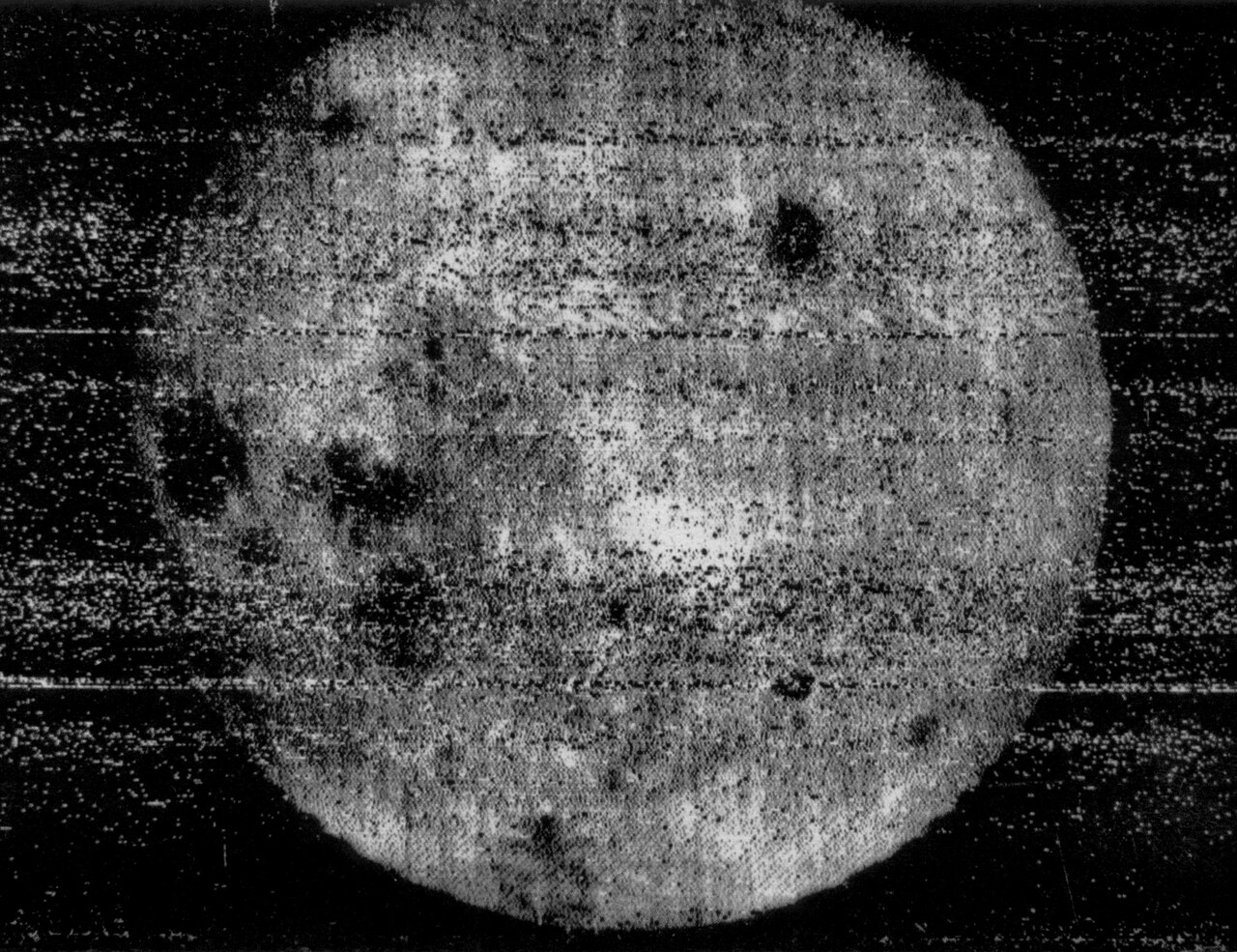
Photo · OKB-1 (USSR), Public Domain, Wikimedia Commons
The Moon is still slowly moving away
The force that created the tidal locking is still slowly changing the Earth–Moon system today. Thanks to lunar laser ranging (LLR) — firing a laser from the ground at the retroreflectors that Apollo astronauts placed on the Moon and timing the round trip — we have confirmed, down to the millimeter, that the Moon is receding from the Earth by about 3.8 cm each year. The tides that stretch the Moon also stretch the Earth, slowing the Earth’s rotation ever so slightly, and the angular momentum the Earth loses is transferred to the Moon’s orbit, pushing the Moon into a higher orbit.
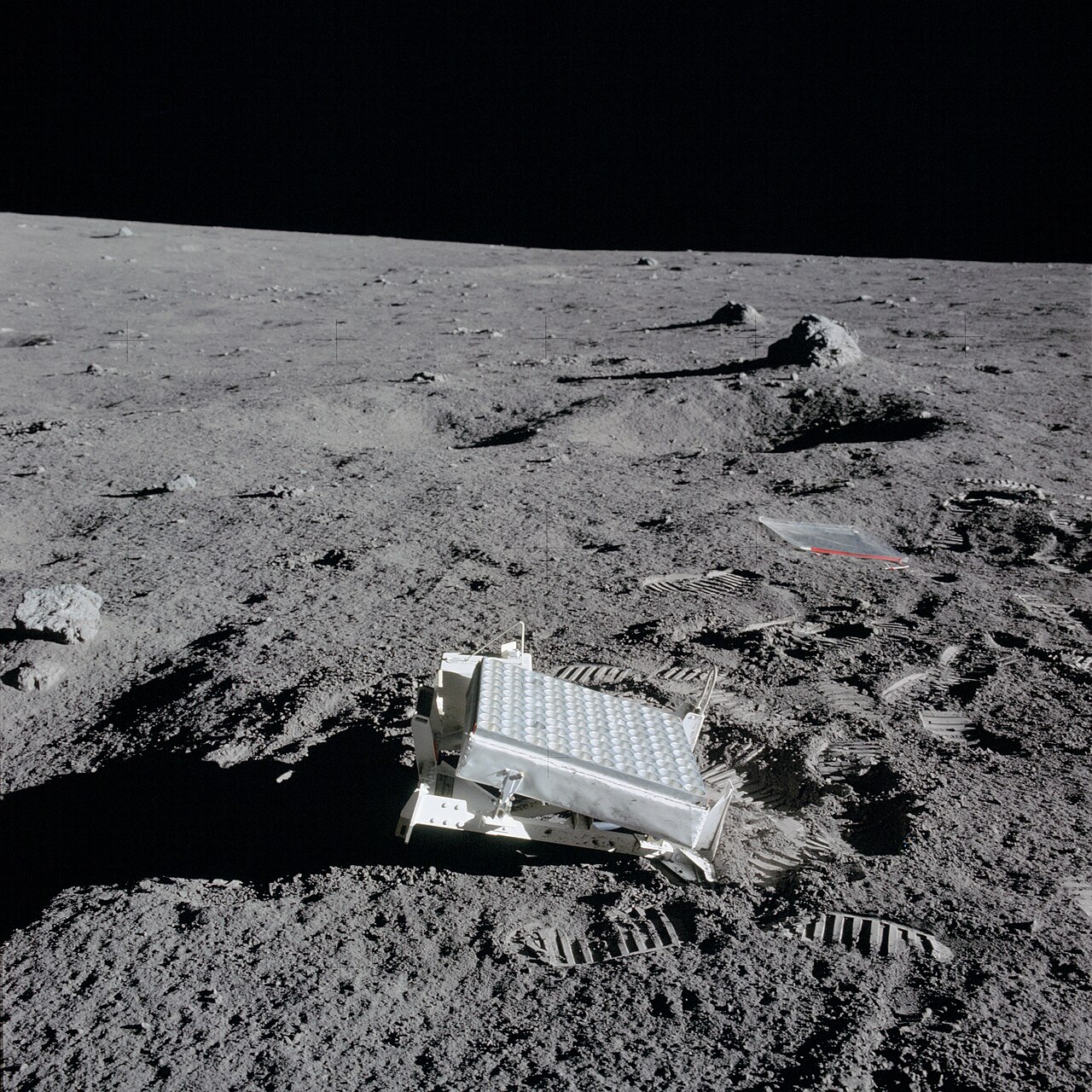
Photo · NASA, Public Domain, Wikimedia Commons
The saying “the day is getting longer” comes from here too. But this point breeds misunderstanding if lumped into a single number. The theoretical contribution calculated from tidal friction alone is about +2.3 milliseconds per century, but the actual trend of increasing day length estimated from thousands of years of eclipse records is about +1.7 to +1.8 milliseconds per century, smaller than that (from the 2024 PNAS family of studies). To that gap, the post-glacial rebound (GIA) — the land slowly rising after the last ice age — contributes about -0.80 milliseconds per century in the direction of speeding the rotation back up. Since these are different physical effects, they must be understood separately rather than lumped together.
If we push this process into the very far future, someday the Earth too could become tidally locked to the Moon, so that only one face of the Earth points toward the Moon. That moment, however, is estimated to be on the order of 50 billion years away — and long before then, in about 5 billion years, the Sun is likely to swell into a red giant and swallow the Earth–Moon system. So this “mutual locking” is closer to a distant theoretical endpoint unlikely ever to be realized.
In closing — the exquisite balance in a familiar face
Behind the same-faced Moon we gaze at absent-mindedly each night lie, layer upon layer: a synchronous rotation that locks orbit and rotation precisely to the 27.32-day sidereal month, a tidal locking in which torque on the tidal bulge refined the rotation over millions of years, and a subtle adjustment of about 3.8 cm each year that continues even now. It is not because it “doesn’t rotate” but because it is “tuned with the utmost precision” that we always see the same Moon. When we read, one by one, the exquisitely designed order of the Earth–Moon system, the familiar night sky comes to feel wondrous all over again.
References
- NASA Science — Tidal Locking (overview, recession rate, Pluto–Charon, future scenario)
- Wikipedia — Tidal locking (mechanism, torque, mutual locking, other bodies, future red-giant note)
- Wikipedia — Orbit of the Moon (sidereal month 27.32 d, synodic 29.53 d, eccentricity)
- Wikipedia — Libration (longitude, latitude, diurnal libration, cumulative 59% coverage)
- Wikipedia — Far side of the Moon (maria 1% vs 31.2%, near–far asymmetry)
- Wikipedia — Luna 3 (launched 1959-10-04, imaged 10-07, 29 frames, ~70% of far side)
- Wikipedia — Tidal acceleration (leading bulge, angular-momentum transfer, lunar recession, length of day)
- arXiv — Lunar laser ranging: the millimeter challenge (T. W. Murphy Jr.)
- NASA JPL — The Apollo Experiment That Keeps on Giving
- PNAS 2024 — The increasingly dominant role of climate change on length of day variations