
There is a small rodent that fills barely half your palm. It has almost no fur; its skin is wrinkled, ranging from pink to yellowish-brown; and two pairs of large, yellowish incisors jut out in front of its lips. It is 8–10 cm long and weighs 30–35 g — about the size of a house mouse. This is the naked mole-rat (Heterocephalus glaber), which digs and lives underground in the dry grasslands of East Africa (Ethiopia, Kenya and Somalia — the so-called “Horn of Africa”). It looks unremarkable, but this small creature overturns our assumptions about mammals not once but several times.
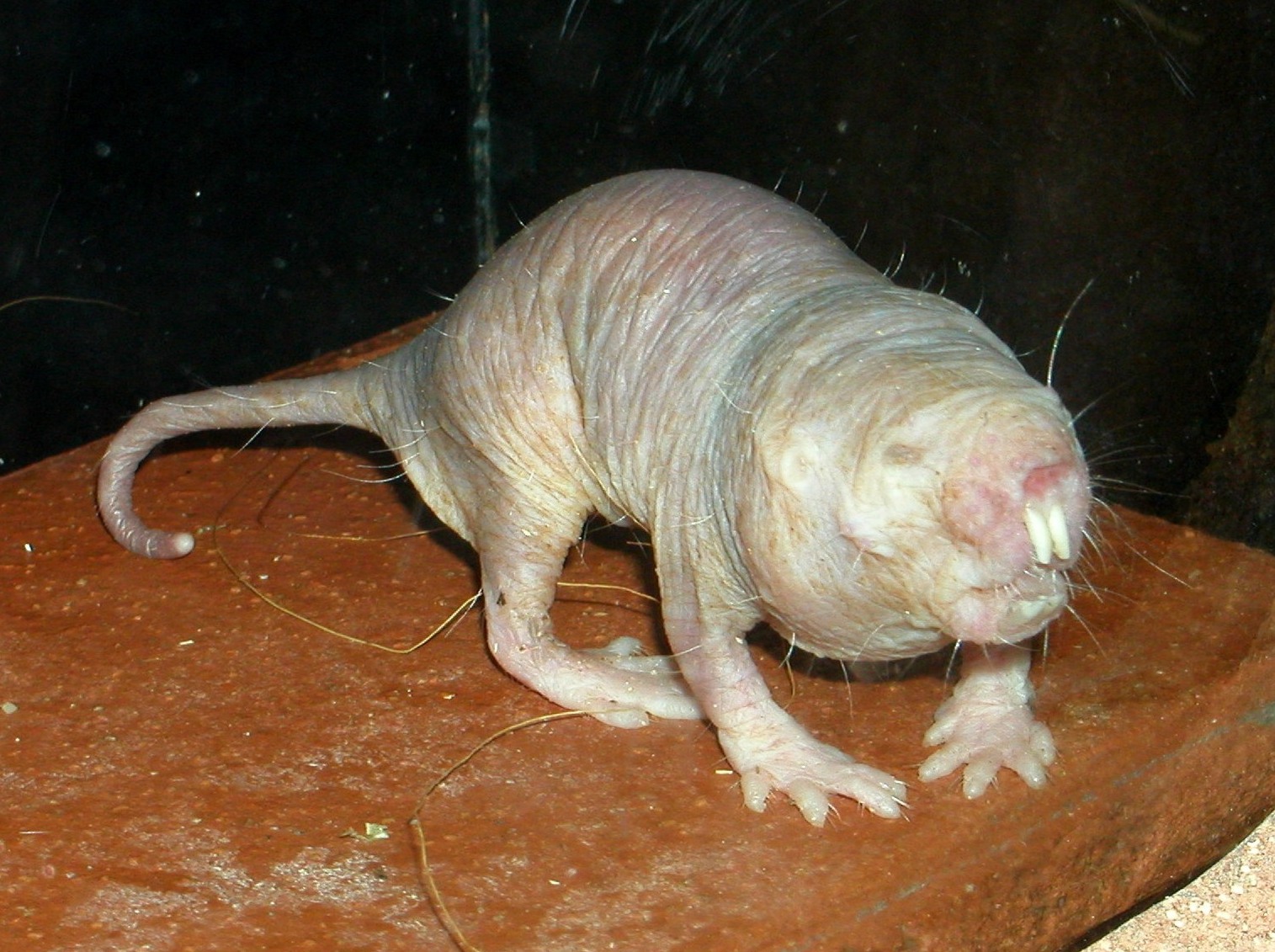
Photo · Roman Klementschitz, CC BY-SA 3.0, Wikimedia Commons
The very placement of those incisors outside the lips is by design. The lips close behind the front teeth, so the animal can use its teeth as digging tools without any soil getting into its mouth. Its eyes are so tiny as to be almost vestigial, and its eyesight is poor; instead, suited to life in pitch-dark tunnels, it relies heavily on its whiskers and body touch-hairs. Every feature is fitted to a life spent entirely underground.
A Subterranean Kingdom Ruled by a Single Queen
The first surprise is its social structure. In a naked mole-rat colony, only a single queen (the breeding female) and the one to three males she pairs with produce offspring. The remaining dozens do not breed; instead, grouped by body size and task, they form worker castes that dig tunnels, carry food and defend the colony. The queen suppresses the breeding of the other females through behaviour and hormones, keeping for herself the sole right to bear young. A colony ranges from a few dozen to an average of about 75–80 individuals, and sometimes more than 300 (Sherman et al., 1991).
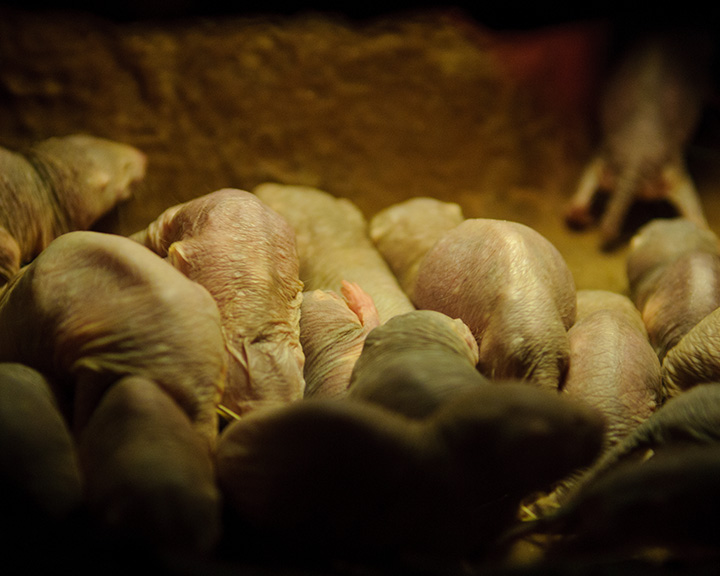
Photo · BFS Man, CC BY 2.0, Wikimedia Commons
A social system in which only one individual breeds while the rest cooperate as sterile workers is called eusociality. It is familiar in insects such as ants, honeybees and termites, but extremely rare among mammals. The naked mole-rat became widely known when Jennifer Jarvis described it in Science in 1981 as the first eusocial mammal (Jarvis 1981). The popular phrase “the only eusocial mammal,” however, is not accurate. The Damaraland mole-rat (Fukomys damarensis), of the same family (Bathyergidae), is also known to form eusocial colonies centred on a single queen (Jarvis & Bennett), so eusociality has appeared at least twice within this family. It is therefore better to call it a social system that is “extremely rare among mammals” rather than “unique.”
A Body That Barely Knows Cancer — Cells That Stop ‘Early,’ Not ‘Late’
The second surprise is the cancer resistance that has excited medical research. The claim that naked mole-rats “never get cancer” has spread widely, but it is an exaggeration. In 2016, Delaney and colleagues reported the first officially documented tumours — an adenocarcinoma and a gastric neuroendocrine carcinoma — in two long-lived zoo animals (non-breeding males of about 20 and 22 years) (Delaney et al., 2016). In other words, it is not that tumours never arise; rather, the accurate statement is that their cancer resistance is very strong, such that spontaneous tumours are reported only extremely rarely.
A clue to that resistance lies in how their cells stop dividing. Most cells stop proliferating once they are surrounded densely by other cells (contact inhibition), but the naked mole-rat’s fibroblasts stop at a much earlier stage — they halt division as soon as the cells merely touch sparsely, an “early contact inhibition.” At this point the cell-cycle brake protein p16(INK4a) is strongly induced, engaging a double braking system different from that of humans and mice (Seluanov et al., 2009).
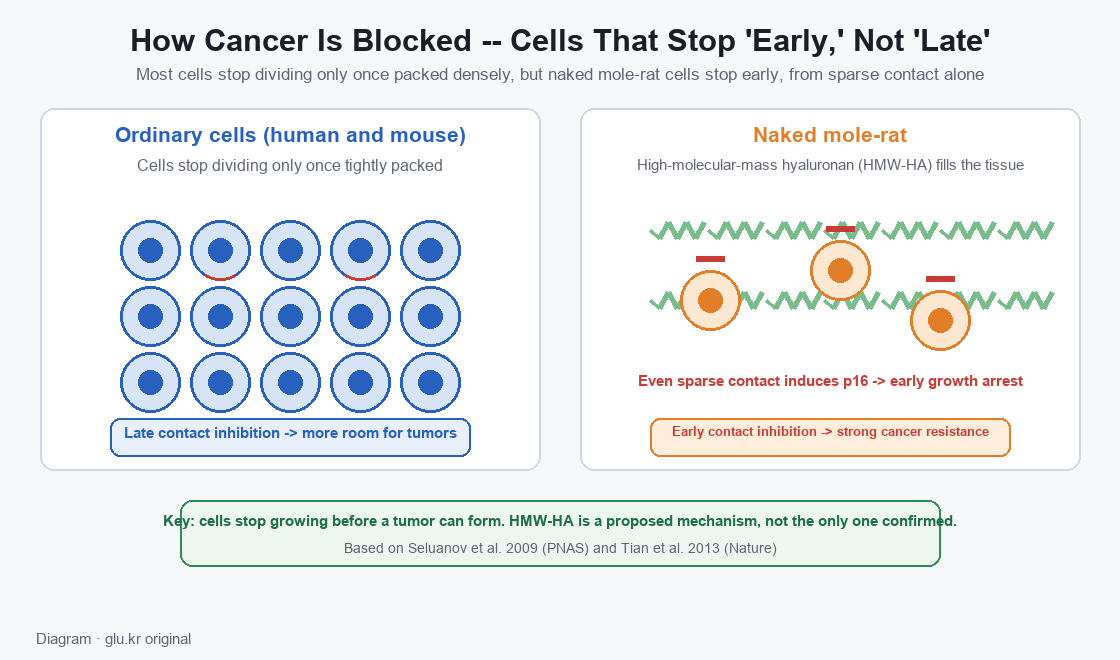
Diagram · created by glu.kr
The substance identified as mediating this early braking is high-molecular-mass hyaluronan (HMW-HA). In 2013, Tian and colleagues showed that naked mole-rats accumulate hyaluronan more than five times larger than that of humans or mice in the space outside their cells (Tian et al., 2013, Nature). This giant molecule fills the tissue so that cells sense one another early and, as a result, stop dividing before they can grow into a tumour. Indeed, when this hyaluronan was degraded or prevented from forming, naked mole-rat cells too became prone to malignant transformation. That said, this has not been established as the sole reason for their cancer resistance; several mechanisms — including an ability to synthesize proteins more accurately — are proposed to work together (Azpurua et al., 2013).
Living 30 Years — and a Death Risk That Barely Rises with Age?
The third surprise is longevity. The maximum recorded lifespan of the naked mole-rat in captivity reaches about 31 years (AnAge database). Compared with a house mouse of similar body size (about 35 g), which lives 3–4 years, that is roughly five times the value predicted from body size. An even more striking claim concerns how death risk changes with age. In 2018, Ruby and colleagues analysed the birth-and-death records of about 3,300 animals and reported that the daily risk of death does not noticeably rise as the animals age (Ruby et al., 2018, eLife). The Gompertz law — that mortality rises exponentially with age — fits most mammals, including humans, well; the naked mole-rat appears to depart from it.

Diagram · created by glu.kr
This, however, is not something to declare as “ageless” or “immortal.” The analysis has drawn counter-arguments — that many of the animals were observed for relatively short periods (a large share for eight years or less) and that the data are skewed toward animals born in a particular period — so it remains debated in the field. What is certain is that the naked mole-rat lives out a span of healthy years hard to imagine for a rodent of its size; that “death risk does not rise with age” is an attractive but still-unverified claim under ongoing testing.
A Metabolism That Endures Without Oxygen — Fructose Instead of Glucose
The fourth surprise is in breathing. Poorly ventilated underground burrows are low in oxygen and high in carbon dioxide. Fitted to such an environment, the naked mole-rat does not readily die even when oxygen is scarce. In a 2017 experiment by Park and colleagues, the animal endured a state with no oxygen at all (anoxia) for about 18 minutes without apparent injury (though none survived a 30-minute exposure). In an atmosphere lowered to 5% oxygen it held out for at least five hours with no ill effects, whereas comparison mice suffocated within 15 minutes under the same conditions (Park et al., 2017, Science).
The secret lies in switching fuel. Ordinary animals, deprived of oxygen, break down glucose until that pathway blocks itself (through acidification and feedback inhibition) and soon hits a wall. At that point the naked mole-rat switches to an anaerobic pathway that uses fructose. The fructose route is not caught by the brake that stops the glucose pathway, so it can keep extracting energy even without oxygen (Park et al., 2017). In effect, the animal repurposes the sugar that fruits normally use for sweetness as an emergency fuel to survive an oxygen crisis.
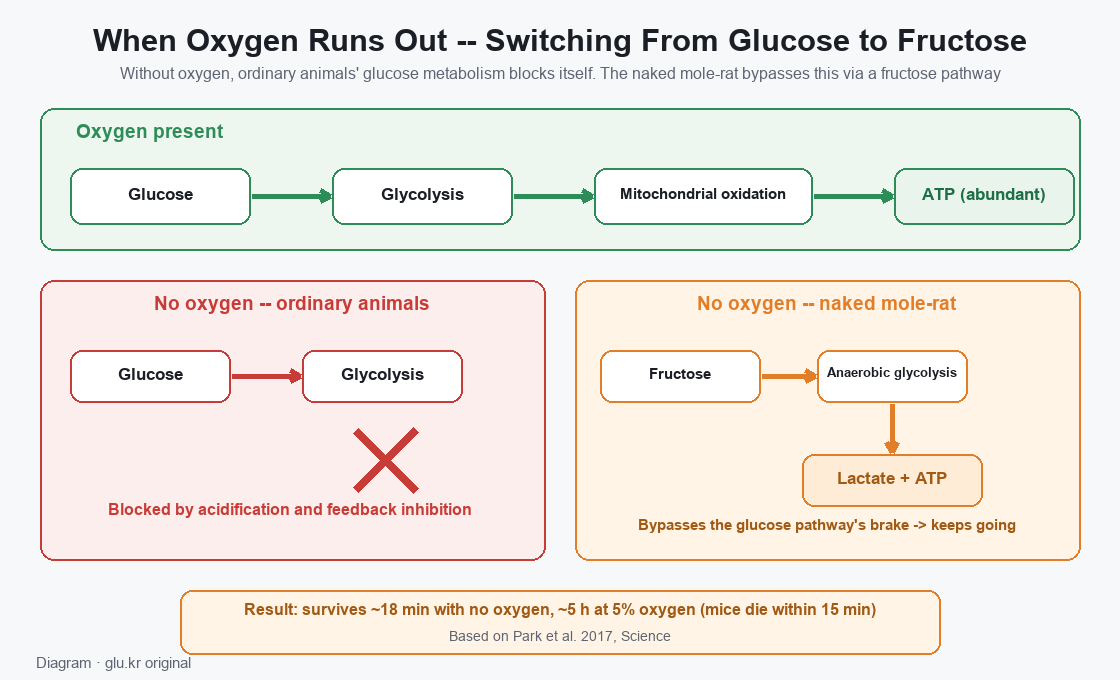
Diagram · created by glu.kr
Feeling Neither Acid Nor Chilli — Senses Tuned for Underground Life
The fifth surprise is pain. The naked mole-rat feels almost no pain from acid or capsaicin (the pungent compound in chilli peppers) — a trait that makes sense given a burrow environment prone to turning acidic as carbon dioxide builds up. In 2008, Park and colleagues showed that the pain-signalling molecule Substance P is missing from this animal’s skin sensory nerves. When Substance P was restored via a gene, the pain response to capsaicin returned, but the response to acid did not — revealing that the two kinds of insensitivity have different mechanisms (Park et al., 2008). The acid insensitivity arises because the neuron’s sodium channel (NaV1.7) is modified in a species-specific way, so that the acidic signal that excites nerves in other animals instead blocks the nerve from firing (Smith et al., 2011).
It should be noted that this does not mean the animal “feels no pain at all.” Naked mole-rats respond normally, like other rodents, to a hard pinch or to heat. The insensitivity is a finely tuned analgesia limited to particular stimuli (acid and capsaicin) directly tied to burrow life.
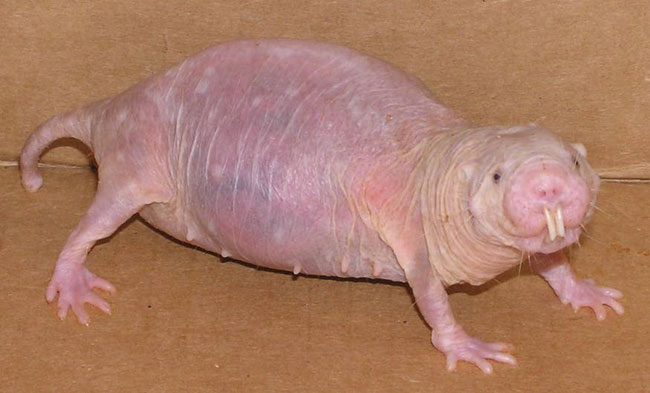
Photo · Chomez, Public domain, Wikimedia Commons
Their temperature control is unusual too. Unlike most mammals, which keep a constant body temperature whether it is cold or hot outside, the naked mole-rat is a thermoconformer closer to a cold-blooded animal, its body temperature tracking the surroundings. It can get by with such a body because burrow temperatures are fairly stable (about 30–33 °C), and when it gets colder the animal manages its temperature behaviourally — huddling together or moving to shallow tunnels warmed by the sun. Its metabolic rate, too, is among the lowest of similarly sized rodents, fitted to a life of enduring long on little oxygen and food.
An Intricately Designed Survivor Beneath East Africa
The naked mole-rat spends its whole life underground, out of the sunlight, eating large tubers. When one animal digging a tunnel strikes a big tuber, the whole colony shares it for a long time. There is no outward flamboyance, but layered inside this body are cells that suppress cancer, a metabolism that endures without oxygen, senses that filter out only particular pains, and a society that cooperates around a single queen.
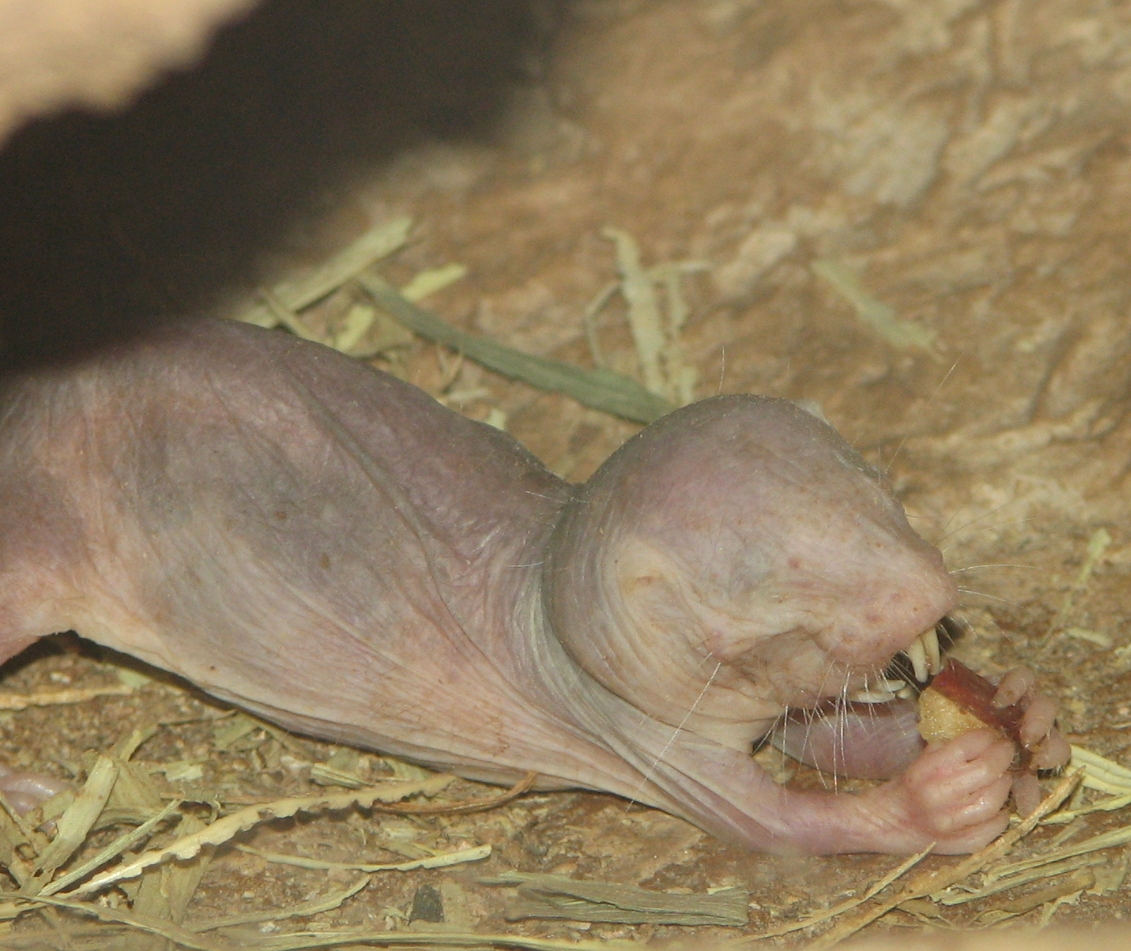
Photo · Ltshears (Trisha M. Shears), Public domain, Wikimedia Commons
This small animal, which strikes the human eye as an “ugly rat,” turns out to be an unexpected teacher on the very questions we most want answered — how to stop cancer, why we age, how to protect tissue cut off from oxygen. That so intricate a design is folded, layer upon layer, into a single palm-sized creature reminds us once again that the deeper we look into the created world, the deeper our wonder grows.
References
- Tian et al. 2013, Nature 499:346 — High-molecular-mass hyaluronan mediates the cancer resistance of the naked mole rat (PubMed)
- Seluanov et al. 2009, PNAS 106(46):19352 — Hypersensitivity to contact inhibition provides a clue to cancer resistance of naked mole-rat (PMC)
- Delaney et al. 2016, Veterinary Pathology 53(3):691 — Initial Case Reports of Cancer in Naked Mole-rats (PubMed)
- Ruby et al. 2018, eLife 7:e31157 — Naked mole-rat mortality rates defy Gompertzian laws by not increasing with age
- Park et al. 2017, Science 356:307 — Fructose-driven glycolysis supports anoxia resistance in the naked mole-rat (PubMed)
- Park & Reznick 2022, J. Muscle Res. Cell Motil. — Endurance in extreme conditions: metabolic adaptations of the naked mole-rat (PMC; supporting source for the 5% O2 hypoxia data)
- Park et al. 2008, PLoS Biology 6(1):e13 — Selective Inflammatory Pain Insensitivity in the African Naked Mole-Rat
- Smith et al. 2011, Science 334:1557 — The Molecular Basis of Acid Insensitivity in the African Naked Mole-Rat (NaV1.7)
- Azpurua et al. 2013, PNAS 110(43):17350 — Naked mole-rat has increased translational fidelity, associated with a unique 28S rRNA cleavage (PubMed)
- Jarvis 1981, Science 212:571 — Eusociality in a Mammal: Cooperative Breeding in Naked Mole-Rat Colonies
- Buffenstein et al. 2022, Biological Reviews 97:115 — The naked truth: a comprehensive clarification and classification of current myths in naked mole-rat biology
- AnAge / HAGR — Heterocephalus glaber longevity record (max 31 years, 35 g)
- Wikipedia — Naked mole-rat (Heterocephalus glaber)
- Wikipedia — Damaraland mole-rat (Fukomys damarensis, eusocial)