
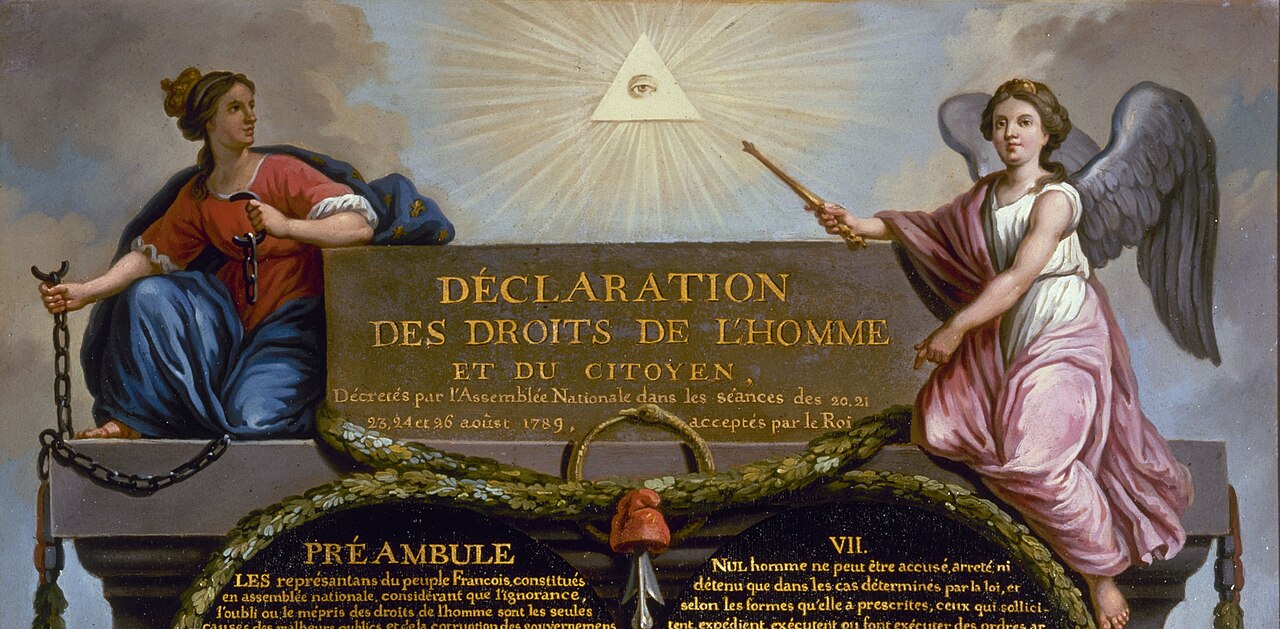
On 26 August 1789, Article 11 of the Declaration of the Rights of Man and of the Citizen, adopted by the French National Assembly, proclaims: “The free communication of ideas and opinions is one of the most precious of the rights of man. Accordingly, every citizen may speak, write, and print freely.” Read only this far, it sounds like an unlimited freedom. Yet the very same sentence immediately adds a condition: “but shall be responsible for such abuses of this freedom as shall be defined by law.” (Yale Avalon Project) This clause, the first to inscribe freedom of expression at the heart of a human-rights document, wrote the freedom and its boundary in a single breath. The history of freedom of expression has been a history of asking not only what it protects, but where it stops.
A Right in Three Layers
Today’s international norms treat freedom of expression not as a single, simple right but as a right in three layers. The first is the freedom to hold opinions without interference; the second is the freedom to access information; the third is the freedom to seek, receive, and impart information and ideas through any medium. Article 19 of the Universal Declaration of Human Rights and Article 19 of the International Covenant on Civil and Political Rights bind these three together, guaranteeing them “regardless of frontiers” and through any media. (UDHR; ICCPR)
A fact must be noted at the outset: no major norm defines freedom of expression as an absolute, unlimited right. From the French Declaration to the ICCPR and the European Convention on Human Rights, every document states that this freedom carries “special duties and responsibilities” and places alongside it the limits set by law. The “inviolable, absolute right” often imagined does not exist in the actual legal texts. The dispute is not over whether the freedom exists, but over where its boundary is drawn.
Two Athenian Words: Isegoria and Parrhesia
When the roots of freedom of expression are discussed, ancient Athens is often summoned. The Greeks had two words. “Isegoria” meant the equal right of citizens to speak on policy in the assembly, while “parrhesia” meant the freedom to speak frankly and candidly. In today’s terms, the former is close to “an equal right to address,” the latter to “unreserved speech.”
Yet to equate these concepts directly with modern freedom of expression is an exaggeration. The Athenian right to speak was open only to adult male citizens; women, slaves, and foreigners (metics) were excluded. A more important difference remains: this freedom was not “an individual’s right against the state” but a tool of self-government by which citizens jointly ruled the city. (Antigone Journal) Rather than a shield protecting the individual from power, it was closer to a qualification for taking part in the community’s decisions. The path freedom of expression has traveled has been a succession of ruptures and redefinitions, not a single line running straight from antiquity to the present.
The Printing Press, Censorship, and Milton
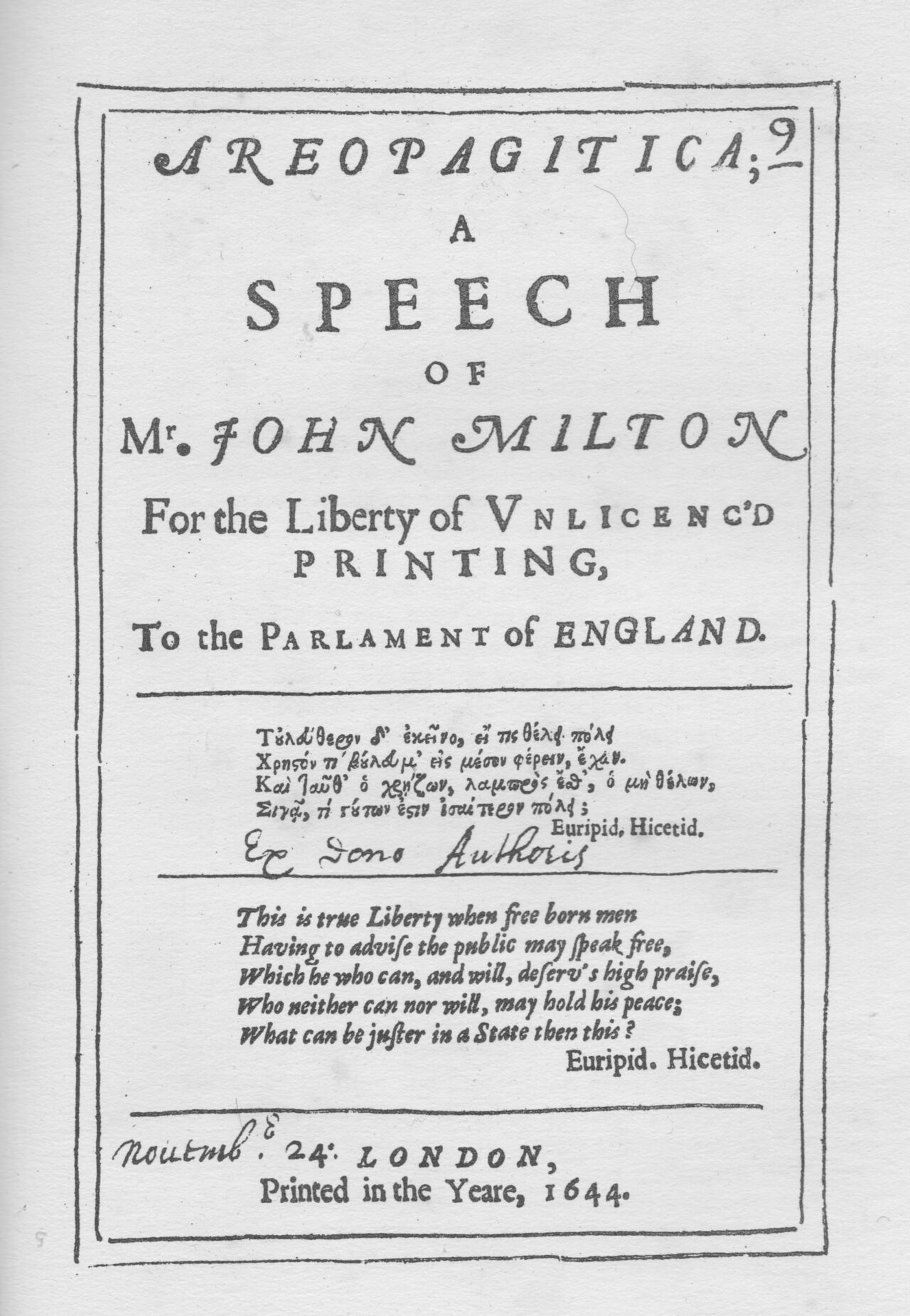
Freedom of expression in the modern sense sharpened together with the printing press. In 1643 the English Parliament issued a Licensing Order to censor printed matter in advance. The following year, on 23 November 1644, the poet John Milton published Areopagitica, a speech opposing this licensing system. He argued for “the liberty of unlicensed printing” and yet this very text was itself published without a license. Though it is counted among the representative classics defending freedom of expression in the English-speaking world, a misunderstanding often arises here. Areopagitica had little practical effect in its own time, and the licensing system continued for some while afterward. (Britannica) The seed of an idea did not grow at once into an institution.
Institutional change came slowly. The English Bill of Rights of 1689 guaranteed “freedom of speech and debate within Parliament,” but this was a privilege of members, not the freedom of expression of ordinary citizens. In written legislation, Sweden was in fact ahead. The Swedish Freedom of the Press Act of 1766 was one of the earliest press-freedom laws in the world, preceding the United States Constitutional amendment. This point corrects a common misconception. The claim that the First Amendment of the United States was the world’s first guarantee of freedom of expression is not true. Sweden’s law of 1766, the French Declaration of 1789, and, further back, the Bill of Rights of 1689 and the Athenian concepts all came before it. (Wikipedia, “Freedom of speech”)
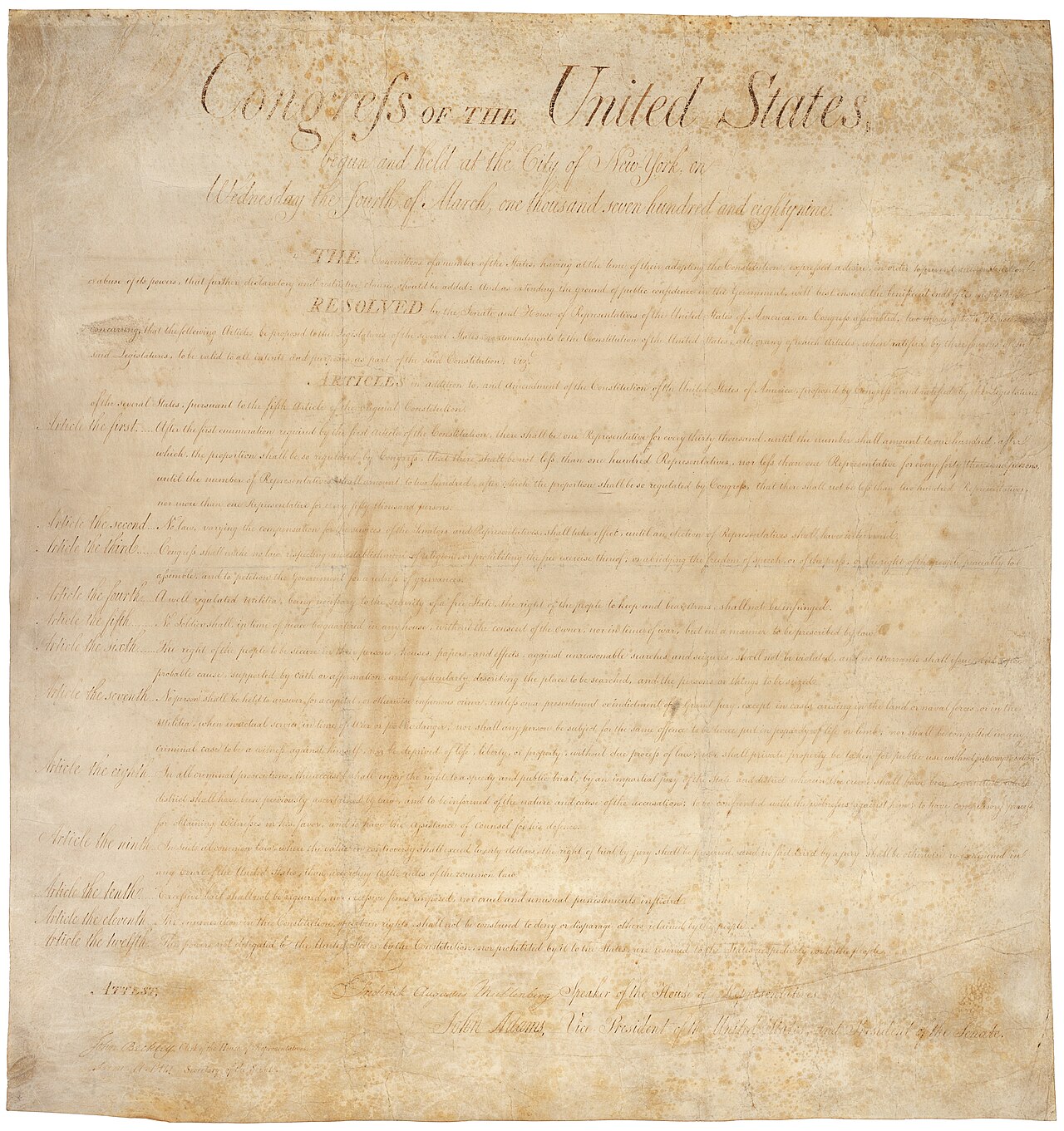
The United States Bill of Rights was ratified on 15 December 1791. Of the twelve amendments proposed in 1789, ten were ratified to become the Bill of Rights; the clause containing freedom of expression was, in the original order of proposal, the third. Because the two preceding clauses were not ratified, this clause became the “First Amendment.” (U.S. National Archives) Its wording is terse: “Congress shall make no law … abridging the freedom of speech, or of the press.” This way of barring the state from infringing individual expression differs in texture from the French Declaration’s manner of writing freedom and responsibility side by side. This subtle difference between the two traditions would later lead to a parting of ways over where the boundary lies.
Mill’s Harm Principle and the “Marketplace of Ideas”
By the nineteenth century, freedom of expression acquired a philosophical foundation. In 1859, in On Liberty, John Stuart Mill set out what is known as the harm principle: “the only purpose for which power can be rightfully exercised over any member of a civilized community, against his will, is to prevent harm to others.” Discussing the liberty of thought and discussion, Mill held that because no opinion is entirely certain, one can approach truth only through free debate. Even he, however, recognized exceptions such as immediate incitement to violence. (MTSU First Amendment Encyclopedia) Even a champion of freedom, in other words, admitted a boundary.
The widely used metaphor of the “free marketplace of ideas” is also often misunderstood at this point. There is a common belief that Mill coined the phrase, but this is not accurate. Its seed lies in the phrase “free trade in ideas,” written in 1919 by the United States Supreme Court Justice Oliver Wendell Holmes in his dissent in the Abrams case, and the expression “marketplace of ideas” itself appears in a 1953 opinion by Justice Douglas. (Wikipedia, “Marketplace of ideas”) Even a single metaphor bears the overlapping hands of several people.

The Boundaries Drawn by International Norms
After the two world wars of the twentieth century, freedom of expression was codified into international human-rights norms. Article 19 of the Universal Declaration of Human Rights, adopted by the United Nations General Assembly in Paris on 10 December 1948, proclaimed that “everyone has the right to freedom of opinion and expression.” The Universal Declaration, however, is in itself a declaration without legal binding force. (UN)
The binding treaty is the International Covenant on Civil and Political Rights, adopted on 16 December 1966 and entering into force on 23 March 1976. Article 19 of this treaty, to which 175 states were parties as of December 2025, guarantees freedom of expression but stipulates that for a restriction to be legitimate it must satisfy three requirements: first, that it be provided by law; second, that it be necessary; and third, that its aim be to respect the rights and reputations of others, or to protect national security, public order, public health, or morals. Article 20 goes a step further, requiring that the propaganda for war and the advocacy of national, racial, or religious hatred that constitutes incitement to discrimination, hostility, or violence be prohibited by law. (OHCHR) In Europe, Article 10 of the European Convention on Human Rights, signed in Rome on 4 November 1950 and in force from 1953, already carried the same structure: because freedom of expression “carries with it duties and responsibilities,” it may be subject to restrictions that are prescribed by law and necessary in a democratic society. (ECHR Article 10)
Where It Stops: Not a Single Boundary
So where exactly does the freedom stop? The internationally recognized test is the three-step framework seen above: is the restriction grounded in law, does it serve a legitimate aim, and is it necessary and proportionate to that aim? Defamation, incitement to violence, hate speech, obscenity, state secrets, invasion of privacy, and copyright are categories of restriction that many countries hold in common.
Yet exactly where that line is drawn differs from country to country. This is the heart of the conceptual history. The United States protects even inflammatory expression broadly as a matter of principle. In the 1969 case Brandenburg v. Ohio, the Supreme Court established the standard that expression may be punished only when it incites “imminent lawless action” and is likely actually to produce it. This greatly narrowed the “clear and present danger” standard of the 1919 Schenck case. (Brandenburg v. Ohio) By contrast, many European countries and the ICCPR impose a positive obligation to prohibit the advocacy of hatred by law. The same expression may be protected under one legal system and prohibited under another. It is worth placing these differences side by side not in order to judge which is right, but to see the fact that humanity does not hold a single answer to the question of “where it stops.”
Freedom of expression is not a finished right handed down as inviolable from antiquity. It is a concept redefined again and again through Athenian self-government, the disputes surrounding the printing press, the declarations of the revolutionary era, the arguments of philosophers, and the international norms that followed two wars. Throughout, there has always been the question of the boundary. If there is one conviction running through this history, it is that the human being is made to seek truth, to keep conscience, and to speak to one another. Deciding what to protect and where to stop is not settled once and for all; it remains a task that each generation must ask and answer anew.
References
- Transcript of the United States Bill of Rights (U.S. National Archives)
- Declaration of the Rights of Man and of the Citizen, 1789 (Yale Law School, Avalon Project)
- Universal Declaration of Human Rights (United Nations)
- International Covenant on Civil and Political Rights (UN Office of the High Commissioner for Human Rights)
- Article 10 of the European Convention on Human Rights (Wikipedia)
- Areopagitica (Encyclopaedia Britannica)
- On Liberty by John Stuart Mill (MTSU First Amendment Encyclopedia)
- Brandenburg v. Ohio (Wikipedia)
- Freedom of speech: an overview (Wikipedia)
- Marketplace of ideas (Wikipedia)
- Two Concepts of Free Speech: isegoria and parrhesia (Antigone Journal)