
Deep inside a dark hive, a worker bee that has just returned from a distant flower patch begins to bustle and shake her body in the middle of her nestmates. She runs almost straight ahead while vibrating her abdomen from side to side, then circles back to the starting point, over and over. After watching the dance for a few minutes, her nestmates leave the hive and fly almost straight to a flower patch hundreds of meters away that they have never seen. In utter darkness, without a single word, the coordinates “which direction, how far” have been passed on through the movements of one bee.
Andreas Trepte · CC BY-SA 2.5 · Wikimedia Commons · Source
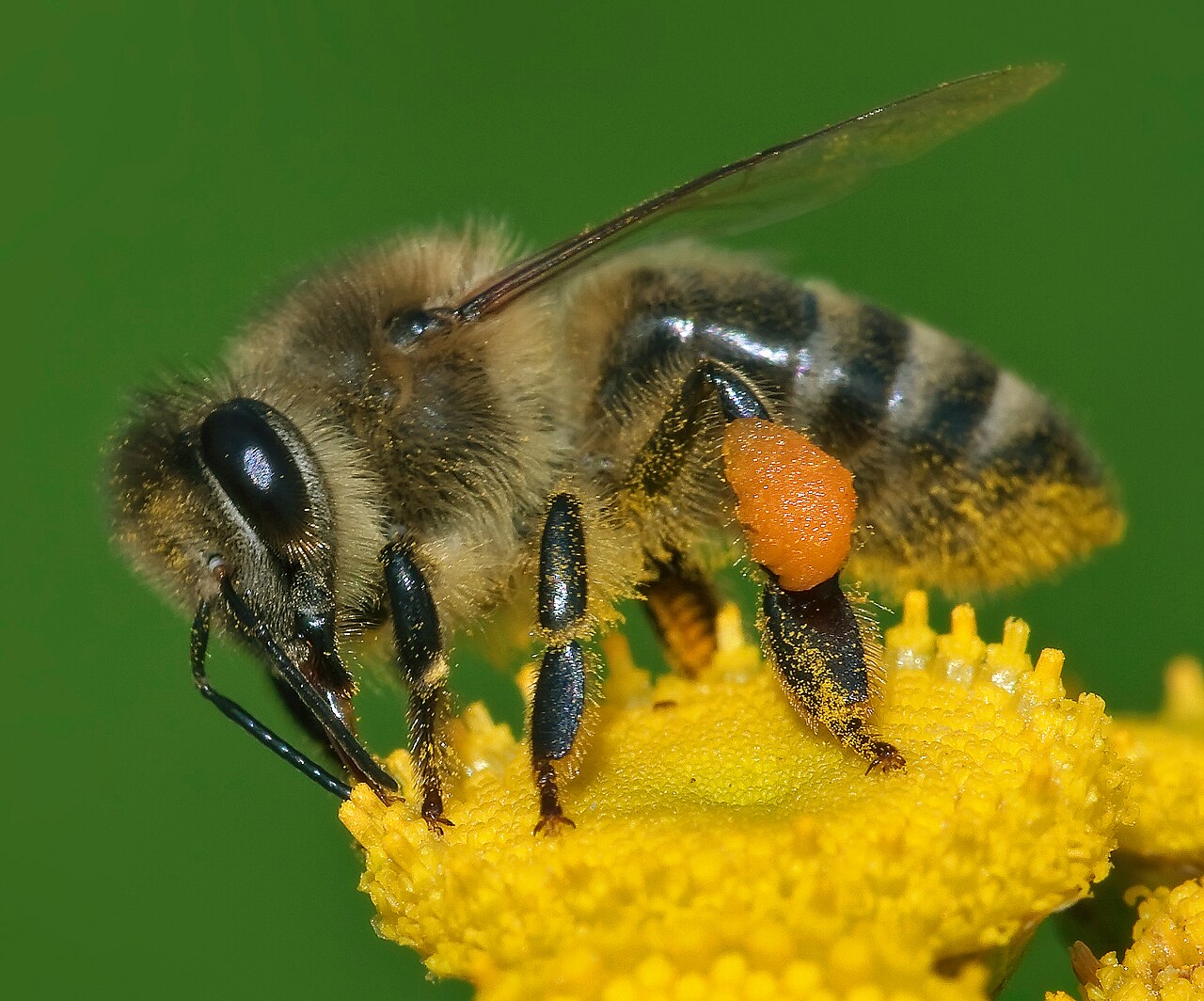
What is astonishing is the size of the brain that pulls this off. A honey bee’s brain is about one cubic millimeter in volume, with an estimated 960,000 neurons (the human brain has about 86 billion). This tiny brain, often compared to a single sesame seed, encodes abstract information — the distance and direction to a place not even in sight — into symbols and hands it to its nestmates. Let us unpack that elegant design one layer at a time.
What the waggle dance is
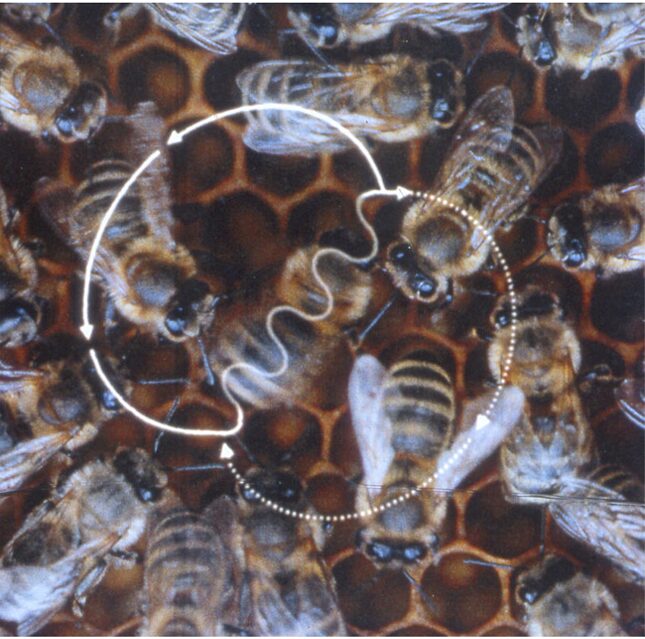
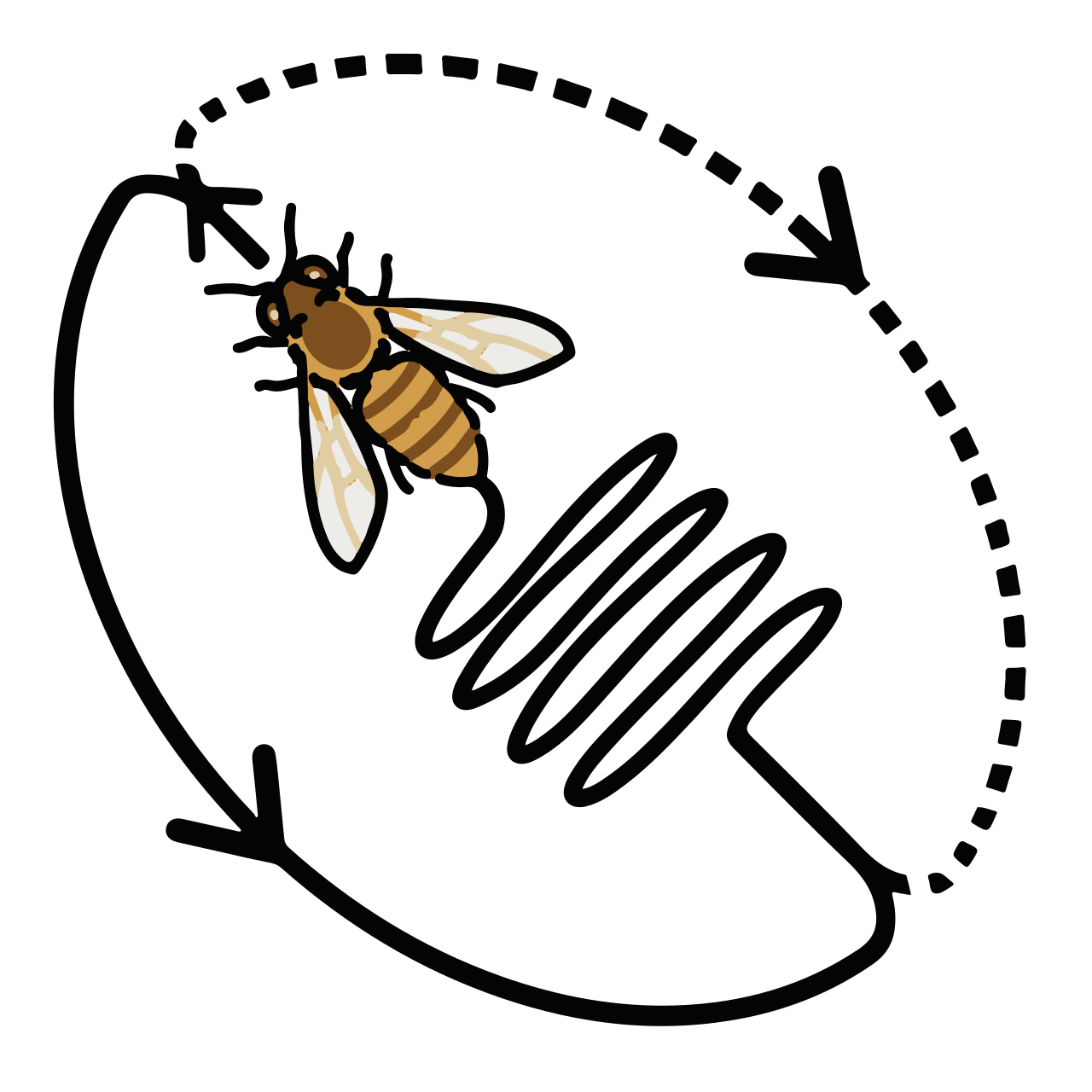
The honey bee’s waggle dance is a repeated motion performed on the vertical face of the comb. One circuit has two phases. First, in the waggle run, the worker runs almost straight ahead while rapidly shaking her abdomen from side to side. In the following return run, she circles back to the starting point. Because the direction of this return run alternates right and left, the whole path traces out the shape of a figure eight. Hence the name “waggle dance” (a figure-eight dance).
J. Tautz · M. Kleinhenz (Beegroup Würzburg) · CC BY 2.5 · Wikimedia Commons · Source
The key is that two pieces of information are carried on two separate channels. The angle the waggle run points encodes the direction of the food, while the duration of the waggle run encodes the distance to it. Direction and distance are written almost independently.
DataBase Center for Life Science (DBCLS) · CC BY 4.0 · Wikimedia Commons · Source
The dance looks different depending on whether the food is near or far. In the traditional account, when the food is very close to the hive the bee performs a round dance, which carries weak directional information, and switches to the waggle dance once the food is far enough away. Karl von Frisch even put the critical switch-over distance at about 50 meters. The modern view, however, differs. The round dance and the waggle dance are not two separate dances cut apart by a sharp threshold, but rather the two ends of a single dance whose precision and expression vary continuously with distance. At intermediate distances a transitional form such as the crescent-shaped sickle dance also appears. So rather than “the waggle dance begins at X meters,” it is more accurate to understand it as a continuum that runs smoothly from the round dance at the near end to the crisp figure-eight waggle dance at the far end.
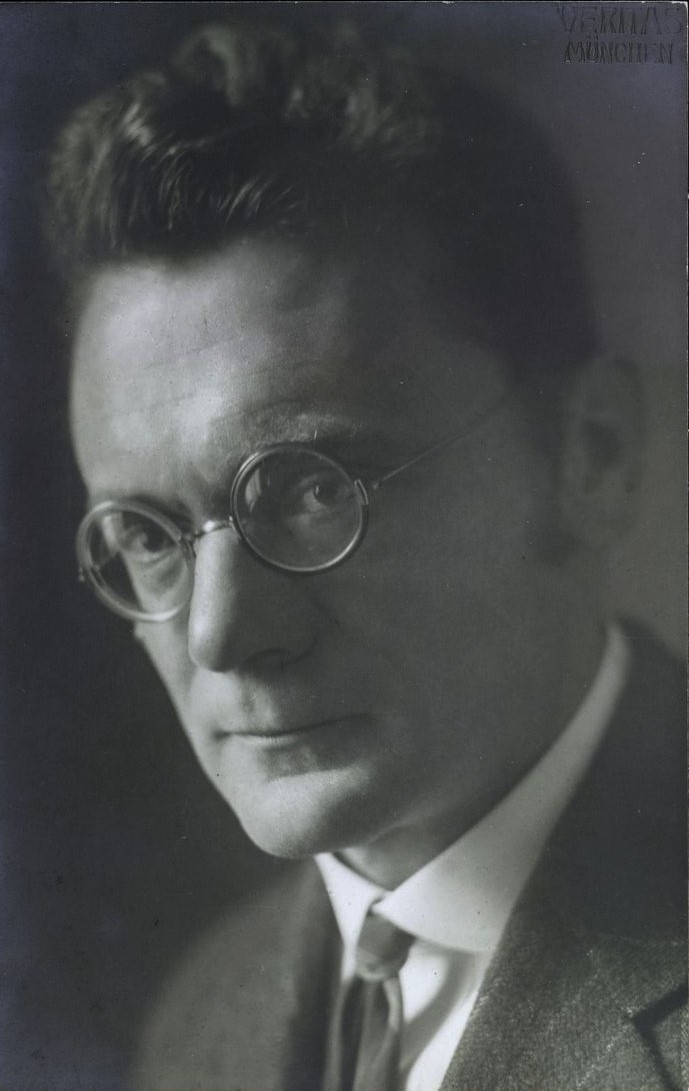
The person who decoded this dance through decades of experiments was the Austrian ethologist Karl von Frisch. He received the 1973 Nobel Prize in Physiology or Medicine for this work — not alone, but shared with Konrad Lorenz and Nikolaas Tinbergen. The prize was awarded for discoveries concerning “the organization and elicitation of individual and social behaviour patterns.” Von Frisch named the bees’ dance the Tanzsprache (dance language). Yet even borrowing his term, it does not mean this is identical to human language. More precisely, the bees’ dance is a symbolic, referential, and displaced form of communication that points to an object not currently in sight and encodes abstract information — distance and direction — into symbols, a phenomenon very rarely observed in the animal kingdom.
How direction is written: rewriting the sun as gravity
A question arises at once. It is pitch dark inside the hive — so how can a bee write down a “sun-based direction”? The answer lies in switching the reference line. Because the honey bee dances on the vertical face of the dark comb, she cannot see the sun directly. So she uses gravity (straight up, against gravity) as the reference line in place of the sun’s direction, transposing the bearing.
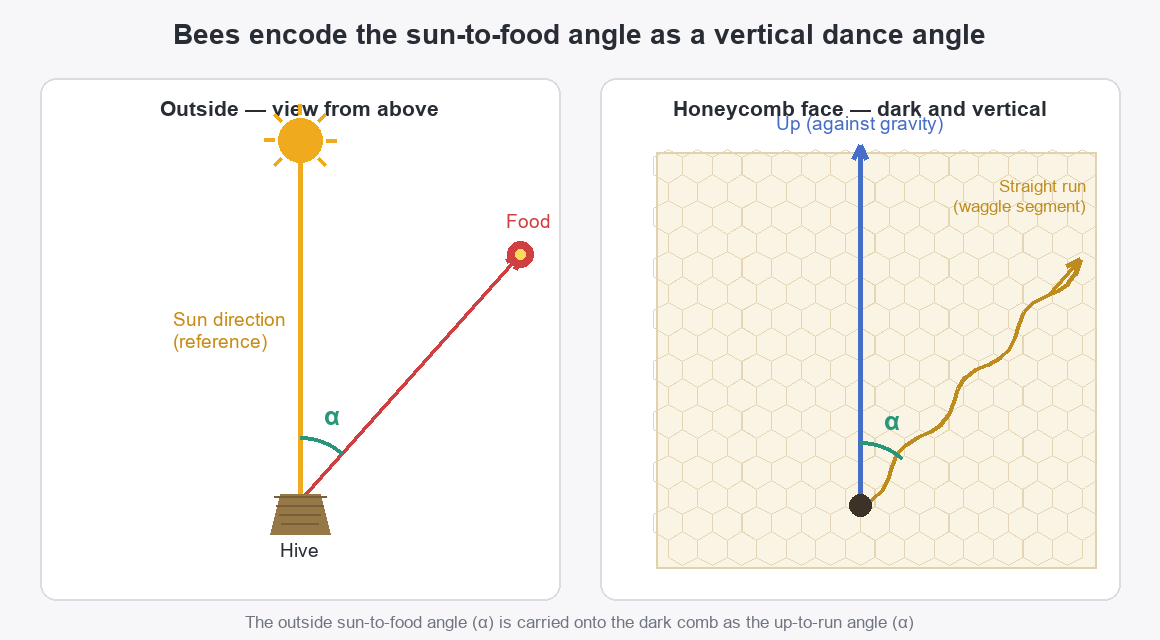
Diagram · created by glu.kr
The rule is simple yet elegant. The angle the waggle run makes relative to straight up (against gravity) equals the angle the food’s direction makes relative to the sun’s azimuth.
- If the waggle run points straight up (↑) → the food lies toward the sun.
- If the waggle run points straight down (↓) → the food lies away from the sun.
- If the waggle run tilts 60° to the right of vertical → the food lies 60° to the right of the sun’s azimuth.
But there is a trickier problem hidden here. The sun does not stay in one place all day. Its azimuth shifts continuously, on average by about 15° per hour (and non-linearly, depending on latitude, season, and time of day). If so, a dance seen in the morning and a dance seen at noon would point to different real directions even at the same angle — so how does the bee solve this?
This is where the time-compensated sun compass comes in. The honey bee uses her internal biological clock to estimate and correct for the sun’s movement. There is decisive evidence. A dancer that dances for a long time inside the hive, or that has been confined in the dark and sets out late, gradually adjusts the angle of her waggle run over time by exactly as much as the sun has moved in the meantime. That is, she uses her internal clock to calculate how far the sun would have moved during the elapsed time, and updates the angle on her own so that it keeps pointing to the same destination. Thanks to this, even when the moment a dance is watched and the moment of actual flight differ, the newly recruited worker can use the sun as a consistent compass.
Even when the sun is hidden by clouds, there is a way. If only a patch of blue sky is visible, the bee infers the sun’s position from the polarization pattern of sunlight scattered in the atmosphere. Because the polarization pattern is geometrically fixed with respect to the sun’s position, a single patch of sky is enough to recover the bearing. This ability, too, was worked out by von Frisch. The bee detects the direction of ultraviolet polarization with polarization-sensitive photoreceptors in the dorsal rim area (DRA) of her compound eye. In the end the direct sun compass and the polarization compass act as backups for each other, so that even on cloudy days, as long as a patch of blue sky is available, directional information is preserved.
How distance is written: measured by how much the scenery flowed
Distance is held in the duration of the waggle run. The farther the food, the longer the waggle run. But this relationship must not be pinned down as simple proportionality (linear). When Kohl and Rutschmann (2021) trained bees to feeders 0.1–1.7 km from the nest and measured them, the increase in waggle duration with distance was best explained by a non-linear function whose slope gradually flattens. The first kilometer is the steepest, and it grows shallower thereafter. In fact, a two-line model with a break-point at about 1 km fit nearly as well. The measured values run from about 0.41 s at 100 m to about 2.20 s at 1.7 km — roughly a 5.4-fold increase over 1.6 km. Averaged out, that is about 110 ms per 100 m, but since it is non-linear it should not be treated as a single constant.
So what does the bee measure distance with? Von Frisch once thought she gauged distance by the “energy” spent in flight, but that hypothesis was revised. Today’s consensus is optic flow. As she travels to and from the food, she gauges distance by the total amount of imagery streaming across her eye (retina), and transcribes that amount into the length of the waggle run.
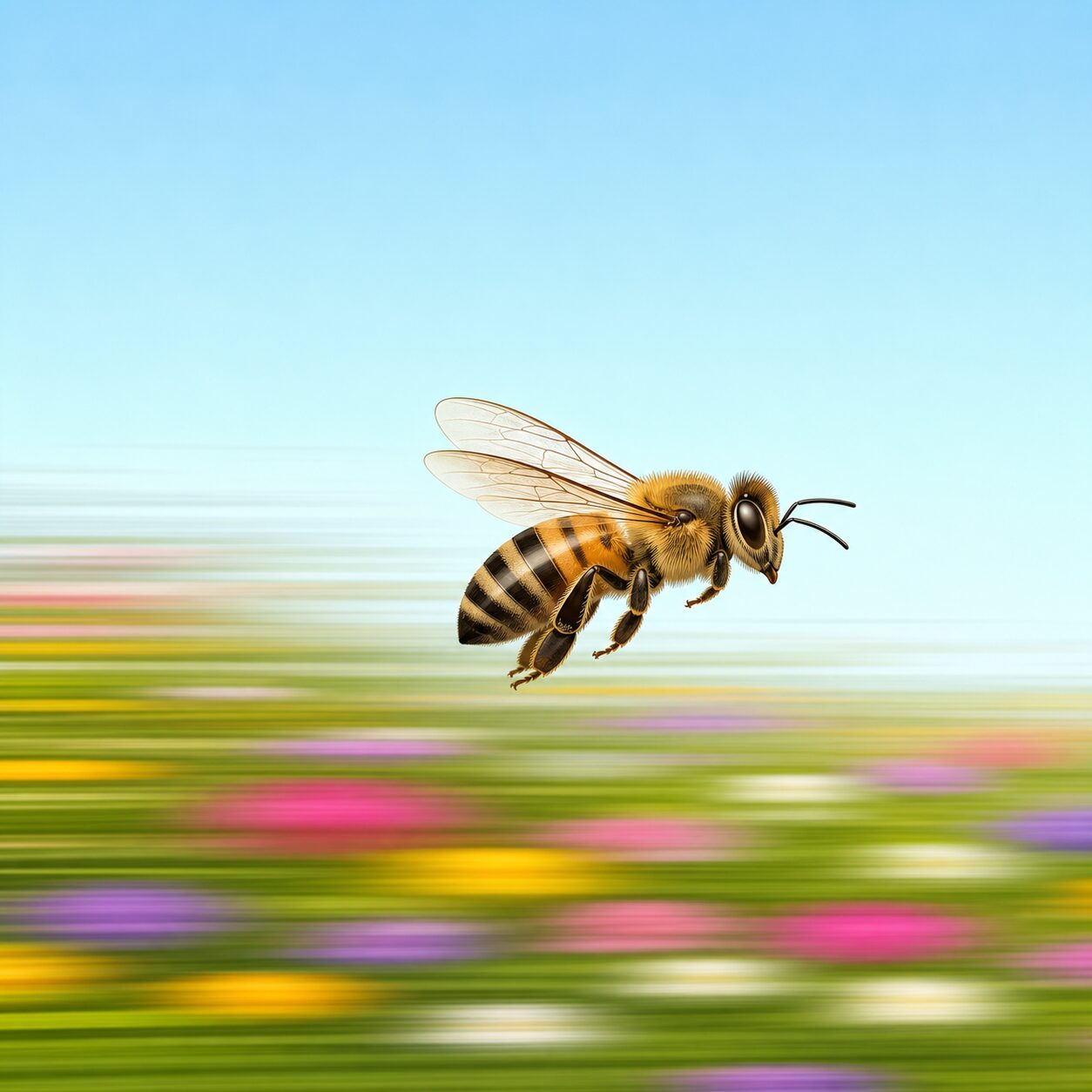
Illustration · AI-generated (Codex/ChatGPT subscription)
The decisive evidence came from tunnel experiments. When bees are made to pass through a narrow, patterned tunnel, the nearby walls exaggerate the optic flow, so the bee mistakes the distance for far longer than it really was. A kind of “vision-based odometer” mis-measures, and the waggle run of the dance lengthens accordingly. It directly showed that the distance estimate is tied not to the flight distance itself but to the amount of scenery that flowed across the eye.
That said, optic flow is not the only mechanism for measuring distance. A 2024 study showed that bees which have explored and grown familiar with the surrounding environment ignore the exaggerated optic flow created by the tunnel and instead estimate distance by relying on landmark memory. Only when the landmarks were blocked off with a screen did the tunnel’s optic-flow effect reappear. In short, the primary mechanism is optic flow, but in familiar terrain landmark memory can complement or override it.
A different unit of distance for each species: the bees’ “dialects”
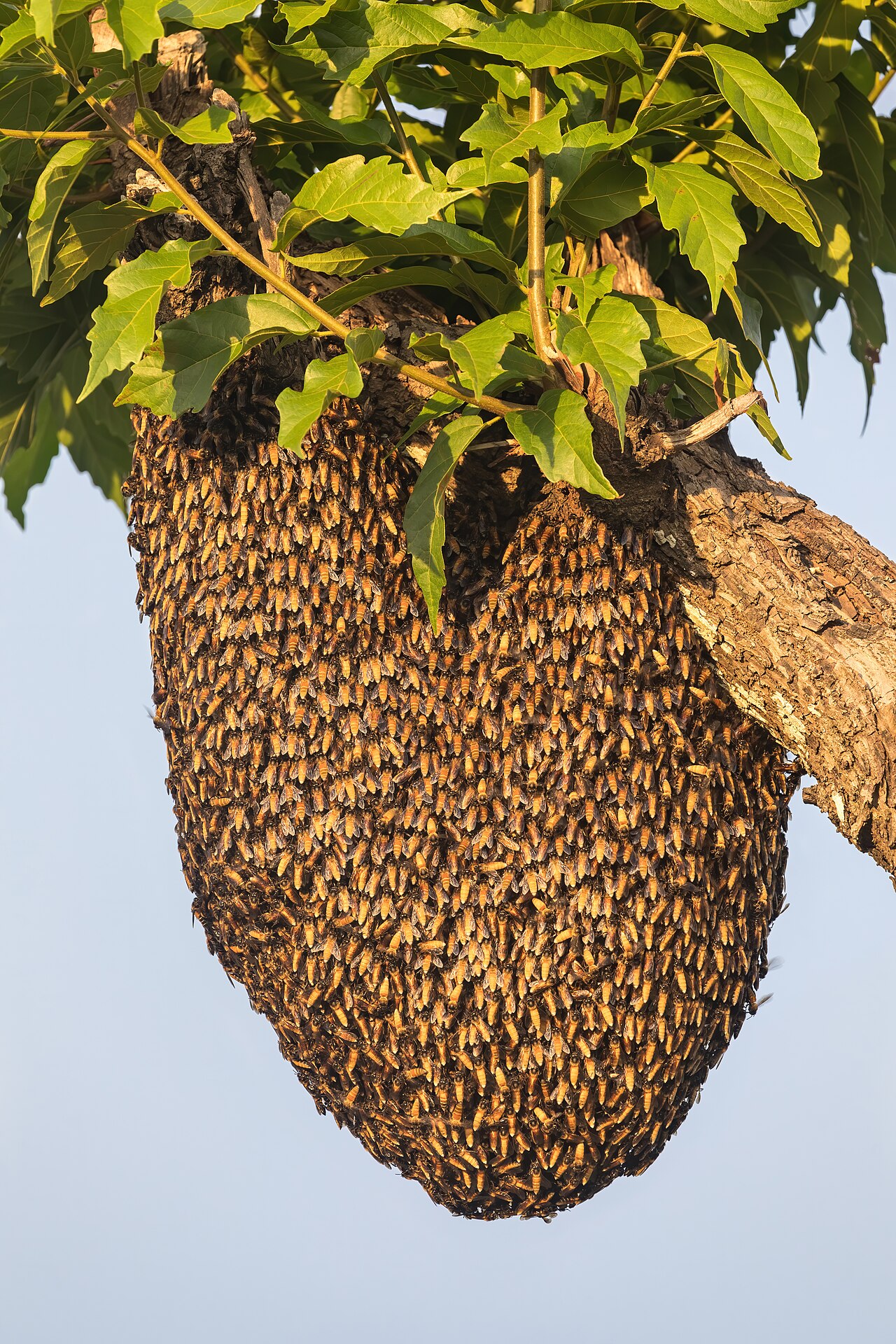
Intriguingly, even for the very same distance, the length of the waggle run comes out differently depending on the honey bee species — much like saying the same meaning in different units, a dialect. A dialect refers to the between-species difference in “how steeply the waggle duration increases with distance.” By measurement, the eastern honey bee (Apis cerana) is the steepest at about 5.4 s/km, the dwarf honey bee (Apis florea) is intermediate at about 4.6 s/km, and the giant honey bee (Apis dorsata) is the shallowest at about 2.1 s/km.
Here let us pin down one frequently cited figure precisely. The “about 1 km / 2.5 km / 3 km” commonly attached to these three species are not the maximum distances that can be encoded by the dance, but the maximum foraging ranges each species flies. That is, the eastern honey bee forages up to about 1 km from the nest, the dwarf honey bee up to about 2.5 km, and the giant honey bee up to about 3 km. In fact, the median foraging distances actually measured in the Indian field experiments that built the calibration curves were far shorter — about 94 m for the eastern honey bee, about 148 m for the dwarf honey bee, and about 197 m for the giant honey bee.
Basile Morin · CC BY-SA 4.0 · Wikimedia Commons · Source
There is a sensible design behind this difference (the adaptive tuning hypothesis). The wider a species’ foraging range, the shallower its slope. A steep dialect has a large change in time per unit distance, giving high distance resolution (precision), but it quickly hits the ceiling of the waggle duration, so the range it can encode is narrow. A shallow dialect, by contrast, sacrifices a little precision in exchange for being able to express the whole of a wide foraging range. Also, on a crowded dance floor, a waggle run that grows too long is hard for other bees to follow (the per-distance slope mentioned here is the value for the near range; at far distances the curve approaches its ceiling and flattens). So the wider the range a species forages, the more it favors a shallow dialect, encoding even far distances without strain.
Is this dialect innate, or shaped by the environment? A 2024 study compared tropical and montane eastern honey bees (Apis cerana) to separate the two directly. Even when a Himalayan colony was relocated 2,600 km to Bangalore, its slope remained lower than that of the tropical form, revealing a genetically fixed difference in distance encoding. At the same time, the relocated colony’s slope became significantly higher than in its original habitat, confirming that the environment also has an effect. In the end, a species’ or lineage’s dialect turned out to be a trait shaped by genetics and environment together.
Does the dance really convey information? A debate that was once real
It seems obvious today, but this was once a genuine matter of debate. Von Frisch argued that the waggle dance symbolically conveys the distance-and-direction vector to the food, whereas Adrian Wenner put forward an “odor hypothesis” — that bees actually find food mainly by scent cues rather than by the dance’s information. This opposition went on for decades.
Atelier Veritas (München) · Public domain · Wikimedia Commons · Source
The matter was settled by a study Riley and colleagues published in Nature in 2005. The team used harmonic radar to track the actual flight paths of bees recruited by watching the dance. The result was clear. The recruited bees flew straight to the vicinity of the destination along the vector (direction and distance) the dance had indicated (even correcting for wind drift on the way), and only after arriving in that vicinity did they search precisely with scent and the like to find the exact spot.
So the answer is not “who won” but “both work.” The dance conveys the distance-and-direction vector to the destination, and scent handles the final fine-tuning at the arrival point. Von Frisch’s hypothesis was vindicated in its essentials, while the role of scent was not denied either.
Instinct, or learned?
One last question remains. Is this elaborate dance entirely instinct, or is it learned? A 2023 study by Dong and colleagues, published in Science, separated this out precisely. They compared bees raised with no chance to follow and learn from experienced dancers before their own first dance against bees that normally observed their elders’ dances.
The result was asymmetric. The bees that could not learn from elders showed, in their first dances, a large divergence error in direction (angle), and they encoded distance incorrectly too. What follows, though, is the interesting part. Directional accuracy later improved with experience, but the error in distance encoding was never recovered and stayed fixed for life. In other words, this dance is neither pure instinct nor pure learning. To put it in a single sentence: direction is the axis refined by learning, and distance is the axis fixed at birth.
A brain the size of a sesame seed points to a place it has never visited, writes its distance and direction in symbols — and one of those two axes it even learns from its elders.
The elaborate communication design of a tiny creature
The more closely you look at the honey bee’s waggle dance, the more you marvel at how many problems are solved within it so elegantly. In the dark hive it takes gravity as its reference in place of the sun; as time passes and the sun moves, it corrects for that much with its internal clock; when clouds roll in, it back-calculates position from the polarization pattern. It measures distance by the amount of scenery that flowed across the eye, and tunes that “unit” differently to suit each species’ environment. Direction is refined by learning; distance is fixed at birth. All of this happens inside a brain the size of a single sesame seed.
The mission of glu.kr is to learn, discuss, and explain all things that God created. Such precise communication design packed into so small a life invites us to look once more into the depth of the created world we had overlooked. The next time you see a bee brushing past a flower bed, why not recall that inside that tiny head, even at this very moment, coordinates may be being translated into symbols.
References
- Waggle dance (English Wikipedia)
- Round dance, honey bee (English Wikipedia)
- Karl von Frisch (English Wikipedia)
- Karl von Frisch (Korean Wikipedia)
- The Nobel Prize in Physiology or Medicine 1973 — Karl von Frisch (NobelPrize.org)
- Kohl & Rutschmann (2021), non-linear waggle duration functions (PMC)
- Srinivasan et al. (2000), visual-flow calibration of the honey bee odometer (Nature)
- Schwarz et al. (2024), landmark knowledge overrides optic flow (J Exp Biol)
- Kohl et al. (2020), honey bee dance dialects — species distance encoding (Proc. R. Soc. B / PMC)
- Honeybee dance dialects (University of Würzburg press release)
- Tropical and montane Apis cerana show distinct distance dialects (J Exp Biol, 2024)
- Riley et al. (2005), flight paths of bees recruited by the waggle dance tracked by harmonic radar (Nature)
- Dong et al. (2023), social signal learning of the waggle dance (Science)
- Menzel & Giurfa (2001), cognitive architecture of a mini-brain: the honeybee (Trends in Cognitive Sciences)