
On a clear day, look up and the sky is blue; near sunset, that same sky glows orange. It is a scene we see every day, yet the moment someone asks “why is it blue?”, the answer is not so easy. People often say “because it reflects the sea,” but the sky is just as blue in the middle of a desert. The real protagonist is the air itself, filling the space above our heads.
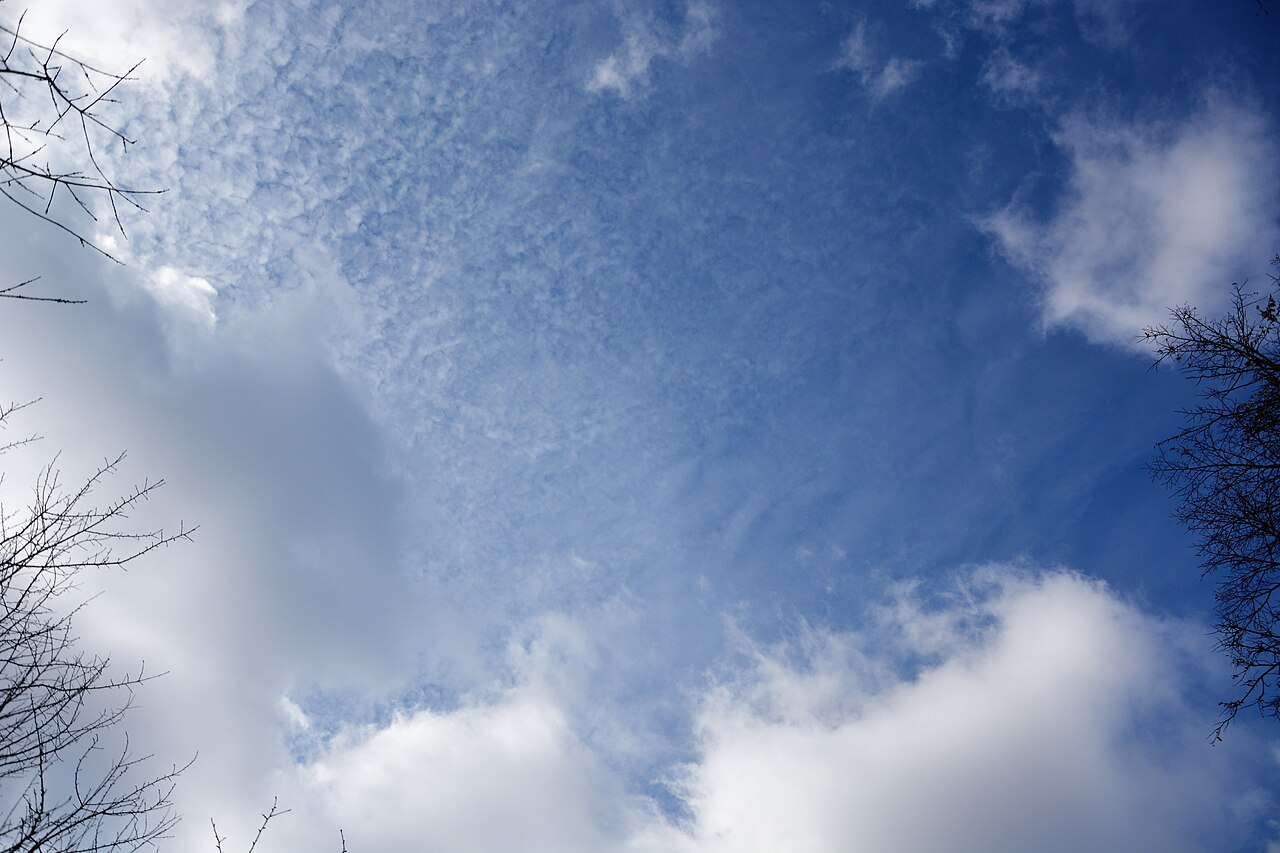
Podaliriy55 · CC BY-SA 4.0 · Wikimedia Commons · Source
In this article we will work through, step by step, how the blue sky and the red sunset are in fact two faces of the same physical phenomenon, and why that color flips completely once you go to Mars. The key concept is Rayleigh scattering.
1. Rayleigh scattering — air molecules scatter light
Sunlight looks white, but it is really a mix of light of many colors (wavelengths), from red all the way to violet. The proof is that passing it through a prism splits it into a rainbow.
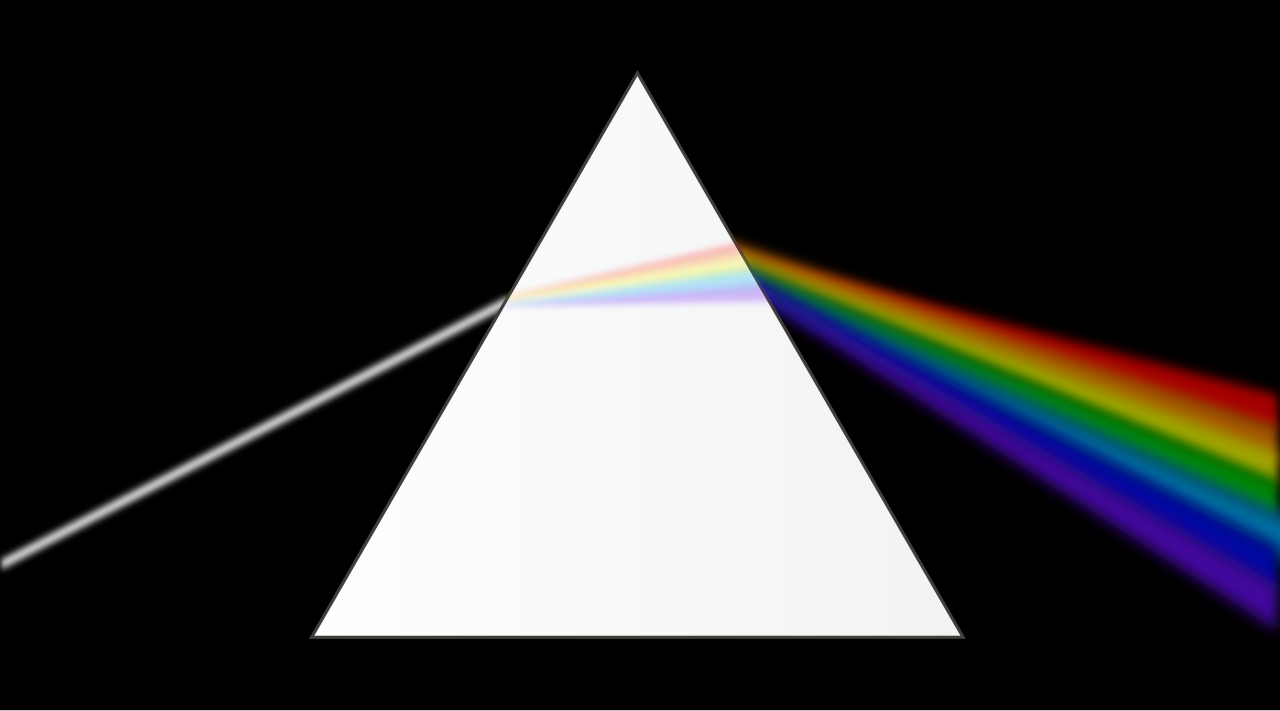
Astroskiandhike · CC BY-SA 4.0 · Wikimedia Commons · Source
As this light crosses the atmosphere, it collides with air molecules (nitrogen and oxygen). The molecules are far smaller than the wavelength of light (when the particle size is less than about one-tenth of the wavelength), and they scatter the light in all directions — this is Rayleigh scattering. The key point is that the shorter the wavelength, the much more strongly it is scattered.
The degree is inversely proportional to the fourth power of the wavelength; that is, the scattering intensity is proportional to 1/λ⁴. The electric field of the incoming light shakes the charges inside a molecule into an oscillating dipole, and that dipole re-emits light — and the intensity of this re-radiation is proportional to the fourth power of the frequency.
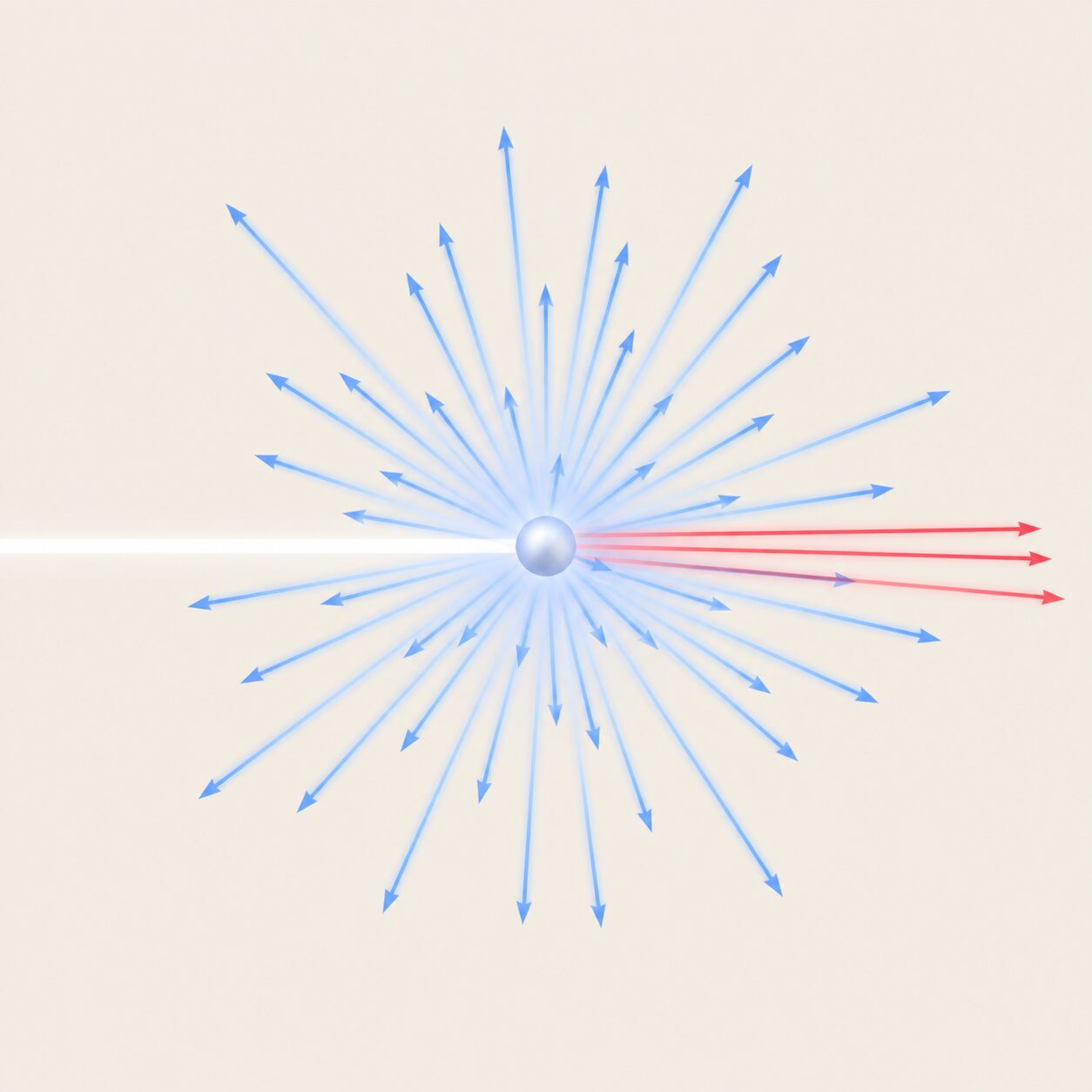
Illustration · AI-generated (Codex/ChatGPT subscription)
This 1/λ⁴ law becomes vivid in numbers. Blue (about 450 nm) is scattered (650/450)⁴ ≈ 4.4 times more strongly than red (about 650 nm) (it is often rounded to “about 5 times”). Comparing violet (about 400 nm) with red, the gap widens to (650/400)⁴ ≈ 7 times. So the short-wavelength blue light scatters all across the sky and enters our eyes from every direction, making the whole sky look blue.
2. But why blue, not violet?
A sharp-eyed reader will wonder: if violet is scattered even more strongly than blue, shouldn’t the sky be violet? There are two reasons it is blue nonetheless.
(1) Sunlight itself contains less violet. The Sun’s radiation is strongest near 500 nm (around green), and the output in the 400 nm violet region is lower than in the blue. There is simply less violet light to scatter in the first place.
(2) The human eye is more sensitive to blue than to violet. The cone cells of our eyes respond far more strongly to blue than to violet. So when the scattered bluish light mixes together, the brain perceives it as a “low-saturation blue” — a single blue near 474–476 nm blended with white light.
You may often hear that “the upper atmosphere absorbs violet, which is why the sky looks blue,” but this is not the main cause of the daytime sky color. What sets the daytime sky color is not absorption but three things: scattering efficiency + the solar spectrum + the eye’s sensitivity.
3. Why is the sunset red — subtraction, not addition
When the Sun sinks close to the horizon, the same sunlight passes through the atmosphere at a slant. The thickness of air the light traverses becomes tens of times longer than when the Sun is straight overhead at noon.
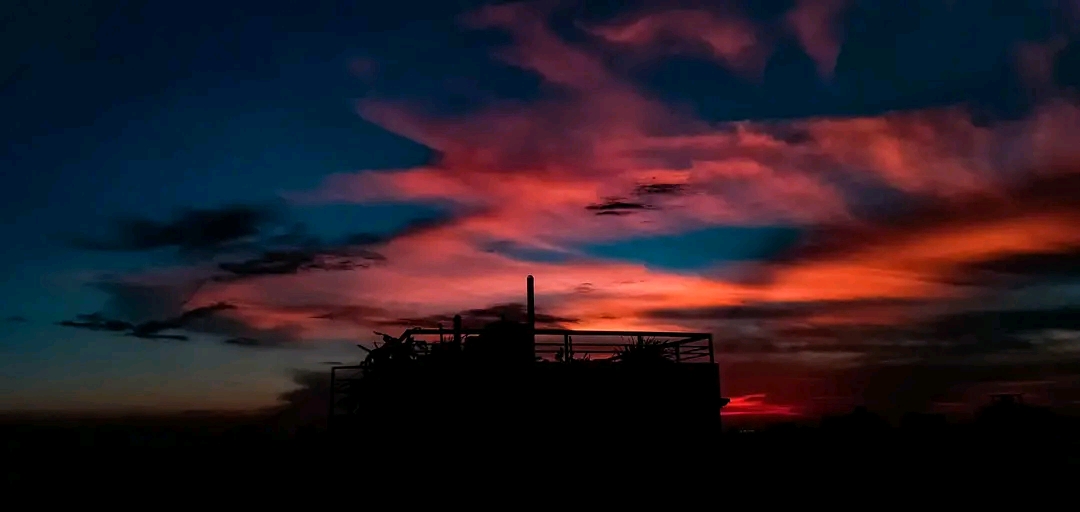
R trisha · CC BY 4.0 · Wikimedia Commons · Source
Over this long journey, blue and green are almost entirely scattered away to the sides. Only red and orange, which scatter weakly, travel straight through to reach the observer’s eye. So the redness of a sunset is the color left behind not because red was ‘added’, but because blue was ‘removed’. It is a kind of subtraction.
Here the primary cause is, above all, the ‘length of the atmospheric path’. Aerosols such as dust, haze, and volcanic ash are only secondary factors that make a red sunset deeper and more intense; they are not the cause of the color (the unusually red sunsets after a large volcanic eruption are an example).
For the deeper blue of the sky during the ‘blue hour’, just after the Sun has slipped below the horizon, the Chappuis absorption band of ozone (about 400–650 nm, with peaks near 575 and 603 nm) plays a part. As the light passes through the ozone layer over a very long path, orange and yellow are absorbed and removed, leaving the blue purer.
4. Common misconceptions — sea reflection, and Tyndall versus Rayleigh
The saying “the sky is blue because it reflects the sea” is wrong. The primary cause of the color is scattering by atmospheric molecules, not reflection off the sea. The sky is just as blue over sealess deserts and inland regions, and from space the Earth wears a band of blue.
If anything, the causation is closer to the reverse. Much of the blue of a calm sea is the blue sky reflected as if in a mirror, plus the effect of water itself absorbing a little red. It is “the sea reflecting the sky,” not “the sky reflecting the sea.”
Another point worth noting is the history of the research. In 1859, John Tyndall showed experimentally that when light passes through a liquid holding fine particles, it looks blue from the side and red where it passes through. This is the Tyndall effect. But Tyndall believed the blue of the sky was likewise due to ‘particles’ such as dust and water vapor, which was inaccurate.
In 1871, Lord Rayleigh quantified that the air ‘molecules’ themselves are enough to scatter light even without any separate particles, and established the 1/λ⁴ law. The essence of the blue sky is not particle scattering (the Tyndall effect) but Rayleigh scattering by molecules. Later, Smoluchowski in 1908 and Einstein in 1910 refined this further from the viewpoint of ‘density fluctuations’ in the medium.
5. Mars — same light, different scatterer, inverted colors
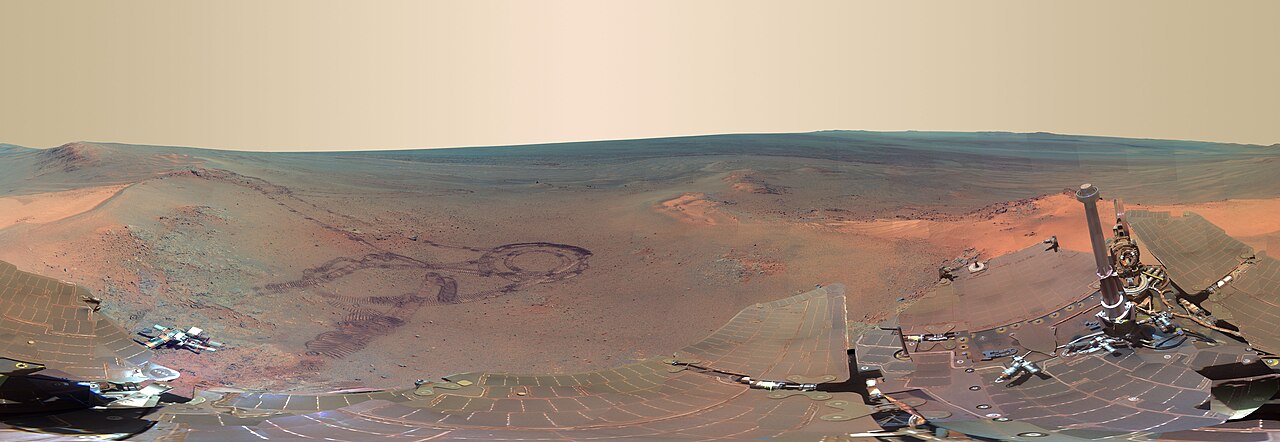
That was the ‘Earth story’. The blue sky and the red sunset were two faces of the same Rayleigh scattering, seen only at different path lengths. But on Mars this whole picture is turned upside down. The daytime sky takes on a yellowish tan to reddish hue, while the sunset is, instead, blue.
NASA/JPL-Caltech/Cornell/Arizona State U. · Public domain · Wikimedia Commons · Source
The key is “who decides the sky color.” Mars’s atmosphere is thin — about one-hundredth of Earth’s (roughly 0.6%) — so the contribution of Rayleigh scattering by air molecules is small. Instead, what dominates the scattering is the fine dust always suspended in the atmosphere. Dust particles about 1–3 µm across, rich in iron oxide (rusted iron), scatter and absorb the light.
This dust spreads red light widely while absorbing blue light or scattering it only forward. As a result, the daytime sky takes on a reddish cast over a butterscotch (yellowish tan). In other words, it is not that ‘Rayleigh runs in reverse’, but that the particles dominating the scattering change from small air molecules to dust grains about the size of the wavelength, so the physics that sets the color shifts (from the Rayleigh regime to the Mie scattering regime).
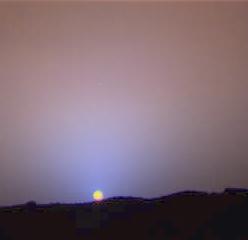
The sunset is the opposite. Dust particles strongly forward-scatter blue light into a narrow angle right around each particle. So as the Sun sets, only the sky near the Sun looks bluish, like a halo; the whole sky does not turn blue.
NASA/JPL-Caltech · Public domain · Wikimedia Commons · Source
This is not imagination but real observation. Mars Pathfinder (1997) first photographed the butterscotch sky and the blue sunset; the Spirit rover (2005, Gusev crater) captured the blue sunset clearly in color; and Curiosity recorded a blue sunset on video at Gale crater in 2015. The color is not a fixed value but varies with the amount of dust in the atmosphere and with the season.
6. Scattering in everyday life — why are clouds white?
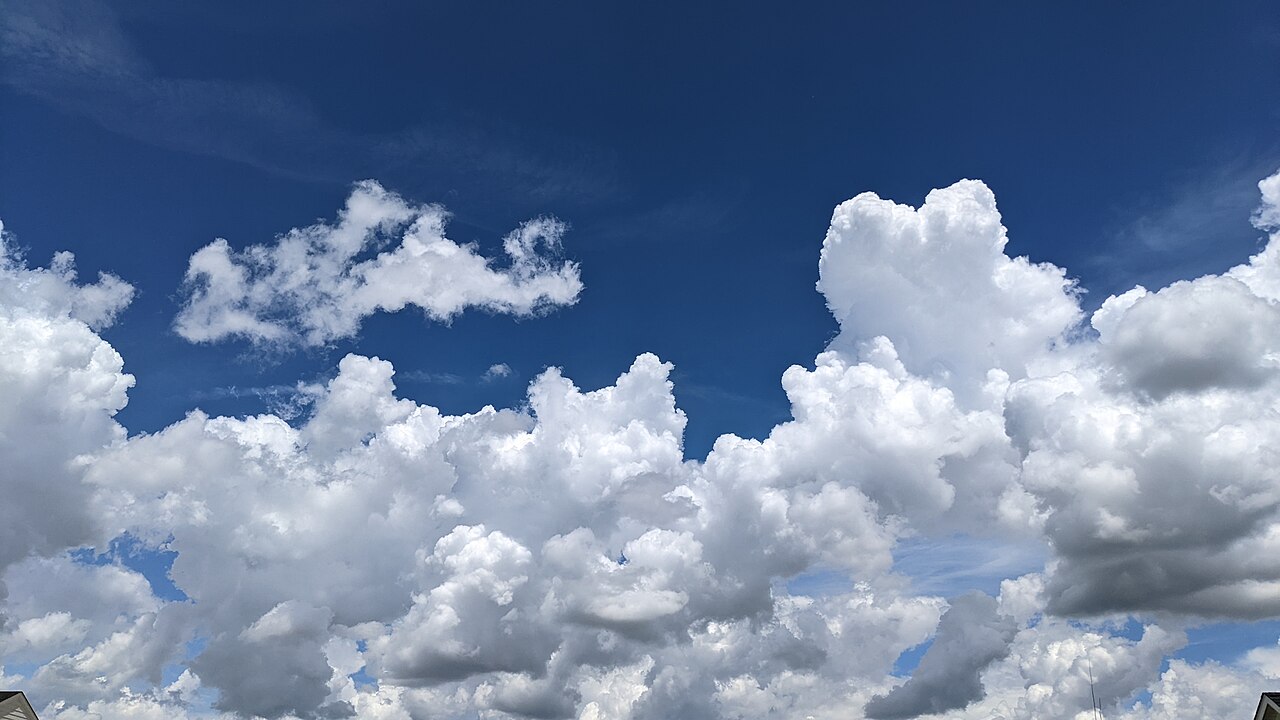
Even with the same scattering, the color changes when the particles grow larger. The water droplets in clouds and fog are about 20 µm across, far larger than visible wavelengths (0.4–0.7 µm). In this regime, Mie scattering dominates, scattering all colors at nearly equal intensity regardless of wavelength. Since every color mixes evenly and comes back, clouds look white (gray where little light reaches them).
Lance Vanlewen · CC BY-SA 4.0 · Wikimedia Commons · Source
By the same logic, the smoke rising from the burning tip of a cigarette is bluish because its particles are small, while the smoke in exhaled breath — which has picked up moisture passing through the lungs so its particles are larger — looks white. A single factor, particle size, separates the colors.
Rayleigh-scattered light is also polarized. Polarization is strongest in the part of the sky 90° from the Sun, which is why the brightness changes when you hold polarized sunglasses up to the sky and rotate them. Bees read this polarization pattern to gauge the Sun’s position even on cloudy days, and the Vikings are thought to have used birefringent crystals (‘sunstones’) to estimate the Sun’s direction beyond the clouds.
Closing — color is made not by light but by ‘path’
The blue sky and the red sunset are not different phenomena but the result of seeing the same Rayleigh scattering over a short path and a long path. The sky is blue by adding blue, and the sunset is red by subtracting blue. And the moment the scatterer changes from air molecules to dust, the color flips entirely, as on Mars. Even in a single patch of the everyday sky there hides an intricate physics, shaped together by light, particles, and our eyes.
References
- Rayleigh scattering — Wikipedia
- Diffuse sky radiation — Wikipedia
- Solar Radiation Spectrum — Penn State Meteo 300
- Tyndall effect — Wikipedia
- Critical opalescence — Wikipedia
- Sunset — Wikipedia
- Chappuis absorption — Wikipedia
- Twilight — Wikipedia
- Sunset at Gale Crater (Curiosity, 2015) — NASA
- Martian Sunset at Gusev Crater (Spirit, 2005) — NASA
- Atmosphere of Mars — Wikipedia
- Mie scattering — Wikipedia
- Color of water — Wikipedia
- Rayleigh sky model — Wikipedia