
Step outside a city on a clear night and look up: the stars never sit still, flickering constantly. Yet in the same sky, Venus or Jupiter shines steadily, without a flicker. Both are light that has crossed the same atmosphere to reach your eye, so why does one twinkle while the other stays calm? The answer lies not in the stars or planets themselves, but in Earth’s atmosphere, which light crosses in its final few hundred kilometers, and in the different apparent sizes each kind of creation has.
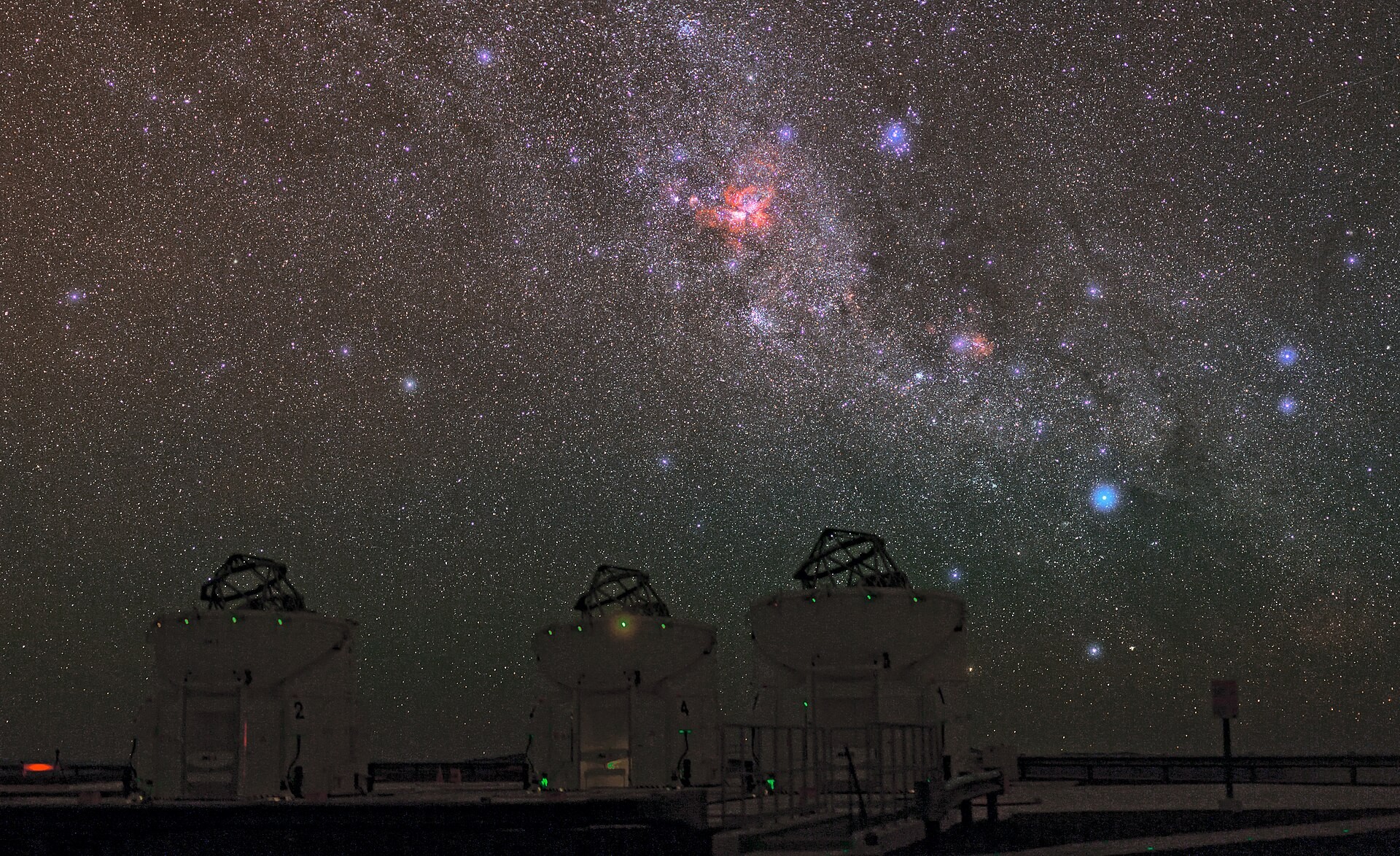
Photo · ESO/B. Tafreshi (twanight.org), CC BY 4.0, Wikimedia Commons
The Atmospheric Wobble Behind the Twinkle
Starlight twinkling, or atmospheric scintillation, happens because pockets of air with slightly different temperatures and densities, called turbulent cells, are constantly moving through the atmosphere. Since each pocket of air has a slightly different refractive index, the path of light passing through keeps bending, ever so slightly. As starlight descends from the top of the atmosphere to the ground, it passes through countless such turbulent cells, its path shifting moment to moment, and the result is a twinkle in which brightness and color change from instant to instant.
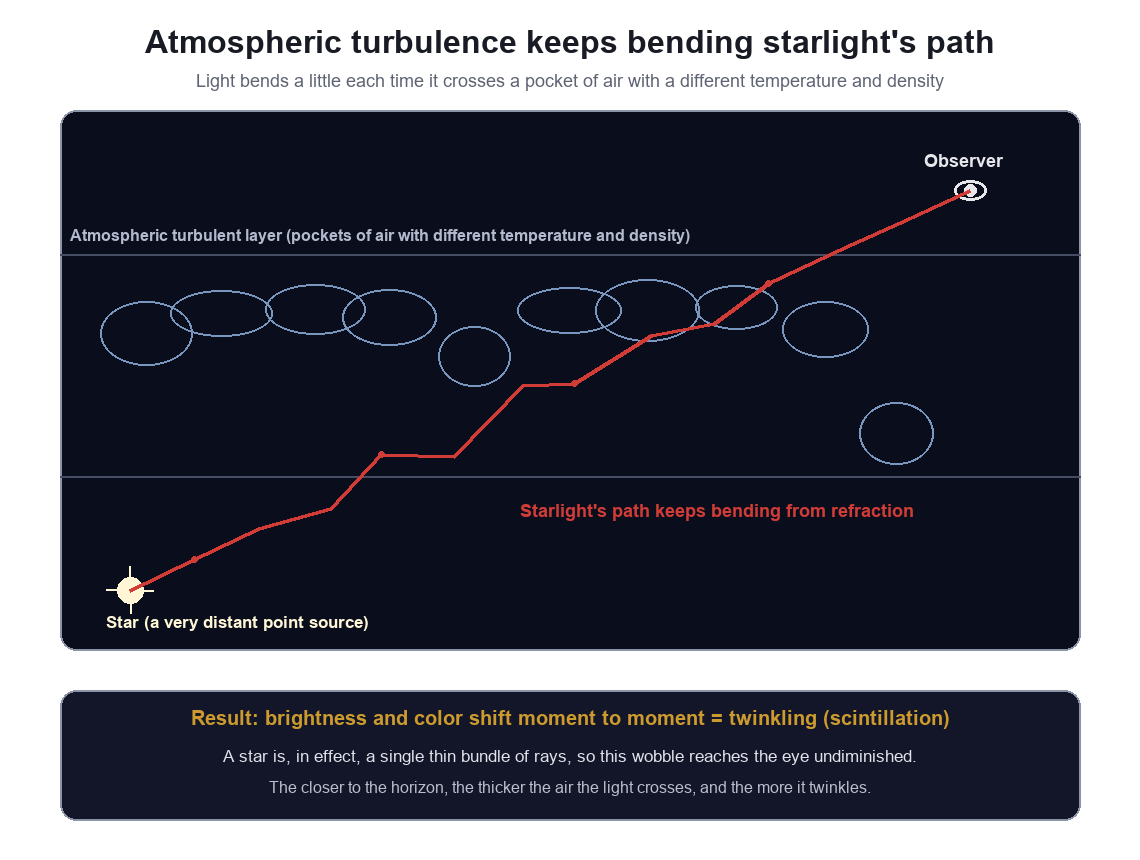
Diagram · made by glu.kr (schematic)
A Star Looks Like a Single Point, So It Shakes Completely
A star is so far from Earth that even the largest star appears, in effect, as a single point. The light reaching an observer is just one thin bundle of rays. So when atmospheric turbulence shakes that path, the resulting changes in brightness and color reach the eye undiminished. This is also why, when the focus momentarily shifts, starlight seems to briefly vanish, dimming and then brightening again.
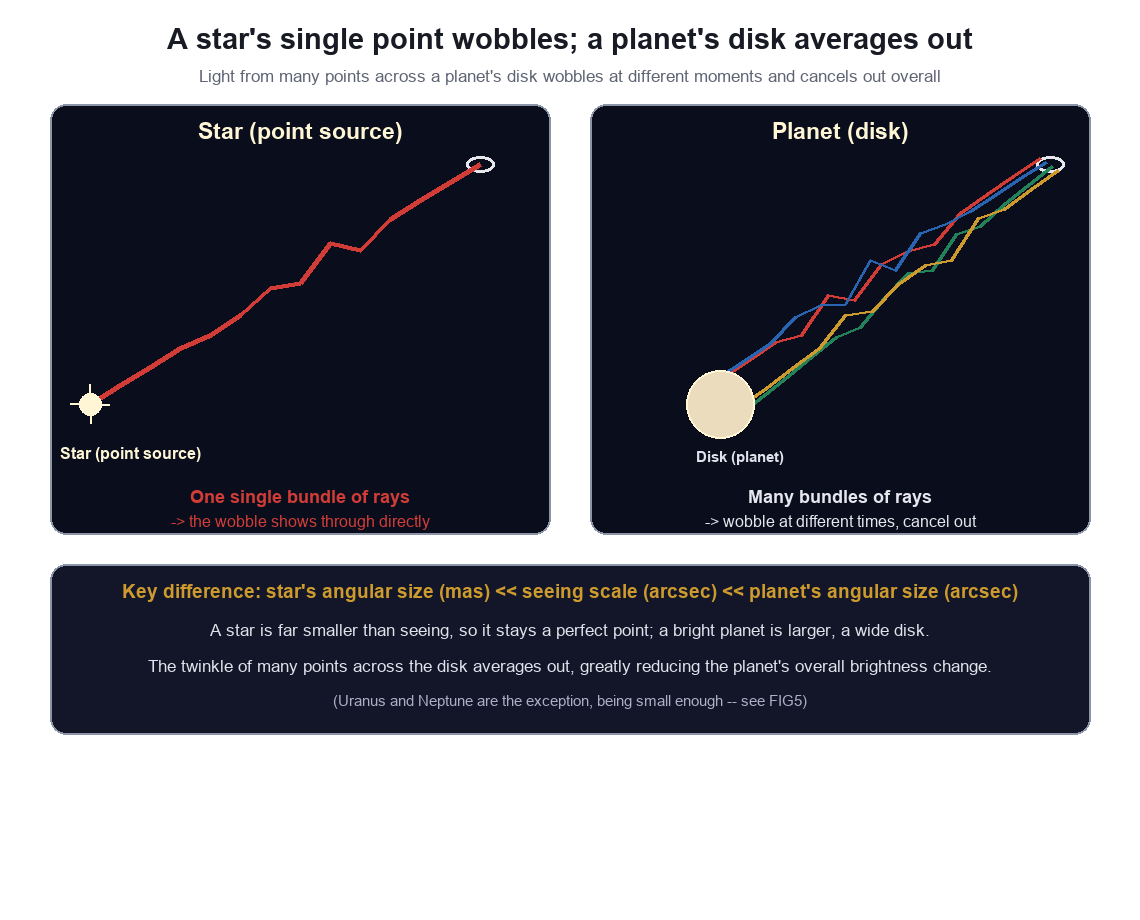
Diagram · made by glu.kr (schematic)
A Planet Looks Like a Disk — The Difference in Numbers
Planets are different. Being much closer to Earth, a planet appears through a telescope as a disk with measurable width. Because light leaving different points across that disk travels through different turbulent paths, the timing of each point’s twinkle is slightly offset from the others, and as a result the shimmer of countless points statistically cancels out, greatly reducing the overall change in brightness.
This difference becomes clear once the units are aligned. A star’s angular size is small enough to be measured in milliarcseconds (mas). Sirius A, the brightest star to the naked eye, measures only about 5.9 to 6.05 mas by interferometry, and even Betelgeuse, far larger than the Sun, is only about 42 to 56 mas. Atmospheric seeing, meanwhile, the typical scale at which turbulence shakes an image, is measured in the much larger unit of arcseconds, where 1 arcsecond equals 1,000 mas. Even at excellent high-altitude sites, seeing is usually about 0.4 to 1.0 arcsecond, and at ordinary sites it reaches 2 to 4 arcseconds. A star’s angular size is generally tens to hundreds of times smaller than this seeing scale (roughly 66 to 678 times for Sirius A, and about 7 to 95 times for Betelgeuse), so it is treated as an essentially perfect point source, and its twinkle shows through undiminished.
Bright naked-eye planets, by contrast, have angular sizes of roughly 4.5 to 13 arcseconds for Mercury, 9.7 to 66 arcseconds for Venus, 3.5 to 25.1 arcseconds for Mars, 29.8 to 50.1 arcseconds for Jupiter, and 14.5 to 20.1 arcseconds for Saturn’s disk. These are comparable to or much larger than the typical seeing scale, so the disk-averaging effect is pronounced and the twinkle is greatly reduced.
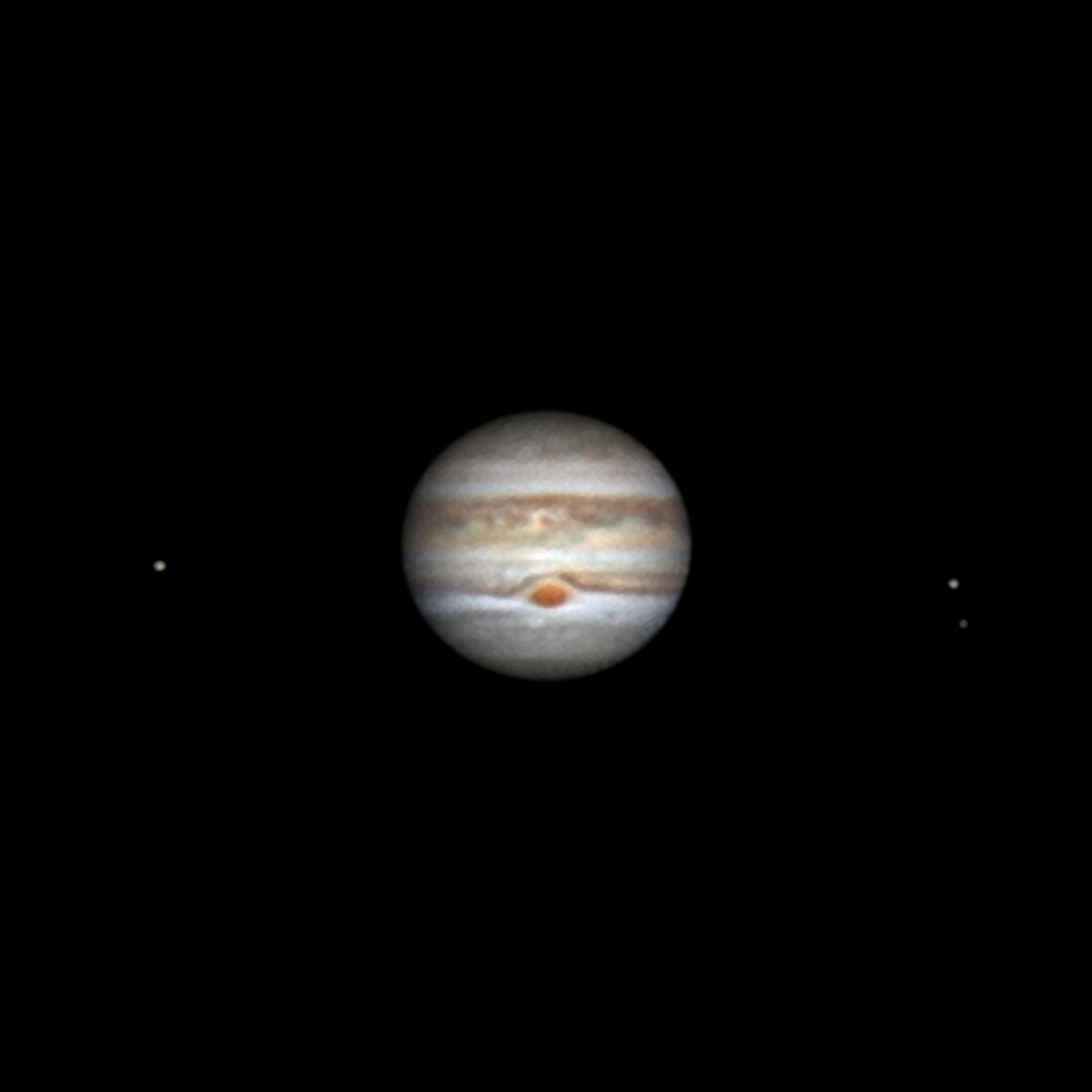
Photo · Astrobond, CC BY-SA 4.0, Wikimedia Commons
But Uranus and Neptune Are the Exception
This does not mean planets never twinkle at all. Among the naked-eye planets, Uranus (about 3.3 to 4.1 arcseconds) and Neptune (about 2.2 to 2.4 arcseconds) have the smallest angular sizes, often comparable to or not much larger than the seeing scale at an ordinary observing site (2 to 4 arcseconds) — though at excellent high-altitude seeing conditions they can in fact be several times larger than seeing. That means they are not wide enough to produce a strong disk-averaging effect. So these two planets behave much like point sources close to stars, and when the atmosphere is unstable or they sit near the horizon, they are sometimes observed and reported to twinkle like stars. The precise statement should be limited to this: ‘the twinkle is far weaker for planets whose angular size is clearly larger than the seeing scale, such as Venus, Jupiter, and Mars.’
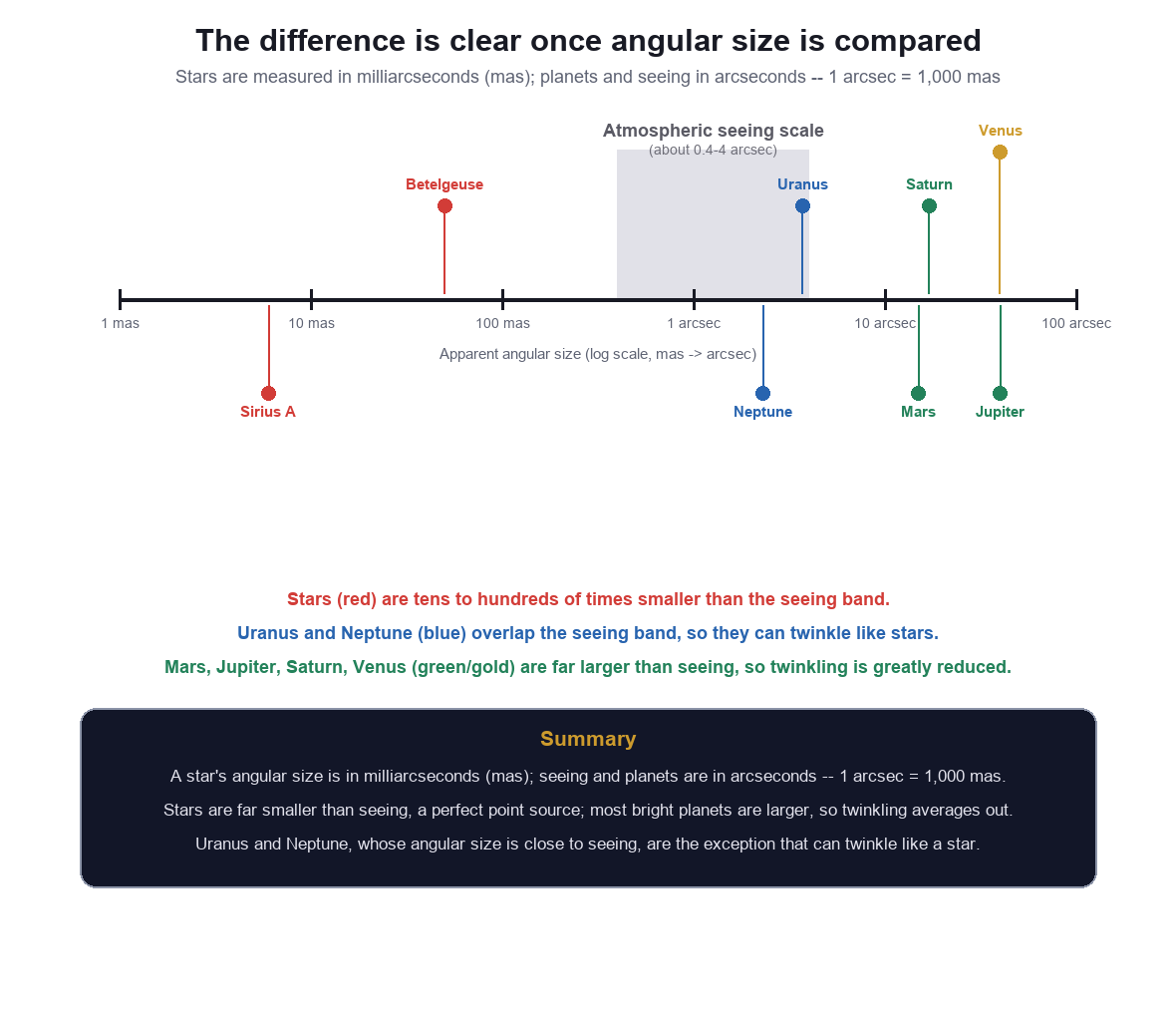
Diagram · made by glu.kr (schematic)
Twinkling Intensifies Near the Horizon — And the Technology That Overcomes It
Whether star or planet, an object low near the horizon twinkles far more noticeably. The lower the altitude, the thicker the layer of atmosphere the light must cross, known as air mass, which increases both refraction and turbulence. On top of that, because the refractive index varies slightly with wavelength, light splits into different colors, an effect called chromatic scintillation. This is why Sirius near the horizon is famous for flashing between red, blue, and other colors, a phenomenon that has often led to it being mistaken for and reported as a UFO.
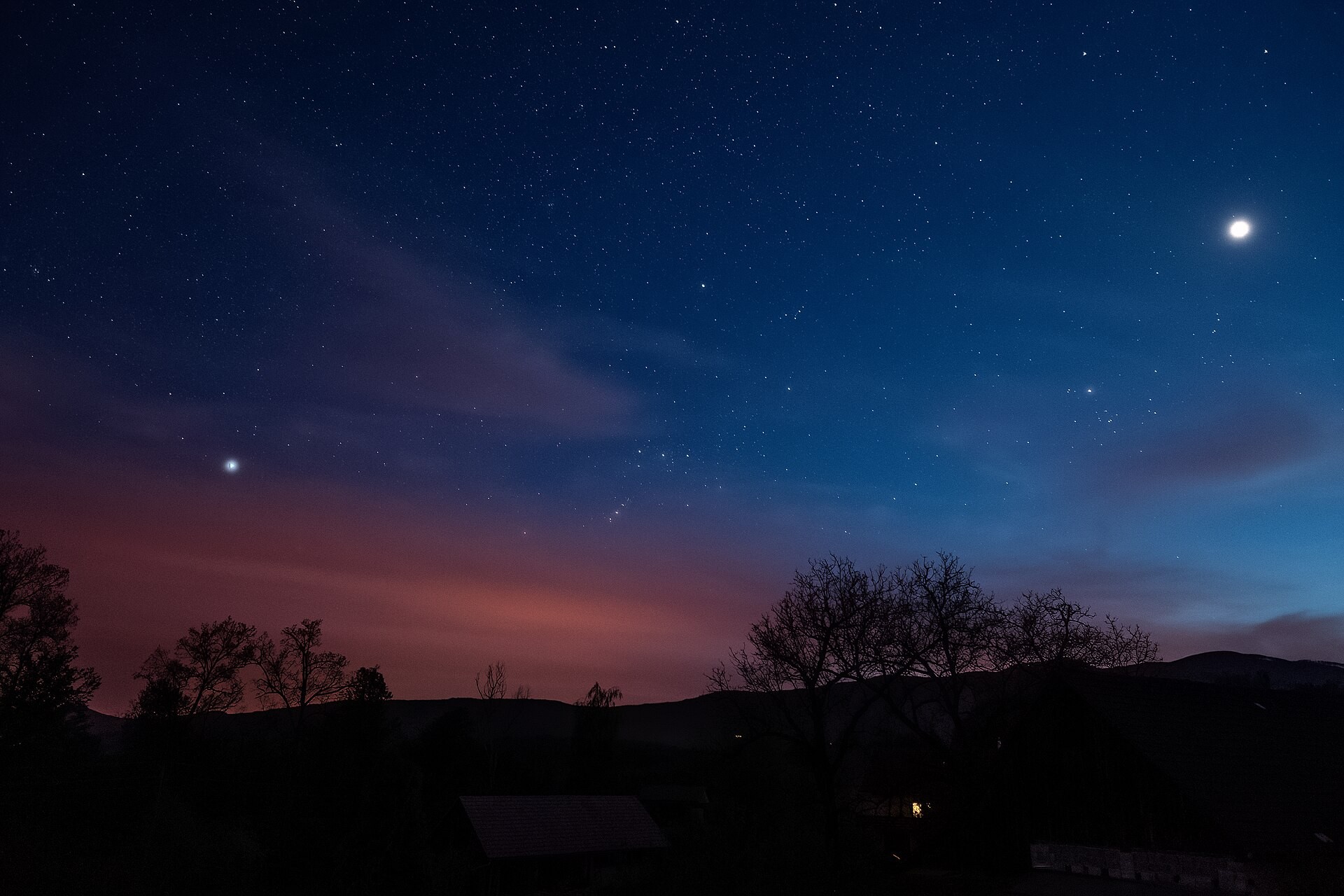
Photo · Uroš Novina, CC BY 2.0, Wikimedia Commons
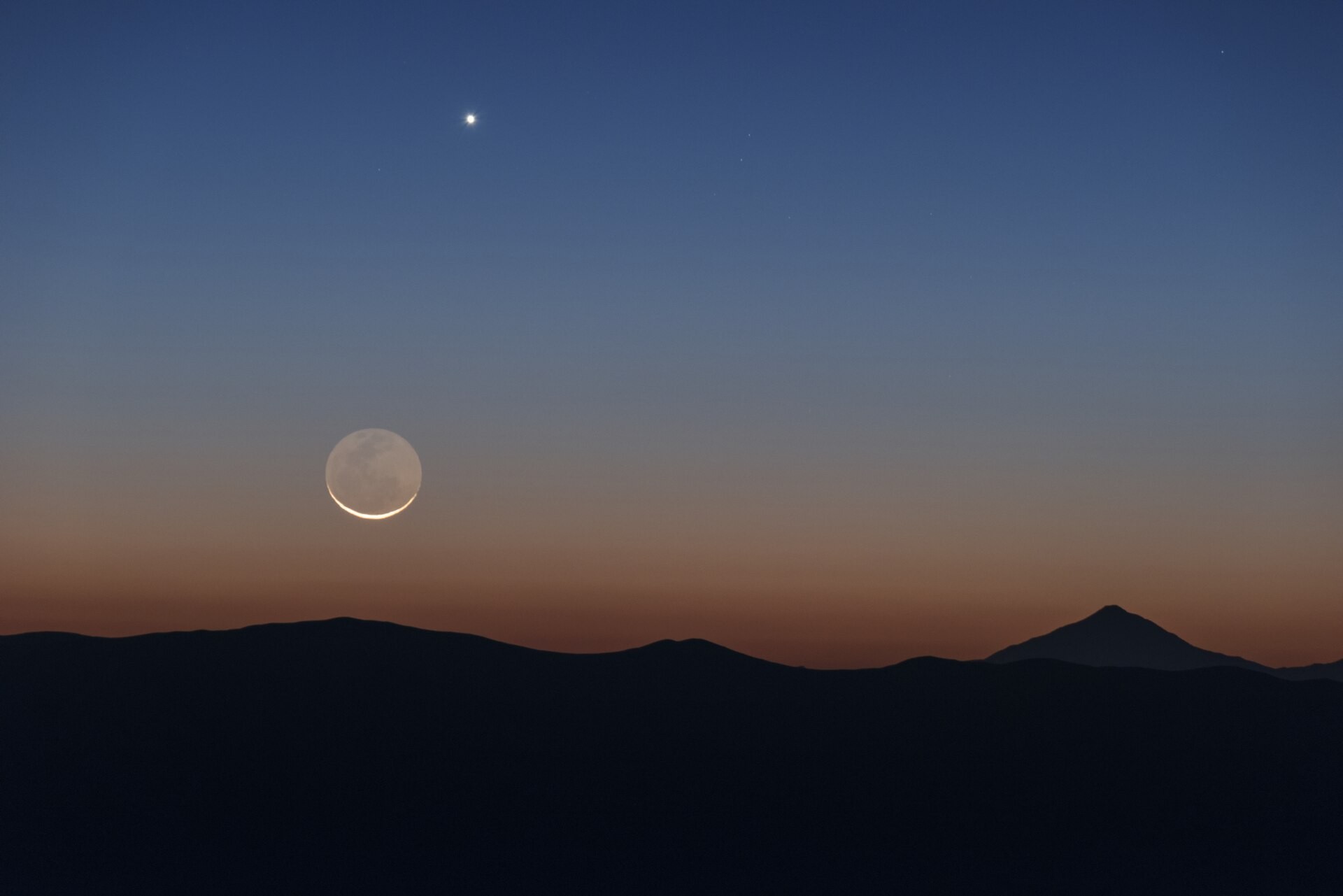
Photo · ESO/Y. Beletsky, CC BY 4.0, Wikimedia Commons
Atmospheric turbulence makes the night sky romantic, but it is also a nuisance that erodes the resolution of ground-based telescopes. That is why modern observatories use adaptive optics, measuring the distortion of an image hundreds to thousands of times per second with a wavefront sensor and correcting it instantly with a deformable mirror. In the size and distance unique to each part of creation, and in the thin veil of atmosphere between them, a precise interplay is etched into even a single twinkle in the night sky.
References
- Twinkling — Wikipedia
- Astronomical seeing — Wikipedia
- Angular diameter — Wikipedia
- Betelgeuse — Wikipedia
- Why Do Stars Twinkle Whereas Planets Do Not? — Physics FAQ (UC Riverside)
- Why do stars twinkle, but planets don’t? — EarthSky
- Why do stars twinkle? — NASA StarChild
- The Angular Diameter and Fundamental Parameters of Sirius A (arXiv:1010.3790)
- Sirius, UFO trickster extraordinaire — Universe Today
- Why Don’t Planets Twinkle? — SMU Physics Demos