
When summer deepens, city street trees and mountainsides alike fill with the sound of cicadas. Everyone knows that booming chorus that pierces even closed windows, yet few know ‘how’ such a small insect produces it. We often say a cicada ‘sings,’ but it makes no sound with a throat or vocal cords. The secret, surprisingly, lies in its belly.
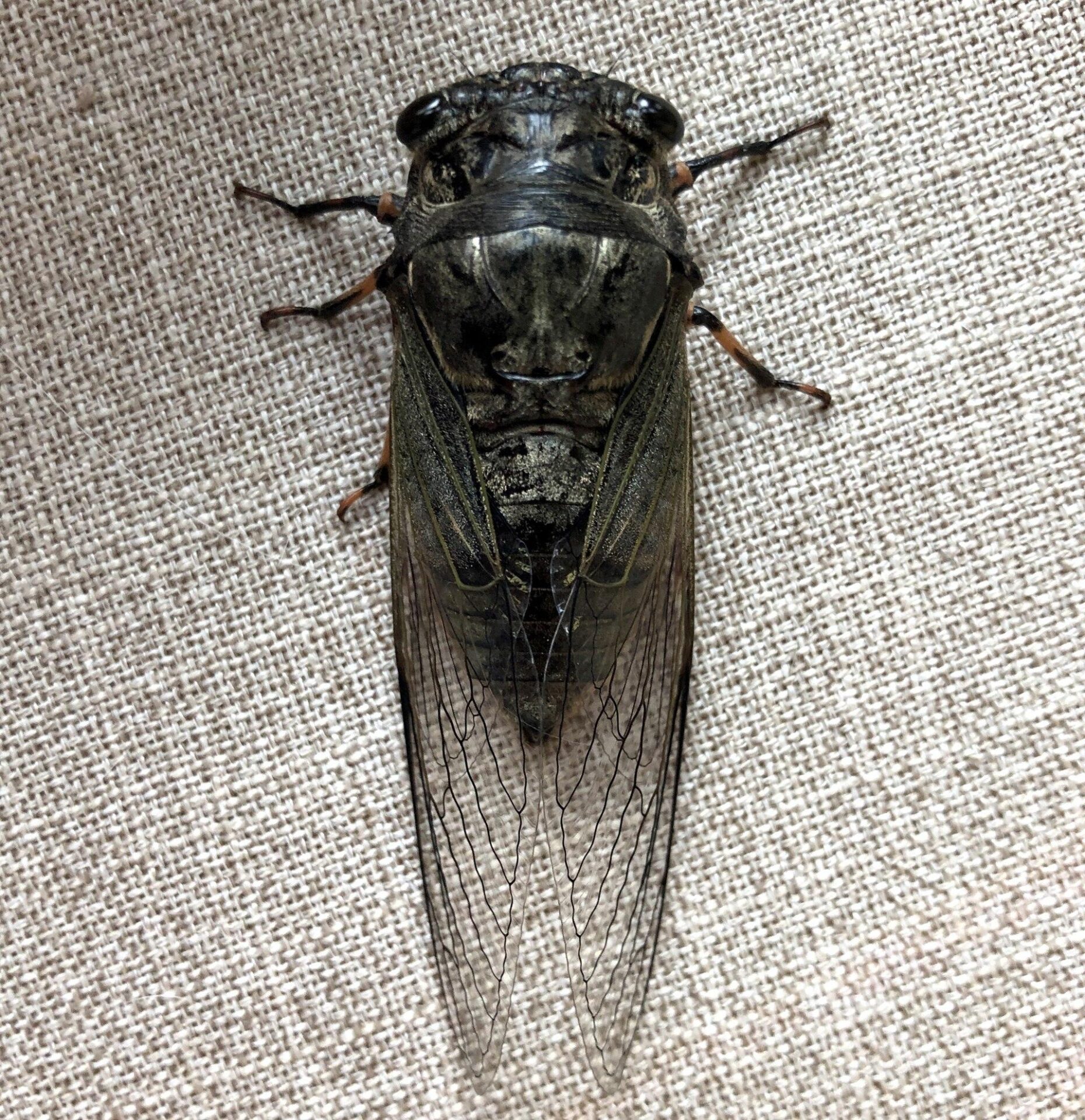
Photo · Yi Chen, CC BY 4.0, Wikimedia Commons
A ‘Drum’ on the Belly, Not a Throat
On both sides of the first segment of a male cicada’s abdomen sits a drum-shaped sound membrane called the ‘tymbal.’ It is a stiff cuticular membrane bearing ribs; when the tymbal muscle attached to it pulls the membrane inward, the membrane suddenly buckles inward with a ‘click.’ When the muscle relaxes, the elastic protein resilin springs the membrane back to its original position, producing another click. In other words, during a single contraction and relaxation of the muscle, sound is generated both as it folds inward and as it springs back out.
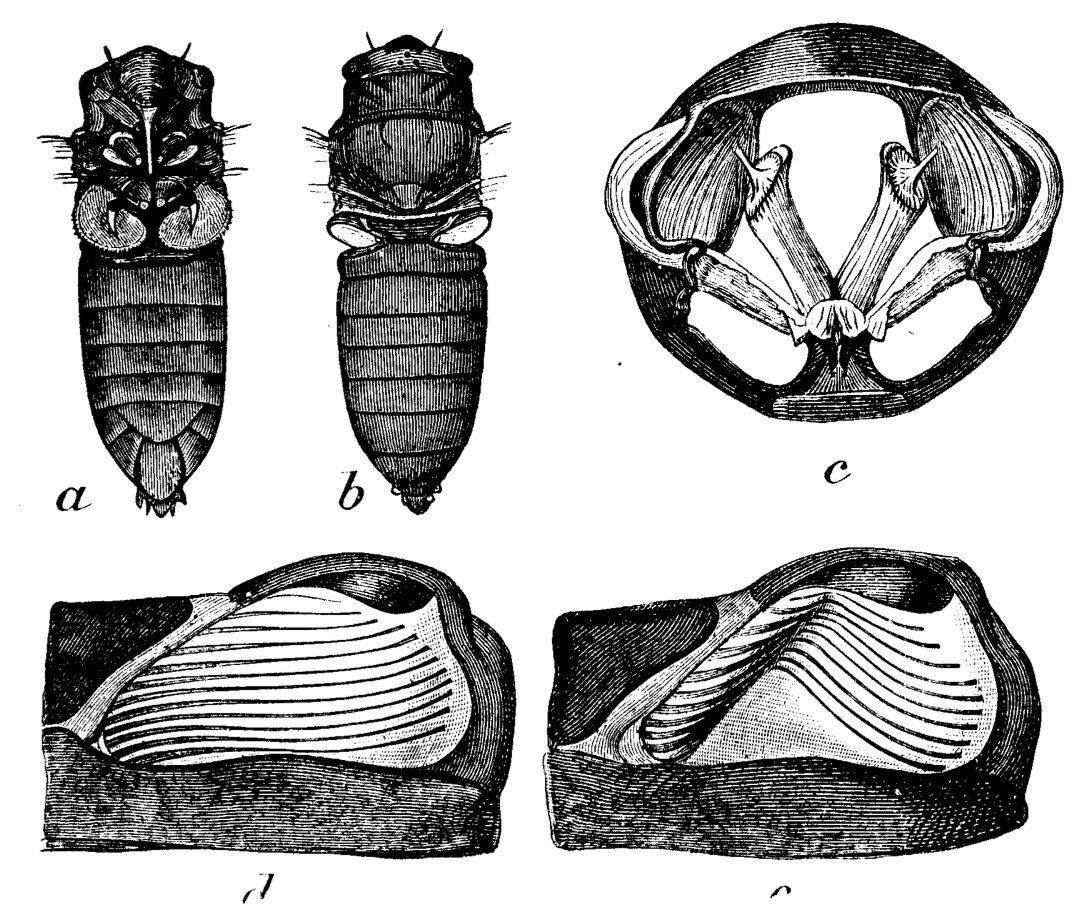
Plate · Encyclopaedia Britannica (1911), public domain, Wikimedia Commons
Hundreds of Times a Second, Folding in Sequence
The tymbal has more than one rib. When the muscle pulls once, several ribs buckle one after another from back to front, and each rib produces a short click that strings together into a pulse train. More remarkable still, the tymbal acts as a kind of ‘frequency multiplier.’ In the Australian cicada Cyclochila australasiae, the tymbal muscle contracts about 117 times per second, yet the actual song produced as the ribs resonate reaches about 4.3 kHz. It is not the speed of the trembling muscle but the rapid buckling vibration of the ribs that shapes the high-pitched sound. Depending on the species, the tymbal muscle contracts up to 300 to 400 times per second, and to the human ear the individual clicks blend into one continuous sound. The resilin pad, like a spring, stores and returns elastic energy, the key component that makes this rapid buckling possible.
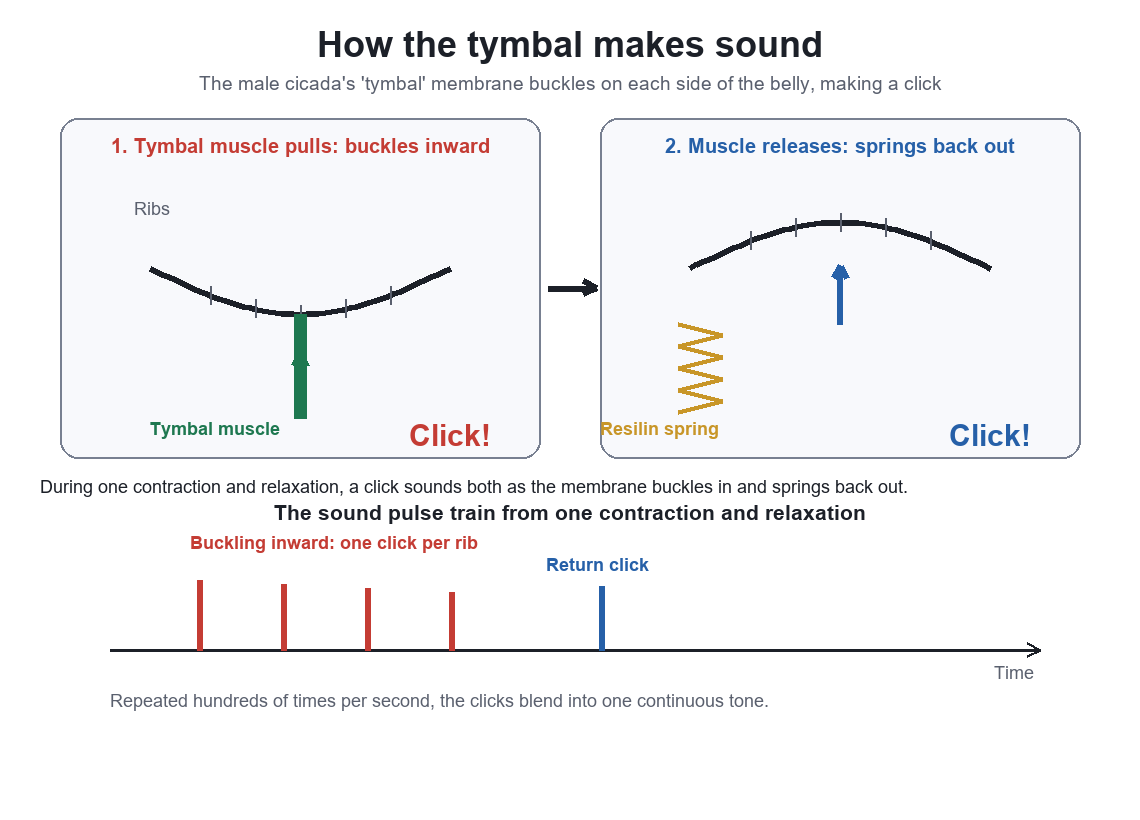
Diagram · made by glu.kr (schematic)
Resonance Made by a Hollow Belly
What makes the sound loud and clear is the rest of the space in the belly. A male cicada’s abdomen is mostly filled with a greatly enlarged air sac, which serves as an excellent resonating chamber. The saying that ‘it rings well because the belly is empty’ is only half true. It is not completely empty; rather, a thinly inflated air sac forms a wide cavity. Researchers have modeled this structure as a ‘Helmholtz resonator,’ with the air sac as the cavity and the acoustically transparent tympana as the neck, the very principle by which blowing across the mouth of an empty bottle produces a particular tone. That said, recent research shows that depending on the species, the tymbal, tympana, and abdominal wall each contribute differently, revealing a complexity that cannot be reduced to a single simple resonator. In a small insect’s body, the sound membrane, air sac, and tympana are precisely designed to interlock as a single instrument.
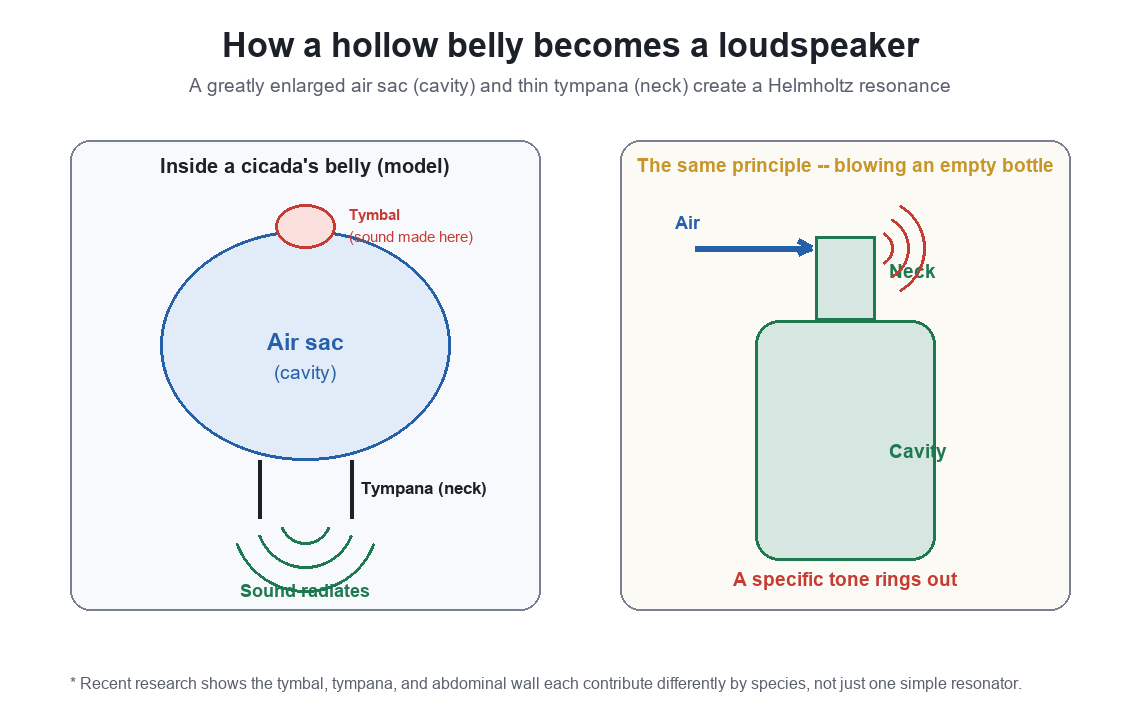
Diagram · made by glu.kr (schematic)
A Song Only Males Sing, and the Loudness of the Sound
This elaborate sound apparatus belongs only to males. A cicada’s booming call is essentially a courtship signal to attract females, and females, which lack a tymbal, can barely make such a sound (in some species they flick their wings to signal). The sound can be astonishingly loud; some species reach about 120 dB at close range. So while singing, a male lowers the sensitivity of its own hearing organs to protect its hearing. The insect often cited as the ‘loudest in the world’ is the African cicada Brevisana brevis, measured at 106.7 dB from 50 cm and listed in the Guinness records. But because there are several close rivals such as North America’s Megatibicen, the title of ‘loudest’ depends on which species is measured and at what distance. Korea’s large black cicada (Cryptotympana atrata) and the common cicada (Hyalessa fuscata) also reach roughly 70 to 90 dB in cities, regular culprits behind summer noise complaints.
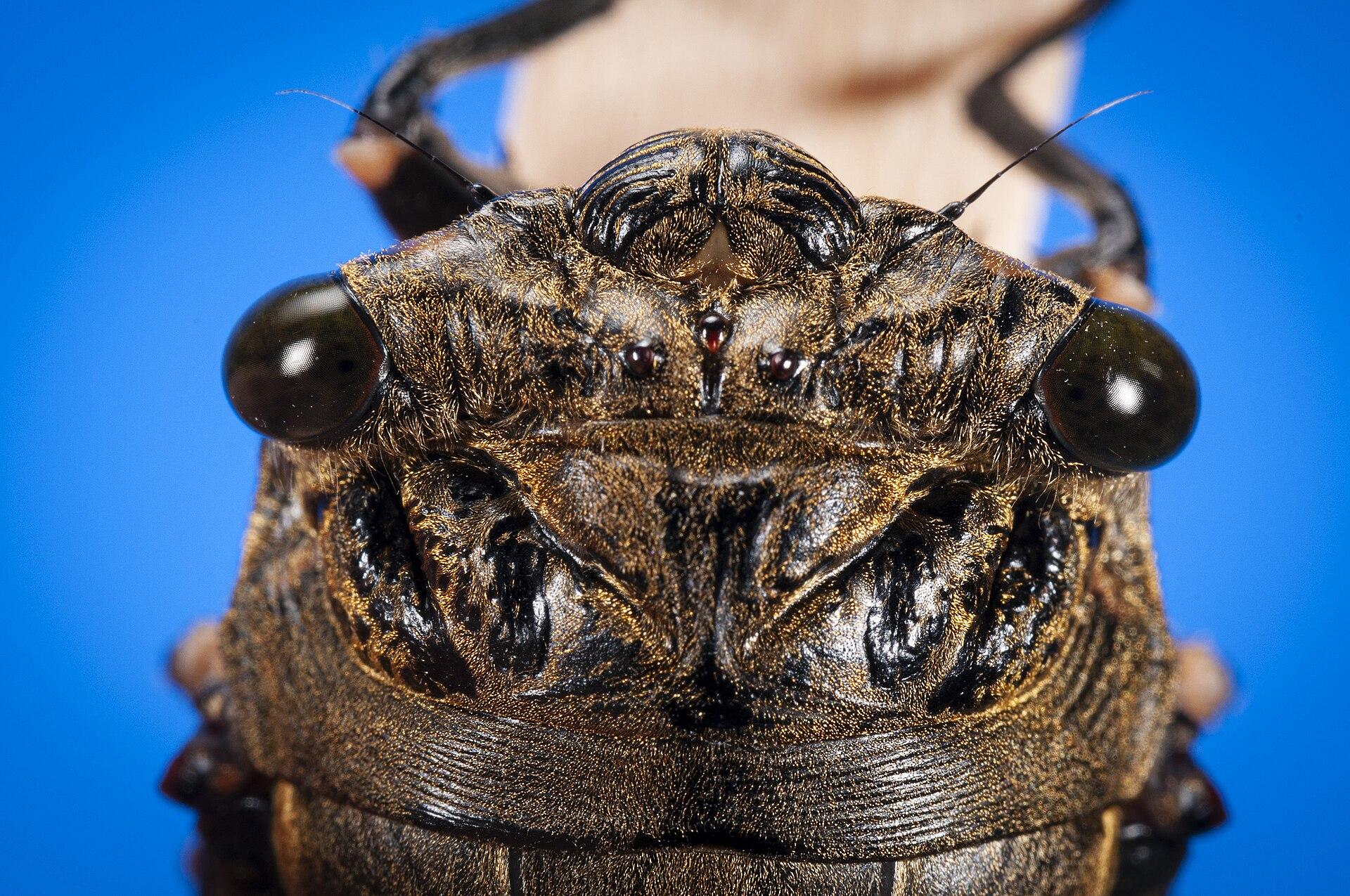
Photo · Eastolany, CC BY-SA 4.0, Wikimedia Commons
The Long Wait Underground
Behind this brief, intense summer stage lies a long wait. Korean cicadas spend roughly 2 to 5 years, and as long as 7 years, as nymphs (grubs) underground at a depth of about 15 to 61 cm, feeding on sap from tree roots, before climbing above ground to molt into adults. The adult life thus won is a mere month or so. People often confuse our cicadas with America’s ‘periodical cicadas’ (Magicicada), but the two are distinctly different. Periodical cicadas emerge en masse on strict prime-number cycles of 13 or 17 years, whereas Korean cicadas are ordinary, annual cicadas that appear every year without such rigid prime-cycle synchronization. That raucous chorus outside the window on a summer evening is a desperate serenade sung by males who, after several years underground, live for just one month, using their whole bodies as instruments.
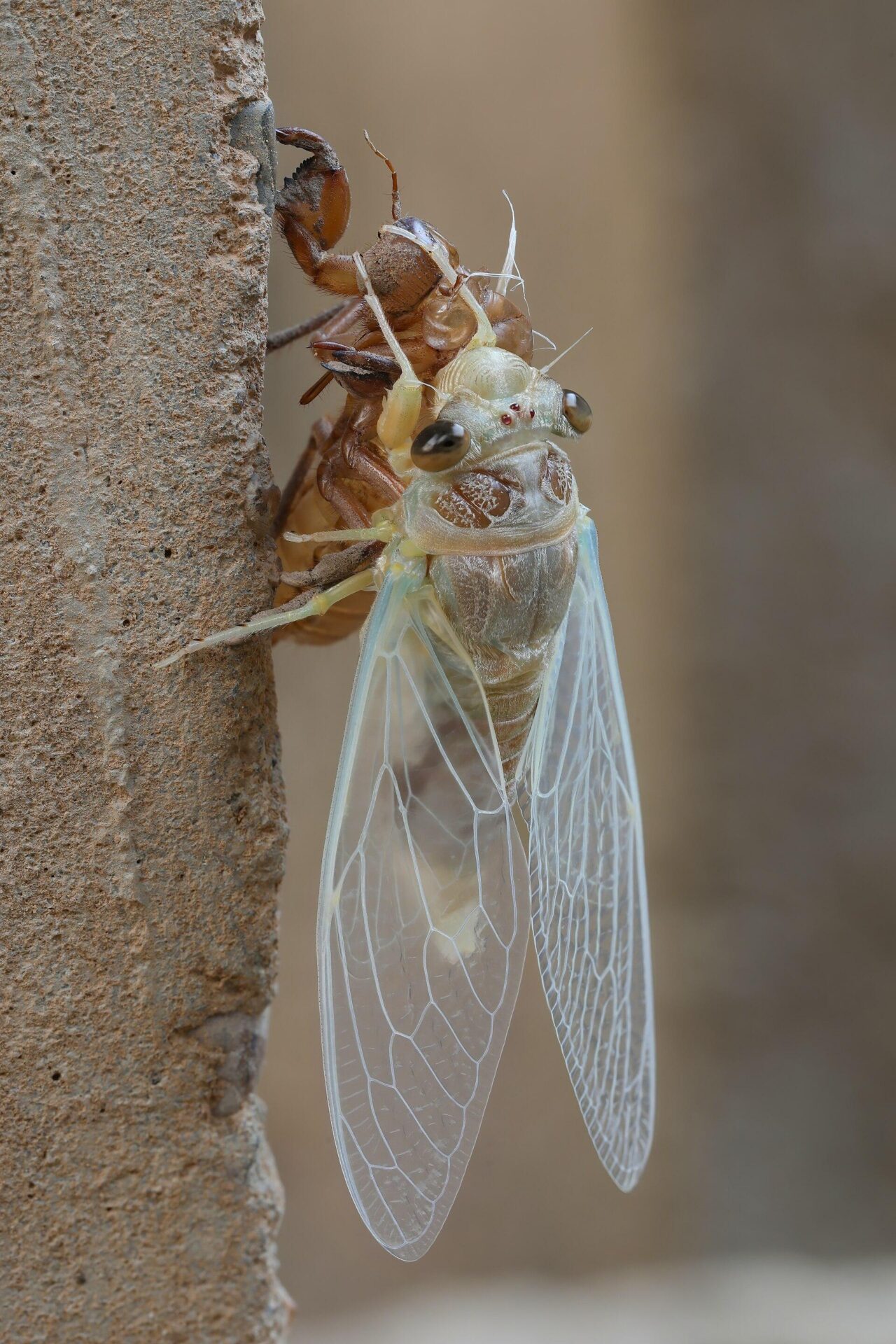
Photo · Basile Morin, CC BY-SA 4.0, Wikimedia Commons
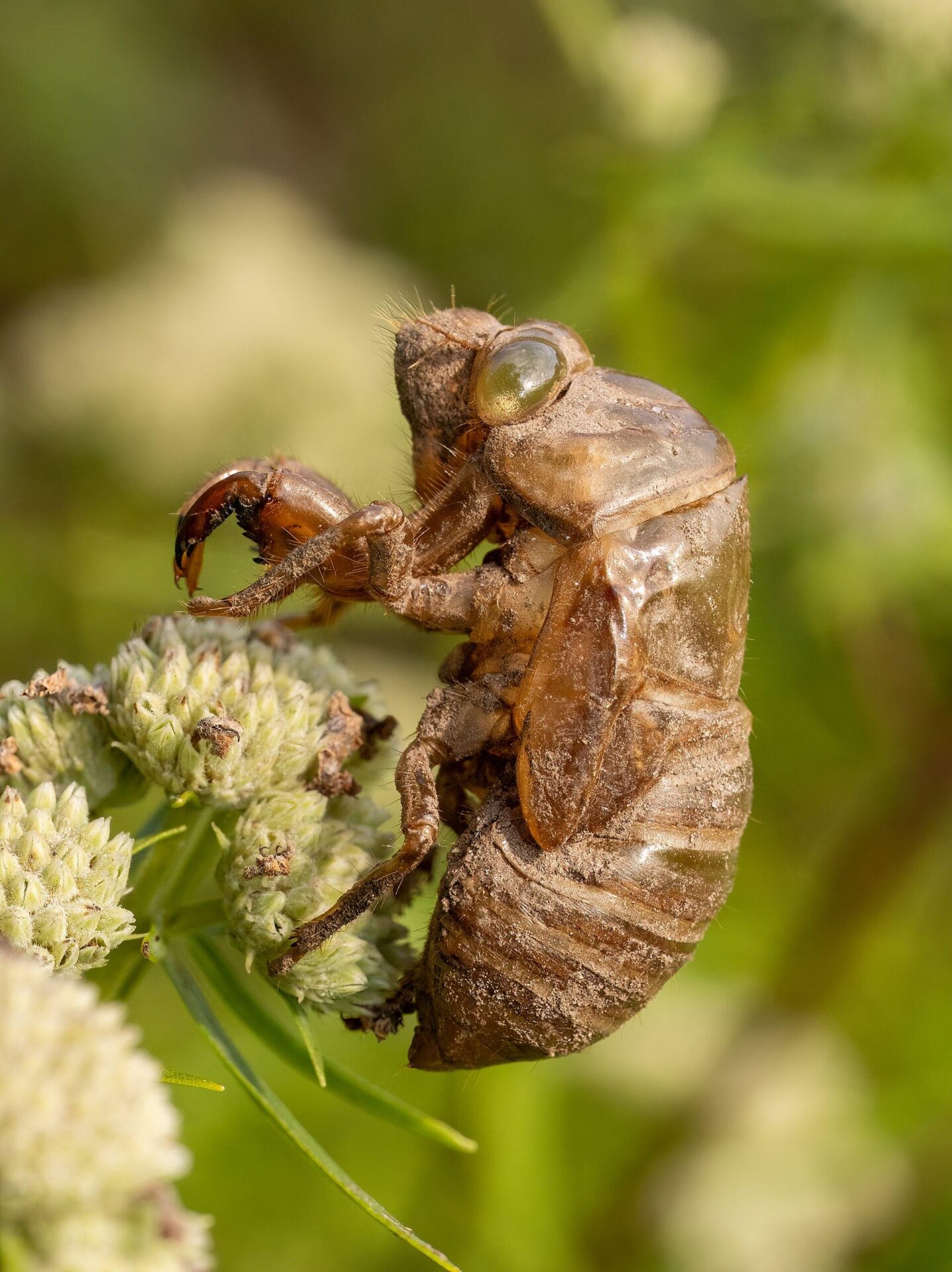
Photo · Rhododendrites, CC BY-SA 4.0, Wikimedia Commons
References
- Cicada — Wikipedia
- Cicada — Korean Wikipedia
- Brevisana brevis — Wikipedia
- Loudest insect — Guinness World Records
- What is the loudest cicada? — Cicada Mania
- The tymbal of a cicada: nature’s sound-generating metastructure — Nature Communications (2025)
- The Role of the Tymbal in Cicada Sound Production — Young & Bennet-Clark, JEB 198:1001 (1995)
- Tymbal Mechanics and the Control of Song Frequency — Bennet-Clark, JEB 200:1681 (1997)
- A Model of the Mechanism of Sound Production in Cicadas — Bennet-Clark & Young, JEB 173:123 (1992)
- A Study on the Differences in Breeding Call of Cicadas — Korean Journal of Environment and Ecology