
When spring arrives, whole neighborhoods turn pink. Yet calling every one of those blossoms a “cherry blossom” would be a little unfair to some trees. The Japanese apricot, apricot, peach, and plum — spring blossoms that look just like cherry blossoms — are in fact different trees altogether. Why do they resemble one another so closely, and how can you tell them apart at a glance?
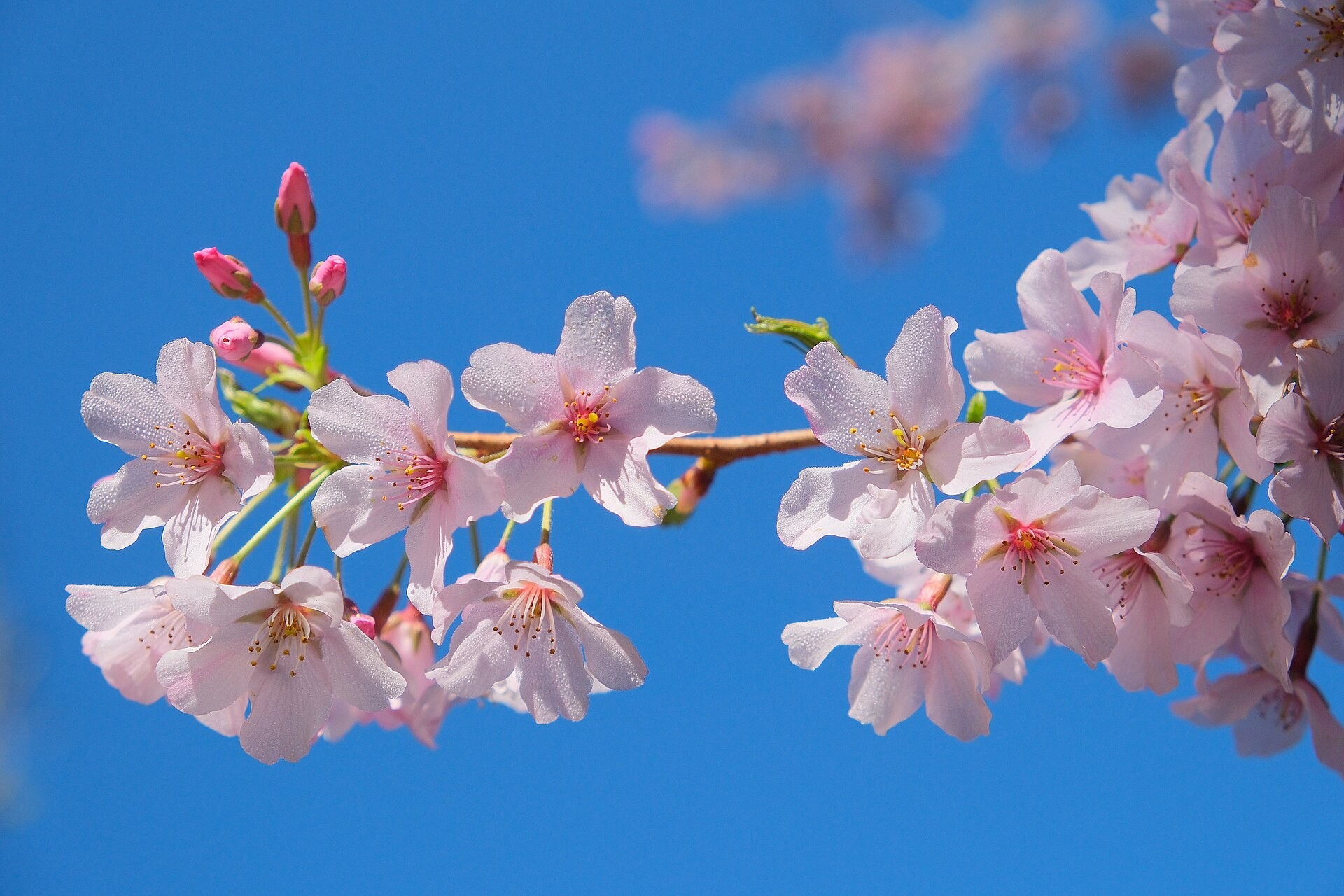
Photo · Cherry blossoms (Prunus × yedoensis ‘Awanui’) — Pseudopanax, public domain, Wikimedia Commons
Why So Alike — All Cousins in the Genus Prunus
The secret is that all five trees are close cousins in the genus Prunus (family Rosaceae). Cherry, Japanese apricot (Prunus mume), apricot, peach, and plum share the same family blueprint. That structure — five petals spread out radially, with many stamens and a single pistil gathered at the center — is nearly identical from one to the next. No wonder they are hard to tell apart at first sight.
But on top of that shared blueprint, each carries clues shaped a little differently. The length of the flower stalk, the shape of the petal tip, whether the calyx curls back, and whether leaves emerge alongside the flowers — check these four things in order and the five spring blossoms sort out cleanly.
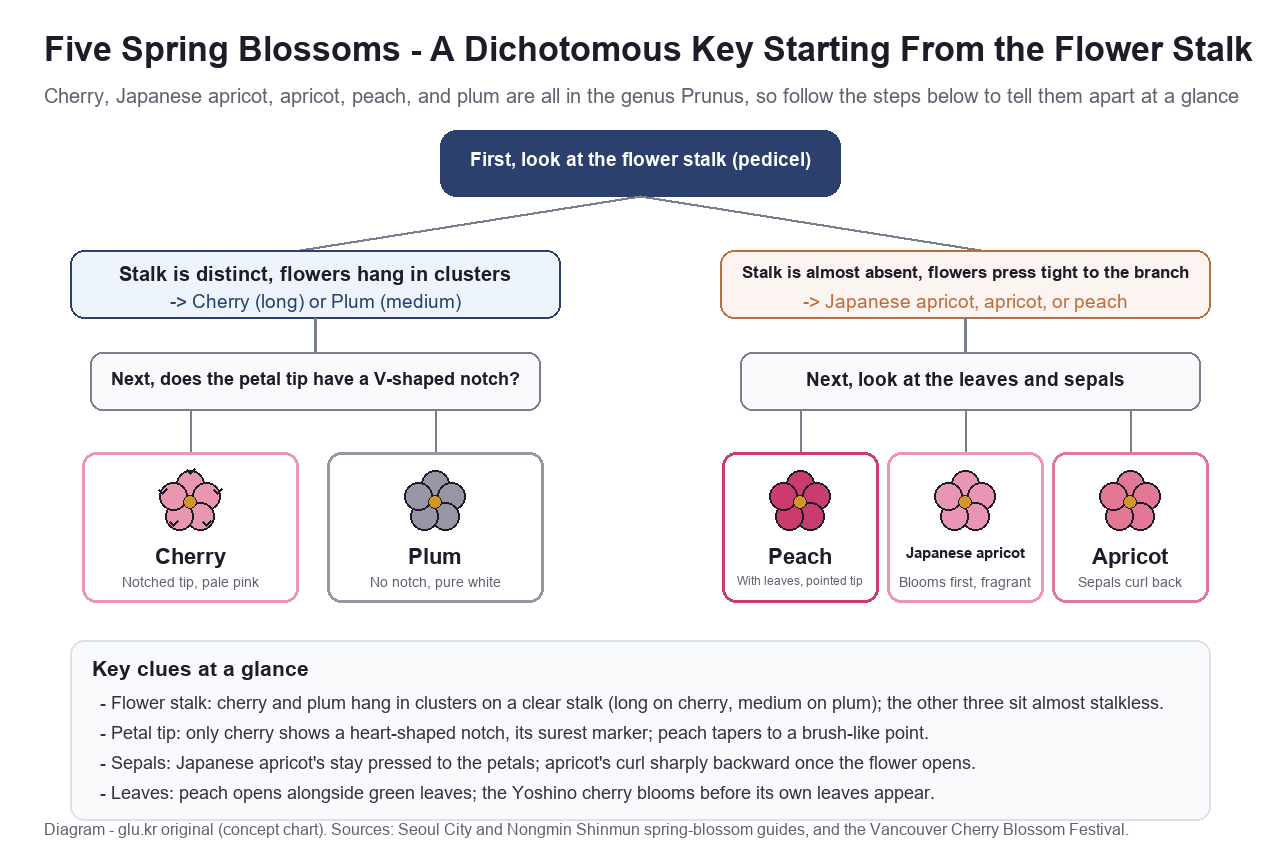
Illustration · self-made by glu.kr (conceptual diagram). Basis: Seoul city and Nongmin newspaper blossom guides, and the Vancouver Cherry Blossom Festival
Step 1 — The Flower Stalk: Dangling or Hugging?
The first thing to look at is the flower stalk (pedicel). This one feature splits the five into two groups at once.
- If the stalks are distinct and several flowers hang together in clusters (long in cherry, medium in plum) → cherry or plum
- If there is almost no stalk and the flowers sit tight against the branch → Japanese apricot, apricot, or peach
That long stalk is exactly why cherry blossoms look so full and airy. By contrast, the Japanese apricot and peach bloom pressed close to the branch, so the flowers look studded along the line of the twig.
The Dangling Group — Cherry vs. Plum
Cherry and plum, which bloom in clusters on distinct stalks, are told apart at once by the petal tip.
Cherry petals have a slight V-shaped notch (a heart shape) at the tip. This notch is the single most reliable mark for identifying cherry, and it stays clearly visible even after the flower is fully open. The color ranges from pale pink to white. Horizontal streaks (lenticels) on the bark can also help, but since this trait appears across many Prunus species — including apricot and plum — it is best used only as a secondary clue. The familiar Yoshino cherry blooms before its leaves, so a leafless branch is covered entirely in flowers.
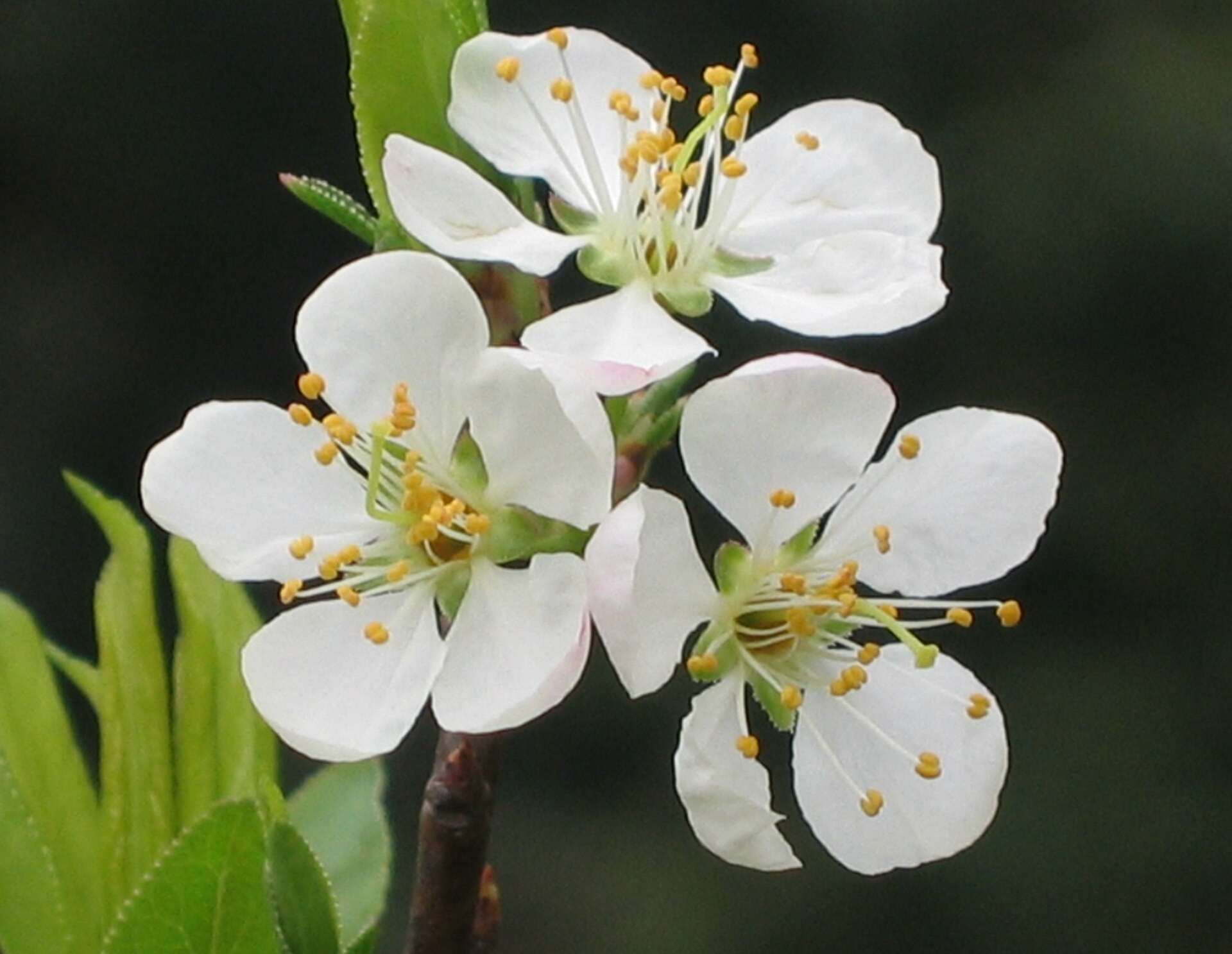
Photo · 李花 Prunus salicina, Sai Kung, Hong Kong — 阿橋 HQ, CC BY-SA 2.0, Wikimedia Commons
Plum is the opposite. The petal tips are rounded with no notch, and the color is a spotless pure white. So a simple rule: “a V-notch at the petal tip means cherry; pure white and rounded means plum.”
The Hugging Group — Japanese Apricot vs. Apricot vs. Peach
The three that bloom pressed to the branch with almost no stalk are sorted by their leaves and calyx.
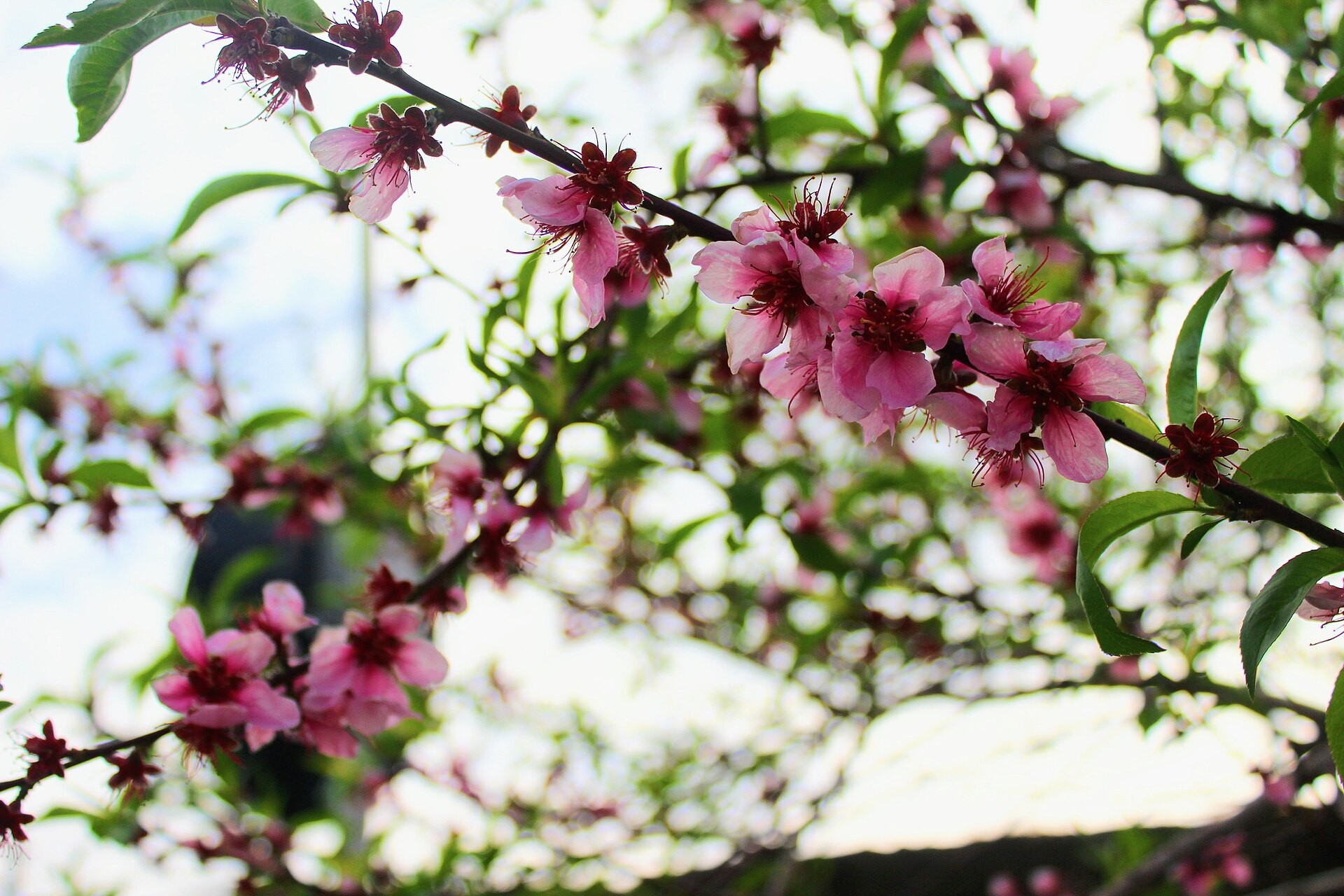
Photo · Şeftali çiçeği (Peach blossom, Prunus persica) — Kızıl, CC BY-SA 4.0, Wikimedia Commons
The easiest is the peach. While the Japanese apricot, apricot, and cherry open on bare, leafless branches, the peach puts out green leaves alongside its pink flowers. Its color is the deepest magenta-pink of the group, and the petal tips are pointed like the tip of a brush. Blooming two flowers to a node is another peach-like habit.
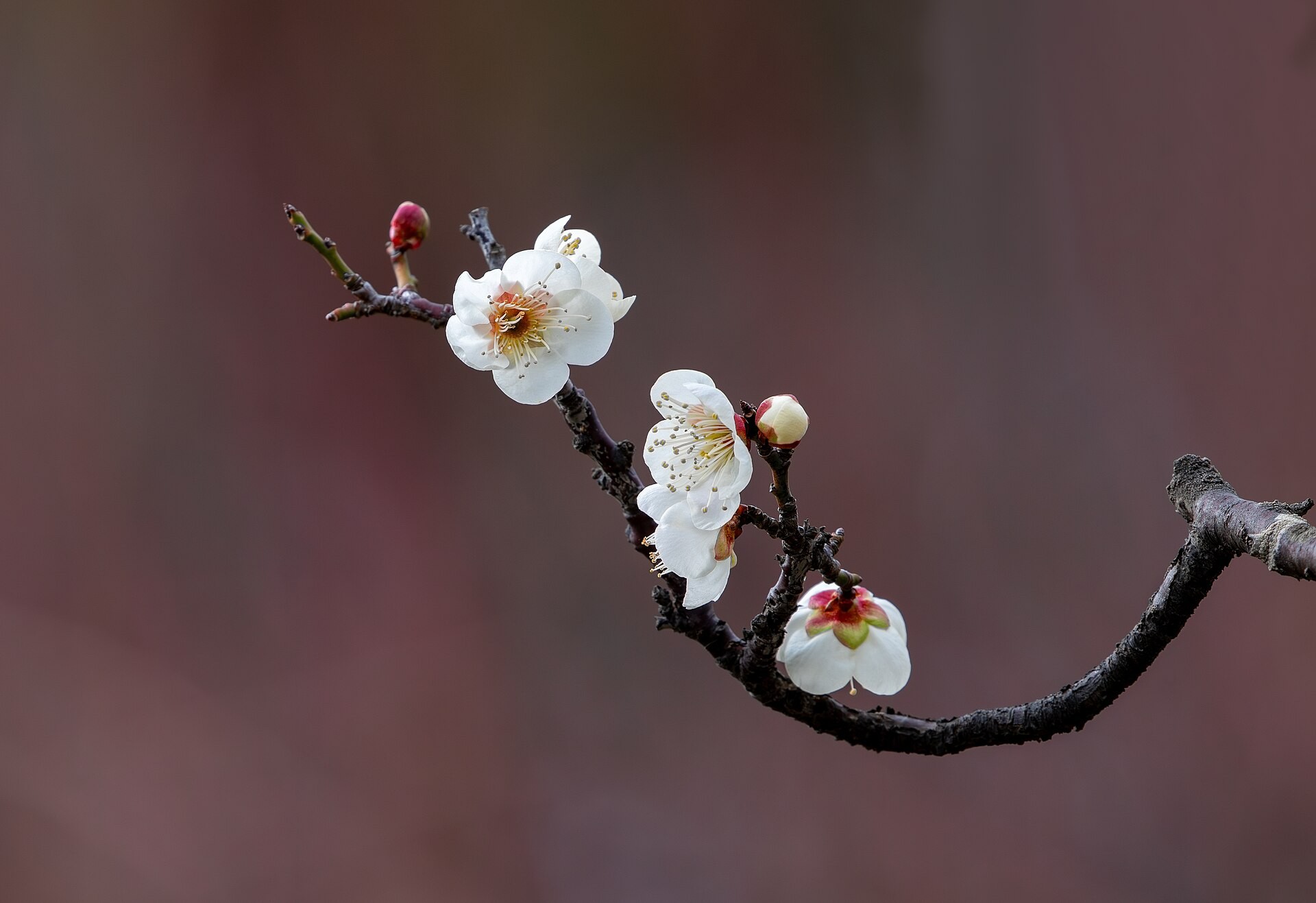
Photo · Flowers of Prunus mume ‘Bumpi’, Nagai Botanical Garden — Laitche, CC BY-SA 4.0, Wikimedia Commons
That leaves the most confusable pair — Japanese apricot (Prunus mume) and apricot (Prunus armeniaca). Here, look at the calyx. Peek behind the flower: if the sepals stay pressed neatly against the petals, it is the Japanese apricot; if they curl sharply backward as the flower opens fully, it is the apricot. The Japanese apricot also blooms earliest of all the spring flowers, and one sniff reveals its unusually strong fragrance.
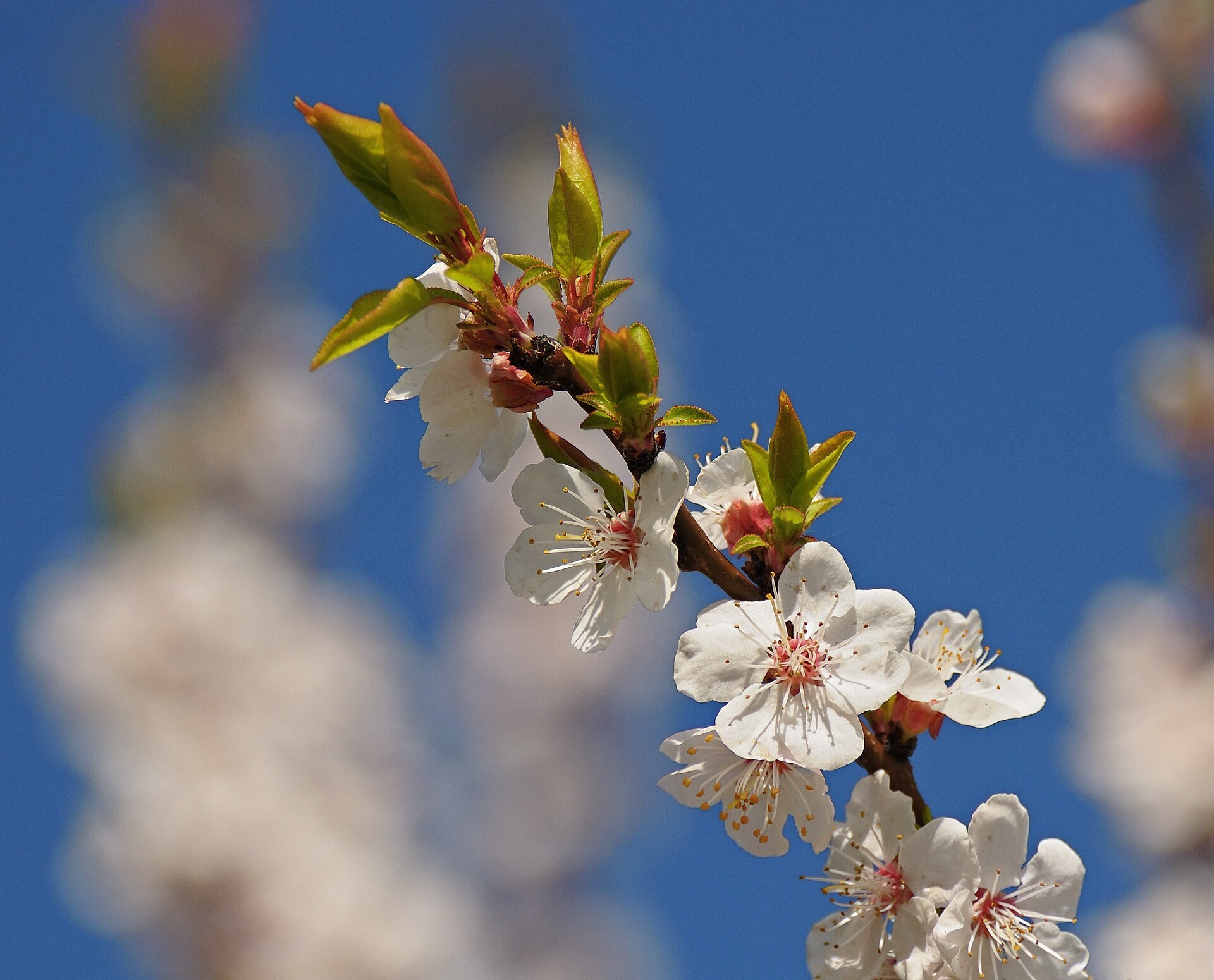
Photo · Blossoming branch of the apricot tree — Ввласенко, CC BY-SA 3.0, Wikimedia Commons
Timing Is Another Clue
When the flower shapes are hard to judge, the time of blooming offers another clue. As a rule, the Japanese apricot blooms first, at the tail end of winter, followed in turn by apricot, cherry, and peach, with the plum blooming last to round off spring. Bear in mind, though, that bloom timing shifts greatly with region and the weather of the year, so treat it only as a rough sense of order.
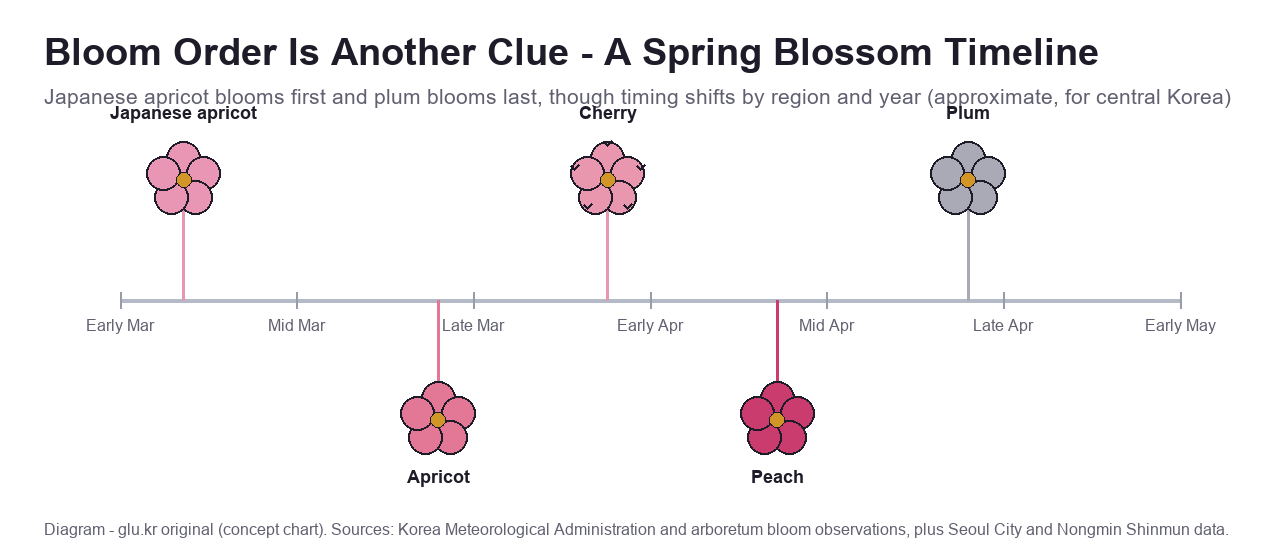
Illustration · self-made by glu.kr (conceptual diagram). Basis: KMA and arboretum bloom observations, and Seoul city and Nongmin newspaper materials
The Five Spring Blossoms at a Glance
| Flower | Stalk | Petal tip | Decisive clue | Color | Bloom (central KR, approx.) |
|---|---|---|---|---|---|
| Japanese apricot | Almost none | Rounded | Calyx appressed · strong scent | White · pink | Early–mid March |
| Apricot | Almost none | Rounded | Calyx curls backward | White · pale pink | Mid–late March |
| Cherry | Long (hangs in clusters) | V-notch (heart) | Notched petal tip · long stalk | Pale pink · white | Late March–early April |
| Peach | Almost none | Pointed | Leaves alongside · deep pink | Deep pink · red | Early–mid April |
| Plum | Medium (in clusters) | Rounded | Pure white, no notch | White | Mid April–early May |
Alike, Yet Each Its Own Design
On the single shared blueprint of the genus Prunus, the five spring blossoms each took on their own form — a different flower stalk, petal, calyx, and blooming time. Along a spring street we pass by while absently calling it “all cherry blossoms,” there were in fact five distinct creations, each with its own name and character, blooming in their appointed order.
This spring, pause a moment before the pink flowers and start with the stalk. Cherry or Japanese apricot, apricot or peach or plum — the moment you can call each by name, a familiar spring scene will come into far sharper, richer focus.
References
- Seoul Metropolitan Government — A guide to telling apart similar spring flowers
- Nongmin News — How to distinguish cherry, apricot, and peach blossoms
- Wikipedia (KO) — Prunus (genus)
- Wikipedia (KO) — Cherry tree
- Wikipedia (KO) — Prunus mume (Japanese apricot)
- Wikipedia (KO) — Apricot tree
- Wikipedia (KO) — Peach tree
- Wikipedia (KO) — Plum tree (Prunus salicina)
- Encyclopædia Britannica — Prunus
- Vancouver Cherry Blossom Festival — Plum versus cherry trees