
Look up on a clear summer day and you will see cotton-like cumulus clouds resting on the blue sky. Soft and weightless as they appear, a single one of those clouds weighs about 500,000 kilograms — some 500 tonnes, as much as 100 elephants. Hard to believe, perhaps. But here is the truly strange part: how does such a heavy mass of water stay up in the sky instead of crashing to the ground?
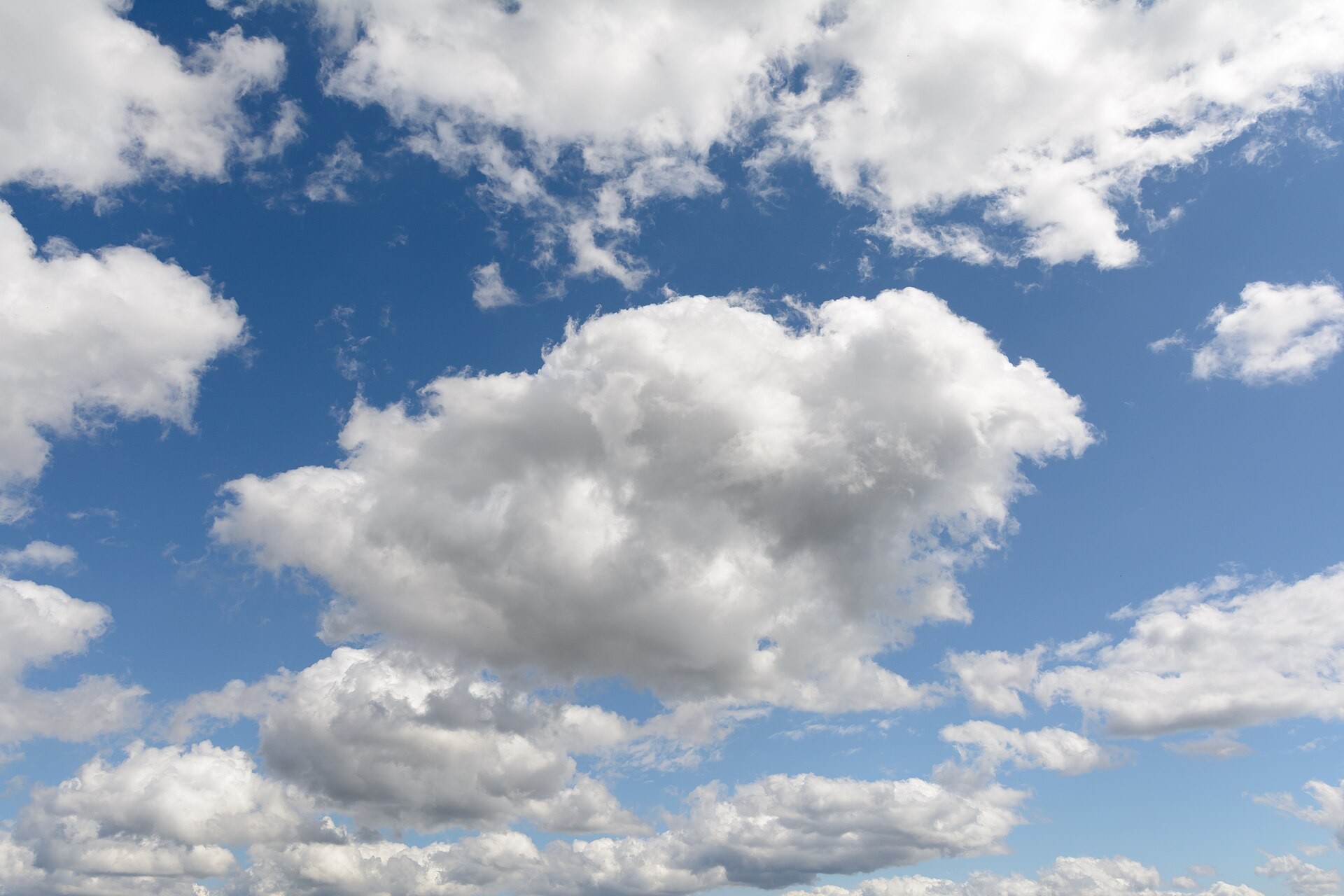
Photo · Cumulus humilis, Schönwald im Schwarzwald — Uoaei1, CC BY-SA 4.0, Wikimedia Commons
How to Weigh a Single Cloud
The U.S. Geological Survey (USGS) explains a cloud’s weight with a simple multiplication. The water content of a fair-weather cumulus cloud is roughly 0.5 grams per cubic meter. A typical cumulus cloud one kilometer on each side has a volume of one billion cubic meters, so multiplying by 0.5 grams gives 500 million grams — that is 500,000 kilograms (about 500 tonnes). The weight of 100 elephants, or five blue whales. Large cumulus clouds and cumulonimbus that bring downpours carry 1 to 3 grams of water per cubic meter, so the water they hold weighs several times more.
So why doesn’t all this enormous weight fall at once? The first clue is that these 500 tonnes are not a single lump of water, but rather countless tiny droplets scattered through the air.
The Key Twist — Droplets Are Actually Falling
People often assume “clouds float because they are lighter than air,” but to be precise, the droplets in a cloud are also being pulled down by gravity. They simply fall much, much more slowly than you would imagine.
The droplets that make up a cloud are only a few to a few tens of micrometers in diameter (one micrometer is a thousandth of a millimeter). Within a single cubic centimeter — a space the size of a sugar cube — hundreds of these droplets float. When a droplet this small falls through the air, its terminal velocity (the falling speed at which air resistance and weight balance so it no longer accelerates) is astonishingly small.

Illustration · self-made by glu.kr (conceptual diagram). Data: USGS · Scientific American · Gunn & Kinzer (1949)
A droplet 10 micrometers in radius has a terminal velocity of just a little over 1 centimeter per second. That is only 36 meters in an hour, so falling from a few kilometers up to the ground would take days. In the meantime, even the faintest movement of air easily cancels the fall.
Why so slow? A droplet’s weight grows with the cube of its radius (r³), but the air resistance (drag) that opposes its fall grows with the droplet’s cross-sectional area — the square of its radius (r²). The smaller the droplet, the more overwhelming the air resistance is relative to its weight. That is why a fat raindrop plummets in an instant while a tiny droplet, buried in the cushion of air, can barely sink at all.
Three Forces That Hold a Cloud Up
On top of the fact that each droplet falls so slowly, two more forces combine to keep a cloud aloft all day long.

Illustration · self-made by glu.kr (conceptual diagram). Basis: USGS · Scientific American
First, the large drag created by small size. As we saw, droplets are so small that air resistance is large relative to their weight, so their terminal velocity itself is negligible. This is the most fundamental reason a cloud stays up.
Second, updrafts. Air warmed by the sun-heated ground rises. The updraft inside a fair-weather cumulus cloud reaches several meters per second, which easily lofts droplets falling at 1 centimeter per second. And when a droplet does drop out, newly condensed droplets soon fill its place. So a cloud is not a static object but a dynamic equilibrium in which droplets are ceaselessly formed and lost.

Photo · Cumulus congestus — Jacek Halicki, CC BY-SA 4.0, Wikimedia Commons
Third, the buoyancy of moist air. Surprisingly, air laden with moisture is lighter than dry air. The nitrogen and oxygen molecules that make up most of the air have molecular masses of about 28 to 32, whereas a water molecule (H₂O) is lighter, with a molecular mass of 18. At the same temperature and pressure, air with more water vapor is less dense, and so — like oil floating on water — it rises above the surrounding dry air. By Scientific American’s calculation, the water in a one-cubic-kilometer cloud weighs about 1 million kilograms, while the same volume of air weighs about 1 billion kilograms — 1,000 times more. It is the air holding the cloud up that is actually the heavy one.
Fog — A Cloud That Has Settled to the Ground
It is easy to think of clouds as belonging only to some special place high above, but we have already walked through a cloud. That is because fog is simply a cloud that has settled to the ground. Fog and clouds are the same thing — tiny droplets suspended in air — and we merely call it fog when it forms near the ground and a cloud when it forms high up.

Photo · Dülmen, Umland, Sonnenaufgang — Dietmar Rabich, CC BY-SA 4.0, Wikimedia Commons
Anyone who has walked a mountain path on a foggy dawn has felt firsthand how slowly droplets settle. Fog lingers in place for hours, and if you look closely into a shaft of light, the droplets seem to drift almost motionless. The very same principle that keeps clouds aloft plays out right at our eye level.
So How Does Rain Fall?
If droplets resist falling so stubbornly, how does rain ever pour down? The key is size. Once a droplet grows large enough, its weight overcomes the drag and it finally begins to fall. The problem is that reaching that size is not easy.

Illustration · self-made by glu.kr (conceptual diagram). Basis: Stull, Practical Meteorology (collision-coalescence / the Bergeron process)
Droplets are born when water vapor condenses onto tiny condensation nuclei such as dust or sea salt. But condensation of water vapor alone can only grow a droplet to about 20 micrometers in radius. To grow larger, there are two routes. In warm clouds, droplets collide and merge in a process called collision-coalescence; in cold clouds mixed with ice, ice crystals draw in the moisture of surrounding droplets and grow — the Bergeron process.
Just how dramatic this is becomes clear in the numbers. For a cloud droplet 10 micrometers in radius to grow into a raindrop 1 millimeter in radius (2 millimeters in diameter), its volume must increase about one million times. In other words, a million droplets must merge to make a single raindrop. A raindrop grown to this size has a terminal velocity of about 6.5 meters per second — hundreds of times faster than a cloud droplet. Now no updraft can hold it, and the droplet falls to the ground as rain.
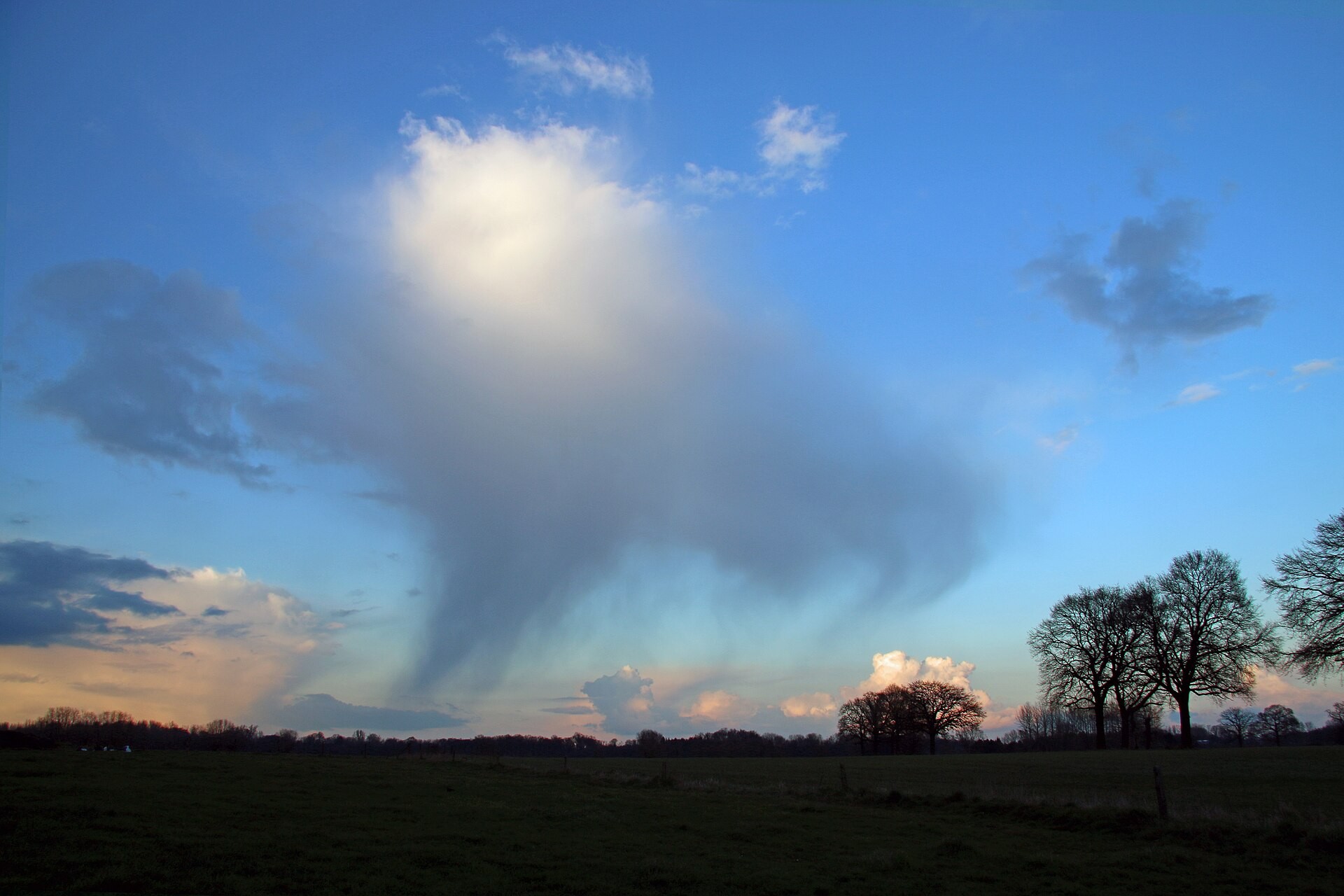
Photo · Virga — Sally V, CC BY-SA 4.0, Wikimedia Commons
When falling raindrops pass through a layer of dry air and all evaporate before reaching the ground, they leave a faint streak of rain hanging beneath the cloud — virga. The boundary between the droplets that fall as rain and those still suspended in the air is exactly this “threshold of size.”
A Reservoir Hung in the Sky
A cloud stays aloft not by magic but by the physics of size. A single simple rule — divide water finely enough and air resistance overwhelms its weight — holds hundreds of tonnes of water up in the air. And the moment those droplets grow large enough to cross the threshold, the same physics sends the rain back down.
Thanks to this exquisite design — dividing water small to lift it, growing it large to release it — water evaporated from the sea is carried across the sky and delivered to every corner of the land. Even in a cumulus cloud we glance at without a thought, there is a meticulous design principle that keeps Earth’s water in motion.
References
- USGS Water Science School — How Much Does a Cloud Weigh?
- Scientific American — Why Do Clouds Float When They Have Tons of Water in Them?
- Live Science — Why do clouds float?
- Library of Congress — How much does a cloud weigh?
- Geosciences LibreTexts — Cloud Droplets (Atmospheric Processes and Phenomena)
- Stull, Practical Meteorology — Collision and Collection
- Wikipedia — Liquid water content
- Wikipedia — Terminal velocity
- Wikipedia — Cumulus cloud
- NOAA NWS JetStream — Clouds